
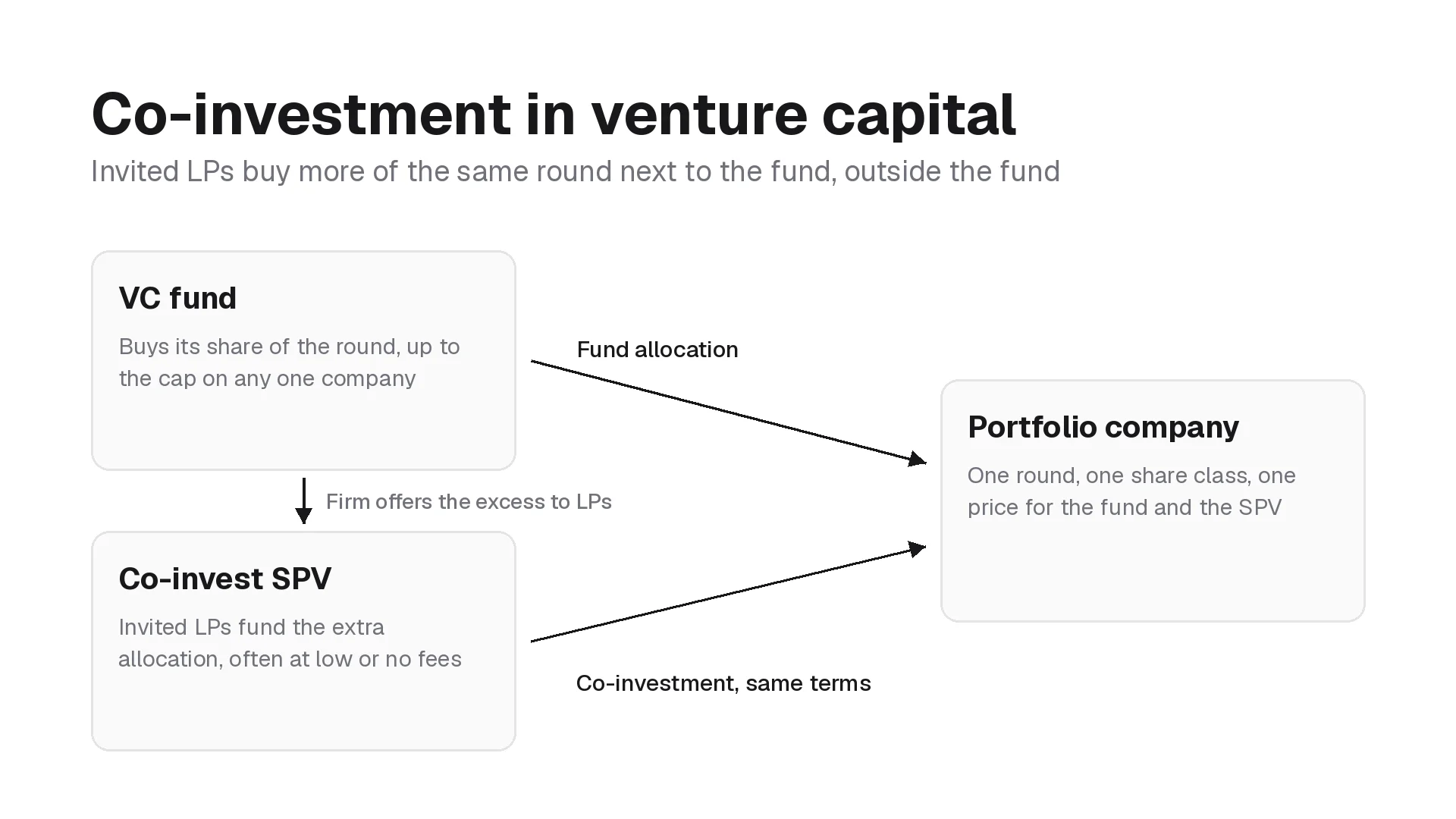
A venture capital co-investment is a direct investment in one startup that a limited partner makes next to the VC fund, outside the fund itself. The firm sources and leads the deal, the fund buys its share, and invited LPs buy more of the same round, usually through a single-purpose vehicle and usually at lower fees than they pay on the fund. Firms use co-investments when a round is bigger than the fund can hold. LPs use them to put more money behind a company they already like at a lower fee load.
The term gets used loosely, so it helps to pin down which version someone means before you model it, diligence it or answer an interview question about it.
What co-investment means in venture capital
Three different arrangements all get called co-investment. They have different economics, different paperwork and different people doing the work.
| Meaning | Who invests next to whom | Typical vehicle | Fees to the VC firm | Where you meet it |
|---|---|---|---|---|
| LP co-investment | A fund's LPs invest beside the fund in one company | An SPV managed by the firm, or direct shares | Often no management fee and no carry for LPs, more often some fee in venture | Fundraising, LP relations, large late-stage rounds |
| Syndicate co-investing | Two or more VC firms invest in the same round | Each firm's own fund | None between firms | Deal execution, term negotiation, follow-on planning |
| Staff co-invest | Partners and employees invest personal money beside the fund | A GP-level employee vehicle | Usually none | Your offer letter and compensation |
Most explainers mean the first one. Founders and VC investors often mean the second, which is really a question of who is the lead investor and who follows. The third shows up in compensation conversations.
Why VC firms offer co-investments and why LPs want them
A firm offers a co-investment when it wants more money in a company than its fund can or should hold. A fund's limited partnership agreement usually caps how much of the fund can sit in one company, and reserves for follow-on rounds run out in the companies that keep raising. When a winner raises a large round, the firm can either cut its allocation or bring LP money in beside the fund. Co-investment lets the firm keep its full ownership target without breaking the cap or draining reserves meant for the rest of the portfolio.
Firms also use co-investment as a relationship tool. Offering a strong deal to a large LP rewards the commitment and helps the next fundraise. Cambridge Associates, which runs a co-investment program for institutional clients, names a third reason plainly: LPs ask for co-investment, and GPs want to keep them happy or risk losing a future fund commitment.
For LPs, the draw is the fee load. Cambridge Associates reports that GPs typically offer co-investments to their own LPs on a no management fee, no carry basis, and are more likely to charge investors who are not LPs. A dollar in a co-investment can therefore earn close to the company's gross return, while a dollar in the fund earns the net return after management fees and carried interest. LPs also get to pick the company, control their pace of deployment, and see how the firm runs diligence up close.
The market is large. Cambridge Associates estimated private equity co-investment activity at about $50 billion in 2022, and that figure covers buyouts and growth equity, not early-stage venture.
How a co-investment works, step by step
The process is short and front-loaded. Most of the work happens in the few weeks between the firm deciding to syndicate and the round closing.
- The LP asks for co-invest rights at fund commitment. Interest is usually recorded in the subscription documents or a side letter. Some side letters give a large LP a first look at co-investment above a size threshold. Few promise a guaranteed allocation.
- The firm decides to syndicate part of a deal. The trigger is usually a round where the firm wants more ownership than the fund's concentration cap or reserves allow.
- The firm picks which LPs to offer. It should follow a written allocation policy rather than choosing deal by deal. In practice the list is LPs with co-invest rights, LPs that have co-invested before and answered quickly, and LPs big enough to write the ticket.
- LPs get the materials and a deadline. That usually means the investment memo, the model, data room access and a call with the deal team. Cambridge Associates puts a typical syndication at four to six weeks from first contact to binding agreement. When the firm invites LPs in before it has won the deal, called co-underwriting, the window shrinks to three to four weeks with no guarantee the deal happens.
- LPs commit and the firm forms the vehicle. The usual structure is an SPV that holds the single position, so the company adds one line to its cap table instead of a dozen. Capital is called and invested almost at once, unlike a fund commitment that is drawn over years.
- The round closes on the same terms for fund and co-investors. The SPV buys the same class of shares at the same price as the fund.
- The firm reports and manages the position to exit. The SPV gets its own capital account statements, audits and tax filings. Follow-on decisions, a later continuation fund or a sale all need a defined answer for the co-investors.
Co-investment versus other ways to invest
| Route | Who picks the company | Company known before committing | Typical fee load | LP control | Diversification |
|---|---|---|---|---|---|
| Fund commitment | GP, after the commitment | No | Full fund fee and carry | None over picks | Whole portfolio |
| LP co-investment | GP sources, LP opts in | Yes | Low or none, more often some fee in venture | Yes or no on each deal | One company |
| Direct investment | LP sources and leads | Yes | No GP fees, LP carries its own team cost | Full | One company |
| Third-party SPV syndicate | Syndicate lead | Yes | Deal-level carry, often with a fee | Yes or no on each deal | One company |
| Fund secondary | Buyer picks a fund stake already formed | Yes, the existing portfolio | Buyer inherits the fund's terms | None over picks | Existing portfolio |
The table explains why co-investment sits in the middle. The LP gets the company choice of a direct deal without building a sourcing team, and the firm keeps the lead.
Fees, carry and a worked example
Co-investment terms vary more than fund terms. The items to read in any co-invest offer are these.
- Management fee. None is common for LPs. Some venture SPVs charge an annual fee or a one-time admin charge.
- Carry. None is common for existing LPs in buyout deals. Venture co-investments are more likely to carry some economics, often a reduced rate compared with the fund.
- Transaction and monitoring fees. A deal can be fee free on paper and still pass legal, admin or monitoring costs to the SPV.
- Broken-deal expenses. The documents should say who pays if the round does not close after lawyers and diligence providers have billed.
- Sizing. Cambridge Associates suggests sizing a single co-investment at about a quarter of a typical fund commitment, and a co-investment program at 15% to 30% of an investor's total private investment allocation.
Worked example
The numbers below are illustrative, not market data.
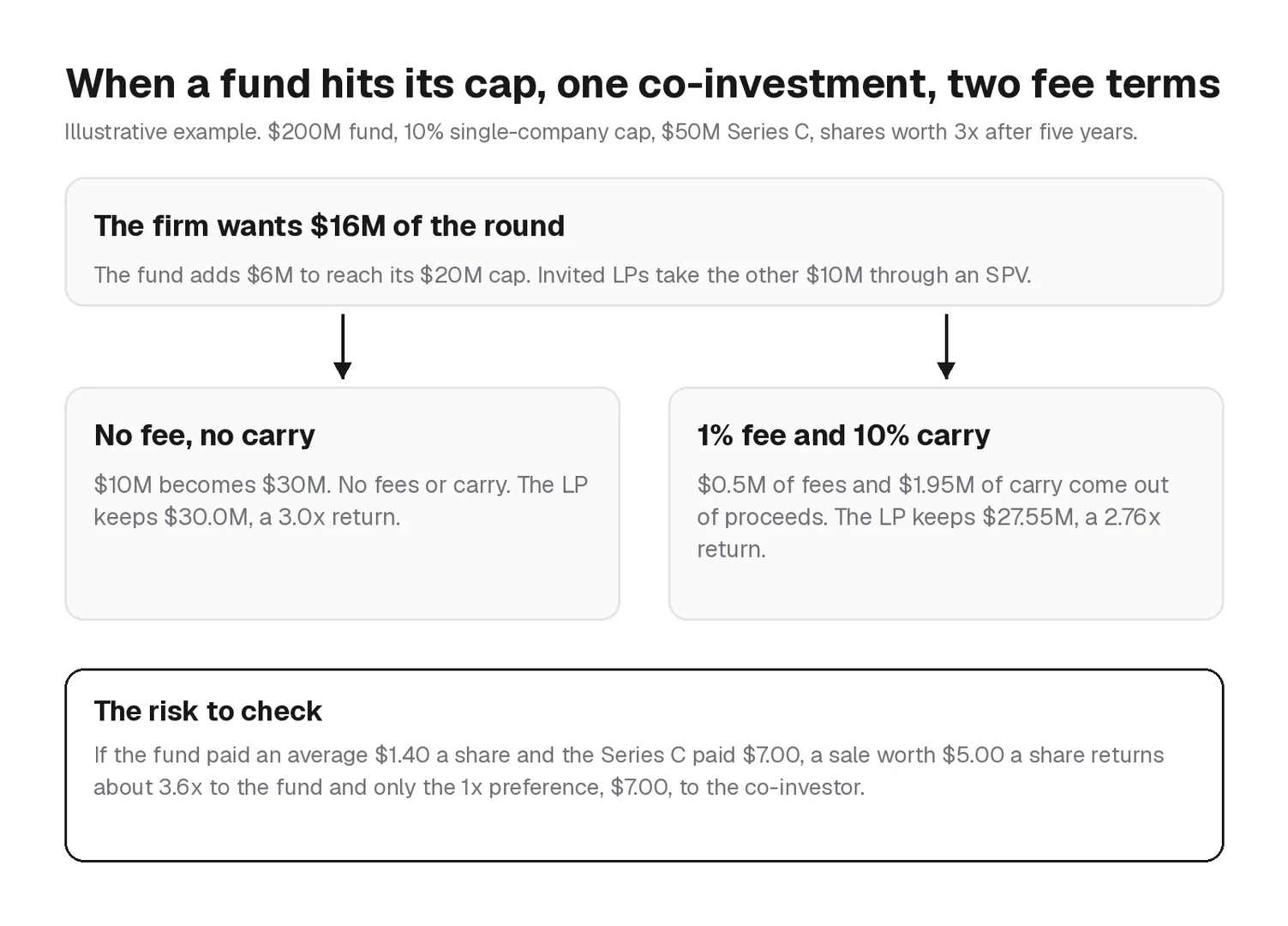
A firm runs a $200 million fund whose LPA caps any single company at 10% of commitments, or $20 million. The fund already has $14 million in a portfolio company. The company raises a $50 million Series C and the firm wants a $16 million allocation to hold its ownership. The fund can add only $6 million before it hits the cap, so the firm offers the other $10 million to LPs through an SPV.
Five years later the Series C shares are worth three times their cost. The $10 million SPV position is worth $30 million, a $20 million gain.
| Co-invest terms | Fees paid | Carry paid | LP gets back | LP net multiple |
|---|---|---|---|---|
| No fee, no carry | $0 | $0 | $30.0M | 3.0x |
| 1% annual fee and 10% carry | $0.5M | $1.95M | $27.55M | 2.76x |
Fees here come out of the proceeds at exit. Under the second set of terms, five years of a 1% fee on $10 million costs $0.5 million, and 10% carry on the $19.5 million profit after fees costs $1.95 million. The gap between the two rows is the price of access, and in venture it is often worth paying if the alternative is no allocation at all.
The risks, and why venture co-investments are different
Every co-investment carries three risks. The position is concentrated in one company. The LP is a passive minority holder with little say over follow-ons or exit timing. The diligence window is short. Cambridge Associates adds adverse selection, the worry that a GP offers the deals it is least eager to keep, and says the best defense is to evaluate both the deal and the GP's reasons for syndicating it.
Venture adds two problems that buyout co-investments mostly avoid.
The firm and the co-investor enter at different prices. A buyout co-investor usually buys in at the same time and price as the fund. In venture, the firm often invites co-investors into a late round of a company it backed years earlier, so most of its money went in at a lower valuation. Cambridge Associates flags this as an alignment concern.
Here is how it plays out. Say the fund's $14 million from the example went in across earlier rounds at an average of $1.40 a share, and the Series C co-investors paid $7.00. The company later sells for a price that works out to $5.00 a share for common-equivalent holders. The fund's earlier shares return about 3.6 times their cost. The Series C holders sit behind a 1x non-participating liquidation preference, so they get their $7.00 back and no more, a 1.0x before fees. The fund reports a strong exit and the co-investor makes nothing. If the sale price fell short of the preference stack, the co-investor would lose money while the fund still booked a gain.
Follow-on rounds can dilute the co-investor. A fund has reserves and pro rata rights. An SPV usually has neither, so when the company raises again, the co-investor either finds new money on short notice or gets diluted. Read whether the SPV can call more capital and whether the firm will offer a follow-on.
Allocation, conflicts and co-investor rights
Choosing who gets a co-investment is a conflict of interest. The firm is handing a low-fee deal to some investors and not others, and it may favor LPs it hopes will commit to the next fund. LPs ask about it in diligence, and the firm's answers end up in its fund documents. A firm with a sound process can answer each of these questions in writing.
- Is there a written allocation policy, and do LPs see it before they commit?
- Does the policy say how the firm splits a deal between the fund, LP co-investors, other investors and staff?
- Does the fund always take its full allocation first, up to its cap, before any co-investment is offered?
- Who pays broken-deal expenses, and is that the same for the fund and the SPV?
- If the firm sells part of the fund's stake, can co-investors sell on the same terms at the same time?
- Do co-investors get the same information rights as the fund, or only an annual statement?
The rights co-investors most often negotiate are tag-along rights to sell alongside the fund, drag-along terms so the firm can deliver the SPV in a sale, information rights, and a say in whether the SPV joins any later restructuring.
What co-investment means if you work in venture capital
Who does the work
| Role | Co-investment work |
|---|---|
| Partner or deal lead | Decides whether to syndicate, how much, and to whom; takes the LP calls |
| Principal or associate | Prepares the co-invest version of the memo and model, runs the data room, answers LP diligence questions |
| Analyst | Builds cap table and ownership scenarios, tracks the concentration cap and reserves |
| Investor relations | Tracks which LPs have co-invest rights, gauges interest early, runs the allocation list and timeline |
| CFO and fund operations | Forms the SPV, calls capital, keeps separate books, runs the SPV waterfall and audits |
| Legal and compliance | Owns the allocation policy, expense rules, disclosure and side letter terms |
At a small firm one associate may touch most of this list. A co-investment is one of the few times a junior investor presents a deal directly to LPs, so it is worth doing well.
Co-invest rights in your own offer
Some firms let partners and employees invest their own money beside the fund, usually through an employee vehicle with no fee and no carry. A principal-level offer may list co-invest rights next to salary, bonus and carry. Before you count it as part of your pay, ask whether participation is optional or expected, the minimum check, whether the firm lends or advances the money, how it handles the employee vehicle when you leave, and whether compliance must pre-clear each investment. Co-invest is your own money at risk. It is not the same thing as carry, which pays you a share of profit on other people's capital.
Co-investment careers on the LP side
Pension funds, endowments, sovereign funds, insurers, family offices and funds of funds run co-investment teams. The job is underwriting single companies fast, on a GP's materials and timeline, and judging the GP as much as the deal. It suits people with banking, private equity or VC diligence experience, and it is a path into direct investing for people who started in fund selection. If you are looking at these seats, browse the VC job board and research the GPs you would work with in the VC firm directory.
Questions to ask a firm before you join
- How often has the firm syndicated co-investments, and in which funds?
- Who decides allocation, and is the policy written?
- Has a co-investment ever lost money while the fund made money on the same company?
- Do employees co-invest, and on what terms?
- How many SPVs does the finance team administer, and with what support?
How to answer it in an interview
If an interviewer asks how co-investment works, give the definition, the reason, and the risk. A strong answer runs like this. "A co-investment lets LPs put money into one company next to the fund, usually through an SPV at lower fees. Firms offer it when a round is bigger than the fund's concentration cap or reserves allow, and LPs take it to cut their fee load on a company they like. In venture the catch is entry price. If the firm brings co-investors into a late round, they can earn 1x while the fund makes 3x on its earlier shares, so I would look at the preference stack and the firm's reason for syndicating." Then connect it to deal work you have done. For more practice, see our VC interview questions.
Frequently asked questions
Do co-investors pay management fees and carry?
Often not, when the co-investor is already an LP in the fund. Cambridge Associates says GPs typically offer their LPs no fee, no carry terms and are more likely to charge others. Venture co-investments are more likely to carry some fee or carry than buyout deals.
Is a co-investment the same as an SPV?
No. A co-investment is the decision to invest beside the fund in one company. An SPV is the legal entity most firms use to hold that investment. An SPV can also be used for deals that are not co-investments, such as a syndicate led by an angel.
Can individuals co-invest in venture deals?
Mostly through being an LP, an employee of the firm, or a member of an SPV syndicate. Firms usually offer co-investments to institutional LPs and large family offices, and securities rules limit who can buy into a private vehicle.
Why would a VC firm give away part of a good deal?
Because the fund cannot hold more without breaking its concentration cap or using reserves meant for other companies, and because offering the deal to LPs helps the next fundraise.
What is co-underwriting?
Co-underwriting is when a firm invites LPs into a deal before it has won it, so LPs diligence in parallel with the firm. Cambridge Associates puts the window at three to four weeks, with no guarantee the deal closes.
Next steps
Co-investment knowledge pays off in fund ops, IR and deal roles alike. Browse open VC jobs on the Venture Capital Careers job board, research firms in the companies directory, and create a free account to get alerts when new roles go live.
Related posts
How to get a venture capital internship: the five internship types, which firms hire interns, when structured programs and small funds recruit, what interns are paid and when unpaid is legal, outreach with proof, interview questions, and how to screen an offer.
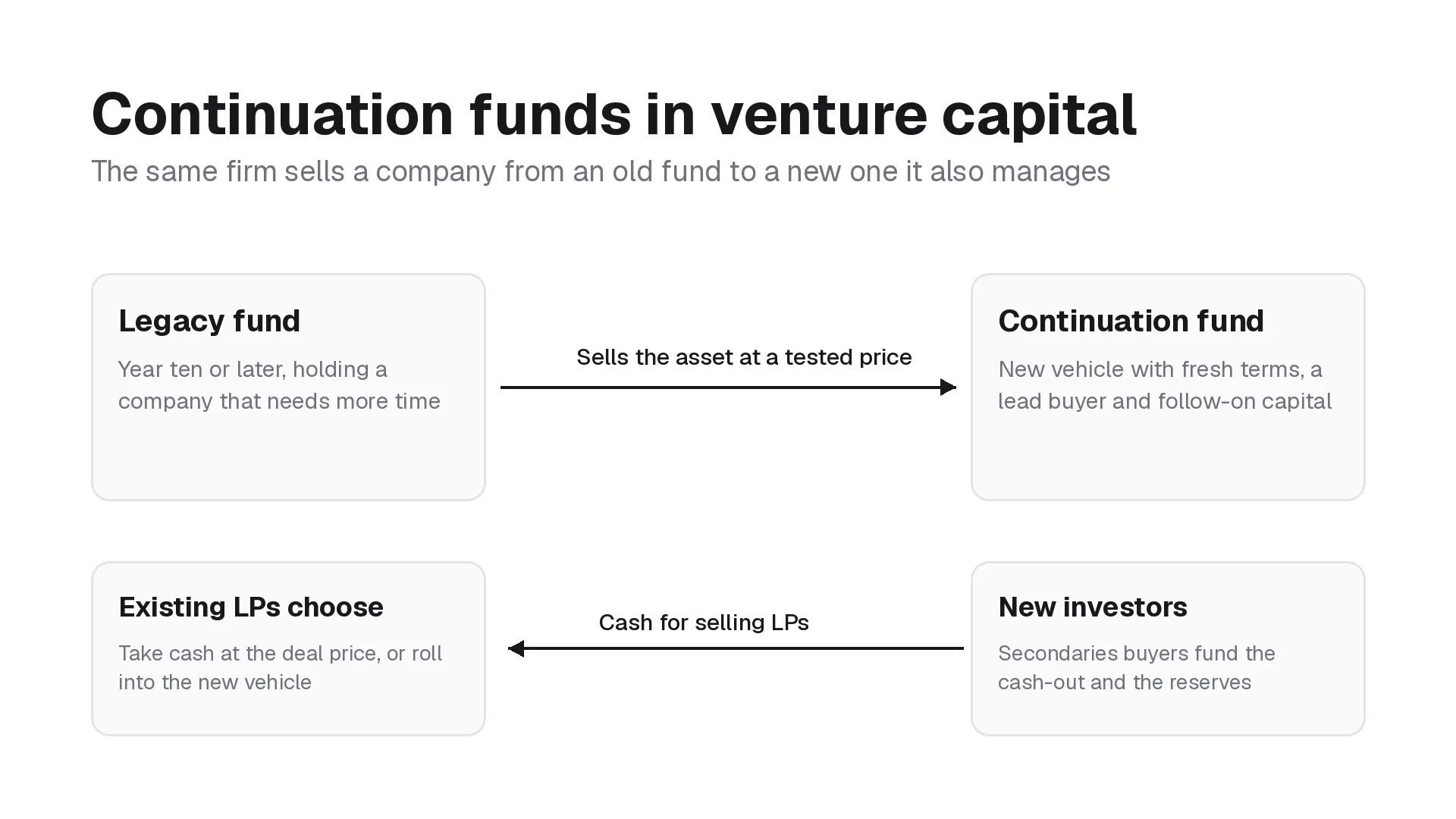
A continuation fund lets a VC firm sell a company from an old fund to a new vehicle it also manages, while LPs choose cash or a roll. Here is how the deal works, how price, fees and carry are set, and what it changes for people who work at the firm.
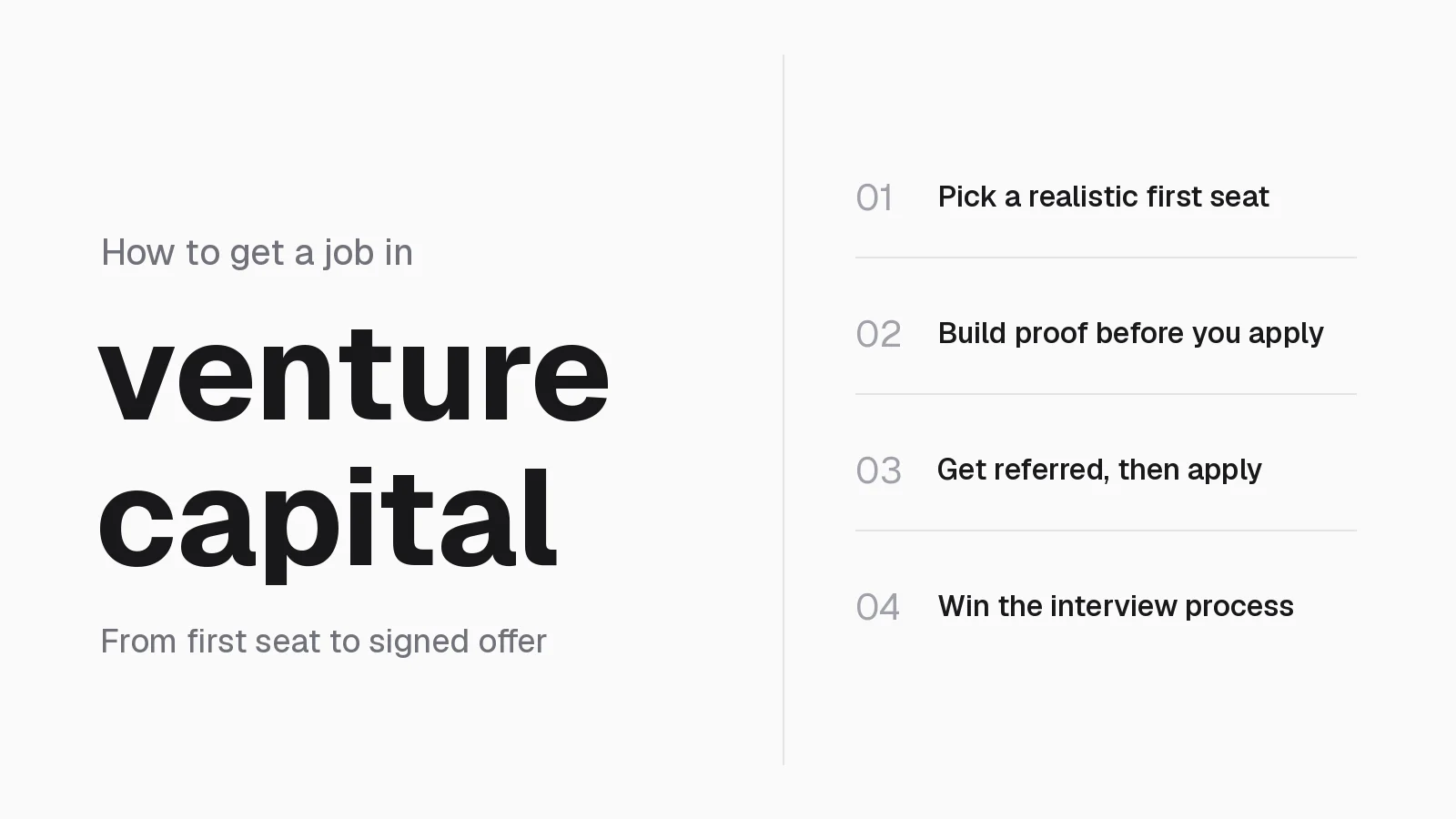
How to get a job in venture capital: which seats exist, the first seat that fits your background, proof to build, where VC jobs come from, how to screen a posting, the recruiting process from screen to offer, pay, and what to ask before accepting.