
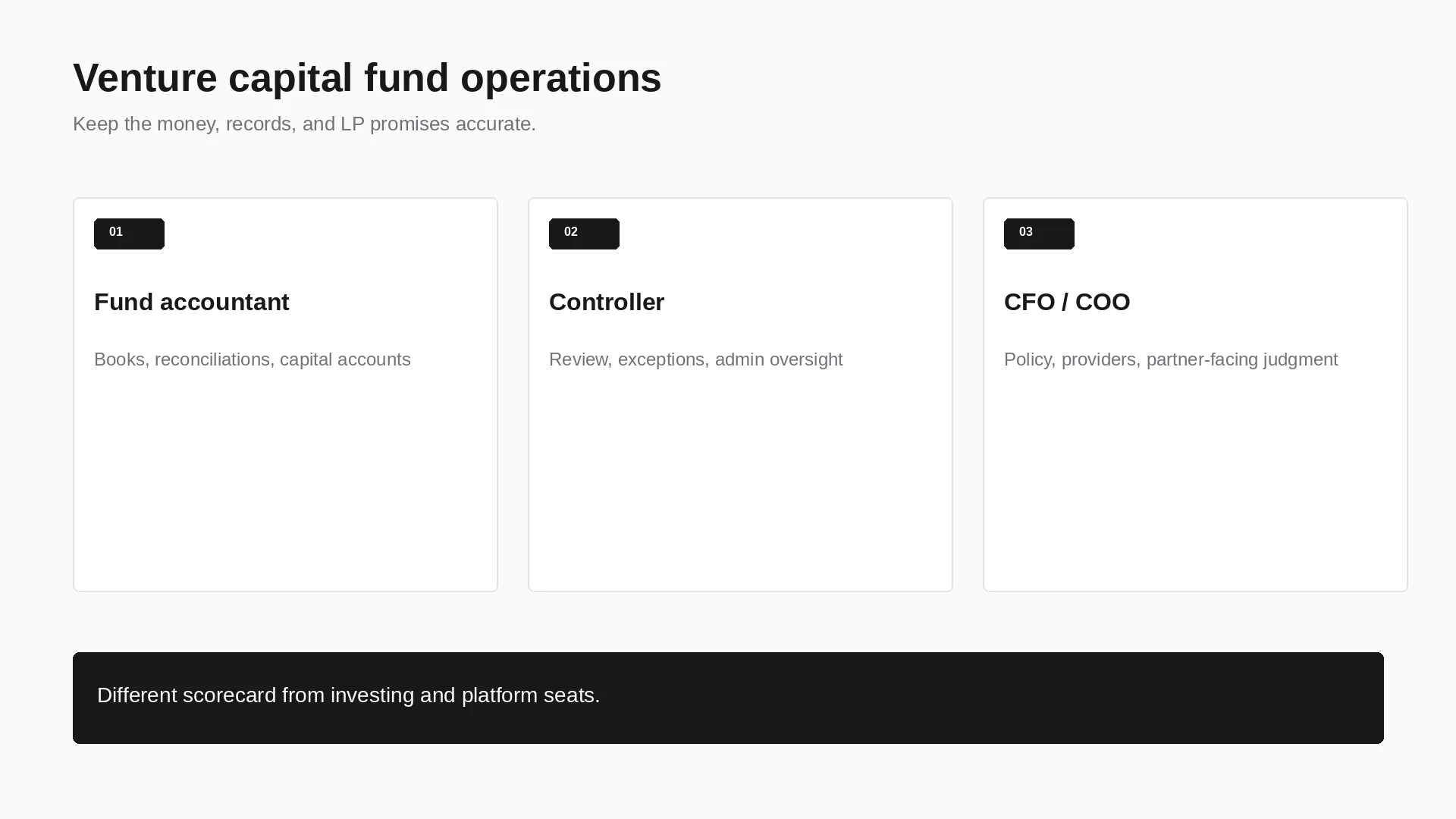
Venture capital fund operations is the function that keeps a fund's money, records, and LP promises accurate. When a firm calls capital, wires an investment, marks a portfolio company, or distributes proceeds, operations makes the numbers agree with the limited partnership agreement, the bank, and the investor report.
That is a different job from sourcing startups or building founder programs. Investing seats are scored on judgment and deal attribution. Platform seats are scored on founder support. Fund operations seats are scored on whether capital accounts, NAV, calls, and distributions survive LP questions and an audit.
If you are evaluating a finance or ops title at a VC firm, start with the entities you would own and the judgments you would review, not the word "venture" in the job title.
What venture capital fund operations is
Fund operations sits in the middle and back office of a venture firm. The core loop is simple to say and hard to run cleanly:
- Track LP commitments and unfunded balances.
- Issue and collect capital calls for investments, fees, and expenses the LPA allows.
- Record investments, follow-ons, conversions, and exits against legal documents.
- Close the books, support valuations, and publish NAV and capital-account statements.
- Calculate distributions under the waterfall and pay LPs.
- Coordinate administrators, auditors, tax advisers, banks, and counsel.
The people who own that loop may sit under titles like fund accountant, fund controller, VP of finance, CFO, COO, or head of fund operations. At a three-person emerging manager, one person may wear several of those hats. At a multi-fund platform, the work splits across specialists and a third-party administrator.
The economics underneath the work are the same ones founders and investors talk about in plain English elsewhere on Venture Capital Careers: fund structure, capital calls, management fees, performance metrics, and carried interest. Operations turns those terms into investor-level records that have to be reproducible.
Fund ops vs investing, platform, and fund accounting
Candidates lose months treating every VC job posting as the same door into "venture." The seats are not interchangeable.
| Seat | Main scorecard | Typical output | Usually owns investment decisions? |
|---|---|---|---|
| Investing | Judgment, sourcing, diligence, attribution | Memos, founder calls, IC recommendations | Yes |
| Platform | Founder support and firm leverage | Talent programs, community, GTM help, content | Rarely |
| Fund accounting | Accurate books and closes | Ledgers, reconciliations, capital accounts, audit packs | No |
| Fund operations | End-to-end fund mechanics and controls | Calls, distributions, NAV, vendor oversight, LP-ready reporting | No |
Fund accounting is the technical core of recording and closing. Fund operations is the broader career surface that often includes accounting plus banking, insurance, vendor management, process design, LP reporting cadence, and (at senior levels) partnership-facing judgment on exceptions.
Platform can mention "portfolio operations" in a title and still mean founder hiring help. Read the posting. If the work is talent intros and community dinners, it is platform. If the work is capital-call notices and K-1 timelines, it is fund ops.
The investing career path is the analyst-to-partner ladder. Fund operations is a parallel track with its own promotion logic. Do not expect a controller seat to become a deal partner because the firm logo is famous.
Roles inside fund operations
Titles vary. The work clusters.
Fund accountant / senior accountant. Prepares journals, bank reconciliations, investment position updates, and first-pass capital-account rolls. Strong seats teach entity discipline: fund LP, GP, management company, and SPVs stay separate.
Fund controller / accounting manager. Reviews rather than only prepares. Owns close calendars, exception logs, administrator oversight, and the bridge from approved valuations into the books.
VP of finance / head of fund operations. Designs the operating system across vehicles. Sets policy with counsel, manages providers, and explains breaks to partners without drowning them in jargon.
CFO. At many VC firms the CFO owns finance end-to-end: fund accounting quality, management-company budgets, banking, insurance, and often tax and audit relationships. Some CFOs also sit close to LP reporting.
COO. Operations leadership that may include fund ops plus HR, office, systems, and firm process. At smaller funds COO and CFO blur. At larger funds they split.
Administrator-side roles. Fund administrators hire people who process the same loop across many clients. That path builds repetition and technical breadth. In-house seats usually add more partner and investment-team context.
Use team structure to see where finance sits relative to investing and platform before you apply.
What the work looks like week to week
Quiet weeks look like control work. Busy weeks look like event response.
Steady-state. Reconcile bank accounts across entities. Post fees and expenses that the LPA permits. Update investment cost and quantity when legal documents arrive. Keep commitment, contribution, distribution, and unfunded schedules honest. Chase breaks between the ledger, the portfolio tracker, and the closing binder.
Quarter end. Freeze the investment population. Finish reconciliations. Record approved fair values. Calculate NAV and investor allocations. Tie performance figures used in LP packs to the books. Retain a close file someone else could reopen.
Annual cycle. Audit fieldwork. Tax pack support for partnership returns and investor K-1s. Roll-forward of fee calculations, valuation files, and process notes from last year's review comments.
Event spikes. New investments and follow-ons. Equalization when new LPs close into an open fund. Exits and distribution waterfalls. New SPV or parallel vehicle setup. Side-letter edge cases that break a "everyone is equal" spreadsheet assumption.
The job rewards people who like reproducible systems more than narrative pitch energy. If you want founder dinners as the center of the week, look at platform or investing instead.
Skills and proof that hire
Firms hire evidence that you can keep complex economics accurate under time pressure.
| Skill | What good looks like | Proof you can show |
|---|---|---|
| Partnership accounting | Contributions, allocations, and distributions roll by investor | A capital-account rollforward you built or reviewed |
| Entity discipline | Fund, GP, management company, and SPV activity stays separate | An intercompany break you found and fixed |
| Investment accounting | Cost, instrument, quantity, conversions, and proceeds reconcile | A position rollforward tied to legal docs |
| Close control | Reconciliations and deliverables finish in a known order | A close calendar or exception log you improved |
| Provider oversight | Administrator and auditor work is reviewed, not rubber-stamped | An example where you challenged an external work product |
| Plain explanation | Partners understand the issue without a lecture | A one-page memo on an error, estimate, or policy |
Interview answers that land follow a control story: what should have happened, what evidence you compared, what disagreed, how you found the cause, and what preventive control you added.
Public accounting, fund administration, private equity fund accounting, and investment-management finance all transfer. The strongest stories show increasing review ownership, not only that you touched venture clients.
Paths that actually work
Big 4 or national firm audit / tax with private-fund clients. You already speak confirmations, testing, and partnership quirks. Translate that into "I owned the review notes and the tie-out," not "I was on a VC engagement."
Fund administrator. High volume across funds builds technical breadth fast. To move in-house, collect examples where you escalated bad source data, fixed investor master errors, or improved a close for a specific client.
PE or other private-fund accounting. Waterfalls, capital accounts, and LP reporting transfer. Learn VC-specific instruments (SAFEs, convertibles, frequent SPVs) before interviews.
Startup or growth-company finance. Useful for management-company finance and partner communication. Weaker alone for LP allocations unless you add partnership-accounting reps.
Banking operations / middle office. Process discipline helps. You still need partnership and investment accounting vocabulary.
Career changers from corporate accounting. Possible if you build a portfolio of partnership accounting study plus a tangible work sample (even a sanitized case). Cold enthusiasm for startups is not a substitute.
Geographic reality matters. San Francisco, New York, London, and a handful of other hubs concentrate institutional fund-ops hiring. Remote seats exist, especially at emerging managers and administrator hybrids, but audit season and banking access still pull many teams toward overlap hours with partners and providers.
Compensation conversations go better when you separate management-company payroll from fund expenses in your own head. Your salary usually sits on the management company. The fund pays investments, permitted expenses, and distributions. Mixing those buckets in an interview is an instant credibility hit.
For general break-in tactics that still apply to networking and applications, use how to get a job in venture capital. For the investing ladder you are not joining, keep career path as contrast reading.
Ladder from accountant to CFO or COO
A common progression inside firms that grow past a single bookkeeper:
Fund accountant → senior accountant / assistant controller → fund controller → VP finance or head of fund operations → CFO and/or COO.
Promotion usually follows judgment, not headcount of journals:
- Can you review someone else's close and catch the break that matters?
- Can you interpret an LPA clause with counsel instead of inventing a shortcut?
- Can you oversee an administrator without losing accountability?
- Can you explain a valuation bridge or distribution assumption to a partner cleanly?
Carry is uncommon for junior fund-ops seats. Cash compensation varies hard by fund size and city. Treat published ranges on other sites as directional marketing unless the offer shows numbers. Use the salary guide for investing-side context and ask fund-ops candidates for written base, bonus, and any carry language before you compare logos.
Emerging managers often trade title inflation for scope. You may be "Head of Operations" and still reconcile banks yourself. Multi-fund platforms offer clearer ladders and narrower ownership. Neither is automatically better. Match the scope to the skills you want after twelve months.
How to screen a fund-ops job posting
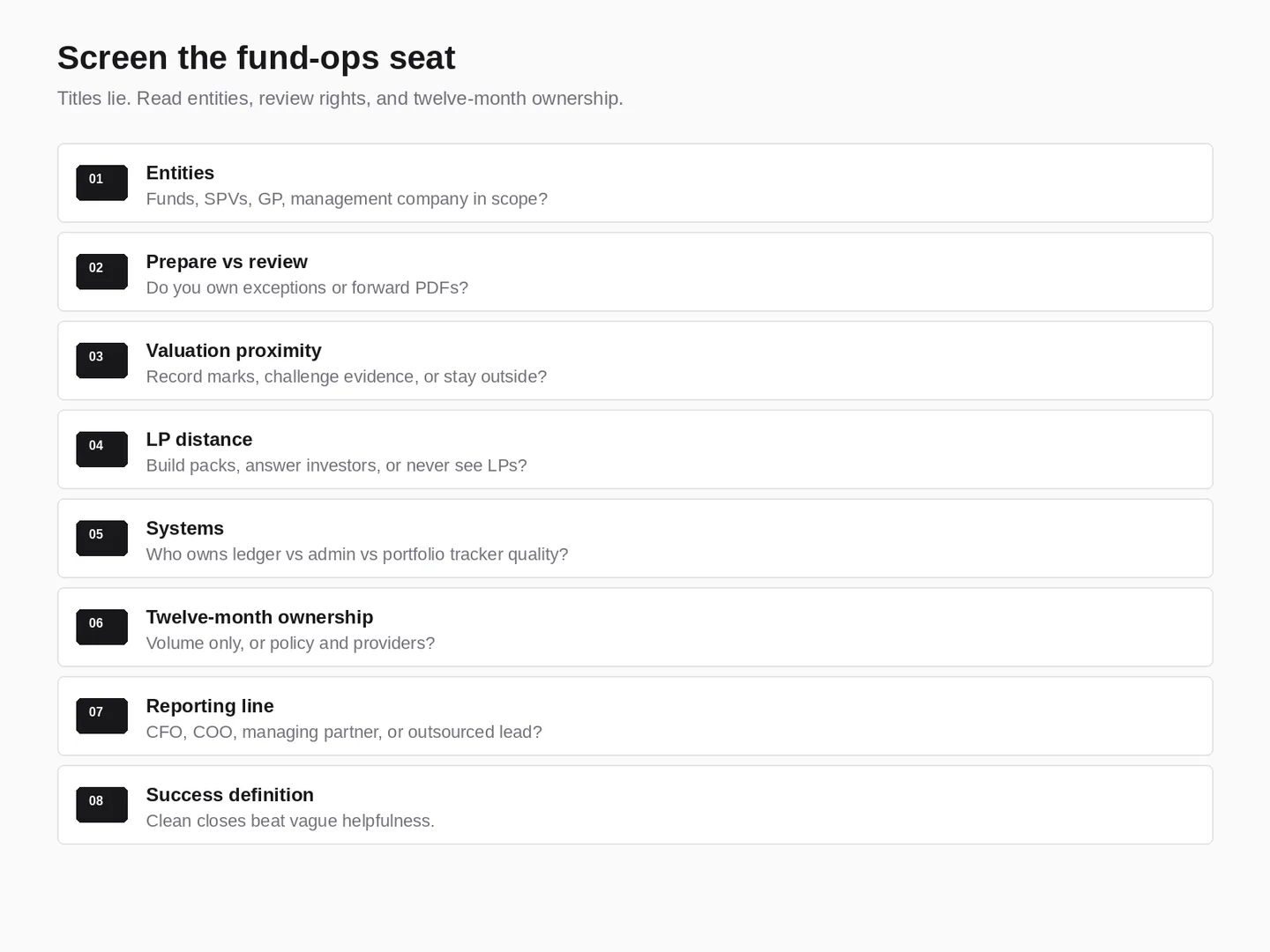
Titles lie. Screen the seat before you polish the cover letter.
- Entities in scope. How many funds, SPVs, co-invest vehicles, GP entities, and management companies? Multi-currency? Digital assets?
- Prepare vs review. If an administrator prepares the books, do you review exceptions or only forward PDFs?
- Valuation proximity. Do you record approved marks, challenge missing evidence, or sit outside valuation entirely?
- LP distance. Will you answer investor questions, build the pack, or never see an LP?
- Systems. Which ledger, admin portal, portfolio tracker, and banking stack? Who owns data quality between them?
- Twelve-month ownership. More funds with the same reconciliations, or expansion into policy, providers, and communication?
- Reporting line. CFO, COO, managing partner, or outsourced finance lead?
- Success definition. First two closes without material audit adjustments is a better target than "be helpful."
Walk if the posting is only brand and vibes. A famous logo with no review ownership is often a worse career move than a smaller firm where you own the close.
Browse live finance and operations titles on the Venture Capital Careers job board, then research fund complexity on the companies directory before interviews.
Partner communication is part of the senior job. A good controller does not dump a thirty-line reconciliation into Slack. They bring the break, the risk, the proposed fix, and the evidence still missing. That habit is what separates prepare-only seats from review seats.
LP reporting cadence is another tell. Some funds want operations to assemble the full pack. Others want finance numbers only, with IR owning narrative. Neither model is wrong. Knowing which one you are joining changes whether writing and stakeholder management are core skills or side skills.
When fund ops is the wrong seat
Choose a different path if:
- You want deal ownership and investment committee votes as the core of the job.
- You want founder coaching, talent intros, or community programming as the weekly center of gravity.
- You dislike audit, tax, and document-driven work.
- You need carry-driven wealth in the first few years.
- You are using "ops at a VC firm" as a stealth entry to investing without a plan to build investing proof separately.
Fund ops is a real career inside venture, not a consolation prize. It is the wrong career if you will resent the scorecard.
Frequently asked questions
Is fund operations the same as platform?
No. Platform supports founders and firm brand. Fund operations keeps the fund's money and investor records correct. Some titles blur "portfolio operations." Read the responsibilities.
Do I need a CPA?
Many strong candidates have CPA or equivalent training. Firms also hire sharp fund-admin and PE accounting alumni without the letters if the work samples are strong. Credentials help. Review ownership hires.
Can fund ops lead to an investing seat?
Sometimes, rarely as the default. If investing is the goal, build separate evidence of judgment (sector writing, scout work, angel reps) and choose seats with real investment-team adjacency. Do not assume the CFO track becomes a deal partner track.
Is administrator experience respected in-house?
Yes when you can show escalation judgment and client-specific problem solving. Pure production volume without review stories is a weaker pitch.
How is this different from the fund-accounting article on this site?
Fund accounting explains the mechanics and what accountants do in the close. This page is the career map around that work: seats, paths in, ladder, and how to screen offers.
Your next step on Venture Capital Careers
If fund operations is the seat you want:
- Browse open finance, controller, COO, and fund-operations roles on the job board.
- Research fund size, stage, and team shape in the companies directory.
- Create a candidate profile at venturecapitalcareers.com/auth/join so hiring managers can find you.
- Deepen mechanics with fund accounting, capital calls, and fund structure.
- Keep investing and platform goals honest by reading the career path and platform role guides side by side with this one.
The people who thrive in fund operations like clean books, sharp exceptions, and LP-ready explanations. If that is your craft, optimize for ownership of the close, not for a title that merely sits near the partnership.
Related posts
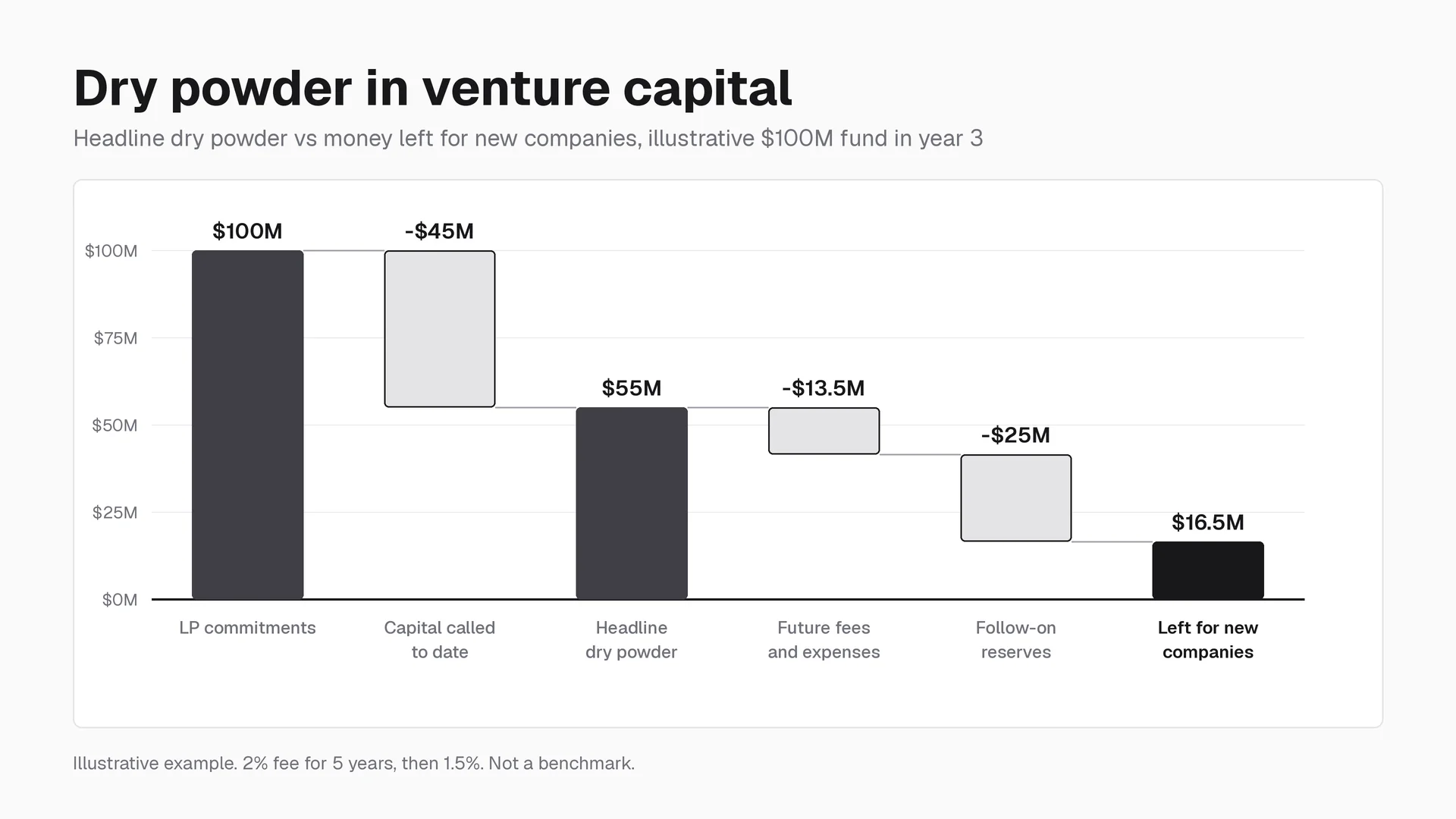
Dry powder in venture capital explained: the formula, a worked $100M fund example showing how little headline dry powder is left for new companies, current US and global data, and what a firm's dry powder tells you about hiring and the junior job.
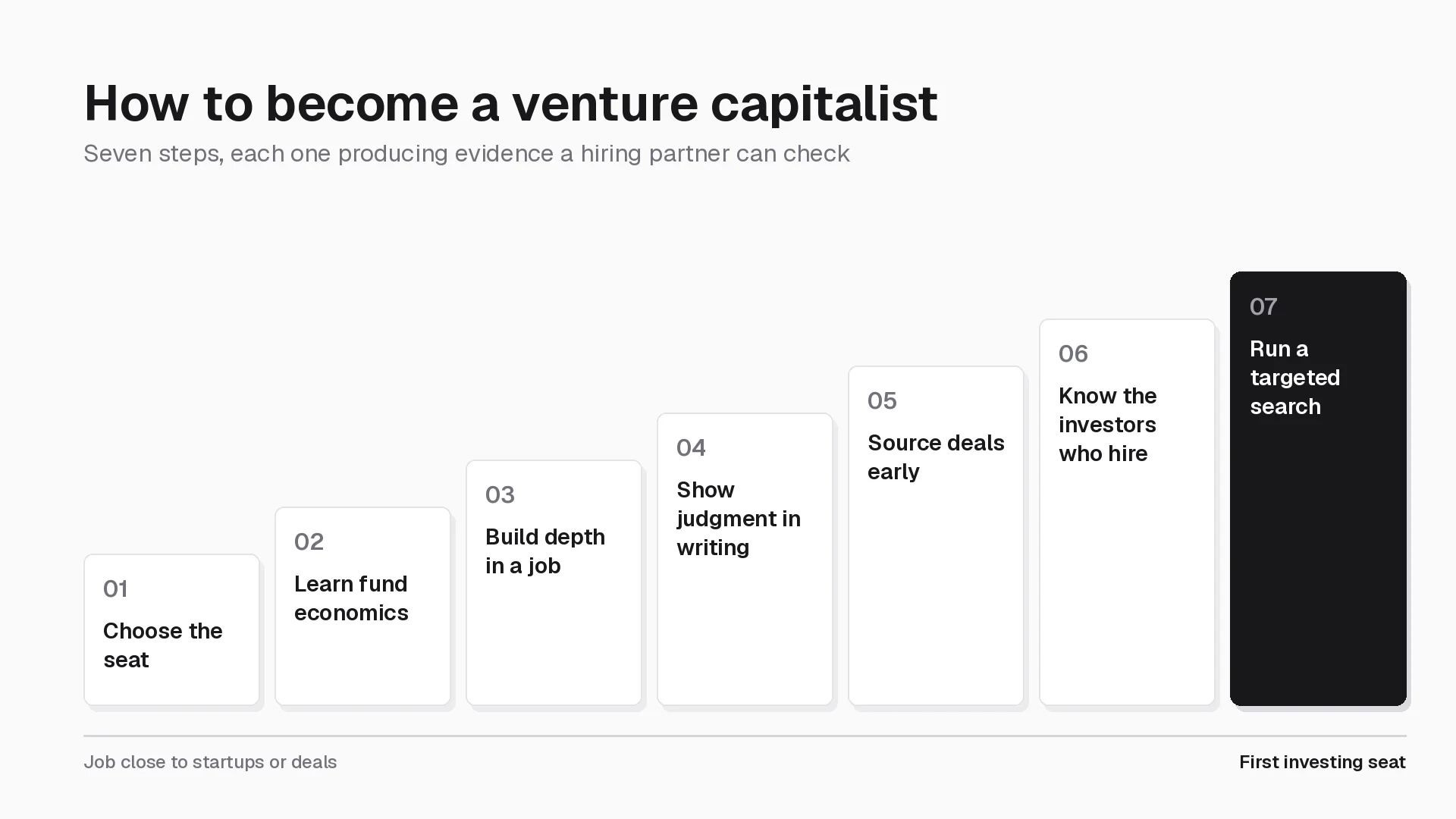
How to become a venture capitalist in seven steps: choose the seat, build depth, prove judgment in writing, source early, and run a targeted search. Includes entry paths by background, how fund size limits hiring, MBA placement data, and licensing.
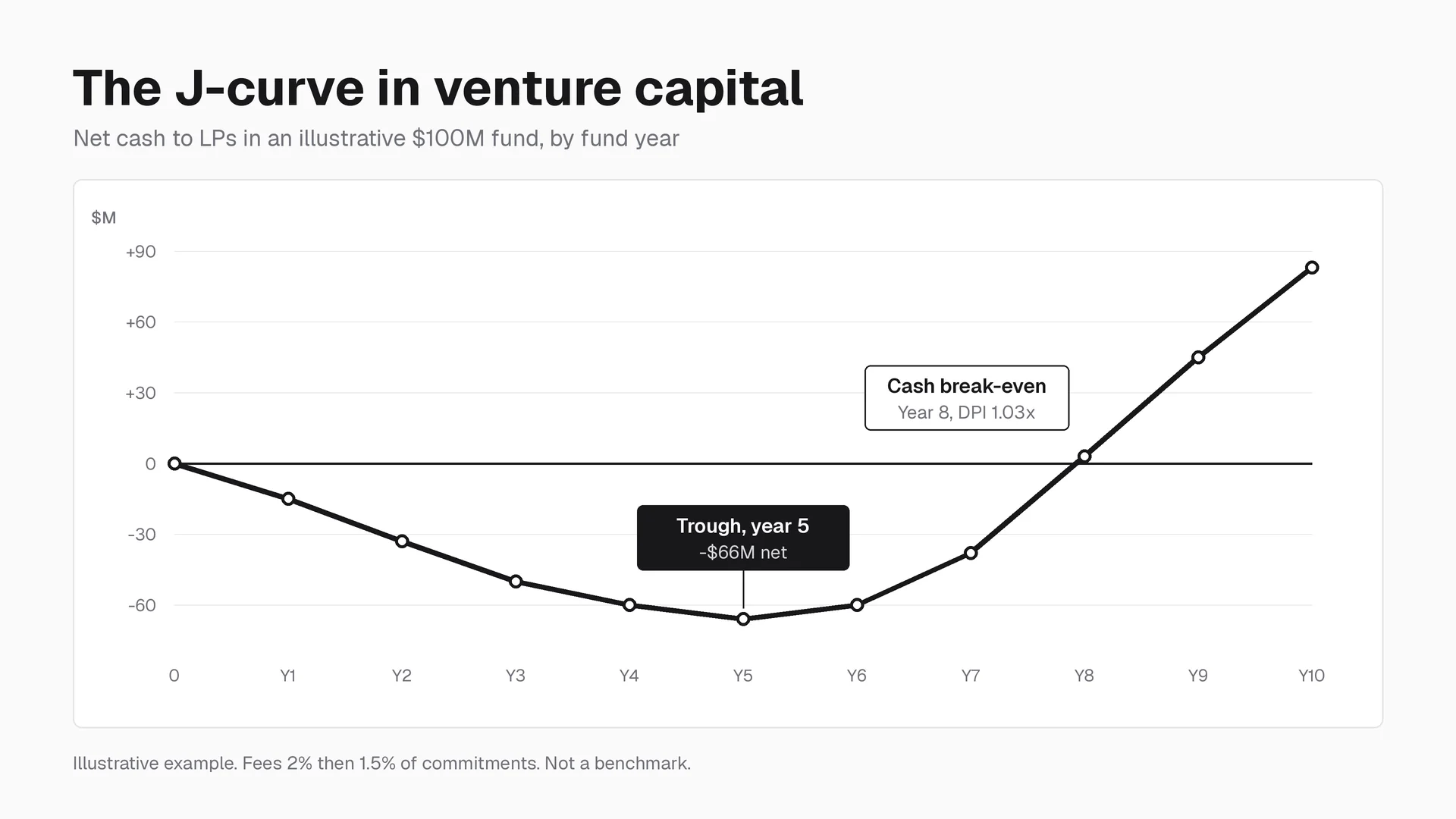
The J-curve in venture capital explained with a worked $100M fund example, current vintage data on DPI and IRR, a check for telling a normal trough from a weak fund, and what the curve means for VC carry, offers, and interviews.