
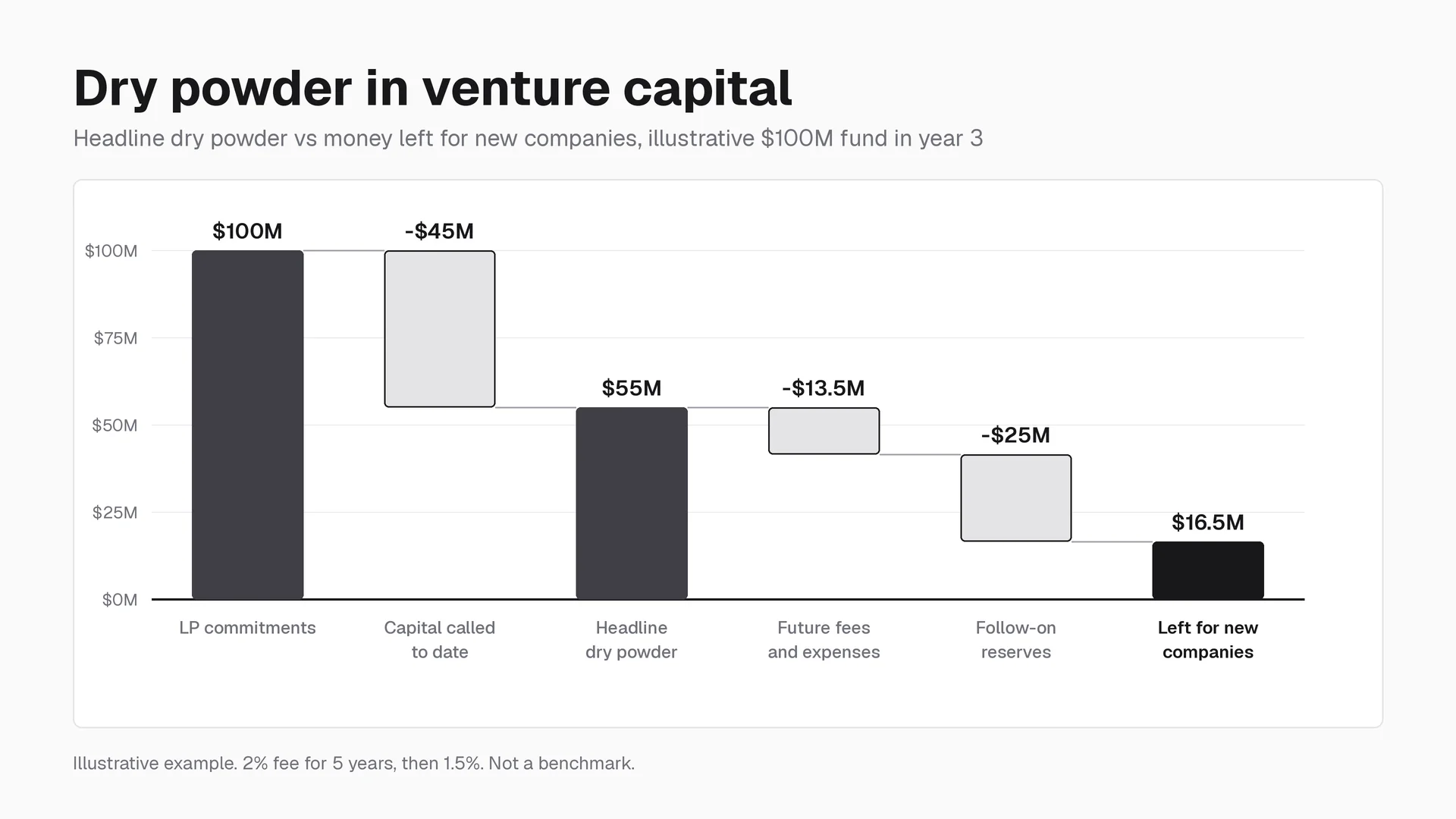
Dry powder in venture capital is the money limited partners have committed to a fund that the fund has not yet called and invested. The math is total commitments minus capital called to date. US venture funds held $299.3 billion of it at the end of 2025, according to PitchBook data in the NVCA 2026 Yearbook, roughly flat with a year earlier.
The headline number overstates what a fund can actually put into new companies. Part of it will go to management fees, part is held back for follow-on rounds, and most of the total sits with a small group of large firms. For anyone trying to get hired in venture, dry powder is also one of the better public clues to which firms are about to add people and what the junior job will look like once you are there.
What dry powder means in venture capital
A VC fund does not collect its money up front. During fundraising, limited partners sign commitments, legally binding promises to send cash when the general partner asks for it. The GP then draws that money down over several years through capital calls, usually right before a check goes out to a startup or a fee comes due.
Dry powder is the part of those commitments that has not been called yet. It is a claim on LP money, not cash in the fund's bank account. That distinction matters when you read a fund announcement. A firm that "closed a $300 million fund" last month has close to $300 million of dry powder and very little cash on hand.
The phrase is borrowed from the military habit of keeping gunpowder dry so it could be used the moment it was needed. In venture it means capacity to act.
How to calculate a fund's dry powder
The formula
Dry powder = total LP commitments minus cumulative capital called.
Industry databases add up this figure across every active fund to produce the market totals you see in headlines. Some versions also add back distributions that the fund agreement allows the GP to recycle into new deals.
Worked example: a $100 million fund in year three
The headline figure and the money available for new companies are different numbers. Here is an illustrative early-stage fund at the end of its third year, with a 2% management fee on commitments for five years that steps down to 1.5% afterward.
| Line item | Amount |
|---|---|
| LP commitments | $100M |
| Called so far for 20 initial investments of $1.5M each | $30M |
| Called so far for follow-on rounds | $7M |
| Called so far for management fees, years 1 to 3 | $6M |
| Called so far for fund expenses | $2M |
| Headline dry powder | $55M |
| Future management fees, years 4 to 10 | $11.5M |
| Future fund expenses | $2M |
| Reserves held for follow-ons in the existing 20 companies | $25M |
| Left for new companies | $16.5M |
The fund reports $55 million of dry powder, but only $16.5 million, about 11 more initial checks at $1.5 million, can go into companies it does not already own. Most venture funds hold back a large share of capital for follow-ons, and how they size that share is a portfolio strategy decision. So when a partner says the fund "still has plenty of dry powder," the useful follow-up is how much of it is unreserved.
Dry powder vs reserves, cash, and AUM
These terms get mixed up in fund updates and in interviews.
| Term | What it means | Where it sits |
|---|---|---|
| Dry powder | Committed capital not yet called | With LPs, until called |
| Reserves | Part of the fund earmarked for follow-ons in current portfolio companies | Usually still uncalled, so part of dry powder |
| Cash | Money already called and held by the fund before it is invested or spent | Fund bank account, usually briefly |
| Remaining value or NAV | Current marked value of the investments the fund holds | Portfolio companies |
| AUM | Remaining value plus dry powder | Both |
A firm can report large AUM because of strong markups while having little dry powder left, or the reverse right after a new close. They answer different questions. AUM tells you the size of the business. Dry powder tells you what it can still do.
How much dry powder venture capital has now
US venture dry powder by year
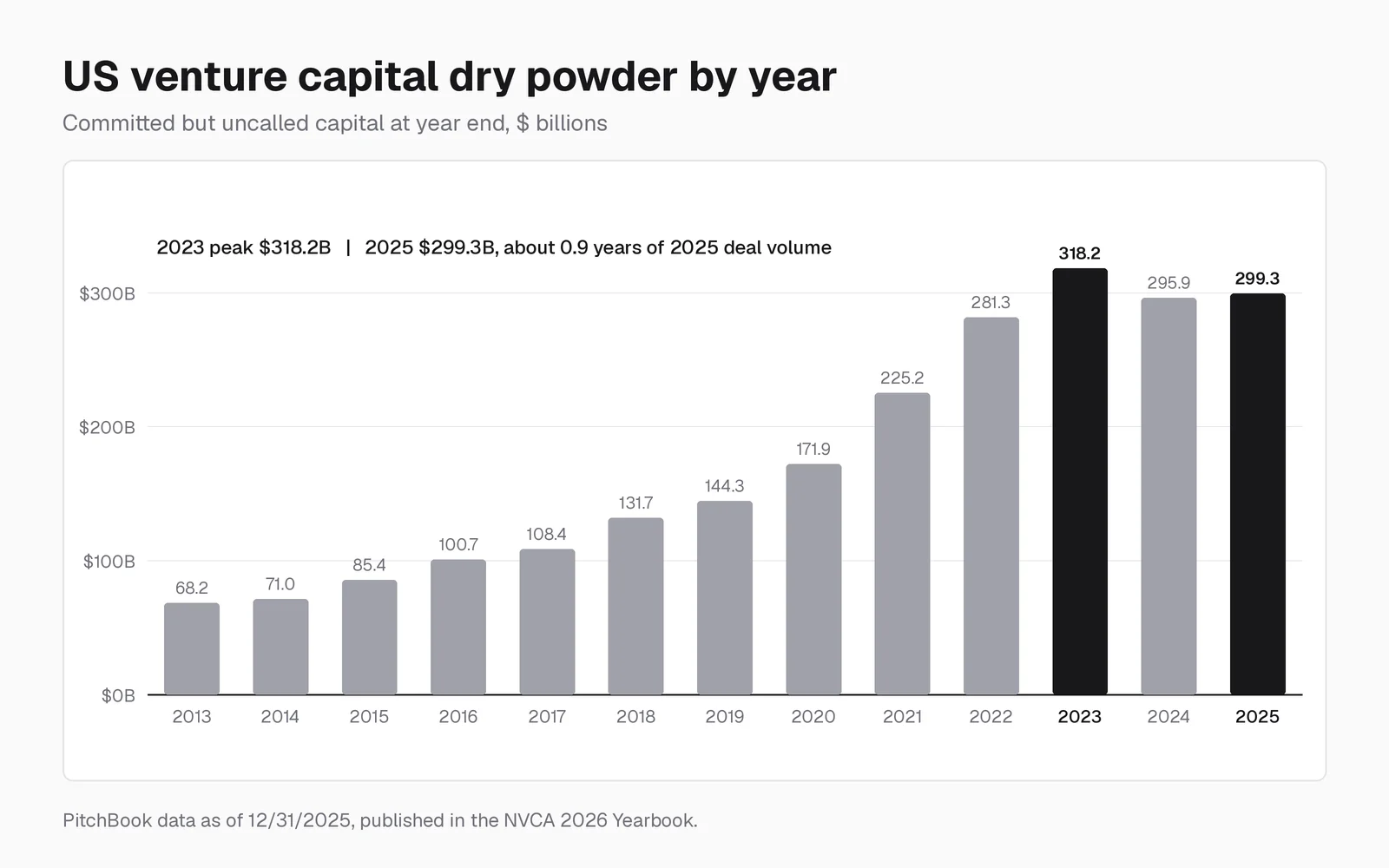
US dry powder more than quadrupled between 2013 and its 2023 peak of $318.2 billion, fed by the record fundraising of 2020 to 2022. It dipped to $295.9 billion in 2024 and held at $299.3 billion in 2025. Against that, US startups raised about $320 billion in 2025, which the NVCA 2026 Yearbook translates into roughly 0.9 years of runway. Strip out money from hedge funds, sovereign funds, and corporates in AI mega-rounds, which never counted as venture dry powder in the first place, and the yearbook puts effective runway at 1.2 to 1.5 years.
The total also hides how concentrated it is. In 2025 the ten largest US venture funds raised $22 billion, 32.9% of all capital raised, and only 101 first-time funds closed, the fewest since 2007. The yearbook notes that dry powder sits with the same platform firms that dominate fundraising, leaving the median fund under $100 million with far less runway than the aggregate suggests.
Global figures and why totals differ
Global venture dry powder peaked at $743.9 billion at the end of 2023 and fell 19% to $600.9 billion by March 31, 2025, according to an S&P Global Market Intelligence analysis of Preqin data published in December 2025. The same analysis put global private equity dry powder at $2.184 trillion.
Do not compare figures from different providers as if they were one series. PitchBook, Preqin, and other databases define the fund universe differently, treating growth equity, secondaries, and evergreen vehicles in their own ways, and they update on different dates. Quote one provider, with its as-of date.
Dry powder by fund vintage
Fund-level data shows how quickly young funds spend down. In Carta's Q4 2025 VC fund performance report, venture funds on its platform still held this share of committed capital as dry powder at the end of 2025:
| Fund vintage | Share of commitments still dry powder |
|---|---|
| 2025 | 72% |
| 2024 | 53% |
| 2023 | 35% |
| 2021 | 16% |
A fund one to two years old still has most of its money to invest. By year four or five, most of what remains is spoken for by fees and reserves. That pattern is also why a young fund sits at the bottom of the J-curve while it deploys.
How dry powder moves through a fund's life
Dry powder is created at the close, consumed during the investment period, and mostly frozen after it. The fund lifecycle sets the clock.
- At first and final close, commitments are signed and the fund starts with nearly all of its capital as dry powder.
- During the investment period, often the first three to five years, the GP calls capital for new investments, follow-ons, fees, and expenses. This is when dry powder falls fastest.
- After the investment period ends, most fund agreements stop new platform investments. The GP can usually still call capital for follow-ons into existing companies, fees, and expenses within limits the agreement sets. Commitments that are never needed are never called.
- Recycling provisions let some funds reinvest early exit proceeds, which stretches capacity without adding commitments.
A fund that reaches the end of its investment period with a lot of unreserved dry powder has a problem. Either it could not find deals it liked, or it moved too slowly, and both stories come up when the firm raises its next fund.
What high dry powder does to the venture market
Large dry powder balances change behavior in a few predictable ways.
Competition for the best deals. Funds with capital to deploy and a clock running bid against each other for the companies they all want. That pushes up round sizes and valuations at the top of the market even when the median company finds fundraising hard.
Deployment pressure. Capital raised in the 2022 and 2023 vintages has to be invested before those investment periods close. Managers who wait too long face a choice between rushing into weaker deals and explaining unspent commitments to LPs.
Concentration. When most dry powder sits with a few large platforms, a record headline total can coexist with a hard market for small funds and for companies outside the favored sectors.
A cushion in downturns. Funds that raised before a market reset can keep investing and supporting their portfolio while new fundraising is slow. Dry powder is protection as well as pressure.
Dry powder is neither good nor bad on its own. The useful questions are whose it is, how old it is, and what it is reserved for.
What dry powder means if you want to work at a VC firm
Hiring tends to follow fund closes
A new fund brings a fresh pool of capital to invest and a new stream of management fees, which pay salaries. That is why many firms add analysts and associates in the months after they close a fund, and why hiring often pauses while they are raising the next one. A firm that announced a close in the last year is a stronger target than one sitting on an old, mostly spent fund. Building your recruiting timeline around fund announcements, rather than a campus calendar alone, puts you in front of firms when they actually need people.
How a fund's dry powder changes the junior job
| Where the current fund is | Dry powder position | What the junior team spends time on | Hiring read |
|---|---|---|---|
| Just closed, years 0 to 1 | Almost all uncalled | Sourcing, first meetings, market maps, building the pipeline | Often hiring |
| Mid investment period, years 2 to 4 | Falling fast | Diligence, memos, first follow-on decisions | Steady |
| Late investment period | Mostly reserved | Follow-on analysis, portfolio support, fundraise prep | Often waits for next close |
| Between funds or post investment period | Little unreserved | Portfolio work, board prep, exits | Riskier, ask which fund the role serves |
Joining right after a close usually means more first meetings and more chances to work on new deals. Joining late in a fund's life can mean more follow-on and portfolio work, plus a firm whose attention is on raising the next fund.
How to estimate a firm's dry powder before you apply
Firms rarely publish the number, but you can get close with public information.
- Find the current fund's size and close date in the firm's announcement, press coverage, or its profile in the companies directory.
- Check SEC EDGAR. Many US funds file a Form D after their first sale of interests, which shows the offering amount and the amount sold so far. A new Form D for a fund with a higher number usually means the next fund is being raised.
- Count the new investments announced since that close and multiply by the firm's typical first check.
- Compare the fund's age with a three-to-five-year investment period. A fund three years in with only a handful of new deals still has room. One four years in with a full portfolio does not.
The estimate will be rough. It is still enough to separate a firm that is deploying a fresh fund from one that is quietly preparing to raise.
Questions to ask in interviews and before accepting an offer
- Which fund would I be working on, and when did it close?
- How many new investments do you expect to make from it this year?
- How much of the fund is reserved for follow-ons?
- When do you expect to raise the next fund?
- If my role includes carry, which fund is it in?
Partners expect these questions from serious candidates, and the answers matter when you are evaluating and negotiating the offer.
How to talk about dry powder in a VC interview
Dry powder comes up in market-view questions, such as "what do you think about the current funding environment," and in questions about a firm's strategy. A good answer defines the term in one sentence, uses one dated number, and then says what it means for the firm you are talking to.
"Dry powder is LP capital that's been committed but not yet called. US venture funds held about $300 billion at the end of 2025, roughly flat on the year, but it's concentrated in the large platforms, so a record total doesn't mean money is easy for most seed companies or small funds. For a firm like yours that closed a new fund recently, it means you can lead rounds while other early-stage funds are still raising, which should be a sourcing advantage over the next two years."
Expect follow-ups such as these, and prepare them alongside your other VC interview questions:
- How would you estimate how much of our fund is still available for new companies? Walk through commitments, capital called, future fees, and reserves.
- Is high dry powder good or bad for returns? Good for funds that can wait for fair prices, bad when deployment pressure pushes managers into crowded deals.
- Why would a fund with plenty of dry powder still pass on good companies? Reserves, stage or sector mandate, portfolio conflicts, and a short investment period clock.
FAQ
Is dry powder the same as cash?
No. Dry powder is mostly uncalled LP commitments. A fund calls cash shortly before it needs it, so the money in the fund's account at any time is usually small compared with its dry powder.
What happens to dry powder at the end of the investment period?
New platform investments usually stop. The GP can typically still call capital for follow-ons, fees, and expenses as the fund agreement allows. Any commitment that is never needed is never called.
Does record dry powder make it easier for founders to raise?
Not evenly. Most of the capital sits with a small number of large firms that compete for the same companies, so the best-placed startups see more term sheets while many others find the market tight.
What is the difference between dry powder in VC and private equity?
The definition is the same. The scale does not. Global private equity dry powder was $2.184 trillion in March 2025 against $600.9 billion for venture in the same S&P Global and Preqin analysis. Buyout funds also add debt to their equity, so their buying power is larger than their dry powder. The PE vs VC comparison covers the other differences.
Why does dry powder matter to LPs?
It shows how fast a manager is deploying. LPs read slow deployment as a warning about deal flow, and they read it again when the firm asks them to commit to its next fund. That is also why fund performance metrics for young funds should be read alongside how much capital has been called.
Next steps
If you are targeting venture firms, start with the ones that closed a fund recently. You can browse open VC jobs, research each firm's funds in the venture capital companies directory, and create a free account to get new roles by email.
Related posts
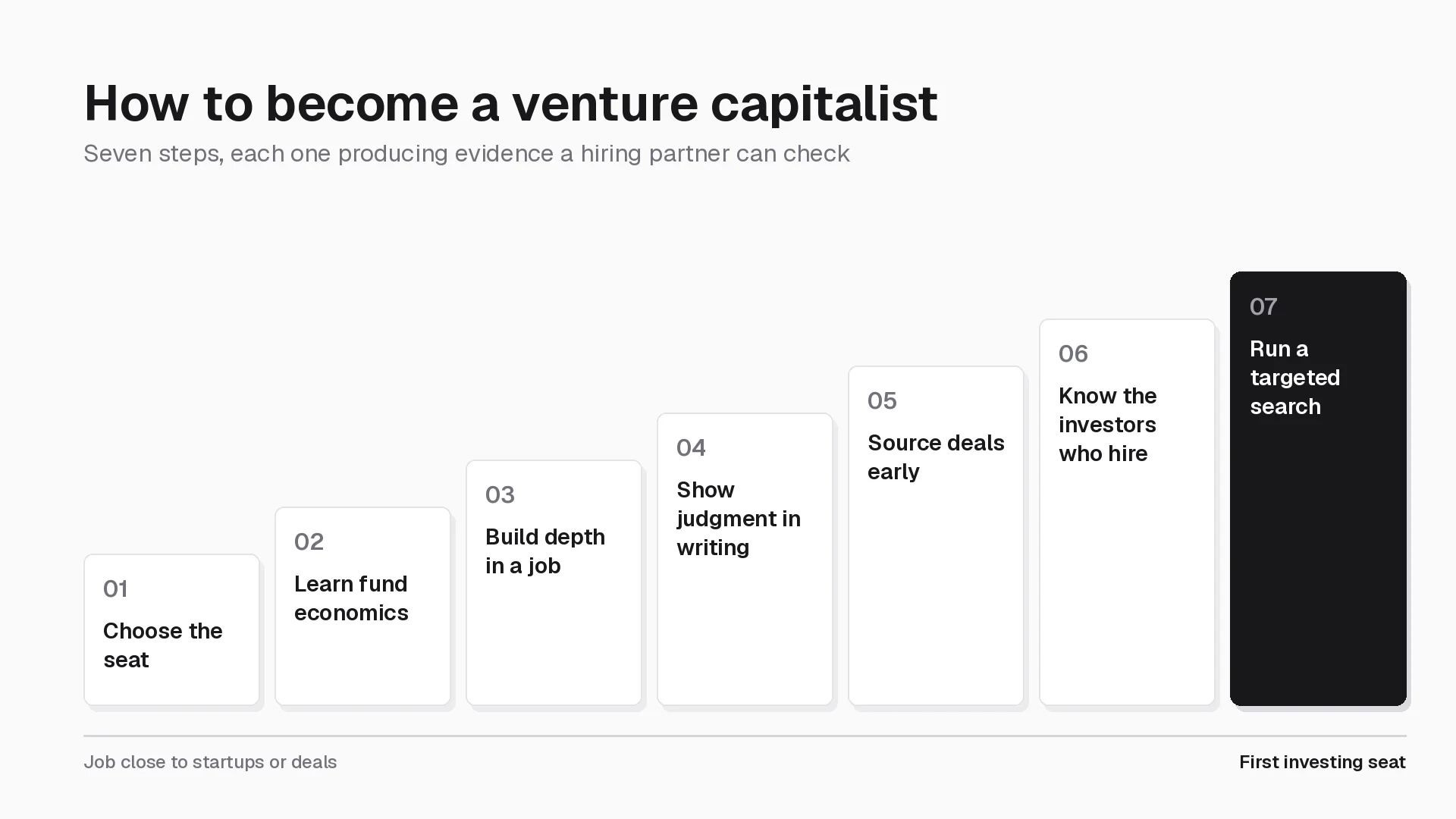
How to become a venture capitalist in seven steps: choose the seat, build depth, prove judgment in writing, source early, and run a targeted search. Includes entry paths by background, how fund size limits hiring, MBA placement data, and licensing.
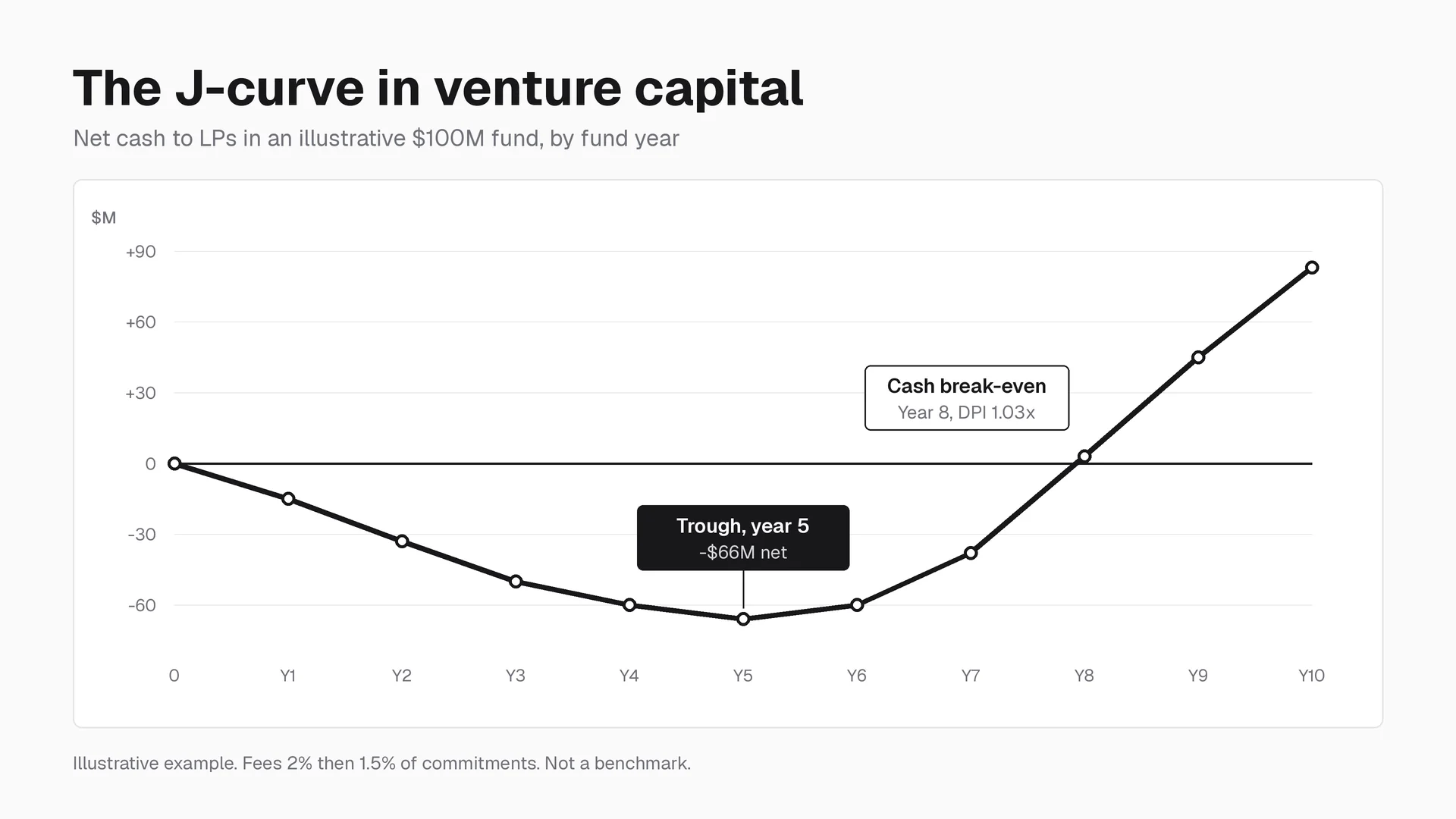
The J-curve in venture capital explained with a worked $100M fund example, current vintage data on DPI and IRR, a check for telling a normal trough from a weak fund, and what the curve means for VC carry, offers, and interviews.
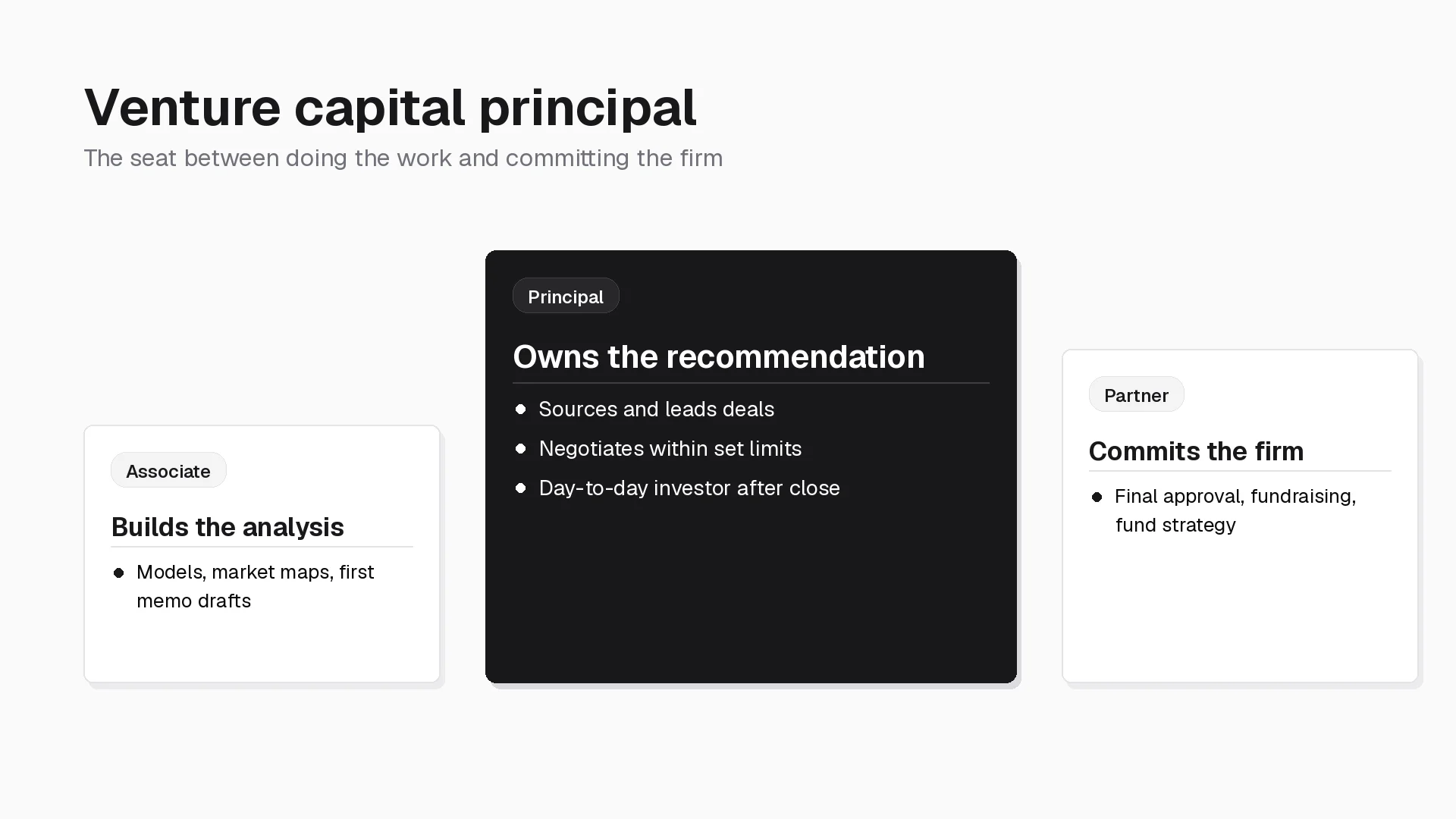
What a venture capital principal does, how the role differs from associate and partner, how to read a principal posting and value its carry, plus a copy-ready job description template and hiring scorecard.