
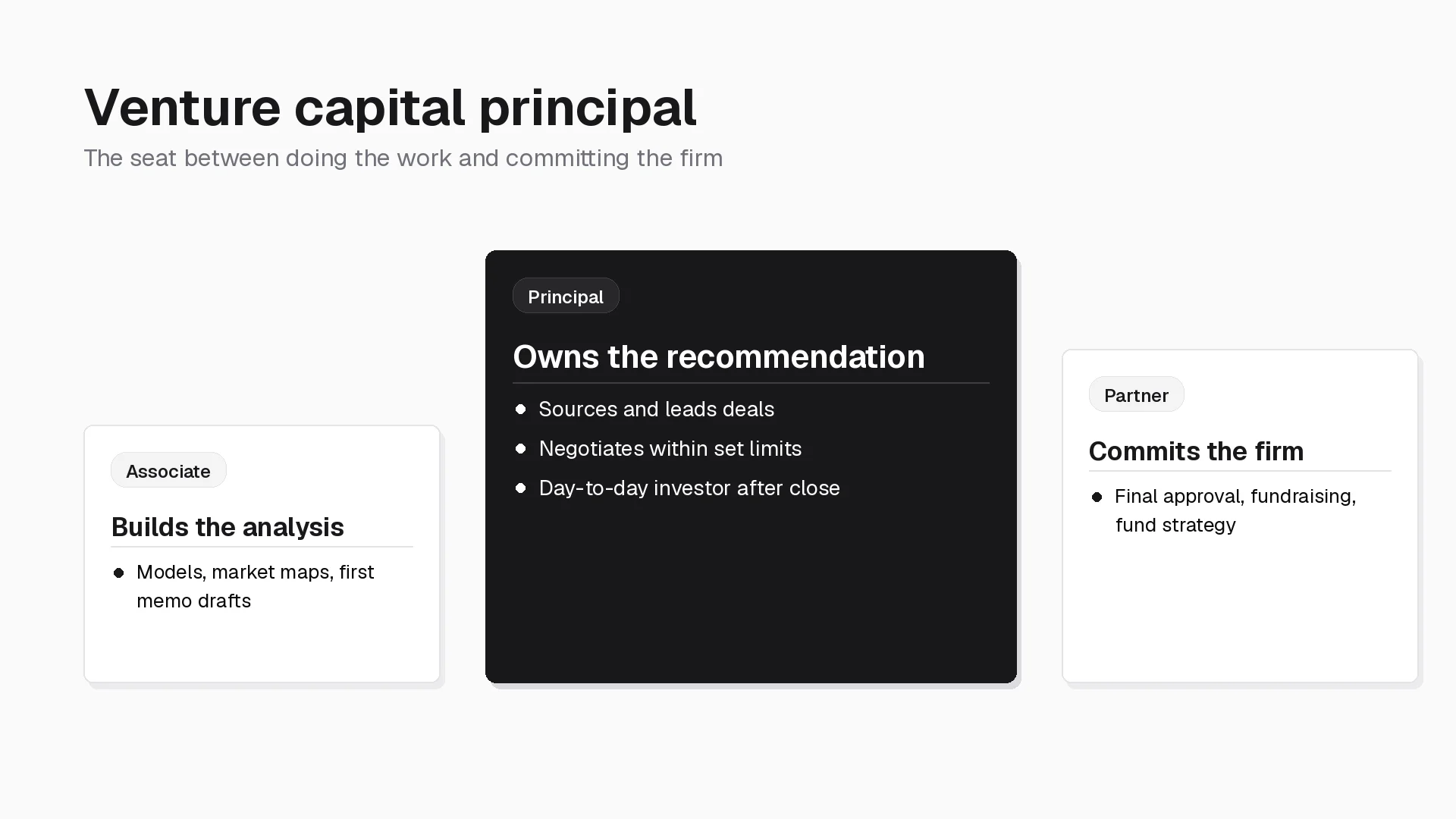
A venture capital principal is a senior investor who sits between associate and partner. Principals originate deals, lead diligence and term negotiation, carry the recommendation into the investment committee, and act as the day-to-day investor for portfolio companies. In most firms they shape investment decisions without holding final approval, and they earn salary, bonus, and a modest share of the fund's carry.
The title is not standardized. At one fund a principal votes in investment committee, negotiates term sheets, and holds board seats. At another, the same title means senior execution work with no approval authority. Judge the role by decision rights, carry terms, and promotion criteria, not the title.
Candidates can browse current VC roles and research venture firms. Firms hiring at this level can use the template and scorecard below.
What is a venture capital principal?
The principal is the hinge between analysis and partnership-level accountability. Associates gather evidence, build models, and draft investment materials. Partners set fund strategy, raise capital, and carry final responsibility for investment and management-company decisions. Principals own the judgment and coordination between those layers.
In practice, a principal can take a company from first meeting to an investment-committee recommendation. The principal directs the diligence plan, challenges the market thesis, negotiates major terms, coordinates counsel, and becomes the founder's main contact after closing. Whether that person can approve or sign the investment depends on the firm.
The most reliable way to understand the role is an authority test:
| Area | Typical principal ownership | What varies by firm | Question to ask |
|---|---|---|---|
| Sourcing | Builds sector relationships and originates credible opportunities | Individual sourcing targets and attribution rules | What counts as a sourced deal, and how is credit assigned? |
| Investment committee | Presents recommendations and defends the investment case | Observer, non-binding voice, formal vote, or delegated approval | Does the principal vote, recommend, or only present? |
| Deal authority | Leads diligence, term-sheet work, and closing coordination | Check-writing limit, signature authority, and partner oversight | What can the principal approve without a partner? |
| Portfolio governance | Owns founder relationships and operating follow-through | Informal support, board observer, or director seat | Which companies and governance rights will the principal hold? |
| Fund economics | Salary, bonus, and some long-term upside | Carry pool, vesting, co-invest, clawback, and departure treatment | What does the carry percentage refer to, and when does it vest? |
| Firm building | Mentors junior investors and develops a sector or thesis | LP exposure, fundraising, hiring, and budget ownership | Which firm-level outcomes determine promotion? |
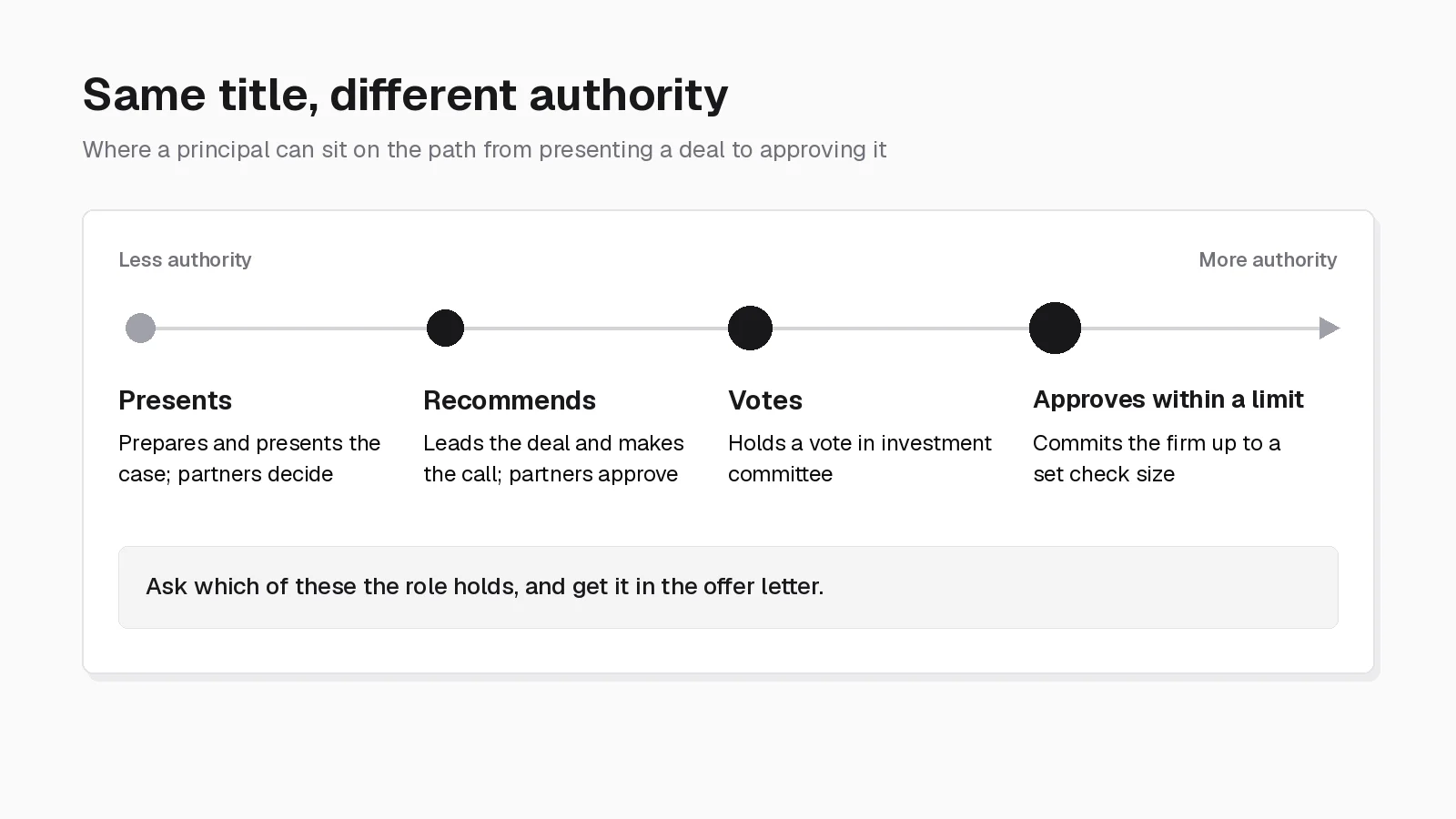
Some funds use vice president or director for the same level. Others split those titles into separate rungs. Junior partner can describe a principal with more authority or economics who still falls short of full general partner status. Read any VC career path as a common pattern, not an industry-wide org chart.
Venture capital principal responsibilities
A strong job description separates work the principal owns from work the person supports. "Assist with sourcing and diligence" is an associate line. "Originate qualified opportunities, set the diligence plan, and lead recommendations to the investment committee" defines a principal's accountability.
Build a differentiated sourcing engine
Principals are expected to create access rather than work through inbound decks. That means developing a sector thesis, meeting founders before they raise, keeping trusted connections with operators and co-investors, and representing the fund in a focused ecosystem.
Success is a pipeline of companies that fit the fund's stage, geography, ownership targets, check size, and return model, not a count of meetings. A posting should say whether success means proprietary origination, sector coverage, local ecosystem presence, or conversion from first meeting to partner review. For working methods, see the VC deal-sourcing framework.
Lead investment analysis and due diligence
The principal turns interest into an investable recommendation. They define the open questions, assign work across the deal team, and decide which evidence would change the call. Typical areas include market structure, customer pain, product differentiation, founder-market fit, unit economics, financing needs, ownership, downside cases, and exit potential.
At this level the job is to design a decision-quality process, inspect the work, and make the judgment legible to the partnership in a concise investment memo that names what remains uncertain, rather than to run every analysis personally. The venture capital due diligence process is the adjacent workflow.
Drive investment-committee decisions and deal execution
Principals present the investment case, answer objections, and keep diligence findings tied to proposed terms. Once the firm decides to proceed, they lead term-sheet negotiation, coordinate legal and financial workstreams, manage syndicate relationships, and keep the deal moving to close. How that committee works at each firm is covered in the guide to the venture capital investment committee.
The posting must say where authority stops. A principal who can negotiate within an approved range has a different mandate from one who only prepares the partner for negotiation. Either model can work if the posting states it.
Support portfolio companies and boards
After investment, the principal is often the firm's most frequent contact with the company. The work includes executive hiring, follow-on financing, customer introductions, planning, metrics, board preparation, and acquisition discussions. Principals also surface risks to the partnership and recommend reserve and follow-on decisions.
Do not promise that the principal will "add value" across every operating function. Define the fund's actual support model, the expected portfolio load, and whether the person will hold board observer or director seats.
Develop the team, thesis, and firm
A partner-track principal improves the investment platform, not only personal deals. Common responsibilities include coaching analysts and associates, raising memo and pipeline standards, publishing credible sector work, recruiting investment talent, contributing to portfolio reviews, and representing the firm with founders, co-investors, and sometimes LPs.
State fundraising responsibility carefully. A principal may contribute case studies, data, or sector expertise to LP conversations without owning the raise. If LP relationship work is part of the promotion case, say so.
How the work changes from associate to principal
The jump from associate to principal changes what a person produces more than how many hours they work. Associates build the model, the market map, and the first memo draft. Principals review that work, decide which questions matter, and own the recommendation and the founder relationship.
| Activity | Associate output | Principal output |
|---|---|---|
| Sourcing | Lists, screens, and first calls | Relationships that produce deals the fund would not otherwise see |
| Diligence | Analysis on assigned workstreams | The diligence plan and the judgment of what changes the decision |
| Investment memo | First draft and exhibits | The recommendation, its risks, and its defense in committee |
| Terms | Comparable terms and cap table work | Negotiation within the authority the partnership grants |
| Portfolio | Data requests and ad hoc projects | Board preparation, follow-on calls, and hard conversations with founders |
| Team | Own work product | Review, feedback, and staffing of analysts and associates |
A principal's week usually tilts toward meetings: founder pitches, partner check-ins on live deals, portfolio board calls, reviews of associate work, and recruiting. Less time goes to spreadsheets, and more goes to judgment calls that someone senior will later test. The associate job description shows the level below in detail.
Principal vs associate vs partner
The practical difference is who owns the recommendation, who can commit the firm, and who carries the consequences.
| Dimension | Associate | Principal | Partner / general partner |
|---|---|---|---|
| Primary job | Research, diligence, sourcing support, and execution | Origination, judgment, deal leadership, and portfolio ownership | Fund strategy, final decisions, fundraising, and partnership leadership |
| Deal autonomy | Runs defined workstreams | Designs and leads the full process, usually with partner oversight | Sets approval boundaries and commits the firm |
| Investment committee | Prepares analysis; may present sections | Leads the recommendation; vote varies | Holds formal decision authority in most firms |
| Founder relationship | Supports meetings and follow-up | Often the day-to-day senior investor | Owns the highest-stakes relationship and firm commitment |
| Board work | Limited; sometimes observer exposure | Observer or director depending on mandate | Commonly director or senior sponsor |
| Team leadership | May guide analysts or interns | Manages and develops the deal team | Builds the organization and partnership |
| Fundraising and LP work | Rare | Selective exposure or supporting role | Core responsibility |
| Economics | Salary and bonus; carry varies | Salary, bonus, and more meaningful carry | Management-company economics and the largest carry allocation |
| Success test | Quality and reliability of work | Judgment, sourced deals, portfolio outcomes, and leadership | Fund performance, fundraising, franchise strength, and succession |
A principal is senior to an associate and junior to a partner. VP and director cannot be placed without firm-specific context. The same goes for venture partner, which is often a part-time or specialist affiliation rather than the rung above principal. For the senior seat, compare the venture capital partner job description.
How firms fill principal roles
Few people start their VC career as a principal. Firms usually fill the seat in one of four ways, and each route has to prove something different.
| Route | What the firm is buying | Evidence the firm will want |
|---|---|---|
| Internal promotion from senior or post-MBA associate | Proven fit with the firm's process and partners | Deals the candidate sourced or led, memo quality, founder references, and partner sponsorship |
| Lateral hire from another fund | Ready-made deal leadership in a stage or sector | Attributable deals, board work, and a clear reason for leaving that does not involve a stalled promotion story |
| Senior operator or founder | Domain access and credibility with founders in a target market | Investment judgment shown through angel checks, advisory work, or a written thesis, plus a network that produces deals |
| Domain specialist (scientist, clinician, engineer) | Technical diligence the partnership cannot do itself | Track record evaluating technology, relationships with founders and researchers, and evidence of commercial judgment |
Whatever the route, the hiring question is the same: can this person bring in and lead deals the partnership would back, and can they handle founders after the check clears? The full career route lives in the guide on how to become a venture capital principal. Candidates applying now can pair it with a principal cover letter that leads with attributable deals.
Qualifications and skills firms should require
Principal hiring often fails when a firm screens for pedigree instead of evidence. An MBA, an investment banking background, or a brand-name employer can help, but none proves that a person can originate a venture opportunity, decide under uncertainty, earn founder trust, or lead a deal team.
Evidence of investment judgment
Ask for two or three decisions the candidate can unpack: one pursued, one declined, and one that changed after new evidence. Strong candidates explain the original thesis, the disconfirming evidence they looked for, the decision, and what later outcomes taught them. They do not hide behind a firm's track record or claim sole credit for a team decision.
Repeatable sourcing and relationship depth
"Strong network" is not a qualification until the candidate can show how it produces relevant access. Look for a clear market map, trusted relationships in the fund's focus area, examples of founder engagement before a process starts, and a repeatable method for keeping those relationships warm. The evidence should match the mandate: a seed fund may value early technical communities, while a growth fund may need executive and later-stage investor networks.
Deal leadership and written thinking
The candidate should be able to scope diligence, prioritize the few questions that drive the return case, review quantitative work, write a sharp recommendation, and negotiate without damaging the founder relationship. A sanitized investment memo or live case discussion reveals more than finance trivia.
Founder empathy and portfolio effectiveness
Portfolio work takes judgment about when to advise, when to introduce, when to challenge, and when to stay out of the way. References from founders and former colleagues should test whether the candidate follows through, handles bad news, and can tell governance apart from running the company.
Team leadership and firm contribution
Principals either multiply or consume junior-team capacity. Look for evidence that the candidate sets clear workstreams, improves analysis, gives useful feedback, and shares credit. Partner-track hires should also bring a point of view the firm needs: a sector, a geography, a network, an operating capability, or an investment approach.
Prior investing experience is the cleanest preparation, but not the only one. Make prior VC experience mandatory only when the role truly needs immediate fluency in fund process and deal leadership.
Compensation, carry, and the path to partner
Principal pay combines base salary, a cash bonus, and long-term economics such as carry. Some firms add co-invest rights or deal-level participation. The mix moves with fund size, geography, strategy, and whether the firm treats principal as a partnership pipeline or a senior terminal role. For market ranges by level, use the venture capital salary guide rather than one posting.
A complete offer explains:
- The base salary range and location policy.
- The target bonus, how it is set, and whether it depends on individual or fund performance.
- Whether carry is included, which fund or pool it covers, and whether the quoted percentage is of fund profits or of the carry pool.
- The vesting schedule, any cliff, treatment of vested and unvested carry on departure, and any clawback.
- Co-invest rights, any required personal commitment to the fund, and whether the firm finances it.
- The criteria, decision process, and economic change tied to promotion to partner.
How to estimate what a carry offer could be worth
Carry is paid from fund profits, years after the work, and only if the fund clears its obligations to LPs. A rough estimate takes four inputs: fund size, a gross outcome multiple, the carry rate, and the principal's share of the carry pool. The example below uses round hypothetical numbers to show the arithmetic. It is not a market benchmark.
| Step | Hypothetical input | Result |
|---|---|---|
| Fund size | $150M | $150M committed |
| Outcome | Fund returns 2.5x | $375M returned, $225M profit before fees and expenses |
| Carry rate | 20% of profits | $45M carry pool |
| Principal's share | 2% of the carry pool | $900K, equal to 0.4% of fund profits |
| Vesting | 25% vested at departure in year 3 | $225K if the fund performs as assumed |
Three checks change the answer more than the percentage. First, confirm the denominator: "2% carry" can mean 2% of the carry pool or 2% of total profits, a fivefold difference at a 20% carry rate. Second, read the vesting and departure terms, because most of the value sits in years the principal may not stay for. Third, remember that fees, expenses, and a weaker fund outcome shrink the profit line, and a fund that does not return capital pays no carry at all. The guide to venture capital carried interest covers waterfalls and clawbacks.
What partner track should mean
"Partner track" should come with observable milestones: originating investments the partnership approves, leading portfolio work well, building a sector franchise, developing junior talent, supporting fundraising, and earning the partners' trust. Promotion also depends on partnership capacity. A new fund, a growing team, or a retiring partner opens seats. A flat or shrinking firm rarely does. A promised timeline without criteria, available economics, or examples of past promotions is not a progression plan.
Common next steps for principals who are not promoted include a partner seat at another fund, a senior role at a newer firm, an operating role at a portfolio company, or a fund of their own. The VC offer negotiation guide covers how to get carry and promotion terms in writing before signing.
How to read a principal job posting
Postings at this level often use the same phrases for very different jobs. The wording usually signals how much authority the role has, and each phrase points to a question worth asking before the second interview.
| Posting language | What it usually signals | What to confirm |
|---|---|---|
| "Support partners on sourcing and diligence" | A senior associate seat with a principal title | Whether any deal can be led end to end without a partner running it |
| "Lead investments from sourcing to close" | Real deal leadership, often with partner sign-off | Who signs the term sheet and who presents in committee |
| "Member of the investment committee" | Anything from observer to voting member | Whether the seat carries a vote and on which decisions |
| "Board seats on portfolio companies" | Governance work, sometimes as observer only | Director or observer, how many companies, and which ones |
| "Carry participation" | Some upside, terms unknown | Percentage of what, in which funds, vesting, and departure treatment |
| "Partner-track" | An intention, not a promise | Promotion criteria, decision-makers, and how past principals progressed |
| "Build the firm's presence in [sector or region]" | The role owns a franchise the firm does not have yet | Budget, junior support, and how long the firm expects to wait for results |
| "Assist with fundraising" | LP exposure, not ownership of the raise | Which LP meetings, materials, and relationships the role touches |
| Specific deal quotas or multiple targets | A volume-driven seat | Whether passes, process quality, and portfolio work also count |
A posting that names authority, governance load, carry terms, and promotion criteria is rare and worth noticing. A posting that names none of them is not disqualifying, but every gap becomes an interview question. Track openings at this level on the VC job board and compare how firms describe the same seat.
Copy-ready venture capital principal job description template
Replace every bracketed field and delete responsibilities the role will not own. The finished posting should make the fund's mandate, decision rights, success measures, and economics clear to a qualified candidate.
About [fund name]
[Fund name] is a [stage] venture capital firm investing in [sectors] across [geography]. We typically invest [initial check range] in [company profile] and reserve capital for [follow-on strategy]. Our portfolio includes [representative companies or themes].
Our advantage comes from [specific sourcing, domain, operating, geographic, or network edge]. Avoid claims such as "leading fund" unless the posting can back them up.
The mandate
We are hiring a principal to own [sector / geography / stage] investment activity from origination through portfolio support. You will report to [role], lead [team or resources], and work with the partnership to turn [fund thesis] into a focused pipeline and high-conviction investments.
This role has [IC participation or vote], [authority to negotiate or approve terms], and [board observer or director expectations]. It is [partner-track / a senior investing role with a distinct path], with performance assessed against the outcomes below.
Responsibilities
- Build and maintain a differentiated pipeline in [focus area], with clear ownership of sourcing relationships and attribution.
- Develop investment theses and market maps that show where the fund should and should not spend time.
- Lead founder meetings and assess fit with the fund's stage, ownership, check size, and return requirements.
- Design and manage commercial, product, technical, financial, legal, and reference diligence with internal and external specialists.
- Produce clear investment recommendations, present them to the investment committee, and answer the strongest counterarguments directly.
- Lead term-sheet development and negotiation within [approved authority], coordinating counsel, co-investors, and the deal team through close.
- Support [number or range] portfolio companies through [board work, hiring, financing, customer introductions, strategy, M&A, or other actual support].
- Recommend reserves, follow-on participation, and portfolio actions using current company evidence and the fund's construction model.
- Coach [analysts / associates] and improve sourcing, diligence, memo, and portfolio-review processes.
- Contribute to [sector content, events, recruiting, portfolio reviews, LP materials, fundraising, or other firm-building work].
Required qualifications
- Evidence of sound investment or strategic judgment in [stage / sector], including the ability to explain decisions, uncertainty, and lessons without overstating personal credit.
- Experience leading complex workstreams and influencing senior decision-makers under time pressure.
- A repeatable sourcing approach and trusted relationships relevant to [fund focus].
- Ability to assess markets, products, teams, business models, financing needs, ownership, and venture-return potential.
- Clear written and verbal communication with founders, investment committees, colleagues, co-investors, and advisers.
- Leadership that raises the quality of junior-team work without unnecessary process.
- [Work authorization, location, travel, regulatory, or language requirement that is genuinely necessary].
Preferred qualifications
- Prior venture investing experience at [stage / strategy].
- Operating, founding, technical, scientific, clinical, or commercial depth in [focus area].
- Experience negotiating venture financings and working with outside counsel.
- Board observer or director experience.
- Experience supporting follow-on financings, strategic transactions, or exits.
- Working fluency with [CRM, market data, and cap table tools the team uses].
- [Degree or credential] only if it reflects a real requirement rather than a pedigree filter.
How success will be measured
In the first 12 months, success means:
- A qualified pipeline in [focus], with [appropriate target] opportunities advanced to substantive partner or IC review.
- [Target or description] diligence processes led, with recommendations that are concise, decision-ready, and honest about risk.
- Ownership of [portfolio scope], with strong founder feedback and reliable internal reporting.
- Improvement in [specific team process] and development of [junior-team expectation].
- A differentiated thesis or network position the firm can keep building on.
Do not set investment-count or markup targets that reward weak decisions or short-term valuation moves. Use a balanced scorecard that credits disciplined passes, process quality, and portfolio outcomes alongside completed deals.
Compensation and benefits
The base salary range is [range] for [location basis]. The role is eligible for [target bonus and basis], [carry description with denominator and fund], [vesting summary], and [co-invest terms if applicable]. Benefits include [health, retirement, leave, learning, travel, or other benefits].
If the role is partner-track, describe the review cadence, criteria, decision-makers, and expected economic change. If it is not, say what advancement looks like.
Location and working model
This role is based in [city or region], with [in-office expectation, for example days per week] and [travel expectation for founder meetings, board meetings, and events]. [State any relocation support or remote eligibility.]
Hiring process
- Introductory conversation on mandate, motivations, and relevant track record.
- Investment discussion using one pursued, one declined, and one changed-view example.
- Structured case or sanitized memo review that tests judgment, prioritization, writing, and communication.
- Meetings with the investment team and relevant operating or portfolio colleagues.
- References that include a founder, a senior decision-maker, and someone the candidate managed, where possible.
- Final conversation covering role authority, scorecard, compensation, carry, and progression, confirmed in writing.
Equal opportunity statement
[Insert the firm's approved equal opportunity and accommodation language.]
Before publishing, have the partnership confirm the authority language and have employment counsel review location-specific pay-transparency, privacy, equal-opportunity, and hiring-process requirements. When the mandate is ready, post the principal role on Venture Capital Careers to reach candidates focused on venture investing.
Venture capital principal hiring scorecard
Score candidates against the mandate before interviews begin. The weights below are a starting point for an institutional investment role. A thesis-heavy seed fund, a sector-specialist fund, or a portfolio-intensive platform should change them.
| Competency | Starting weight | Evidence to request | Interview exercise | Warning sign |
|---|---|---|---|---|
| Investment judgment and thesis | 25% | Pursued, declined, and changed-view decisions; memo or thesis work | Defend a recommendation, then update it when given disconfirming evidence | Confuses confidence with certainty; cannot name a disciplined pass |
| Sourcing and relationships | 20% | Originated opportunities, network map, relationship-building method | Build a 90-day sourcing plan for the fund's mandate | Relies on meeting volume, databases, or a former firm's brand |
| Diligence and deal execution | 20% | Led workstreams, negotiated terms, counsel and syndicate coordination | Scope diligence under a fixed time and budget | Produces exhaustive checklists without prioritizing decision drivers |
| Portfolio and founder work | 20% | Founder references, board examples, follow-on or difficult-company decisions | Respond to a portfolio company missing plan with six months of runway | Defaults to running the company or avoids hard governance issues |
| Leadership and firm building | 15% | People developed, process improvements, sector franchise, LP or recruiting contribution | Give feedback on a flawed associate memo and set a revision plan | Takes individual credit, delegates vaguely, or treats junior work as disposable |
Use the same core questions and an anchored scoring scale for every candidate. Interviewers should record evidence before discussing impressions. A polished networker who cannot show judgment should not outrank a quieter candidate with a repeatable sourcing edge and strong decisions.
The case should resemble the work. A short deck, customer evidence, a cap table, and an ambiguous market question show what the candidate prioritizes, which diligence they commission, how they frame ownership and return, and how they communicate a recommendation. That reveals more than a perfect model disconnected from the fund's process. The VC case study interview guide shows the format from the candidate side.
Questions candidates should ask before accepting
A principal interview runs both ways. These questions test whether the title, authority, resources, economics, and promotion story fit together:
- Does the principal have an IC vote, a recommendation role, or presentation responsibility only?
- Which investment, term, reserve, expense, or signature decisions can the principal make without further approval?
- How does the firm define a sourced deal, and how is attribution handled when relationships are shared?
- Which board or observer seats come with the role, and what is the expected portfolio load?
- What analyst, associate, platform, expert, and operating support does the principal get?
- Which outcomes drive bonus and annual reviews? Do disciplined passes and portfolio work count?
- What does the carry figure measure, which vehicles does it cover, and how do vesting and departure treatment work?
- What personal commitment to the fund or co-invest is expected, and how is it financed?
- What must be true for promotion to partner, who decides, and how have past principals progressed?
- How do the current fund's deployment pace, reserves, fundraising outlook, and partnership capacity affect the role?
Compare the answers with the written job description and offer. If the firm sells the seat as partner-track but cannot define decision rights, economics, or prior promotions, treat the title as unverified. Use the venture capital companies directory to research a firm's focus and team before the final round.
Frequently asked questions
What does a principal do at a VC firm?
A principal originates and leads investments, runs diligence and term negotiation, presents recommendations to the investment committee, and manages founder relationships and board work after the deal closes. Principals also review junior work and build a sector focus for the firm.
Is principal higher than VP in venture capital?
Sometimes, but there is no universal hierarchy. Some firms use VP and principal interchangeably, others place VP below principal, and some skip one title. Compare investment-committee role, deal authority, board responsibility, carry, and reporting line.
Is a VC principal a partner?
Usually not. A principal is commonly the most senior non-partner investor and may be on a path to the partnership. Some firms use junior partner for a similar mandate, but the economics and legal authority can still differ from a general partner's.
Can a principal make investment decisions?
A principal shapes the decision and leads the recommendation. Formal approval varies: the person may hold a vote, delegated check authority, or no final approval. The job description should state which model applies.
How much does a VC principal make?
Pay depends on fund size, stage, geography, and the firm's carry policy, and it combines base salary, bonus, and carry. Carry is the least certain part and is paid years later, if at all. The venture capital salary guide has ranges by level; the carry example above shows how to size an offer's long-term piece.
Is an MBA required to become a VC principal?
No industry rule requires one. Many principals are promoted from post-MBA associate roles, but firms also hire operators, founders, and domain specialists at this level when their judgment and network are already visible.
How long does it take to become partner?
There is no standard timeline. Promotion depends on investment evidence, portfolio outcomes, fundraising and firm-building contribution, partnership capacity, fund performance, and whether the firm is growing. Ask for milestones and examples of past promotions rather than a timeline alone.
The title matters less than the mandate. A well-scoped principal owns judgment, relationships, and investment outcomes inside clearly stated partnership boundaries. Candidates should confirm those boundaries before joining, and firms should write them into the posting before interviewing. Create a profile to get alerts when principal roles open.
Related posts
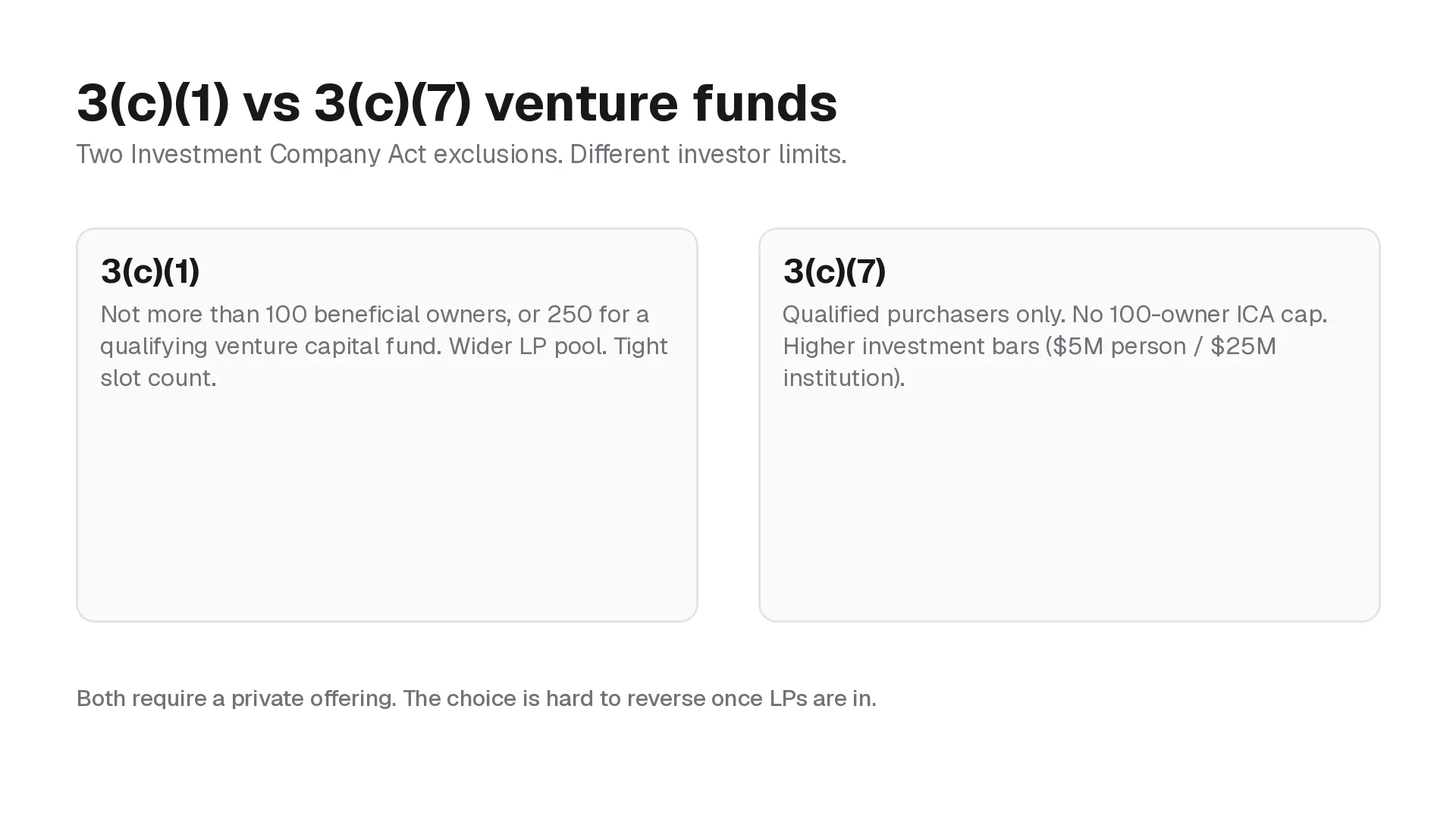
U.S. venture funds usually avoid Investment Company Act registration through 3(c)(1) or 3(c)(7). One caps how many people can own the fund. The other admits only qualified purchasers. Here is the difference, a worked slot example, and what it means for people who work at VC firms.
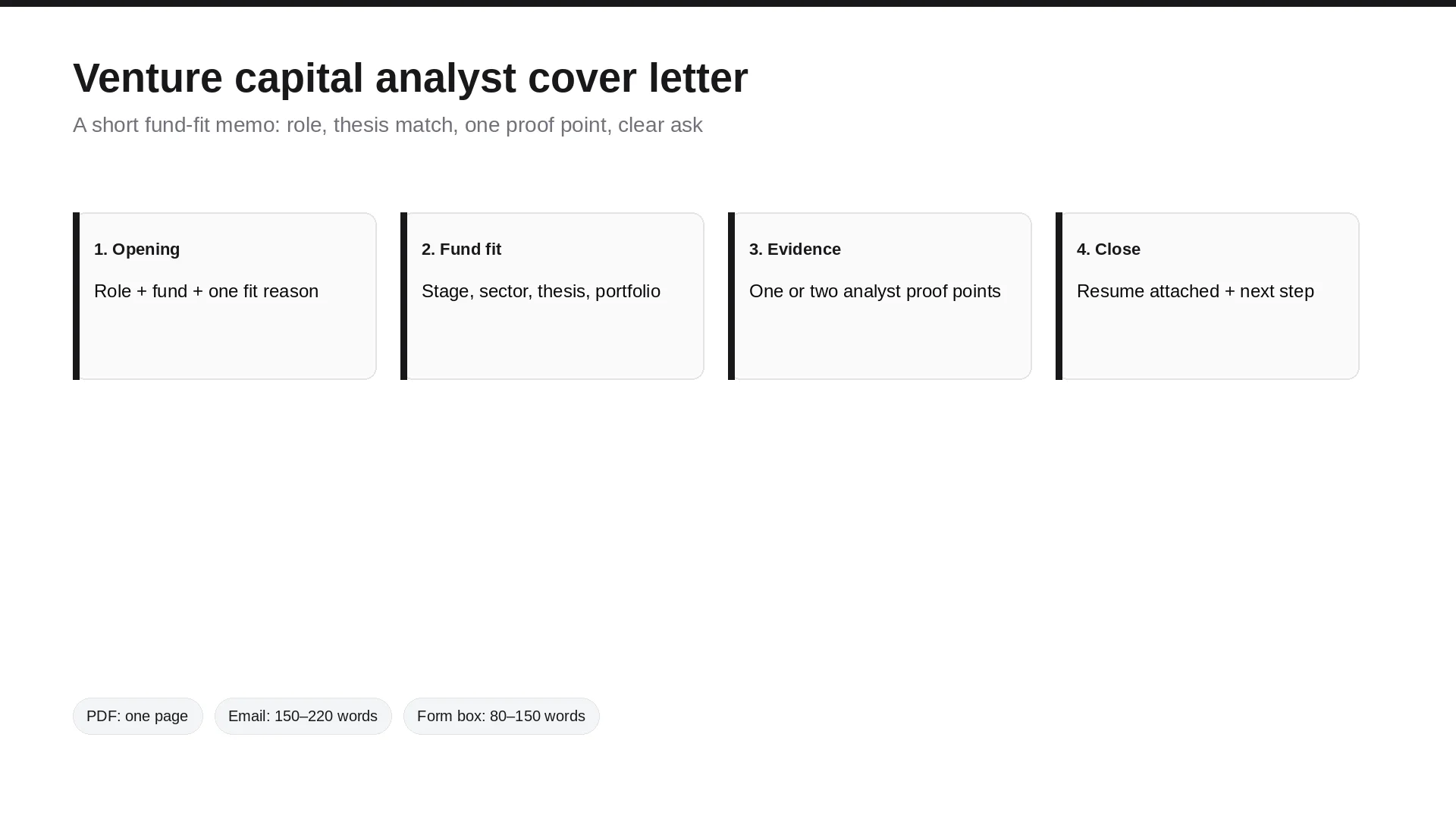
Write a concise VC analyst cover letter that ties your background to fund fit, sourcing, research, and investment analysis. Includes a template, sample letter, channel lengths, alternate application prompts, and checklist.
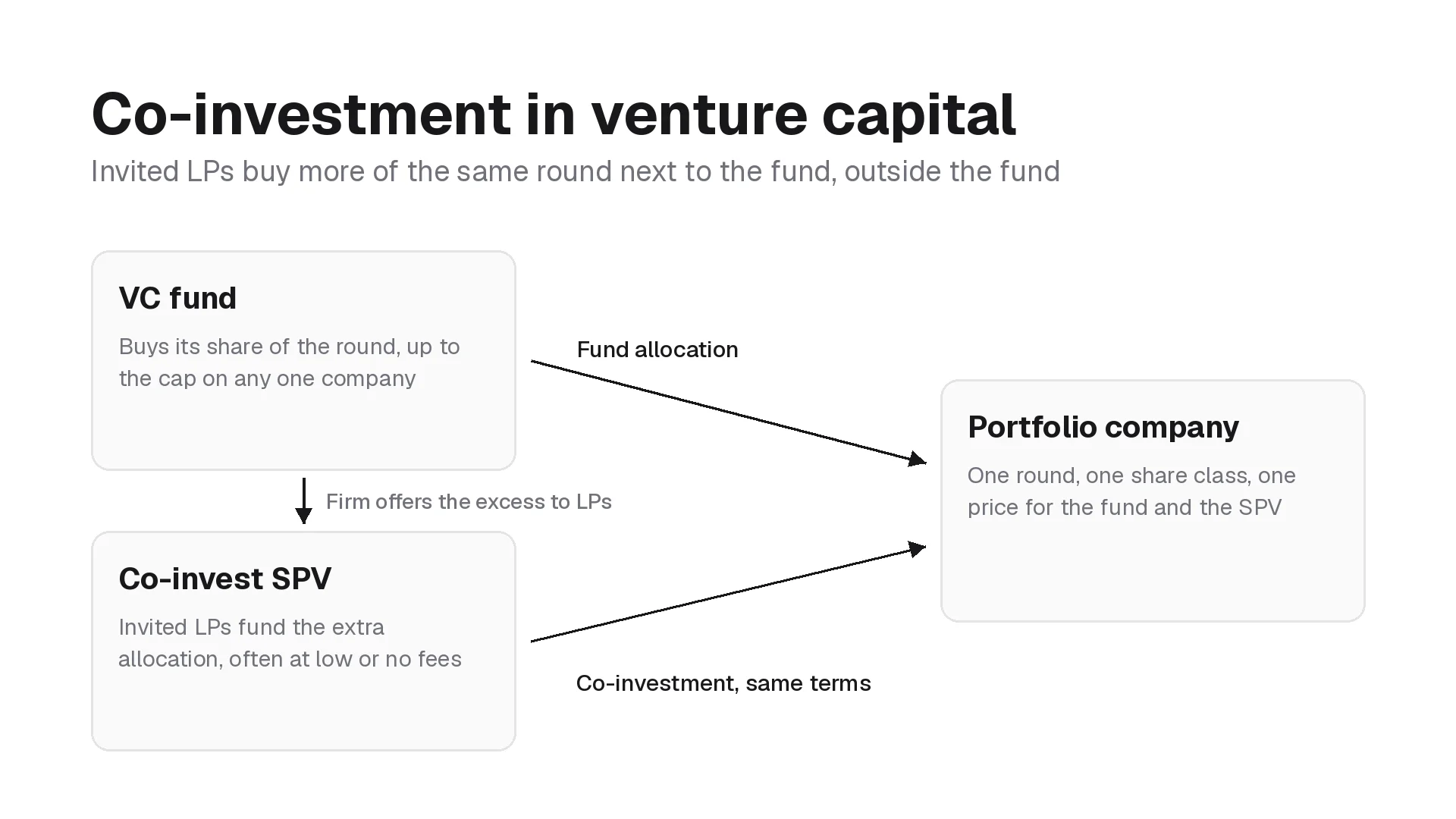
A venture capital co-investment lets LPs put money into one startup next to the fund, outside the fund, usually at lower fees. Here is how the offer works, what the terms cost, why late-stage venture co-investments carry extra risk, and what co-investment means for people who work at VC firms.