
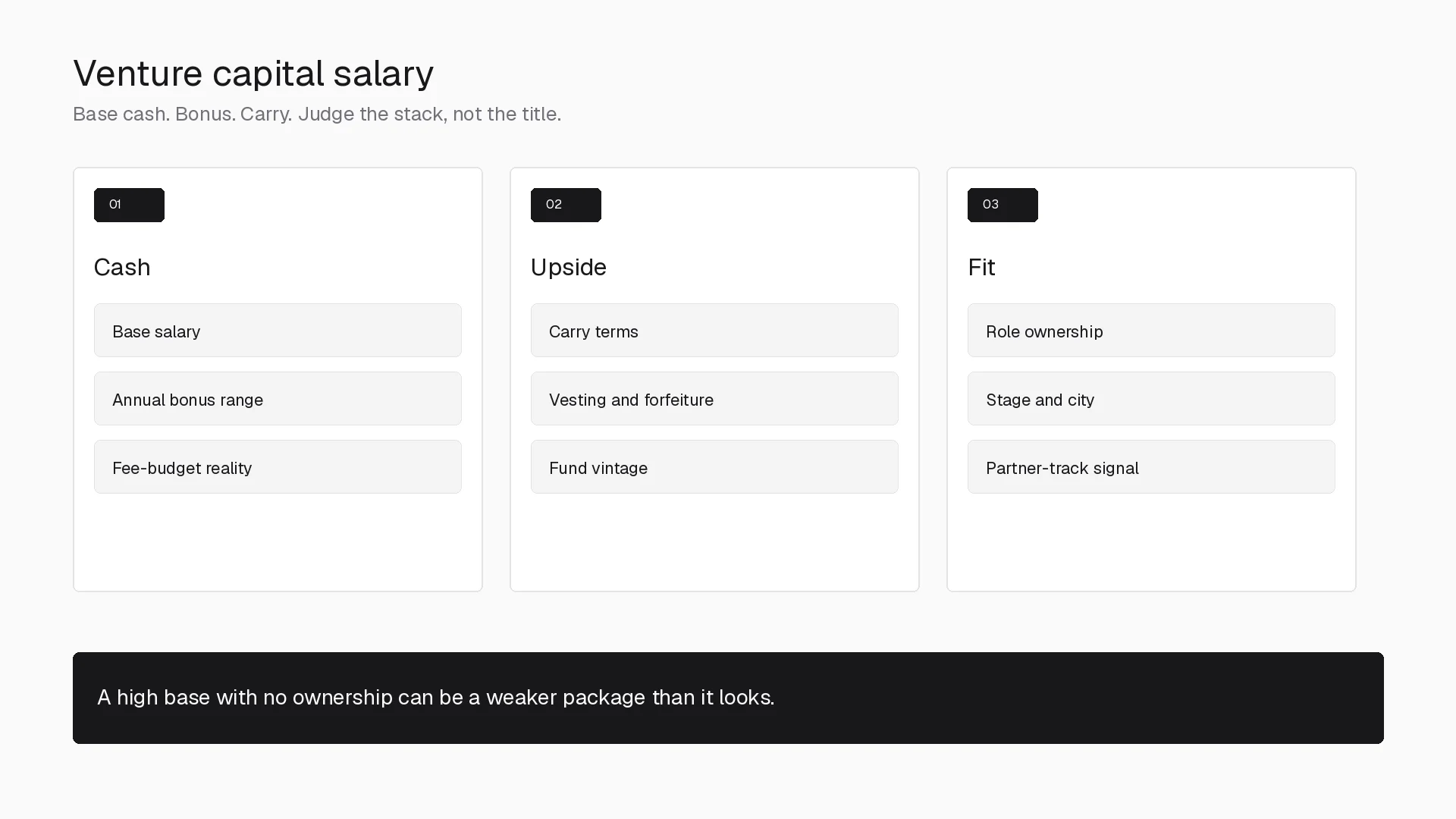
Venture capital salary is usually a stack of base cash, a discretionary bonus, and long-dated carried interest. Junior investment roles in the US often pay less cash than investment banking or private equity at the same experience level. The tradeoff is earlier exposure to founders, sourcing, diligence, and a possible path toward carry.
The ranges below are directional US-market benchmarks. Pay moves with fund size, stage focus, city, role scope, carry policy, and hiring cycles. Public survey summaries such as Venture5's 2025 VC Salary Survey also show softer cash compensation below partner level in recent cycles. Treat any table as a starting point for questions, not a promise from a specific firm.
Venture capital salary by role
Use this table as a practical US-market benchmark for investment-track roles.
| Role | Typical base salary | Typical bonus | Carry access | What usually drives the range |
|---|---|---|---|---|
| Analyst | $70K–$115K | $5K–$25K | Rare | Market maps, sourcing support, CRM work, memo help, fund size, city |
| Associate | $100K–$175K | $10K–$50K | Sometimes small or deferred | Deal screening, diligence, founder calls, prior banking/consulting/startup or MBA experience |
| Senior associate | $140K–$210K | $20K–$75K | More possible, still not guaranteed | Independent sourcing, investment memos, portfolio support, promotion path |
| Principal or VP | $175K–$275K | $30K–$125K | Often meaningful if partner-track | Ownership of sectors, deals, boards, founder relationships |
| Partner or GP | $250K–$600K+ cash, wide variation | Highly variable | Core economics | Fund size, management fees, GP ownership, carry split, realized exits |
| Venture partner | Highly variable | Highly variable | Deal-by-deal or fund-specific | Full-time vs part-time, sourcing expectations, operating background |
The bands are wide because VC firms are not standardized employers. A seed fund with a thin fee base cannot pay like a multi-billion-dollar platform. A corporate venture team may pay closer to corporate strategy or finance. A growth fund may sit nearer private equity cash because checks and companies are larger.
Higher base salary helps only when the role also builds investment judgment or includes credible economics. A large cash number attached to pure support work with no promotion path is a weaker package than it looks.
What changes as you move up the VC ladder
At analyst level, pay is mostly cash because the work is mostly support. Analysts build market maps, update pipelines, research sectors, help with memos, and track startup activity. Meaningful carry is uncommon.
Associates move closer to investment judgment. They screen companies, talk to founders, prepare diligence, and help partners decide which companies deserve more time. Cash rises when the person can source credible opportunities and write useful memos without constant direction.
Senior associates, principals, and VPs get paid for judgment. They may own themes, lead parts of diligence, sit as board observers or directors, and represent the firm externally. The compensation question becomes whether the seat is genuinely partner-track or a senior execution role with limited economics.
Partner pay is different. Partners raise capital, win allocation, make investment decisions, support portfolio companies, and return capital to LPs. Cash can be high at established funds. The larger upside is usually carried interest, which arrives late and only if the fund produces realized profits.
For titles and promotion paths in more detail, see the venture capital career path guide.
How VC bonuses and carry work
VC bonuses are usually less formulaic than investment banking bonuses. A junior investor may receive a year-end bonus based on firm performance, individual contribution, sourcing quality, or a discretionary partner decision. Some emerging funds keep bonuses modest to preserve fee budget.
Carry is the misunderstood piece. Carried interest is a share of fund profits after investors receive capital back and the fund clears its economic hurdles. It can be valuable. It is not annual cash.
Three carry questions matter more than the headline percentage:
- When does it vest? Carry may vest over several years and may be tied to staying at the firm.
- What fund does it apply to? Carry in an older fund may be less valuable if most investments are already allocated or marked.
- How likely is it to pay out? Paper gains do not pay rent. Realized exits, fund performance, and timing matter.
Analysts rarely receive meaningful carry. Associates sometimes receive small or deferred allocations. Principals and partners are more likely to receive real participation, and even then the terms decide the value.
How fund size, stage, geography, and firm type change pay
The same title can mean different cash at different firms. Adjust for the levers that actually move offers.
| Factor | Why it matters |
|---|---|
| Fund size | Larger funds usually have more management-fee budget for cash compensation. |
| Stage focus | Growth and late-stage funds often pay more cash than small pre-seed funds. Upside shape differs. |
| Geography | San Francisco, New York, Boston, and other hubs often pay more. Cost of living and competition are higher. |
| Firm maturity | Established firms may offer more cash stability. Emerging managers may offer faster responsibility and more asymmetric carry. |
| Firm type | Institutional VC, corporate venture, and crossover vehicles can sit in different cash bands. |
| Role scope | A sourcing-heavy seat differs from a role that owns diligence, memos, boards, and portfolio work. |
| Market cycle | Hiring slowdowns and automation pressure can soften junior cash. Venture5's public 2025 summary reports lower average cash below partner and especially sharp pressure on analyst cash. |
Platform, talent, and operating roles often sit on a different band than investment seats. An operations partner may earn strong cash while still receiving less carry than an investment partner at the same firm. Always separate title prestige from investment ownership.
Venture capital partner compensation
Partner compensation is best understood through fund economics. A fund typically charges management fees to run the firm and pays carry if the fund produces profits. A small fund has a much smaller annual budget for salaries, rent, travel, software, and operations than a large fund.
That is why two partners with the same title can have very different packages. A partner at a large established firm may earn substantial cash and hold carry across multiple funds. An emerging manager may take less cash because fees are thin and the real upside depends on future exits.
For partner roles, ask:
- What is the current fund size and fee structure?
- Is the person an employee, venture partner, junior partner, general partner, or owner of the management company?
- How is carry split across the partnership?
- Is carry tied to one deal, one fund, or multiple funds?
The headline "VC partner salary" is often misleading because the largest outcomes come from carry, not salary. Modest annual cash can still produce meaningful wealth if the fund realizes exceptional returns. A high-status title without carry can be weaker than it looks.
How VC pay compares with banking and private equity
At junior levels, private equity and investment banking usually pay more predictable cash than venture capital. Associates comparing offers should expect a cash discount in many VC seats relative to banking or PE at similar tenure.
The VC side of the tradeoff is different work and different upside timing. More founder contact, more qualitative diligence, earlier thematic ownership, and long-dated carry are the usual offsets. Those offsets only matter if the candidate wants that work and if the seat actually builds investment judgment.
At partner level, cash can look closer across asset classes, but outcomes still diverge. PE mega-fund cash is often higher and more regular. Top VC carry in a breakout fund can exceed many PE outcomes. Median VC fund outcomes do not. Candidates should underwrite cash they can live on, then treat carry as optionality with hard questions attached.
How to triangulate one VC offer against fund size, stage, and role scope
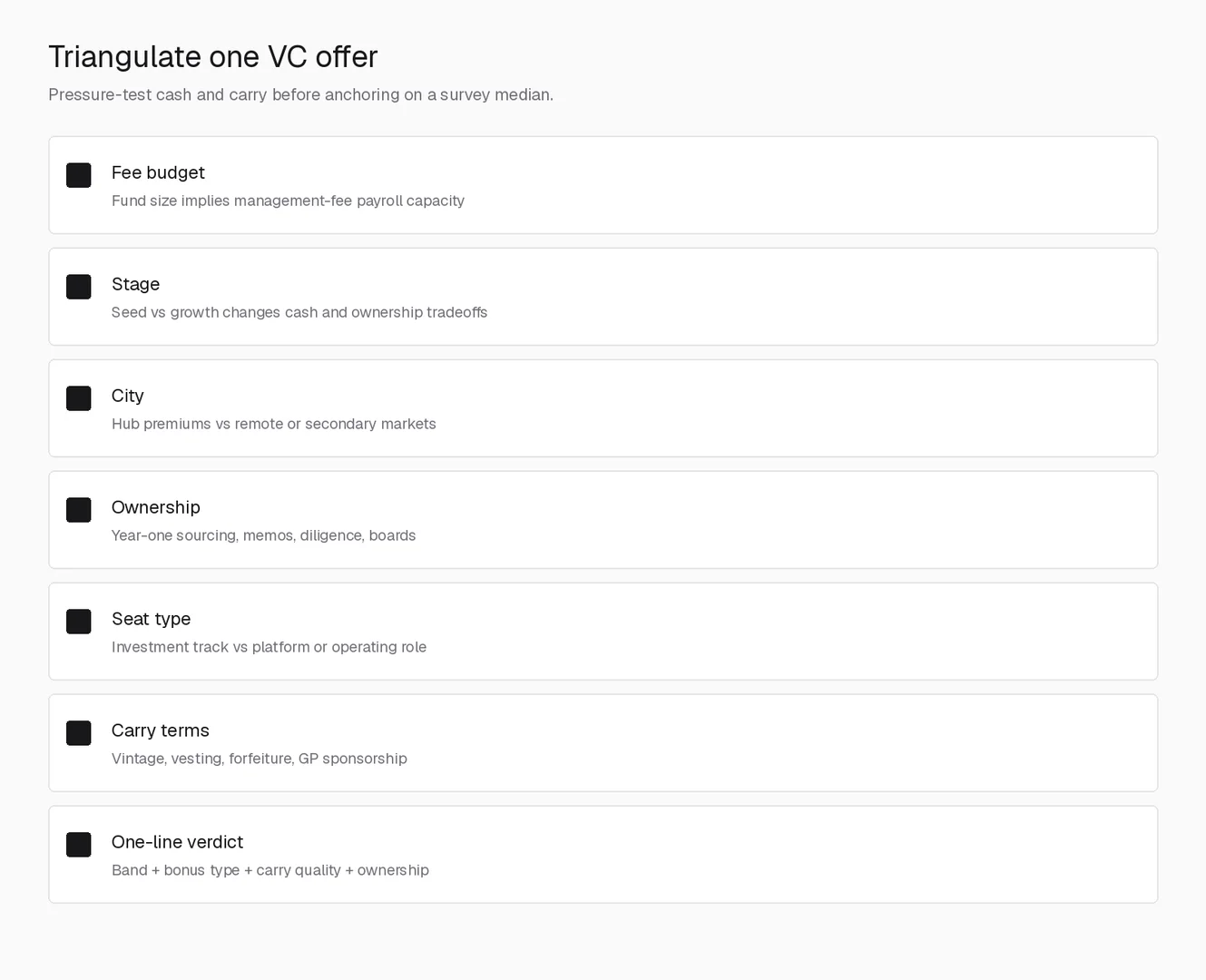
Range tables help. They do not tell a candidate whether one specific offer is coherent. Use this triangulation before anchoring on a single survey median.
- Name the fee budget context. Estimate management-fee capacity from public fund size. A $40M seed fund with a 2% fee has a very different payroll capacity than a $1B growth fund. If cash looks institutional while the fee base looks tiny, ask what else funds the package.
- Place the stage. Pre-seed and seed seats often trade cash for earlier ownership and broader work. Growth seats often look closer to PE cash. Stage mismatch explains many "low" or "high" offers that are actually consistent.
- Adjust for city. Hub offers in San Francisco and New York often sit above Midwest or remote bands. Compare after cost-of-living, not before.
- Score role ownership, not title. List what the person will own in year one: sourcing, memos, diligence leadership, founder relationships, board exposure, portfolio support. A senior title with associate-level ownership should not clear a principal cash band without a clear promotion story.
- Separate platform vs investment economics. If the seat is talent, marketing, finance, or platform, benchmark against similar operating roles, not against investment-partner carry folklore.
- Translate carry into terms. Fund vintage, vesting, forfeiture, cliff, and whether junior staff must contribute capital all change value. A 0.5% line with eight-year vesting and weak fund history is not the same product as a partner-track allocation in a new fund with clear GP sponsorship.
- Write the one-line verdict. Example: "Associate cash mid-band for a $250M early-stage NYC fund, bonus discretionary, carry symbolic, ownership strong on sourcing and memos." If that sentence cannot be written, the offer is still under-specified.
This triangulation is the difference between collecting salary screenshots and making a compensation decision.
How to evaluate a VC compensation offer
Do not evaluate a VC offer only by base salary. A lower base can be reasonable if the role is closer to investment decisions, has credible promotion potential, and includes meaningful economics. A higher base can still be a poor offer if the role is mostly support work with no path to carry.
| Question | Why it matters |
|---|---|
| What is the base salary and expected bonus range? | Separates dependable cash from discretionary upside. |
| Is bonus formulaic or discretionary? | Shows whether performance has a clear payout mechanism. |
| Is there carry? | Determines whether long-term fund upside exists. |
| If there is carry, what fund, vesting, and forfeiture terms apply? | Prevents confusing theoretical carry with practical value. |
| What investment work will you own in the first year? | Salary matters less if the role does not build judgment. |
| Who sponsors promotion decisions? | Advancement in small firms often depends on partner sponsorship. |
| How does the firm define success for this role? | Sourcing volume, memo quality, portfolio support, and network building imply different paths. |
If the firm will not discuss bonus range, carry eligibility, or promotion criteria, treat that silence as information. Small funds may lack polished compensation infrastructure. They should still explain how the role creates value and how strong performance is rewarded.
For negotiation craft on associate offers, see venture capital associate offer negotiation.
How salary should shape your VC job search
Salary research should narrow the search, not replace it. Candidates optimizing for immediate cash may prefer growth equity, late-stage VC, corporate venture, investment banking, or private equity. Candidates optimizing for startup exposure, thematic investing, founder relationships, and long-term carry may accept a lower cash package for a better investing seat.
Use Venture Capital Careers to browse open VC roles and compare titles, responsibilities, and firm types. When reading job descriptions, look for clues that affect compensation:
- Analyst roles that mention market maps and CRM ownership are often more junior and cash-heavy.
- Associate roles that mention diligence, investment memos, and founder calls may build faster toward investment judgment.
- Principal or VP roles should show ownership of sectors, deals, portfolio work, or partner-level leverage.
- Platform, talent, operating, and portfolio support roles may sit on different bands than investment roles.
Use the companies directory to research firm stage, geography, and maturity before comparing offers. Those facts often explain more about compensation than the title alone.
For role-specific scope before negotiating, review the venture capital analyst job description and venture capital associate job description. Create an account at join if job alerts and a candidate profile help keep the search organized.
Frequently asked questions
What is the average VC associate salary?
A US VC associate commonly lands somewhere around the low six figures to the mid-$100Ks in base salary, with bonus on top. Total cash can move higher at large institutional funds, growth funds, and major hubs. Smaller seed funds may pay less cash and offer faster responsibility or some carry participation.
How much do VC principals make?
VC principals and VPs often earn meaningfully more than associates because they are closer to investment ownership. Directionally, base salary may sit in the high-$100Ks to mid-$200Ks, with bonus and carry varying widely. The real question is whether the role is partner-track.
What is a typical VC bonus?
VC bonuses are often discretionary and can range from modest to meaningful depending on role, firm performance, and individual contribution. Junior bonuses are often smaller than investment banking bonuses. At senior levels, carry and fund economics usually matter more than annual bonus alone.
Do junior VC employees get carry?
Sometimes, but it is not guaranteed. Analysts rarely receive meaningful carry. Associates may receive small allocations at some firms. Principals, VPs, and partners are more likely to receive carry, but vesting, fund vintage, forfeiture, and exit timing can change the value dramatically.
Is venture capital compensation higher than private equity?
Usually not at the junior level. Private equity and investment banking often pay more predictable cash. Venture capital may offer better startup exposure, more qualitative investing work, and long-term carry upside. Candidates should be honest about the cash tradeoff.
How do venture partners get paid?
Venture partner compensation varies widely. Some receive cash retainers, some receive deal-by-deal economics, some receive carry allocations, and some are part-time advisors with limited guaranteed compensation. Clarify whether the title is full-time, part-time, sourcing-focused, operating-focused, or partner-track.
How are platform and operating roles paid?
Platform, talent, and operating roles are often benchmarked differently from investment seats. Cash can be competitive, especially at larger firms. Carry is frequently smaller or structured differently than investment-partner carry. Ask for the same clarity on bonus, promotion path, and carry terms that investment candidates should ask for.
Related posts
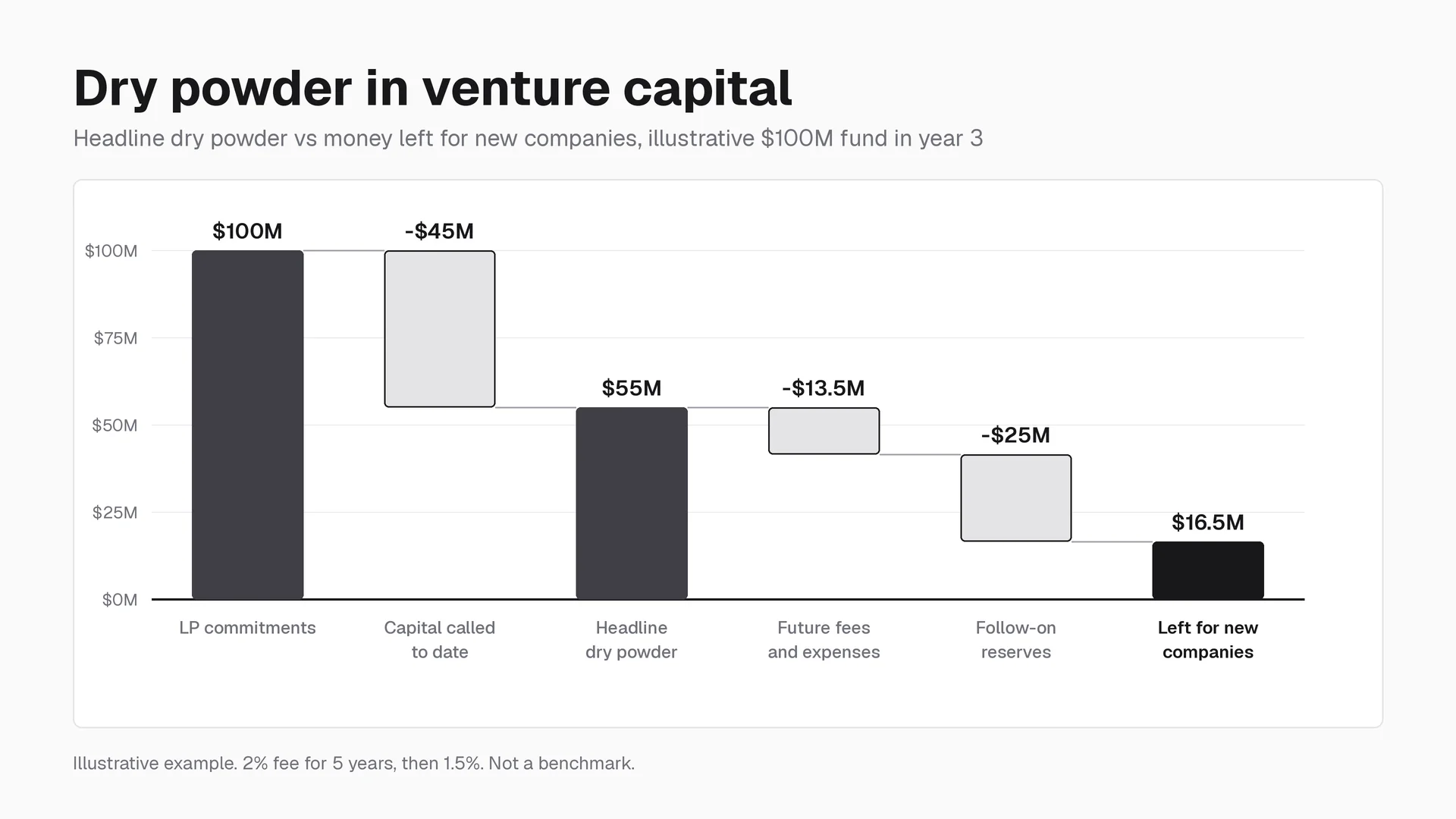
Dry powder in venture capital explained: the formula, a worked $100M fund example showing how little headline dry powder is left for new companies, current US and global data, and what a firm's dry powder tells you about hiring and the junior job.
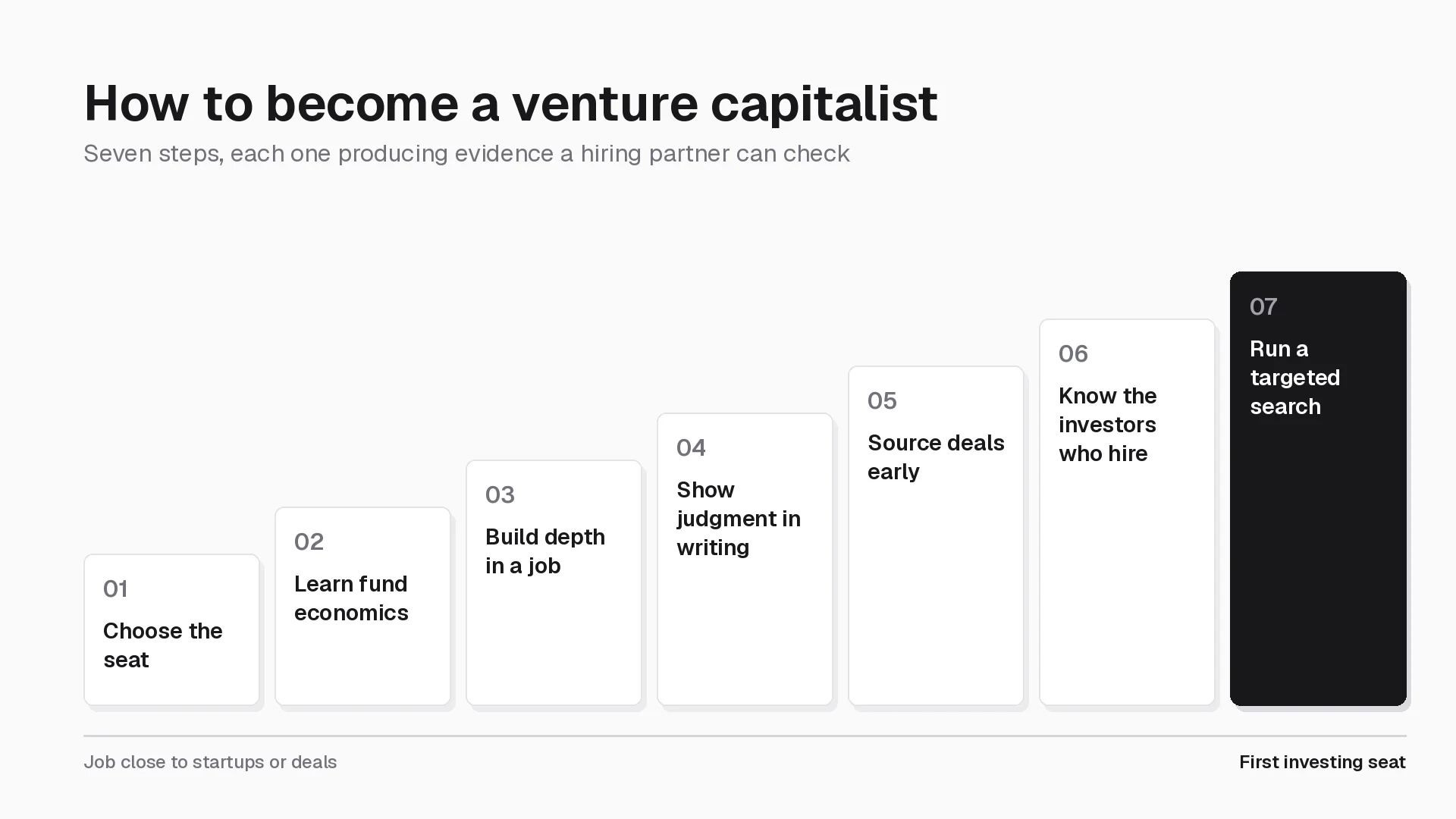
How to become a venture capitalist in seven steps: choose the seat, build depth, prove judgment in writing, source early, and run a targeted search. Includes entry paths by background, how fund size limits hiring, MBA placement data, and licensing.
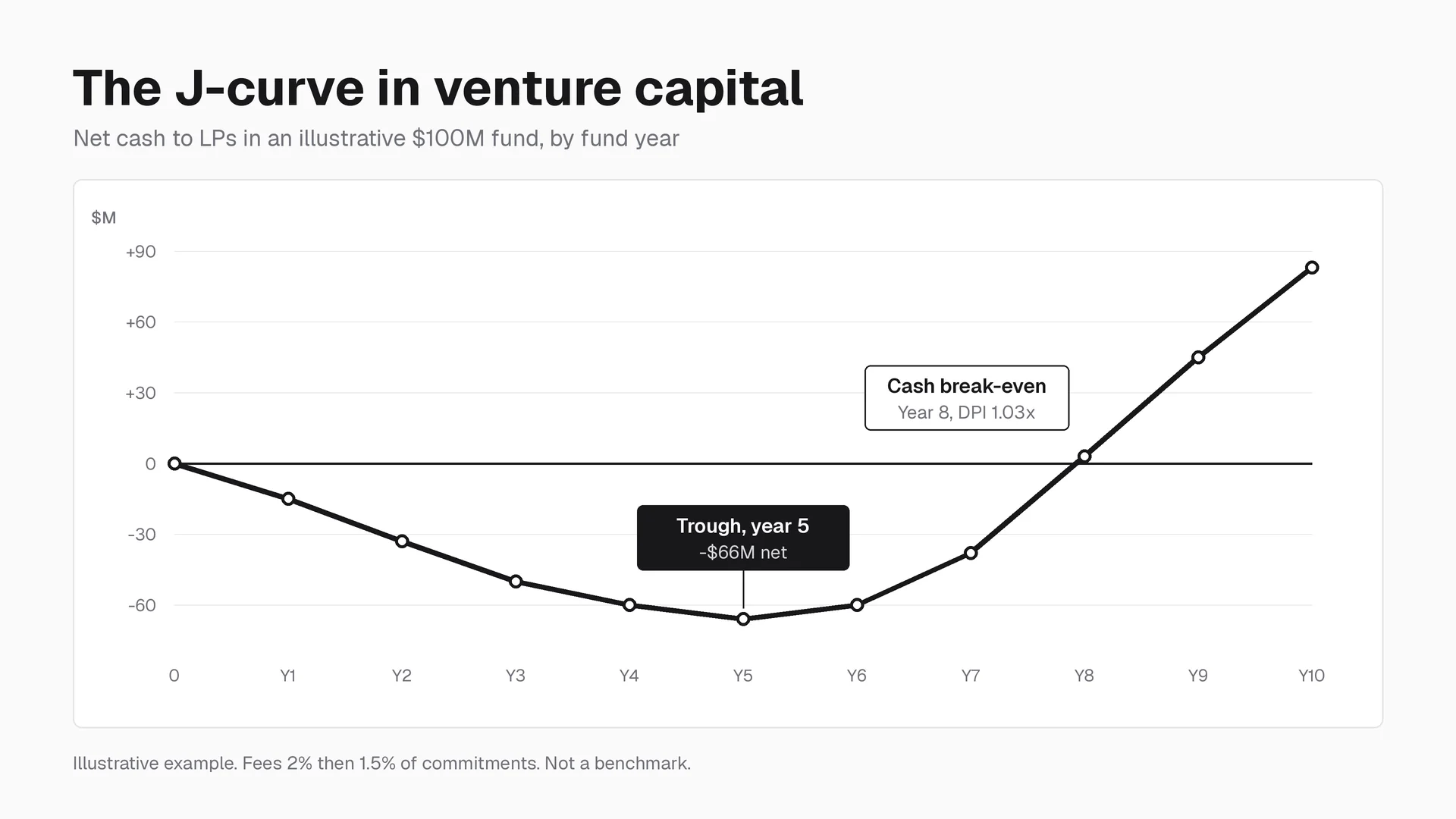
The J-curve in venture capital explained with a worked $100M fund example, current vintage data on DPI and IRR, a check for telling a normal trough from a weak fund, and what the curve means for VC carry, offers, and interviews.