
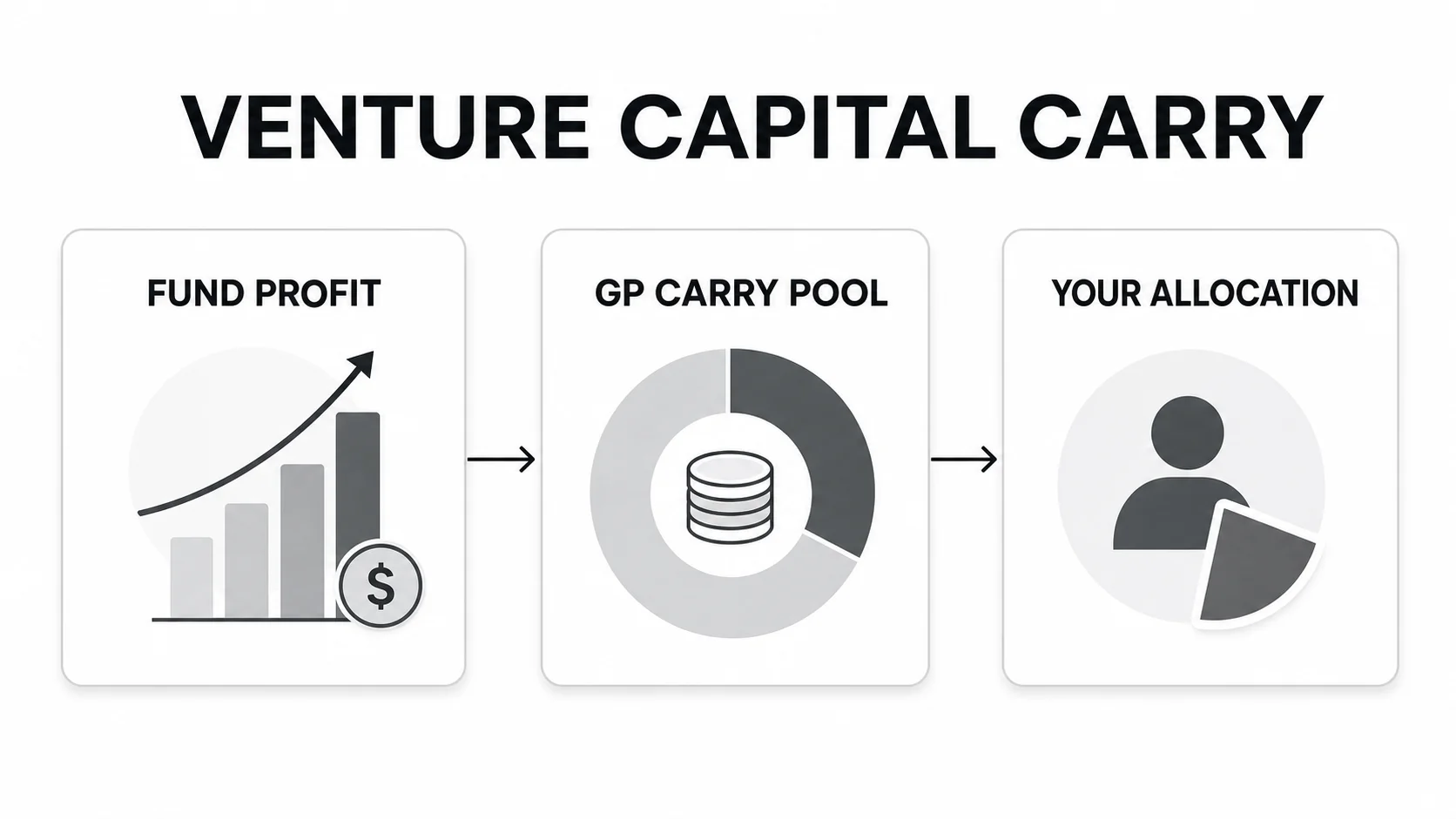
Venture capital carry, or carried interest, is the share of a fund's investment profits allocated to the general partner. It is performance-based, long-dated, and uncertain. For a VC employee, the important number is not just the fund's headline carry rate. It is the employee's share of that carry pool, attached to a specific fund or deal, multiplied by what vests and what the fund eventually realizes.
That distinction prevents the most common compensation mistake. “The fund charges 20% carry” does not mean an associate receives 20% of profits. It usually means the GP entity may receive 20% of qualifying fund profits. The team then divides that pool according to separate agreements.
What venture capital carry is—and what it is not
Carry rewards realized investment performance. Limited partners, or LPs, provide most of a fund's capital. The general partner, or GP, manages the fund and receives the contractual share of profits defined in the limited partnership agreement. A 20% headline rate remains a common starting point, but fund terms vary; Cooley's 2026 market primer notes that premium rates and different waterfall structures also exist.
Carry is separate from the annual management fee used to operate the firm. It is also separate from the return a partner earns on money personally invested through the GP commitment.
| Component | What it pays for | When it becomes cash | Main risk |
|---|---|---|---|
| Base salary | Current work and role scope | Regular payroll | Employment risk |
| Bonus | Annual or periodic performance | After the performance period | Discretion and firm policy |
| Carry | A contractual share of fund or deal profits | After realizations and waterfall conditions | Performance, time, vesting, and contract terms |
| Startup equity | Ownership in one operating company | Sale, tender, dividend, or public-market liquidity | Company concentration and dilution |
| GP capital return | Return on a person's own fund contribution | Fund distributions | Capital at risk |
“Two and twenty” is useful shorthand for a 2% management fee and 20% carry. It is not a complete description of an actual fund. The agreement still has to define the fee base, carry calculation, waterfall, hurdle or preferred return if any, catch-up, recycling, reserves, clawback, and who participates in the GP pool.
For an employee, four states must stay separate:
- Quoted: the allocation described in an offer or compensation conversation.
- Granted: the allocation documented in the relevant carry vehicle or agreement.
- Vested: the portion retained under the vesting and departure terms.
- Distributed: cash or securities actually delivered after the fund's waterfall permits payment.
A quoted percentage can look impressive while producing no cash. The fund may never generate qualifying profits, the allocation may never be formally granted, the employee may leave before vesting, or the investments may remain unrealized for years.
How carry works at the fund level
The cleanest starting point is a simplified whole-fund example. Assume a $100 million fund eventually distributes $200 million after investments and fund expenses. Ignore any preferred return, catch-up, escrow, tax, and special allocation terms for the moment.
| Step | Calculation | Amount |
|---|---|---|
| Total distributions | Realized proceeds returned by the portfolio | $200 million |
| Return of contributed capital | Capital returned to LPs first | $100 million |
| Simplified fund profit | $200 million − $100 million | $100 million |
| GP carry pool at 20% | $100 million × 20% | $20 million |
| LP share of profit | $100 million × 80% | $80 million |
The $20 million is the GP carry pool. It is not one person's compensation. It may be divided among founders, partners, principals, associates, venture partners, operating partners, and other participants under a separate GP or carry plan.
Real fund math can differ in several ways:
- Whole-fund or European waterfall: the GP generally waits until the required capital and other agreed amounts have been returned across the fund before taking carry.
- Deal-by-deal or American waterfall: the GP may receive carry following qualifying individual realizations, usually with protections against over-distribution.
- Hurdle or preferred return: some funds require an additional return to LPs before carry begins. This is common in some private-market strategies but should never be assumed for a particular VC fund.
- Catch-up: after a hurdle, a larger share of the next distributions may go to the GP until the agreed overall profit split is reached.
- Clawback: if early carry distributions prove too high after later losses, recipients may have to return money.
- Reserves or escrow: some potential carry is held back against taxes, expenses, or future clawback exposure.
These mechanics explain why the fund's reported value does not automatically create a carry cheque. A private-company markup can increase NAV and TVPI while producing no distributable cash. Carry depends on the governing agreement and realized distributions, not a press release about valuation.
Readers who need the legal and operating context should start with how venture capital fund structure works. To separate cash returned from remaining paper value, use the VC fund performance metrics framework, especially DPI and RVPI.
What an employee carry allocation actually means
Every carry quote needs a denominator. “One percent carry” could mean 1% of the GP's carry pool, 1 percentage point of the fund's profits, 1% of one deal's carry, or an informal estimate that has not yet become a legal grant. Those are radically different economics.
For a common carry-pool allocation, the simplified formula is:
Personal gross carry = fund profit × headline carry rate × personal share of carry pool × vested share
Using the $100 million profit and $20 million GP carry pool above:
| Personal share of GP carry pool | Fully vested gross allocation | Equivalent share of fund profit |
|---|---|---|
| 0.25% | $50,000 | 0.05% |
| 1% | $200,000 | 0.20% |
| 5% | $1,000,000 | 1.00% |
These are synthetic calculations, not salary benchmarks or expected outcomes. They assume the fund realizes $100 million of qualifying profit, the headline carry rate is 20%, the quoted percentage is a share of the GP pool, and the grant is fully vested. Taxes, clawback reserves, dilution, reallocation, expenses, and timing can reduce or delay what the person receives.
Now change only vesting. If the 1% allocation is 40% vested when employment ends, the simplified gross amount falls from $200,000 to $80,000. If the agreement cancels even vested carry after a defined bad-leaver event, the practical value can be lower still.
The scope question matters as much as the percentage
Ask what the allocation covers:
- One named fund vintage or every new fund raised during employment.
- Existing investments, only investments made after the start date, or only personally sourced deals.
- The whole GP carry pool or a smaller employee pool carved out of it.
- Gross carry before internal costs and clawback reserves or a net amount after them.
- A fixed percentage or a discretionary allocation the partnership can change.
An allocation in a young fund can provide more years of potential vesting and investment exposure, but cash may be far away. An allocation in an older fund may be closer to realizations, but much of the value may already be attributed to work done before the employee arrived. Neither is automatically better.
There is no reliable universal percentage by title
Public discussions often quote associate, principal, or partner ranges without defining the denominator, fund size, geography, vintage, vesting, or whether the number is deal-specific. That makes the ranges look more comparable than they are.
A smaller percentage of a credible, mature portfolio can be more valuable than a large percentage of a pool that never generates profits. Normalize the mechanics before debating whether the percentage is “market.”
When carry turns into cash
Carry can be economically real long before it is liquid. A typical venture fund spends years investing, supporting companies, and waiting for acquisitions, secondary sales, tender offers, dividends, or public-market exits. Even then, the waterfall may delay the GP's distribution.
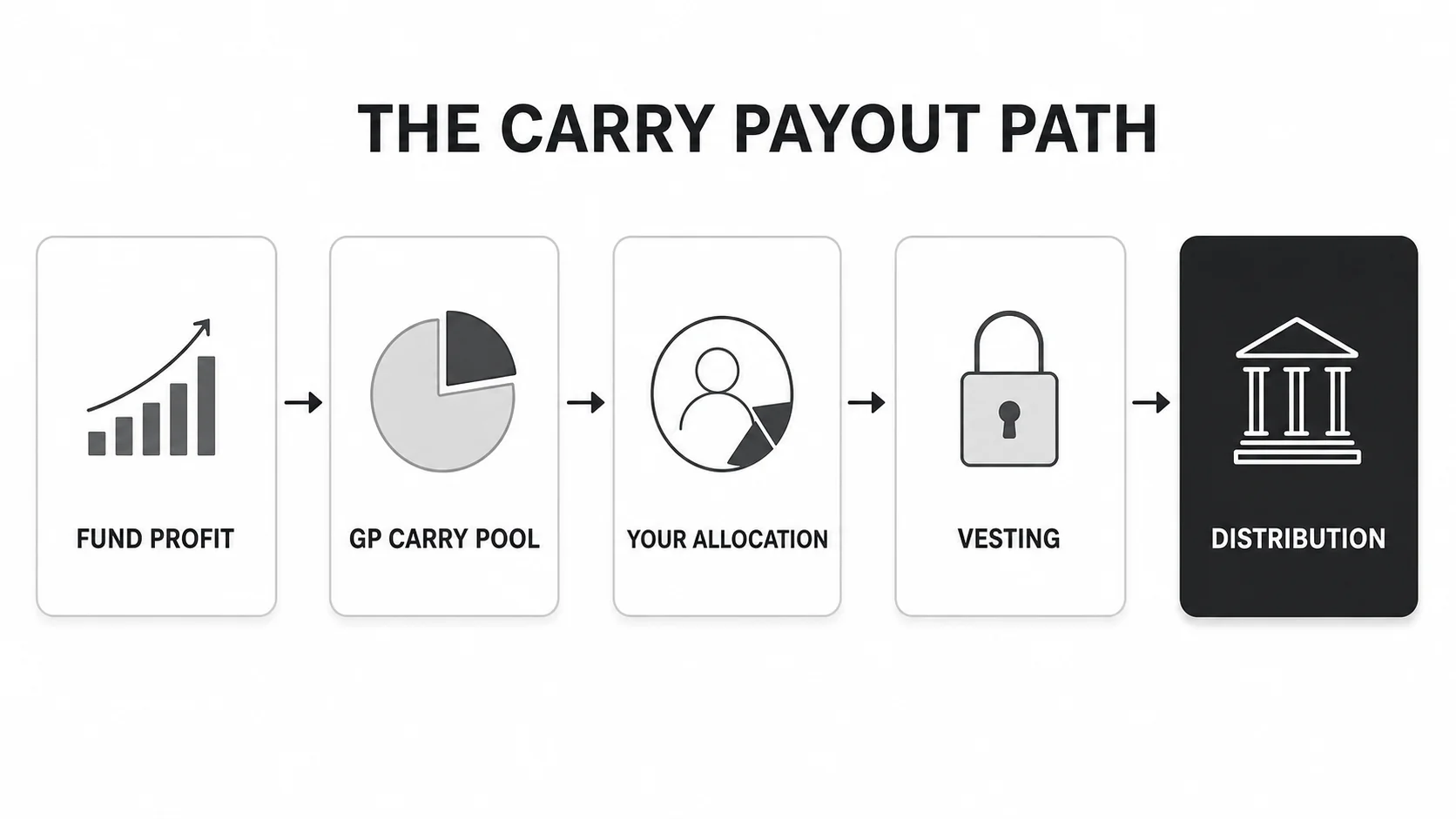
The payout path has five separate gates:
1. Fund profit: investments must produce qualifying realized gains. 2. GP carry pool: the LPA applies the carry rate and waterfall. 3. Personal allocation: the internal carry agreement assigns a share to the employee. 4. Vesting: only the vested portion is normally protected, subject to departure terms. 5. Distribution: reserves, escrow, tax withholding, and clawback rules determine what is delivered.
This is why carry should not fill a household budget gap created by a lower base salary. A fund can show strong unrealized value while distributing little cash. A young fund can take most of a decade to produce meaningful realizations, and even successful exits may be concentrated in a small number of companies.
Whole-fund and deal-by-deal timing
In a whole-fund waterfall, LPs typically receive the agreed return of capital and other priority distributions across the portfolio before the GP receives carry. In a deal-by-deal structure, an early successful exit may generate carry sooner. The tradeoff is more over-distribution risk, which makes clawback, escrow, NAV tests, and reserves more important.
Cooley's 2026 primer reports that whole-fund waterfalls were used by most funds in its reviewed sample and describes them as especially prevalent in venture capital. Treat that as current market context, not a substitute for reading the actual LPA.
Paper value is not a distribution
When reviewing the fund, separate:
- DPI: capital already distributed relative to paid-in capital.
- RVPI: remaining reported value relative to paid-in capital.
- TVPI: the combination of distributed and remaining value.
A high TVPI driven mostly by RVPI may support the possibility of future carry, but it does not answer when, at what price, or under which waterfall the value becomes distributable. Ask for realized proceeds, remaining cost and value, concentration, exit timing, and the carry vehicle's reporting cadence.
How vesting and departure terms change the value
A carry allocation can vest over time, by investment milestone, by fund milestone, or through a hybrid. The schedule may start on the employment date, the fund's first close, the grant date, or another date. A one-year cliff followed by monthly or quarterly vesting behaves differently from straight-line vesting that begins immediately.
The grant document should answer at least these departure cases:
| Event | Terms to check |
|---|---|
| Voluntary resignation | Does vesting stop, and is vested carry retained? |
| Termination without cause | Is there acceleration, continued vesting, or only retained vested carry? |
| Termination for cause | Can vested and unvested carry be forfeited, and how is cause defined? |
| Retirement or approved transition | Can vesting continue for board or portfolio support? |
| Death or disability | Does vesting accelerate, and who receives future distributions? |
| Joining a competitor | Is there a forfeiture, repurchase, or non-compete consequence? |
Do not rely on the phrase “you keep what is vested” until the agreement confirms it. Some plans distinguish ordinary vested ownership from later forfeiture events, repurchase rights, clawback obligations, or conditions for receiving future distributions.
Also ask who bears a clawback after departure. A former employee may receive an early carry distribution and still remain responsible for returning part of it if later fund losses create an overpayment. The agreement should explain allocation of that liability, reserves, tax treatment, and how the firm communicates future obligations.
Fund vintage and promotion can create separate vesting clocks
A person may hold different percentages in Fund I, Fund II, and Fund III, each with its own start date, economics, and performance. Promotion does not always increase the old-vintage allocation. It may only improve participation in the next fund.
That makes a carry schedule closer to a portfolio of contingent claims than a single bonus account. Keep a simple register with the fund, vehicle, headline rate, personal denominator, grant date, vesting schedule, vested amount, performance basis, distributions, reserves, and departure terms.
How to evaluate carry in a VC offer
Start with cash. The base salary and realistic bonus should make the role financially workable without a carry distribution. Then evaluate carry as contingent upside and as evidence of whether the firm treats the role as part of the long-term investing team.
Use these questions to normalize the quote:
| Question | Why it matters |
|---|---|
| Is the percentage a share of fund profits or of the GP carry pool? | Establishes the denominator. |
| Which fund, vintage, deals, or carry vehicle does it cover? | Defines the economic scope. |
| Is the grant fixed, discretionary, or subject to reallocation? | Tests whether the headline can change. |
| What is the headline carry rate and waterfall? | Determines the size and timing of the pool. |
| Is there a hurdle, catch-up, escrow, reserve, or clawback? | Identifies conditions before and after payment. |
| When does vesting begin, and is there a cliff? | Sets the earned timeline. |
| What happens under each departure scenario? | Tests whether vested carry is genuinely durable. |
| Does the grant include investments made before the start date? | Clarifies exposure to the existing portfolio. |
| How will participation change in the next fund or after promotion? | Reveals whether economics can compound across vintages. |
| Is a GP commitment required from the employee? | Separates sweat-equity carry from capital at risk. |
| How often will the firm report vested allocation and fund performance? | Determines whether the employee can monitor the asset. |
| Who handles tax distributions and post-departure clawback obligations? | Surfaces cash-flow and liability risk. |
If the firm cannot provide a formal agreement during the offer process, ask for a redacted plan document, a written term summary, and a deadline for the grant. An oral percentage without a vehicle, denominator, vesting schedule, or approval process is not equivalent to documented carry.
Use scenarios, not one heroic forecast
Assume a fully vested 1% share of a 20% GP carry pool. The table below varies only realized fund profit. It is a decision aid, not a valuation.
| Synthetic outcome | Realized qualifying fund profit | GP carry pool | Personal gross allocation |
|---|---|---|---|
| No carry | $0 | $0 | $0 |
| Moderate outcome | $50 million | $10 million | $100,000 |
| Strong outcome | $200 million | $40 million | $400,000 |
Then stress the result:
- Apply the actual vested percentage.
- Delay the cash to a plausible distribution year.
- Subtract any reserve or escrow.
- Consider the probability that paper value becomes realized profit.
- Keep tax outside the model unless a qualified adviser has reviewed the facts.
Compare the whole role
Carry cannot repair a seat with weak learning, unclear decision rights, poor fund quality, or no promotion path. Compare:
- dependable cash compensation;
- investment ownership and quality of mentorship;
- fund strategy, portfolio, reserves, and ability to raise the next vintage;
- sourcing, diligence, board, and portfolio exposure;
- promotion criteria and future-vintage participation;
- documented carry terms after normalization.
The Venture Capital Salary Guide helps separate base, bonus, and long-term economics. The VC career path explains how responsibility changes by level. Use the Venture Capital Careers job board to compare current roles and the companies directory to research each fund before interviews.
Common carry mistakes
Treating 20% as a personal allocation
The headline rate usually defines the GP's share of qualifying fund profits. A team member's grant is commonly a much smaller share of that pool. Always name both percentages and both denominators.
Counting unrealized value as cash
A portfolio markup can support TVPI while DPI remains low. Carry normally depends on realized distributions and the waterfall. Ask what has exited, not just what has been marked up.
Comparing percentages without scope
One percent of the full carry pool across a fund is different from 1% of an employee sub-pool or a share of carry from one deal. Fund size alone does not solve the comparison; performance, vintage, and terms still matter.
Ignoring the vesting start and departure rules
Two grants with the same percentage and vesting length can produce different outcomes if one starts at fund close and the other starts at grant date, or if one preserves vested carry after resignation and the other has broader forfeiture provisions.
Trading guaranteed cash for a single upside forecast
Carry is not an annual bonus. Use a zero-carry scenario, discount long-dated outcomes in your own decision process, and make sure the cash package works independently.
Assuming the tax result
US carried-interest taxation is fact-specific. IRS Section 1061 guidance generally requires a capital asset to be held for more than three years for certain gains tied to an applicable partnership interest to receive long-term treatment. Exceptions, recharacterization, state tax, the carry vehicle, and individual facts can change the outcome. Get qualified tax advice rather than treating a headline rate as take-home pay.
Frequently asked questions
What does 20% carry mean?
In a simplified example, it means the GP receives 20% of qualifying fund profits after the distribution priorities in the LPA are satisfied. It does not mean every employee receives 20%. Employees may receive a separate percentage of the GP carry pool.
How much carry do VC associates receive?
There is no reliable universal percentage. Public figures often mix percentages of fund profits, percentages of the GP pool, deal carry, different fund sizes, and different vesting schedules. Ask for the denominator, fund vintage, scope, vesting, and departure terms before comparing an allocation.
Is carry paid every year?
Usually not like salary or an annual bonus. Venture funds may take years to realize investments. Carry distributions depend on exits, the fund's waterfall, reserves, and the participant's grant terms.
What happens to vested carry after leaving a VC firm?
It depends on the agreement. Some plans let a former employee retain vested carry while unvested carry stops. Others include repurchase, forfeiture, competition, cause, or clawback provisions that can affect even previously vested or distributed amounts.
Is carry the same as startup equity?
No. Startup equity is ownership in one operating company. Carry is a contractual share of profits from a fund or specified investments. Both are uncertain and illiquid, but their legal structures, diversification, vesting, and payout triggers differ.
How is carried interest taxed in the United States?
Tax treatment depends on the carry vehicle, holding periods, underlying gains, jurisdiction, and the recipient's facts. Section 1061 can recharacterize certain gains when its more-than-three-year rule is not met. A fund employee should obtain advice from a qualified tax professional before valuing after-tax carry.
A carry percentage is the start of the analysis
The useful question is not “How much carry did they offer?” It is “What exactly participates in which profits, under which vesting and departure terms, and when could it become cash?”
Normalize the denominator, vintage, waterfall, vesting, and distribution timing. Make the cash package work without carry. Then use the upside to compare long-term alignment—not to manufacture certainty where none exists.
Browse current roles on Venture Capital Careers and use the checklist above to compare the economics behind similar titles at different funds.
Related posts
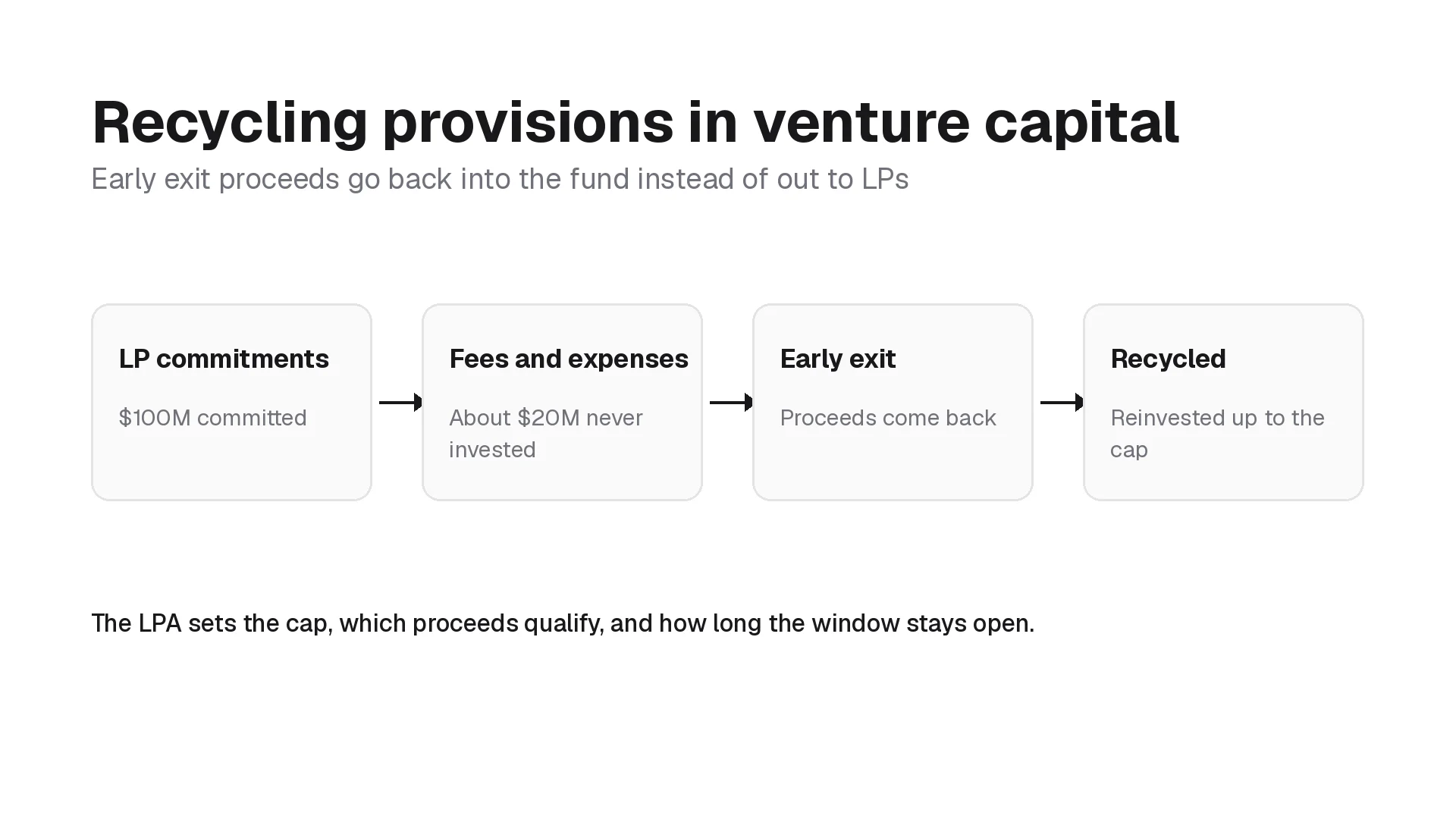
A recycling provision lets a VC fund reinvest early exit proceeds instead of distributing them. Here are the standard LPA terms, a worked example with the 1.0x break-even, the effect on DPI and IRR, and who handles recycling inside a firm.
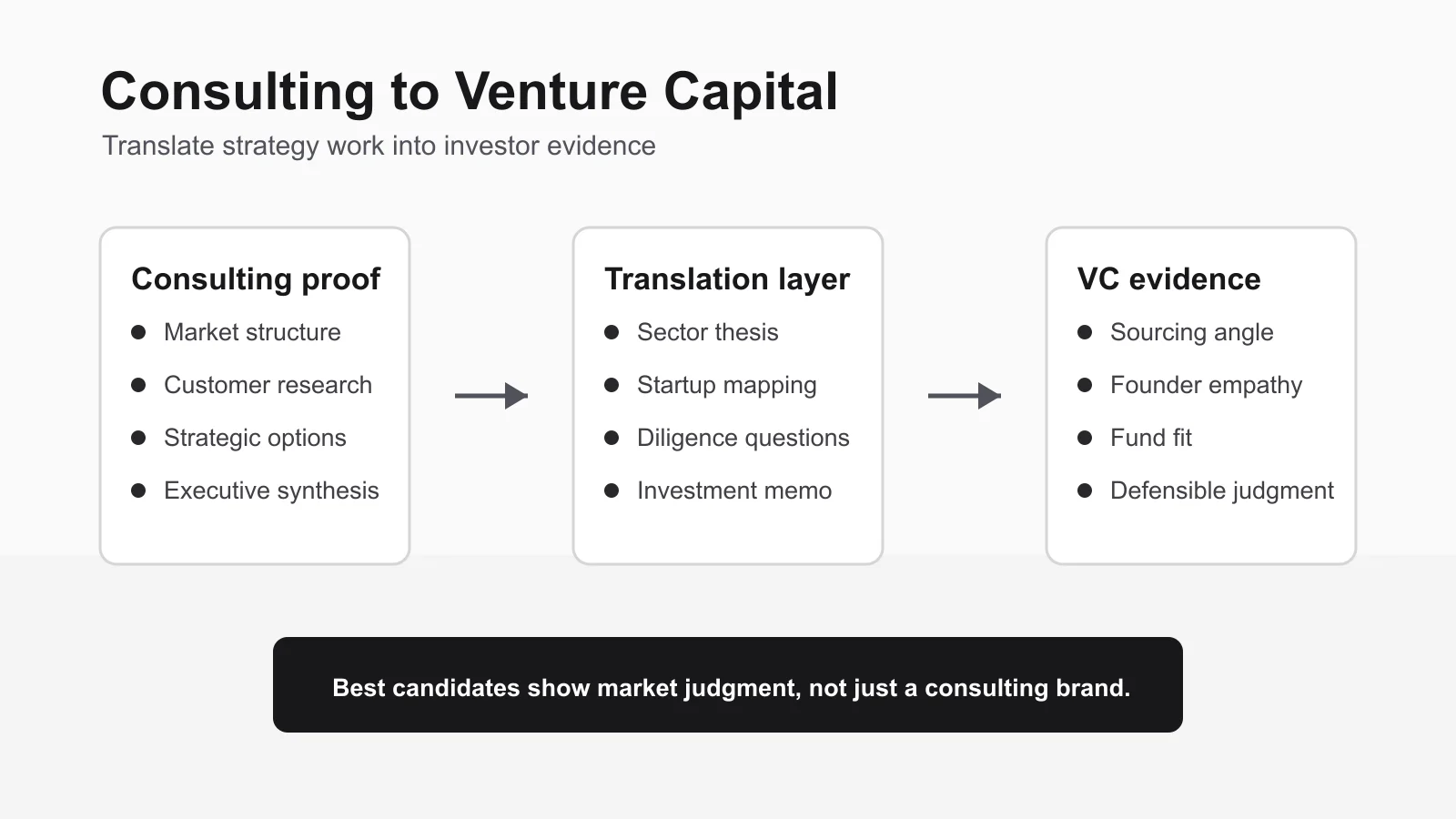
How consultants move into venture capital: four realistic paths, which funds hire consultants, pay trade-offs, timing, what to staff on before leaving, project-to-evidence worksheet, resume, and interview process.
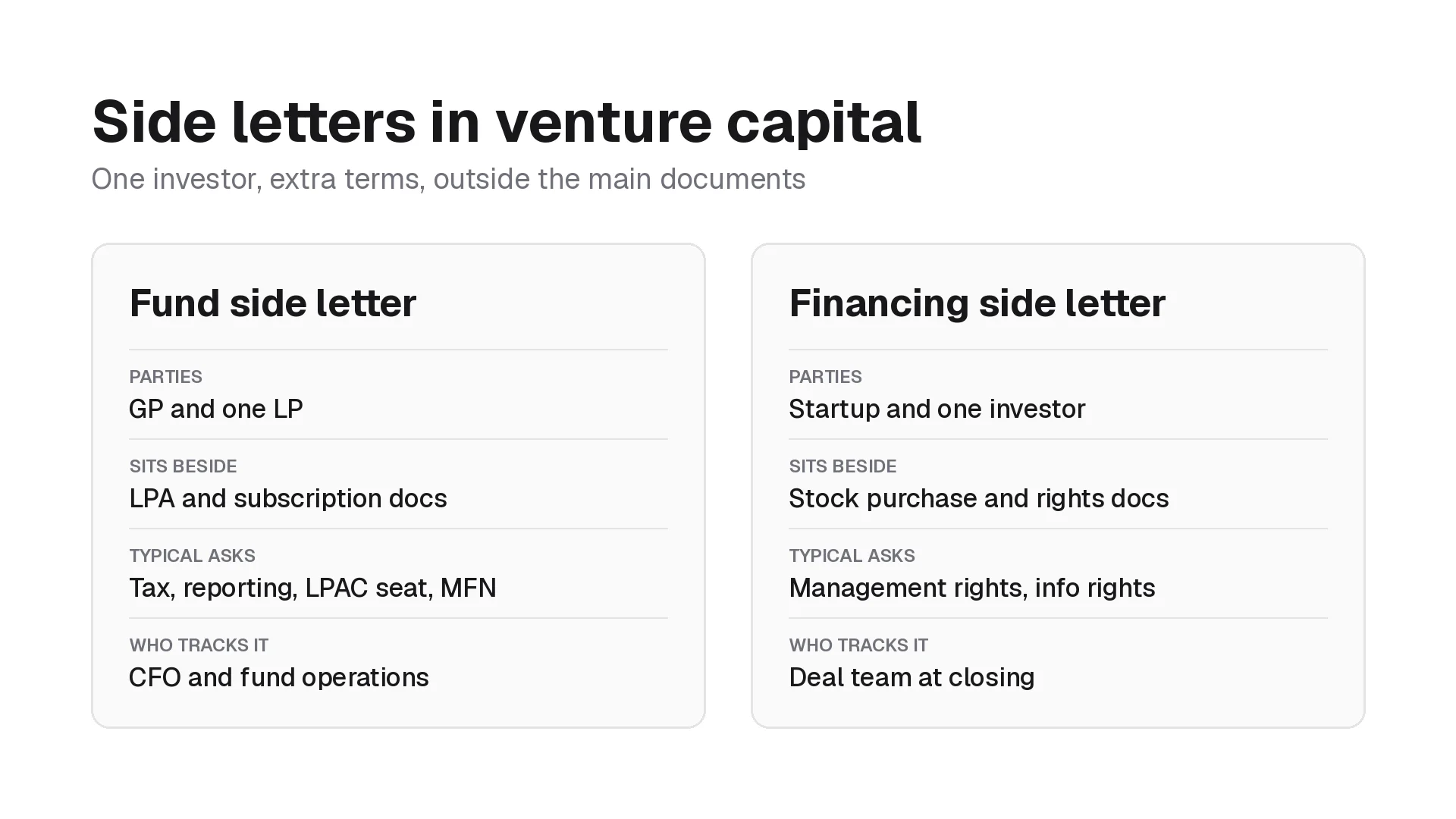
A side letter gives one investor terms the main documents don't give everyone else. Here is how fund and startup side letters differ, how MFN elections and management rights letters work, and who handles side letters inside a VC firm.