
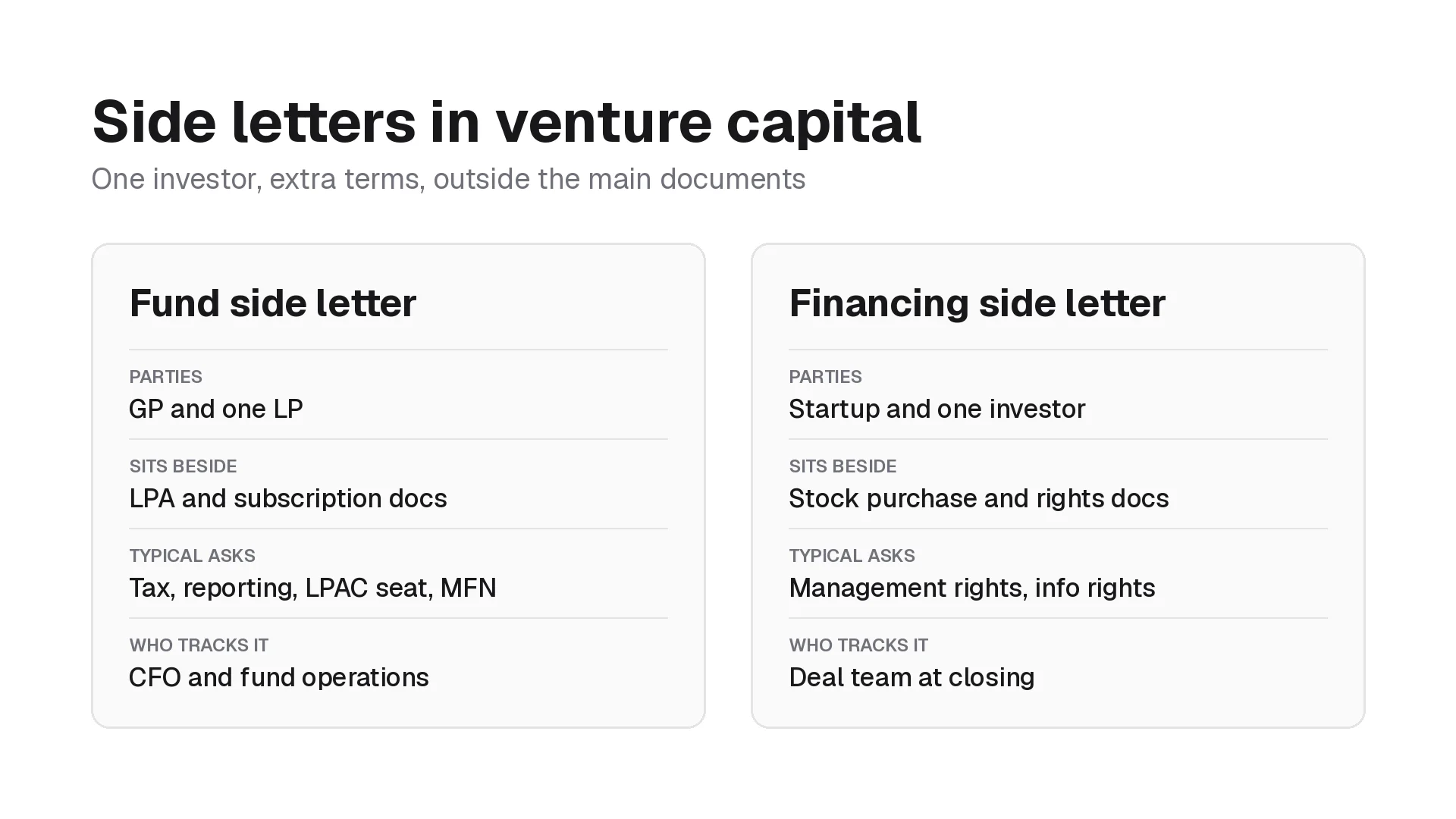
A side letter is a separate agreement that gives one investor rights, or carve-outs, that the main deal documents don't give everyone else. In venture capital it shows up in two places. A fund signs side letters with individual limited partners (LPs) on top of the limited partnership agreement (LPA). A startup signs side letters with individual investors on top of the financing documents. The name is the same, but the parties and the risks are not.
If you work at a VC firm, you will touch both. Associates chase management rights letters at closings. Fund finance and operations teams track every LP side letter for the life of the fund. Interviewers ask about them because they test whether you understand how a fund actually runs.
What a side letter is
A side letter supplements a main agreement for one party. It does not replace the main agreement, and it usually binds only the people who sign it.
| Fund side letter | Financing side letter | |
|---|---|---|
| Parties | The fund or its general partner (GP) and one LP | The startup and one investor |
| Main document it sits beside | LPA and subscription documents | Stock purchase agreement, investors' rights agreement, voting agreement, ROFR and co-sale agreement, or a SAFE |
| Typical asks | Reporting, tax and regulatory accommodations, advisory committee seat, fee terms, co-investment, transfer rights, MFN | Management rights, information rights, major investor status, participation rights, board observer seat |
| Who drafts it | Fund counsel, with the GP and CFO | Company counsel, with the lead investor's deal team watching |
| Why it matters later | Ongoing compliance for 10+ years | Can survive into the next round and block amendments |
The fund version exists because LPs are not alike. A public pension, a university endowment, a sovereign wealth fund and a family office may accept the same fee and carry but need different legal, tax and disclosure language. Writing all of that into the LPA would bury every LP in terms that apply to one. The side letter keeps the LPA common and handles the exceptions.
The financing version started as a practical shortcut. When a round has a second closing, the company can give a late investor a right through a side letter instead of reopening and re-signing the whole document set.
What LPs ask for in fund side letters
Most fund side letter requests fall into a few buckets.
- Regulatory and tax. ERISA plan language, UBTI and ECI reporting for tax-exempt and non-US investors, sovereign immunity language, public records and FOIA accommodations, sanctions and CFIUS limits.
- Reporting and information. Extra or more detailed reports, the right to share fund information with a fund-of-funds' own investors, specific fee and expense reporting.
- Governance. A seat or observer role on the limited partner advisory committee (LPAC), notice of key person events or GP changes, consultation rights.
- Economics. Reduced management fee or carry for an anchor or very large commitment, co-investment rights, faster distributions. These are the asks that make other LPs nervous.
- Exclusions and transfers. The right to be excused from certain investments, such as tobacco, weapons or a specific country, and easier transfers to affiliates.
- Administration. Most favored nation (MFN) rights, aggregation of related entities' commitments, and confidentiality of the side letter itself.
The first two buckets are routine. A fund with institutional LPs signs them every close. The economic bucket is where a side letter stops being paperwork and starts changing the deal, which is why it tends to come with disclosure and MFN questions.
How most favored nation (MFN) clauses work
An MFN clause lets an LP elect better terms that the GP gave other LPs in their side letters. It is the main check on secret preferential treatment.
MFNs are almost always limited in four ways.
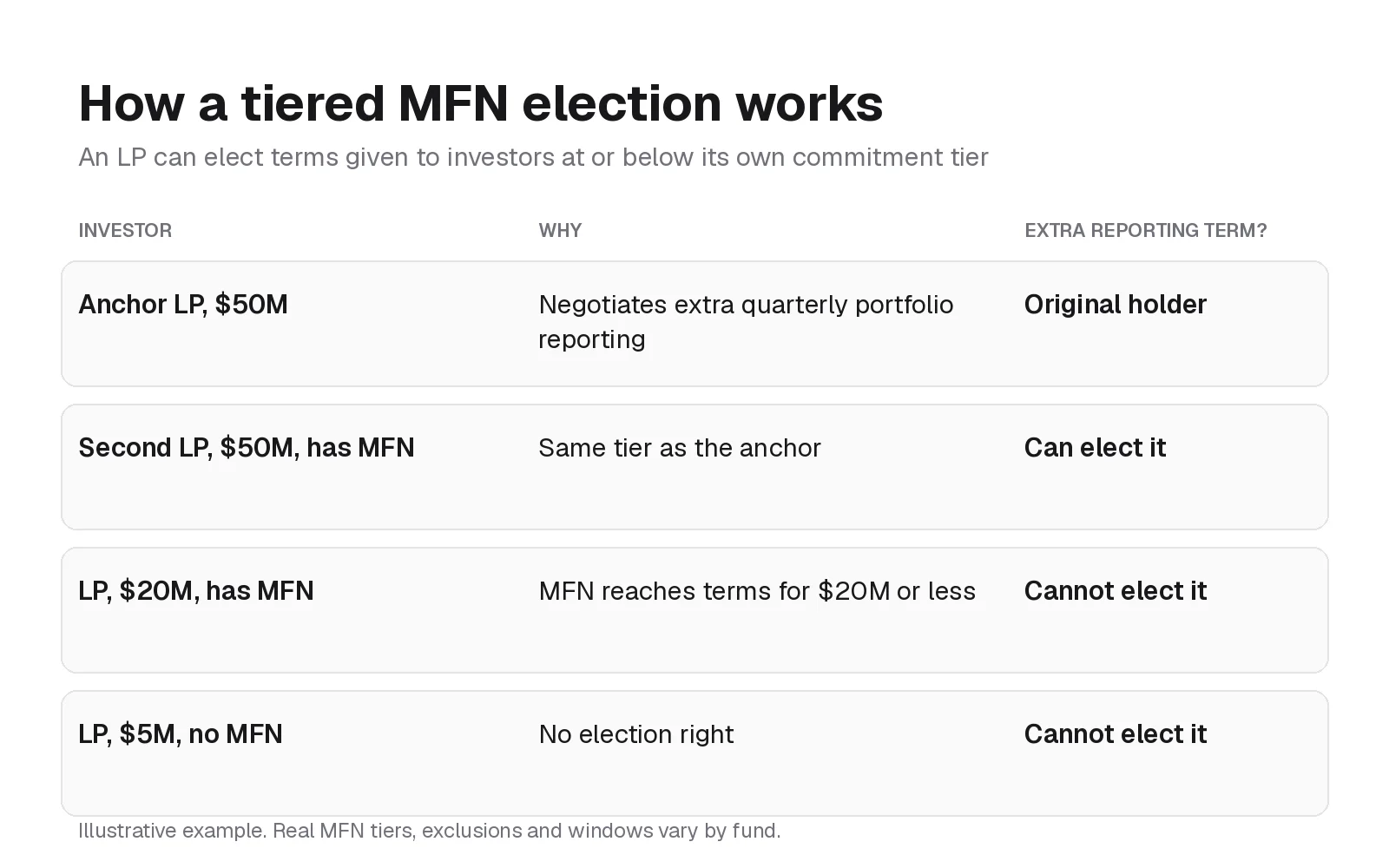
- Who gets one. Often only LPs above a commitment size, or tiered so an LP can elect terms given to investors with the same or smaller commitment, never larger ones.
- Aggregation. Whether related entities, such as several vehicles run by one fund-of-funds, count as one commitment for the threshold.
- What is electable. LPAC seats, commitment-based fee breaks, co-investment rights and status-specific terms like sovereign immunity are usually excluded.
- Process and burdens. After the final close, counsel circulates an MFN disclosure package with provisions grouped by commitment tier. LPs get a fixed window to elect, often 30 days, and an LP that takes a benefit should also take any obligation attached to it.
Here is a simple example. An anchor LP commits $50 million and negotiates extra quarterly portfolio reporting. A $20 million LP with an MFN cannot elect that term if the MFN only reaches provisions given to commitments of $20 million or less. A second $50 million LP with an MFN can elect it.
Side letters in startup financings
In a priced round, most investor rights live in the standard documents. Many US deals start from the NVCA model legal documents. A side letter adds rights for one investor outside that set.
Common financing side letter asks:
- Management rights. The right to consult with management, inspect books and records, and receive board materials if the investor has no board seat.
- Information rights below the threshold. Financial statements for an investor who doesn't meet the major investor ownership cutoff.
- Major investor status. The rights of a major investor without investing enough to qualify.
- Participation rights. The right to buy into the next round, which links to pro rata rights.
- Board observer seat. Attendance without a vote. See board observer rights.
- Carve-outs. Exceptions from a right of first refusal, drag-along or another term in the main documents.
The risk is in how amendments work. Rights in the main documents can usually be waived by a set majority of investors. Rights in a side letter can only be changed by the two people who signed it. One small investor can end up with a personal veto the rest of the cap table never agreed to. Lawyers sort requests into three groups:
| Type of request | Example | Effect on other investors |
|---|---|---|
| Rights others already have that don't touch anyone else | Standard information rights, observer seat | Usually none beyond admin work |
| Rights others already have that do affect other investors | Major investor status, preemptive rights, drag-along carve-outs | Dilutes or shifts negotiated thresholds |
| New rights nobody else has | A standalone consent right | May need board and investor approval because it can amend the deal |
Management rights letters and ERISA
A management rights letter (MRL) is the side letter VC funds ask for most often. It is routine, and founders sign it almost every time.
The reason sits upstream with the fund's LPs. When pension plans covered by ERISA invest in a VC fund, the fund risks having its assets treated as plan assets, which would put heavy fiduciary duties on the GP for every investment. Funds avoid that by qualifying as a venture capital operating company, which requires real management rights in portfolio companies. A board seat provides them. Where the fund has no board seat, an MRL provides them in writing.
A typical MRL gives three things:
- The right to consult with and advise management on significant business issues.
- The right to inspect books and records at reasonable times.
- If the fund has no board seat, copies of board notices, minutes and materials, often with a carve-out for privileged or conflicted items.
On the deal team, the MRL is a closing-checklist item. If the fund needs one and it isn't signed before money moves, someone will be chasing a founder for a signature after the wire, which is a bad week for the associate who owned the checklist.
How GPs and companies decide whether to grant a request
Every side letter request comes down to the same few questions. GPs ask them about LPs, and companies ask them about investors.
- Does it favor one investor at the expense of others? Lower fees for an anchor may be fine. Faster distributions for one LP can conflict with the distribution waterfall.
- Can we actually operate it? A custom report every month for one LP is a real cost for a three-person finance team.
- Does it trigger MFN elections? A term granted to a mid-sized LP may become available to every LP at that tier or above.
- Does it conflict with the main documents? If so, it may be an amendment in disguise that needs formal approval.
- Will it survive the next round or the next fund? Financing side letters can follow the company into later rounds. Fund side letters sometimes include rights in successor funds.
- How much is this investor worth to us? Leverage is real. A large anchor LP or a strategic investor gets more than a small check.
Who handles side letters inside a VC firm
Side letters are real work inside a fund, and who does it depends on the size of the firm.
| Role | Fund side letters | Financing side letters |
|---|---|---|
| Managing partner or GP | Negotiates the big asks with anchor LPs, decides what to give | Approves any non-standard ask from or to the fund |
| CFO, COO or head of fund operations | Keeps the side letter matrix, runs MFN elections, checks compliance on every capital call, distribution and investment | Confirms the fund's MRL and reporting needs are met |
| Investor relations | Collects LP requests during fundraising, delivers custom reporting | Rarely involved |
| Fund counsel and fund administrator | Drafts letters, prepares the MFN package, tracks elections | Drafts the fund's standard MRL |
| Principal or associate | Usually not involved, except prepping data for LP reporting asks | Owns the closing checklist, gets the MRL signed, flags side letters other investors request |
| Analyst | Rarely involved | Tracks documents in the deal room and post-close reporting |
The side letter matrix is the document to know. It lists each LP, its commitment, its side letter rights, its MFN status, which terms it elected, its reporting and notice obligations, and its excuse and transfer rights. Someone checks it every time the fund calls capital, makes an investment that might hit an excuse right, distributes stock in kind, or starts raising the next fund. At a small fund that someone may be a fund controller or the COO, so it is a core skill for finance and operations hires. See venture capital fund operations and fund accounting for those paths.
What side letters tell you about a firm you might join
You won't see a fund's side letters as a candidate. You can still ask useful questions in later rounds:
- Does the firm have an anchor LP with special terms, such as a fee break or co-investment rights? Co-investment rights often mean extra deal work for the team.
- How many LPs need custom reporting? A finance or IR hire will feel that directly.
- Does the fund have ERISA investors? If yes, MRLs are standard on every deal where the fund has no board seat.
How to answer side letter questions in an interview
A strong short answer covers both kinds and one mechanism:
"A side letter is a separate agreement that gives one investor rights outside the main documents. At the fund level, LPs use them for tax, regulatory and reporting needs, and sometimes economics like a fee break, with MFN clauses letting similar-sized LPs elect the same terms. At the company level, the most common one for a VC fund is the management rights letter, which helps the fund stay a venture capital operating company for its ERISA LPs. The risk at the company level is that a side letter right can only be waived by the person who holds it."
Practice it alongside other venture capital interview questions and the term sheet terms you are expected to know.
Common questions about side letters
Are side letters legal?
Yes. They are standard in both fund formation and venture financings. The legal questions are about authority and disclosure: whether the LPA lets the GP sign them, whether other LPs must be told, and whether a company side letter conflicts with its charter and investor agreements.
Are side letters confidential?
Usually, with limits. Fund side letters are often confidential, but the substance of the terms is shared with other LPs through the MFN process, frequently with names and commitment amounts redacted.
What is the difference between a side letter and the LPA?
The LPA binds every LP and sets the common deal: fees, carry, term, investment period, waterfall and governance. A side letter changes or adds to that deal for one LP. For the roles behind those terms, see limited partner vs general partner and venture capital fund structure.
Do side letters carry over to the next funding round?
Sometimes. Some financing side letters end at the next priced round or an IPO. Others stay in force until amended, which is why lawyers push for an end date.
Next steps
If you want to work where this matters, look at firms with institutional LPs and real fund operations teams. Browse VC firms hiring, see current venture capital jobs, and create a free account to get new roles by email.
Related posts
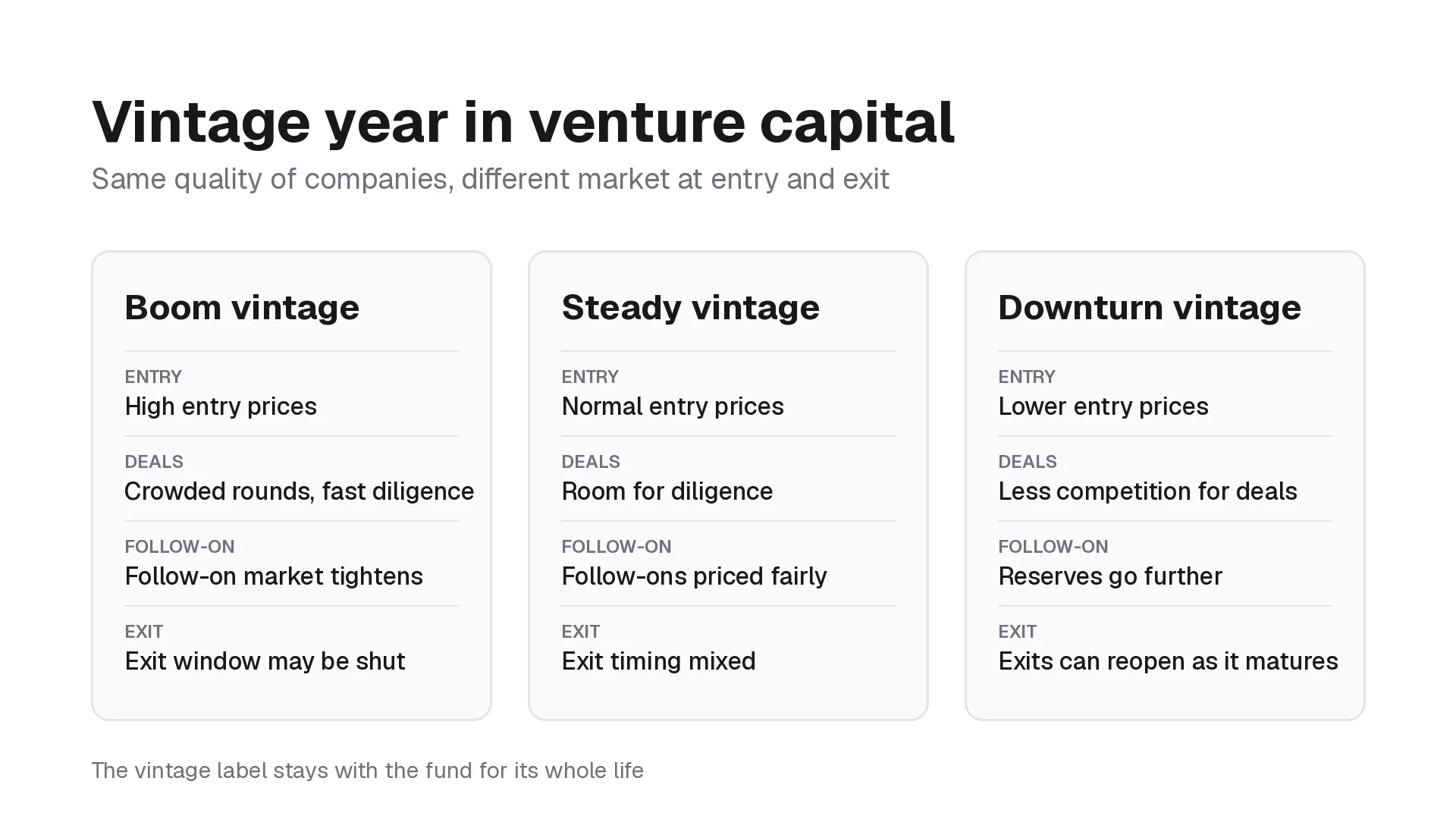
A vintage year is the year a venture fund starts investing, and it decides which funds you can fairly compare. Here is how vintage gets assigned, why it moves returns, and what it means for the job, carry, and interviews at a VC firm.
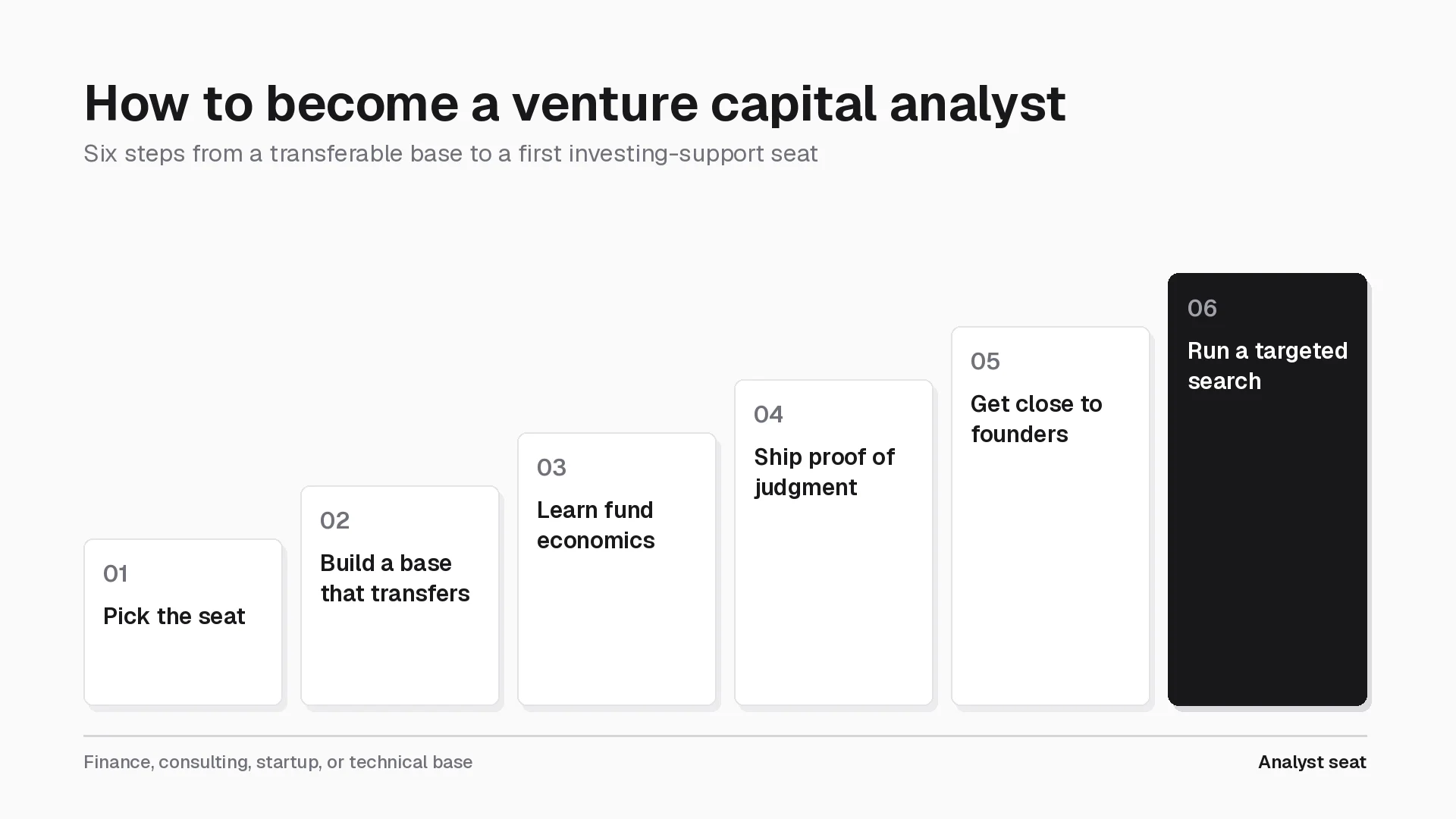
How to become a venture capital analyst in six steps: pick the seat, build a transferable base, ship proof of judgment, and target the firms that still hire analysts. Includes entry routes, interviews, salary, and exit paths.
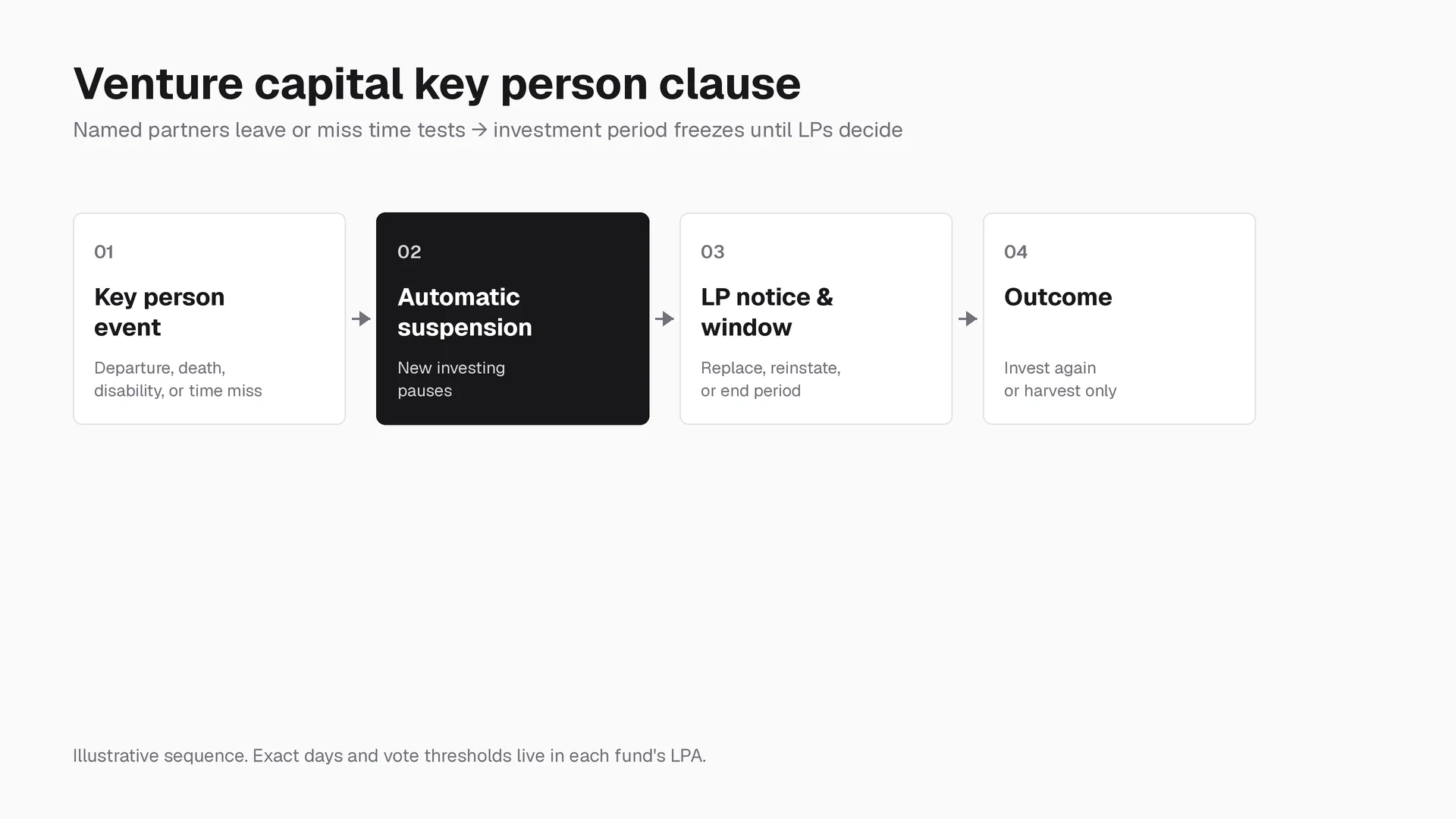
A key person clause names the partners a venture fund depends on and can freeze new investing if they leave. Here is how the trigger works, what still happens during a suspension, and what it means for your job search and seat.