
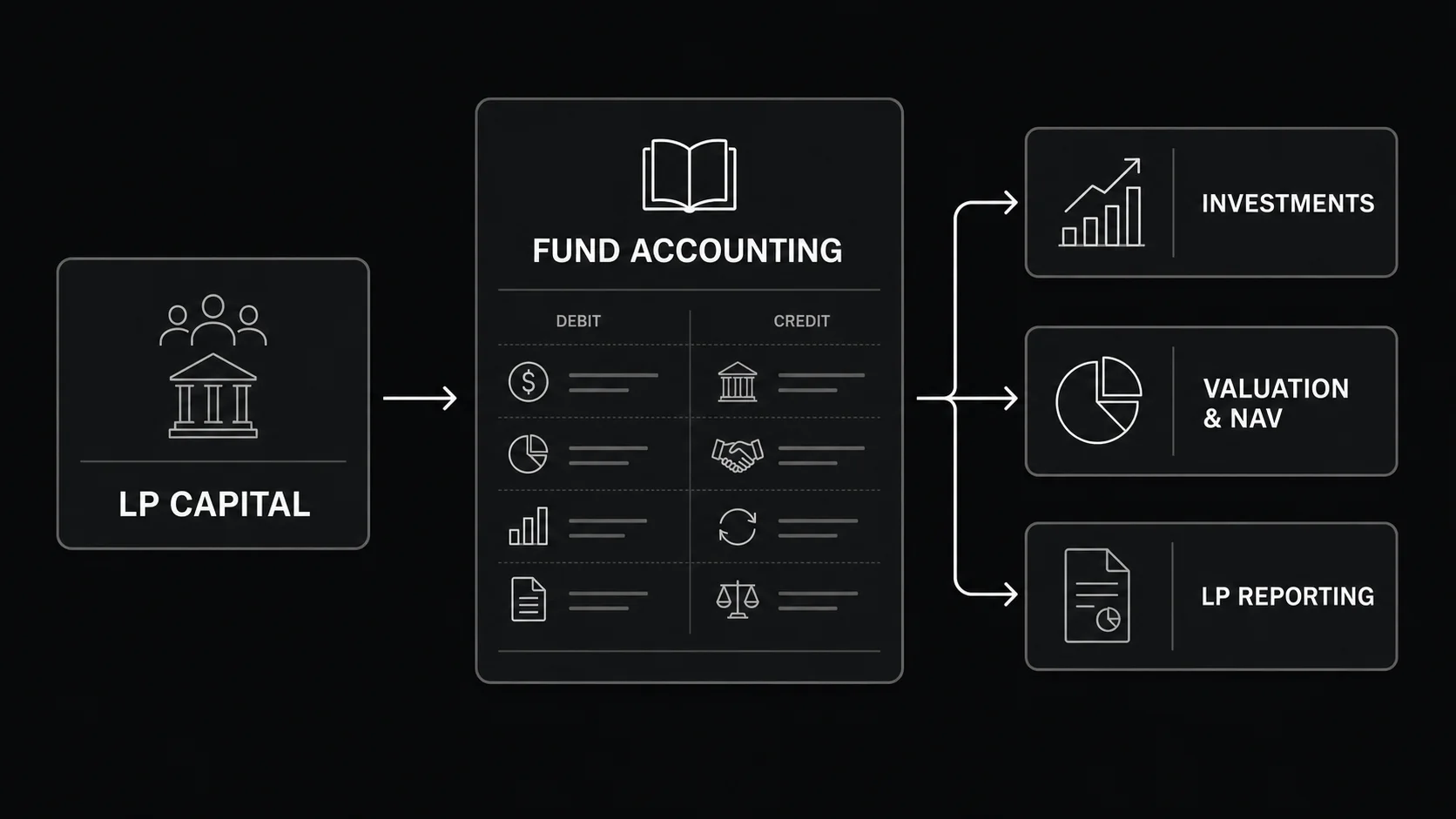
Venture capital fund accounting is the system that records how money moves through a VC fund and how each movement changes the economics of its investors. It tracks LP commitments and capital calls, investment cost and fair value, fees and expenses, NAV, distributions, and each investor's capital account.
That is different from accounting for a startup. A startup accountant records the operations of one company. A fund accountant has to keep several legal entities separate, apply the fund's governing documents, maintain investor-level allocations, and support reporting across investments that may remain private for a decade.
The work is not merely bookkeeping. A clean ledger has to agree with bank activity, legal investment records, the valuation process, investor reports, tax allocations, and the limited partnership agreement (LPA). A fund can outsource much of the processing to an administrator, but it cannot outsource responsibility for getting those records right.
What venture capital fund accounting covers
Most venture firms operate through more than one entity. The venture capital fund structure usually includes a limited partnership that holds investments, a general partner that controls the fund, and a management company that employs the team and receives management fees. Larger firms may add parallel funds, alternative investment vehicles, SPVs, co-investment vehicles, and separate entities for different vintages.
Each entity needs its own books and bank records. A management-company payroll cost should not drift into a fund's investment ledger without a documented allocation. Cash received by an SPV should not be treated as cash belonging to the flagship fund. An expense allowed under one LPA may not be chargeable to another vehicle.
| Question | Corporate accounting | Venture fund accounting |
|---|---|---|
| What is the reporting entity? | One operating company or consolidated group | Fund LP, GP, management company, SPVs, and related vehicles |
| What comes in? | Revenue, financing, and customer cash | LP capital contributions, investment proceeds, interest, dividends, and other fund receipts |
| What goes out? | Payroll, vendors, operating expenses, debt service | Investments, fund expenses, management fees, distributions, and taxes or withholding where applicable |
| What are the core assets? | Cash, receivables, inventory, equipment, and intangibles | Private-company securities, SAFEs, convertible notes, warrants, cash, and receivables |
| Who needs allocations? | Departments, products, or subsidiaries | Every LP capital account and sometimes classes, side-letter arrangements, or vehicles |
| What drives the economics? | Corporate agreements and accounting policy | LPA, side letters, subscription documents, valuation policy, and accounting framework |
| What is the reporting rhythm? | Monthly close and corporate financial statements | Fund close, NAV, capital-account statements, LP reports, audit, and partnership tax reporting |
An LP commitment is not revenue. It is a contractual promise to fund a stated amount when the GP issues valid capital calls. The accountant must track the committed amount, contributions received, distributions made, and remaining unfunded commitment for every investor.
The investment side is equally specific. When a fund buys preferred stock or a SAFE, the accounting records need to agree with wire instructions, closing documents, ownership records, and the portfolio schedule. At each reporting date, the team then needs an approved fair-value conclusion and a clear bridge from cost to current carrying value.
The result is one connected system: legal terms define the economics, investment events create transactions, accounting records the transactions, controls test the records, and reports explain the outcome to LPs.
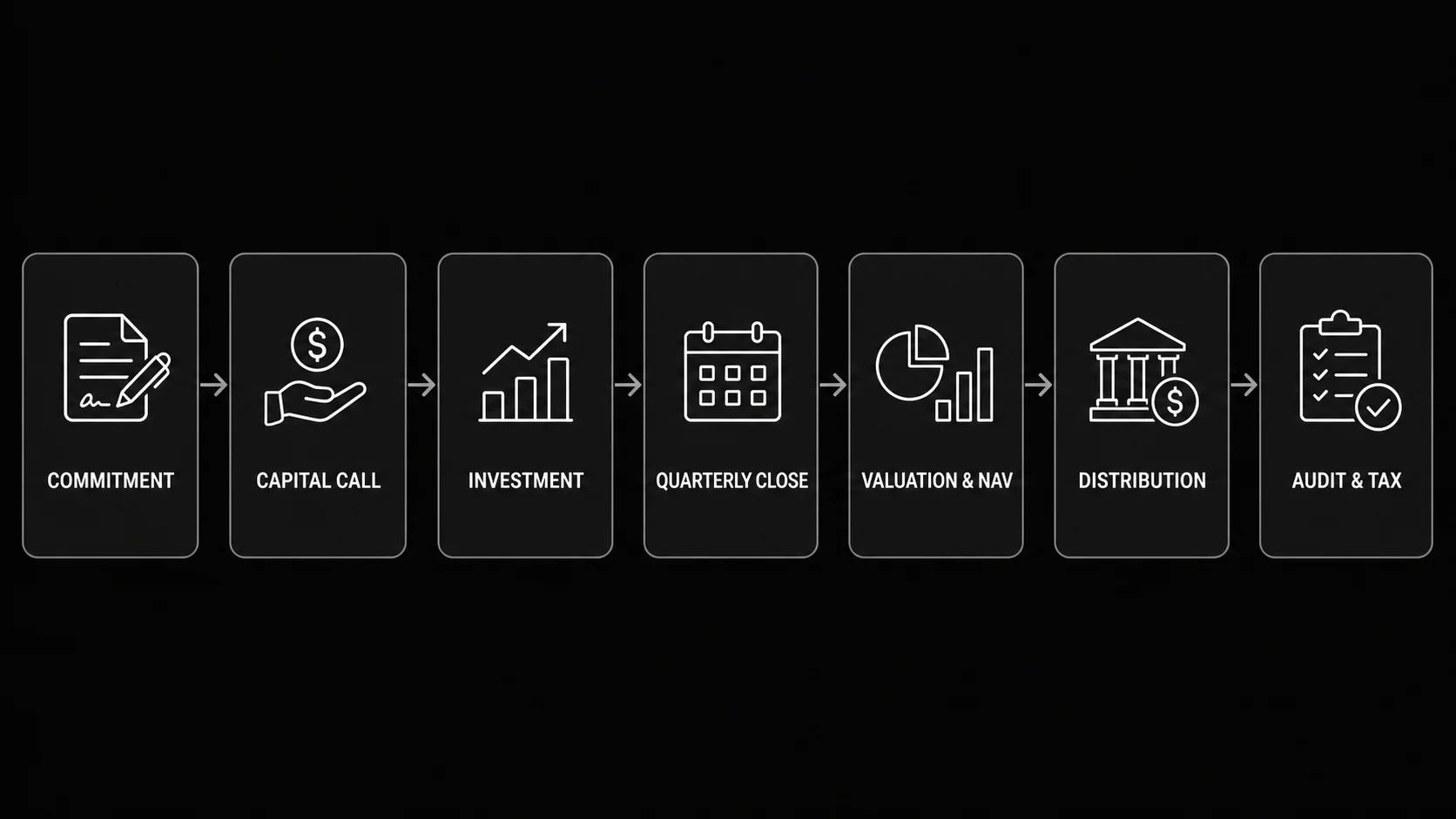
The venture fund accounting lifecycle
Fund accounting becomes easier to understand when every event is tied to five questions: What happened? What gets recorded? What must be checked? What does the fund deliver? Who owns the judgment?
| Stage | Accounting work | Key control | Main output | Accountable owner |
|---|---|---|---|---|
| LP commitment | Open the investor record and record commitment terms | Agree commitment, class, and special terms to signed documents | Commitment schedule and investor master data | Internal finance with administrator support |
| Capital call | Calculate each LP's share, issue notices, record receivable and cash | Tie the call to the LPA, approved use, and investor percentages | Call notices, receipts, and updated unfunded commitments | Internal finance; administrator often processes |
| Investment | Record cost, instrument, ownership, fees, and wire activity | Match approval, legal documents, cap-table evidence, and bank movement | Investment ledger and portfolio schedule | Finance with investment and legal teams |
| Period close | Reconcile cash, expenses, fees, investments, and intercompany balances | Independent review of reconciliations and exception log | Trial balance and close package | Fund accountant or controller |
| Valuation and NAV | Update fair values, unrealized gains/losses, liabilities, and allocations | Approved valuation support applied consistently with policy | NAV, schedule of investments, and capital accounts | Investment team proposes; valuation committee/GP approves; finance records |
| Exit and distribution | Record proceeds, realized gain/loss, waterfall allocations, and payments | Tie proceeds to closing statements and distribution terms | Distribution notices and updated capital accounts | Internal finance with administrator and legal input |
| Audit and tax | Support financial statements, confirmations, tax allocations, and partner reporting | Books, legal records, valuation files, and investor data agree | Audited financials, Form 1065, Schedules K-1/K-3 where applicable | Controller/CFO with auditor and tax adviser |
Commitments and capital calls
The commitment schedule is the foundation. If an investor's commitment, ownership class, fee terms, or start date is wrong in the investor master, every later call and allocation can be wrong even when the arithmetic is flawless.
Before issuing a call, the team should confirm the approved amount, purpose, notice period, allocation basis, and any investor-specific terms. After cash arrives, receipts should tie to the bank, the call ledger, and each LP's unfunded balance. Late or short payments belong on an exception list rather than being buried in a reconciliation.
Investment activity
The fund accountant does not decide whether a startup is attractive, but the accountant needs authoritative evidence of what the fund owns. The investment record should capture the security type, acquisition date, quantity or principal amount, cost, transaction expenses, vehicle, and any later conversion, split, write-off, or exit.
This is where finance, legal, and the investment team must share one version of the transaction. A signed SAFE in the legal folder, a wire from a different vehicle, and a portfolio tracker with an inconsistent amount are not three minor differences; they are a control failure.
Valuation and NAV
Private investments do not come with a daily market price. The investment team or valuation function develops the supporting analysis, the appropriate governance body approves it, and finance records the approved fair value. The accountant should be able to reproduce the movement from opening value to closing value and retain the evidence behind it.
The 2025 IPEV Valuation Guidelines describe current best practice for reporting private-capital investments at fair value. They do not turn valuation into a mechanical formula. The method and inputs should reflect the investment's facts, the fund's accounting framework, and a consistently applied policy.
At a simplified level:
> Fund NAV = fair value of investments + cash and other assets − liabilities
That NAV then has to be allocated to investor capital accounts according to the fund's governing terms. Equal commitments do not guarantee equal economics when investors have different closing dates, fee arrangements, excuse rights, or other negotiated terms.
Distributions, audit, and tax
An exit replaces an unrealized estimate with realized proceeds. Finance reconciles the closing statement and cash, removes or reduces the investment position, records the realized gain or loss, calculates distributions under the governing waterfall, and updates LP capital accounts.
For US partnerships, Schedule K-1 reports each partner's share of partnership income, deductions, credits, and other items. The IRS partner instructions for Schedule K-1 also make an important practical point: the partnership's reporting and the partner's treatment need to stay consistent. Fund accounting therefore feeds tax reporting; it does not replace tax advice.
A worked example from capital call to distribution
Consider a simplified $10 million venture fund with ten LPs. Each LP commits $1 million and has identical terms. The example ignores side letters, different closing dates, taxes, recycling, management-fee offsets, and carried interest so the accounting relationships stay visible.
1. The fund calls 20% of commitments
The GP calls $2 million in total. Each LP contributes $200,000.
| Investor-level record | Per LP | Fund total |
|---|---|---|
| Commitment | $1,000,000 | $10,000,000 |
| Capital called and received | $200,000 | $2,000,000 |
| Unfunded commitment | $800,000 | $8,000,000 |
The accountant ties the ten receipts to the bank, closes the capital-call receivable, and updates every LP's contribution and unfunded balance.
2. The fund invests and pays expenses
Assume the fund invests $1.6 million in one portfolio company, pays $250,000 of management fees and permitted fund expenses, and retains $150,000 of cash.
The books now need to show:
- Investment at cost: $1.6 million.
- Cash: $150,000.
- Cumulative fees and expenses: $250,000.
- LP contributions: $2 million.
The investment balance must agree to the closing documents and portfolio schedule. The expenses must agree to invoices, the LPA, allocation policy, and management-fee calculation.
3. The quarter-end value changes
At quarter end, the approved fair value of the investment is $1.9 million. With no other assets or liabilities in this simplified example:
| NAV component | Amount |
|---|---|
| Investment at fair value | $1,900,000 |
| Cash | $150,000 |
| Liabilities | $0 |
| Fund NAV | $2,050,000 |
The fund records a $300,000 unrealized gain above the $1.6 million cost. Because the investors have equal terms and funded equal amounts, each LP's simplified capital account is $205,000: one tenth of the $2.05 million NAV.
That $205,000 is not a promise that the LP can redeem at that value. Venture funds are illiquid, and NAV depends on estimates for private assets. It is an accounting allocation at the reporting date.
4. The investment is sold
Assume the company is later sold and the fund receives $3 million. Finance would:
1. Reconcile the proceeds to the closing statement and bank. 2. Remove the $1.9 million carrying value. 3. Record total realized gain of $1.4 million relative to the original $1.6 million cost. 4. Reverse the previously recorded $300,000 unrealized gain and recognize the remaining movement as realized. 5. Update cash, NAV, performance schedules, and LP capital accounts. 6. Calculate the amount available for distribution after liabilities, reserves, fees, and expenses. 7. Apply the LPA's distribution waterfall and obtain an independent review. 8. Issue distribution notices and reconcile payments.
The last two steps are where generic examples often become misleading. A fund may use a whole-fund waterfall, a deal-by-deal waterfall, preferred return or hurdle provisions, catch-up mechanics, escrow, and clawback protections. The existing Venture Capital Careers explanation of carried interest covers the economics. The accountant's job is to apply the actual governing terms, preserve the calculation history, and make the distribution reproducible.
What a VC fund accountant actually does
The work changes with the calendar and the fund's activity. A quiet month may focus on reconciliations and reporting infrastructure. A quarter end adds valuation and investor reporting. A new investment, exit, or fund close creates a separate burst of work.
Monthly work
- Reconcile every fund, GP, management-company, and SPV bank account.
- Record investment wires, legal bills, administration costs, management fees, and intercompany activity.
- Update investment positions, cost, cash, payables, and receivables.
- Maintain commitment, contribution, distribution, and unfunded schedules by LP.
- Investigate breaks between the general ledger, portfolio tracker, legal records, and bank.
- Review cash forecasts for investments, expenses, and upcoming calls.
At junior levels, the emphasis is preparation and reconciliation. At manager and controller levels, the emphasis shifts to reviewing exceptions, interpreting documents, approving allocations, and deciding what needs escalation.
Quarterly close
Quarter end brings the investment team, finance team, and administrator together.
1. Freeze the investment-activity population for the period. 2. Complete cash, investment, expense, fee, and intercompany reconciliations. 3. Gather portfolio-company data and financing-event evidence. 4. Record approved valuation adjustments. 5. Calculate NAV and investor allocations. 6. Review VC fund performance metrics such as TVPI, DPI, RVPI, and IRR against the underlying books. 7. Prepare financial statements, capital-account statements, and LP reporting packages. 8. Resolve review notes and retain a final close file.
The accounting and investment views must agree. If the portfolio review marks a company down but the accounting schedule still carries the old value, the fund is not closed.
Annual work
- Coordinate the financial-statement audit and respond to testing requests.
- Support tax advisers with entity, investor, transaction, allocation, and realized-gain data.
- Review Form 1065, Schedule K-1, and any required international reporting with qualified advisers.
- Confirm investor details and delivery records.
- Roll forward management fees, budgets, valuation files, and audit schedules.
- Improve controls based on audit adjustments, late data, and recurring review notes.
Annual work should not be a reconstruction project. A strong quarterly process leaves an audit trail that can be reused rather than rebuilt.
Event-driven work
New investments and follow-ons require wire control, document review, and position updates. New LP closings require equalization or other LPA-specific calculations. Exits require proceeds reconciliation and distribution analysis. New SPVs require entity setup, investor records, bank accounts, expense treatment, and reporting from day one.
This is why current manager-level role descriptions often ask for more than journal-entry skill. The job sits between fund administration, investment data, legal documents, valuation, investor relations, audit, tax, and systems. A strong accountant can explain an exception to a partner or LP without losing the accounting precision underneath it.
Who owns what: in-house finance versus the fund administrator
Many VC firms use a third-party fund administrator. The administrator may maintain the ledger, process calls and distributions, prepare capital-account statements, and assemble financial statements. That does not make the administrator the final owner of the fund's economics.
| Work | Administrator | Internal finance | Investment team | Auditor, tax, or legal |
|---|---|---|---|---|
| Book transactions and reconcile cash | prepare | review exceptions and approve | provide investment context | auditor tests |
| Maintain LP records and allocations | prepare | approve terms, changes, and exceptions | limited input | legal confirms governing terms |
| Calculate management fees and expenses | prepare | validate to LPA, side letters, and policy | budget input | auditor/tax review treatment |
| Maintain investment positions | prepare from source data | reconcile to legal and portfolio records | confirm security and activity | legal supports documents |
| Develop fair-value support | assist with schedules | record approved values and control the bridge | prepare analysis and recommendation | valuation committee/GP approves; auditor tests |
| Calculate NAV and capital accounts | prepare | independently review and approve | review performance implications | auditor tests |
| Prepare investor reports | produce accounting schedules | own consistency and final delivery | add portfolio narrative | tax/legal input where needed |
| Apply a distribution waterfall | calculate | validate assumptions, review, approve, and fund | confirm reserves and exit context | legal interprets disputed terms |
The operating rule is simple:
> Outsource repeatable processing if it improves quality or scale. Keep policy, review, exceptions, and accountability inside the firm.
An administrator cannot know that an invoice was coded to the wrong vehicle unless the firm gives it complete information. It cannot resolve an ambiguous side letter without legal interpretation. It should not approve the investment team's valuation judgment. And it cannot own the explanation to an LP when reported economics change.
How the role changes by organization
| Setting | Typical work | Main learning opportunity | Main risk |
|---|---|---|---|
| Fund administrator | High volume across funds, standardized closes, calls, allocations, and reporting | Repetition builds technical breadth quickly | Work can become production-heavy with limited investment-team context |
| Emerging VC manager | Broad remit across books, vendors, operations, LP requests, and systems | End-to-end ownership and direct partner exposure | Thin staffing, weak processes, and blurred entity boundaries |
| Established multi-fund firm | Specialized teams, formal reviews, multiple vehicles, complex reporting | Deeper controls, larger data sets, and clearer progression | Narrow ownership if responsibilities are heavily segmented |
| Management company finance | Payroll, budgeting, payables, revenue, and corporate reporting | Firm operating model and strategic finance | Less exposure to LP allocations and investment accounting |
“Fund accountant” and “finance manager” can therefore describe very different jobs. The title matters less than the records you own, the judgments you review, and the people who rely on your work.
Skills that matter in a fund-accounting career
Accounting credentials help, but firms hire for evidence that you can keep complex economics accurate under time pressure.
| Skill | What good work looks like | Evidence to show in an interview |
|---|---|---|
| Partnership accounting | Contributions, allocations, distributions, and capital accounts roll correctly by investor | A capital-account rollforward you built or reviewed |
| Entity discipline | Fund, GP, management company, and SPV activity stays separate | An intercompany break or allocation error you resolved |
| Investment accounting | Cost, instrument, quantity, conversions, proceeds, and realized/unrealized movement reconcile | A position rollforward or transaction close file |
| Valuation support | Approved marks are documented and bridge cleanly between periods | A valuation support schedule, review checklist, or audit response |
| Close control | Reconciliations, review notes, and deliverables finish in a repeatable order | A close calendar or control you improved |
| Systems and data | The ledger, administrator, CRM, portfolio tracker, and reporting tools share controlled data | A migration, automation, or exception report you designed |
| Communication | Partners and LP-facing teams understand issues without accounting jargon | A concise memo explaining an error, policy, or estimate |
| Provider oversight | Administrator, auditor, tax, and legal work is coordinated and reviewed | An example where you challenged an external work product |
The best interview answers follow a control story:
1. What was supposed to happen? 2. What evidence did you compare? 3. What did not agree? 4. How did you find the cause? 5. What correction and preventive control did you implement?
A useful work sample is a simplified quarter-end review. Give the candidate a bank reconciliation, investment schedule, capital-call ledger, fee calculation, and valuation memo with three planted inconsistencies. Ask for a short review note that identifies the issues, ranks their risk, and requests the missing evidence. That tests accounting, judgment, and communication at once.
Public-accounting, fund-administration, private-equity accounting, and investment-management finance can all lead to an in-house VC role. The strongest transition story shows increasing review ownership—not just exposure to venture clients.
How to evaluate a venture capital fund-accounting job
Ask these questions before accepting the title at face value.
What entities and strategies are in scope?
Find out how many funds, SPVs, co-invest vehicles, GP entities, and management companies the role covers. Ask about stage, geography, currencies, investor types, and whether the portfolio includes only equity or also SAFEs, notes, warrants, secondaries, or digital assets.
Who prepares, reviews, and approves?
If an administrator prepares the books, clarify whether you will review its work or only forward files internally. Ask who approves valuations, waterfalls, investor reports, and audit adjustments.
What breaks most often?
The answer reveals the real job. Chronic late closes may point to weak portfolio data. Repeated allocation errors may point to bad investor master data. Constant intercompany breaks may mean the entities are not operationally separated.
How close is the role to the investment and LP teams?
Exposure matters when it creates context and judgment, not when it only creates last-minute requests. Ask whether finance joins valuation meetings, reviews transaction documents before wires, supports LP questions, and contributes to new-fund setup.
What would you own after 12 months?
A controller-track role should expand from preparation into review, policy, provider oversight, systems, and communication. If the answer is “more funds with the same reconciliations,” progression may be volume rather than judgment.
Use the Venture Capital Careers job board to compare finance, fund-accounting, controller, and fund-operations roles. Then use the companies directory to research each firm's investment stage, portfolio, team structure, and fund complexity before interviewing.
For hiring managers, the same questions improve the job description. State which entities the person owns, whether accounting is in-house or administered, who owns valuation and LP reporting, and what success looks like at the first two closes. When the scope is ready, post a VC job with that detail.
Quarterly close control checklist
Use this as a review framework, then adapt it to the fund's LPA, side letters, valuation policy, accounting framework, service model, and jurisdiction.
1. Cash is complete. Every bank account is reconciled to an independently obtained statement, and old reconciling items are explained. 2. Capital activity ties. Commitment, contribution, distribution, recallable amount, and unfunded schedules agree to investor records and notices. 3. Entity boundaries hold. Intercompany and cross-vehicle activity reconciles, and expenses sit in the entity permitted to bear them. 4. Investment positions agree. Cost, instrument, quantity, ownership, conversions, follow-ons, exits, and write-offs tie to legal and portfolio records. 5. Fees and expenses follow the documents. Management-fee bases, step-downs, offsets, waivers, caps, and allocations agree to governing terms. 6. Valuations are approved and reproducible. Every mark has current support, the method is consistent with policy, and changes from the prior period are explained. 7. NAV and LP allocations are reviewed. Assets, liabilities, realized and unrealized results, and capital accounts add up across the fund and investors. 8. Performance metrics tie to accounting. Contributions, distributions, NAV, dates, and ownership used in IRR, TVPI, DPI, and RVPI agree to the books. 9. Investor reports agree to the final close. Financial statements, capital-account statements, portfolio schedules, and narrative figures use the same approved data. 10. Evidence survives the deadline. Review notes, approvals, valuation files, legal documents, tax data, and final reports are retained in an audit-ready close package.
The highest-value control is often not another spreadsheet. It is a clear exception log with an owner, due date, evidence request, risk assessment, and resolution. That prevents a small break from being copied into the next quarter.
FAQ
Is venture capital fund accounting the same as startup accounting?
No. Startup accounting records the operations of a portfolio company. VC fund accounting records the fund and related entities, including LP capital, investments, fees, fair value, NAV, distributions, and investor reporting.
Does a fund accountant make investment decisions?
Usually not. The investment team and investment committee decide which companies to back. Finance records the approved transaction, maintains the ownership evidence, supports valuation controls, and reports the result. Senior finance leaders may challenge missing evidence or inconsistent valuation treatment without making the investment call.
Is VC fund accounting performed in-house?
It can be in-house, outsourced to a fund administrator, or split between both. Even when an administrator prepares the books and reports, the firm's finance lead should own policy, review, exceptions, approvals, and final accountability.
Do VC fund accountants calculate carried interest?
Often, yes. The administrator or internal finance team may prepare the waterfall and carry allocation, while a controller or CFO reviews it against the LPA and legal advice. The applicable terms vary, so a generic “20% carry” shortcut is not enough.
Can audit or fund-administration experience lead to an in-house VC role?
Yes. The transition is strongest when you can show partnership-accounting knowledge, investment and capital-account reconciliations, valuation support, audit/tax coordination, provider oversight, and clear communication with investment or LP-facing teams.
What qualifications are most useful?
An accounting or finance foundation, CPA/CA or equivalent training, private-fund experience, strong Excel and systems skills, and evidence of close ownership are all useful. Firms may value different combinations, so the role's entities, accounting framework, jurisdiction, and service model should drive preparation.
The career value is in judgment, not transaction volume
Fund accounting is the operating record of a venture fund. It turns commitments, investment documents, valuation decisions, and exit proceeds into investor-level economics that can withstand LP questions, audits, and tax reporting.
For candidates, the best role is not necessarily the one with the most funds or the most journal entries. Look for increasing ownership of review, policy, exceptions, systems, and communication across the fund lifecycle.
Browse current opportunities on the VC job board, research firms in the companies directory, and use the lifecycle above to ask sharper questions before you join a fund-finance team.
Related posts
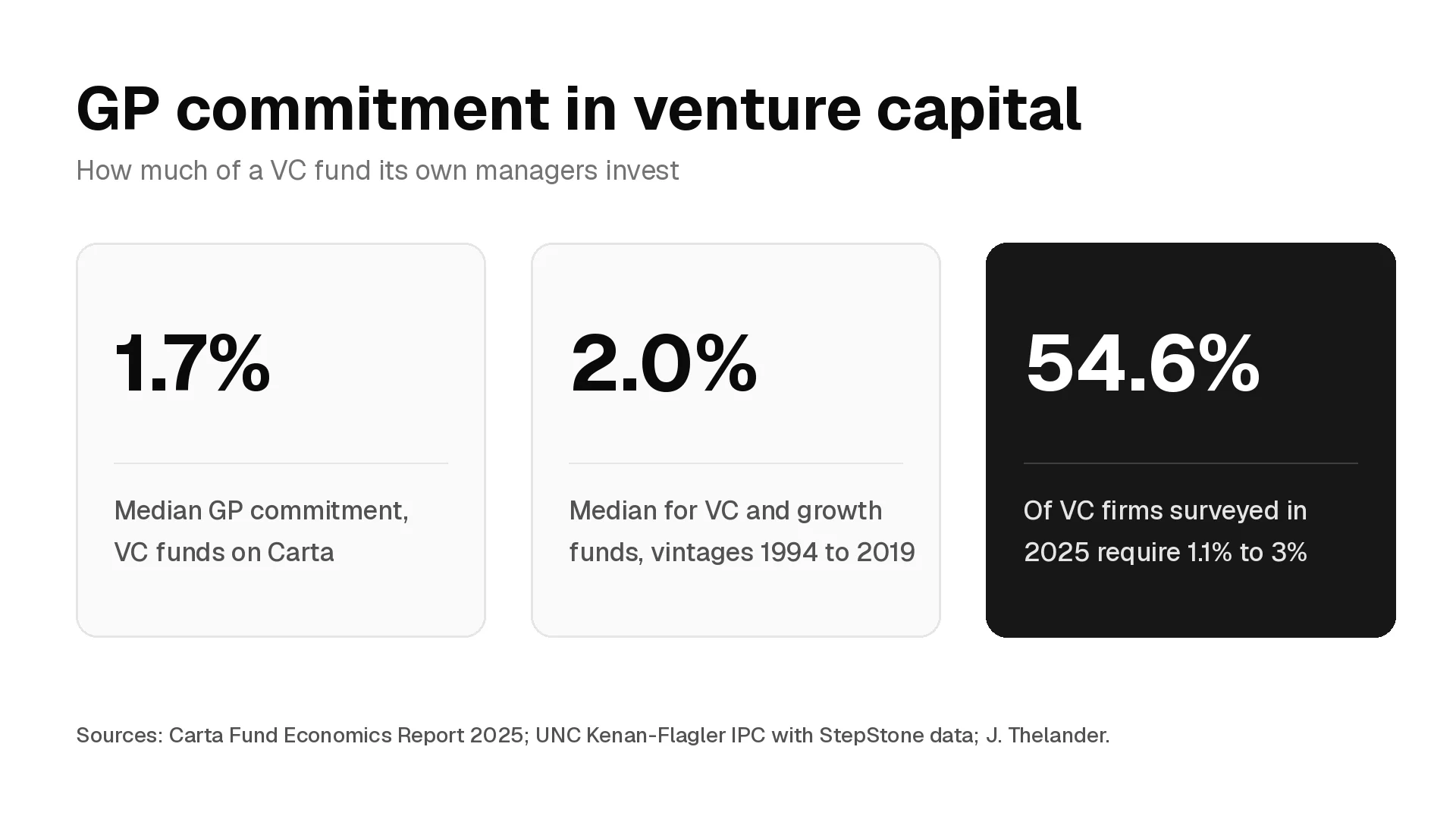
What a GP commitment is, how large it is in venture capital, how GPs fund it, where it sits in the LPA, what the returns evidence says, how firms split it across partners and principals, and what to ask before you accept a role with carry.
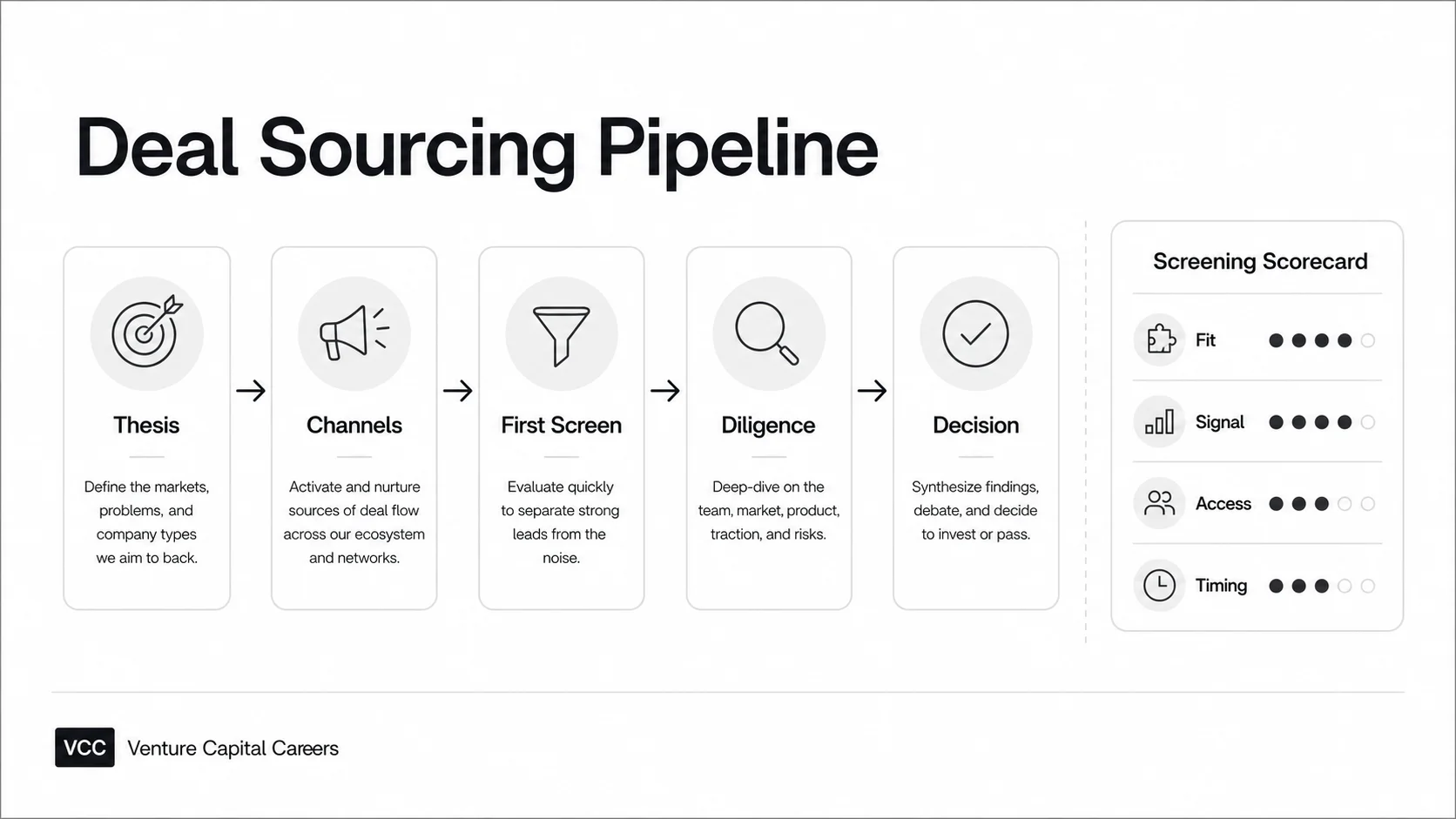
Most closed VC deals start with a relationship. See where deals come from by stage, how to work each sourcing channel, which signals show up early, and how analysts run a weekly sourcing process.
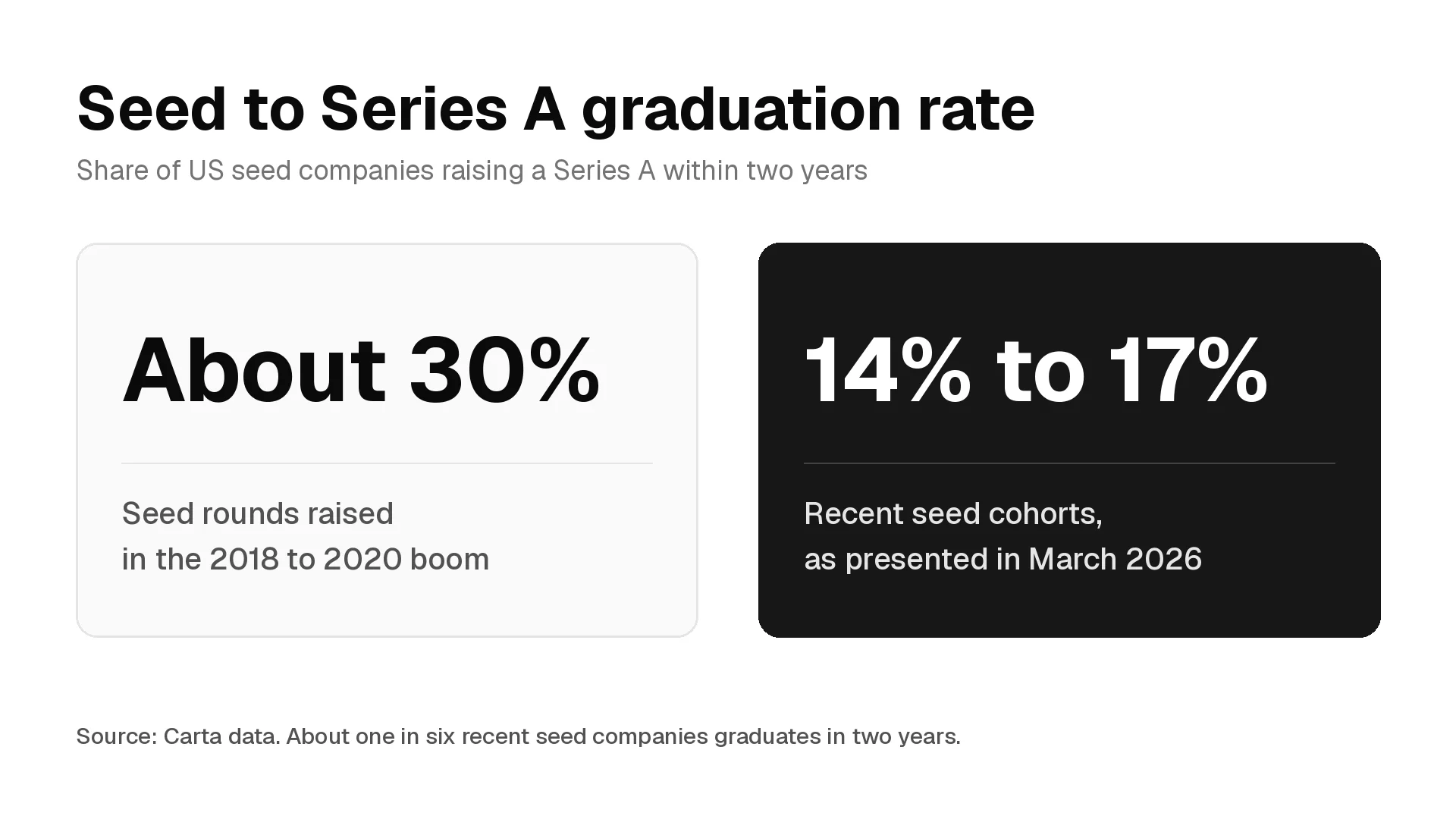
Seed to Series A graduation rates by cohort from Carta and Crunchbase, how long the jump takes, why rates fell after 2021, why published figures disagree, and how seed and Series A firms use the rate for reserves, LP reporting, portfolio reviews and interviews.