
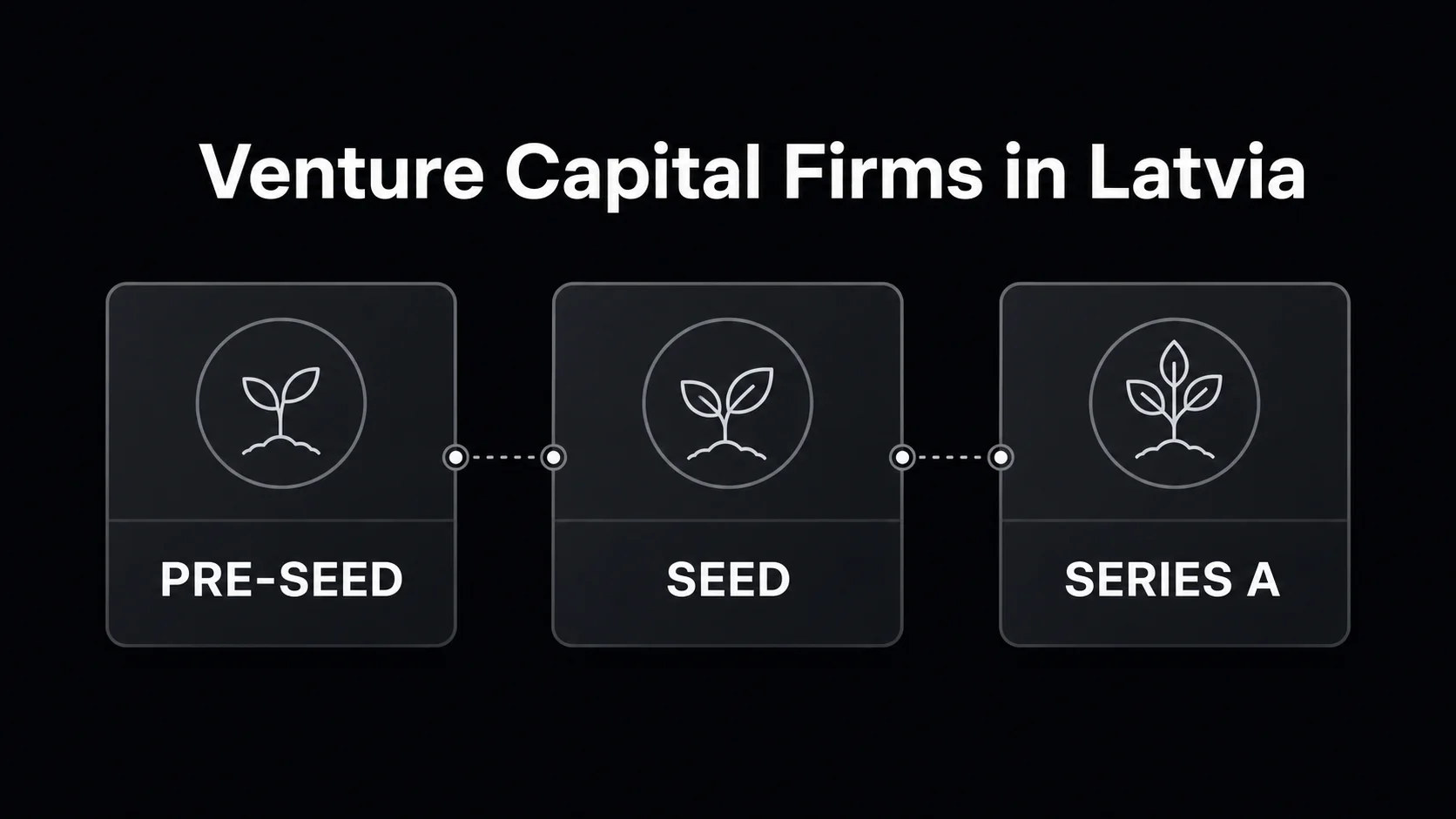
The clearest active venture capital firms for Latvian startups are Change Ventures, BADideas.fund, Buildit VC, and Outlast Fund. Change backs Baltic founders broadly; the other three are part of Latvia's current Altum-supported early-stage fund generation. Latvian founders can also approach pan-Baltic investors including Practica Capital, Specialist VC, FIRSTPICK, Iron Wolf Capital, and byFounders when the stage and thesis fit.
That distinction matters. A fund may appear in a Latvia investor database because it can invest across Europe, not because it is actively looking for Latvian deals. Other familiar names are managing existing portfolios, providing private debt, investing at buyout stage, or organizing angels rather than writing new startup-equity cheques.
This map was checked on 29 July 2026. Published ticket ranges are screening guides, not offers; verify the fund's current mandate before outreach.
Latvia's early-stage market has real new capacity. The Investment and Development Agency of Latvia reported that BADideas, Buildit, and Outlast began active investment in 2025 and plan to deploy more than €62 million into early-stage companies over the coming years.
Active venture capital firms in Latvia at a glance
Latvia-based or Latvia-rooted funds
| Fund | Stage | Published cheque guidance | Focus and geography | Activity signal | Best fit |
|---|---|---|---|---|---|
| Change Ventures | Pre-seed and seed | €100k-€750k initial; follow-on possible | Baltic founders or Baltic diaspora; technology with global potential | Current investment mandate and portfolio activity | Baltic software and technology teams seeking a hands-on early investor |
| BADideas.fund | Pre-seed and seed | Altum program maximums: up to €250k pre-seed and €1.5m seed | Latvia and wider CEE; strongest stated fit in B2B and marketplaces | €20.67m Altum-backed fund with a five-year active investment period | CEE-rooted operators building B2B software or marketplaces |
| Buildit VC | Pre-seed and seed/follow-on | Up to €250k pre-seed; up to €1.5m seed/follow-on | Latvia at pre-seed; Baltics, Nordics, and possibly wider EU at seed; Industry 4.0 | Current investment page and application path | Robotics, automation, IoT, industrial AI, hardware, and enabling software |
| Outlast Fund | Pre-seed and seed | €50k-€250k initial; up to €1.5m follow-on | Baltics and Nordics; software, AI infrastructure, digital health, fintech, and deep tech | €21m fund, current portfolio, and open pitch path | Teams with a working product or prototype and early evidence of demand |
Regional funds that explicitly accept Latvian founders
| Fund | Stage | Published cheque guidance | Latvia fit | Best fit |
|---|---|---|---|---|
| Practica Capital | Selected pre-seed, seed, and Series A | €300k-€3m | Invests in Baltic founders | Technology companies seeking a Baltic lead investor, particularly at seed |
| Specialist VC | Pre-seed to Series A | Typical start around €250k; up to €3m | Explicitly supports founders from Latvia and four other target countries | B2B, SaaS, fintech, platforms, software-enabled hardware, and deep tech |
| FIRSTPICK | Inception and pre-seed | €100k-€500k initial; up to €1m follow-on | Invests in startups from the Baltics | Teams moving from idea validation to early market evidence |
| Iron Wolf Capital | Early stage through growth within its mandate | €500k-€5m | Baltic Sea Region and diaspora | Deep tech, AI, defence, dual-use, photonics, robotics, and science-led companies |
| byFounders | Pre-seed and seed | Average €500k-€4m | Founders from or based in the Nordics and Baltics | Globally ambitious technology teams seeking a lead investor |
These are not ranked from "best" to "worst." The right first call depends on stage, incorporation and founder geography, sector, round size, and whether the fund is actively deploying into new companies.
Use the Venture Capital Careers companies directory to extend firm and portfolio research, then confirm every investment mandate on the fund's own site.
How to build a Latvia investor shortlist
A long investor spreadsheet is not a fundraising strategy. Start with four to six high-fit funds and expand the list only when the evidence supports it.
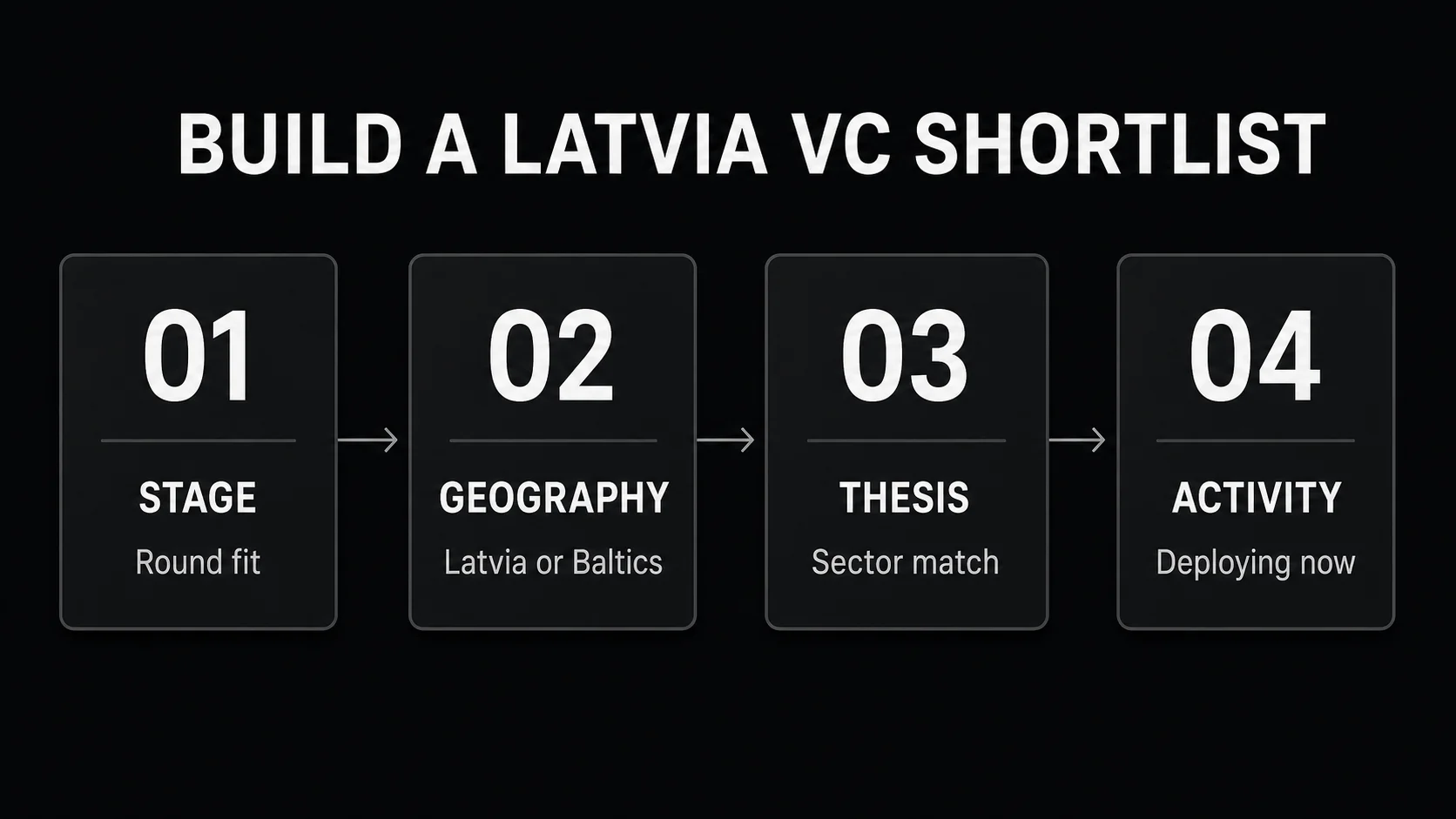
1. Match stage before sector
A relevant sector is not enough if the fund writes cheques two rounds later than the one you are raising.
- At inception or early pre-seed, FIRSTPICK may be relevant before a €500k-plus institutional lead.
- At pre-seed with a working prototype, Buildit, Outlast, Change, BADideas, and Specialist become plausible depending on the thesis.
- At seed, Practica, Change, Specialist, Iron Wolf, and byFounders can enter the conversation alongside the seed capacity of Latvia's Altum-backed managers.
- At later growth stage, the domestic menu is thinner. Do not relabel private debt or buyout capital as venture capital merely to make the shortlist longer.
2. Confirm the geography rule
"Invests in Europe" is weak evidence. Look for language that names Latvia, the Baltics, the Baltic Sea Region, or a founder/diaspora connection.
Buildit's pre-seed page, for example, prioritizes startups incorporated or predominantly operating in Latvia. Change accepts local Baltic founders and the global Baltic diaspora. Iron Wolf uses a Baltic Sea Region and diaspora mandate. These are different eligibility tests.
3. Match the fund's actual thesis
Use the investment thesis to eliminate funds, not to invent a loose connection.
- A Riga robotics startup with an MVP should look hard at Buildit.
- A CEE B2B marketplace may fit BADideas.
- A deep-tech or dual-use company raising a larger seed round may fit Iron Wolf.
- A sector-agnostic company still needs to show the operating quality, market scale, and evidence each generalist fund expects.
4. Verify current deployment before outreach
Check four signals on the official site:
- 1. A current fund or investment period.
- 2. A live pitch or application path.
- 3. Recent first investments, not only follow-ons or exits.
- 4. A team page that still identifies the people making new investment decisions.
If those signals are missing, label the fund "verify" rather than assuming that an old portfolio means fresh capital is available.
Worked example: Industry 4.0 pre-seed
A two-founder Riga team has a working industrial-automation prototype, two design partners, and is raising €400k.
- Buildit is the first thesis match because the product and Latvia pre-seed geography align.
- Outlast is plausible if the product shows early user evidence and a durable technical advantage.
- Specialist can fit software-enabled hardware and deep tech.
- Change becomes stronger when the team can show a venture-scale global market and a credible path to product-market fit.
- BADideas moves up only if the commercial model matches its B2B or marketplace strengths; "technology" alone is not enough.
Worked example: Baltic deep-tech seed
A Latvian university spinout has validated core technology, early paid pilots, and needs a €2.5 million seed round.
- Iron Wolf is a natural lead candidate if the company sits in deep tech, AI, defence, or dual-use.
- Practica and Specialist can be credible Baltic syndicate partners.
- Outlast may participate where its science and hard-tech thesis fits, but its published initial ticket is smaller; the round may need several investors.
The useful output is not one perfect fund. It is a deliberate syndicate hypothesis: likely lead, credible co-investors, and follow-on capacity.
Latvia-based and Latvia-rooted early-stage funds
Change Ventures
Change Ventures backs Baltic founders at pre-seed and seed, including founders in Latvia and Baltic founders living elsewhere. Its current site publishes initial investments of €100k-€750k and describes follow-on participation in later rounds.
Best fit: a technology company with global potential and a team that can use hands-on operating support to reach product-market fit. The firm is broad enough to consider several sectors, so team quality, market size, and speed of learning carry more weight than a narrow category label.
Check before outreach: whether the current portfolio creates a direct conflict and which partner's operating background best matches the company.
BADideas.fund
BADideas.fund grew from an operator-led angel syndicate into a manager of an Altum-backed €20.67 million fund. The fund targets early-stage companies led by CEE-rooted founders with global ambition, with a visible emphasis on B2B and marketplace businesses.
Altum publishes program maximums of €250k at pre-seed and €1.5 million at seed. Those figures define the supported program ceiling, not an automatic offer for every company.
Best fit: founders who value a network of operators and can articulate a concrete go-to-market advantage. A generic "large market" slide is unlikely to be enough; the model is built around practical founder and operator help.
Check before outreach: which investment route applies, the evidence expected at your stage, and whether the company meets the relevant EU/Altum eligibility conditions.
Buildit VC
Buildit VC is the most specialized local option in the active group. It focuses on Industry 4.0: robotics, automation, IoT, big data, industrial AI, hardware, and software that enables those systems.
The published pre-seed maximum is €250k for startups incorporated or predominantly operating in Latvia. Seed and follow-on investment can reach €1.5 million, with a broader stated geography across the Baltics, Nordics, and potentially other EU markets.
Best fit: a technical team of at least two people with an MVP or working prototype, credible founder-market fit, and a scalable market. Hardware founders should also value Buildit's manufacturing network rather than treating it as capital alone.
Check before outreach: whether a current cohort or direct investment path is open and whether the company fits the pre-seed Latvia rule or the wider seed rule.
Outlast Fund
Outlast Fund is a €21 million Riga-and-Stockholm fund investing at pre-seed and seed across the Baltics and Nordics. It publishes €50k-€250k initial tickets and up to €1.5 million of follow-on capacity.
Its sector list includes B2B SaaS, AI infrastructure and applied AI, digital health, fintech, deep tech, and hard science. Its screening language is unusually direct: the team expects a working product or serious prototype, early user feedback, and some sign of traction, while allowing more flexibility for deep-tech and regulated companies.
Best fit: founders who can show disciplined progress and a durable problem rather than a trend-led pitch.
Check before outreach: whether the company can demonstrate the customer evidence the fund expects and whether a Riga or Stockholm partner is the better entry point.
Regional funds that explicitly invest in Latvian founders
Latvian startups should not stop at Riga. The Baltic market is small enough that credible seed rounds often combine a local investor with one or more regional funds.
Practica Capital
Practica Capital is an early-stage investor dedicated to Baltic founders. It invests primarily at seed, with selected pre-seed and Series A opportunities, and publishes a €300k-€3 million ticket range.
Best fit: technology founders who want a Baltic lead investor and expect active company-building support. Practica describes itself as a frequent syndicate partner, which makes it relevant when a round needs both local knowledge and regional follow-on relationships.
Specialist VC
Specialist VC explicitly supports founders from Estonia, Latvia, Lithuania, Finland, and Ukraine. It invests from pre-seed to Series A, typically starting around €250k and going up to €3 million.
Best fit: B2B, SaaS, fintech, platforms, software-enabled hardware, and deep-tech companies. Its mandate is broad but not indiscriminate; the strongest pitch explains why the team's insight is difficult to reproduce.
FIRSTPICK
FIRSTPICK invests in inception and pre-seed startups from the Baltics. It publishes €100k-€500k initial investments and up to €1 million of follow-on capacity.
Best fit: teams that are earlier than a conventional seed round. The inception route can suit an experienced team validating an idea or MVP; the pre-seed route expects stronger market validation and momentum.
Iron Wolf Capital
Iron Wolf Capital invests €500k-€5 million in deep tech, AI, defence, and dual-use companies across the Baltic Sea Region and its diaspora. The firm says it prefers to lead rounds.
Best fit: science-led or technically defensible companies whose capital needs are larger than a typical accelerator cheque. Founders should be ready to explain technical risk, regulatory or procurement pathways, and why the team can build internationally.
byFounders
byFounders invests at pre-seed and seed in founders from or based in the Nordic and Baltic countries. Its published average ticket range is €500k-€4 million, and it can lead rounds.
Best fit: globally ambitious technology teams that want an operator-founded regional fund. The firm's "New Nordics" geography is broader than Latvia, so the pitch still needs a sharp reason the company belongs in its portfolio.
Regional eligibility is a starting condition, not a recommendation by itself. A founder should still check conflicts, partner fit, lead versus follower appetite, ownership expectations, and the fund's remaining deployment period.
Altum, angels, private debt, and private equity are different
Several organizations matter to Latvia's funding market without belonging in an active startup-VC ranking.
| Organization or category | What it actually does | When it is useful | Why it is separate from the active VC tables |
|---|---|---|---|
| Altum | State-owned development-finance institution and investor in fund programs | Finding Altum-supported managers and understanding public-backed investment programs | It is the market's capital and program infrastructure, not a substitute for pitching the selected fund manager |
| LatBAN | Business angel network | Angel introductions, syndication, mentorship, and early private capital | An angel network is not a single institutional VC fund |
| LVCA | Private-equity and venture-capital industry association | Member research, events, policy, training, and ecosystem context | An association represents investors but does not itself make the ranked investment recommendation |
| FlyCap | Current live strategy is private debt; its site publishes €1m-€4m loans | Growth companies with positive cash flow, more than €1m annual revenue, and debt capacity | A 12%+ private-debt instrument is not an early-stage equity cheque |
| ZGI Capital | Growth-capital manager; ZGI-4 is described as being in portfolio-management phase | Understanding Latvian growth-capital history and watching for a future fund generation | The current page does not support treating ZGI-4 as an open new-startup fund |
| Overkill Ventures | Existing portfolio support and follow-ons | Portfolio context and introductions to related managers | Overkill explicitly says it is not making new investments |
| BaltCap and Livonia Partners | Private equity, growth, and buyout investing | Established companies seeking larger expansion or ownership-transition capital | Their core use case is not a first institutional startup round |
Older Latvia VC lists also name Imprimatur Capital, Capitalia, rubylight, iTech Capital, Baltic Tech Ventures, Commercialization Reactor, and other managers. Some remain relevant as portfolio investors, historical ecosystem builders, or adjacent capital sources. None should be labelled an active new-cheque Latvia startup VC without a current official mandate.
What Altum's role means in practice
Altum is central because it selects and backs fund managers, publishes program limits, and helps create risk-capital capacity. Founders still pitch the manager—Buildit, BADideas, Outlast, FlyCap, or another program participant—not a generic "Altum VC team."
The distinction also prevents a common fundraising error: comparing a €150k pre-seed equity cheque with a €2 million private-debt facility or a buyout fund as if they solve the same financing problem. They do not.
What the current Latvia funding market says
Latvia's startup market is small, technically capable, and increasingly connected to Baltic and European capital.
At the end of 2025, Latvia had 569 operating startups. Those companies attracted approximately €78 million during 2025, with Aerones accounting for the largest disclosed round. Deep tech represented 26% of the ecosystem, which helps explain the prominence of industrial, science, energy, defence, and infrastructure-adjacent mandates.
Early-stage capacity improved when BADideas, Buildit, and Outlast began active investing in 2025. The financing path becomes harder later. A June 2026 EIB and LIAA assessment identified limited growth capital, insufficient venture-capital intensity, and fragmented support as material constraints. It also reported that roughly 70% of Latvia's scale-ups relocate operations abroad.
The practical implication is clear:
- A Latvian pre-seed founder now has several visible local entry points.
- A seed founder should build a pan-Baltic syndicate, not wait until the local list is exhausted.
- A capital-intensive or growth-stage company should plan the next funding geography early and distinguish equity, debt, and public support.
- A deep-tech team should map validation grants, pilots, and European programs alongside VC because the research-to-market gap remains difficult.
Latvia investment opportunities are therefore strongest when viewed as a Baltic funding network with local public-backed anchors, not as an isolated national market.
How candidates should use this investor map
A fund list becomes useful for a career search only after it is turned into evidence about teams, mandates, and hiring needs.
- 1. Read the thesis. Record stage, sector, geography, typical ownership, and whether the fund leads.
- 2. Map the portfolio. Identify companies added recently, follow-on rounds, exits, and where the fund appears to spend partner time.
- 3. Track activity. A new fund, active deployment period, recent first investment, or newly promoted investor is a stronger hiring signal than an old logo wall.
- 4. Match the role. A hardware-focused pre-seed fund may value technical diligence and ecosystem work; a seed software fund may emphasize sourcing, market work, and portfolio support; a private-debt manager needs a different underwriting skill set.
- 5. Build a targeted point of view. Arrive with one sector map, a credible company thesis, or a portfolio observation. Generic enthusiasm for "Latvia's startup scene" is not differentiated.
Use the Venture Capital Careers companies directory to research firms and the VC job board to browse current roles. The venture capital career path explains how analyst, associate, principal, partner, platform, and operating roles differ. The VC deal-sourcing framework shows what market mapping looks like in the job.
Do not rely on a single job advert. Fund hiring is episodic, and portfolio-company roles can provide a strong operating route into the same ecosystem.
Frequently asked questions
What are the main venture capital firms in Latvia?
The clearest active Latvia-based or Latvia-rooted early-stage funds are Change Ventures, BADideas.fund, Buildit VC, and Outlast Fund. Latvian founders can also approach regional investors such as Practica Capital, Specialist VC, FIRSTPICK, Iron Wolf Capital, and byFounders when the stage and thesis fit.
Which investors are relevant for a first institutional cheque?
At inception and pre-seed, FIRSTPICK, Buildit, Outlast, Change, BADideas, and Specialist are plausible starting points depending on product maturity, geography, and sector. "First cheque" does not mean idea-only: several funds expect an MVP, prototype, user evidence, or a strong experienced team.
For a deeper explanation of the round itself, see how pre-seed funding works.
Does a startup need to be incorporated in Latvia?
It depends on the fund and program. Buildit's published pre-seed criteria prioritize companies incorporated or predominantly operating in Latvia. Change includes local Baltic founders and Baltic diaspora. Regional funds use Baltic, Nordic-Baltic, or Baltic Sea Region tests. Read the exact rule before applying.
How large are venture capital checks in Latvia?
Published ranges in this market span roughly €50k initial pre-seed cheques to several million euros for seed or regional lead investments. Altum-supported early-stage program maximums can reach €250k at pre-seed and €1.5 million at seed; regional firms publish larger ranges in some cases. Actual cheque size depends on the round, fund, eligibility, ownership, and remaining reserves.
Is Altum a venture capital firm?
Altum is Latvia's state-owned development-finance institution and a major investor in venture-capital programs and fund structures. Founders usually approach the selected fund manager for an equity investment rather than treating Altum as one generic startup VC.
Where can candidates find venture capital roles in Latvia?
Start with the Venture Capital Careers job board and companies directory, then monitor active fund websites, team changes, new funds, portfolio activity, and portfolio-company hiring. Use stable job-board and firm pages rather than bookmarking individual vacancies that will expire.
Choose fit over list length
Latvia does not need a longer investor list. Founders need a smaller set of funds with a live mandate, the right stage, an explicit geography match, and a thesis they can defend. Candidates need the same discipline: research active teams and portfolios, then show a point of view that fits how those investors actually work.
Related posts
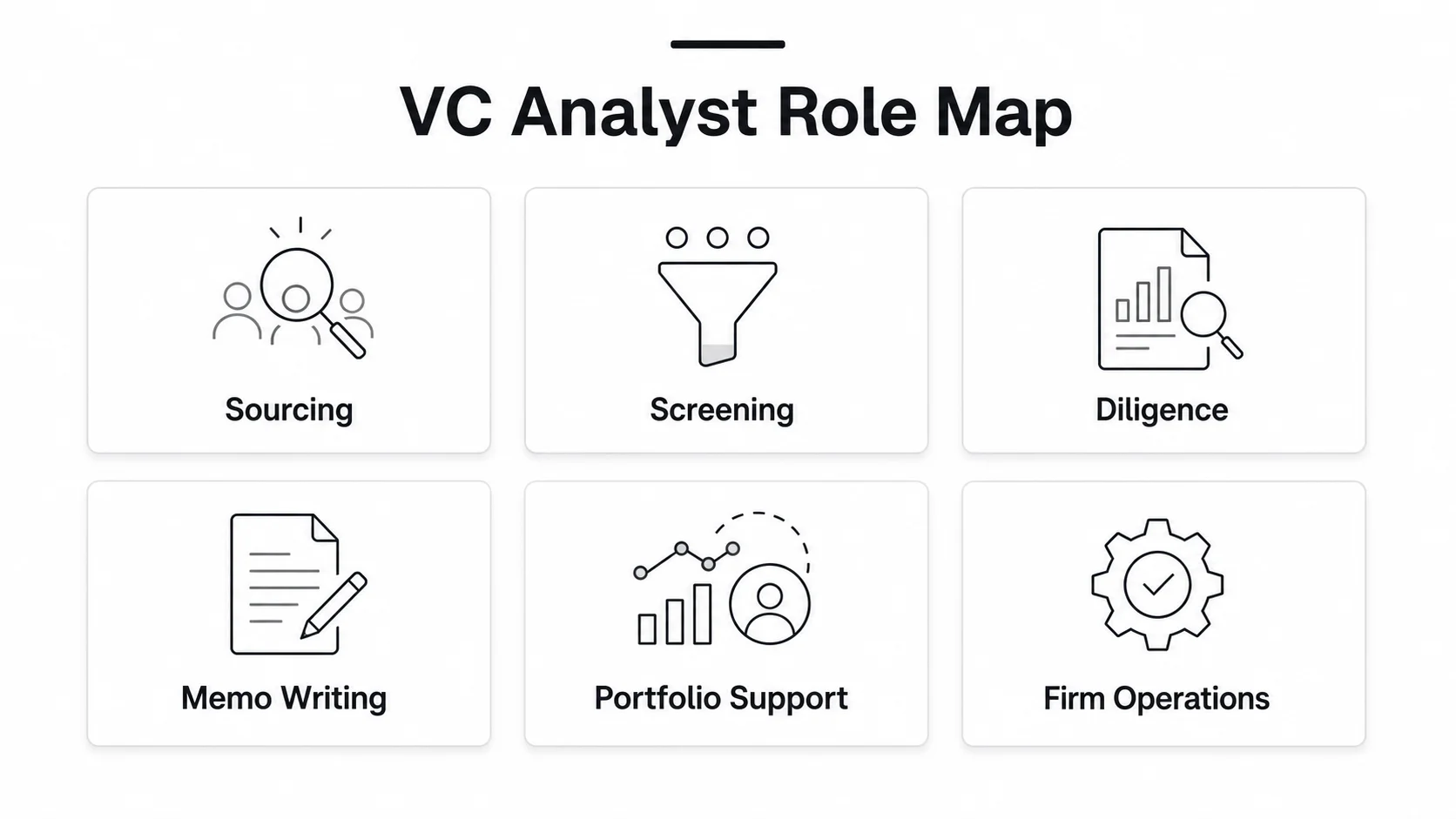
Copy-ready VC analyst job description template with responsibilities, skills, sourcing vs diligence seat signals, interview scorecard, and how candidates should read a posting.
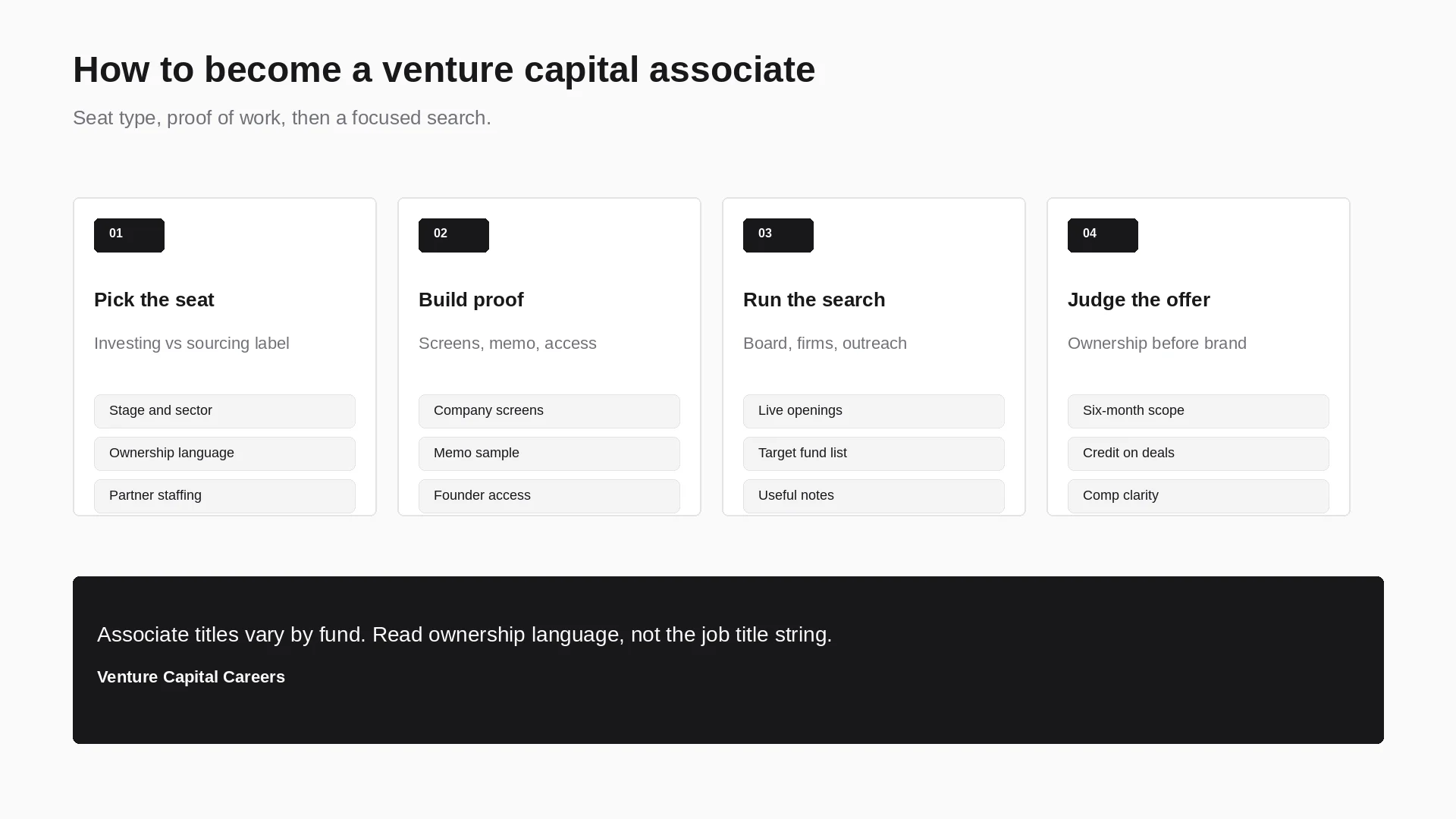
A practical guide to becoming a venture capital associate: what the seat is, which paths convert, how to prove you can do the work, and how to screen real associate openings.
A VC analyst resume is a one-page proof document. Template, bullet formula, investing projects section, examples, and next steps for analyst applications.