
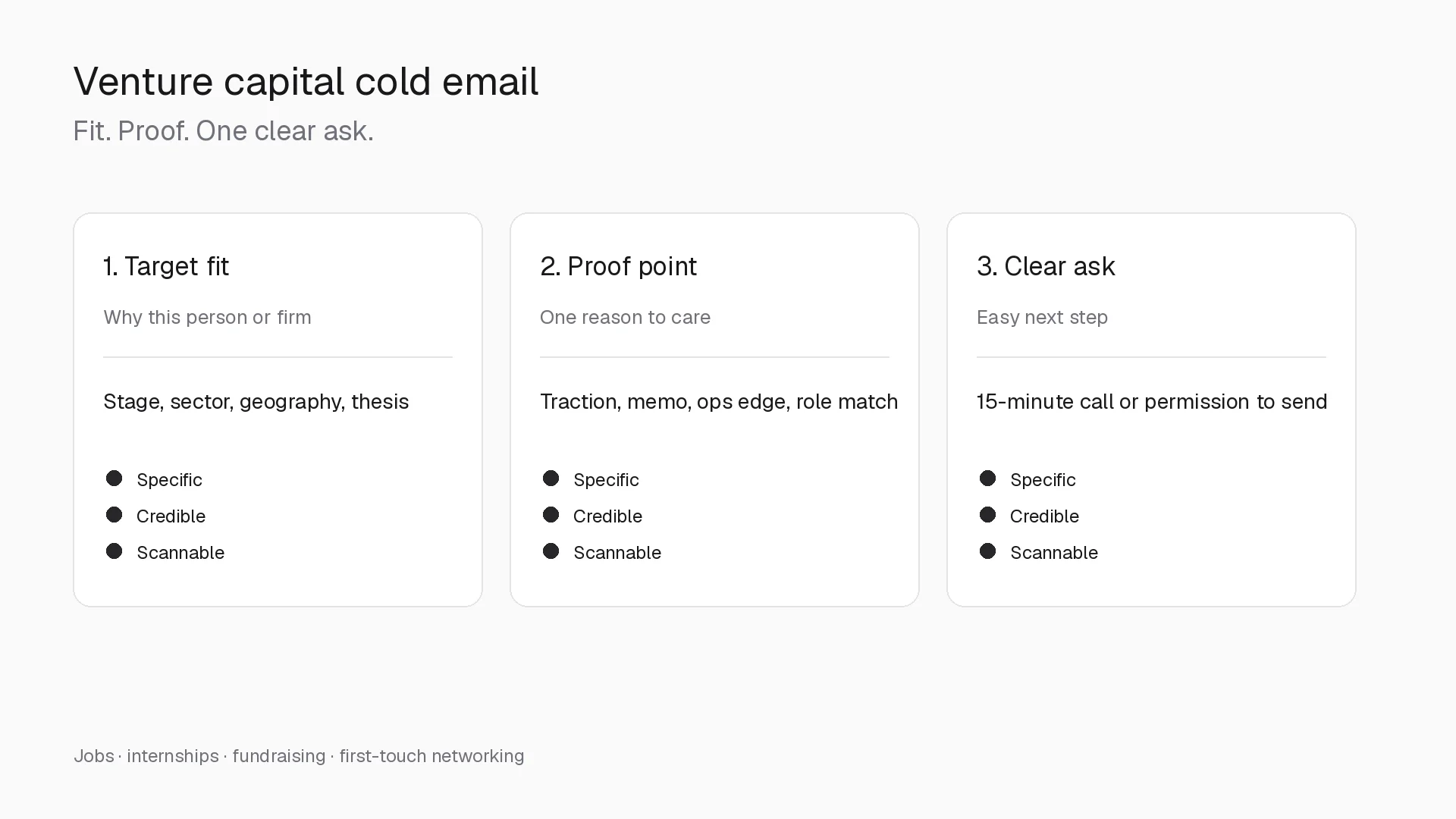
A useful venture capital cold email does three things fast: it proves the recipient is a deliberate fit, gives one credible proof point, and makes the next step easy. That holds for a founder emailing an investor, a student asking about internships, or a candidate reaching someone at a VC firm before or after applying.
Treat the message as a short relevance test, not a cover letter, pitch deck, or life story. If the reader can see the fit, the proof, and the ask in under a minute, the email has a chance of earning a reply.
Pick the right cold-email goal before you write
Most advice online collapses every VC cold email into a fundraising pitch. The goal changes the proof point and the ask. Pick one before drafting.
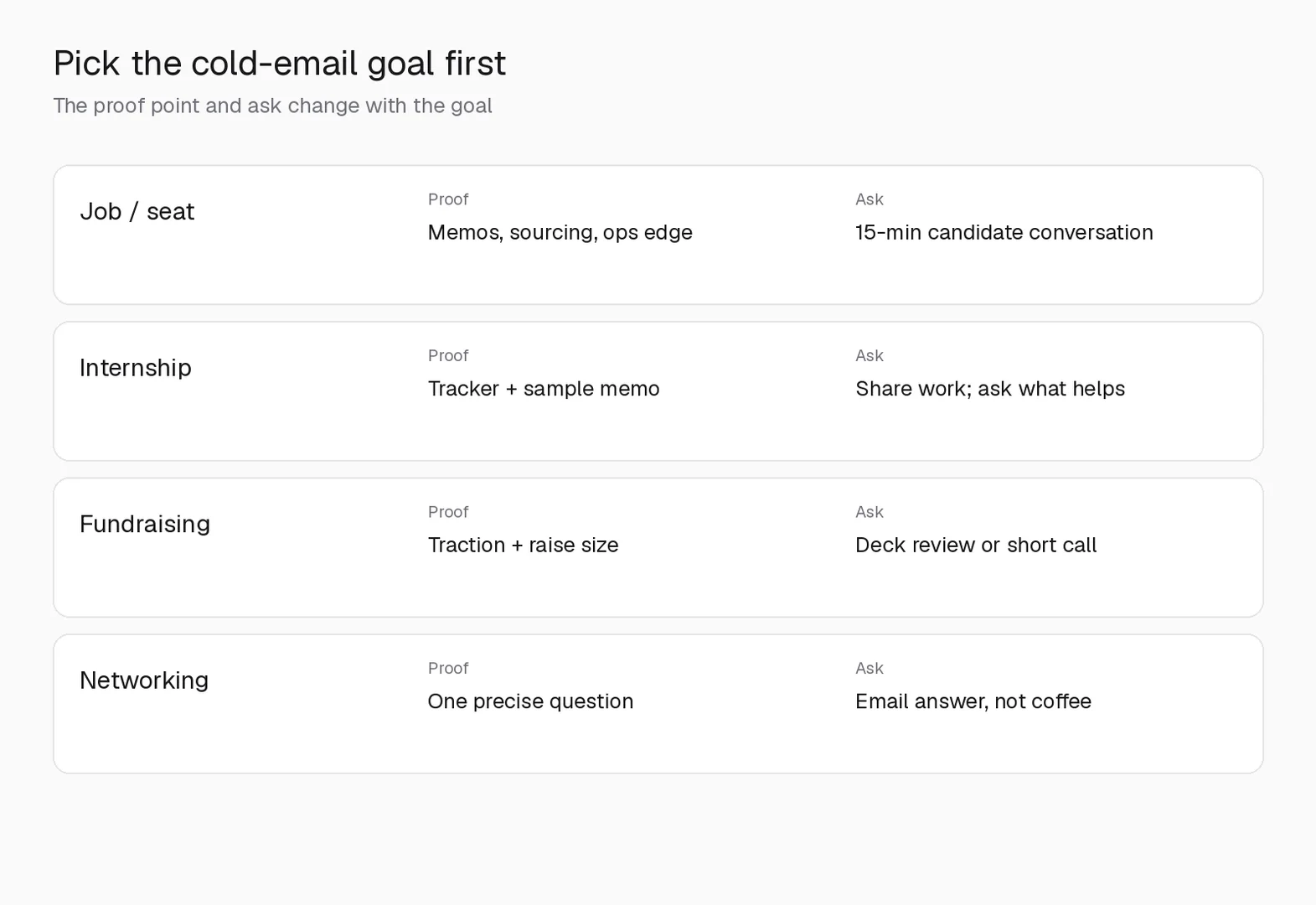
| Goal | Proof that matters | Good ask | Wrong ask |
|---|---|---|---|
| Job / investing seat | Sector reps, memos, sourcing, operating edge, role match | 15-minute conversation about how the team evaluates candidates | "Hire me" with no role context |
| Internship / scout | Trackers, sample memos, campus or community deal flow | Share a short sample and learn what would be useful | "Do you have internships?" with no evidence |
| Fundraising | Traction, customers, growth, raise amount, thesis fit | Permission to share a short deck or a brief call if fit looks right | Full pitch in the first email |
| Networking / advice | Specific question tied to their public work | One precise question by email | Vague "pick your brain" coffee |
Longer relationship sequences belong on the venture capital networking email guide. Investor pass emails to founders belong on how to say no as a VC. This page stays on first-touch cold outreach.
What a good VC cold email must do
The email's job is to earn the next interaction.
| Part | Purpose | Weak version | Stronger version |
|---|---|---|---|
| Target fit | Shows why this person or firm makes sense | "Reaching out to investors" | "Your seed fintech work matches the sector I cover" |
| Proof point | One reason to pay attention | "Passionate about startups" | "Built a map of 80 fintech infrastructure companies and wrote three short memos" |
| Clear ask | Makes the next step easy | "Would love to connect sometime" | "Open to a 15-minute call next week?" |
The proof point changes by goal. Founders lean on traction or insight. Candidates lean on investing reps, founder access, sector depth, or a posted-role match.
Venture capital cold email template
Use this base shape:
Subject: [Specific reason for outreach]

Hi [Name],

I am reaching out because [specific reason this firm or person is relevant].

I am [one-line context]. [One credible proof point: traction, investing work, sector insight, operating experience, or role fit].

I am hoping to [specific ask]. Would you be open to [one clear next step]?

Thanks,
[Name]
Most weak emails fail by adding too much around that shape: origin stories, vague praise, multiple asks, or claims without evidence.
Example: VC job seeker cold email
Use this when reaching an investor, principal, platform lead, or hiring manager at a firm.
Subject: Fintech investing background + associate roles

Hi Maya,

I am reaching out because your team invests in early-stage fintech and recently backed several infrastructure companies in payments and compliance.

I am a fintech operator moving into VC. Over the last four years I worked on risk and partnerships at a payments startup, built a private market map of 80 fintech infrastructure companies, and have been writing short investment memos to sharpen sourcing judgment.

I saw your firm sometimes hires associates with operating backgrounds. Would you be open to a 15-minute conversation about how you evaluate candidates for the investment team?

Thanks,
Alex
Why it works: the firm is named for a reason, the candidate angle is clear, and the ask is a short conversation rather than a job on the spot. Confirm stage, sector, geography, and team on the VC companies directory before sending. Pair with a focused venture capital resume when a role is live.
Example: VC internship cold email
Use this when a role is not posted but there is a credible reason to reach out.
Subject: Student sourcing AI infrastructure startups

Hi Daniel,

I am a junior at [University] researching AI infrastructure companies and noticed your firm has made several seed investments in developer tooling.

I have built a tracker of 120 infrastructure startups, written three short investment notes, and helped organize a student founder demo day this semester.

If your team ever brings on part-time interns or campus scouts, I would be grateful to share a short sample memo and learn what would make a useful candidate.

Thanks,
Priya
This beats "Do you have internships?" because it shows contribution. For posted roles, apply through the proper channel and use email as a supplement. Prep materials: how to get a venture capital internship and the venture capital internship cover letter.
Example: founder email to a venture capitalist
Subject: Seed round for compliance automation in private markets

Hi Jordan,

I am reaching out because you have invested in workflow software for financial services teams, including companies selling into fund operations and compliance.

I am the founder of [Company], which helps private-market firms automate regulatory evidence collection. We launched six months ago, have 14 paying customers, and grew revenue 18% month over month across the last quarter.

We are raising a $2.5M seed round to expand engineering and sales. Would you be open to reviewing a short deck and taking a 20-minute call if the fit looks right?

Thanks,
Sam
Compression matters more than clever wording. The investor should see market, proof, raise, and ask without scrolling.
Example: short networking follow-up
Use this after a brief meeting, event comment, or light intro. For fuller sequences and templates, use the venture capital networking email guide.
Subject: Follow-up on healthcare AI investing

Hi Rachel,

Thank you for the comments on healthcare AI investing at yesterday's event. Your point about buyer urgency in provider workflows stuck with me.

I am comparing a few clinical operations companies for a short investment memo and have one question: how do you separate real buyer pain from interesting but unfunded pilots?

Thanks,
Nina
A precise question beats a vague networking call.
Research the firm in ten minutes before you write
"Do your homework" is useless without a checklist. Spend ten minutes and write one fit sentence before opening Gmail.
- Stage: Does the firm invest at the stage you are raising or targeting for roles?
- Sector: Is there a thesis or portfolio pattern that matches your company or expertise?
- Geography: Does the firm invest where you operate or want to work?
- Team: Who actually owns the sector or hiring lane you care about?
- Conflict: For founders, is there an obvious competing portfolio company?
- Open roles: For candidates, check the Venture Capital Careers job board before asking for a job by email.
- Public signal: One recent post, podcast, memo, or portfolio note you can reference without flattery.
If you cannot complete steps 1–4, do not send yet. Use the companies directory to confirm firm facts, then write the one-sentence fit line that opens the email.
Subject lines that work
Specific without inflation.
Good:
Fintech operator exploring associate rolesStudent sourcing AI infrastructure startupsSeed round for compliance automation in private marketsQuestion on healthcare AI investingFormer founder interested in platform roles
Weak:
Quick questionSeeking advicePassionate about venture capitalCan we connect?Amazing startup opportunity
If the subject could go to any firm, rewrite it.
What to include and what to cut
| Include | Cut |
|---|---|
| One sentence on why this person or firm fits | Generic praise about reputation |
| One proof point | Full biography |
| One clear ask | Multiple asks |
| One useful link if needed | Unrequested heavy attachments |
| Honest context | Inflated traction or vague superlatives |
Candidate proof points: sourced companies, memos, founder network, sector expertise, operating experience, analysis, customer insight, or a posted-role match. Founder proof points: customers, revenue, growth, technical edge, team-market fit, or a non-obvious market insight.
How to personalize without sounding forced
Personalization is evidence of deliberate choice, not flattery.
Use one of:
- A firm thesis that matches the company, sector, or background
- A portfolio company that shows relevant market interest
- A partner's sector focus
- A recent post, podcast, memo, or event comment referenced naturally
- A geographic, stage, or business-model match
One specific sentence is enough. A long brand paragraph often reads less credible than a short, accurate reason for fit.
Follow-up timing
Send one short follow-up after several business days if the first email was strong and the recipient is clearly relevant.
Hi [Name],

Quick follow-up on this. Timing may not be right, but the fit with [specific reason] seemed close enough to ask once.

If someone else on the team is a better person for this, a pointer would help.

Thanks,
[Name]
After that, stop unless there is a real update: new customer, published memo, role opening, product launch, or warm intro. Repeating "just bumping this" is not an update.
When not to send a cold email
Do not send yet if:
- There is no specific reason the person is relevant
- The only proof is interest, not evidence
- A job is the ask and open roles have not been checked
- The firm does not invest in the stage, sector, or geography (for fundraising)
- The recipient has to infer the ask
- The email only makes sense with attachments
For job seekers, check the job board first. If a relevant role is open, apply through the proper channel and use cold email as a thoughtful supplement. Create a candidate profile so the search is not dependent on one message.
What to have ready if they reply
A reply is not the finish line.
- Candidates: tight resume, clear reason for the firm, two or three thoughtful questions, and readiness for a case-style discussion
- Interns: sample memo or tracker excerpt, availability windows, and a short explanation of what work you can contribute
- Founders: short deck, clean fundraising ask, and a crisp explanation of thesis fit
- Networking: the answer to the question you asked, plus one optional follow-up question
If the conversation goes well, thank-you notes belong on the venture capital interview thank-you email guide.
FAQ
Do cold emails to venture capitalists work?
They can when the message is highly relevant and easy to answer. Warm introductions often work better, but a concise cold email with clear fit and a credible proof point can still earn a reply.
How long should a VC cold email be?
Short enough to read in under a minute. In practice that is usually four to seven sentences: reason for fit, context, proof point, ask, and sign-off.
Should I attach my resume or pitch deck?
For job outreach, link a resume only when it helps and is not intrusive. For founder outreach, a short deck link can help if the email already makes the opportunity clear. Do not make the attachment do all the work.
What is the best ask in a cold email?
One small next step: a 15-minute conversation, permission to send a short memo or deck, feedback on fit, or a pointer to the right person. Avoid stacking job, investment, referral, and advice in one message.
How many follow-ups should I send?
One thoughtful follow-up if the recipient is relevant. Stop after that unless there is a real update or a new reason to reach out.
Next steps on Venture Capital Careers
Cold email is one channel inside a broader system:
- Research firms on the VC companies directory
- Track investing, platform, operating, and internship roles on the VC job board
- Use how to get a job in venture capital for the wider break-in path
- Prep a resume that shows investing judgment, not just startup interest
- Keep networking sequences on the networking email guide and investment writing on the investment memo guide
If a reply arrives, be ready with the materials above. The email only buys the next conversation.
Related posts
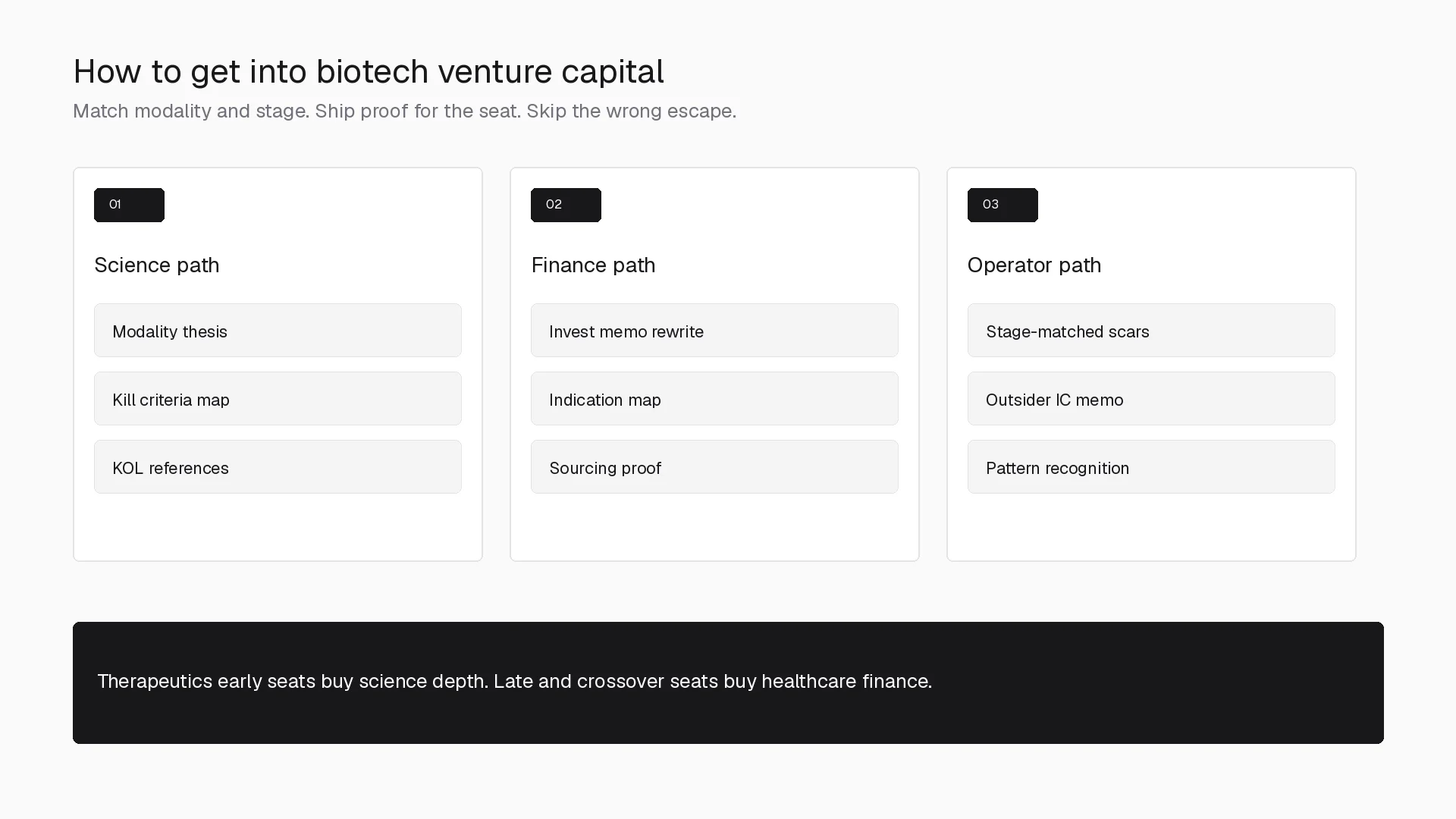
A practical guide to getting into biotech venture capital: seats by stage and modality, which backgrounds win, what proof to build, and when not to go.
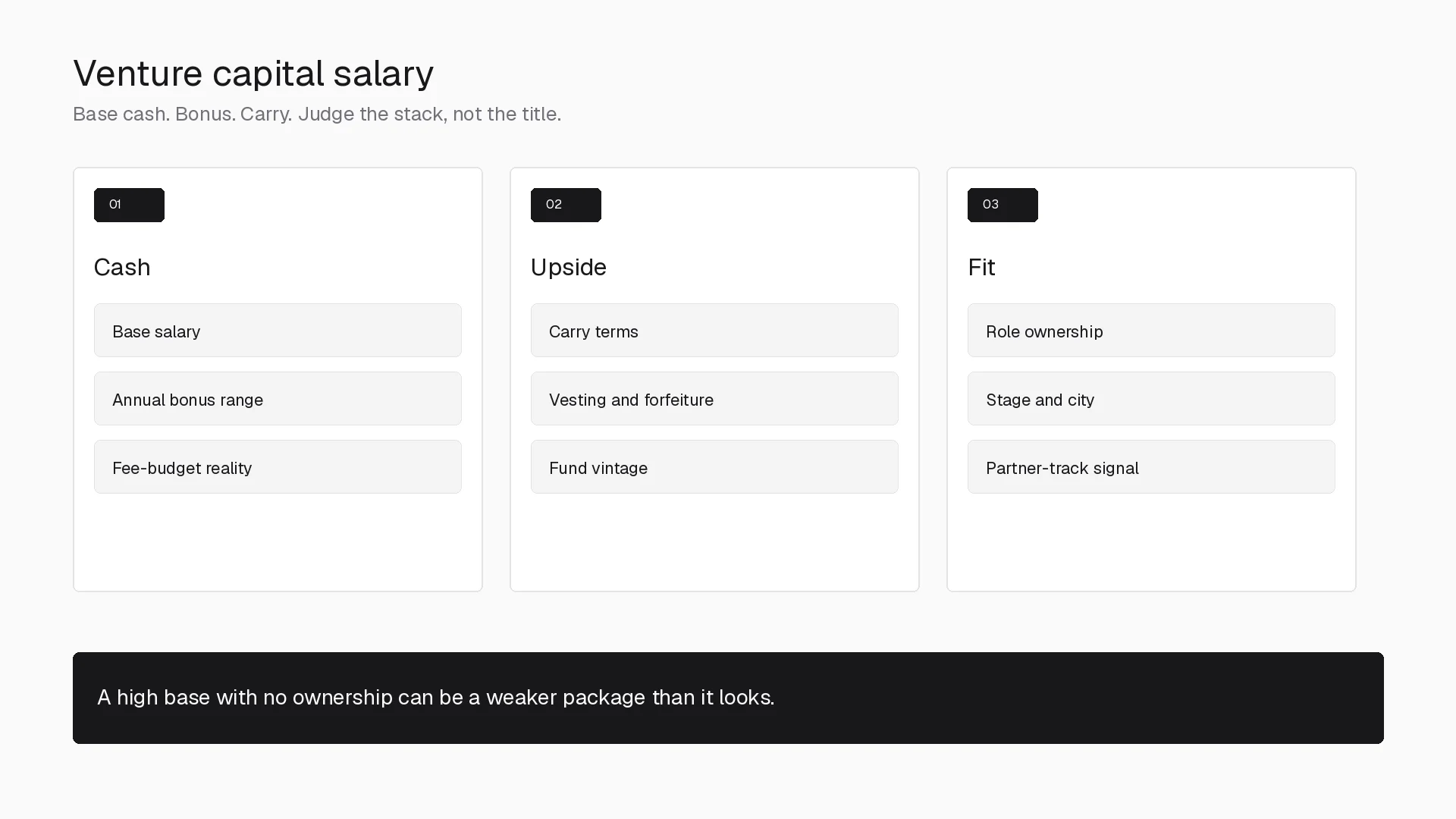
US venture capital salary ranges by role, how bonus and carry work, what moves pay by fund size and stage, and how to triangulate a VC compensation offer.
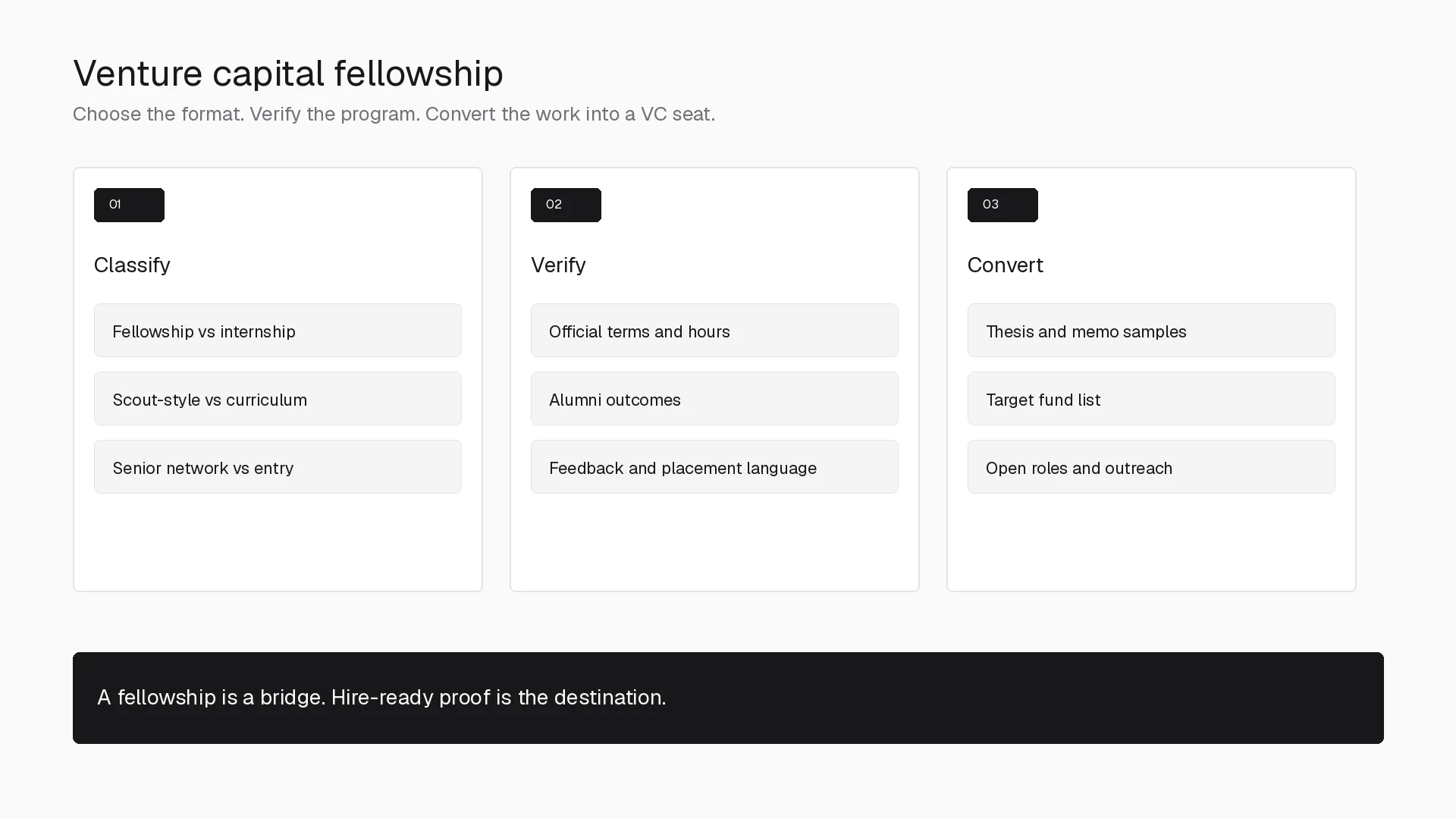
Compare VC fellowship formats, verify a program before you commit, apply with a real edge, and turn fellowship work into a venture capital job search.