
A venture capital internship cover letter should do more than say you are interested in startups. It should show that you understand the fund, can do useful intern-level work, and have evidence that connects your background to venture capital.
For an internship, that evidence does not need to be full-time deal experience. It can be a student investment fund, a market map, founder interviews, startup work, finance coursework, a research memo, a campus entrepreneurship role, or a sector thesis you can defend.
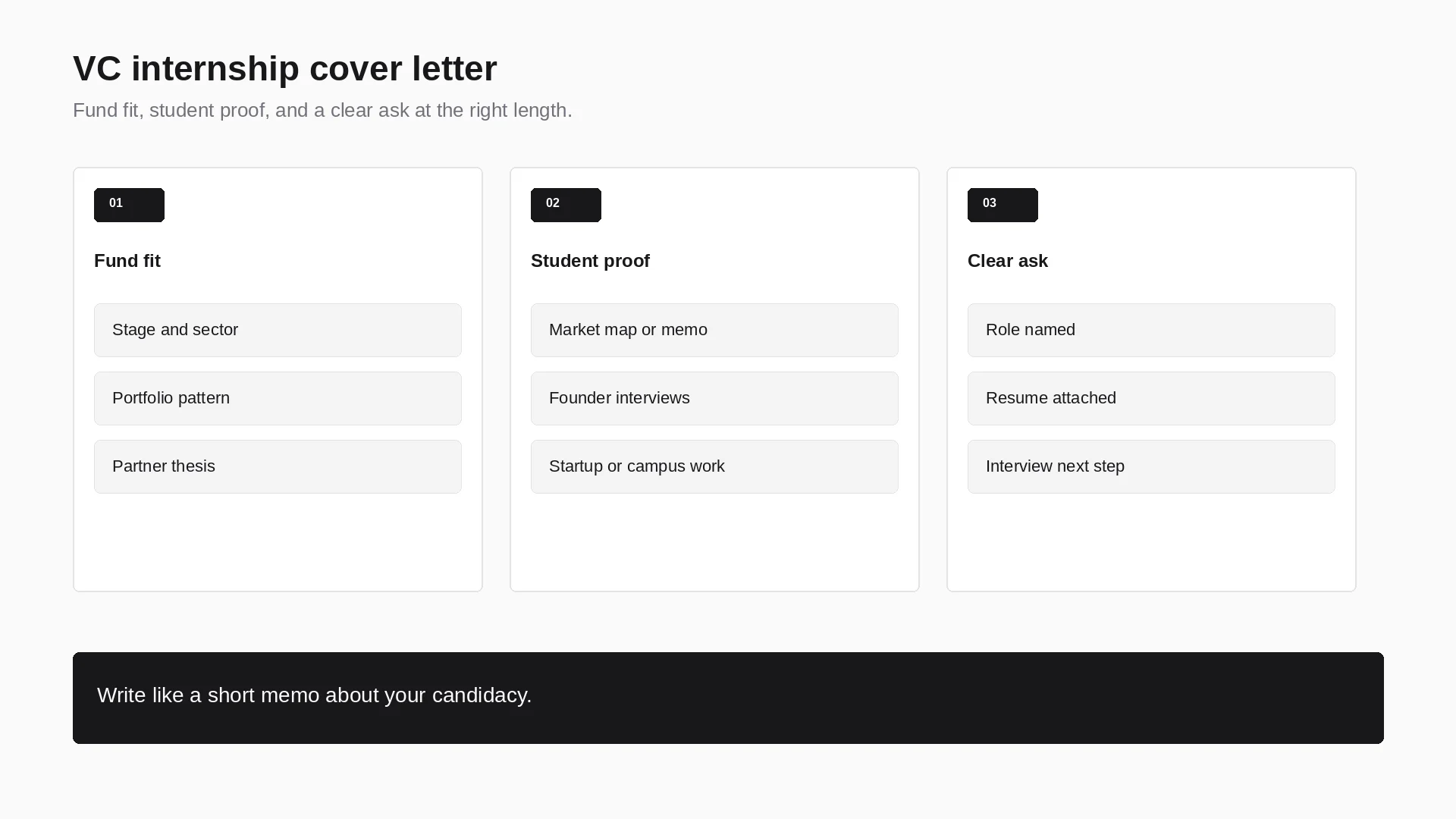
The best VC internship cover letters are short, specific, and grounded in the fund's actual work. They answer four questions quickly: why this fund, why this role, what proof you have, and what you want the reader to do next.
What a VC internship cover letter needs to prove
Most intern candidates have limited investing experience. That is normal. The letter should not pretend otherwise. It should translate student or early-career work into the signals a VC firm can use.
| Signal | What it means | Strong intern evidence |
|---|---|---|
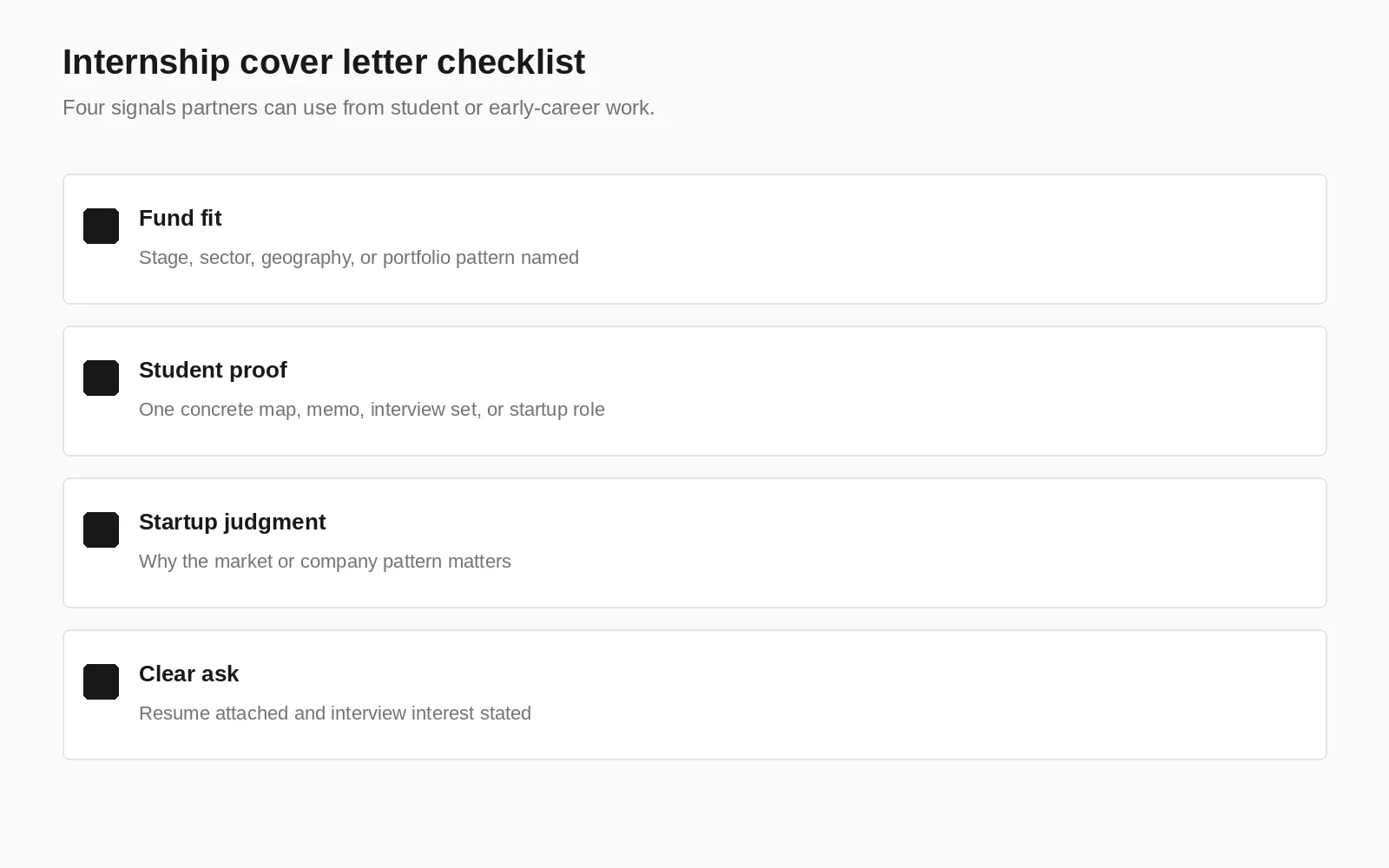
| Fund fit | You know what the firm invests in | A stage, sector, geography, portfolio company, partner thesis, or market theme |
| Analytical ability | You can evaluate markets and companies | Market research, financial analysis, memo writing, customer research, or startup analysis |
| Startup judgment | You think beyond generic finance interest | Founder conversations, startup work, product curiosity, or a clear thesis |
| Writing discipline | You can communicate clearly | Concise memo, newsletter, research note, campus fund write-up, or polished application |
| Follow-through | You can make the next step easy | Resume attached, work sample offered, interview interest stated clearly |
The letter should support your resume, not repeat it. Use the venture capital resume guide so the resume carries the details, then use the cover letter to explain why those details matter for this fund.
When to write a separate internship cover letter
Use an internship-specific cover letter when the posting is for a summer analyst, off-cycle intern, venture fellow, campus scout, student investor, or part-time investment intern role.
Do not simply reuse a full-time analyst cover letter. A full-time analyst letter usually emphasizes sourcing, diligence, memos, market maps, and investment team support at a higher level of readiness. An internship letter can still include those ideas, but it should be honest about your current stage.
If you are applying for a full-time analyst role, use the venture capital analyst cover letter guide instead. If you are still deciding where internships fit into your search, start with the broader guide on how to get a venture capital internship.
VC internship cover letter structure
Keep the letter to one page. If you are sending it as an email, keep it even shorter.
| Section | Purpose | What to include | What to avoid |
|---|---|---|---|
| Opening | State the role and hook | Role, fund name, one specific reason the fund fits your interests | Generic "I am passionate about venture capital" language |
| Fund fit | Show you researched the investor | Stage, sector, geography, portfolio company, partner writing, or thesis | Flattery without evidence |
| Student proof | Translate your background | Campus fund, market map, finance project, startup role, founder interviews, research memo | Listing every class or activity |
| Internship contribution | Connect proof to work | Research, sourcing support, memo writing, market mapping, customer calls, portfolio support | Overclaiming deal ownership |
| Close | Make the next step easy | Resume attached, interview interest, optional work sample | Long summaries or multiple asks |
Think of the letter as a short investment memo about your candidacy. The opening is the thesis. The middle is evidence. The close is the ask.
Venture capital internship cover letter template
Dear [Name],
I am applying for the [Venture Capital Intern / Summer Analyst / Investment Intern] role at [Fund]. I am interested in [Fund] because of your focus on [stage / sector / geography / thesis], especially [specific portfolio company, market, partner article, or investment theme]. My background in [student fund / finance coursework / startup work / research / consulting project / technical project] has prepared me to contribute to market research, company analysis, and investment team support.
At [University / Organization / Company], I [specific proof point]. For example, I [built a market map, wrote an investment memo, interviewed founders, analyzed a startup, supported a student fund, worked at a startup, or researched a sector]. This helped me develop [skill 1], [skill 2], and [skill 3], which are directly relevant to evaluating early-stage companies and supporting a VC team.
I am particularly drawn to [Fund]'s work in [specific theme]. I would be excited to bring my [sector interest / research habit / analytical background / startup exposure] to an internship where I can help with research, sourcing support, and diligence preparation. I have attached my resume and would welcome the opportunity to discuss how I could contribute.
Sincerely,
[Your Name]
Venture capital internship cover letter example
Dear Ms. Rivera,
I am applying for the Venture Capital Intern role at Horizon Seed Partners. I am interested in Horizon because of the firm's focus on pre-seed and seed software companies serving overlooked operational workflows, especially your investments in vertical SaaS tools for healthcare and local services. My background in a student investment fund and independent market research has prepared me to contribute to market mapping, company analysis, and investment team support.
At Lakeside University, I help lead the entrepreneurship club's startup research group. This semester, I built a 35-company market map of healthcare workflow software, interviewed five student founders and operators, and wrote a short memo on why specialty clinics are adopting lighter-weight scheduling and billing tools. That work helped me practice the same skills a VC intern needs: finding relevant companies, asking useful market questions, and turning scattered information into a clear point of view.
I am particularly drawn to Horizon's view that vertical software markets are often won through narrow workflow depth before broader platform expansion. I would be excited to bring my research habit, founder curiosity, and writing discipline to an internship where I can support sourcing research, market maps, and diligence preparation. I have attached my resume and would welcome the opportunity to discuss how I could contribute.
Sincerely,
Maya Chen
How to tailor the letter by background
The strongest proof point depends on what you have actually done. Choose one or two examples and make them specific.
| Background | Lead with | Translate into VC language |
|---|---|---|
| Student investment fund | Memos, pitches, diligence, sector work | You have practiced investment thinking in a structured setting |
| Finance or accounting coursework | Analysis, modeling, valuation, written projects | You can handle analytical work and learn deal mechanics |
| Startup role | Product, customers, GTM, founder context | You understand how early companies operate |
| Campus entrepreneurship | Founder network, events, student startups | You can source conversations and build relationships |
| Technical background | Product judgment, developer insight, market curiosity | You can evaluate technical markets with more depth |
| Consulting or research project | Market sizing, interviews, synthesis | You can structure ambiguity and write clearly |
If your background is light, do not fill the space with vague enthusiasm. Build one strong proof point before you apply: write a one-page market map, analyze three startups in a sector, interview two founders, or summarize a fund's portfolio pattern.
How to research the fund before writing
A generic fund-fit paragraph is the easiest way to weaken the letter. Before writing, gather enough evidence to make the paragraph specific.
Use five filters:
| Filter | What to look for |
|---|---|
| Stage | Pre-seed, seed, Series A, growth, or multi-stage |
| Sector | Enterprise, fintech, healthcare, climate, consumer, AI, deep tech, marketplaces |
| Geography | Local ecosystem, national coverage, or global mandate |
| Portfolio pattern | Similar companies, business models, customer types, or founder profiles |
| Role expectations | Research, sourcing, events, portfolio support, data work, content, or community |
The Venture Capital Careers companies directory can help you build a shortlist of firms by market and role fit. Then use the VC job board to compare live roles and see what internship postings actually ask for. Create an account at join Venture Capital Careers if you want saved searches and alerts while you tailor letters.
PDF, email body, or form box: three internship letter lengths
Internship applications rarely use one channel. The thesis stays the same. The word budget changes.
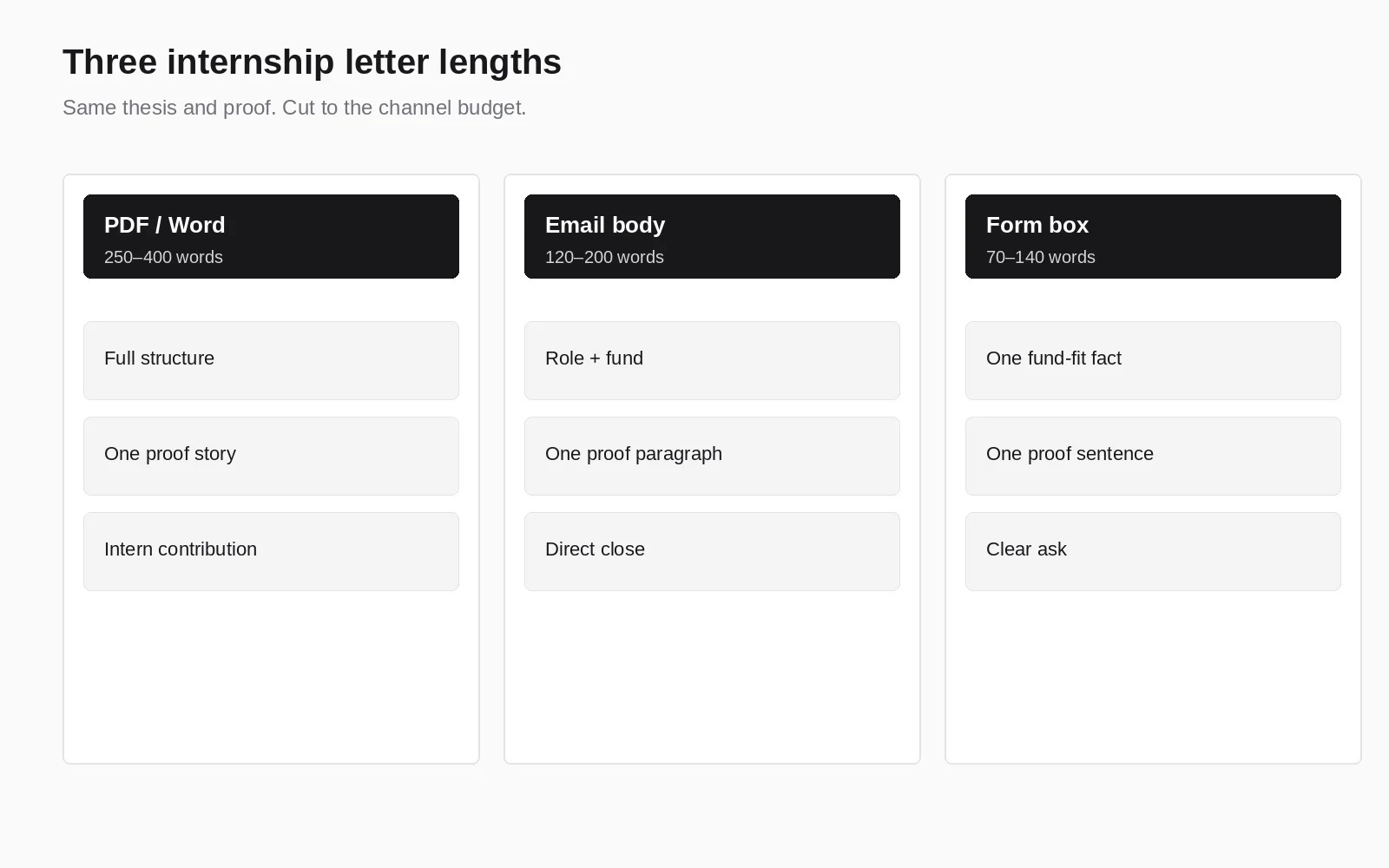
| Channel | Typical budget | Keep | Cut first |
|---|---|---|---|
| PDF / Word attachment | One page, about 250–400 words | Full structure, one student proof story, clear intern contribution | Second proof point, course laundry list, soft thanks |
| Email body | About 120–200 words | Role + fund, one thesis line, one proof paragraph, close | Formal postal header, resume restatement |
| Greenhouse / Lever / LinkedIn text box | About 70–140 words | Role, one fund-fit fact, one proof sentence, ask | Template filler, multiple praise paragraphs |
Rules that travel across channels:
- Reuse the same role, fund, and proof point. Do not invent a second story for the short version.
- Put the fund-specific detail in the first two sentences of every version.
- If the form says optional and you only have a generic letter, skip it and improve the resume instead.
- If you are applying for full-time analyst roles, use the venture capital analyst cover letter guide. The readiness bar is higher.
Common mistakes in VC internship cover letters
Writing a generic finance letter
Venture capital is not just finance. A good intern letter should show curiosity about startups, markets, founders, and why a fund's strategy makes sense.
Repeating the resume
Do not turn every bullet into a paragraph. Pick the best proof point and explain why it matters for this fund.
Overclaiming investing experience
If you helped a student fund write a memo, say that. Do not imply you led institutional diligence or sourced a major deal unless you did.
Naming a portfolio company without insight
It is not enough to say you admire a portfolio company. Explain what the company reveals about the fund's thesis or why the market interests you.
Forgetting the intern job
The letter should connect to work an intern can actually do: market maps, research, company lists, event support, founder notes, memo drafts, and diligence preparation.
Final checklist before you send
Before submitting the letter, check every line against this list:
- The first paragraph names the exact fund and role.
- The fund-fit paragraph includes a real stage, sector, thesis, portfolio company, or geography.
- The proof paragraph uses one or two concrete examples.
- The letter explains what you can do as an intern.
- The length matches the channel: PDF, email body, or form box.
- The tone is direct and professional.
- The letter does not repeat the resume line by line.
- The resume and cover letter tell the same story.
- The firm name, role title, and contact name are correct.
- The close makes the next step easy.
After the cover letter: prepare for the process
The cover letter is only one part of the internship process. Pair it with a focused resume, a firm target list, and interview preparation.
Start with open roles on the Venture Capital Careers job board. Research each firm in the companies directory, then align your resume with the venture capital resume guide. If you get an interview, prepare with venture capital internship interview questions. For the broader break-in path, see how to get a job in venture capital and how to become a venture capital analyst.
FAQ
Do I need a cover letter for a VC internship?
If the posting asks for one, yes. If it is optional, a short and specific letter can still help when you have a clear reason for the fund and a proof point that does not fully fit on your resume.
What should a VC internship cover letter include?
It should include the role, fund name, fund-fit reason, one or two proof points, the kind of intern work you can support, and a direct closing sentence.
Can I write one without previous VC experience?
Yes. Use adjacent evidence: student fund work, market research, startup experience, founder interviews, finance projects, technical projects, or a sector thesis.
How long should the letter be?
One page maximum for a PDF. For email outreach or form boxes, shorter is better. Match the channel budget rather than pasting the same long letter everywhere.
Should I mention specific portfolio companies?
Yes, if you can explain why they matter. A portfolio name without insight feels generic. Tie the company to the fund's thesis, stage, sector, or market pattern.
Should I send the same letter as a PDF and in email?
Keep the same thesis and proof point, but cut to the channel. A PDF can carry the full structure. An email body should drop the formal header and tighten to a few short paragraphs. A form box should be even shorter.
Related posts
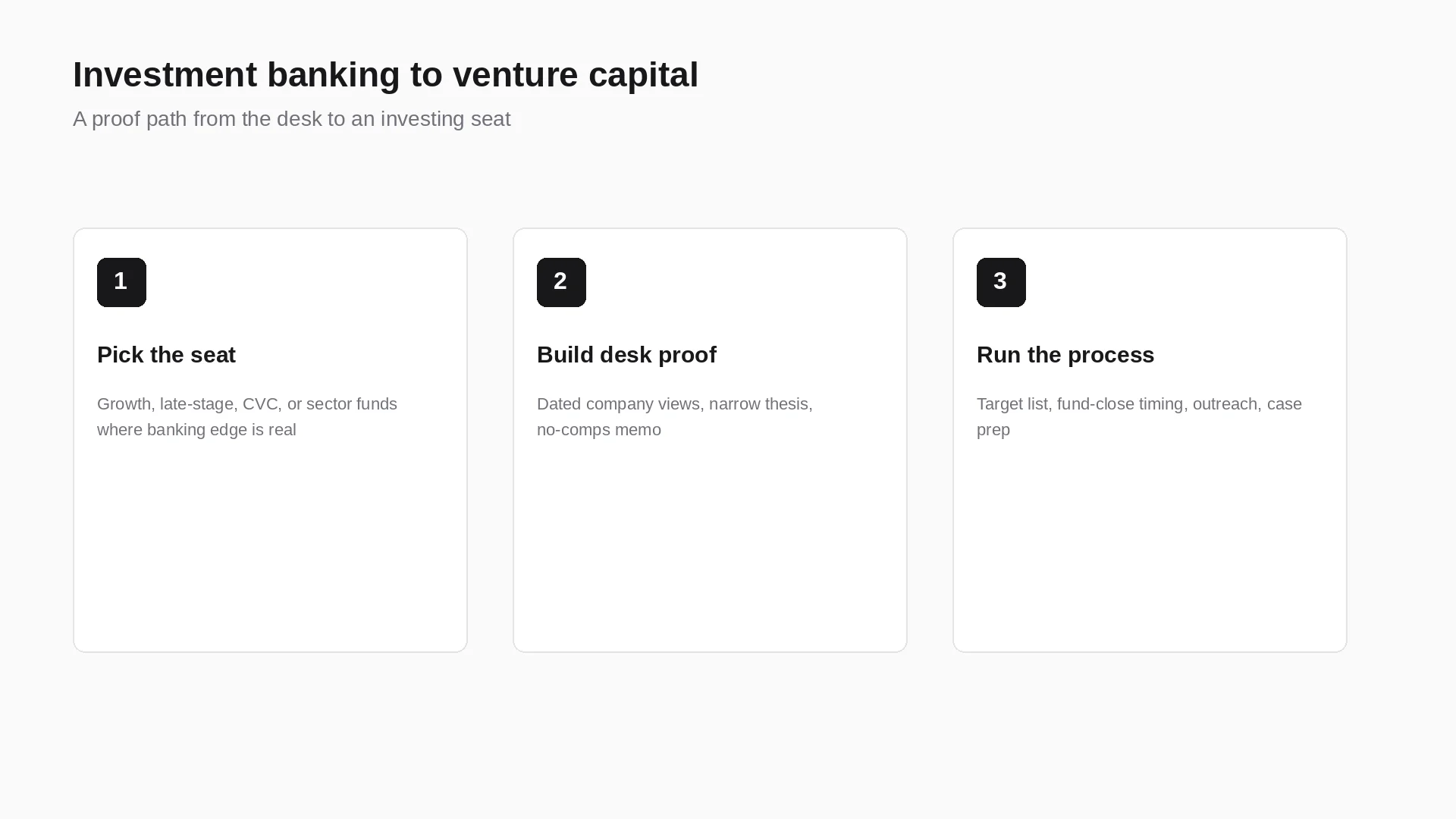
How investment bankers move into venture capital: which seats hire, what to unlearn, how to build proof on the desk, rewrite your resume, and run a 30-day transition plan.
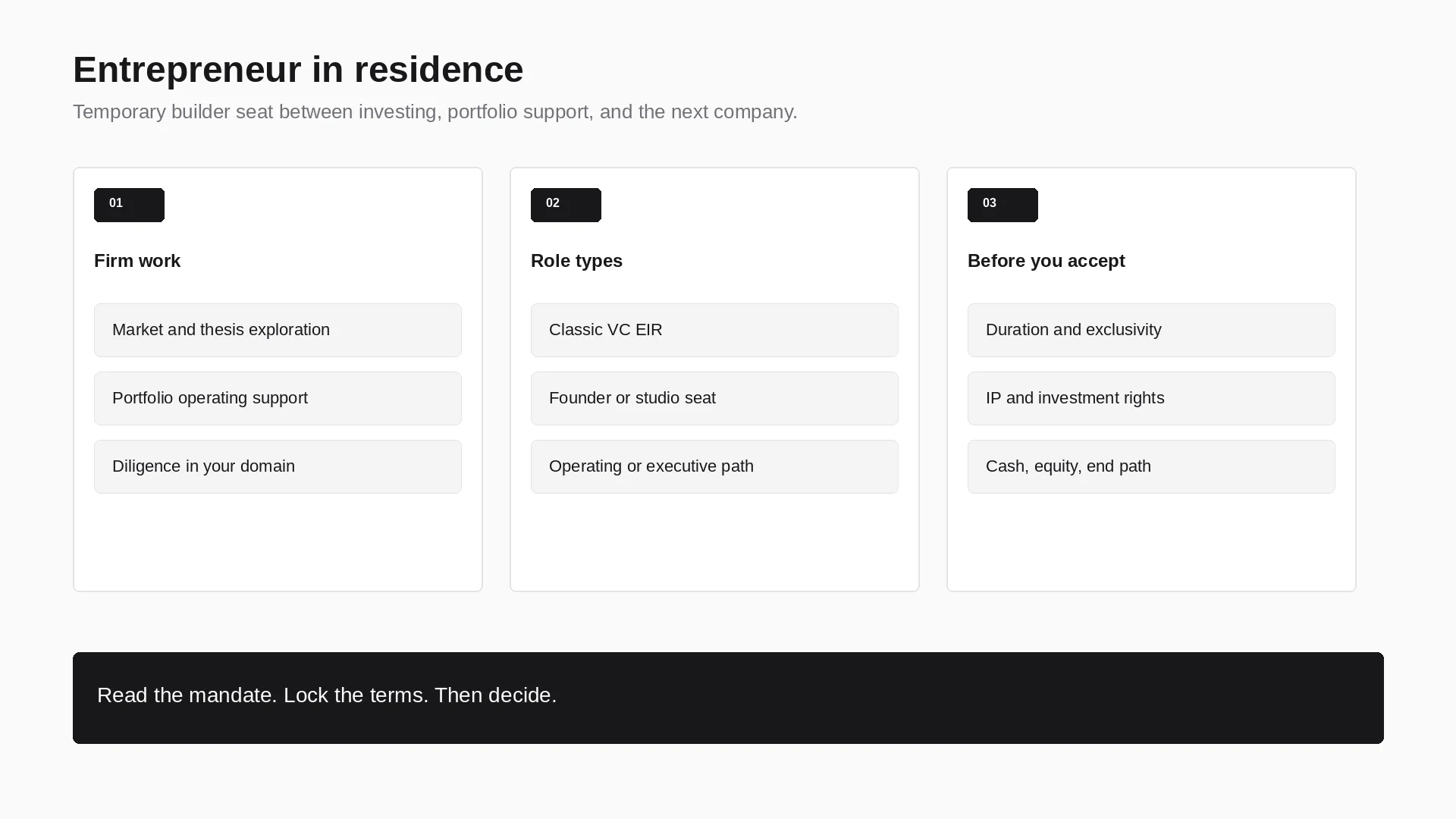
What an entrepreneur in residence does at a VC firm, how EIR roles differ, which mandate terms to lock before accepting, and how to find EIR jobs.
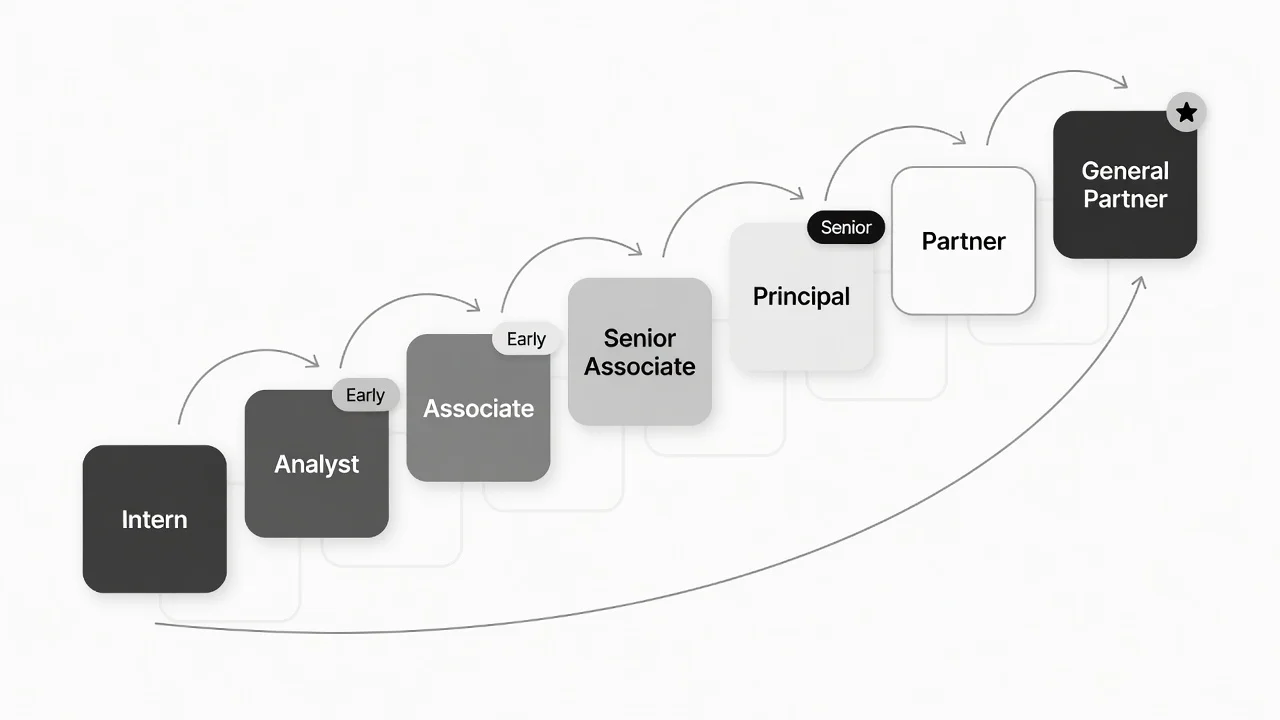
How the VC career ladder works from analyst to partner, with title translation by firm size, pay ranges, entry-path choices, partner-track realism, and how to read job postings for career-path signals.