
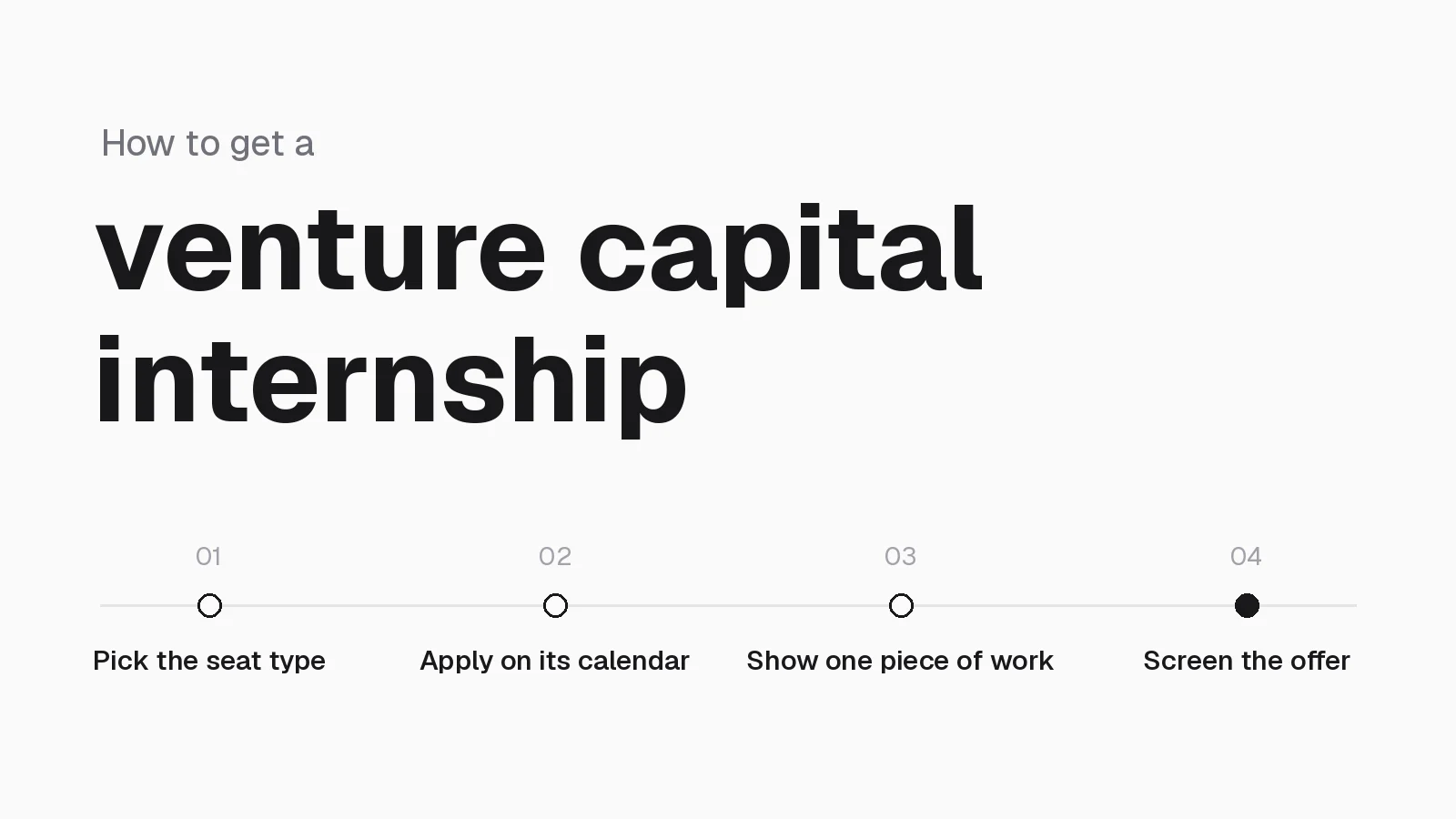
Most venture capital internships come from two places. A handful of large firms run structured summer programs that can recruit more than a year ahead, and a much larger number of small funds take interns when they need help, often without posting the role. Students who land a seat pick the internship type that fits their year, apply on that type's calendar, show one piece of real work before asking, reach 15 to 20 funds through warm introductions and short emails, and check the scope, pay, and mentor before accepting.
What a venture capital internship is
A VC internship is a temporary seat on or beside a fund's investing team. Interns do the work that stretches a small team's time. They screen inbound pitch decks, build market maps, research competitors, draft sections of investment memos, take notes on founder calls, and keep the deal-flow tracker current. At small funds the job also includes database cleanup and one-off projects for portfolio companies.
What an intern rarely does is make the call. A partner decides; the intern supplies evidence. Interviewers know this, so they look for someone who will produce clean, finished work under supervision, not someone who claims to pick winners.
The label covers five different arrangements. Know which one you are chasing, because each recruits on a different calendar and pays differently.
| Type | What it is | Typical length | Who it suits |
|---|---|---|---|
| Structured summer program | A defined class of summer analysts at a large or growth-stage firm, with interviews, a start date, and a mentor | About 10 weeks | Undergraduates a year or two before graduation; MBA students between first and second year |
| In-semester seat at a small fund | Part-time, often remote work at a seed or early-stage fund, scoped by one partner | A semester, often renewed | Students who can give 10 to 15 hours a week during term |
| Student-run fund or fellowship | A campus or cohort program that trains students to source and assess startups | One to two years, part-time | Undergraduates who want reps before a formal internship |
| Portfolio-company internship | An internship at a startup the fund backs, sometimes run through the fund's talent team | A summer | Technical and product students; a side door to the fund's network |
| Project engagement | A bounded deliverable such as a sector map or diligence support on one deal | A few weeks | Career changers and graduate students testing fit |
A fellowship or scout title can be useful, but it is not the same as a seat inside one fund. The venture capital fellowship guide compares those programs, and the day in the life of a VC intern walks through an ordinary week in the seat.
Which firms hire interns
Firm size and stage decide what kind of internship exists.
| Firm type | Internship pattern | What they expect |
|---|---|---|
| Large growth and multi-stage firms | Formal summer analyst classes with a published recruiting calendar | Strong academics, a sharp view on software or another sector, polish in a multi-round process |
| Mid-sized early-stage funds | Occasional summer or part-time interns when a fund is new or the team is stretched | Sourcing help, research, memo support, some independence |
| Seed funds and emerging managers | Ad hoc seats, usually unposted, scoped around one partner's need | Initiative, a specific edge such as campus founder access or a technical domain |
| Corporate venture arms | Interns often hired through the parent company's internship system | The parent's application process and work authorization rules |
| Student-run funds and campus programs | Cohort recruiting each term | Commitment across the school year and a sourcing network |
Two consequences follow. First, the best-known firms are not where most internships are. Many brand-name partnerships hire few or no undergraduate interns, so a list of famous names alone produces silence. Second, small funds see fewer polished applicants and often have the most work to hand out. A five-person seed fund cannot run a summer class, but one partner can say yes to a student who already sent a useful market map.
Sort firms by stage and sector first, then check each firm's own site and team page for a careers or campus section.
Which path fits your background
Your year in school and your prior experience narrow the realistic options. Aim at the seat that fits now and keep one stretch target.
| You are | Realistic first internship | Main route in | What to have ready |
|---|---|---|---|
| First or second year undergraduate | Student-run fund, fellowship, in-semester seat at a small fund, portfolio-company internship | Campus clubs, alumni, cold outreach to seed funds | One market map or startup write-up, a short resume |
| Undergraduate a year or two from graduating | Structured summer program at a large firm, or a summer seat at an early-stage fund | Firm application portals early in the cycle, plus warm intros | Transcript, a sector view, two companies you can pitch |
| MBA student | Summer associate or in-semester role at a fund, often found through classmates and the school's VC club | Club treks, alumni, partners who teach or guest lecture | A thesis tied to pre-MBA work, a memo sample |
| Career changer or graduate student | Project engagement, part-time seat, or a fund that values your domain | Your industry network and operator contacts | Proof from your field, such as a teardown of a startup in your industry |
| International student in the US | Large firms and corporate venture arms with an existing intern process | Formal programs first, then funds that have hired international students before | Your work authorization details and dates |
If you are already out of school and looking for a full-time seat, the guide to getting a job in venture capital fits better than an internship search. MBA students can read MBA to venture capital for the business-school calendar.
When VC internship recruiting happens
Structured programs recruit early and on a fixed calendar. Everything else is rolling. Plan for both at once.
The clearest public example is Insight Partners. Its 2028 Summer Analyst Program roadmap opens applications in September 2026, runs recruiting events from September to November 2026, starts interviews and superdays in January 2027, and closes applications on May 1, 2027, for a program that begins in June 2028. The firm reviews applications in the order they are completed. That is a summer internship recruited nearly two years ahead, which is why waiting for "internship season" misses the window.
| Internship type | When outreach or applications start | When decisions usually land |
|---|---|---|
| Structured summer program at a large firm | Fall, sometimes more than a year before the summer; apply early in the window when review is rolling | Winter through spring of the following year |
| Summer seat at an early-stage fund | Late fall through early spring before the summer | Spring, sometimes weeks before the start date |
| In-semester seat at a small fund | Four to eight weeks before the term | Rolling |
| Student-run fund or fellowship | Each program's own intake, often fall and spring | Within the term |
| Portfolio-company internship | The startup's own hiring calendar | Rolling |
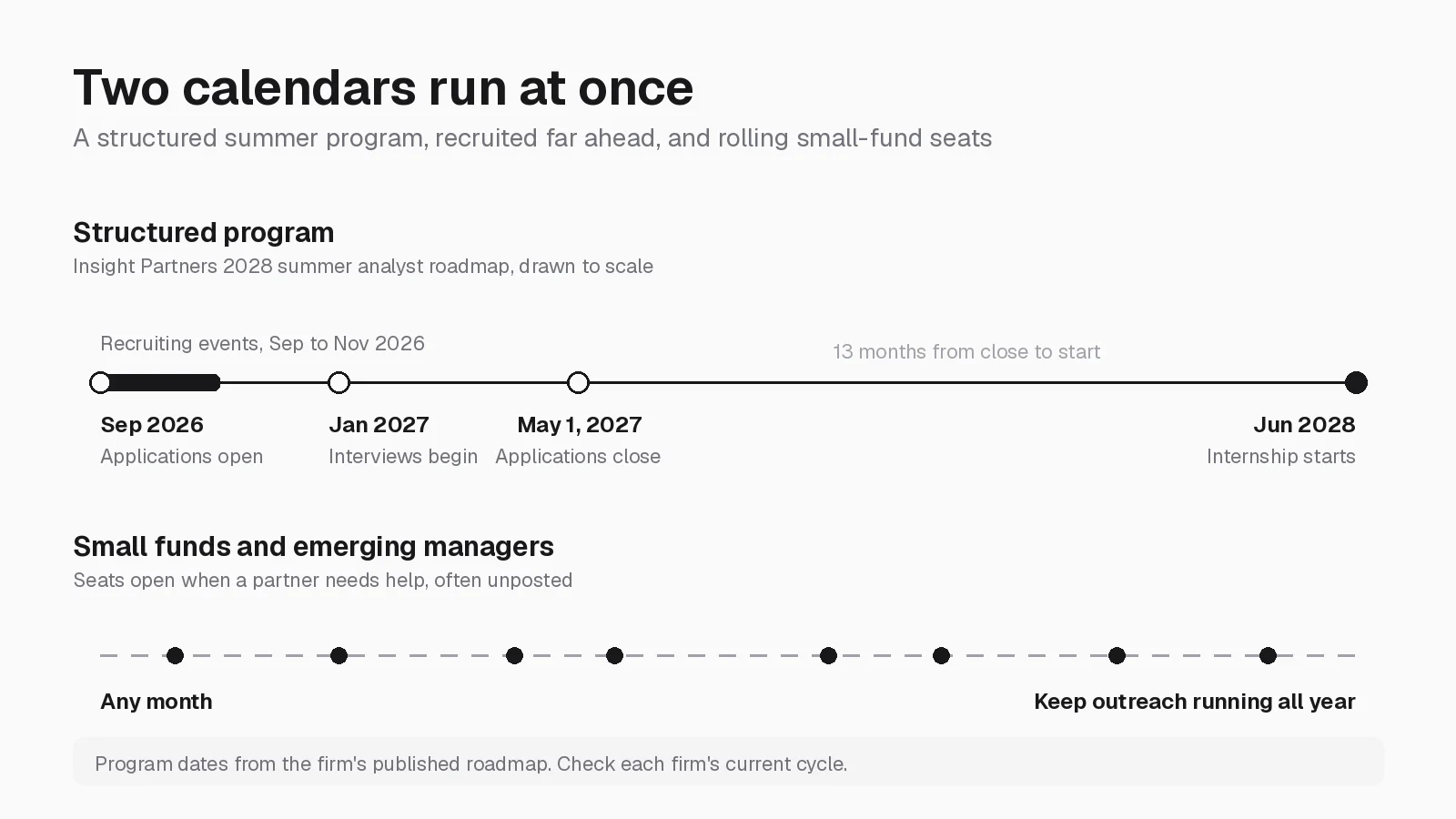
The table is a planning guide, not a promise. Check each firm's site for its current cycle, and keep small-fund outreach running all year, since a partner can decide in any month that a project needs help. The VC recruiting timeline covers on-cycle and off-cycle hiring after the internship stage.
What VC internships pay, and when unpaid is legal
Pay runs from a full prorated salary at structured programs to a small stipend or nothing at seed funds. Larger firms and corporate venture arms tend to pay. Small funds are more likely to offer a stipend, an hourly rate, or school credit.
A useful ceiling is analyst pay. The venture capital salary guide puts analyst base salary at $70K to $115K. Divided across 52 weeks, that is roughly $1,350 to $2,200 a week, so a ten-week summer at a firm that pays interns on its analyst scale would come to about $13,500 to $22,000 before tax. Stipends at small funds can sit far below that band, so weigh mentorship and the work itself alongside the number.
Unpaid internships at US for-profit firms are not automatically legal. The Department of Labor's Fact Sheet #71 says courts use a "primary beneficiary test" with seven factors to decide whether an intern is really an employee:
- Whether both sides understand there is no expectation of pay
- Whether the internship gives training similar to an educational setting
- Whether it ties to your formal education through coursework or academic credit
- Whether it fits around your academic calendar
- Whether its length matches the period of useful learning
- Whether your work complements, rather than replaces, the work of paid staff
- Whether both sides understand there is no promise of a paid job at the end
No single factor decides the question. If the facts show the intern is an employee, the fact sheet says the person is owed minimum wage and overtime. State law can be stricter. This is general information, not legal advice.
In practice, a seed fund that asks an unpaid intern to source deals full-time all summer is in a different position from one that offers a credit-bearing, part-time research project with a mentor. Ask how the role is classified before you start. A fair counter to an unpaid offer is a stipend, an hourly rate for a set number of hours, or academic credit through your school.
What firms look for in an intern
Interviewers hiring an intern want to know whether this person will save the team time without creating cleanup. Evidence that answers it:
- A specific interest. Name a sector, a stage, or a type of founder you follow, and show what you read or built because of it.
- A reason for this fund. Know three portfolio companies and one recent investment, and have a view on it.
- Clear writing. A one-page note a partner can forward without rewriting.
- Analytical basics. Read a pitch deck, spot numbers that do not add up, and understand a simple cap table and income statement.
- Sourcing reach. A campus, a technical community, or a founder network the fund does not already cover.
- Reliability. Replies within a day and work delivered on the date agreed.
- Low ego. Willingness to clean the CRM and organize files.
A finance major is not required, especially at seed funds, where sector knowledge and founder access matter more than modeling. The venture capital skills guide breaks these down by seat.
Build proof before you reach out
One finished piece of work does more than a long list of interests. Build it before the first email, then tailor it to each fund's stage and sector.
| Proof | What it shows | Fund need it answers |
|---|---|---|
| A market map of 30 to 50 companies in one category, with a useful split | You can find companies and organize a market | Thin coverage of a sector the fund is exploring |
| A two-page investment memo on one startup, with a recommendation and the main risks | You can form and defend a view | Memo and diligence workload |
| A list of five early-stage companies the fund should meet, one sentence each | You can source, not only research | Deal flow from a network the fund lacks |
| A fantasy portfolio with written reasons for each pick | Judgment over time | Evidence of investing taste for interviews |
Avoid overclaiming. Offer to support sourcing and research while you learn, rather than presenting yourself as someone who can already pick investments. Offer a scoped trial too. A line such as "10 hours a week this semester covering seed-stage developer tools, with one memo a month" is easier to approve than "do you have any internships?"
Build a target list of 15 to 20 funds
A short, researched list beats a mass email. For each fund, record:
- Stage and check size, if published
- Sector or thesis focus
- City, and whether the team works in person
- Three portfolio companies and one recent deal you have a view on
- One or two people you could reasonably reach, such as an associate, an alum, or a partner who writes publicly
- Whether the firm runs a formal intern or campus program this cycle, and its deadline
- The specific help you could offer in the first month
Mix the list on purpose. Put two or three structured programs on it if you are eligible, then fill the rest with early-stage and emerging funds where your background gives you an edge, such as a local ecosystem, a technical field, or a founder community. Start in the companies directory, then confirm details on each firm's own site, since team pages and theses change.
Warm intros, cold email, and postings
Warm introductions convert best. The usual sources are alumni at funds or startups, professors who teach entrepreneurship or invest, second-year MBA students, campus venture club speakers, and founders you have helped. Ask for advice or one specific introduction after you have something to say about the firm, not before.
Where there is no warm path, a short cold email works when it is specific. Keep it to five or six sentences:
| Line | What it does | Example |
|---|---|---|
| Who you are | One line of context | "I'm a junior at [school] studying computer science and I run our hackathon's sponsor program." |
| Why this fund | Proof you read their portfolio | "Your seed bets in developer tools, especially [company], match what I see founders building on campus." |
| What you made | The proof, attached or linked | "I mapped 40 developer-tool startups that raised pre-seed rounds this year; it's attached." |
| What you offer | A scoped piece of help | "I can spend 10 hours a week this spring screening inbound and adding to the map." |
| The ask | Small and easy to say yes to | "Would a 15-minute call in the next two weeks work?" |
Attach a one-page resume. Reply within a day or two when someone answers, and follow up every two to three weeks with something new, such as a company they should meet or an update to your map, rather than a bare "checking in." The VC cold email template has more versions, and the coffee chat guide covers the call that follows.
Apply to posted roles as well. Titles are inconsistent, so read the description. "Summer analyst," "investment intern," "venture fellow," and "scout" can describe very different seats. Browse open VC roles and create a free account for alerts when funds post internships and analyst seats.
Resume and cover letter
An internship resume should show useful work at intern level, not inflated deal ownership.
- Keep it to one page and lead with the evidence closest to the job, such as research, a student fund, a startup role, or technical projects.
- Quantify where the number is real, for example "screened 60 startups for the campus fund; wrote 4 investment memos."
- List the proof you built and link to it.
- Tailor one version for structured programs at large firms and one for early-stage funds.
The cover letter, or the cover note in an email, needs five things: why this fund, why now, what you can do in the first weeks, one or two pieces of proof, and a clear next step. Structured programs may ask for a recorded video instead; Insight's application, for example, uses a HireVue video cover letter alongside the resume and transcript. Use the VC internship cover letter and VC resume guides for templates.
Interview questions for VC internships
Internship interviews lean on fit, firm knowledge, and judgment. Expect light technical questions at most, except in structured programs that test modeling or run a case.
| Question | What a strong answer includes |
|---|---|
| Why venture capital? | A specific moment or habit that pulled you toward startups, not a dislike of another field |
| Why this firm? | Stage, thesis, and two portfolio companies, with a view on one |
| Pitch a startup you would invest in | Problem, team, traction, market size, round, and the main risk; have three ready that fit the fund |
| What markets interest you now? | One theme with a reason it is timely and two companies inside it |
| What do you think of one of our portfolio companies? | Something you learned from using or researching the product, plus one risk |
| How would you add value as an intern? | The scoped offer from your outreach, restated |
| Walk me through how a fund makes an investment | Sourcing, screening, diligence, memo, partner decision, and term sheet, in plain terms |
Structured programs at large firms often add rounds, such as a video first round followed by an in-person superday. Read the firm's recent posts and portfolio news in the week before. For practice sets, use the VC internship interview questions guide.
How to evaluate an internship offer before you accept
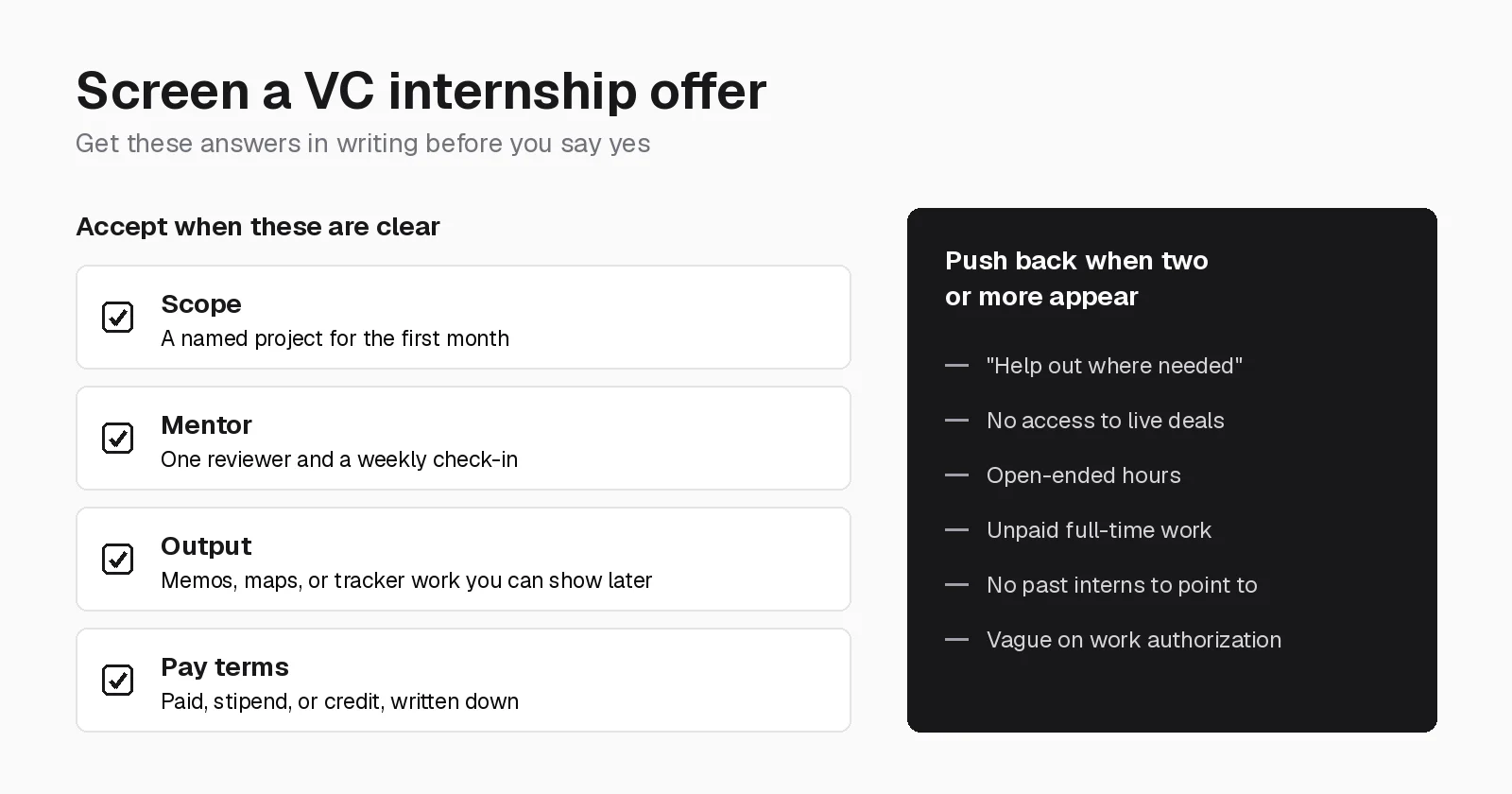
An offer from a small fund often arrives as an email with no job description. Get the basics in writing before you say yes. The answers tell you whether the seat teaches the job or only fills the fund's admin gap.
| Check | Ask | Good sign | Warning sign |
|---|---|---|---|
| Scope | What will I own in the first month? | A named project or deliverable, such as a sector map or screening a share of inbound | "Help out where needed" |
| Mentor | Who reviews my work, and how often? | One named person and a weekly check-in | Work assigned by whoever is free |
| Exposure | Will I join founder calls or partner meetings? | Regular seats on calls, even as note-taker | No access to live deals |
| Hours | How many hours a week, and when? | A stated number that fits your term | Open-ended evenings and weekends |
| Pay and classification | Is it paid, stipended, or for credit? | Written terms; credit arranged with your school if unpaid | Unpaid full-time work that replaces a paid role |
| Output | What does a good intern produce by the end? | A list of memos, maps, or tracker work you can show later | No defined result |
| After the summer | Has anyone converted or been referred onward? | A specific example of a past intern's next step | No past interns, or none they can name |
| Logistics | Location, equipment, and work authorization | Clear answers, and experience with CPT or your visa status if relevant | Vague answers on authorization |
International students on F-1 visas usually need Curricular Practical Training approved by their school's international office before starting. Raise it in the first conversation, because a small fund may never have handled the paperwork.
You will rarely get perfect answers. Accept when scope, mentor, and output are clear and the pay terms are written down. Push back, or keep looking, when two or more warning signs appear.
Make the internship count
A VC internship often does not convert into a full-time offer, because most funds have few junior seats and fill them on their own schedule. Structured programs at large firms are the main exception. Insight, for example, profiles a former summer analyst who returned as a full-time analyst and is now an associate, so ask any large firm directly how its summer class feeds full-time hiring. Everywhere else, treat the internship as a source of proof and references.
- Write something durable on every company you touch, even a one-page note.
- Ask to join founder and partner meetings when appropriate, and send clean notes afterward.
- Get to know portfolio operators as well as investors; they become references and a source of deals.
- Keep a private log of what you worked on, what the team decided, and what you got wrong.
- Two weeks before the end, ask your mentor for direct feedback and whether a return, extension, or referral is possible.
When the internship ends, you should be able to state what you owned, show two or three pieces of work, and name people who will vouch for you. For the next step after school, see how to become a venture capital analyst.
Common mistakes
- Applying only to famous firms and posted roles. Many seats sit at smaller funds and are never listed.
- Starting too late for structured programs. Some open applications in the fall well over a year before the summer and review in order of completion.
- Sending generic emails. "I'm passionate about venture capital" with no company, sector, or attachment rarely gets a reply.
- Overclaiming. Promising to source and evaluate deals before you have written one memo.
- Accepting a vague offer. No scope, no mentor, and no written pay terms usually means admin work.
- Ignoring work authorization until the offer stage.
- Going quiet after the internship. Keep sending the team companies and updates; the relationship is much of what the internship is worth.
Frequently asked questions
Do VC firms hire undergraduate interns?
Yes, but far fewer than banks or consulting firms. Structured summer programs at large growth and multi-stage firms take undergraduates a year or two from graduating. Small funds take students for part-time and project work, and student-run funds recruit on campus.
Can high school students get a venture capital internship?
Formal VC internships are mostly for university students. High school students get closer through startup internships, school entrepreneurship programs, and writing about companies they follow, then apply to student funds once in college.
Are VC internships paid?
Some are paid in full, prorated against an analyst salary, especially at large firms and corporate venture arms. Others pay a stipend or offer academic credit, and some are unpaid. Under the Department of Labor's primary beneficiary test, an unpaid intern at a for-profit firm who is in fact an employee is owed minimum wage and overtime.
Can I get a VC internship without a finance background?
Yes. Seed and early-stage funds often value sector knowledge, technical skill, and founder access over modeling. Bring one piece of written analysis and learn the basics of cap tables and income statements before interviews.
Do VC internships lead to full-time offers?
Sometimes, mostly at large firms whose summer classes feed a full-time analyst program. At small funds, the more common outcome is references and introductions that help the next search.
Are remote VC internships common?
Part-time, in-semester internships at small funds are often remote. Structured summer programs set their own location rules, so ask during the offer stage.
Next step
Choose the internship type that fits your year, put its deadline on your calendar, and build one piece of proof this week. Then browse open VC roles, shortlist funds in the companies directory, and sign up for alerts when internships post.
Related posts
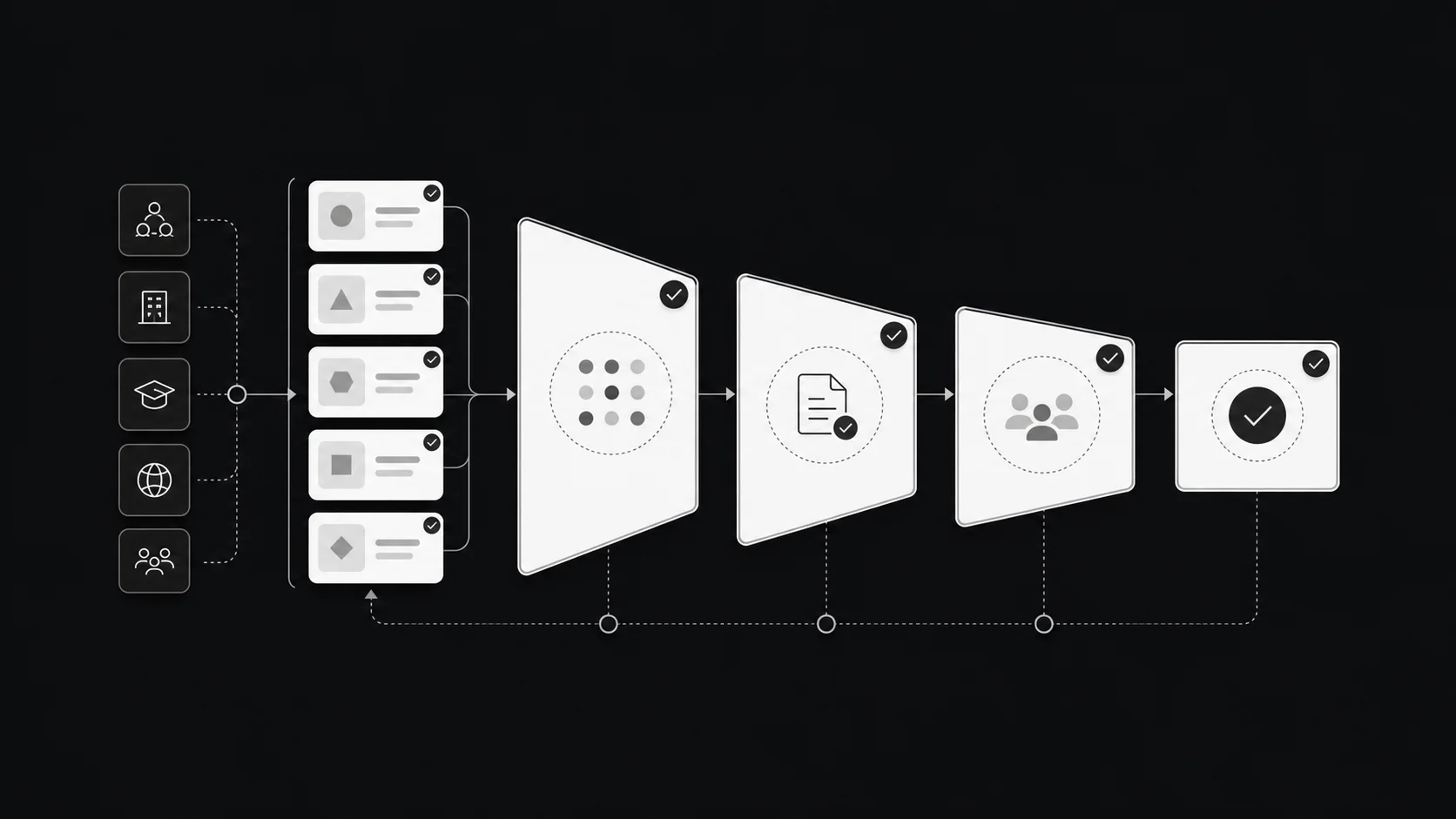
Deal flow is the stream of investment opportunities a venture firm receives and the funnel that sorts them. For every deal closed, firms consider about 101 companies.
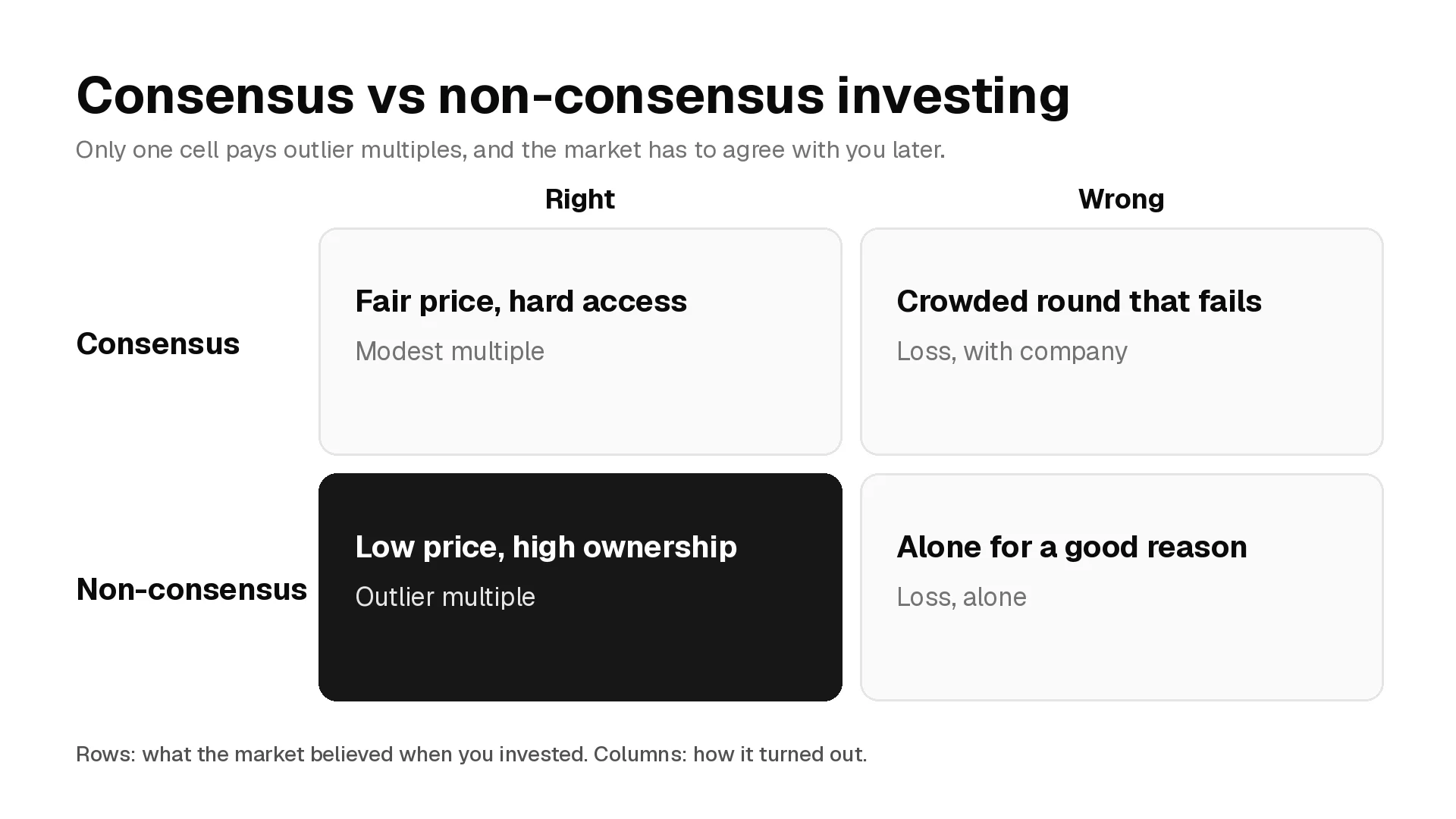
Non-consensus investing means backing a company most investors have passed on or not yet seen, for a reason you can state and test. How the 2x2 works, why firms drift toward consensus, how investment committees vote, and how analysts and associates bring a non-consensus deal.
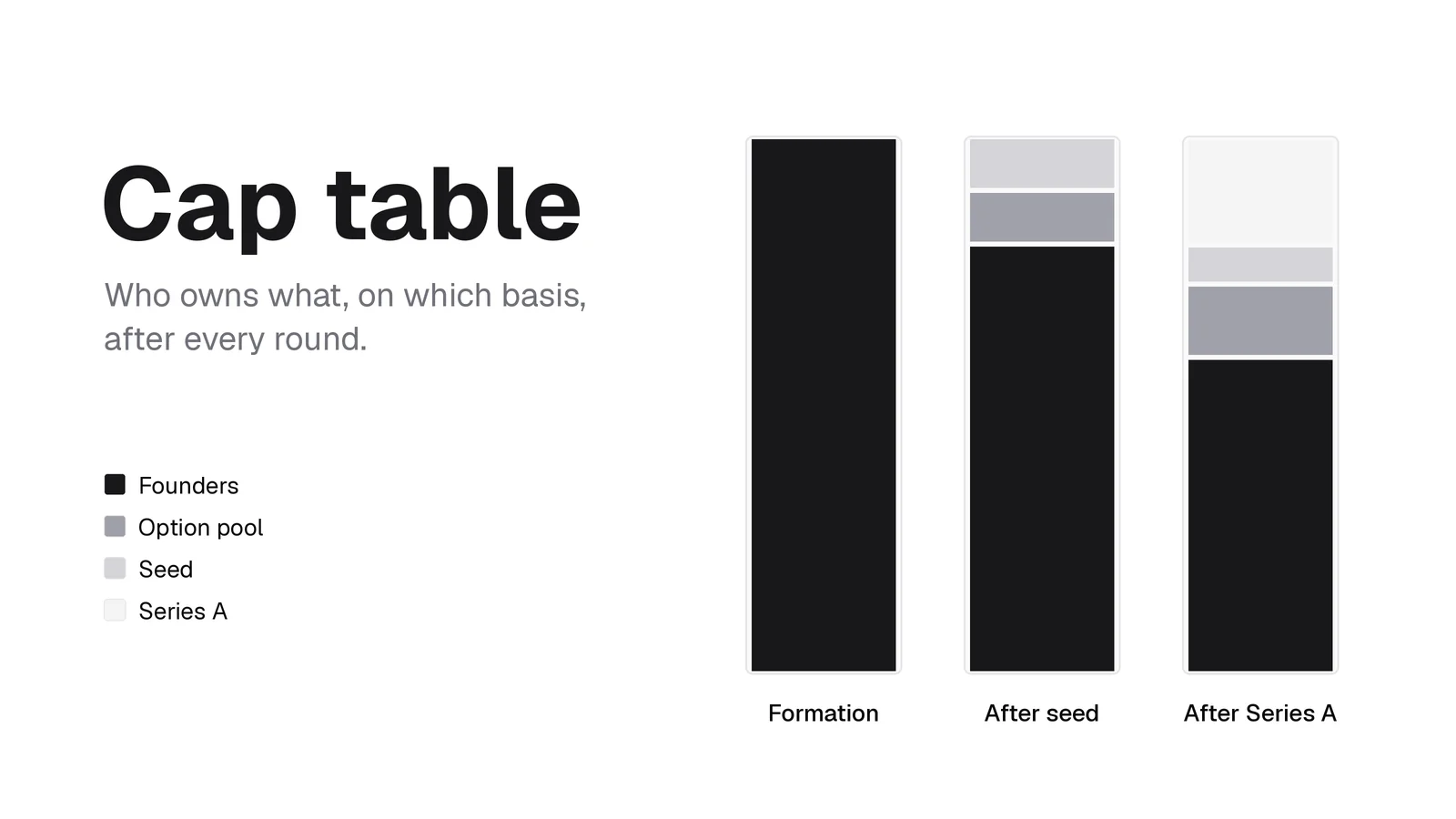
A cap table records who owns a company's shares, options, warrants, and convertible securities, and what percentage each holder owns on a stated basis.