
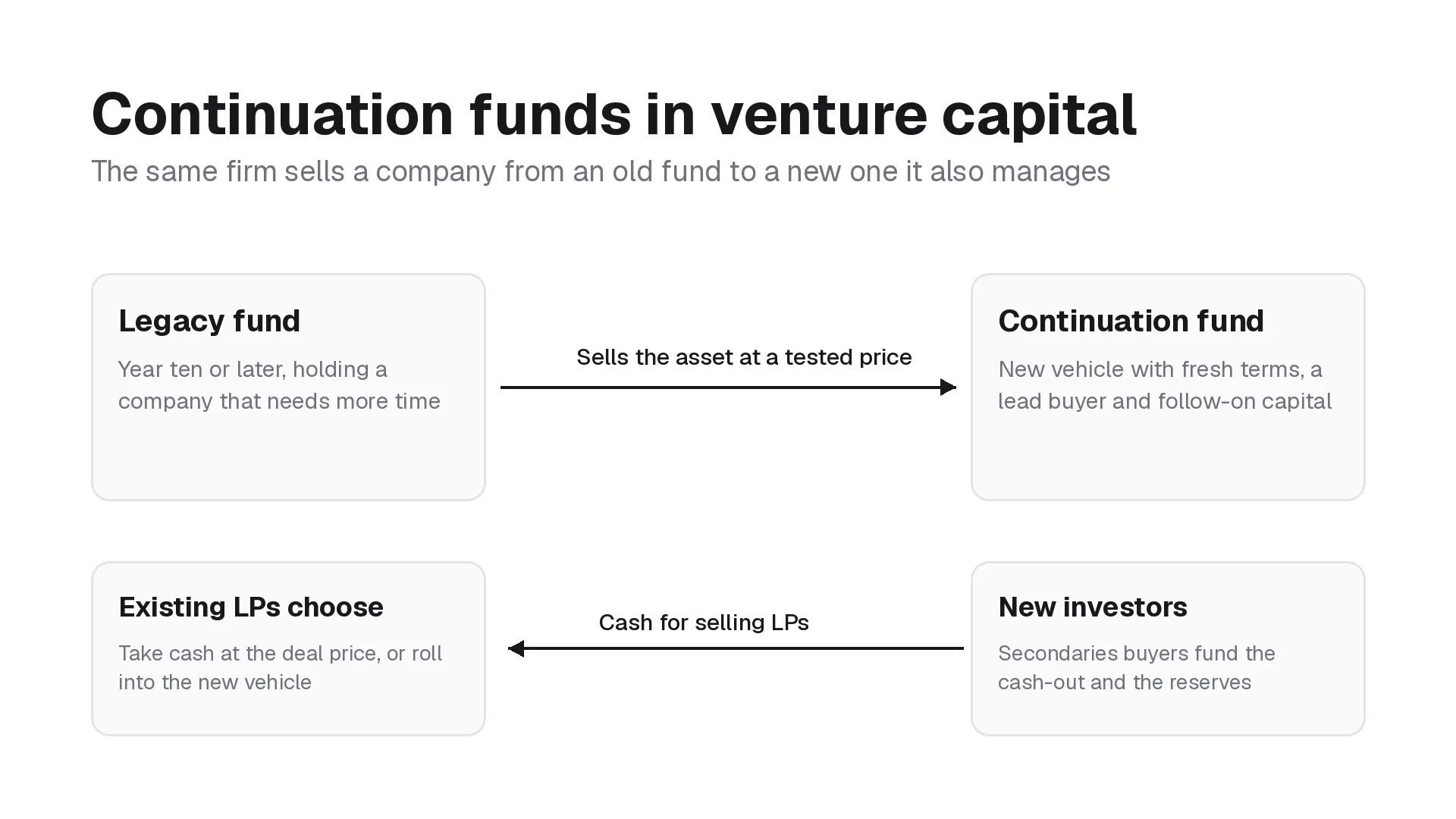
A continuation fund is a new vehicle that a venture firm forms to buy one or more portfolio companies from an older fund it already manages. Investors in the old fund choose between taking cash at the deal price or rolling their stake into the new vehicle, and the firm keeps holding the company past the old fund's ten-year life. Outside buyers, usually secondaries funds, put up the cash for the investors who sell and add fresh capital for follow-on rounds.
The structure started in buyout funds and has moved into venture as companies stay private longer. It matters to anyone who works at a VC firm because it touches the things that decide your pay and your workload. Those are which fund owns the winners, when carry gets paid and how many hours the fund-ops calendar eats.
What a continuation fund is
A continuation fund, also called a continuation vehicle or CV, is the main form of a GP-led secondary. The general partner starts the deal, picks the asset, hires the advisers and sets up the new fund. That is the difference from an LP-led secondary, where one limited partner sells its fund interest to a buyer and the fund itself does not change.
The firm sits on both sides of the trade. It is the fiduciary for the selling fund and the sponsor of the buying fund, and it knows more about the company than anyone else at the table. Almost every rule in a continuation fund deal exists to manage that conflict.
The vocabulary is short and you will hear it in every meeting about one.
| Term | Meaning |
|---|---|
| Legacy fund | The older fund that sells the company |
| Lead investor | The secondaries buyer that sets the price and negotiates the new fund's terms |
| Reference date | The valuation date the price is quoted against, usually a recent quarter-end mark |
| Selling LP | An investor in the legacy fund who takes cash |
| Rolling LP | An investor who moves their exposure into the continuation fund |
| Status quo option | A roll on the legacy fund's existing fee and carry terms |
| Crystallization | Booking the carried interest earned to date at the deal price |
| Fairness opinion | An independent adviser's view that the price is fair to the selling fund |
Single-asset and multi-asset continuation funds
A single-asset continuation fund holds one company. A multi-asset fund holds several, sometimes drawn from more than one of the firm's funds. Single-asset deals were rare a decade ago. In Houlihan Lokey's 2025 Continuation Fund Study, they made up 69% of sampled transactions.
| Single-asset | Multi-asset | |
|---|---|---|
| What it holds | One company with a clear next leg of growth | A basket of companies, often the tail of a fund |
| Why a firm uses it | Keep its best company longer | Give LPs liquidity on several positions at once |
| Pricing | Stronger in the 2025 sample | Discounted more often because the basket is harder to underwrite |
| Concentration for buyers | High | Lower |
| Extra complexity | Less | Value has to be split across assets and sometimes across funds |
| What it tells you about the firm | Conviction in one name | Usually a liquidity solution for an aging fund |
Why venture firms use continuation funds
A traditional venture fund runs about ten years, with one or two extensions, and the fund lifecycle assumes the best companies exit in years six through ten. Many of them now take longer. When IPOs and acquisitions slow down, a fund can reach the end of its term still holding a company that is growing fast but not ready to sell.
The firm then has four bad choices and one awkward one. It can sell at a price it thinks is too low, ask LPs for another extension, distribute illiquid shares, or let the clock force a decision. A continuation fund is the awkward choice. LPs who want cash get it now, and the firm keeps managing the company with new money behind it.
LP pressure is the other driver. Distributions decide whether pension funds and endowments commit to the next fund. A fund with large paper gains and little cash returned has a weak DPI and a harder raise. A continuation fund turns part of a mark into cash for the legacy fund.
Scale explains why venture firms are paying attention. The Houlihan Lokey study puts 2025 GP-led continuation fund volume above $100 billion, a record. Buyout assets were 89% of the transactions it sampled, so venture is still a small slice. Venture adopted the structure later than buyout, its deals are smaller, and its companies are harder to value.
How a continuation fund deal works, step by step
The sequence below follows ILPA's guidance and common practice. Timelines vary by deal.
- The firm picks the asset and the reason. The partners decide which company stays and write down why the legacy fund cannot capture the remaining upside before its term ends.
- The LP advisory committee hears it early. The LPAC reviews the conflict and usually has to consent before the deal can close. Firms that bring the LPAC in late, or brief members one by one, invite challenges.
- An adviser runs a competitive process. A secondaries adviser markets the asset to buyers. Bids are quoted against the reference-date mark.
- A lead investor sets the price and terms. The winning buyer negotiates the price, the new fund's fees, carry, term, governance and how much fresh capital it adds.
- An independent firm tests the price. A fairness or valuation opinion goes to the LPAC and LPs. Its provider should have no other relationship that compromises it.
- LPs elect to sell or roll. ILPA's continuation fund guidance calls for at least 30 calendar days or 20 business days. An LP who does not respond in time is treated as a seller. Nobody should be forced to roll.
- The deal closes and two funds run side by side. The legacy fund distributes cash to sellers. The continuation fund starts with rolling LPs, the new buyers, the GP's commitment and a new reporting calendar.
Continuation funds versus other liquidity options
A continuation fund is one of several tools a firm can use when a fund runs out of time. Candidates and new associates mix them up all the time, and the differences matter for who gets cash and who keeps risk.
| Option | Who sells | What changes | When firms use it |
|---|---|---|---|
| Fund term extension | Nobody | The fund runs one or two more years; later extensions usually need LPAC or LP consent | A few companies are close to an exit |
| LP-led secondary | One LP, by choice | The LP's interest moves to a buyer; the fund does not change | An LP wants out for its own reasons |
| GP-led tender offer | Any LP who accepts | A buyer offers to purchase LP interests in the existing fund | Broad liquidity without a new vehicle |
| Strip sale | The fund | A slice of several positions goes to a buyer; the fund keeps the rest | Partial cash across the portfolio |
| Direct secondary | The fund | Shares in one company go to a buyer; see liquidity events | A company-level sale or tender |
| NAV facility | Nobody | The fund borrows against portfolio value | Short-term cash need, no appetite to sell |
| Continuation fund | LPs who choose cash | A new vehicle buys the asset; LPs pick cash or roll | The firm wants to keep the company for years |
Pricing, fees and carry
Price is the first thing every LP checks. Buyers quote against the reference-date mark, and the gap to that mark says a lot about how the market sees the company. Single-asset deals tend to price better than multi-asset deals. Younger funds and newer investments also tend to price closer to their marks than old ones.
Deferred payment has become a common way to close the gap between buyer and seller. In the Houlihan Lokey sample, 23% of 2025 deals deferred part of the price. The median deferral covered half the price and ran six months. Deferrals were more common for venture and growth assets, which fits how hard late-stage private companies are to value.
New money for the company is part of the package. More than 90% of the deals in the study included unfunded commitments on top of the purchase price, with a 2025 median of 17% of transaction value. That reserve is what lets the continuation fund support the company's next rounds.
The continuation fund's own economics usually look different from a flagship fund. Management fees are commonly around 1% and charged on invested capital rather than commitments. Carry is often tiered, with a higher rate only after the buyers clear return hurdles.
Carry in the legacy fund is the term that gets the most scrutiny. Selling the company books a gain, so carry on that gain crystallizes. Market practice is for the GP to roll all of that crystallized carry into the new vehicle rather than take it as cash. A GP that cashes out while asking LPs to back the next chapter is telling everyone how much it believes in the asset.
ILPA's guidance defines a true status quo option for rolling LPs. It has four parts.
- No increase in the management fee rate
- The same fee base as the legacy fund
- No higher carry rate, lower hurdle or other GP-friendly waterfall change
- No crystallization of carry on the rolling LPs' share
Some firms offer a modified version. Fee and waterfall terms stay the same, but carry crystallizes for everyone at closing and the GP rolls it. That removes the protection of the old waterfall, where a later loss could have offset today's paper gain before any carry was earned. It is a real difference, and good firms describe it plainly rather than calling it status quo.
Worked example
The numbers below are illustrative. A ten-year-old fund that has already returned its LPs' capital holds a company stake marked at $100 million. Its cost was $20 million. The lead buyer prices the stake at $90 million. Seventy percent of LPs sell and 30% roll on status quo terms. The fund charges 20% carry.
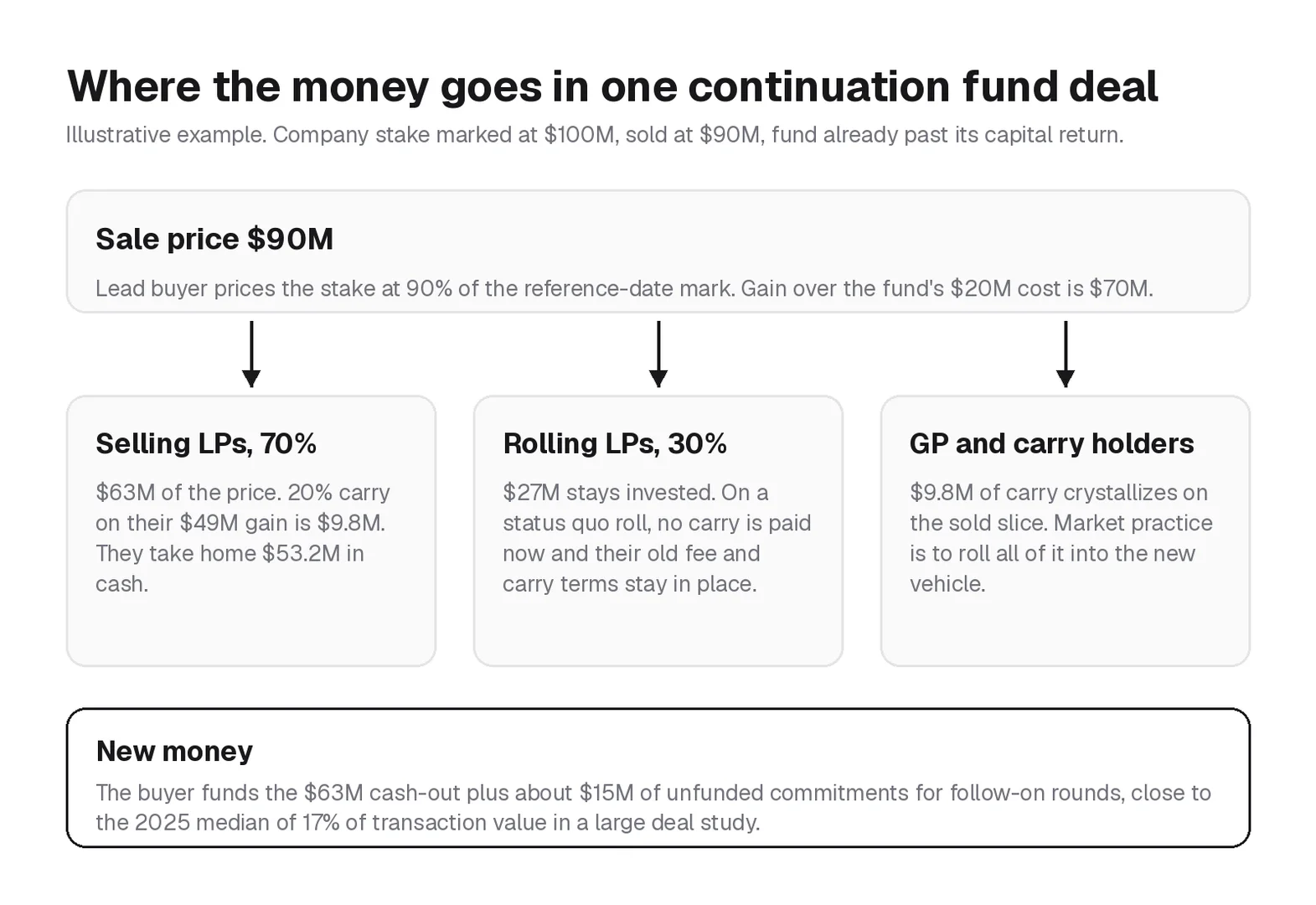
| Party | What happens | Amount |
|---|---|---|
| Selling LPs | 70% of the $90M price, less 20% carry on their $49M share of the gain | $53.2M cash |
| Rolling LPs | 30% of the price stays invested on old terms with no carry paid now | $27M rolled |
| GP | Carry on the sold slice crystallizes, then rolls into the new fund | $9.8M rolled |
| New buyer | Funds the cash-out plus reserves for follow-on rounds | $63M plus about $15M |
If you hold 2% of the carry pool in that legacy fund, your share of the crystallized carry is $196,000. If the GP rolls it, you do not receive that as cash. It becomes your interest in the continuation fund, paid out only when the new vehicle exits.
Conflicts and the protections LPs expect
Every protection in a continuation fund deal answers one question. How do LPs know the firm did not underprice the company it is buying from itself? LPs look for the following.
- A competitive process. An independent adviser markets the asset to several buyers, so the price comes from bids and not from the GP.
- A fairness or valuation opinion. The opinion goes to the LPAC, and the provider discloses any other relationship with the firm.
- Equal information. Every LP gets the same material facts at the same time, and those facts match what buyers saw.
- A real LPAC process. Members get time and full materials before they vote on the conflict, and they can talk to each other.
- Enough time to elect. At least 30 calendar days or 20 business days, with non-response treated as a sale.
- Alignment. The GP rolls its crystallized carry and commits fresh capital to the new fund.
Regulation does not impose most of this. The SEC's private fund adviser rules would have required a fairness or valuation opinion for these deals, but a federal appeals court vacated them in 2024. Protections now come from the fund's LPA, ILPA guidance and what LPs will accept. Recent Delaware litigation has included claims that a firm rushed its LPAC vote or gave buyers better information than its own investors.
What a continuation fund means if you work at a VC firm
If you work at the firm, or are about to join one, a continuation fund changes your calendar, your carry and sometimes your career options.
Who does the work
| Role | What lands on their desk |
|---|---|
| Partners | Choosing the asset, the conviction case, negotiating with the lead buyer, presenting to the LPAC |
| Principals, associates and analysts | The company model and investment case for buyers, data room, buyer diligence calls, updated portfolio monitoring |
| CFO, controller and fund accounting | Reference-date valuation, carry crystallization, waterfalls for sellers, rollers and new investors, closing funds flow |
| Investor relations | The election package, LP questions, tracking elections, the new fund's first reports |
| Legal and compliance | LPA conflict provisions, LPAC consent, disclosure and election documents with outside counsel |
| Outside parties | The secondaries adviser, the fairness opinion provider and the lead buyer's team |
At a small firm without a fund-ops team, much of the investor-facing work falls on associates. Expect weeks of buyer questions, model updates and LPAC materials on top of normal deal flow.
What happens to your carry
If you hold carried interest in the legacy fund, read three things in your carry documents and the deal terms.
- Whether your crystallized carry rolls with the GP's or can be taken in cash
- Whether vesting continues on the same schedule in the continuation fund
- Whether you get a share of the continuation fund's new carry, and on what terms
A status quo roll for LPs does not settle what happens to staff carry. Ask before the deal closes, not after.
Secondaries as a career path
Continuation funds created a hiring market of their own. Dedicated secondaries funds hire investors to underwrite these deals. Investment banks and advisory firms run GP-led processes and hire for them. Large LPs and funds of funds need people who can judge a continuation fund election in 30 days. The skills transfer well to and from venture, because the work is company diligence, valuation and fund terms in one job. You can browse open roles on the VC job board and research secondaries investors in the VC firm directory.
Questions to ask a firm before you join
- Has the firm done or explored a continuation fund, and from which fund?
- Did the LPAC approve it, and roughly how many LPs sold versus rolled?
- Did the GP roll all of its crystallized carry?
- Which fund pays my salary, and which fund holds my carry?
- Who runs the work on these deals, a fund-ops team or the investment team?
A firm that did a clean single-asset deal on a strong company with most LPs rolling is showing conviction. A firm with several old funds, a multi-asset deal priced well below its marks and LPs voting it down is managing a problem. Both can be good places to work, but you should know which one you are joining. The vintage year of each fund tells you where the pressure sits.
How to answer it in an interview
A common interview question is "What do you think about continuation funds in venture?" A strong answer is short and balanced.
"They solve a real problem. Venture funds have ten-year terms, but the best companies are taking longer to exit, so a continuation fund lets LPs who need cash take it while the firm keeps backing a company it believes in. The risk is the conflict, since the firm sets the price on both sides. I'd judge a deal by whether there was a competitive process with a fairness opinion, whether LPs got a real status quo option and enough time to decide, and whether the GP rolled its carry. In venture specifically, I'd want the asset to have a clear path to exit, because valuation is much harder than in buyouts."
Frequently asked questions
Is a continuation fund the same as a secondary fund?
No. A secondary fund is an investor that buys existing private assets from others. A continuation fund is a vehicle a GP creates to buy assets from its own older fund. Secondary funds are often the lead investors in continuation funds.
Do LPs have to roll into a continuation fund?
No. ILPA's guidance says LPs should never be forced to roll, and an LP who misses the election deadline should be treated as selling.
How long does a continuation fund last?
The new LPA sets the term. Continuation funds are usually designed for a shorter hold than a ten-year flagship fund, because the plan is to take one company or a small group to exit.
Does a continuation fund count as an exit for the legacy fund?
For the legacy fund, the sale is a realization, and cash paid to selling LPs counts toward its DPI. Because the firm set the price on both sides, LPs judge that number with the fairness opinion and buyer interest in mind.
Is a continuation fund a bad sign about a VC firm?
Not by itself. A single-asset deal on a strong company, priced near its mark with most LPs rolling, signals conviction. Repeated multi-asset deals at steep discounts, or deals that LPs reject, point to a firm struggling to return capital.
Next steps
Continuation funds are now part of how venture funds return capital, so expect them in diligence calls, LP meetings and interviews. If you are looking for a role, browse open VC jobs, research firms and their fund histories in the companies directory, and create a free account for alerts on new roles.
Related posts
How to get a job in venture capital: which seats exist, the first seat that fits your background, proof to build, where VC jobs come from, how to screen a posting, the recruiting process from screen to offer, pay, and what to ask before accepting.
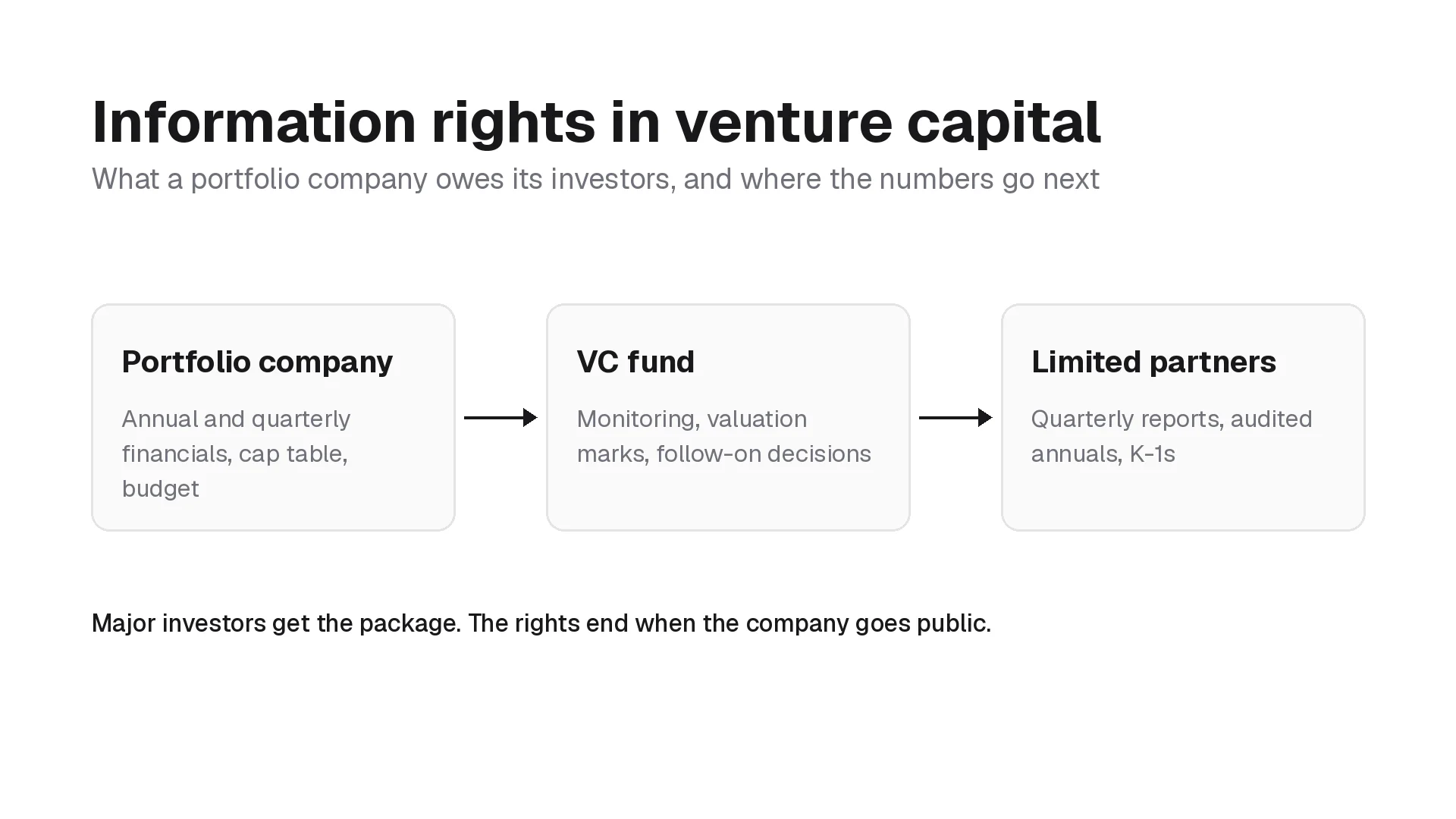
Information rights oblige a venture-backed company to send major investors annual and quarterly financials, a cap table and its budget. Here are the standard deadlines, who qualifies, how the rights end, and how analysts, fund finance and IR teams use the data.
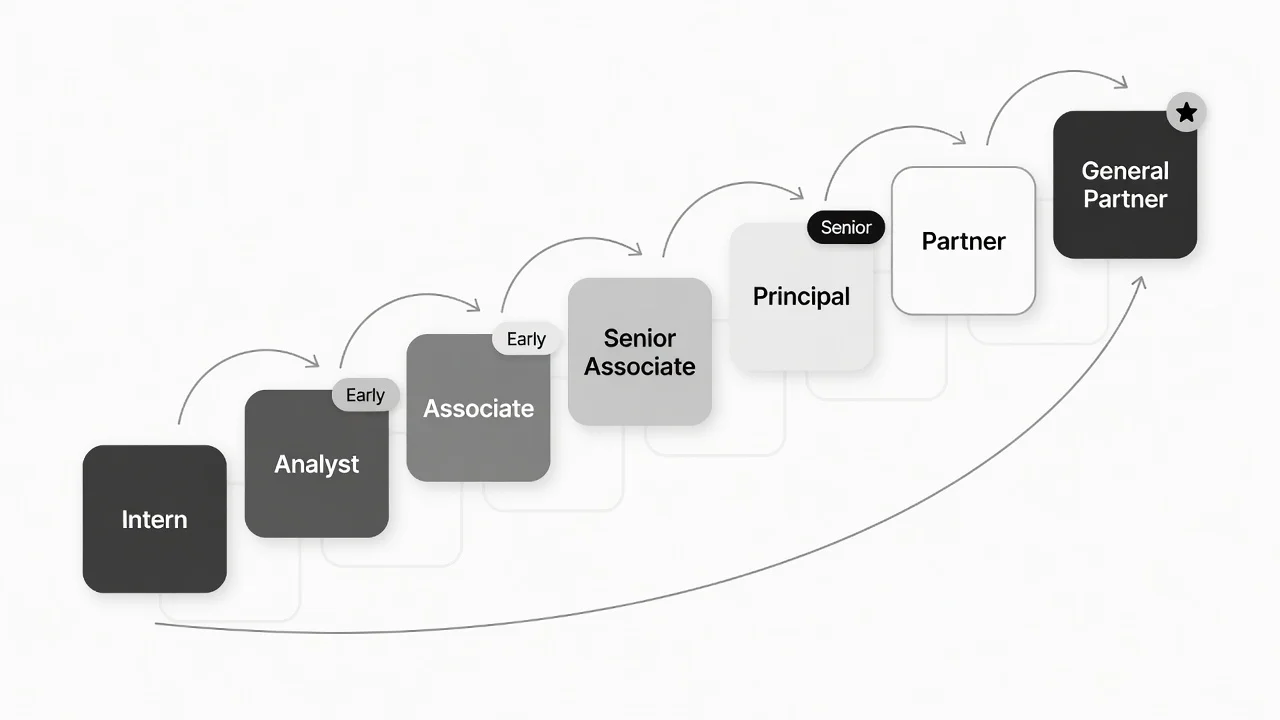
The VC career ladder from analyst to general partner, with typical years in each seat, the evidence that earns promotion, non-investing roles, decision points at years 2, 5, and 9, pay by level, and the own-fund path.