
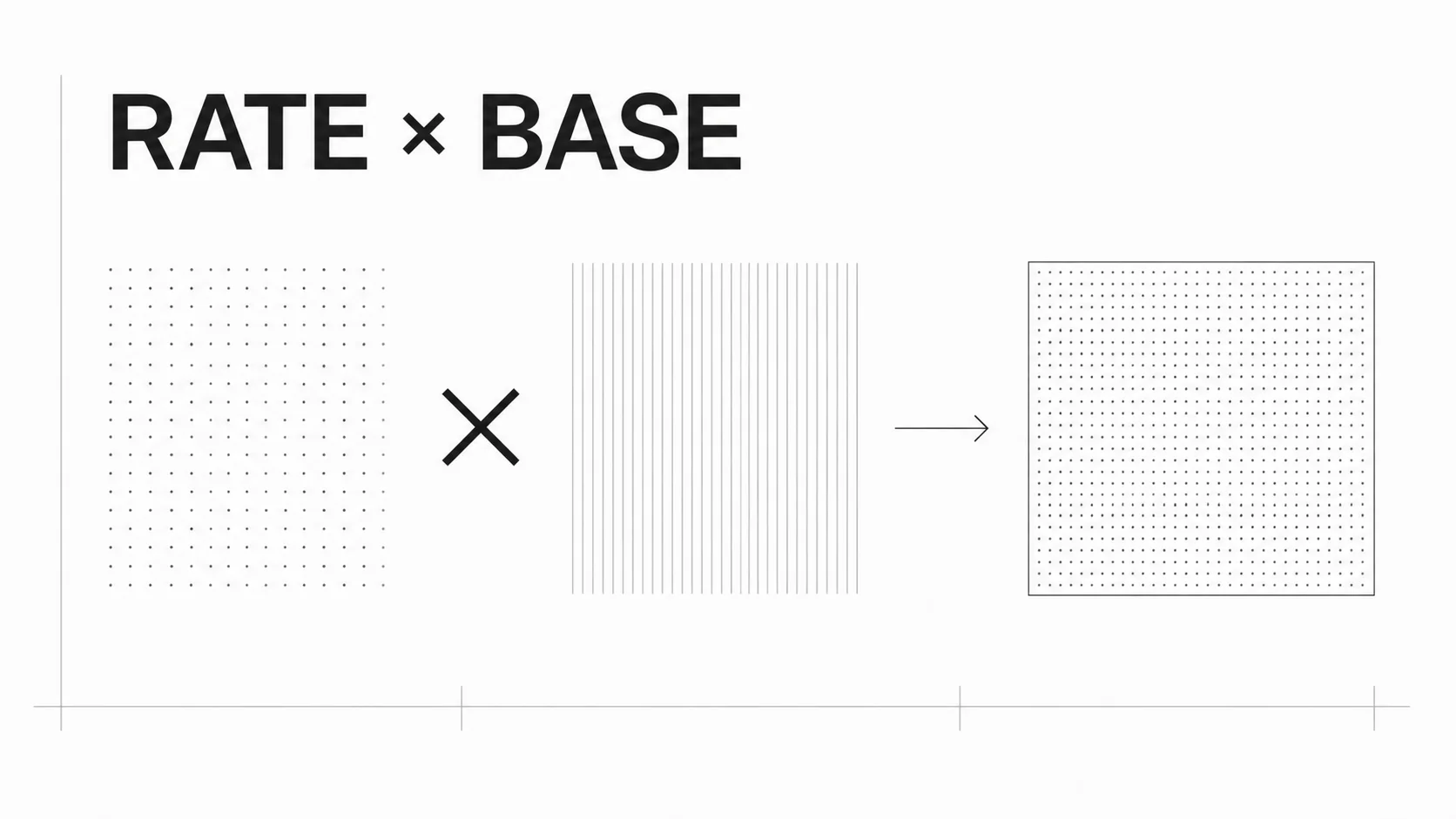
A venture capital management fee is the recurring amount a fund pays its management company to run the investment program. The annual charge is calculated as a fee rate multiplied by a defined fee base—often committed capital during the investment period, then a smaller rate or base later in the fund's life.
The headline percentage is only half the economics. To understand what LPs pay and what a firm can afford, read four variables together: the rate, the fee base, the start and end dates, and any step-down. The limited partnership agreement controls the actual terms.
What venture capital management fees pay for
Management fees fund the management company: the operating business that employs the investment team and runs the firm. Typical uses include salaries, benefits, office and technology costs, insurance, travel, research, sourcing, and other overhead tied to managing the portfolio.
They are not the same as every expense incurred by the fund. Formation counsel, annual audits, tax preparation, fund administration, broken-deal costs, and portfolio-company expenses may be charged separately to the fund if the governing documents allow it. AngelList separates organizational and administrative expenses, management fees, and carried interest.
A useful first-pass test is:
- Who receives the service? Work that primarily keeps the management company operating points toward the management fee. Work performed for the fund as a legal or accounting entity may be a fund expense.
- Who controls and benefits from the cost? A recurring team tool is different from legal diligence on one proposed investment. Ambiguous items need the agreement's expense-allocation language, not intuition.
This distinction matters because every dollar paid from fund commitments reduces the capital available for investments unless the fund is sized or called to account for it.
How the management fee calculation works
The basic formula is simple:
Management fee = annual fee rate × fee base × time fraction
The fee base is the part that changes the answer most.
| Fee-base method | Common use | Economic effect |
|---|---|---|
| Committed capital | Often used during the investment period | Predictable budget; fee does not fall as investments are made |
| Invested or contributed capital | Sometimes used after the investment period | Ties the fee more closely to capital actually deployed |
| Unreturned invested capital | Often considered for a post-investment step-down | Fee base declines as investments are exited or written off |
| Net asset value or another negotiated base | Used in some strategies or later periods | Makes the fee sensitive to valuation and document definitions |
Rates also vary. Fund size, strategy, team needs, track record, geography, and negotiating leverage can all affect the result. The strongest current sources do not support one universal VC rate: AngelList describes a commonly observed 2%–2.5% range, while Cooley explains why fund size, strategy, and market can produce different terms.
Read a quoted “2% fee” as incomplete until you know 2% of what, for which years, and subject to which offsets or waivers.
Worked example: a $50 million fund with a step-down
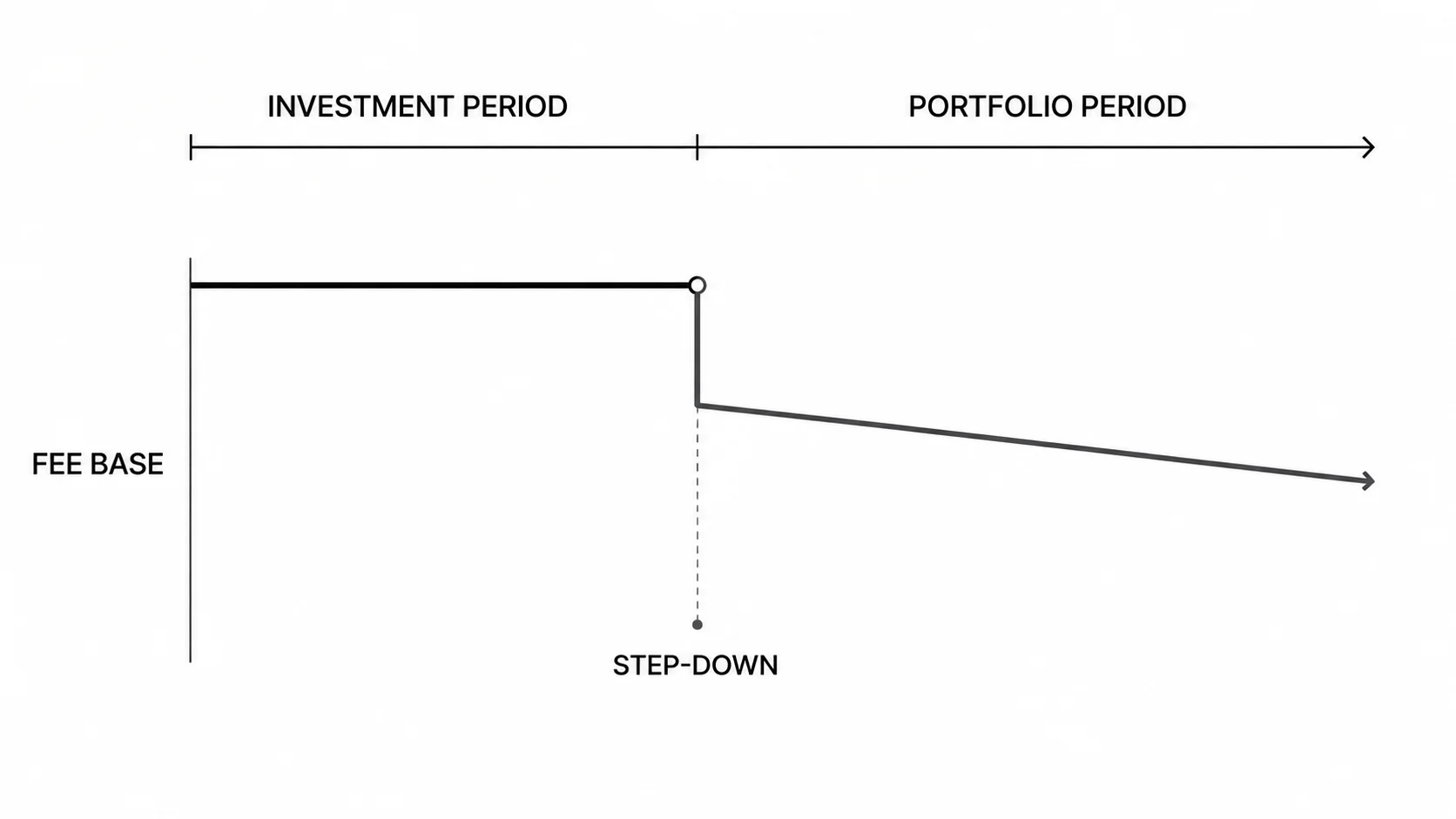
Assume a $50 million fund has a ten-year term and a five-year investment period:
- Years 1–5: 2% of committed capital
- Years 6–10: 1.5% of remaining invested-cost basis
- Remaining invested-cost basis at the start of year 6: $30 million
- For illustration, that base declines by $4 million each year as investments are exited or written off
| Year | Rate | Fee base | Annual fee |
|---|---|---|---|
| 1 | 2.0% | $50.0m | $1.000m |
| 2 | 2.0% | $50.0m | $1.000m |
| 3 | 2.0% | $50.0m | $1.000m |
| 4 | 2.0% | $50.0m | $1.000m |
| 5 | 2.0% | $50.0m | $1.000m |
| 6 | 1.5% | $30.0m | $0.450m |
| 7 | 1.5% | $26.0m | $0.390m |
| 8 | 1.5% | $22.0m | $0.330m |
| 9 | 1.5% | $18.0m | $0.270m |
| 10 | 1.5% | $14.0m | $0.210m |
Total fees in this simplified schedule are $6.65 million. A flat 2% charge on $50 million for all ten years would be $10 million. The $3.35 million difference comes from changing both the rate and the base—not from the label “step-down” by itself.
This is planning arithmetic, not a market benchmark. Actual documents may calculate quarterly, true up later-closing LPs, exclude write-offs on different dates, use a rate-only step-down, or continue reduced fees through extensions and liquidation.
How management fees are paid
The annual percentage does not mean the manager waits until year-end for one payment. Fund documents commonly provide for quarterly or semiannual installments. The fund may call capital from LPs to cover the fee alongside investments and other permitted expenses.
That resolves a frequent point of confusion: the fee is not taken repeatedly from money that has already been deployed into a startup. It is funded from the LPs' remaining commitments through the fund's capital call process, subject to the commitment limit and the agreement.
Later-closing investors may also owe an equalization amount so that similarly situated LPs bear their agreed share from the applicable fee start date. Waivers, offsets, and side-letter discounts can change the amount for a particular investor.
Management fee vs carried interest
Management fees and carried interest pay for different things.
| Management fee | Carried interest |
|---|---|
| Recurring operating revenue | Share of investment profits |
| Generally paid regardless of realized performance | Earned only when the waterfall permits |
| Supports salaries and firm overhead | Rewards successful investment outcomes |
| Calculated from a defined capital base | Calculated from profits or distributions under the waterfall |
“Two and twenty” is shorthand for a 2% management fee and 20% carry, not a complete description of fund economics. It says nothing about fee step-downs, offsets, organizational expenses, the carry waterfall, a preferred return, clawbacks, or the GP commitment.
For LPs, the tension is straightforward: the firm needs enough predictable fee income to retain a capable team, but an oversized or unusually persistent fee can weaken alignment. For GPs, starving the management company may look LP-friendly yet leave the firm unable to execute the strategy it sold.
How to read management fee terms
Do not negotiate the percentage in isolation. Work through the clause in this order:
- Trigger: When does the fee begin—initial close, first investment, or another date? Are later closers charged retroactively?
- Rate: What percentage applies in each period?
- Base: Is it commitments, invested capital, unreturned cost, NAV, or another defined amount?
- Step-down: Does the rate fall, the base shrink, or both? What event starts the change?
- End date: Does the fee stop at the scheduled term, after extensions, or at final liquidation?
- Offsets: Do transaction, monitoring, director, or other portfolio-related fees reduce the management fee?
- Waivers and side letters: Can some LPs receive different economics, and how is equal treatment handled?
- Expense allocation: Which costs are paid by the management company, the fund, a portfolio company, or a parallel vehicle?
Cooley's management-fee primer is particularly useful on the tradeoff between a predictable rate step-down and an investor-preferred declining base. The better term is not always the one with the lowest number; it is the one whose budget, workload, and alignment fit the strategy.
What fee economics reveal about a VC career
Management fees create the operating budget from which most cash compensation and firm infrastructure are paid. That makes fund economics relevant to candidates as well as LPs.
A $50 million fund charging 2% has $1 million of gross annual management-fee revenue before expenses, offsets, taxes, and any sharing across affiliated funds. That does not translate directly into payroll. A firm must also fund partners, operations, finance, legal support, data, travel, insurance, and office costs. The same percentage supports very different organizations at a $25 million micro-fund and a $500 million platform.
When evaluating a role, ask how many active funds support the team, where the firm is in each fund's lifecycle, whether a successor fund is being raised, and which functions are in-house. Those questions reveal more about role durability and resources than the headline AUM alone.
Use the companies directory to research firm stage and strategy, then browse open venture capital roles with a clearer view of the operating model behind each team.
Frequently asked questions
Are VC management fees charged on committed or invested capital?
Often on committed capital during the investment period, but the answer depends on the limited partnership agreement. After the investment period, the rate or base may step down to invested capital, unreturned invested cost, NAV, or another negotiated measure.
Do management fees reduce investable capital?
They can. If management fees and permitted expenses are paid from LP commitments, less of the committed amount is available for portfolio investments. Fund models normally budget for that difference when setting target portfolio construction.
Are management fees the same as carry?
No. The management fee is recurring operating revenue; carry is a share of investment profits distributed under the fund's waterfall.
Why do smaller funds sometimes charge a higher percentage?
A smaller capital base produces fewer fee dollars at the same rate, while a minimum team and compliance infrastructure still cost money. Whether a higher rate is justified depends on the strategy, workload, budget, and negotiating leverage.
What is a management fee offset?
An offset reduces the management fee by some or all of another fee received by the manager or its affiliates—for example, certain transaction, monitoring, or director fees. The agreement defines which receipts count and the offset percentage.
Related posts
A VC resume is a one-page evidence document. Structure, bullet formula, path and firm-type tailoring, template, and examples partners actually screen for.
Cap table interview questions test whether you can track ownership through a round without freezing. Practice the math, then practice saying the answer out loud.
A practical system for getting a job in venture capital: paths by background, proof-of-work, how to screen postings, a 90-day plan, outreach, interviews, and how to evaluate a seat.