
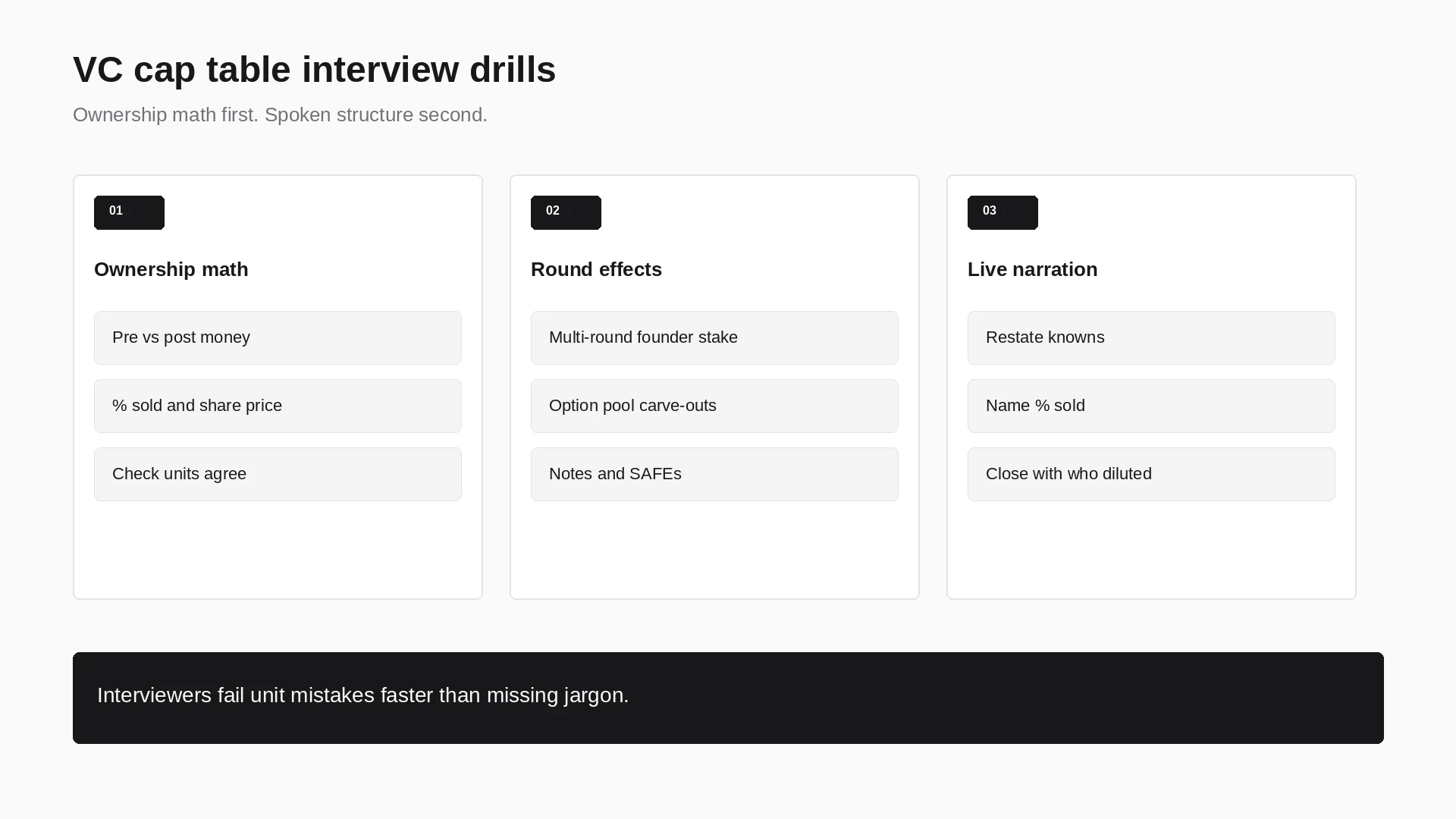
Cap table interview questions test whether you can track ownership through a financing without losing the story. Interviewers care less about memorized jargon and more about whether you can move from dollars raised to percentage sold to who owns what after the round.
If you freeze on pre-money versus post-money, or you invent a founder outcome that ignores the option pool, you fail the screen. If you narrate the steps cleanly, check your units, and state what changed for founders and investors, you pass.
These drills sit beside the broader venture capital interview questions hub. For building and reviewing a pro forma outside an interview, use the cap table guide. This page is for the live ownership questions you will get in screens and cases.
What these questions actually test
Partners are checking three things at once.
- Unit discipline. Dollars, shares, and percentages are different objects. Mixing them is the most common junior failure.
- Round mechanics. Pre-money, post-money, percent sold, and dilution have to stay consistent with each other.
- Judgment under incomplete prompts. Real interviews leave out a number on purpose. Strong candidates ask one clarifying question, state an assumption, and finish the math.
You are not expected to recite every term sheet clause from memory. You are expected to know which terms change ownership and which change economics without changing the share count.
Dilution and ownership math
Start every answer by naming the knowns: pre-money valuation, raise size, and whether the option pool is already carved or still needs to expand. Then compute post-money and percent sold before you touch share counts.
Interview practice example (labeled invented scenario). A company is raising $5M at a $20M pre-money valuation. No new option pool carve-out for this question.
- Post-money = $20M + $5M = $25M
- Percent sold to new investors = $5M / $25M = 20%
- Existing holders keep 80% of the company on a fully diluted basis if nothing else changes
If the interviewer then says there are 8,000,000 shares outstanding before the round, new shares issued = 20% of the post-round fully diluted share count. Let post-round shares be S. New shares = 0.20S, and existing shares are 0.80S = 8,000,000, so S = 10,000,000. New shares issued = 2,000,000. Price per share = $5,000,000 / 2,000,000 = $2.50. That price should also equal post-money / S = $25,000,000 / 10,000,000.
Say the check out loud: percent sold, share count, and price per share must agree. If one disagrees, stop and find the error before you continue.
Common trap: pre-money versus post-money
If someone says "we raised $5M at a $25M valuation" without specifying pre or post, ask which one. A $25M post-money with a $5M raise is a $20M pre-money. A $25M pre-money with a $5M raise is a $30M post-money and only 16.7% sold. Interviewers listen for that clarification. Jumping in with a wrong base is worse than a one-sentence question.
Multi-round fundraising and founder stake
Ownership compounds. A founder who starts at 100% and sells 20% twice does not end at 60%. They end at 64% only if each round dilutes everyone equally and nothing else happens. In practice pools, notes converting, and different share classes change the path.
Interview practice example. Founders own 80% and employees own 20% on a fully diluted basis after the seed. The Series A sells 20% of the company to new investors with no other changes.
- Founders after A = 80% × 80% = 64%
- Employees after A = 20% × 80% = 16%
- New Series A investors = 20%
If the interviewer adds a second round that sells another 20%, founders move to 64% × 80% = 51.2%. Candidates who subtract 20 + 20 from 80 and announce "40% left" fail the compounding test.
When the prompt spans Seed → A → B, narrate round by round. Do not jump to the end ownership until each step's percent sold is explicit. If a convertible note or SAFE sits between rounds, say whether you are treating it as converting into the round or as a separate claim, then stick to that assumption.
Option pool questions
Option pools are where clean candidates separate from fast talkers. The key fork is whether the pool is sized pre-money (investors want the dilution to hit existing holders before the new money comes in) or described loosely after the round.
Interview practice example. Pre-money is $20M. Raise is $5M. Investors require a 10% option pool on a post-money fully diluted basis, and the current pool is empty for simplicity.
One common interview framing: expand the pool so that after the financing, the pool is 10% of post-money ownership, with the expansion diluting pre-round holders. Walk it carefully.
- Post-money target remains $25M if the cash raise is still $5M and pre-money is still quoted as $20M, but the effective ownership split changes because the pool takes 10% post-round.
- New investors still take $5M / $25M = 20% if the valuation quote is unchanged.
- Option pool takes 10%.
- Pre-round holders are left with 70% to split among founders and any prior pool.
State that real term sheets vary on whether "pre-money pool" means the pool is carved before the investor percentage is calculated. If the interviewer uses a specific convention, mirror theirs. Do not invent a third method mid-answer.
A strong closing line: the pool protects hiring, but a large pre-money pool is founder dilution paid up front to make the investor's ownership cleaner.
Cap table plus valuation case
Some screens fold ownership into a mini case. You might get a rough valuation method, then a raise size, then a question about founder ownership after the check.
Use the venture capital method valuation logic when they ask for a target ownership from a required return. Keep the ownership math on this page consistent with that method: required exit value, target ownership, and dilution across future rounds are linked. In the interview, write the chain:
- Required ownership at exit (from return target)
- Expected dilution in future rounds
- Ownership needed today = exit ownership / (1 − future dilution), or the equivalent stepwise version they prefer
- Check that today's ownership × today's post-money matches the check size they proposed
Interview practice example. A partner says the fund needs about 15% ownership at exit, expects later rounds to cut today's stake roughly in half, and is writing a $4M check. If half the ownership is diluted away later, you need about 30% today (15% / 0.50). A $4M check for 30% implies a post-money of about $13.3M and a pre-money of about $9.3M before pool and converting notes. Say "about" when the prompt is rough. Fake precision on a fuzzy case reads worse than a clean range.
For longer written cases, switch to the venture capital case study interview playbook. For spreadsheet tests, use the modeling test guide.
Deal terms that change ownership or economics
Interviewers often ask which terms hit the cap table versus which hit proceeds at exit.
| Term | Typical interview point |
|---|---|
| Price / valuation | Sets percent sold and share price |
| Option pool | Dilutes existing holders when expanded |
| Liquidation preference | Changes exit waterfalls more than share counts |
| Participation | Changes investor economics at exit |
| Anti-dilution | Can issue extra investor shares after a down round |
| Pro rata | Rights to buy in later rounds to hold ownership |
| Convertible note / SAFE | Converts into ownership later; treat conversion assumptions explicitly |
If the question is "what happens to founder ownership," focus on price, pool, anti-dilution, and converting instruments. If the question is "who gets paid first," focus on preference and participation. Mixing those two answers is a common trap.
How to narrate a cap-table answer in a live interview
This is the part most question banks skip. The math can be right on paper and still fail if the spoken answer wanders.
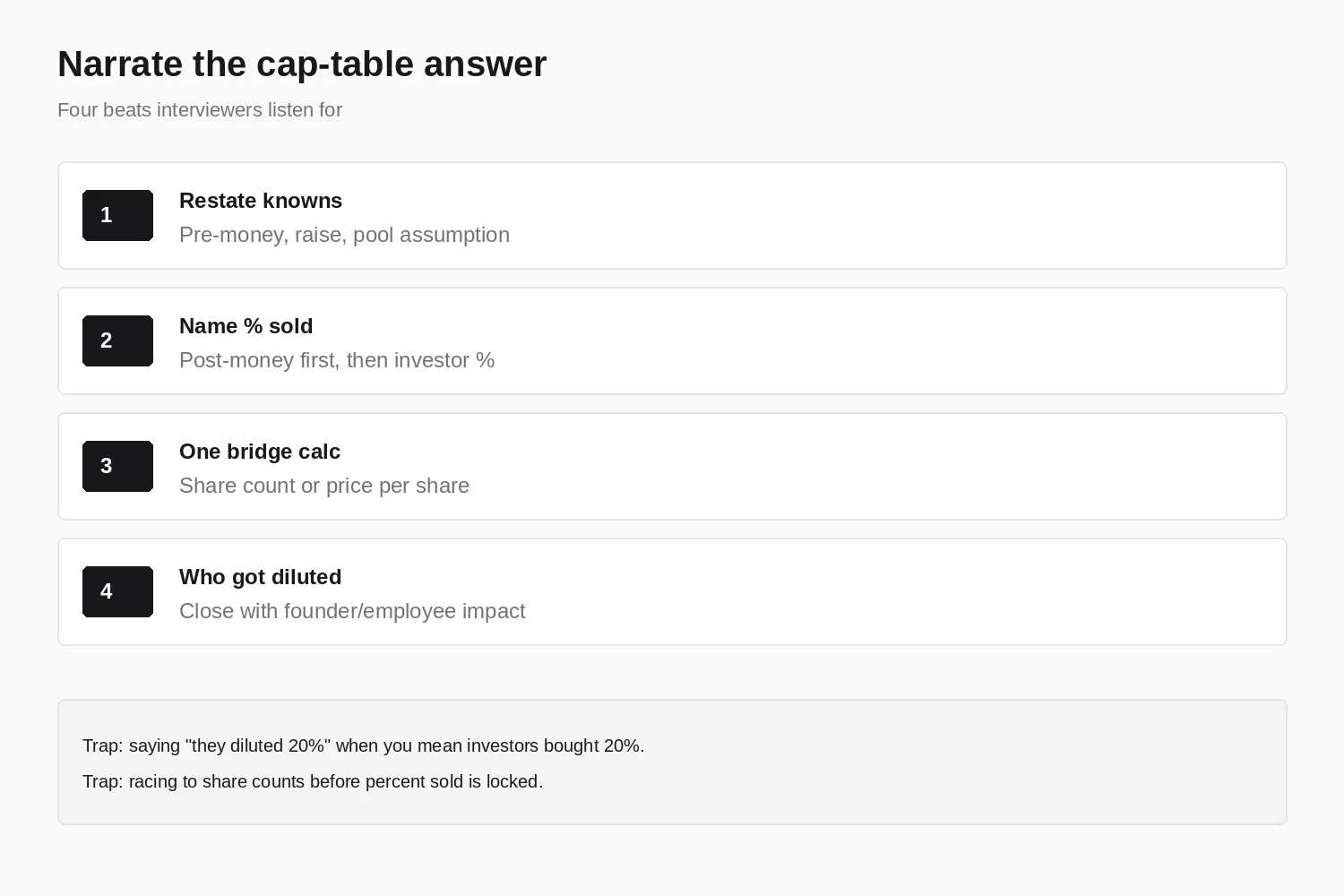
Use a four-beat structure every time:
- Restate the knowns in one breath. "Pre-money $20M, raise $5M, no pool change."
- Name the first output. "Post-money is $25M, so new investors buy 20%."
- Show one bridge calculation. Share count or price per share, not both unless asked.
- Close with who got diluted. "Existing holders move from 100% of the pre-round company to 80% post-round."
What interviewers listen for:
- You separate pre-money and post-money before computing percent sold
- You keep dollars and shares from collapsing into each other
- You flag missing inputs instead of inventing silent assumptions
- You finish with the ownership implication, not a floating arithmetic result
Trap phrasing to avoid:
- "They diluted 20%" when you mean "investors bought 20%" (dilution on prior holders is related but not identical wording)
- "Founders still own most of the company" without a number after a multi-round prompt
- "The pool does not matter" when the prompt centered on hiring or a pool refresh
- Racing to share counts before percent sold when the prompt only gave dollars and valuation
If you get stuck, narrate the recovery: "I am missing whether that valuation is pre or post. If it is post-money, percent sold is raise divided by that number. If it is pre-money, I add the raise first." Partners prefer a controlled recovery over a confident wrong answer.
Which VC roles grill cap tables
Not every "venture" title runs hard ownership drills.
- Analyst and associate seats on investing teams often do. Expect live math or a short take-home.
- Platform, community, and content roles rarely do deep dilution math. They may still ask conceptual ownership questions.
- Operating partner / talent roles vary. Some ask conceptual questions about founder incentives; few run multi-step share math.
- Internship screens are lighter but increasingly include one clean pre/post question.
Read the posting for modeling, diligence, or "investment team" language. Browse open roles on the Venture Capital Careers job board and firm pages in the companies directory before you over-prep for a seat that will not test this.
Prep checklist
- Drill pre-money, post-money, percent sold, and price per share until you can do them without notes.
- Practice one multi-round founder ownership chain out loud.
- Practice one option-pool prompt where you state the convention before calculating.
- Practice one valuation-plus-ownership mini case with rough numbers.
- Record yourself once. Cut filler. Keep the four-beat narration.
- Skim term sheets so preference and participation do not get confused with share count.
- If a fund sends a spreadsheet test, switch prep to the modeling test guide.
Frequently asked questions
How hard are cap table questions in VC interviews?
Hard enough to fail unprepared candidates, and easy enough that prepared candidates finish in a few minutes. The difficulty is composure and unit discipline, not advanced math.
Do I need to memorize every term sheet clause?
No. Know which terms change ownership now versus which change exit economics later. Depth on every clause belongs in diligence, not in a screen.
What is the most common mistake?
Treating a stated "valuation" as post-money when it was pre-money, or the reverse, then charging ahead. Ask one clarifying question.
How should I practice the night before?
Three timed prompts out loud: a simple raise, a two-round founder stake, and a pool question. No new frameworks after that.
Where does this fit in a full VC search?
Ownership drills are one technical slice. Pair them with fit prep on the interview questions hub and a search system in how to get a job in venture capital.
Next step
Pick five prompts and answer them standing up, without a calculator, in under three minutes each. Then apply only to seats that actually need this skill. Browse investing roles on the job board, research funds in the companies directory, and create alerts when you are ready via sign up.
Related posts
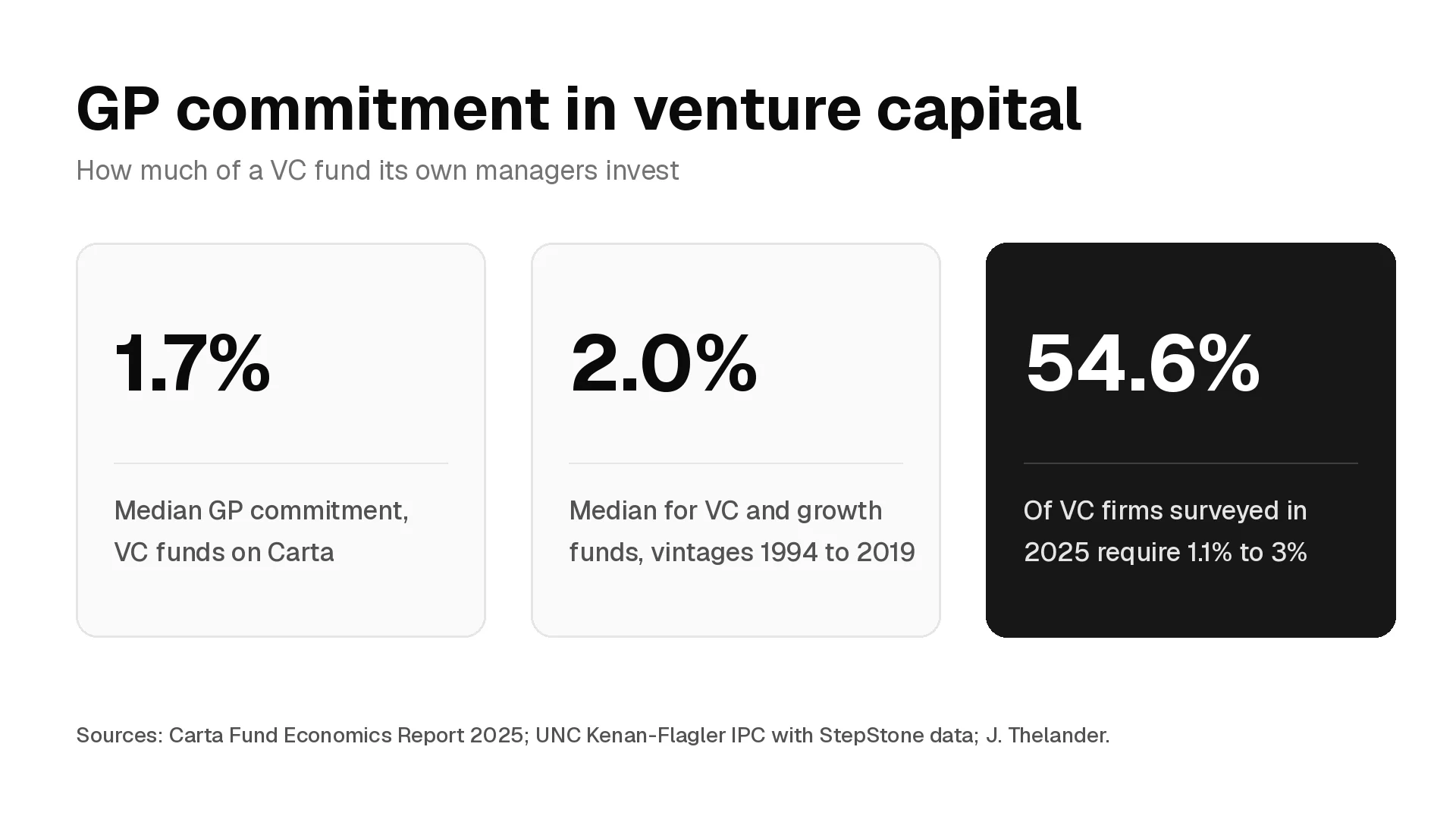
What a GP commitment is, how large it is in venture capital, how GPs fund it, where it sits in the LPA, what the returns evidence says, how firms split it across partners and principals, and what to ask before you accept a role with carry.
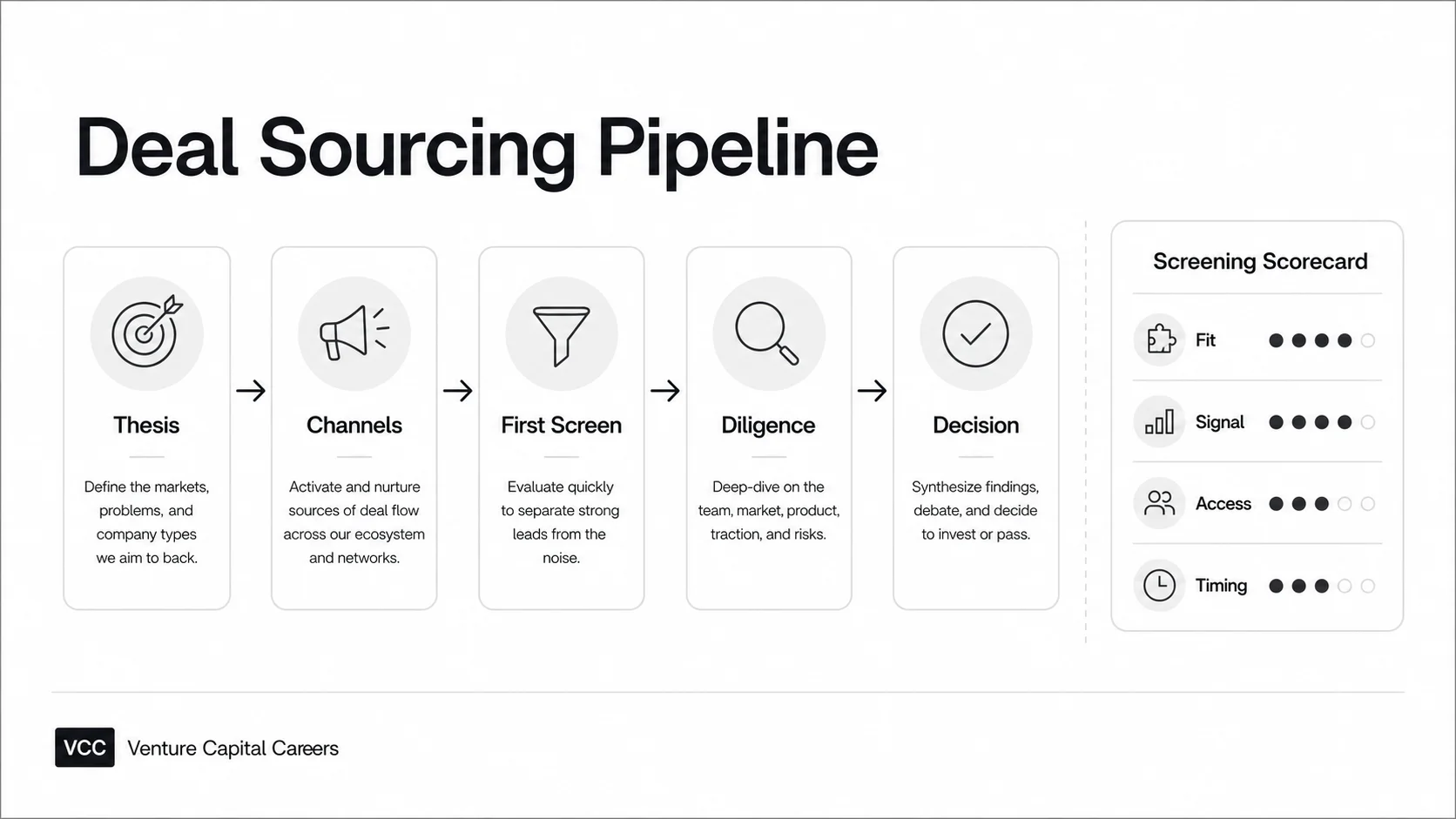
Most closed VC deals start with a relationship. See where deals come from by stage, how to work each sourcing channel, which signals show up early, and how analysts run a weekly sourcing process.
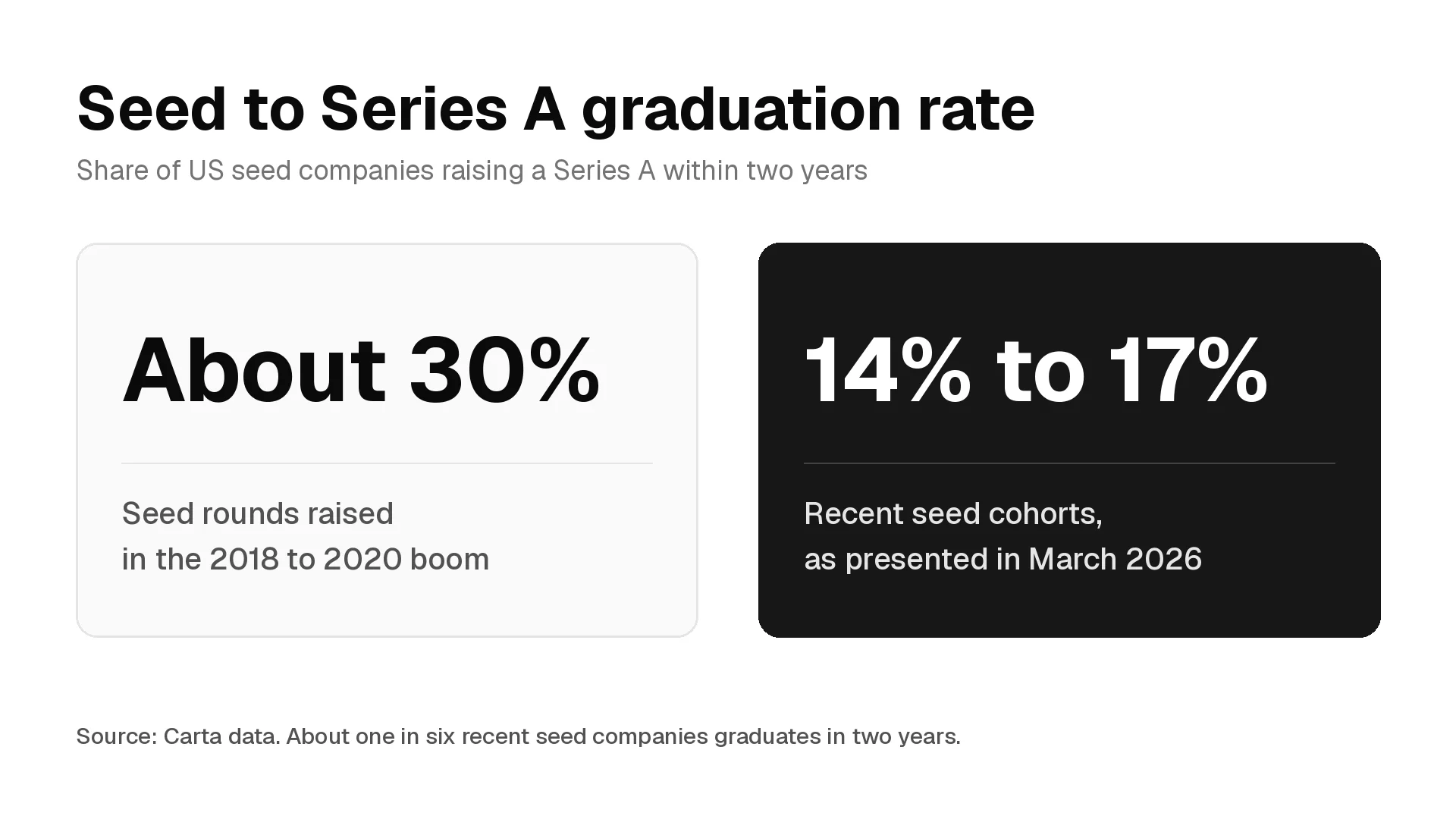
Seed to Series A graduation rates by cohort from Carta and Crunchbase, how long the jump takes, why rates fell after 2021, why published figures disagree, and how seed and Series A firms use the rate for reserves, LP reporting, portfolio reviews and interviews.