
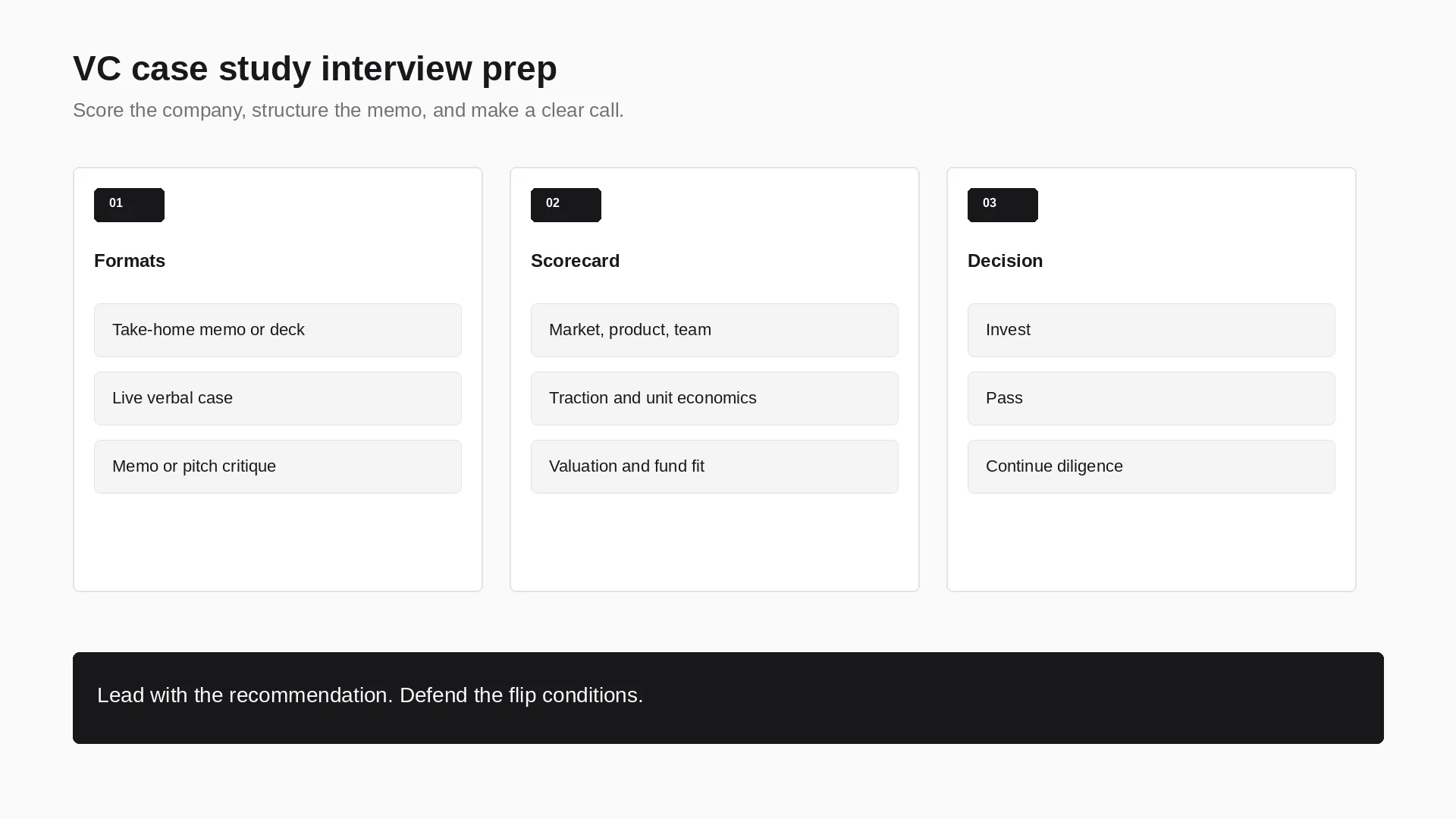
A venture capital case study interview tests whether a candidate can evaluate a startup like an investor: identify the real question, separate signal from noise, build a recommendation, and defend it under follow-up. The goal is not the most complicated model. The goal is investment judgment.
Most VC case studies ask one version of this question: would this fund invest in this company, at this stage, on these terms? A strong answer covers market, customer problem, product, team, traction, business model, valuation, risks, fund fit, and what would change the call.
Use the process below for analyst, associate, intern, MBA, banker, consultant, and operator interviews where the firm gives a startup, deck, memo, data room, market, or live prompt.
What a venture capital case study interview tests
VC firms use case studies because polished behavioral answers are easy to rehearse. A case forces judgment when information is incomplete.
Interviewers usually watch five signals:
| Signal | What they want to see |
|---|---|
| Investment judgment | Can you decide whether the company is venture-backable, not just interesting? |
| Prioritization | Can you focus on the few issues that matter most for this deal? |
| Market thinking | Can you explain why the market could become large, urgent, and valuable? |
| Commercial sense | Can you connect product, customer pain, pricing, GTM, retention, and unit economics? |
| Communication | Can you make a clear recommendation and handle pushback without becoming defensive? |
That is why case studies feel different from standard venture capital interview questions. Interview questions test knowledge and fit. Case studies test judgment in motion.
The main VC case-study formats
The format changes how much analysis belongs on the page versus in the conversation.
| Format | What you receive | What to produce | What matters most |
|---|---|---|---|
| Take-home case | Deck, memo, data excerpt, or company name | Short memo or slide deck | Prioritization, independent research, recommendation |
| Live case | Prompt during the interview | Verbal structure and rough analysis | Clarity, speed, assumptions, tradeoffs |
| Memo review | Existing investment memo or deck | Critique and questions | Risk identification and next diligence |
| Pitch-deck critique | Startup deck | Invest / pass view and follow-up questions | Market, product, team, traction, fund fit |
| Market thesis | Sector or trend | Thesis, target profile, sample companies | Market structure and sourcing judgment |
Early-stage cases often ask for an invest-or-not view. Other versions lean into cap tables, market discussions, or light modeling. Treat the prompt as a clue about the role. An analyst case may stress sourcing and market research. An associate case usually expects sharper investment judgment and return logic.
How to prepare before you receive the prompt
Prep work can start before the company name arrives.
Start with the firm. Read its website, portfolio, stage focus, geography, and recent investments. Use the Venture Capital Careers companies directory for firm context, then check the firm's own site and recent public writing.
Then build a reusable template with these sections:
- Company snapshot
- One-sentence recommendation
- Market and timing
- Customer problem
- Product and differentiation
- Team
- Traction and business model
- Competition
- Valuation and return potential
- Key risks
- Next diligence
Do that scaffolding before the clock starts so structure is not invented under pressure.
The VC case-study scorecard
Use a scorecard so secondary details do not swallow the decision. Weight the rows by stage. Seed leans on team, insight, and wedge. Series A still cares about team, but traction and GTM repeatability rise. Growth puts more weight on revenue quality, retention, margins, and entry price.
| Area | Questions to answer | Strong signal | Weak signal |
|---|---|---|---|
| Market | Is the market large, growing, and urgent? | Clear wedge into a market that can support venture-scale outcomes | Small niche with no expansion path |
| Customer pain | Is the problem frequent, expensive, or mission-critical? | Customer has budget and urgency | Nice-to-have workflow improvement |
| Product | Why does this product win? | Clear differentiation or insight | Similar feature set to many alternatives |
| Team | Why this team? | Founder-market fit, recruiting ability, velocity | Thin domain insight or unclear leadership |
| Traction | Is there evidence customers care? | Revenue, usage, retention, pilots, waitlist quality, strong references | Vanity metrics or vague logos |
| Business model | Can revenue scale efficiently? | Strong gross margin, repeatable GTM, improving unit economics | Expensive acquisition, unclear pricing |
| Competition | Why now and why this company? | Sharp positioning and credible moat | "No competitors" or generic TAM claim |
| Valuation | Does the entry price leave room for returns? | Plausible exit outcomes after dilution | Good company but priced for perfection |
| Fund fit | Does it match the firm's stage, check size, and thesis? | Clear fit with portfolio and mandate | Interesting but wrong for this fund |
| Risks | What could kill the deal? | Honest risks with next diligence | Hand-wavy downside section |
The scorecard should produce a decision, not a checklist performance.
How to structure your memo or presentation
Lead with the answer. Do not make the interviewer wait until slide 10 to learn whether you would invest.
For a short deck, use this flow:
| Slide | Purpose |
|---|---|
| 1 | Recommendation: invest, pass, or continue diligence |
| 2 | Company snapshot: product, customer, stage, round, ask |
| 3 | Market: size, urgency, timing, category structure |
| 4 | Customer problem: who cares and why now |
| 5 | Product: what it does and why it is different |
| 6 | Traction: revenue, usage, retention, pipeline, qualitative proof |
| 7 | Business model: pricing, margins, GTM, unit economics |
| 8 | Competition: direct, indirect, incumbents, substitutes |
| 9 | Valuation and returns: ownership, dilution, exit cases |
| 10 | Risks and next diligence |
For a one-page memo, use the same structure in prose:
Recommendation: [Invest / Pass / Continue diligence] because [one-sentence thesis].

Why it could work:
- Market:
- Product/customer:
- Team:
- Traction/business model:
- Return potential:

Main risks:
- Risk 1:
- Risk 2:
- Risk 3:

Next diligence:
- Question 1:
- Question 2:
- Question 3:
Separate the conclusion from the uncertainty. "Would not invest yet, but would continue diligence if customer references confirm X and the company can show Y" is more credible than a forced yes or no when the data is thin.
What financial analysis is enough
Most VC case studies do not require a full private-equity model. They require enough math to support the recommendation.
For an early-stage company, focus on:
- Revenue growth or usage growth
- Gross margin
- Burn and runway
- Customer acquisition motion
- Retention or repeat usage
- Average contract value or revenue per user
- Sales cycle
- Ownership at entry
- Dilution across future rounds
- Exit value needed for the fund's target return
Even a plausible software company can fail the venture test if the market and valuation do not support a large enough outcome after dilution. Return math is there to pressure-test the story.
For a seed or Series A case, rough numbers are normal. State assumptions clearly:
| If you know | You can estimate |
|---|---|
| Price and round size | Ownership at entry |
| Revenue and growth | Approximate scale and momentum |
| Burn and cash balance | Runway |
| Pricing and customer count | Revenue quality |
| Market size and plausible share | Revenue ceiling |
| Exit multiple range | Potential outcome value |
Do not bury weak logic in precise math. A model with three tabs and weak assumptions is worse than a clean estimate that explains what would need to be true.
Invest, pass, or continue diligence: a decision tree
Most candidates treat the case as a binary invest-or-pass call. Interviewers often prefer a three-way answer when the evidence is incomplete. Map the scorecard to one of three outcomes, then name the flip conditions.
| Call | Use it when | What must be true | What usually kills it |
|---|---|---|---|
| Invest | Core scorecard rows are strong and fund fit is clear | Market and team clear the bar; entry price leaves room; risks are real but diligenceable | Forced optimism on valuation or "no competitors" |
| Pass | A core row fails hard, or fund fit is wrong | Honest explanation of what is still interesting | Soft-passing a company that is simply wrong for the mandate |
| Continue diligence | Upside is real, but one or two load-bearing facts are missing | Named questions that would flip you to invest or pass | Endless maybe with no next step |
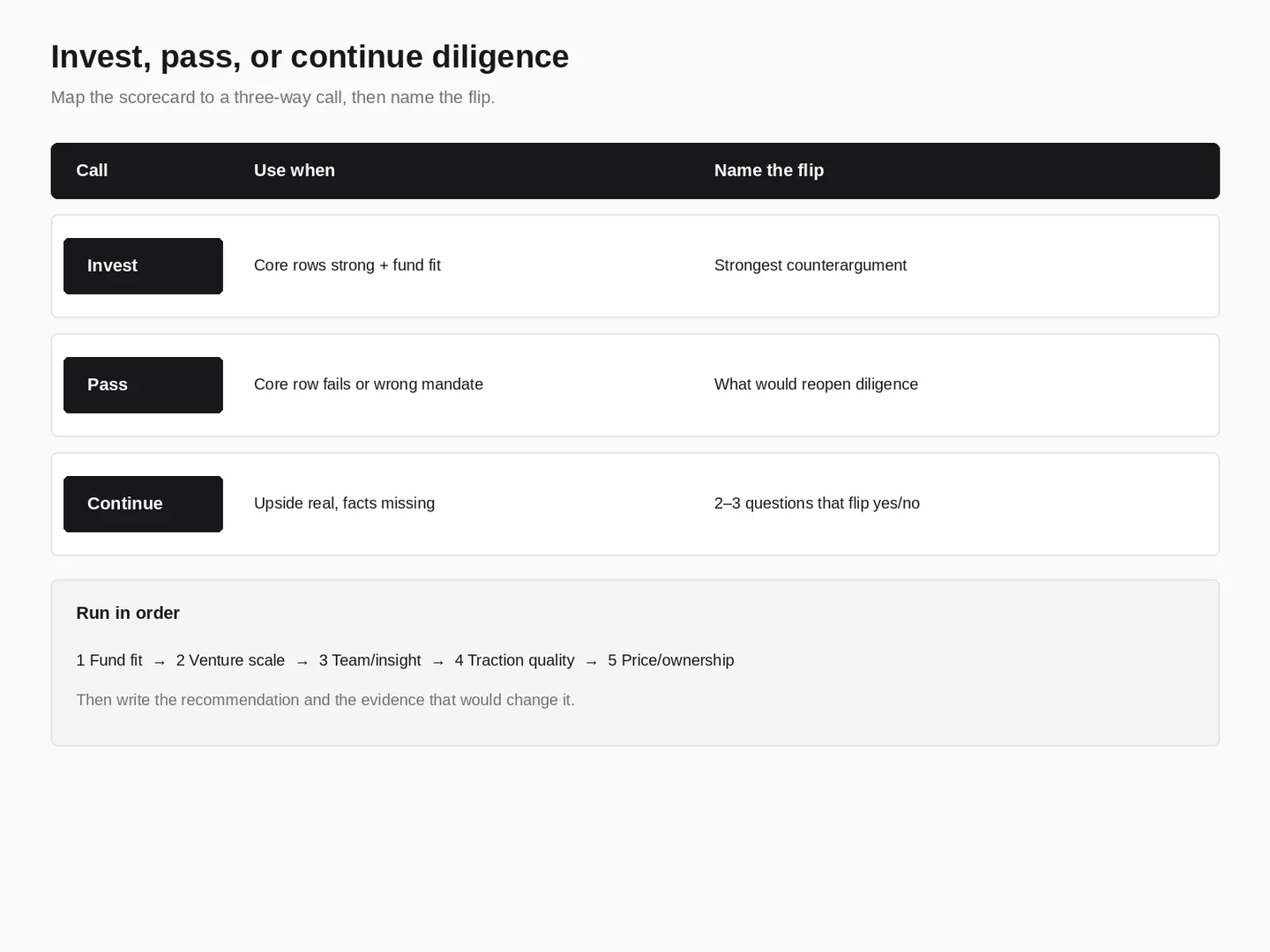
Run the tree in order:
- Fund fit first. Wrong stage, check size, geography, or thesis is a pass even if the company is good.
- Venture-scale test. If the market and business model cannot support a fund-relevant outcome after dilution, pass or continue only if a sharper wedge exists.
- Team and insight. For seed and early Series A, weak founder-market fit is usually fatal.
- Traction quality. Logos without retention, usage without willingness to pay, or growth without a repeatable motion should slow the yes.
- Price and ownership. A strong company at a perfect-world price can still be a pass for this fund.
- Name the flip. Every continue-diligence call needs two or three questions that would change the recommendation. Every invest or pass call needs the strongest counterargument.
A clean three-way call shows judgment and updateability. That is closer to real partnership debate than a theatrical slam-dunk.
A 48-hour take-home schedule
If the take-home window is 48 hours, protect time for synthesis. Candidates often spend too long gathering information and not enough time deciding.
| Time | Work |
|---|---|
| Hours 0-4 | Read the prompt twice, identify the requested output, create the scorecard, list unknowns |
| Hours 4-12 | Research market, customers, competitors, pricing, and recent funding activity |
| Hours 12-24 | Analyze business model, traction, unit economics, valuation, and return potential |
| Hours 24-32 | Decide: invest, pass, or continue diligence; write the core thesis and risks |
| Hours 32-40 | Build the memo or slides; remove anything that does not support the recommendation |
| Hours 40-48 | Rehearse the presentation, prepare follow-up answers, check numbers and sources |
For a 24-hour case, compress research and skip nice-to-have analysis. For a live case, say assumptions out loud and structure the answer before calculating.
How to defend your recommendation
The follow-up discussion often matters as much as the memo. Interviewers want to know whether the view can update.
Prepare answers to these questions:
- What is the strongest argument against your recommendation?
- What one diligence item would most change your mind?
- Which assumption matters most to the return case?
- What did you not have time to analyze?
- Why is this company a fit or not a fit for this specific fund?
- What would you ask the founder?
- Which competitor worries you most?
- What would have to be true for this to become a fund-returning investment?
Structure gets you into the room. Defense is where investor maturity shows.
Common mistakes
No clear recommendation. A case study is not a research report. Make a decision, even if the decision is continue diligence before investing.
Over-modeling. A detailed model will not save a weak investment thesis. Use math to test the investment case, not to avoid judgment.
Generic market slides. "Large and growing" is not enough. Explain why this company has a wedge into the market now.
Ignoring fund fit. A strong company can still be wrong for the fund's stage, check size, ownership target, geography, or sector focus.
Weak risk section. Every startup has risks. If the risks are generic, the interviewer will assume the real ones were missed.
Confusing product quality with venture potential. A useful product is not automatically a venture-scale investment. The company still needs a path to a large outcome.
Failing to explain what would change your mind. Good investors are decisive and updateable. Show both.
FAQ
How long should a VC case-study presentation be?
Use the requested format. If no format is given, aim for 8-10 slides or a concise two-page memo. In the interview, be ready to present the answer in five minutes before going deeper.
Do I need a full financial model?
Usually no. You need enough analysis to support ownership, dilution, revenue scale, burn, and exit logic. If the firm provides detailed financials, use them. If not, keep the math simple and explain assumptions.
Is it okay to recommend passing on the investment?
Yes. A thoughtful pass is often stronger than a forced yes. Explain what makes the company interesting, why the current facts do not clear the bar, and what diligence could change the view.
What if I do not know the sector?
Start with the customer problem, market structure, competitors, and business model. Be explicit about what was learned quickly and where confidence is lower. Do not pretend to be a sector expert after a few hours of research.
Should I use public company comps?
Use comps cautiously. Public-company multiples can help frame valuation, but early-stage startups are priced on growth, market size, team, competition, and financing dynamics. Explain why a comp is relevant before using it.
What should I ask the interviewer after presenting?
Ask questions that show investor thinking: where they would spend diligence time, how the firm thinks about ownership targets, what risks they believe matter most, and how the case resembles real work at the fund.
Find VC firms and roles to target
Case-study prep is more useful when it is tied to real firms. Study the stage, sector, and portfolio patterns of the funds you are targeting, then practice cases that match those patterns.
Use the Venture Capital Careers companies directory to research firms, then browse open roles on the VC job board. If application materials still need work, tighten a venture capital resume and review the broader VC career path before the interview process starts.
For broader prep, pair this article with the venture capital interview questions guide and the venture capital internship interview questions guide. To map the full recruiting path, see how to get a job in venture capital.
Related posts
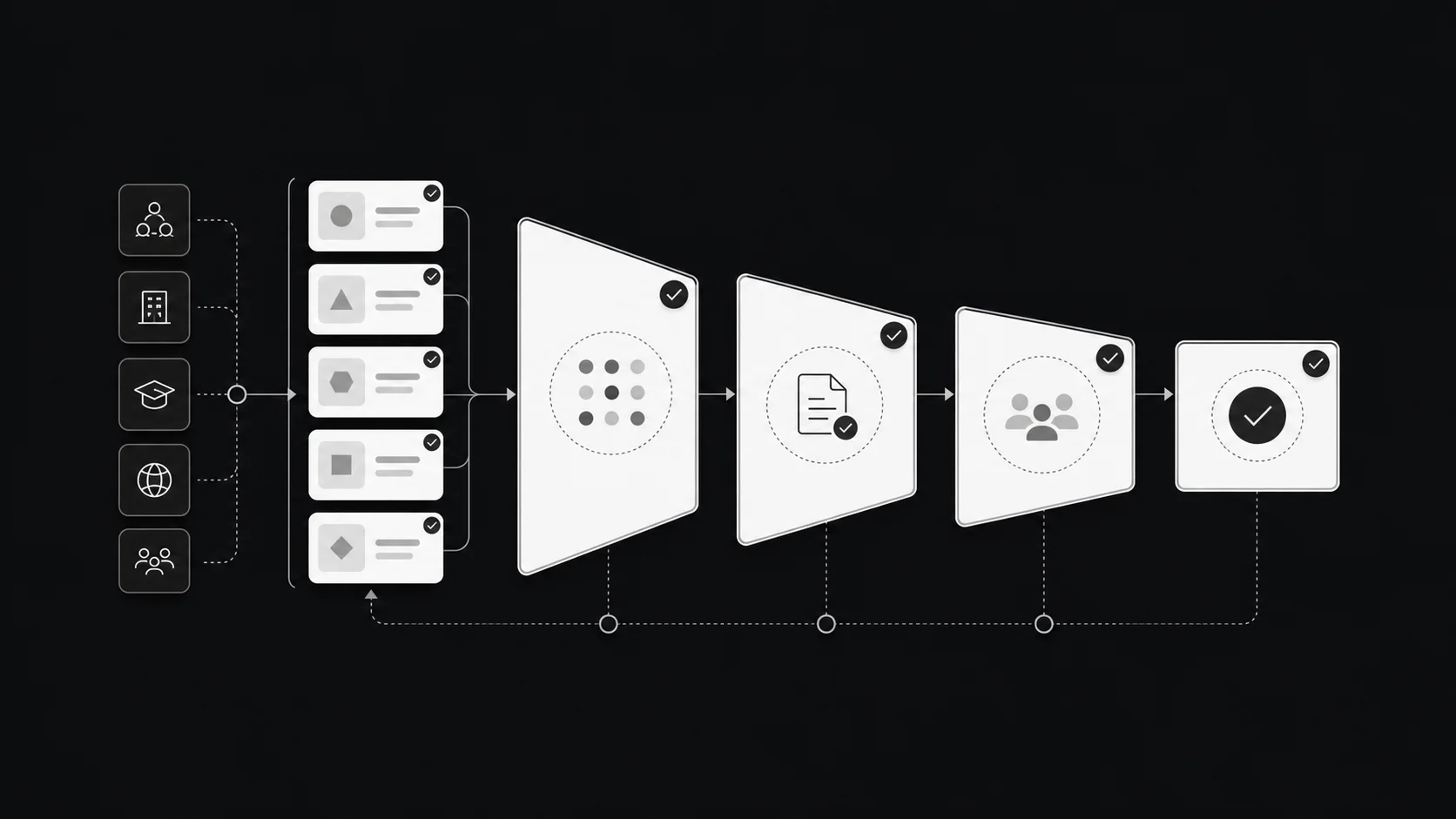
Deal flow is the stream of investment opportunities a venture firm receives and the funnel that sorts them. For every deal closed, firms consider about 101 companies.
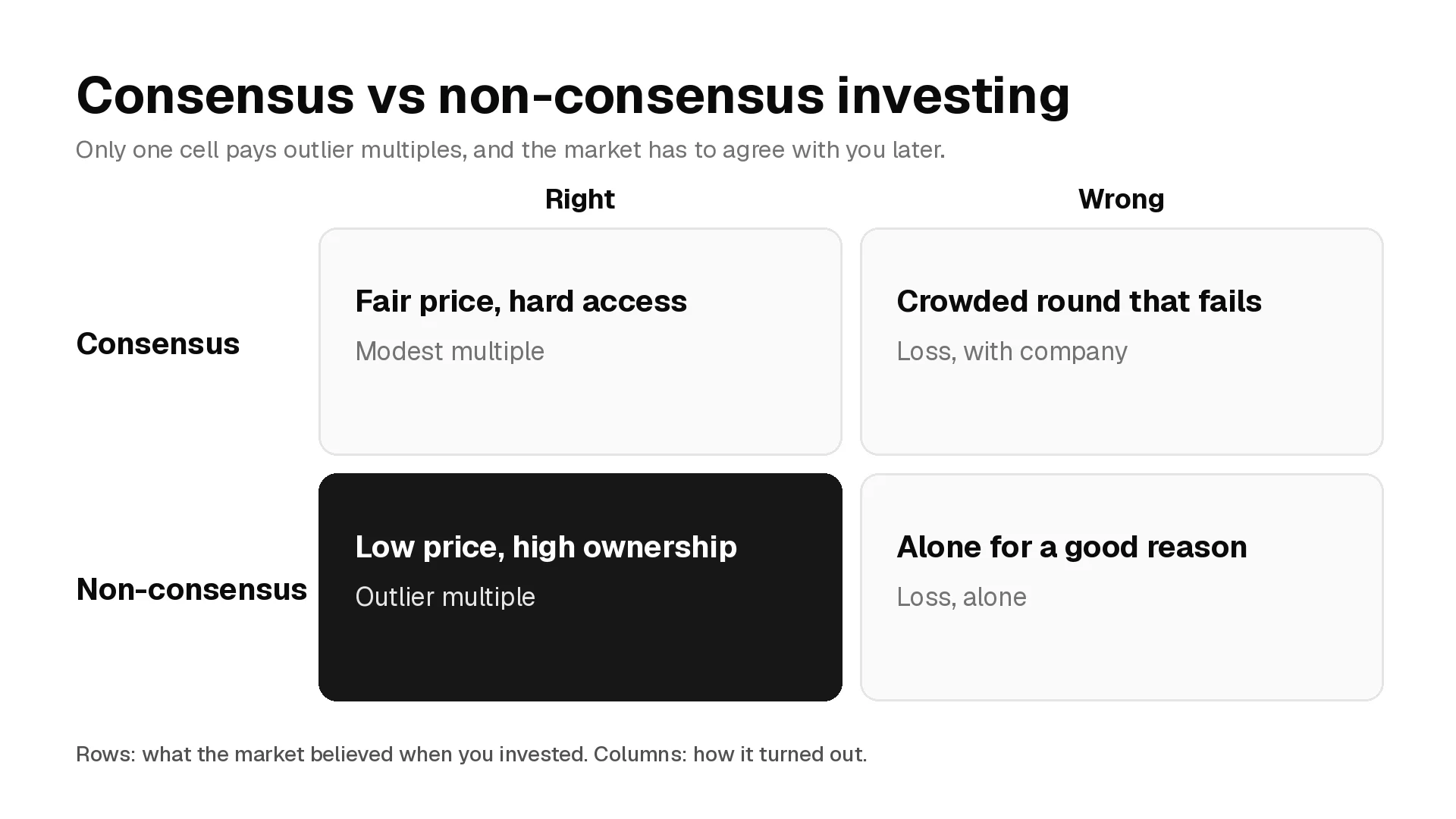
Non-consensus investing means backing a company most investors have passed on or not yet seen, for a reason you can state and test. How the 2x2 works, why firms drift toward consensus, how investment committees vote, and how analysts and associates bring a non-consensus deal.
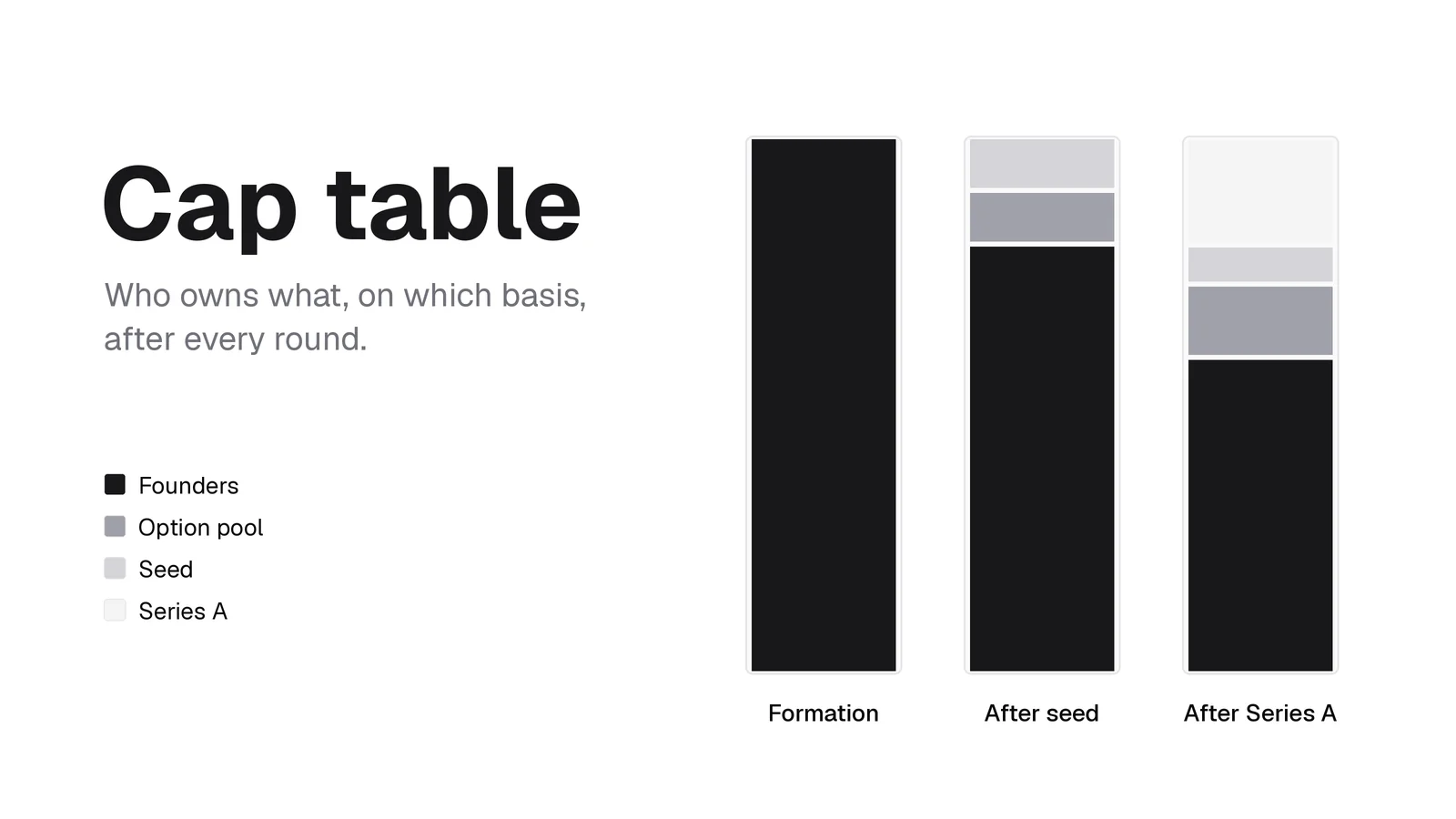
A cap table records who owns a company's shares, options, warrants, and convertible securities, and what percentage each holder owns on a stated basis.