
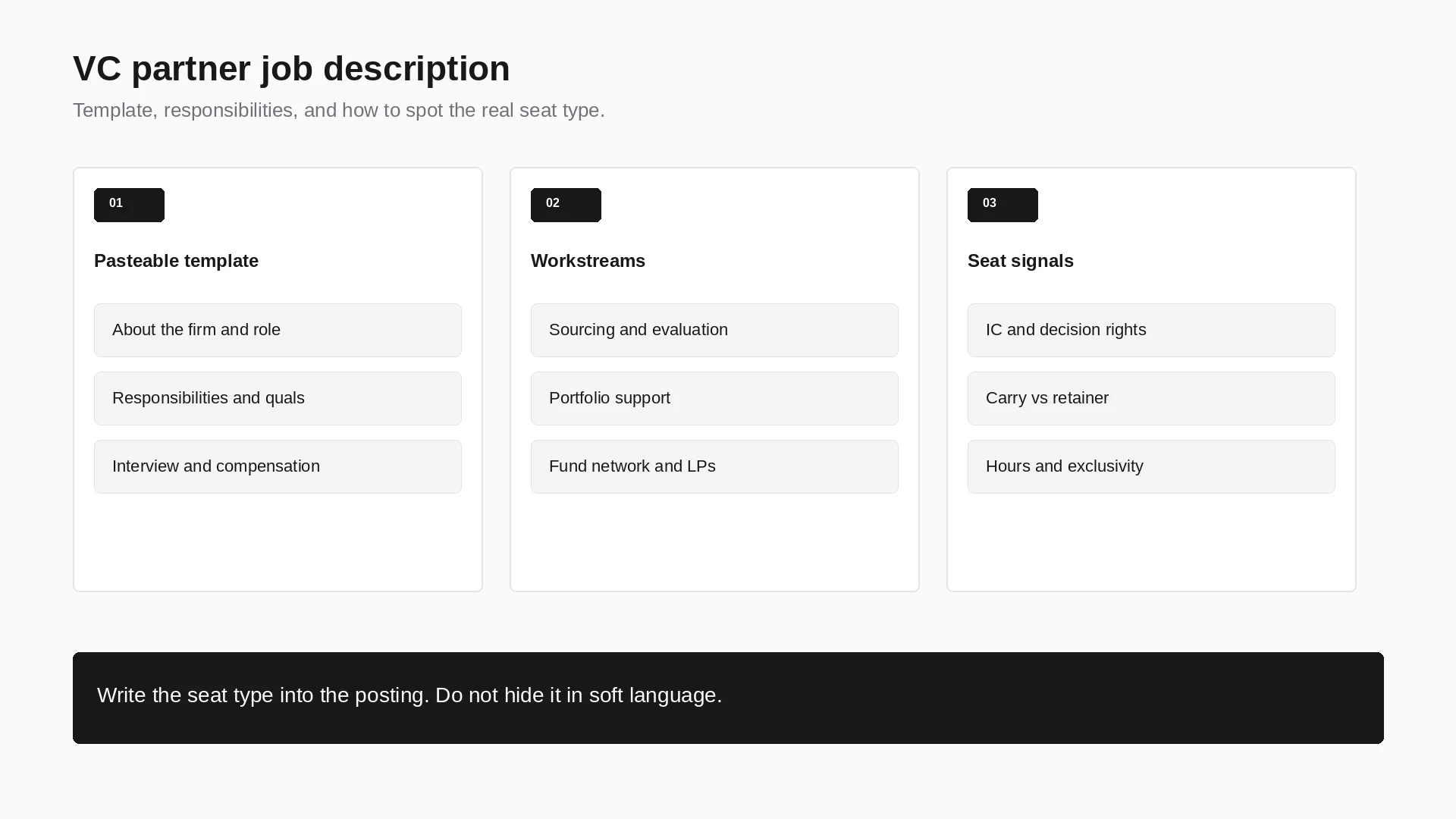
A venture capital partner helps a firm source companies, evaluate investments, support founders, and strengthen the fund's network. The title sounds senior, but it is not one job. At some funds, partner means a full-time investing seat with investment committee authority and fund-level economics. At others, venture partner means a part-time specialist, former founder, operator, or sector expert who brings deal flow and judgment without owning full fund management.
That ambiguity is why the job description matters. A strong posting should say whether the hire will source deals, lead deals, advise on deals, support portfolio companies, help with fundraising, or sit on a path toward general partner. For candidates, the same details show whether the role is a real investing seat, a network-based advisory title, or an undefined senior label.
Browse open partner roles on the Venture Capital Careers job board and research firm focus in the companies directory before you write or apply to a posting.
What does a venture capital partner do?
Partner-level work usually sits above principal and below or alongside general partner and managing partner, depending on the firm. Titles vary: partner, venture partner, investment partner, junior partner, or general partner can describe different scopes of authority.
The work usually falls into four buckets:
| Workstream | What the partner does | Output |
|---|---|---|
| Deal sourcing | Finds founders, maps a sector, makes warm introductions, and surfaces companies that fit the fund's thesis | Qualified deal flow, founder notes, market maps |
| Investment evaluation | Reviews companies, joins founder calls, contributes diligence on market, product, team, and risk | Diligence notes, investment input, IC perspective |
| Portfolio support | Advises portfolio founders on strategy, hiring, go-to-market, partnerships, or fundraising | Founder support, operating plans, introductions |
| Fund network | Builds relationships with founders, angels, operators, later-stage investors, LPs, and ecosystem partners | Referral network, co-investor access, brand reach |
The mix depends on the fund. A seed fund may value founder access and thesis development. A sector specialist may value domain credibility. An emerging manager may want fundraising and co-investor help. A growth fund may want senior operating perspective for diligence and portfolio support.
For level context, read the venture capital career path and the venture capital principal job description. For title comparisons, see venture partner vs general partner and venture partner vs operating partner.
Venture capital partner job description template
Use this as a starting point, then replace the bracketed sections with your fund's stage, sector, location, time commitment, decision rights, and compensation details.
About the firm
[Firm name] is a venture capital firm investing in [stage] companies across [sector or geography]. We partner with founders building [types of companies or markets], and we support portfolio companies with [hiring, customers, fundraising, operations, product, go-to-market, or other strengths].
Role summary
We are hiring a [Venture Partner / Partner / Investment Partner] to help identify high-quality investment opportunities, evaluate companies in [sector or stage], support portfolio founders, and expand our network across founders, operators, angels, co-investors, and strategic partners.
This role is [full-time / part-time / advisory / partner-track]. The right candidate brings deep credibility in [sector or function], strong founder relationships, and the judgment to help decide which companies deserve time, capital, and support.
Decision rights: [IC vote / IC participation without vote / advisory input only]. Primary mandate: [sourcing / deal leadership / sector diligence / portfolio support / fundraising support / mix].
Responsibilities
- Source and qualify investment opportunities that match the firm's thesis.
- Build and maintain relationships with founders, operators, angels, accelerators, co-investors, and ecosystem partners.
- Join founder meetings and help assess team quality, market timing, product differentiation, go-to-market motion, and financing risk.
- Support diligence with sector expertise, customer references, market maps, technical review, or operating perspective.
- Contribute to investment materials and investment committee discussions at the level defined for this seat.
- Help portfolio companies with introductions, hiring, partnerships, fundraising preparation, strategic projects, or functional guidance.
- Represent the firm in the market through events, founder conversations, content, or community relationships.
- Maintain clear records of sourced companies, relationship context, diligence notes, and portfolio-support activity.
- Collaborate with the investment team on thesis development, deal prioritization, and portfolio support.
Required qualifications
- Senior operating, founder, investing, or sector experience relevant to the firm's thesis.
- Strong founder and operator network in [target market].
- Ability to evaluate startups with independent judgment and clear communication.
- Credibility with founders and investors.
- High-trust relationship style and careful handling of confidential information.
- Willingness to work within the firm's investment process and documentation standards.
Preferred qualifications
- Prior angel investing, venture investing, board, advisor, or founder experience.
- Experience helping startups raise capital, hire executives, enter markets, or scale go-to-market.
- Existing relationships with co-investors, accelerators, strategic partners, or LPs.
- Published thesis work, sector research, community leadership, or founder-facing content.
- Track record of introducing high-quality opportunities before they are broadly known.
Interview process
- Introductory conversation with the investment team or managing partner.
- Discussion of sector thesis, founder network, and relevant operating or investing experience.
- Review of two to three companies the candidate would want the fund to meet and why.
- Case discussion around a live or anonymized startup opportunity.
- Portfolio-support discussion with examples of how the candidate helps founders.
- Partner-level calibration on time commitment, economics, decision rights, and success metrics.
Compensation and benefits
- Cash compensation: [salary / retainer / none], with enough clarity that candidates can compare the role to other senior seats.
- Bonus or success incentives: [structure, if any].
- Carry or profit interest: [fund carry / deal-by-deal / advisory equity / none], including vesting basics when possible.
- Benefits and logistics: [office expectations, travel, exclusivity, ability to keep operating or advisory work, public representation rules].
Core responsibilities to include
Generic language such as "support the investment process" is not enough. A useful partner job description names the workstreams and the outcomes the hire will own.
Include at least these responsibility clusters when they are real for the seat:
1. Sourcing and network. Founder relationships, sector maps, warm introductions, and a quality bar for what enters the pipeline. 2. Investment judgment. Diligence input, memo or IC contribution, and a clear statement of whether the person leads or advises. 3. Portfolio support. Structured help on hiring, customers, fundraising, or functional problems, not only ad hoc favors. 4. External representation. Events, content, dinners, or community work when brand is part of the mandate. 5. Fundraising or LP support. Only when this is truly expected; do not bury it as a soft add-on.
Separate core responsibilities from occasional ones. If everything is listed as equally important, candidates cannot tell what the firm actually needs.
Skills and qualifications
Partner hiring is less about generic finance credentials and more about what the existing team cannot already access, judge, or support. Separate must-haves from nice-to-haves so the posting does not over-filter.
| Skill | Why it matters | Evidence to look for |
|---|---|---|
| Founder access | Many partner seats are won through trusted relationships, not cold outbound volume | Warm founder network, angel checks, operator community, accelerator ties |
| Sector judgment | The firm wants sharper pattern recognition in a market | Market thesis, operating track record, customer knowledge, technical credibility |
| Investment judgment | Sourcing only helps if the person can explain why a company matters | Memos, angel portfolio, early evaluations that aged well |
| Founder usefulness | Founders ignore advice that exists only to unlock deal access | Coaching examples, board or advisor work, operating scars |
| Network quality | Introductions should be relevant and trusted | Co-investor, customer, talent, strategic, and LP relationships |
| Process reliability | A loose senior title fails when follow-through is weak | CRM hygiene, confidentiality, consistent availability, clear notes |
Backgrounds that commonly fit include founders, operators, angels, sector experts, and senior investors. The best background is the one that gives the fund credible access and judgment in a specific market. For paths into the title, see how to become a venture partner.
Investing partner vs venture partner vs advisory title
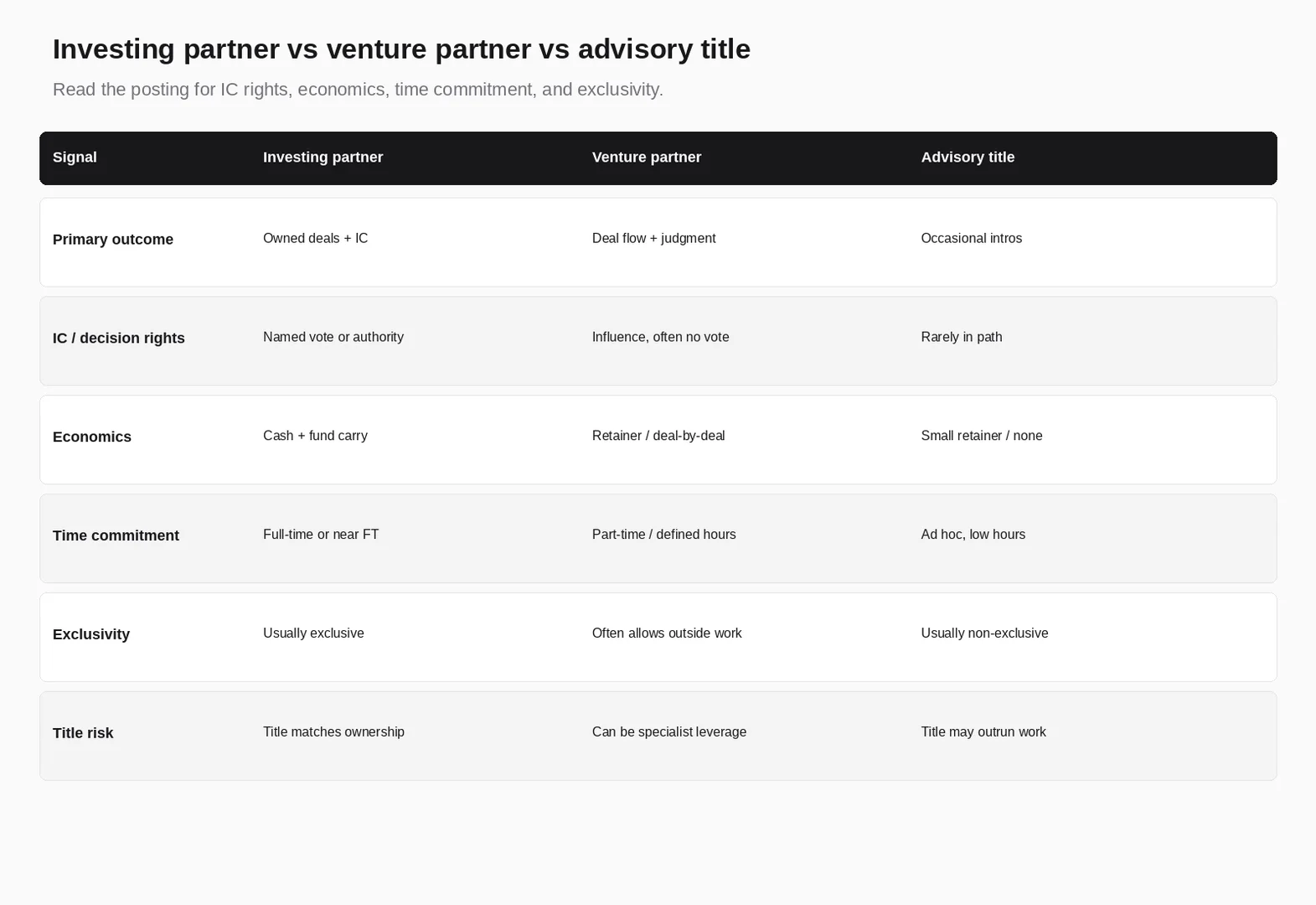
The same "partner" word can hide three different seats. Write the seat type into the posting. Candidates should read the posting for the same signals before investing time in the process.
| Signal | Investing partner | Venture partner | Advisory title |
|---|---|---|---|
| Primary outcome | Owned deals, IC recommendations, fund returns | Qualified deal flow, sector judgment, founder support | Occasional intros, brand association, soft advice |
| IC / decision rights | Named vote or clear decision authority | Participation or influence, often without sole vote | Rarely in the decision path |
| Economics | Salary or meaningful cash plus fund carry | Retainer, deal-by-deal, partial carry, or mix | Small retainer, advisory equity, or reputation only |
| Time commitment | Full-time or near full-time | Part-time or defined days/hours | Ad hoc and low hours |
| Exclusivity | Usually exclusive or tightly limited outside work | Often allows operating, advising, or angel work | Usually non-exclusive |
| Title risk | Title matches investing ownership | Title can be accurate specialist leverage | Title may outrun the work and economics |
If the firm needs portfolio operating help more than deal ownership, write an operating partner job description instead of stretching venture partner into a catch-all. If the hire must lead deals full-time with partner economics, say investing partner or partner-track and define IC rights up front.
Employer rule: do not use venture partner as a soft label for every senior helper. Candidate rule: if IC rights, economics, and hours are vague, ask before the final round.
How to calibrate the role before posting
Decide what problem the hire solves before drafting the posting.
| Hiring need | Better role shape |
|---|---|
| More qualified founder introductions in one sector | Part-time venture partner or sector partner |
| More diligence depth in a technical market | Technical venture partner or domain advisor |
| More portfolio operating support | Operating partner or platform specialist |
| Future investment-team leadership | Full-time partner-track investing role |
| Fundraising and LP access | Senior partner or venture partner with explicit fundraising scope |
| More deal execution capacity without GP scope | Principal or investment director |
Answer four questions in the posting itself:
- Is the role full-time, part-time, advisory, or partner-track?
- Does the person source, lead, advise, or only support portfolio companies?
- What decision rights exist at investment committee?
- What does success look like in the first six to twelve months?
For day-to-day texture after the JD is clear, see the day in the life of a venture capital partner.
Interview process and scorecard
Partner interviews should test judgment, network quality, and reliability, not only seniority. A practical process:
| Stage | What to test | Pass signal |
|---|---|---|
| Intro screen | Mandate fit, time commitment, conflicts, motivation | Clear story for why this fund and this seat type |
| Thesis and network review | Sector depth and relationship quality | Specific founders, markets, and intros, not vague "I know everyone" |
| Company examples | Taste and prioritization | Two or three companies with a crisp why-now and why-this-fund |
| Case or live opportunity | Investment judgment under incomplete information | Clear risks, decision, and what diligence would change the answer |
| Portfolio-support probe | Founder usefulness | Concrete help examples with outcomes, not generic mentorship claims |
| Economics and rights calibration | Alignment on hours, exclusivity, IC, carry | Both sides can state the same deal in plain language |
Score candidates on judgment, network relevance, founder credibility, process reliability, and fit to the written mandate. Do not hire on title hunger alone.
Salary, bonus, and carry language
Partner economics vary widely by fund size, seat type, and whether the role is full-time investing or part-time specialist work. Do not invent universal salary bands in the posting.
What to make explicit:
- Whether cash is salary, retainer, success-based, or none.
- Whether carry is fund-level, deal-by-deal, advisory equity, or not offered.
- When economics vest or crystallize, at a high level.
- Whether outside operating, advising, or angel work is allowed.
A full-time investing partner role usually needs salary, bonus, and carry language. A part-time venture partner role may use retainer, deal-by-deal economics, partial carry, or a mix. Treat any compensation claim as fund-specific. For market context across levels, use the venture capital salary guide.
How candidates should read a partner posting
Read the posting like a term sheet. Look for what is explicit, what is vague, and what incentives sit under the title.
- Identify the exact title: venture partner, partner, investment partner, operating partner, or general partner.
- Find time commitment and exclusivity language.
- Find IC or decision-rights language. Silence usually means limited authority.
- Separate sourcing, deal leadership, portfolio support, and fundraising. Which one is core?
- Read economics for structure, not just optimism. Ask how carry or deal-by-deal economics work.
- Check whether success metrics are meetings, qualified deals, investments, portfolio outcomes, LP access, or brand reach.
- Compare the posting to the firm's team page and portfolio. If the public story and JD disagree, ask about the gap early.
A venture partner role can be a strong way into VC. It can also become an undefined advisory title with limited economics and limited decision authority. Ask early.
Browse partner roles and research firms
- Browse live partner, venture partner, principal, and operating partner roles on the Venture Capital Careers job board.
- Research stage, sector, and team shape in the companies directory.
- Create an account to save searches and alerts via sign up.
Employers should post where VC-interested candidates already search. Pair the posting with a clear companies profile so candidates can research stage and focus before they apply.
FAQ
Is a venture partner the same as a general partner?
Usually no. A general partner typically owns fund-level decisions, fundraising, portfolio construction, and firm leadership. A venture partner may influence deals and support founders, but the role is often part-time, specialist, or narrower in decision authority. See venture partner vs general partner for a deeper comparison.
Is a venture capital partner a full-time job?
Sometimes. Many venture partner roles are part-time, advisory, or project-based. Full-time partner and partner-track investing seats also exist. The job description should state the time commitment clearly.
What background fits a venture capital partner role?
Common backgrounds include founder, executive, angel investor, operator, sector expert, and senior investor. The best fit is the background that gives the fund credible access, judgment, and support in a specific market.
Do venture partners get carry?
They may. Compensation can include retainer, salary, bonus, deal-by-deal economics, carry allocation, advisory equity, or success-based incentives. Ask how economics are structured and when they vest.
Can a venture partner role lead to general partner?
It can, but it is not automatic. Consistent sourcing quality, founder trust, investment contribution, and help raising or returning capital can build a case for a broader partner role. Some venture partner seats are intentionally specialist and not a promotion track.
How is this different from an operating partner?
Operating partners usually focus on helping portfolio companies with functional or strategic operating problems and usually do not own investment decisions. If the mandate is portfolio operating support, use the operating partner job description rather than stretching venture partner.
Related posts
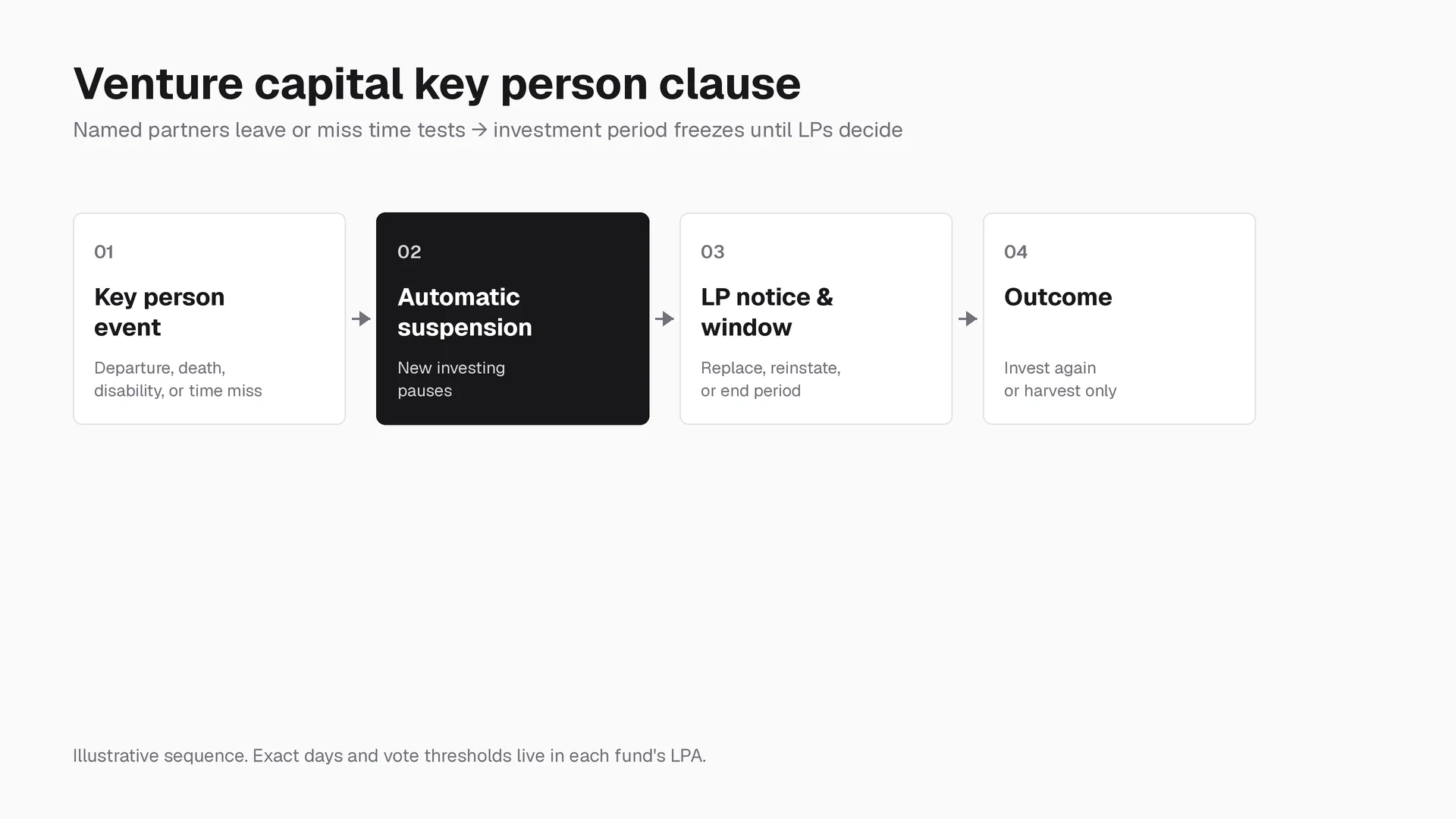
A key person clause names the partners a venture fund depends on and can freeze new investing if they leave. Here is how the trigger works, what still happens during a suspension, and what it means for your job search and seat.
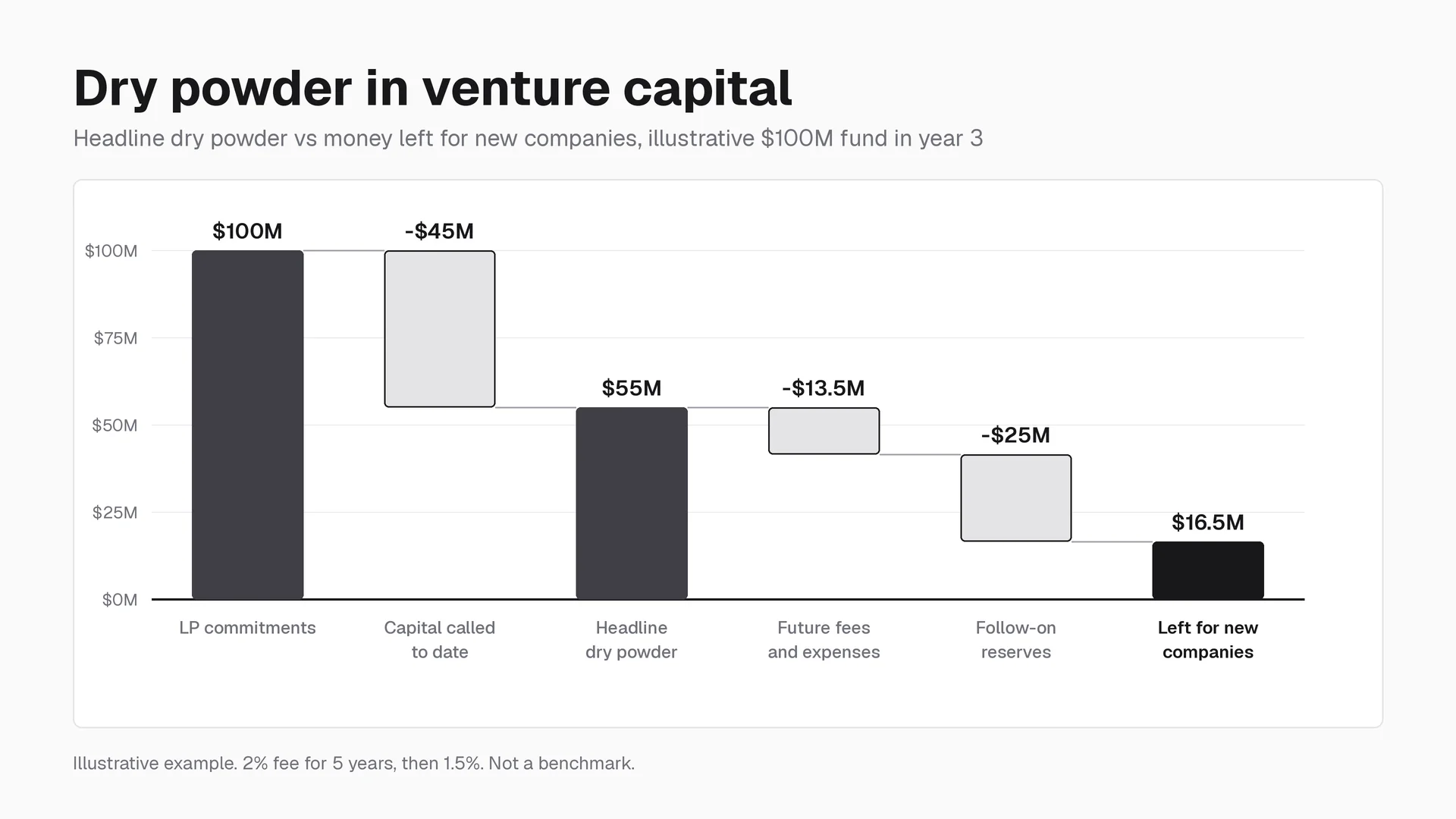
Dry powder in venture capital explained: the formula, a worked $100M fund example showing how little headline dry powder is left for new companies, current US and global data, and what a firm's dry powder tells you about hiring and the junior job.
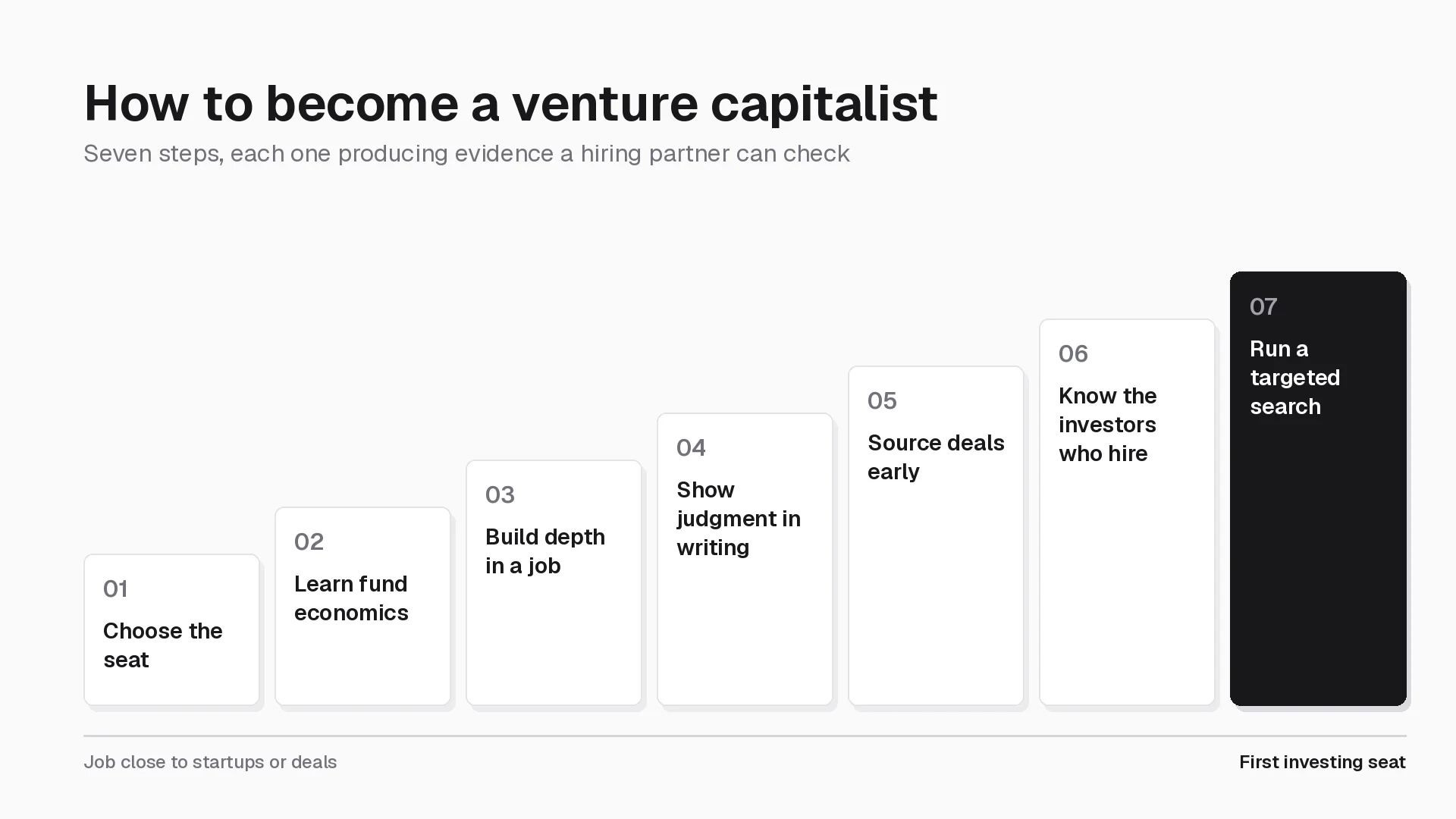
How to become a venture capitalist in seven steps: choose the seat, build depth, prove judgment in writing, source early, and run a targeted search. Includes entry paths by background, how fund size limits hiring, MBA placement data, and licensing.