
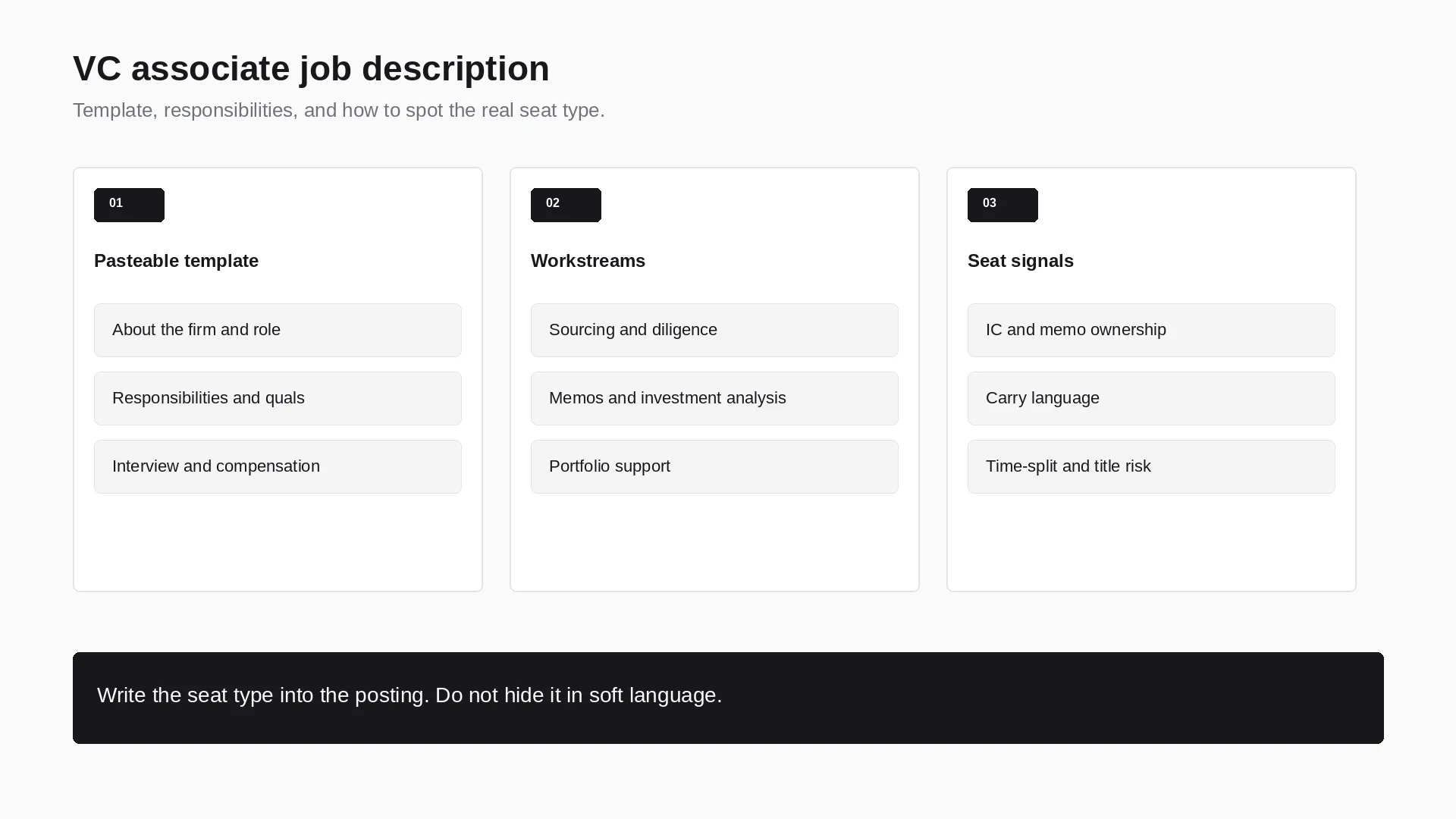
A venture capital associate helps a fund find, evaluate, and support startup investments. In practice that means sourcing companies, researching markets, reviewing pitch decks, building financial and returns analysis, writing investment memos, helping partners prepare for investment committee, and supporting portfolio companies after the deal closes.
For employers, the job description should make one thing clear: is this person being hired mainly to source new deals, run diligence, support portfolio companies, or do a mix of all three? For candidates, that same detail tells you whether the role is a real investing seat, a sourcing-heavy apprenticeship, or senior-associate work with an associate title.
Browse open associate roles on the Venture Capital Careers job board and research firm focus in the companies directory before you write or apply to a posting.
What does a venture capital associate do?
A venture capital associate is usually an early-to-mid-level investment professional. The role sits above analyst and below senior associate, principal, or partner, although titles vary by fund.
The work usually falls into four buckets:
| Workstream | What the associate does | Output |
|---|---|---|
| Sourcing | Maps markets, finds startups, tracks founder relationships, reviews inbound decks | Deal pipeline, founder notes, market maps |
| Diligence | Researches competitors, customers, market size, pricing, metrics, and risk | Diligence memo, questions list, references |
| Investment analysis | Builds financial models, valuation cases, return scenarios, and ownership analysis | Model, return bridge, investment memo |
| Portfolio support | Helps portfolio companies with hiring, customers, follow-on fundraising, reporting, or strategic projects | Portfolio updates, intros, project plans |
The balance changes by fund. A seed fund may expect more founder outreach and thesis work. A growth fund may expect more modeling, customer calls, and diligence process management. A sector specialist may expect deeper market judgment.
For candidates comparing levels, read the venture capital career path and the venture capital analyst job description.
Venture capital associate job description template
Use this as a starting point, then replace the bracketed sections with your fund's stage, sector, location, process, and compensation details.
About the firm
[Firm name] is a venture capital firm investing in [stage] companies across [sector or geography]. We partner with founders building [types of companies or markets], and we support portfolio companies with [hiring, customers, fundraising, operations, product, go-to-market, or other platform strengths].
We are hiring a Venture Capital Associate to join our investment team in [location or remote/hybrid policy]. This person will help source new opportunities, evaluate potential investments, prepare investment recommendations, and support portfolio companies after investment.
Role summary
The Venture Capital Associate will work closely with [partners, principals, senior associates, platform team, or operating partners] across the full investment lifecycle. The role suits someone who can combine analytical rigor with founder empathy: comfortable reading financials, researching unfamiliar markets, writing clearly, and building relationships with entrepreneurs.
This is a [pre-MBA / post-MBA / early-career / mid-career] investment role with meaningful exposure to [sourcing, diligence, investment committee, portfolio support, or board materials].
Responsibilities
- Build and maintain a pipeline of relevant startups through market mapping, founder outreach, investor referrals, accelerators, universities, operators, and sector research.
- Screen inbound and outbound opportunities against the firm's investment thesis.
- Review pitch decks, data rooms, financial statements, KPIs, cohort data, customer materials, and competitive landscapes.
- Conduct market research, customer calls, expert calls, founder references, and competitor analysis.
- Build financial models, valuation cases, ownership scenarios, and return analyses appropriate for the company's stage.
- Draft investment memos, diligence summaries, IC materials, and partner briefing notes.
- Support term sheet, cap table, and financing-round analysis with the senior investment team.
- Track portfolio company progress, follow-on financing needs, hiring priorities, and strategic support requests.
- Help portfolio companies with introductions to talent, customers, advisors, later-stage investors, or operating resources where relevant.
- Represent the firm professionally in founder meetings, industry events, and ecosystem relationships.
Required qualifications
- Two or more years of experience in venture capital, investment banking, private equity, growth equity, management consulting, corporate development, startups, product, strategy, or another relevant analytical or operator role.
- Strong research, writing, and analytical judgment.
- Ability to evaluate markets, business models, competitive dynamics, and founder-market fit.
- Comfort with financial statements, unit economics, capitalization tables, ownership, dilution, and basic valuation methods.
- Clear written communication, especially for investment memos and concise partner updates.
- High ownership, organization, and follow-through in ambiguous situations.
- Genuine interest in startups, technology, markets, and company building.
Preferred qualifications
- Prior experience at a venture fund, startup, accelerator, investment bank, consulting firm, or high-growth technology company.
- Sector expertise in [sector].
- Experience building market maps, sourcing systems, or founder communities.
- Financial modeling, SQL, data analysis, product analytics, or technical fluency relevant to the fund's focus.
- MBA or graduate degree if the role is explicitly post-MBA; do not list this as required unless it truly is.
- Existing founder, operator, investor, university, or sector-specific network.
Interview process
- Introductory screen with the investment team or recruiting lead.
- Work sample, such as a market map, company screen, short investment memo, or written response to a startup pitch.
- Case discussion with one or more investment professionals.
- Founder-style conversation or simulated partner meeting.
- Final interviews with partners or principals.
- Reference checks focused on judgment, ownership, writing quality, and collaboration.
Compensation and benefits
- Base salary: [range or "competitive / commensurate with experience"].
- Bonus: [structure, if any].
- Carry or profit interest: [eligible / not eligible / case-by-case], with enough clarity that candidates can compare offers.
- Benefits: [health, parental leave, learning budget, conference budget, remote/hybrid policy, relocation, visa support].
- Other: [office location expectations, travel expectations, secondment or operating opportunities].
Core responsibilities to include
Generic finance language ("support investment decisions," "analyze opportunities") is not enough. A useful associate job description names the workstreams and the artifacts the hire will own.
Include at least these responsibility clusters when they are real for the seat:
1. Sourcing and thesis work. Market maps, outbound founder outreach, inbound screening, and notes that feed the pipeline. 2. Diligence. Customer and expert calls, competitive analysis, reference checks, and a written risk list. 3. Investment materials. Memos, models appropriate to stage, ownership and dilution analysis, and IC briefing notes. 4. Portfolio support. Hiring intros, customer intros, follow-on process support, reporting, or scoped operating projects. 5. Partner time. Clear ownership of follow-ups, CRM hygiene, and partner preparation so senior investors spend time on judgment, not logistics.
If the role is mostly one of those clusters, say so. Ambiguous postings attract mismatched candidates and waste interview time.
Skills and qualifications
Separate must-haves from nice-to-haves. Overloading "required" with MBA, prior VC, and a rare sector pedigree shrinks the pool without improving hire quality.
| Skill area | What good looks like in an associate | Common over-spec |
|---|---|---|
| Research and judgment | Turns messy company and market information into a clear recommendation with risks | Demands years of prior VC before the first investing seat |
| Writing | Short memos partners actually read; crisp email updates | Treats slide volume as a proxy for quality |
| Modeling | Stage-appropriate financials, unit economics, ownership, and return cases | Requires full LBO depth for seed roles |
| Founder interaction | Credible questions, respectful pushback, reliable follow-through | Expects an existing top-tier founder network on day one |
| Organization | Owns diligence threads, CRM, and IC prep without dropping balls | Lists tools instead of ownership habits |
Backgrounds that commonly transfer well include investment banking, consulting, growth equity or PE, startup operating roles, product or strategy at high-growth companies, and prior VC analyst work. Prior VC is useful when it is available. It is not the only path into an associate seat. For entry-level investing paths, see how to become a venture capital analyst.
Investing seat vs sourcing or platform seat
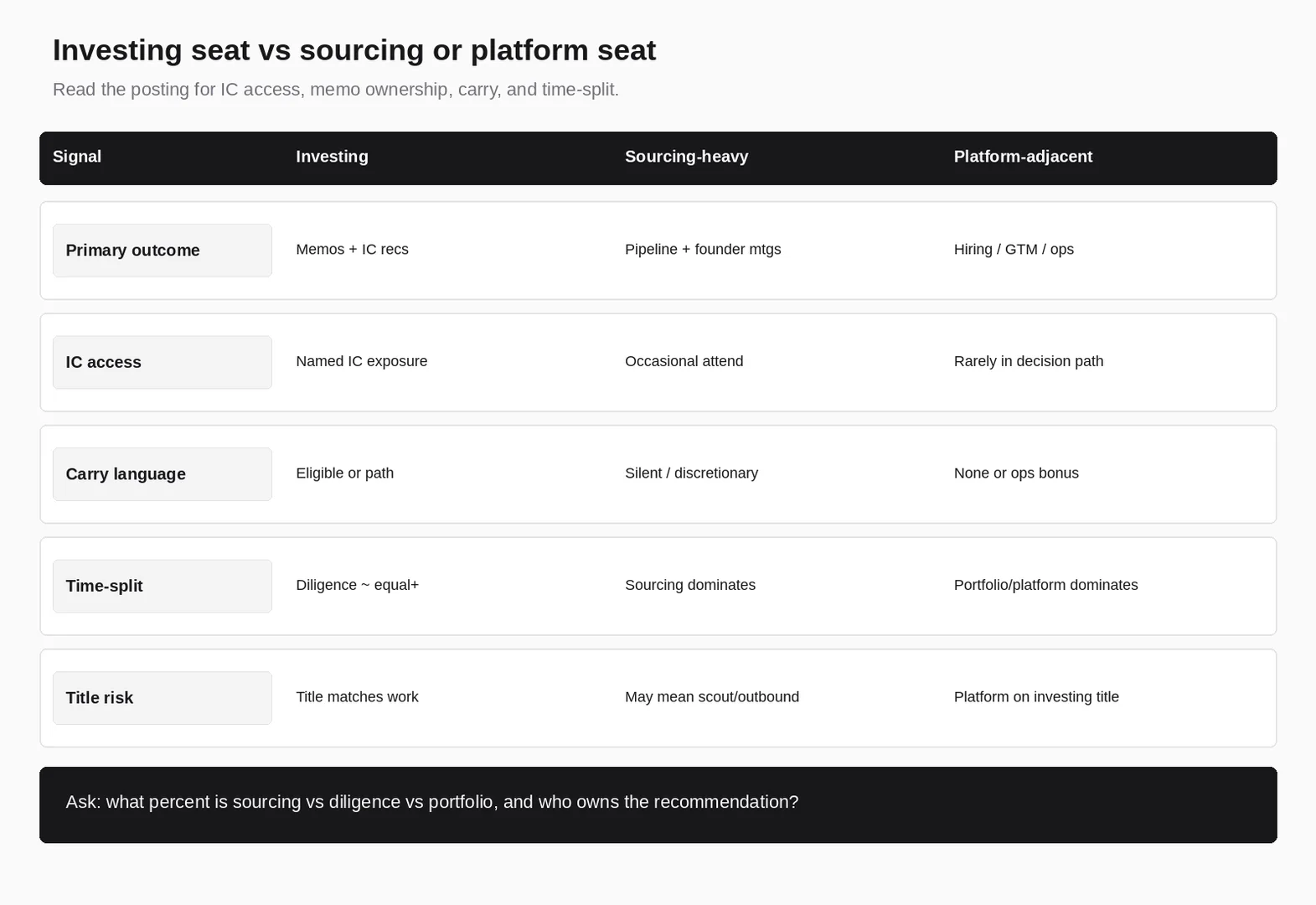
Many postings use "associate" for different jobs. The title alone does not tell candidates whether they will own investment judgment or mainly fill a pipeline or platform queue. Write the posting so the seat type is obvious. Candidates should read the same signals before applying.
| Signal in the posting | Investing associate seat | Sourcing-heavy seat | Platform-adjacent seat |
|---|---|---|---|
| Primary outcome | Memos, IC recommendations, deal ownership with a partner | Qualified pipeline, founder meetings, market maps | Hiring, GTM, community, or portfolio operating projects |
| IC / partner access | Named exposure to IC materials and partner debates | Occasional attend; rarely owns the recommendation | Rarely in the investment decision path |
| Carry language | Often eligible or "path to carry" with a real timeline | Often silent, deferred, or "discretionary" | Often none or ops-style bonus only |
| Time-split stated | Diligence and memos are majority or equal to sourcing | Sourcing and outreach dominate the bullet list | Portfolio support or platform bullets dominate |
| Title risk | Associate matches the work | Associate may mean scout or outbound role | Associate may mean platform hire on investing title |
For employers: if the hire will not write memos or sit near IC, do not market the role as a full investing associate seat. State the split (for example, 60% sourcing / 30% diligence / 10% portfolio) and whether carry is in scope.
For candidates: treat missing IC language, missing memo ownership, and vague "support the team" bullets as yellow flags. Ask in the first screen what percentage of time is sourcing vs diligence vs portfolio, who owns the investment recommendation, and whether associates are carry-eligible.
Title inflation is common. Some "associate" seats are senior-associate work with an associate salary. Others are analyst work with an associate title. Use the signal table above, then confirm in interviews.
How to calibrate the role before posting
Before publishing, answer four questions and put the answers in the posting.
1. Stage. Seed and early stage usually weight founder outreach, thesis writing, and qualitative diligence. Growth and later stage usually weight metrics, customer diligence, competitive dynamics, and more formal modeling. 2. Level. Analyst seats emphasize research support and learning speed. Associate seats expect ownership of workstreams. Senior associate seats often own fuller diligence processes and closer partner partnership. If the work is senior-associate scope, title and compensation should match. Compare against the venture capital analyst job description when the seat is earlier. 3. Sector and geography. Name the focus. "All sectors, anywhere" postings force candidates to guess and force interviewers to re-explain the firm every time. 4. Seat type. Investing, sourcing-heavy, or platform-adjacent. Use the section above. Do not hide the answer in soft language.
Also decide location, travel, visa support, and whether the role is pre-MBA or post-MBA. Ambiguity here creates avoidable drop-off after the first screen.
Interview process and scorecard
A clean process screens for the same skills the job description promises.
| Stage | Purpose | Strong signal |
|---|---|---|
| Intro screen | Motivation, communication, basic firm fit | Clear why this firm and stage; crisp resume walkthrough |
| Work sample | Writing and judgment under time constraints | Structured memo or market map with risks and open questions |
| Case / diligence discussion | Commercial judgment and pushback handling | Updates the view when challenged; does not bluff |
| Founder-style conversation | Empathy, curiosity, professional presence | Asks useful questions; reliable follow-ups |
| Partner final | Judgment, ownership, culture fit | Would trust this person in a founder meeting |
Score candidates on a short rubric tied to the posting: research quality, writing, commercial judgment, ownership, founder presence, and collaboration. Avoid scoring "vibes" or pedigree alone.
For candidates preparing for the loop, use the venture capital interview questions guide and a tailored venture capital associate cover letter.
Salary, bonus, and carry language
Compensation for VC associates varies by fund size, geography, stage, and whether carry is real. Do not invent a universal band in the posting if the firm has not set one. Do give candidates enough structure to compare offers.
Useful posting language:
- Publish a base range when the firm can stand behind it.
- Say whether bonus is guaranteed, discretionary, or formula-based.
- State whether the role is carry-eligible, on a path to carry, or not carry-eligible.
- If carry is "case-by-case," say what that means (tenure, promotion, deal-by-deal).
Avoid implying carry when associates only receive a year-end cash bonus. Candidates comparing offers should also read the venture capital salary guide for current context without treating any one source as a universal schedule.
How candidates should read a VC associate posting
Read the posting like an investment memo about the job.
1. Seat type. Investing, sourcing-heavy, or platform-adjacent? Use the signal table above. 2. Stage and sector. Does the firm's actual portfolio match the words in the post? 3. Ownership. Which artifacts will you own in the first six months: memos, models, pipeline, portfolio projects? 4. Level honesty. Are responsibilities analyst-light or senior-associate-heavy relative to the title? 5. Process. Is there a work sample or case? That usually means writing and judgment matter. 6. Compensation clarity. Base, bonus, and carry language should be specific enough to compare.
Then check live postings on the job board and firm pages in the companies directory. If the public portfolio, team page, and JD disagree, ask about that gap in the first conversation.
For a broader entry plan, see how to get a job in venture capital.
Browse associate roles and research firms
When the job description is ready, put it where VC candidates already look. Candidates should do the reverse: study how funds describe associate work before interviewing.
- Browse current roles on the Venture Capital Careers job board.
- Research stage, sector, and team shape in the companies directory.
- Create an account to save searches and alerts via sign up.
Use the board to sanity-check your own posting against how peer funds describe sourcing, diligence, portfolio support, and seniority. Use the directory to prepare firm-specific questions and examples.
FAQ
What is a venture capital associate job description?
It is the hiring document that explains what a VC associate will do, what skills and experience the firm requires, how interviews work, and how compensation is framed. A strong version also states seat type (investing, sourcing-heavy, or platform-adjacent) and fund stage.
What does a VC associate do day to day?
Most weeks mix pipeline work, diligence, writing, and portfolio follow-ups. Exact mix depends on fund stage and whether the seat is investing-led or sourcing-led. Expect founder meetings, market research, memo drafts, and partner prep more often than formal "deal closing" theater.
What qualifications should a VC associate have?
Most funds look for analytical and writing strength, commercial judgment, comfort with financials at the relevant stage, and evidence of ownership. Prior VC helps but is not the only path. Banking, consulting, growth equity, startup operating roles, and product or strategy backgrounds are common.
Is a VC associate different from a VC analyst?
Yes. Analyst roles are usually earlier and more support-oriented. Associate roles typically expect more ownership of diligence threads, memos, and founder relationships. Some funds collapse the titles. Read responsibilities, not just the label. See the venture capital analyst job description for the earlier seat.
Should a VC associate job description include salary?
When the firm can publish a range, yes. At minimum, clarify bonus structure and whether carry is in scope. Vague "competitive compensation" language forces every strong candidate to reopen the conversation later.
Where should a VC firm post an associate role?
Post where VC-interested candidates already search. Use the Venture Capital Careers job board alongside the firm's own careers page and trusted networks. Pair the posting with a clear companies profile so candidates can research stage and focus.
Related posts
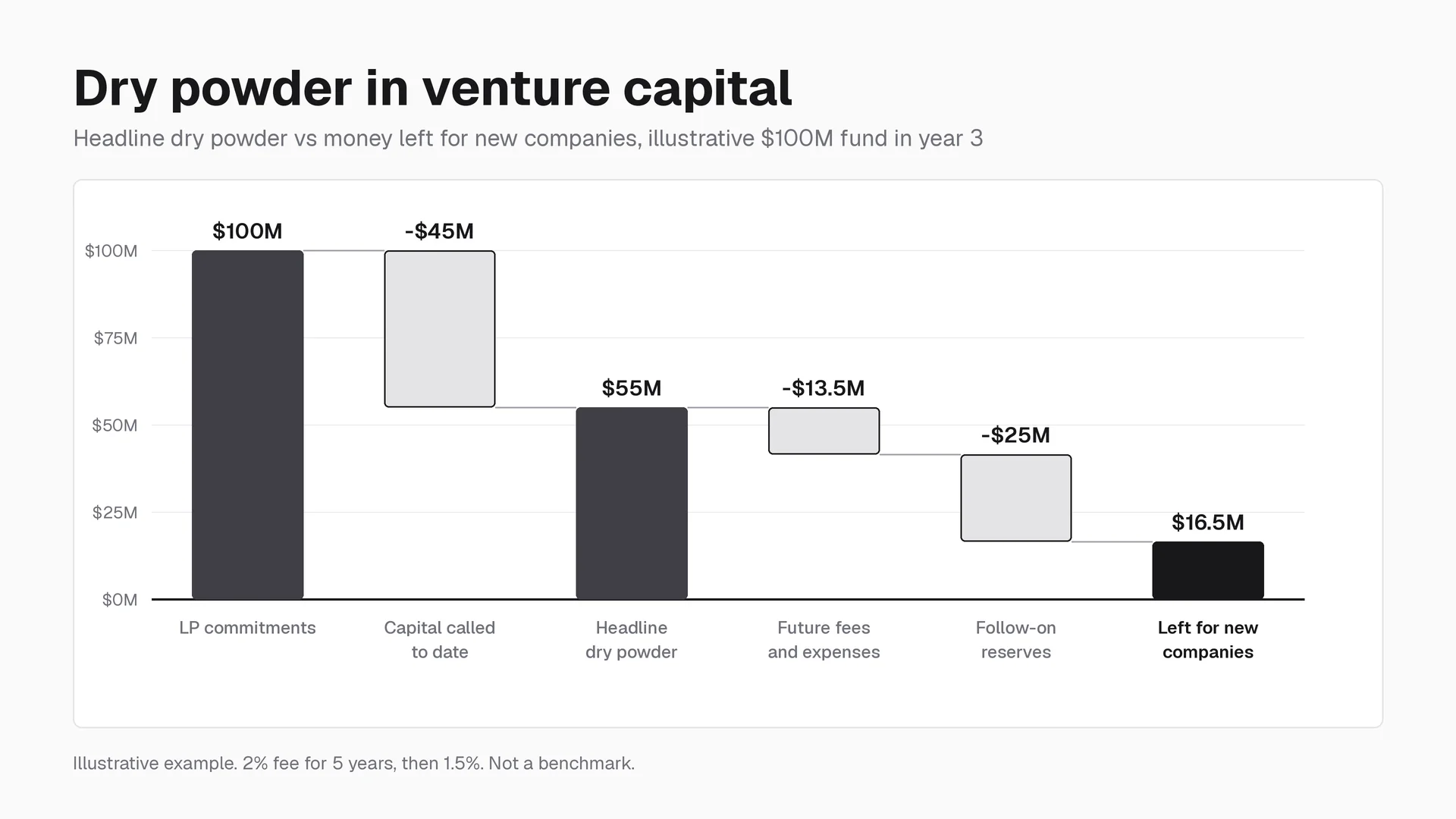
Dry powder in venture capital explained: the formula, a worked $100M fund example showing how little headline dry powder is left for new companies, current US and global data, and what a firm's dry powder tells you about hiring and the junior job.
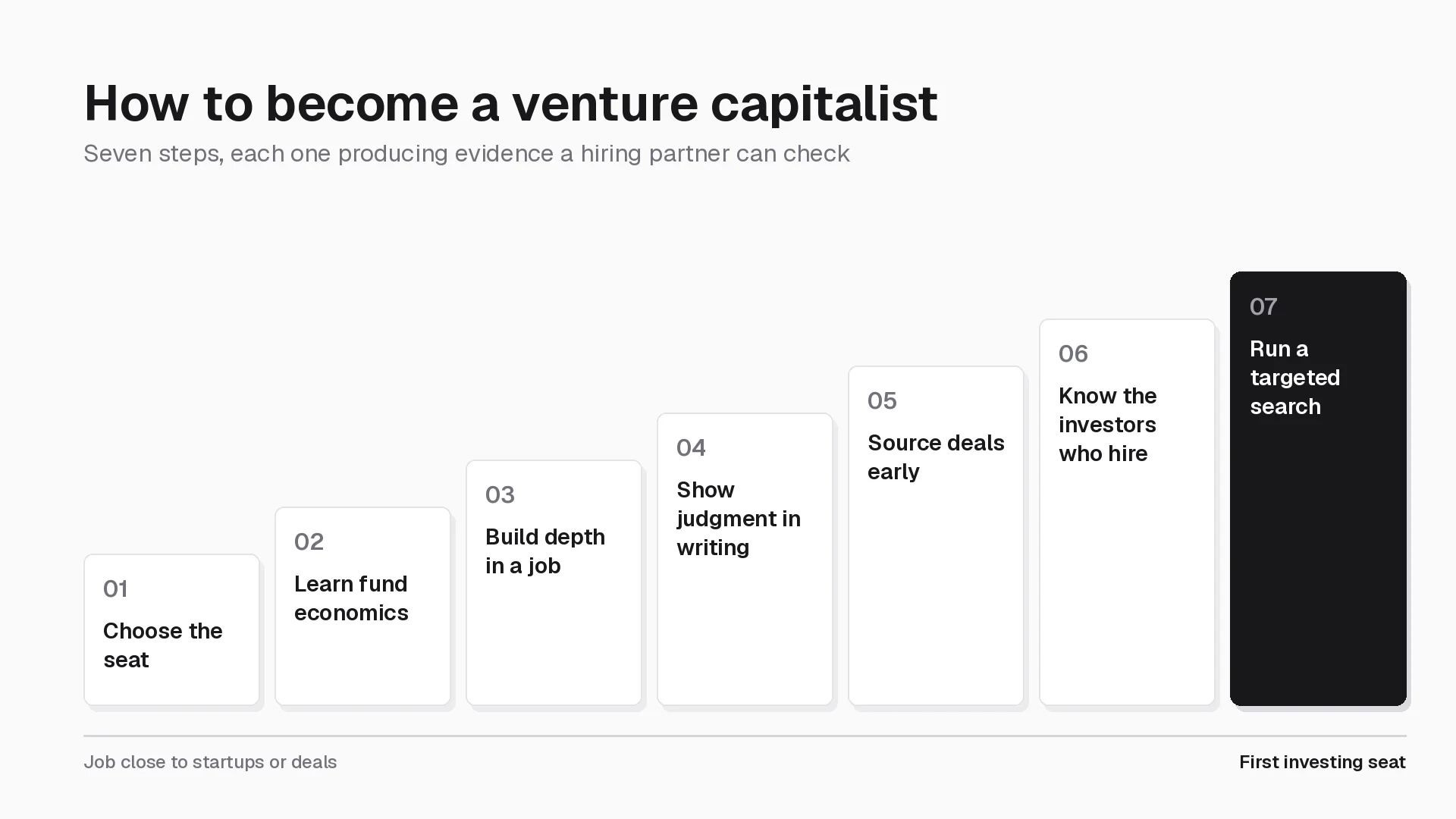
How to become a venture capitalist in seven steps: choose the seat, build depth, prove judgment in writing, source early, and run a targeted search. Includes entry paths by background, how fund size limits hiring, MBA placement data, and licensing.
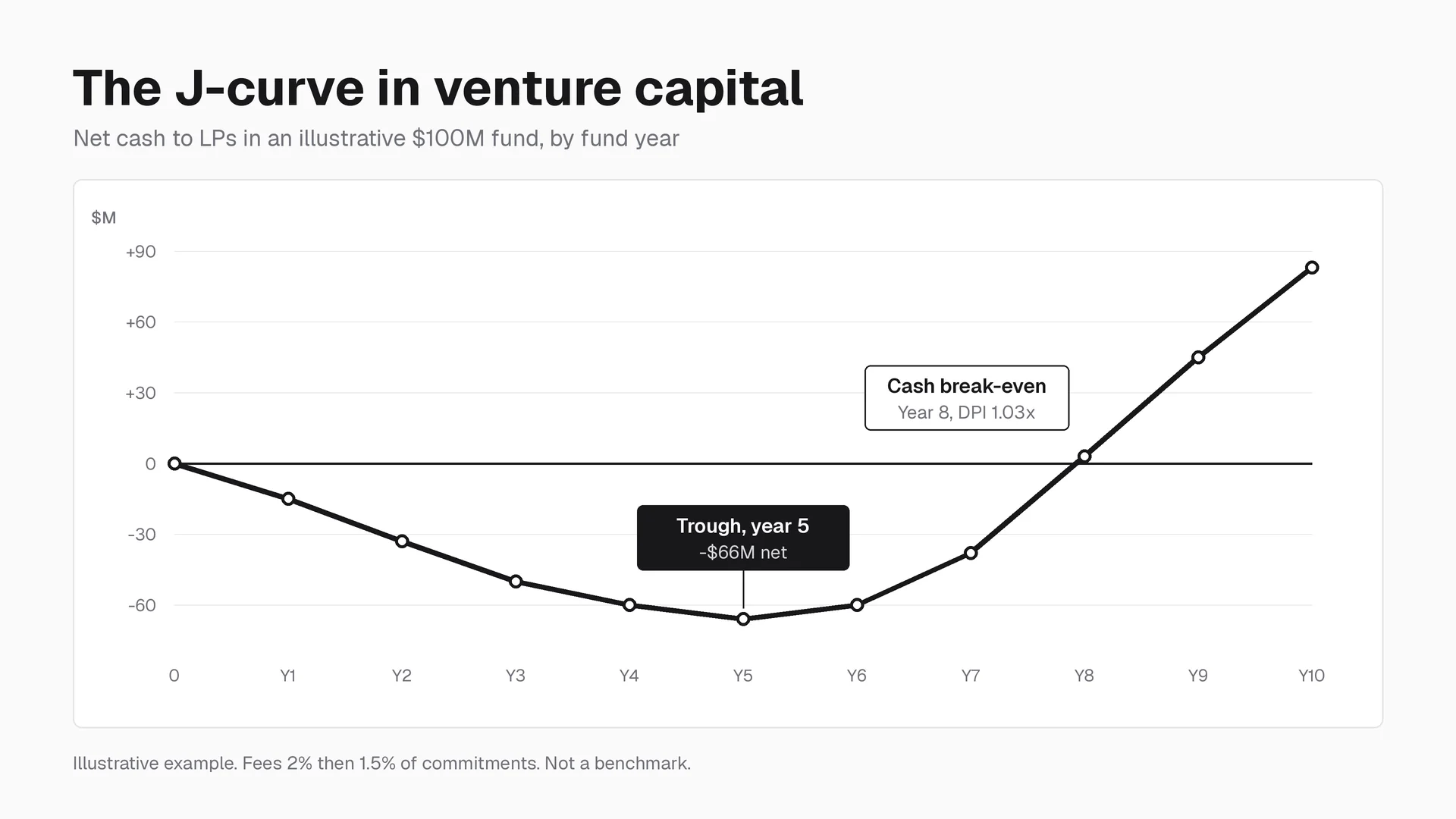
The J-curve in venture capital explained with a worked $100M fund example, current vintage data on DPI and IRR, a check for telling a normal trough from a weak fund, and what the curve means for VC carry, offers, and interviews.