
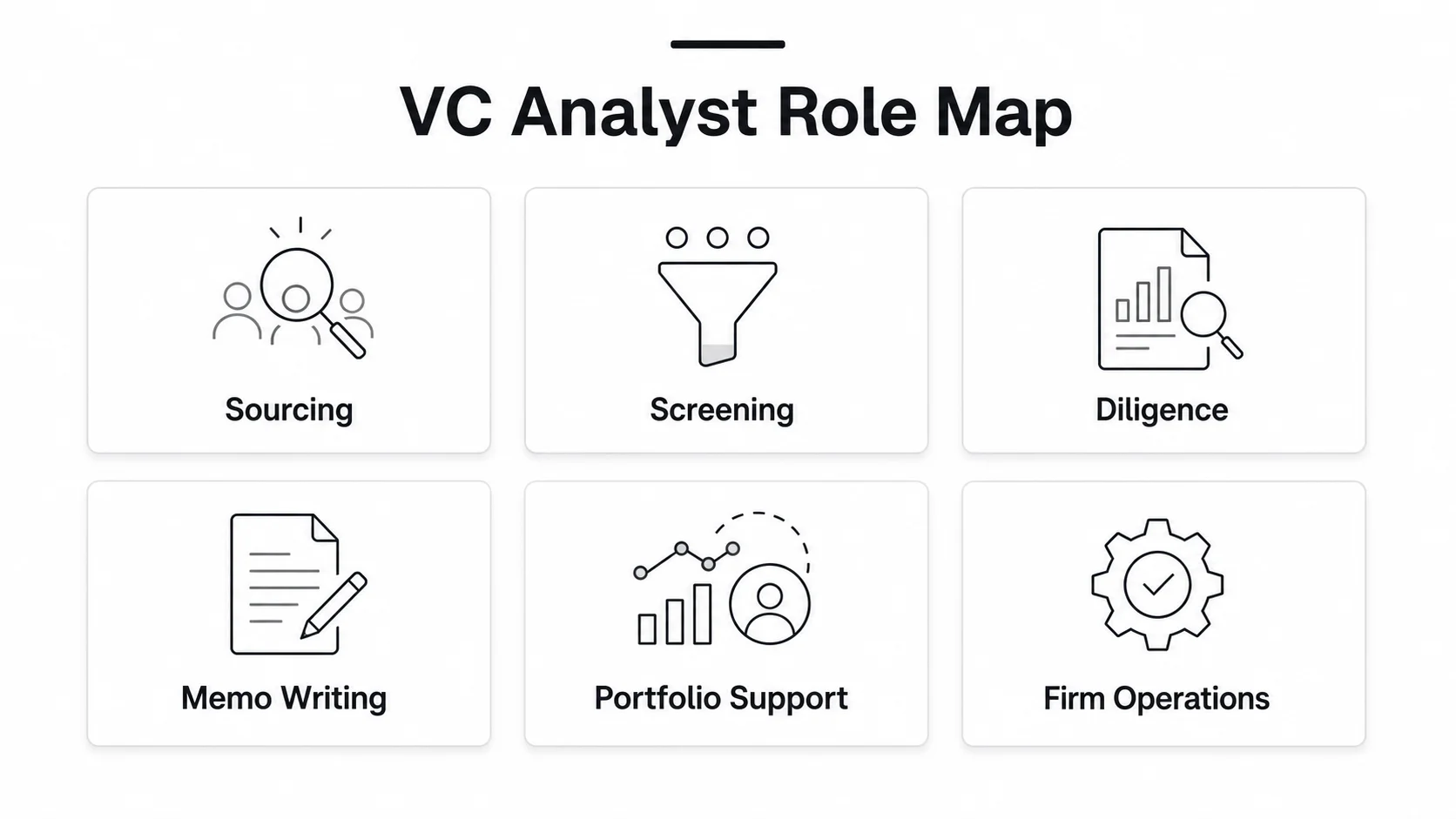
A venture capital analyst helps a fund find, evaluate, and support startup investments. In practice that means mapping markets, screening decks, joining founder calls, supporting diligence, drafting memo sections, keeping the pipeline clean, and tracking portfolio updates. At some funds the analyst is mostly a sourcing engine. At others the analyst is a junior investor who supports every step from first screen to investment committee.
For employers, the job description should make one thing clear: is this person being hired mainly to source new deals, run diligence support, or do a hybrid of both? For candidates, that same detail tells you whether the role is a real investing apprenticeship, a sourcing-heavy seat, or associate work with an analyst title.
Browse open analyst roles on the Venture Capital Careers job board and research firm focus in the companies directory before you write or apply to a posting.
What does a venture capital analyst do?
A venture capital analyst is usually an entry-level or early-career member of the investment team. The job expands partner and associate capacity: research, first-pass screening, memo drafts, data-room hygiene, meeting notes, market maps, and follow-ups that would otherwise stall.
The work usually falls into these buckets:
| Workstream | What the analyst does | Output |
|---|---|---|
| Sourcing | Builds market maps, tracks founders, reviews inbound decks, supports outreach | Pipeline notes, company lists, intro paths |
| Screening | Summarizes business models, traction, and fund fit for partners | First-pass screens, pass/pursue notes |
| Market research | Maps sectors, competitors, customers, and category dynamics | Market maps, thesis notes, expert call summaries |
| Diligence support | Prepares questions, reviews data rooms, synthesizes risks | Diligence checklists, risk lists, reference notes |
| Financial analysis | Supports models, unit economics, cap tables, and simple scenarios | Spreadsheet tabs, metric summaries |
| Investment memos | Drafts overview, market, product, team, traction, competition, and risk sections | Memo sections ready for senior edit |
| Portfolio support | Tracks updates, supports hiring or GTM research, helps with reporting inputs | Portfolio notes, research briefs |
| Firm operations | Keeps CRM clean, prepares weekly deal meetings, maintains dashboards | Reliable pipeline and meeting prep |
The balance changes by fund. A pre-seed or seed fund may expect more founder outreach and thesis work. A Series A or multi-stage fund may expect more screening and memo support. A growth fund may expect more metrics and data-room fluency. A sector specialist may expect domain credibility.
For level context, read the venture capital career path and the venture capital associate job description.
Venture capital analyst job description template
Use this as a starting point, then replace the bracketed sections with your fund's stage, sector, location, process, and compensation details.
About the firm
[Firm name] is a venture capital firm investing in [stage] companies across [sector or geography]. We partner with founders building [types of companies or markets], and we support portfolio companies with [hiring, customers, fundraising, operations, product, go-to-market, or other platform strengths].
We are hiring a Venture Capital Analyst to join our investment team in [location or remote/hybrid policy]. This person will help source and screen opportunities, research markets, support diligence, draft investment materials, and keep the pipeline and portfolio notes organized.
Role summary
The Venture Capital Analyst will work closely with [partners, principals, associates, platform team] across the investment process. The role suits someone who is intellectually curious, analytically rigorous, founder-aware, and excited to build judgment in [early-stage / growth-stage] investing.
This is an [entry-level / early-career] investment role with exposure to [sourcing, screening, diligence support, memo drafting, portfolio tracking]. Seat emphasis: [sourcing-heavy / diligence-heavy / hybrid].
Responsibilities
- Source and screen startups that fit the firm's investment strategy.
- Build market maps and sector research on priority themes.
- Review pitch decks, founder updates, financial data, and product materials.
- Prepare first-pass company summaries and investment memo sections.
- Support diligence through market, customer, competitor, team, product, and financial analysis.
- Track deal pipeline activity and maintain clean CRM notes.
- Join founder calls and prepare follow-up questions for senior investors.
- Monitor portfolio company updates and support reporting or research projects.
- Help prepare investment committee materials, weekly deal meetings, and thematic research.
Required qualifications
- Strong written and verbal communication.
- Demonstrated interest in startups, technology, company building, or venture capital.
- Ability to synthesize messy information into clear recommendations.
- Comfort with spreadsheets, market research, and basic financial analysis.
- Strong attention to detail and follow-through.
- Ability to build relationships with founders, operators, investors, and teammates.
- Work authorization and location expectations: [insert details].
Preferred qualifications
- Experience in venture capital, startups, investment banking, consulting, private equity, growth equity, product, strategy, data, or a relevant technical field.
- Evidence of sector research, deal sourcing, angel or scout activity, founder community involvement, or investment writing.
- Experience with market sizing, financial modeling, cap tables, cohort analysis, or data-room review.
- Sector knowledge in [priority sectors].
- Familiarity with CRM systems, spreadsheets, financial databases, data rooms, and research platforms.
- MBA or graduate degree only if the role genuinely requires it.
Interview process
- Introductory screen with the hiring manager or recruiting lead.
- Investment team interview focused on background, startup interest, and fund fit.
- Work sample such as a market map, short investment memo, pitch-deck screen, or written company analysis with a clear time limit.
- Partner interview focused on judgment, communication, and long-term fit.
- References and offer process.
Compensation and benefits
- Base salary: [range or "competitive / commensurate with experience"].
- Bonus: [eligible / not eligible / discretionary].
- Carry or profit interest: [eligible / not eligible / considered at later levels].
- Benefits: [health, parental leave, learning budget, conference budget, remote/hybrid policy, relocation, visa support].
- Other: [office location expectations, travel expectations].
Core responsibilities to include
Generic finance language ("analyze opportunities," "support the investment team") is not enough. A useful analyst job description names the workstreams and the artifacts the hire will own.
Include at least these clusters when they are real for the seat:
- Sourcing and screening. Market maps, inbound review, outbound support, and crisp pass/pursue notes.
- Research and diligence support. Competitor maps, customer or expert call notes, risk lists, and data-room hygiene.
- Investment materials. Memo sections, metric summaries, and partner briefing notes.
- Pipeline and meeting ops. CRM hygiene, weekly deal-meeting prep, and follow-up ownership.
- Portfolio follow-through. Update tracking and scoped research for founders or partners.
If the role is mostly one cluster, say so. Ambiguous postings attract mismatched candidates and waste interview time.
Skills and qualifications
Separate must-haves from nice-to-haves. Overloading "required" with MBA, prior VC, and rare sector pedigree shrinks the pool without improving hire quality.
| Skill area | What good looks like in an analyst | Common over-spec |
|---|---|---|
| Market research | Maps a sector, names competitors, explains why a market might become venture-scale | Demands years of sector operator experience for an entry seat |
| Analytical judgment | Turns incomplete startup data into upside, risk, and "what must be true" | Expects associate-level IC ownership on day one |
| Writing | Concise screens, founder notes, and memo sections | Requires published research or an MBA thesis |
| Founder communication | Professional outreach, first-call presence, reliable follow-ups | Requires a proprietary founder network before hire |
| Financial fluency | Revenue models, unit economics, basic cap tables, funding rounds | Requires full LBO-style PE modeling for a seed seat |
| Operating discipline | Clean CRM, meeting notes, research docs, and pipeline updates | Treats ops excellence as optional "nice to have" |
Good candidates often prove fit through work samples: a market map, a short investment memo, a founder outreach note, a product teardown, or a resume that shows research and startup exposure. Point applicants to the venture capital analyst resume and venture capital analyst cover letter guides when you want stronger materials.
Sourcing seat vs diligence or hybrid seat
Many postings use "analyst" for different jobs. The title alone does not tell candidates whether they will mainly fill a pipeline, support diligence and memos, or do both. Write the posting so the seat type is obvious. Candidates should read the same signals before applying.
| Signal in the posting | Sourcing-heavy analyst seat | Diligence-heavy analyst seat | Hybrid analyst seat |
|---|---|---|---|
| Primary outcome | Qualified pipeline, founder meetings, market maps | Memo sections, diligence notes, partner-ready screens | Balanced pipeline and diligence support |
| Founder / IC exposure | Frequent outreach and first calls; limited IC ownership | More diligence rooms and memo drafts; selective founder calls | Regular mix of both |
| Carry language | Often silent, deferred, or "later levels" | Sometimes "path to carry" if investing apprenticeship is real | Clarify explicitly either way |
| Time-split stated | Sourcing and outreach dominate the bullet list | Research, modeling, and memo bullets dominate | States an explicit split (for example 50/40/10) |
| Title risk | Analyst may mean scout or outbound role | Analyst may mean associate work with analyst pay | Clear split reduces mismatch |
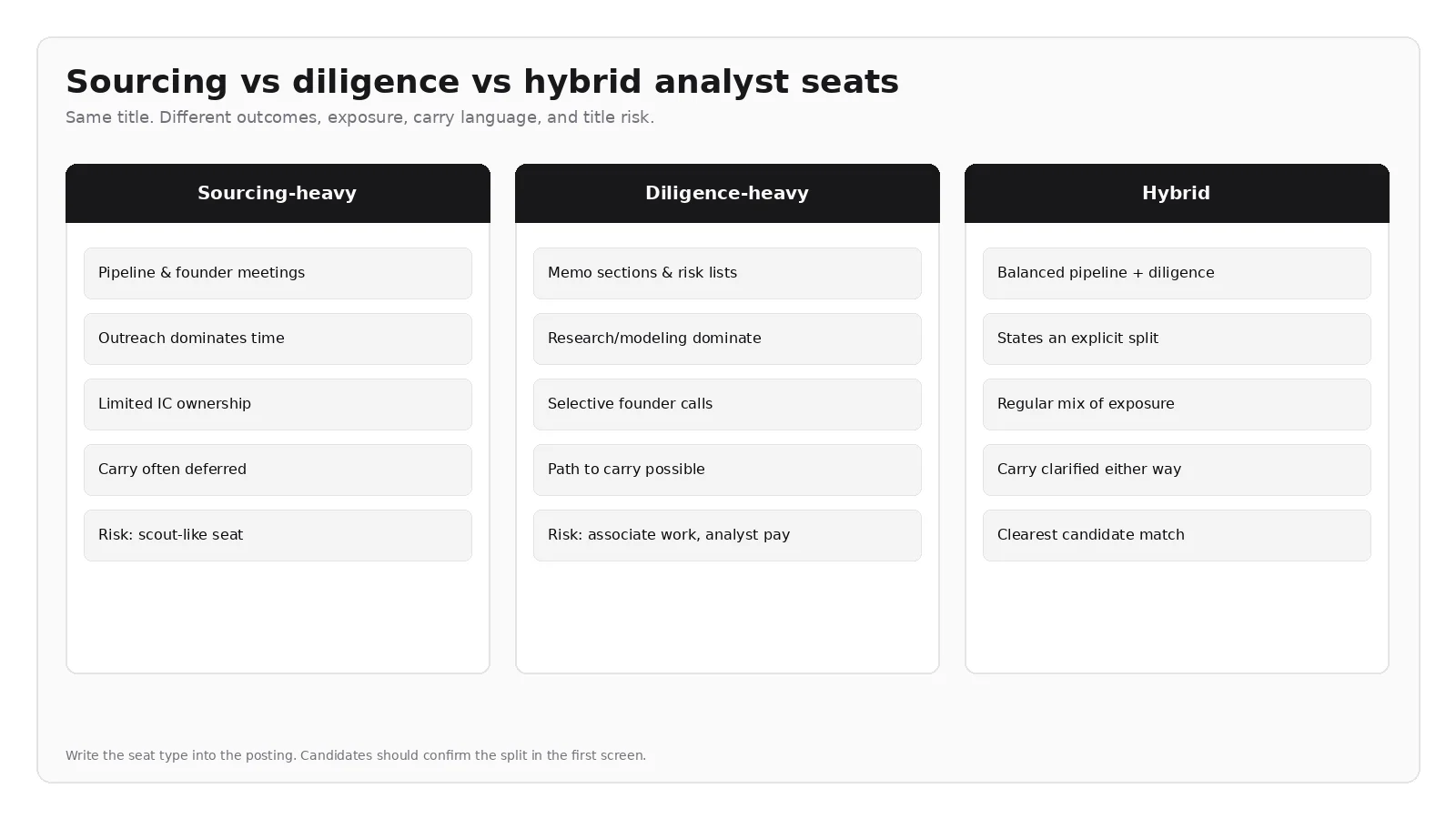
For employers: if the hire will not draft memo sections or sit near diligence, do not market the role as a full investing apprenticeship. State the split and whether carry is in scope at the analyst level.
For candidates: treat missing memo language, missing diligence bullets, and vague "support the team" copy as yellow flags when you want an investing seat. Ask in the first screen what percentage of time is sourcing vs diligence vs portfolio, who edits your writing, and whether analysts are carry-eligible.
Title inflation cuts both ways. Some "analyst" seats are associate work with analyst compensation. Others are coordinator or scout work with an analyst title. Use the signal table above, then confirm in interviews. Candidates comparing levels should also read how to become a venture capital analyst without treating this JD page as a break-in plan.
VC analyst vs associate
Titles vary by firm, but analyst and associate are not always interchangeable.
| Dimension | VC analyst | VC associate |
|---|---|---|
| Typical seniority | Entry-level or early-career investment team role | More experienced junior investor, often post-banking, consulting, startup, or MBA |
| Core work | Research, sourcing support, screening, memo sections, pipeline operations | Sourcing ownership, diligence workstream leadership, deal execution support |
| Founder exposure | Often participates in first calls or supports follow-up | More likely to run founder calls and manage diligence streams |
| Decision influence | Builds evidence for senior investors | Helps shape recommendation and investment committee discussion |
| Hiring bar | High potential, analytical ability, startup fluency, communication | Proven investment judgment, stronger pattern recognition, more independent execution |
If your fund uses "analyst" for a role that is actually associate-level, make that clear in the qualifications, responsibilities, and compensation. Otherwise you attract candidates who are either too junior for the seat or too senior for the scope.
How to calibrate the role before posting
Before publishing, answer these questions and put the answers in the posting.
- Stage. Seed and early stage usually weight founder outreach, thesis writing, and qualitative diligence. Growth and later stage usually weight metrics, customer diligence, and more formal modeling.
- Seat type. Sourcing-heavy, diligence-heavy, or hybrid. Use the section above. Do not hide the answer in soft language.
- Founder exposure. Will the analyst join first calls, own outreach, or only prepare research for partners?
- Financial depth. A light screening role and a late-stage modeling role need different profiles.
- Management. Who manages the analyst: partner, principal, associate, or platform lead?
- 90-day success. What artifacts should exist after three months: market maps, screens, memo sections, CRM hygiene?
- Progression. Is there a realistic path to associate, and what evidence earns it?
Also decide location, travel, visa support, and whether an MBA is truly required. Ambiguity here creates avoidable drop-off after the first screen.
Interview process and scorecard
A clean process screens for the same skills the job description promises, without turning candidates into unpaid consultants.
| Stage | Purpose | Strong signal |
|---|---|---|
| Intro screen | Motivation, communication, basic firm fit | Clear why this firm and stage; crisp background walkthrough |
| Investment conversation | How the candidate thinks about a company or market | Structured view with risks and open questions |
| Work sample | Writing and judgment under a time limit | Useful market map, screen, or memo draft; does not bluff |
| Team interview | Collaboration and founder-facing presence | Reliable follow-ups; clear notes; professional tone |
| Partner final | Judgment, curiosity, long-term fit | Would trust this person in a founder meeting |
Score candidates on a short rubric tied to the posting: research quality, writing, commercial curiosity, ownership, founder presence, and operating discipline. Avoid scoring pedigree alone.
For candidates preparing for the loop, use the venture capital interview questions guide. For a broader entry plan after the JD makes sense, see how to get a job in venture capital.
How candidates should read a VC analyst posting
Read the posting like an investment memo about the job.
- Seat type. Sourcing-heavy, diligence-heavy, or hybrid? Use the signal table above.
- Stage and sector. Does the firm's actual portfolio match the words in the post?
- Ownership. Which artifacts will you own in the first six months: screens, maps, memo sections, CRM, portfolio notes?
- Level honesty. Are responsibilities associate-heavy relative to the analyst title and pay?
- Process. Is there a timed work sample? That usually means writing and judgment matter.
- Compensation clarity. Base, bonus, and carry language should be specific enough to compare.
Then check live postings on the job board and firm pages in the companies directory. If the public portfolio, team page, and JD disagree, ask about that gap in the first conversation.
Green flags include clear stage and sector language, specific workstreams, honest compensation and location details, and a practical interview process. Warning signs include "must source proprietary deals" with no mentorship, associate-level scope with analyst pay, unclear investing vs platform vs ops framing, unbounded take-home cases, and vague carry or promotion promises.
Browse analyst roles and research firms
When the job description is ready, put it where VC candidates already look. Candidates should do the reverse: study how funds describe analyst work before interviewing.
- Browse current roles on the Venture Capital Careers job board.
- Research stage, sector, and team shape in the companies directory.
- Create an account to save searches and alerts via sign up.
Use the board to sanity-check your own posting against how peer funds describe sourcing, diligence support, and seniority. Use the directory to prepare firm-specific questions and examples.
FAQ
What does a venture capital analyst do?
A venture capital analyst helps a VC firm source startups, screen opportunities, research markets, support diligence, draft investment memo sections, maintain pipeline data, and track portfolio updates. The role is junior, but strong analysts improve a fund's market coverage and decision quality.
Is venture capital analyst an entry-level role?
It can be, but not always. Some funds hire analysts from university or early-career finance, consulting, startup, or technical roles. Other funds use "analyst" for work that requires prior investing or operating experience. The job description should make seniority and seat type explicit.
What skills matter most for a VC analyst?
Market research, analytical judgment, concise writing, founder communication, startup curiosity, financial fluency, and operating discipline. Technical sector knowledge matters more at specialist funds.
Should a VC analyst job description require an MBA?
Usually no. MBA requirements are more common for associate or post-MBA investor roles. For analyst seats, practical evidence of research ability, writing, and startup judgment is often more relevant than a graduate degree.
Should the job description mention salary and carry?
Yes when the firm can publish a range. At minimum, clarify bonus structure and whether carry is in scope at the analyst level. If carry is not available, say that directly and explain whether it can become available later.
Where should a VC firm post an analyst role?
Post where VC-interested candidates already search. Use the Venture Capital Careers job board alongside the firm's own careers page and trusted networks. Pair the posting with a clear companies profile so candidates can research stage and focus.
Related posts
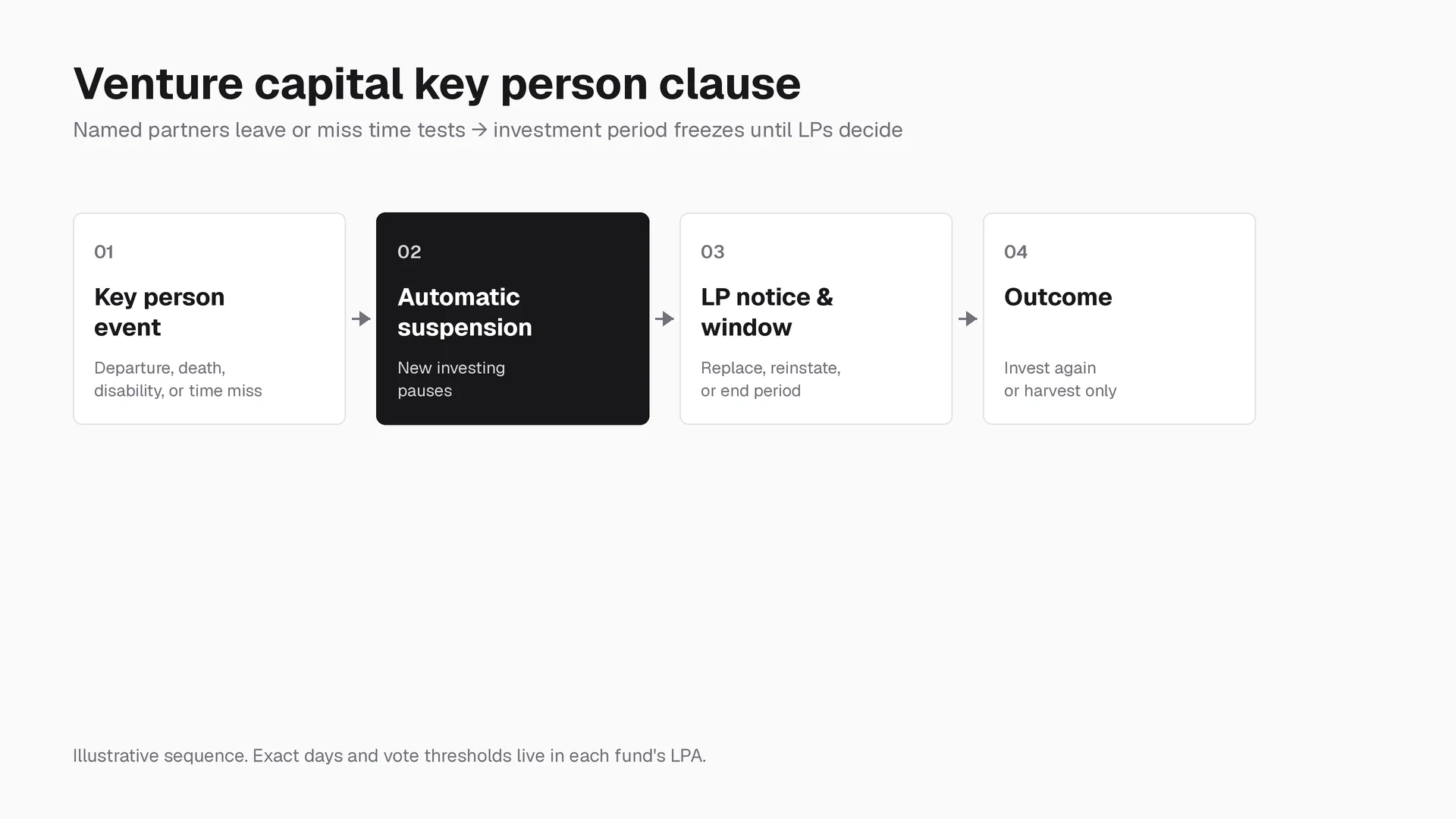
A key person clause names the partners a venture fund depends on and can freeze new investing if they leave. Here is how the trigger works, what still happens during a suspension, and what it means for your job search and seat.
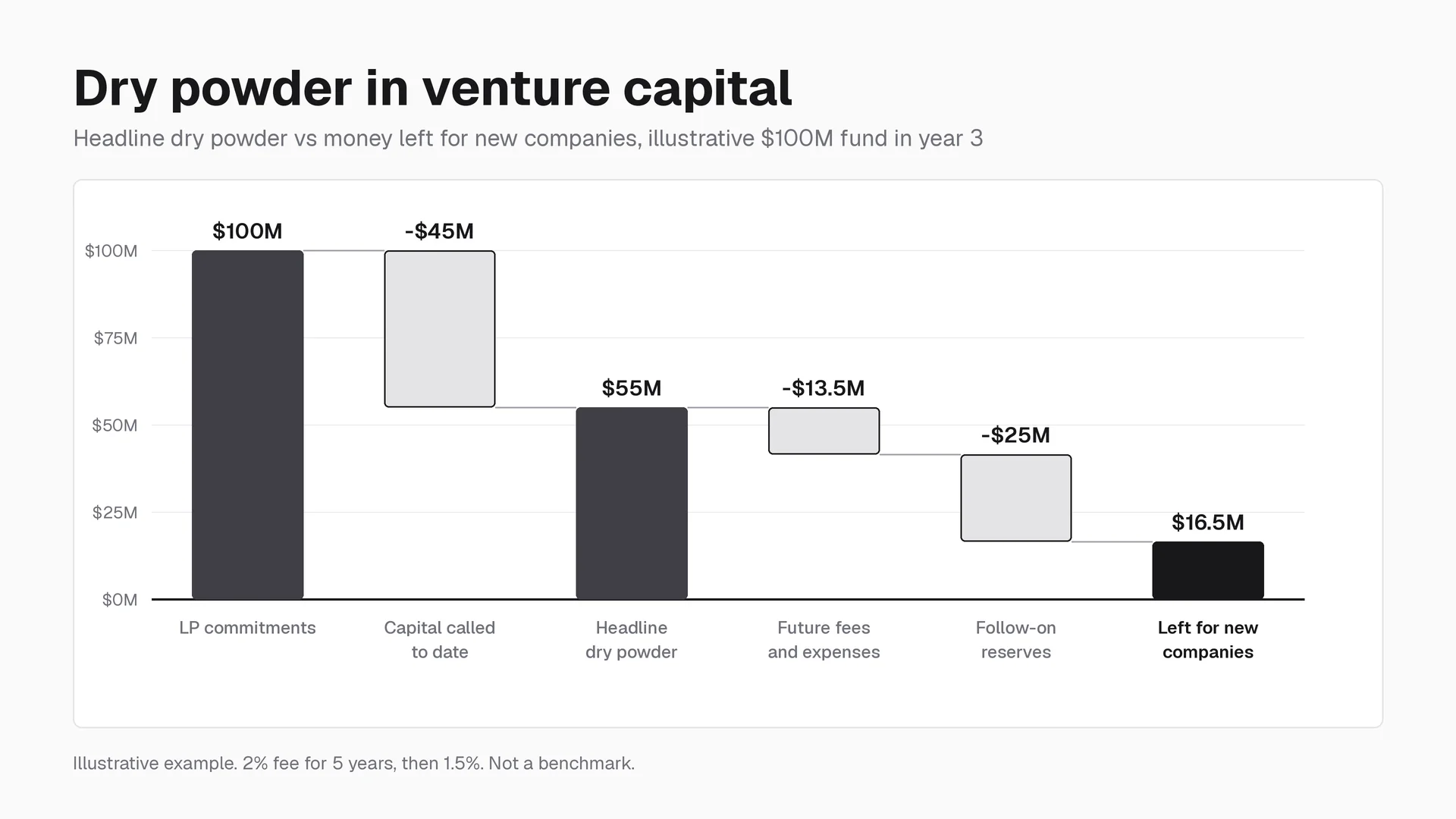
Dry powder in venture capital explained: the formula, a worked $100M fund example showing how little headline dry powder is left for new companies, current US and global data, and what a firm's dry powder tells you about hiring and the junior job.
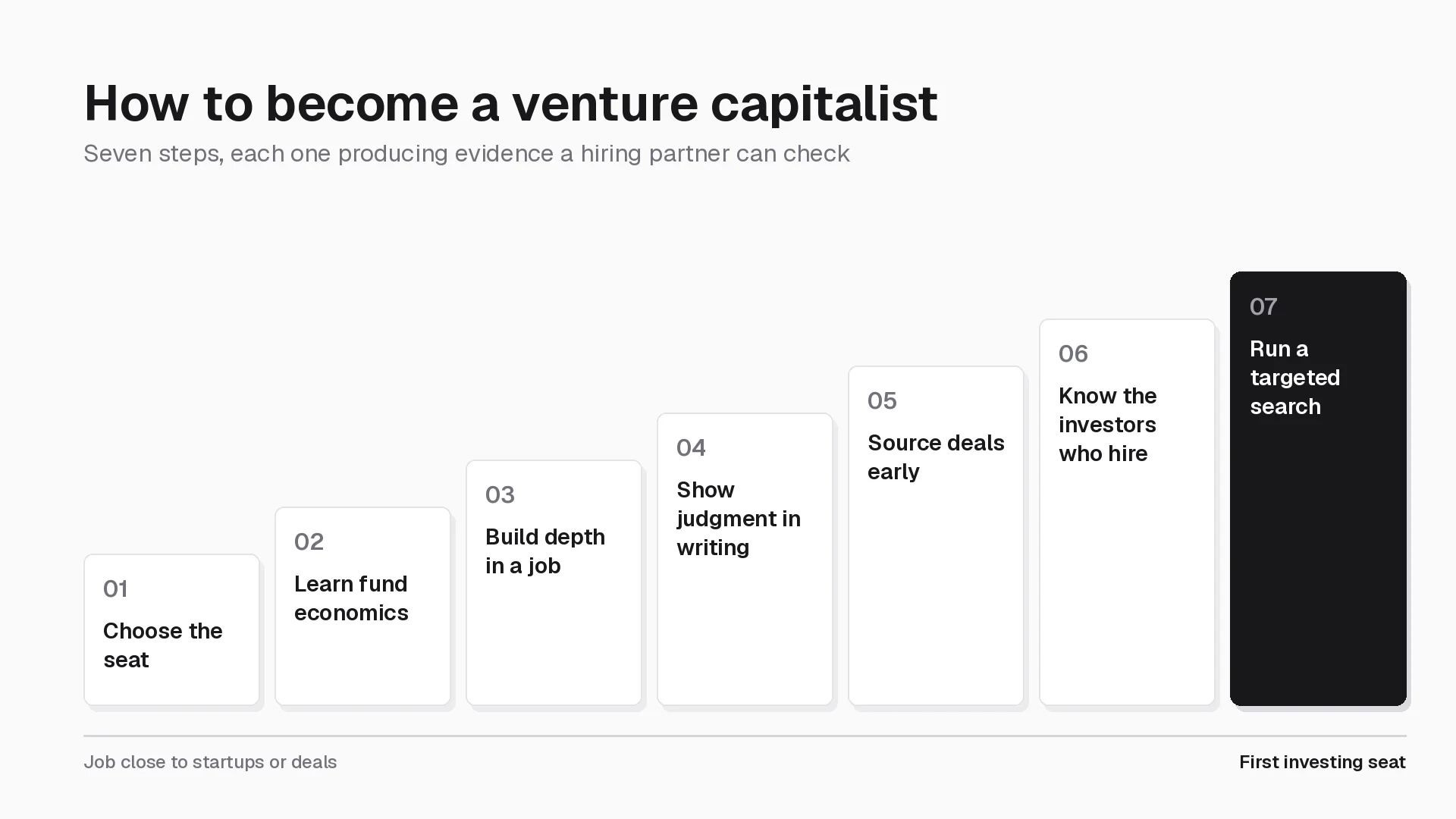
How to become a venture capitalist in seven steps: choose the seat, build depth, prove judgment in writing, source early, and run a targeted search. Includes entry paths by background, how fund size limits hiring, MBA placement data, and licensing.