
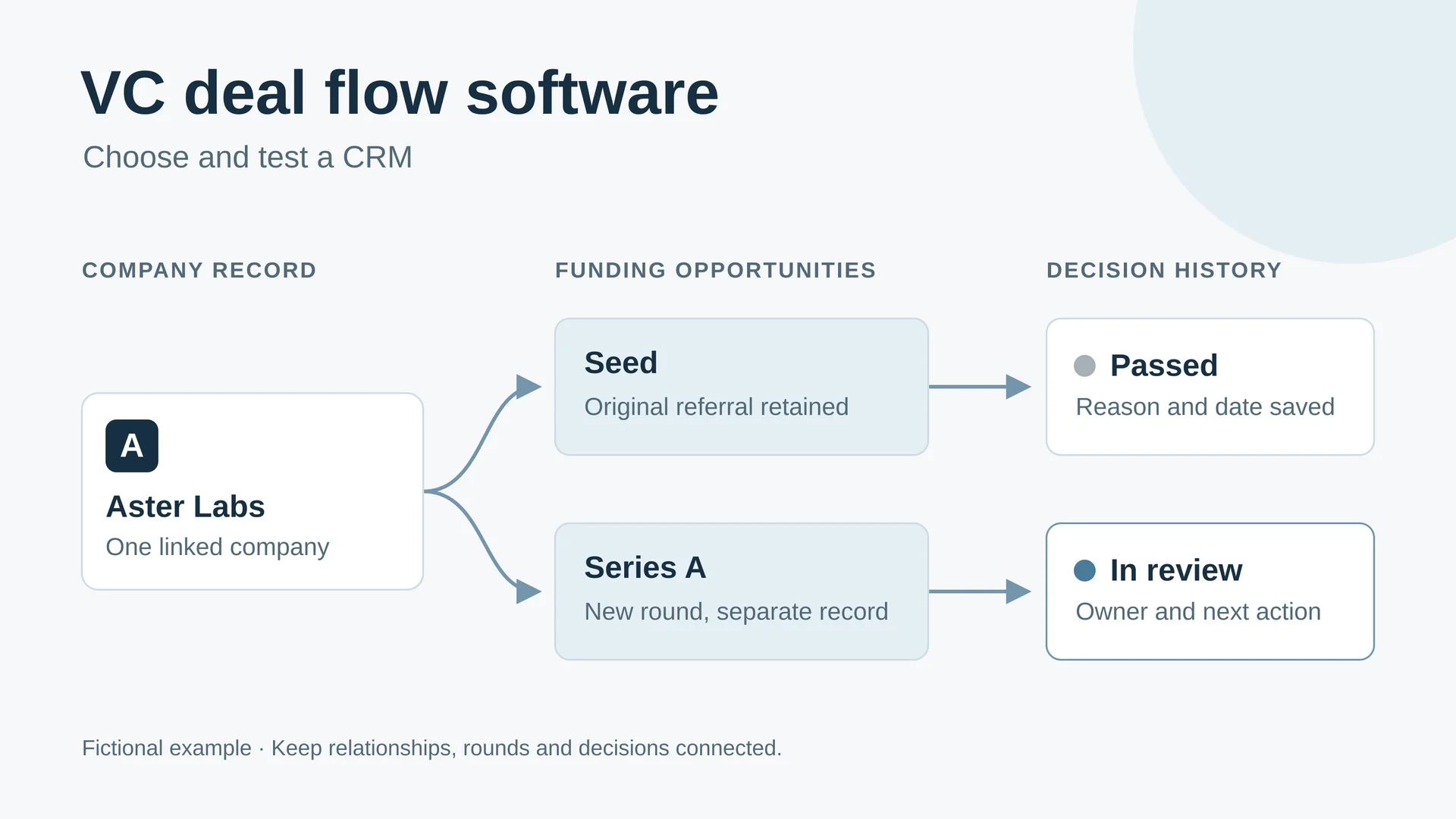
Venture capital deal flow software should help a team answer five questions: have we seen this company before, who knows the founders, what happened last time, who owns the next step, and what needs attention now? A CRM that cannot answer those reliably will leave the investment team searching inboxes beside a polished pipeline dashboard.
Choose a VC CRM by testing your workflow, not by comparing feature counts. Give each shortlisted product the same small dataset, run it through intake and partner review, then check permissions and export the results. This guide provides a fictional six-submission test and a scorecard that analysts, associates and operations teams can use together.
Quick shortlist: which VC CRM should you test?
Use these conditional shortlists to decide which demonstrations are worth your time. They are editorial starting points based on official documentation reviewed on October 30, 2026, not hands-on rankings. The categories overlap; confirm capabilities in the proposed plan.
| Your situation | Compare first | The deciding test |
|---|---|---|
| Your pipeline is accurate and manual upkeep remains manageable | Keep the current spreadsheet as a baseline. Consider Airtable's grid, form and kanban views if shared intake and views are the missing pieces. | Does switching remove recurring work, or merely move it into a new interface? |
| You need a configurable company-and-round model and have someone to maintain it | Test Attio's linked people, companies and funding-round deals. | Can an associate add a new round without changing the old round's decision? |
| Interaction history is scattered across inboxes and introductions are difficult to trace | Compare Affinity's activity capture and relationship intelligence with 4Degrees' relationship scoring, pipelines and automated capture. | Does captured activity reach the correct records, and can you verify a suggested introduction path? |
| You need approvals, diligence and investor-relations workflows alongside the pipeline | Include Intapp DealCloud's configurable private-capital workflows. | Can operations run an approval chain without making routine updates cumbersome? |
Pricing and access: public plans versus a sales process
Airtable offers Free and published paid plans. Attio offers a Free plan with up to three seats, monthly or annual paid plans, and a 14-day Pro trial. Affinity publishes annual per-user prices for Essential, Scale and Advanced, with custom Enterprise pricing and a sales-contact process. 4Degrees uses per-user, per-month pricing supplied after a discussion. DealCloud's product page offers a scheduled demo; request a written scope and quote.
These access routes were checked on October 30, 2026. A free workspace or public seat price does not establish that the permissions, integrations and migration support you need are included. Test the tier you would actually buy.
What should venture capital deal flow software do?
A deal flow system holds your firm's working record of companies, relationships and investment opportunities. It should connect incoming pitches to an owner, a decision history and a next action. The broader venture capital deal flow guide covers the funnel and its metrics; here, the question is whether software can preserve the information behind them.
Keep research and workflow requirements separate. A company database helps you discover businesses or investigate funding history. A CRM records what your team knows and does about a particular opportunity. Products can overlap, but access to company data does not prove that a tool can manage your decision process. Use the venture capital databases comparison for the research side.
Define scope separately for document storage, fund accounting and LP reporting. A product describing portfolio or fundraising workflows has not necessarily demonstrated your accounting or reporting requirements.
Before booking demos, write down three current failures, such as duplicate outreach, missing referral history or overdue founder replies. For each, define an observable result. “Better collaboration” is vague; “another associate can find the last decision and next action without asking the owner” is testable.
Separate the company from the funding-round opportunity
A company can return for several rounds, and a single round can arrive through several people. Treating every email as a new deal inflates the pipeline. Keeping only one editable status per company can erase the history when it raises again.
Use this minimum record structure, whether the product calls the records objects, tables or lists:
- Company: stable internal ID, name, domain and linked people. Treat the domain as a matching clue, not an infallible identity rule.
- Person: identity, organization, role and relationship to the company or introduction.
- Opportunity: linked company, round label, owner, stage, next action, due date, decision date and pass reason.
- Source event: submission or introduction date, channel, referrer and linked opportunity. Keep later introductions alongside the original source.
- Activity and evidence: notes, meetings, document links and stage changes with their dates and authors.
This is an evaluation design, not a requirement to build five custom tables. A vendor may represent the same information differently. For a concrete example, Attio's VC setup guide distinguishes People, Companies and Deals, with individual funding rounds represented as Deals. Ask every candidate to demonstrate the equivalent separation.
A six-submission CRM test
The following companies, people, dates and submissions are fictional. They are a deliberately small test fixture, not market data or a benchmark of any vendor. Use dummy messages and documents rather than live confidential material.
| Submission | Company and domain | Round | Source | Expected treatment |
|---|---|---|---|---|
| 1: January 8 | Aster Labs; aster.example | Seed | Introduction from Mira | Create company and Seed opportunity; retain Mira as the first referrer. |
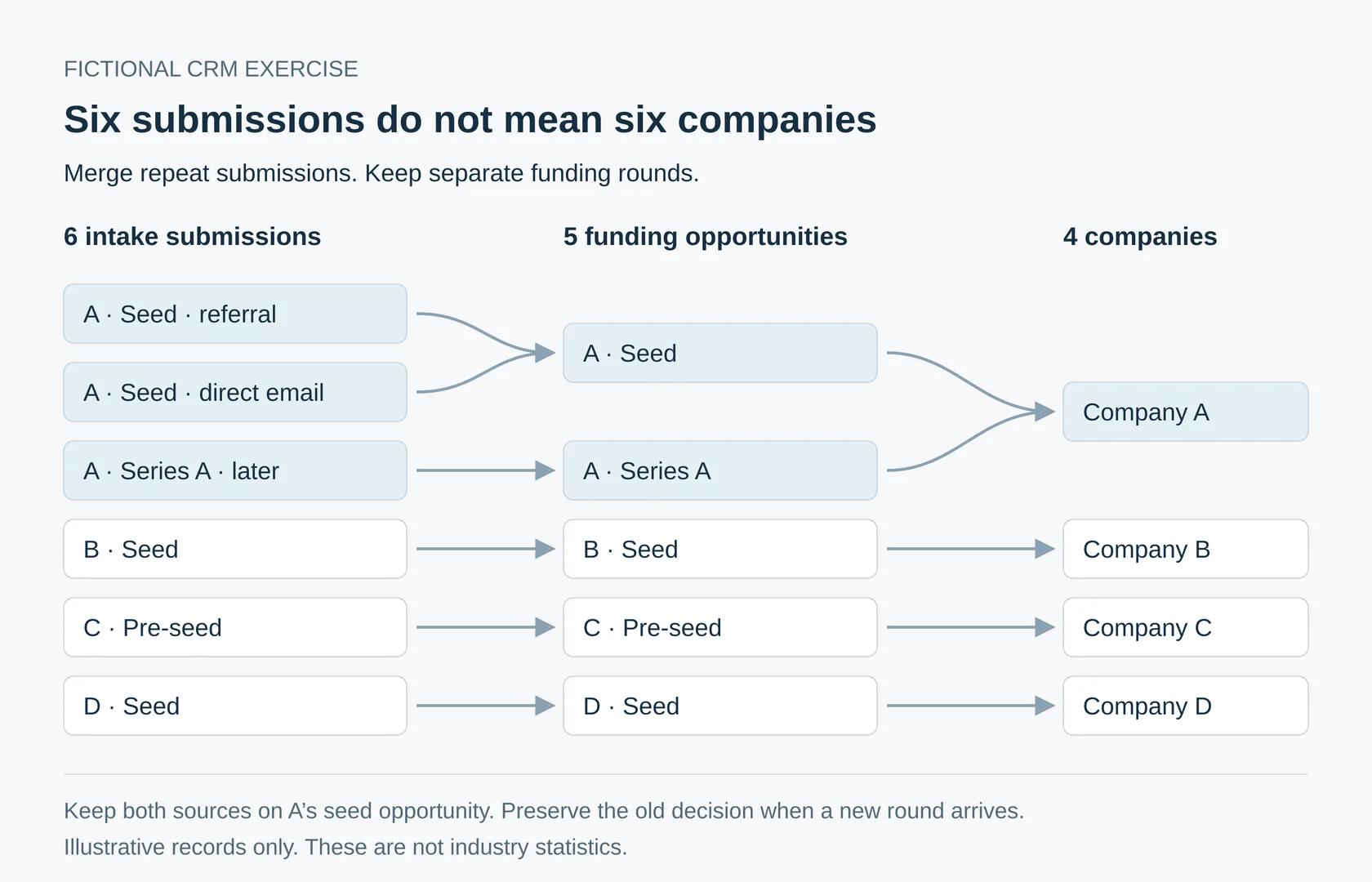
| 2: January 9 | Aster; aster.example | Same Seed round | Direct founder email | Add a source event to the existing opportunity, not another company or round. |
| 3: January 10 | Birch Robotics; birch.example | Seed | Website form | Create company and opportunity; assign an owner. |
| 4: January 11 | Cedar Health; cedar.example | Pre-seed | Analyst outbound research | Create company and opportunity; record the research source. |
| 5: January 12 | Delta Tools; delta.example | Seed | Scout introduction | Create company and opportunity; retain the scout source. |
| 6: September 3 | Aster Labs; aster.example | Series A | Introduction from Noah | Create a new opportunity linked to Aster; keep Seed history intact. |
The expected totals are six submissions, four unique companies and five funding-round opportunities. Those are three different measures. A dashboard labeled “deals received” is ambiguous unless everyone knows which it counts.
Copyable test data
Copy this CSV into an intake staging table, not directly into a company table. The expected keys are the answer key for reconciliation; they are not extra submissions. Dates below use one fictional test year.
submission_id,date,company_name,domain,round,source,expected_company,expected_opportunity
S1,2026-01-08,Aster Labs,aster.example,Seed,Mira intro,C1,O1
S2,2026-01-09,Aster,aster.example,Seed,Direct founder email,C1,O1
S3,2026-01-10,Birch Robotics,birch.example,Seed,Website form,C2,O2
S4,2026-01-11,Cedar Health,cedar.example,Pre-seed,Analyst outbound research,C3,O3
S5,2026-01-12,Delta Tools,delta.example,Seed,Scout intro,C4,O4
S6,2026-09-03,Aster Labs,aster.example,Series A,Noah intro,C1,O5
Test 1: Intake, duplicates and source attribution
Enter the first five submissions through the channels the firm expects to use. Check whether the Aster name variation produces a duplicate and how a user resolves it. A tool need not merge automatically to pass, but the correction should be understandable and preserve both submissions.
Open Aster's Seed opportunity. You should be able to identify Mira's original introduction and the later direct email, including their dates. Decide whether reports attribute sourcing to the first touch, the opportunity's first touch or another defined rule. Store the underlying events so changing a reporting rule does not require rewriting history.
Test 2: A return visit after a pass
Mark Aster's Seed opportunity as passed on January 15, with the fictional reason “too early for the current mandate.” Then enter submission six. The Series A should have its own owner, stage and decision fields while linking to the existing company.
Ask another user to explain what happened at Seed and why Aster is back. They should find the old date, reason and sources without restoring a backup. Noah should appear as the new round's referrer without replacing Mira in the company history. This catches a common design error: using one mutable company status to represent every investment decision.
Test 3: The weekly pipeline meeting
Assign an owner and next action to each active opportunity. Give one an overdue due date and leave another without a next action. Can an associate find both exceptions, prepare the meeting view and update decisions without exporting a separate working spreadsheet?
Time the task and record corrections, not just clicks. Link an opportunity to a draft investment memo and a due diligence checklist. Check that colleagues can locate the current document without duplicating its contents in several places.
Test 4: Email, calendar and relationship capture
Using approved test accounts, recreate Aster's existing Seed introduction as a dummy email and add a follow-up calendar meeting. These are activities on the fixture, not additional submissions or opportunities. Check the participants, timestamps and linked person and company. Where the product supports round-level linking, verify the Seed opportunity; otherwise record the manual step needed to keep Seed and Series A activity distinct.
Have a teammate find who can introduce them to Aster. Can they trace the suggested path to the dummy introduction and its date? A relationship score alone does not establish that someone will make an introduction. Test a forwarded message and an excluded private event too: neither should silently create duplicate deals or expose information outside the intended audience.
Test 5: Permissions, including indirect access
Create a dummy restricted note with a distinctive phrase. Use separate test accounts for an administrator, an ordinary team member and any limited-access role you expect to need. Write down who should see the note, then check the record, search results, reports, notifications, exports and any AI answers available to each role.
Do not confuse a tidy view with an access restriction. For example, Airtable defines a personal view by who can configure it; that label alone is not evidence that underlying records are confidential. Require an actual permission test. Any unintended disclosure is a blocker to resolve before using real data.
Test 6: Export and reconstruct the history
Export with an appropriately authorized test administrator. Reconcile the four companies, five opportunities and six source events. Check stable IDs and links, owners, pass reasons, timestamps, notes, stage history and documents. Export formats may use several files; the question is whether you can reconstruct the relationships.
Record what is missing, what requires an API or paid service, and whether attachment links will still work after access ends. A CSV containing company names and current stages is not a complete migration test. Separately confirm that restricted users cannot export information they should not access.
Use hard gates before scoring
Agree on acceptance criteria before the demonstrations. Otherwise an attractive feature can distract the team from a failed requirement. The following is a suggested evaluation matrix, not a vendor rating.
| Requirement | Evidence to keep | Decision rule |
|---|---|---|
| Record integrity | Reconciled counts and intact Aster round histories | Hard gate: no lost history or unexplained duplicates |
| Permissions | Results for each role and access surface | Hard gate: no unintended disclosure |
| Portability | Export files and documented omissions | Hard gate: agreed essential records are recoverable |
| Daily workflow | Observed intake, follow-up and meeting tasks | Score usability and required workarounds |
| Administration | Who can change fields, rules, access and reports | Score ongoing effort and support dependency |
| Cost | Written quote with included capabilities | Compare the same users, integrations and requirements |
For scored tasks, use a simple scale: 0 cannot complete; 1 needs a substantial workaround; 2 works with acceptable setup; 3 works cleanly for the intended user. Mark untested items “unknown,” not passed. Have the analyst, associate and operations owner score independently before discussing trade-offs.
Copy this scorecard header into a second sheet. Record one row per task, tool, plan and test role. For hard gates, enter pass, fail or unknown instead of a numeric score.
tool,plan,test_role,task,expected_result,observed_result,gate_or_score,elapsed_minutes,manual_corrections,evidence_link,limitation,owner,retest_dateCompare first-year costs beyond seats: implementation, migration, integrations, data subscriptions and required support. Record internal administration time separately. Ask vendors which quoted components are necessary to reproduce the pilot, rather than assuming a demo includes the proposed package.
Roll out the process you tested
Give one person responsibility for the data model and one for the investment workflow. Publish short definitions for stages, source attribution, pass reasons and required next actions. This makes CRM maintenance a shared process rather than an undocumented task handed to the newest VC analyst.
Move a bounded, approved set of records first. Reconcile counts against the old system, review access and run an actual pipeline meeting before expanding. Keep a recoverable copy of the source data and document what did not migrate. The six-submission test is a functional check, not proof of production-scale performance; test a representative volume and your real integrations separately.
Watch three rollout failure modes. Too many required fields: separate what intake needs from what diligence needs, or users may postpone logging. Unreviewed synchronization: inspect exclusions before connecting real inboxes, then monitor incorrect matches. Two competing pipelines: set a cutover owner and date once reconciliation passes; keeping both editable indefinitely leaves colleagues unsure which decision is current. Preserve the old system read-only rather than deleting its history.
The strongest selection case is a short evidence file: the problems you set out to solve, the completed tests, unresolved limitations, full cost and named operating owners. Choose the system the team can keep accurate, and make that accuracy visible in the pilot.
Related posts
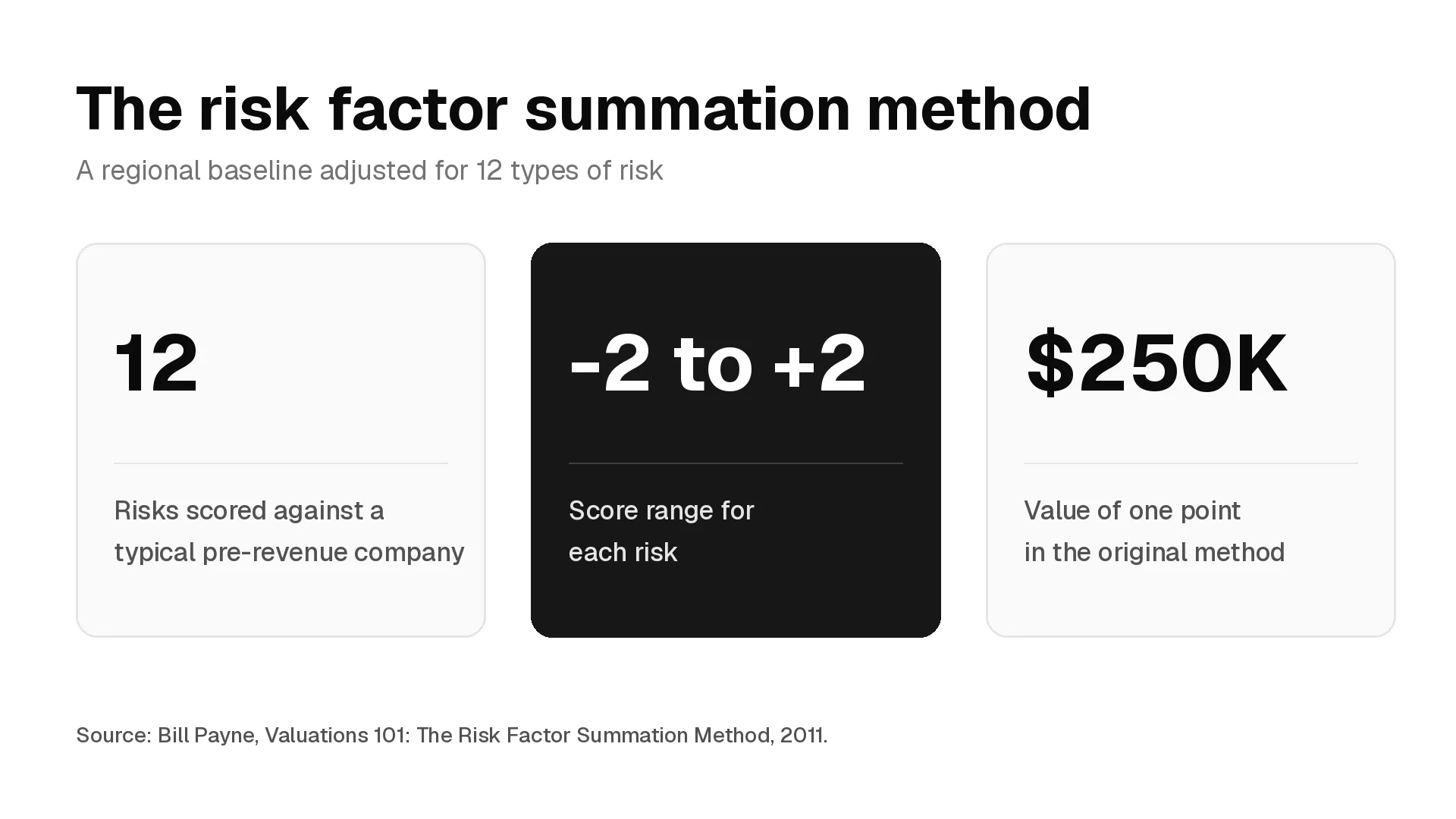
How the risk factor summation method values a pre-revenue startup, how to score each of the 12 risks with evidence, a worked example with ownership and 10x checks, whether the $250,000 step still fits current seed prices, and how VC analysts use it in memos and interviews.
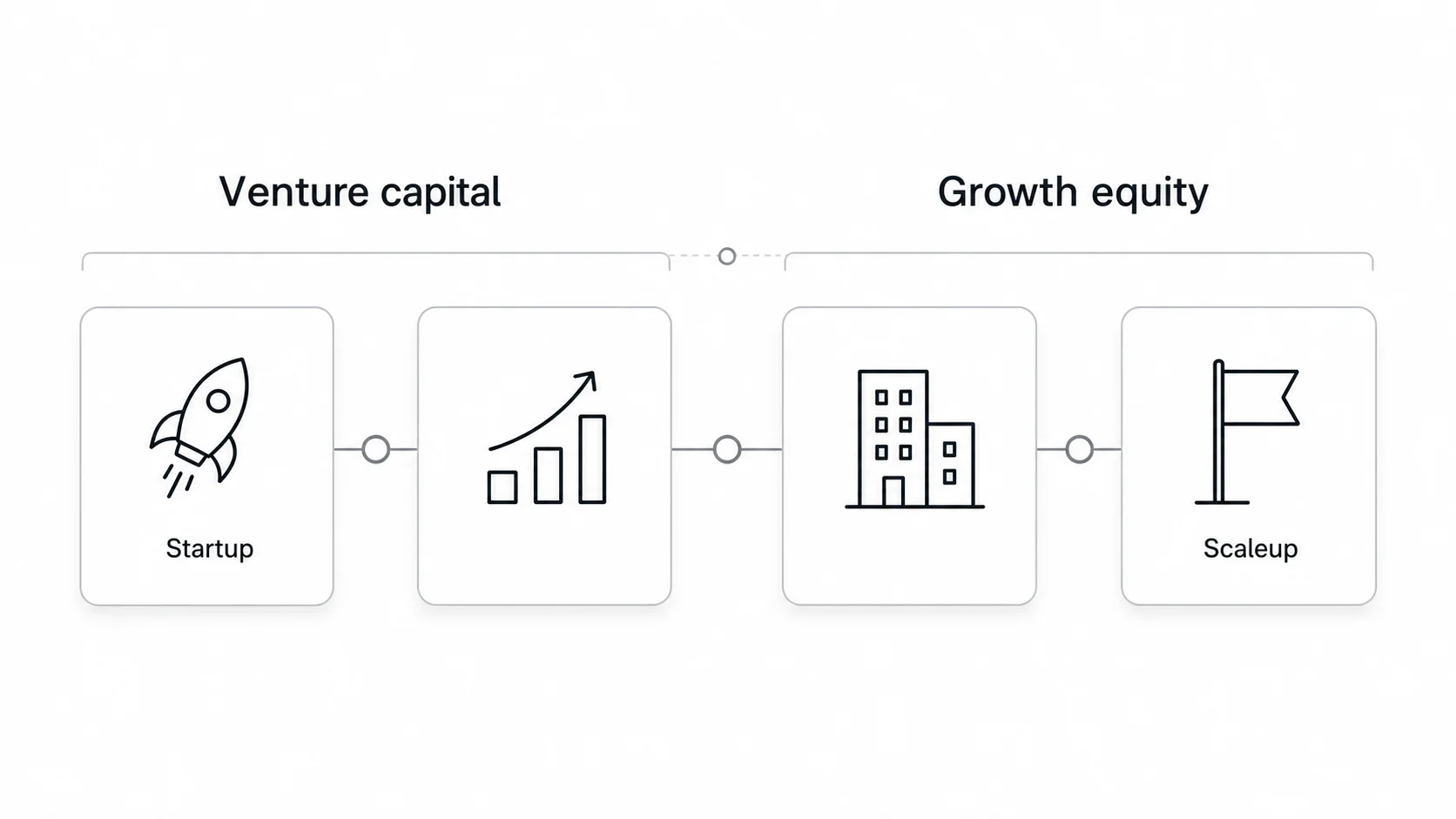
Growth equity buys minority stakes in proven, growing companies; venture capital backs startups still proving the market. Compare stage, risk, terms, secondaries, loss ratios, 2026 round sizes and careers.
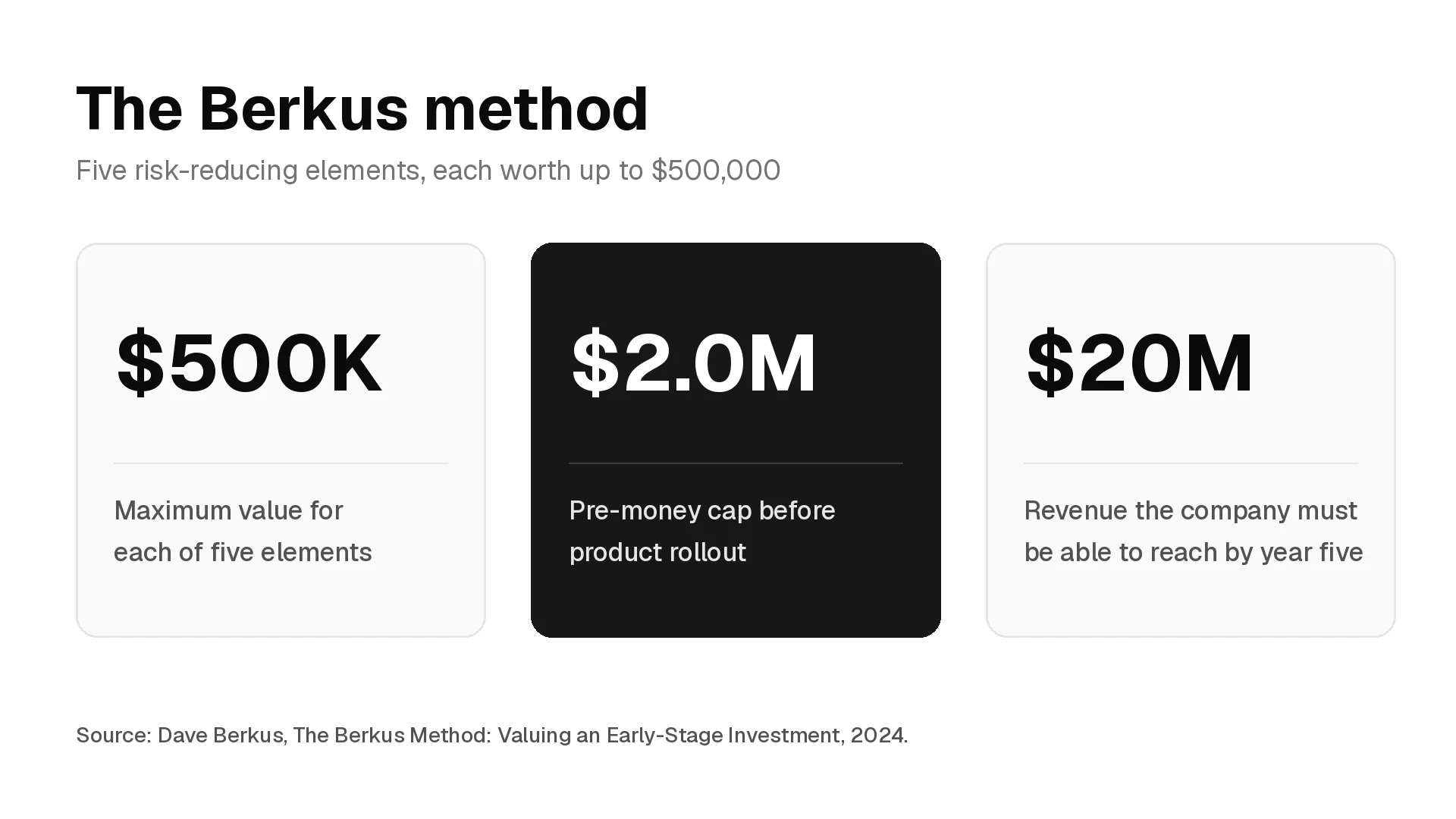
How the Berkus method values a pre-revenue startup, how to score each of the five elements, a worked example with ownership and 10x checks, how the $500,000 caps compare with current seed prices, and how VC analysts use it in memos and interviews.