
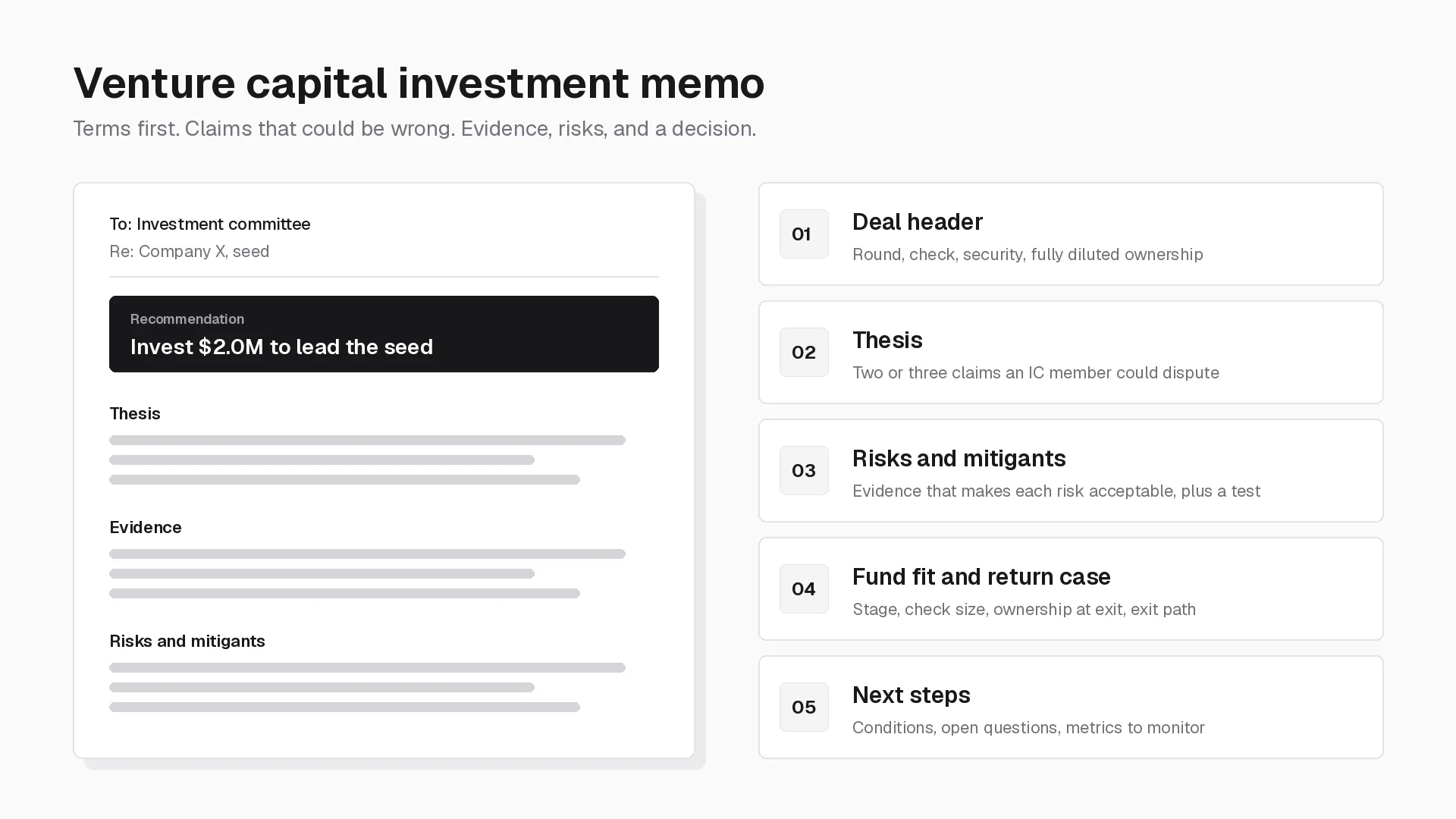
A venture capital investment memo is the written recommendation to invest in a startup, pass on it, or keep diligencing. It states the deal terms, the two or three claims that must be true for the investment to work, the evidence behind each claim, the risks that could break it, and why the deal fits the fund. Partners use it to decide whether a company earns more time, and firms keep it as the record of what the team believed when it wrote the check.
Analysts and associates write most first drafts. Candidates write one in nearly every VC case study. The memo that works is a judgment document, not a tidy summary of the founder's deck.
What is a venture capital investment memo?
A venture capital investment memo is a structured document that explains one investment opportunity and recommends an action. Firms call it a deal memo, diligence memo, investment committee memo, IC memo, or recommendation memo. The name changes with the firm and the stage of the process. The job stays the same. It helps the people with the vote decide what to do next.
The format depends on where the deal sits in the funnel. A screening note after a first call and a full IC memo before a vote are different documents.
| Memo type | Who writes it | Typical length | Decision it supports |
|---|---|---|---|
| Screening note | Analyst or associate after a first call | Half a page to one page | Take a second meeting or pass |
| Deal or diligence memo | Associate or principal during diligence | Two to five pages | Spend partner time and diligence budget |
| Investment committee memo | Sponsoring partner, usually drafted by the deal team | Five to fifteen pages plus appendix | Approve the investment and terms |
| Case-study memo | Candidate in a VC interview or take-home | One to three pages | Show how the candidate thinks |
| Post-investment review | Deal team, months or years later | One to three pages | Check the original thesis against what happened |
Lengths are typical ranges, not rules. Many seed firms run on one-page memos, and some growth funds attach models and customer-call notes that run past thirty pages. The constraint that matters is time. A partner should understand the recommendation and the main risk in the first two minutes.
The memo is also different from the investment thesis. A thesis is the argument for why a market or company could be attractive. The memo is the full decision document: thesis plus terms, evidence, risks, fund fit, and a recommendation.
Investment memo vs pitch deck
Founders also write documents called investment memos, usually to replace or support a pitch deck. Those are sales documents. An investor's memo evaluates the same company from the other side of the table.
| Founder pitch deck or memo | Investor's investment memo | |
|---|---|---|
| Author | Founder | Analyst, associate, or partner at the fund |
| Purpose | Win the meeting and the term sheet | Decide whether to invest and on what terms |
| Reader | Prospective investors | Partners and the investment committee |
| Treatment of risk | Addressed, framed favorably | Ranked, with the evidence and the test that would settle it |
| Must include | Story, traction, ask | Deal terms, ownership, fund fit, recommendation |
If a sentence in the memo could have come from the founder's deck, it either needs evidence attached or needs to go.
VC investment memo template
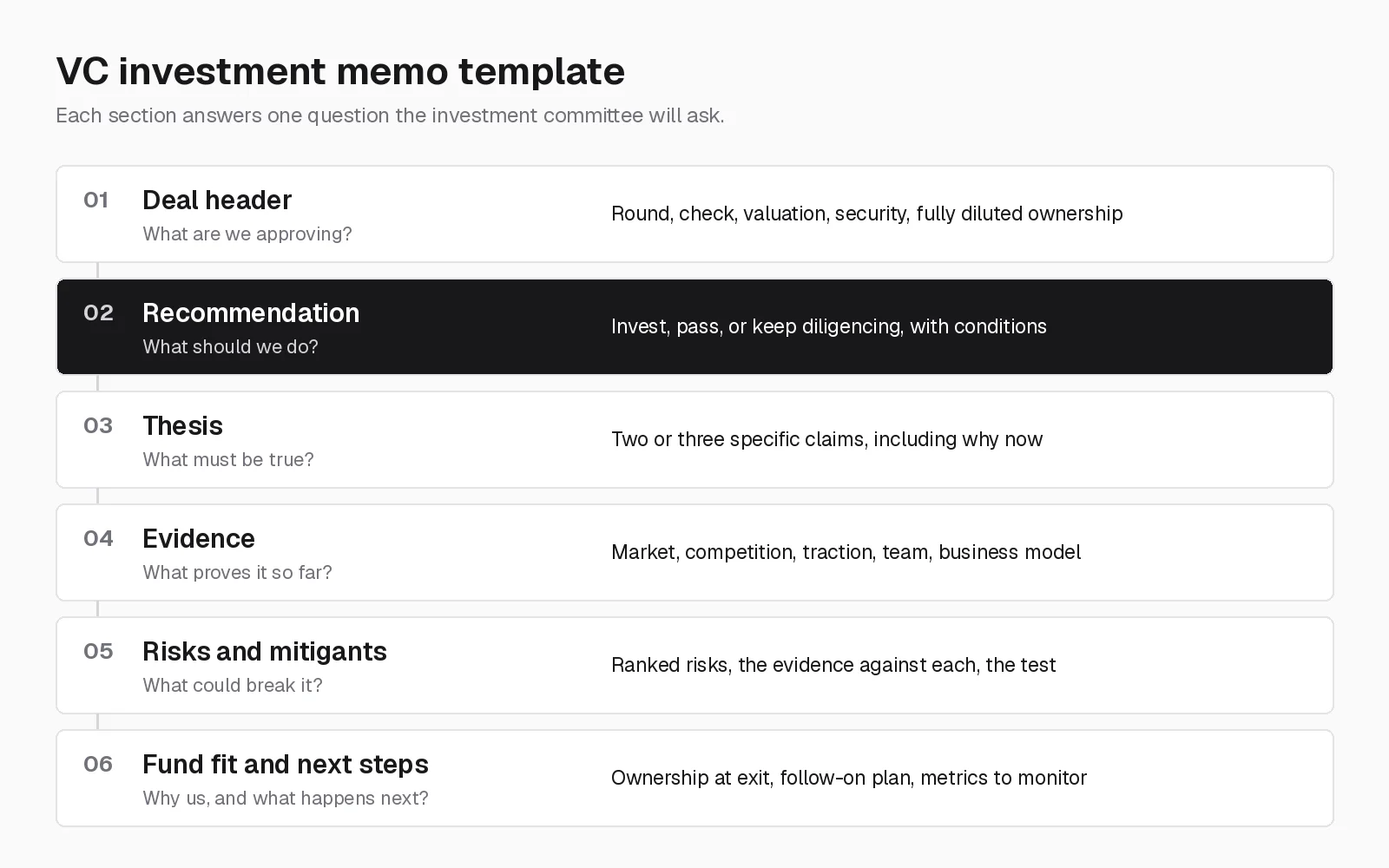
Use this structure for a deal memo, an IC memo, or a case-study memo. Shorter memos compress sections. They do not drop the recommendation, the risks, or fund fit.
| Section | Question it answers | What good looks like |
|---|---|---|
| Deal header | What are we being asked to approve? | Company, round size, check size, valuation, security, fully diluted ownership, board role, reserves |
| Recommendation | What should we do? | Invest, pass, or continue diligence, with conditions |
| Company snapshot | What does the company do? | Product, customer, business model, stage, and traction in plain language |
| Thesis | What must be true for this to work? | Two or three specific claims an IC member could disagree with |
| Market | Is there an opening worth investing in? | Bottom-up sizing, first customer segment, why now, path to expand |
| Competition | Who else could win this customer? | Alternatives from the customer's view, including doing nothing |
| Product and traction | Does the market need this? | Evidence matched to stage |
| Team | Why can these founders win this market? | Experience tied to the execution challenge |
| Business model | How does the company make money as it scales? | Pricing, margins, retention, CAC payback, and the variables that matter most |
| Risks and mitigants | What could break the investment? | Ranked risks, the evidence that makes each acceptable, and the diligence test |
| Fund fit and return case | Why this fund, and what does a win look like? | Stage, sector, check size, ownership, follow-on plan, exit path |
| Next steps | What happens after the vote? | Open questions, conditions, and the metrics to monitor |
How to write each section
Deal header and recommendation
The deal header reads like a term sheet summary. List the company, round size, the fund's check, pre-money and post-money valuation, security type, ownership target, board role, and reserves for follow-on. Calculate ownership on a fully diluted basis, including the option pool. An IC member who sees 15% and later learns it was 12% fully diluted stops trusting the rest of the memo.
Put the recommendation directly under the header:
- "Recommend leading the $4.0M seed with a $2.0M check for 10% fully diluted, subject to two pilot-customer reference calls."
- "Recommend passing. The first customer segment is too small to support a fund-returning outcome at this price."
- "Recommend a second founder meeting focused on retention and sales-cycle length before any term sheet."
Sponsoring IC memos almost always recommend investing, because a partner does not bring a deal to a vote without conviction. Screening notes, diligence memos, and case-study memos recommend passing all the time. A clear pass beats a vague maybe.
Company snapshot
The snapshot makes the company legible. It does not sell.
Weak: "Company X is revolutionizing healthcare operations with an AI-powered platform."
Stronger: "Company X sells workflow software that automates prior authorization for independent specialty clinics. It is raising a seed round after signing five design partners and converting two to paid contracts at $1,200 per location per month."
The stronger version names the buyer, the job, the price, and the proof. A partner can now evaluate it.
Thesis: two or three claims that could be wrong
The thesis is the spine of the memo. Write it as a short list of claims, each specific enough that a colleague could argue the other side. "Large market, strong team, fast growth" is not a thesis. Every company pitch claims all three.
A useful thesis claim covers one of these:
- Customer pain: what problem is urgent enough to create budget?
- Why now: what changed in technology, regulation, cost, or behavior that opens the market today rather than five years ago?
- Right to win: why this company gets the first customers instead of an incumbent?
- Expansion: how the first product becomes a larger company?
Weak: "This is a large market with strong tailwinds."
Stronger: "Prior authorization volume is growing faster than clinic administrative headcount. If Company X owns that workflow in independent specialty clinics, it can expand into eligibility checks and denials and become the operating system for revenue-cycle staff."
The stronger version can be tested. That is the point of writing it down.
Market: opportunity, not a TAM number
A top-down TAM figure tells an IC almost nothing. Size the market from the bottom up and explain why it is open:
- Who is the first customer, and how many of them exist?
- What do they spend on this problem today, in software or in staff time?
- Which budget does the product replace or create?
- Why are incumbents unable or unwilling to serve this segment?
- Which segment comes next, and why does winning the first one help?
The first segment is the beachhead. It should be small enough to win and large enough to prove the model. A memo that cannot name it has not found the company's entry point yet.
Competition from the customer's side
Feature grids comparing the startup with its closest category peers almost always show the startup winning. They are useless. Write competition from the customer's point of view: what else could the buyer hire to do this job? That list includes incumbents, adjacent products, internal tools, outsourced services, spreadsheets, and doing nothing.
For each serious alternative, say why the customer would switch, or why they would not. If incumbents are the threat, explain what stops them: their price, their sales motion, their customer segment, or the cost of rebuilding their product.
Product and traction, matched to stage
Explain what the product does before how it works, and connect it to the customer pain in the market section. Then show evidence. A pre-seed and a Series B company should not face the same standard.
| Stage | Evidence that carries weight |
|---|---|
| Pre-seed | Founder insight, customer discovery notes, prototype usage, design partners |
| Seed | Paid pilots, early revenue, usage frequency, customer references, retention signals |
| Series A | Revenue growth, cohort retention, gross margin, sales efficiency, customer concentration |
| Growth | Cohort economics, net revenue retention, payback by channel, market share, exit path |
The strongest traction sections show users doing something unexpectedly intense, such as daily use of a tool expected to be weekly or customers expanding without a sales push. In a case study, state plainly which evidence the prompt proves and which would need due diligence before a real check.
Team against the execution challenge
"Strong team" is not analysis. Start from what this market demands, then show the evidence that these founders can do it. A payments company needs regulatory and bank-partnership experience. A developer tool needs founders developers already trust. A healthcare workflow company needs someone who has run the workflow.
Name the gaps too. A missing go-to-market leader or a first-time CEO is a fact the IC will discover. A memo that names the gap and the plan to close it reads as judgment. One that hides it reads as advocacy.
Business model and the few variables that matter
State what is sold, to whom, at what price, at what gross margin, and how revenue per customer grows. For software, cover pricing, gross margin, retention, expansion, CAC, and payback. For marketplaces, cover liquidity, take rate, and repeat frequency. For deep tech, cover milestones, capital needed to reach them, and the commercialization path.
Then name the two or three variables that decide whether the model works, such as pilot-to-paid conversion or monthly logo churn. Those variables feed the risk section and become the metrics the firm tracks after investing. If the company is too early for clean metrics, say so and state what would need to be true.
Risks, mitigants, and the diligence test
Every startup has competition, execution, and hiring risk. Listing them adds nothing. Rank the two or three risks that could break this investment, then give each one a mitigant and a test.
A mitigant is evidence, not hope. "The team is strong" is not a mitigant. "Two pilot clinics converted to paid without a discount" is. The test is the diligence step or post-close milestone that would confirm or kill the risk.
| Risk | Why it could break the deal | Mitigant | Test |
|---|---|---|---|
| Buyer urgency | Clinics agree the pain exists but delay purchase | Two of five pilots converted to paid at list price | Two more conversions before close; lost-deal reasons from the other three |
| Integration reliability | Payer portals change often and break automation | CTO built payer integrations at a claims clearinghouse | Technical review of failure logs and support tickets |
| Expansion | Prior authorization alone may cap revenue per clinic | Three design partners asked for eligibility checks | Customer calls on willingness to consolidate tools |
Fund fit and the return case
A good company can still be the wrong investment for a specific fund. Check stage, sector, check size, ownership target, portfolio conflicts, and how much follow-on capital the company will need. The Venture Capital Careers companies directory is a fast way to compare how firms describe their stage and sector focus.
The return case shows what a win means for the fund. Estimate ownership at exit after expected dilution, a plausible exit value, and the resulting multiple. State the exit path and the holding period assumption, because the same multiple produces a very different IRR over five years than over ten.
Next steps and what to monitor
Close with the conditions on the recommendation, the open diligence questions, and the metrics the firm will track after investing. Those metrics come straight from the business-model variables and the risk table. A memo that ends with them gives the team a way to check, a year later, whether the thesis is holding.
One-page memo example
The memo below shows the full structure at seed-stage length. Company X, its founders, and every number are illustrative. Use the shape, not the figures.
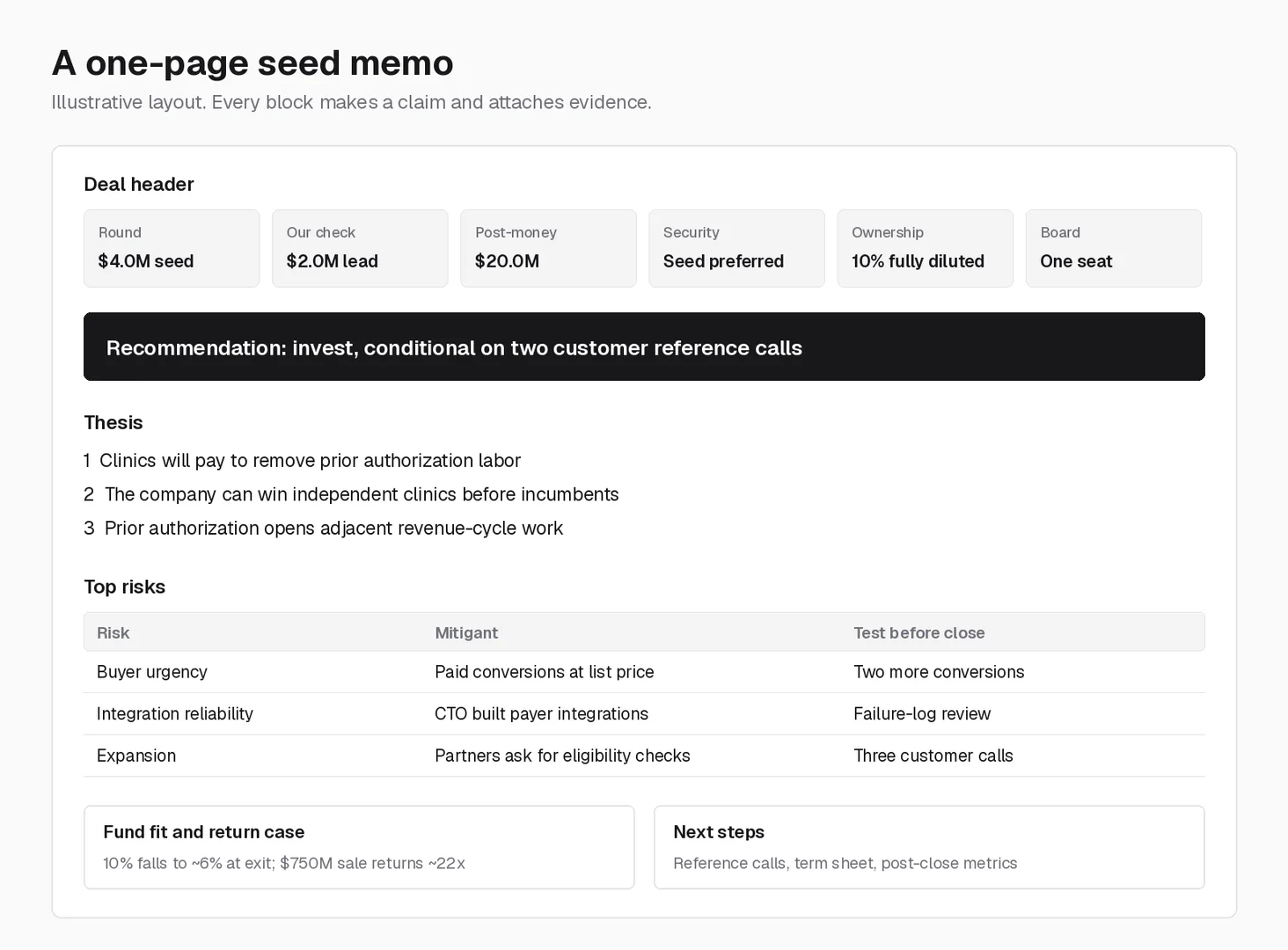
To: Investment committee. Re: Company X, seed.
Deal header
| Field | Detail |
|---|---|
| Company | Company X, prior authorization software for independent specialty clinics |
| Round | $4.0M seed, priced round |
| Our check | $2.0M, lead |
| Valuation | $16.0M pre-money, $20.0M post-money, 10% option pool in pre-money |
| Security | Series Seed preferred, 1x non-participating |
| Ownership | 10.0% fully diluted |
| Board | One seat |
| Reserves | $3.0M for follow-on |
Recommendation. Invest $2.0M to lead the seed, conditional on reference calls with office managers at both paying clinics confirming who owns the budget.
Thesis
- Clinics will pay to remove prior authorization labor. Five design partners report staff spending 15 to 20 hours a week per location on prior authorization, and two converted to paid at $1,200 per location per month.
- Company X can win independent clinics before incumbents do. Incumbent revenue-cycle vendors sell to hospital systems on long procurement cycles. Company X's two paid conversions closed within 45 days of pilot start.
- Prior authorization opens adjacent work. Three of five design partners asked for eligibility checks, and the product already pulls the payer data those checks need.
Evidence to date. $28,800 in annual recurring revenue from two locations. The CEO ran revenue-cycle operations for six years at a 40-location orthopedic group. The CTO built payer integrations at a claims clearinghouse.
Top risks
| Risk | Mitigant | Test before close |
|---|---|---|
| Buyer urgency | Paid conversions at list price | Two more pilot conversions |
| Integration reliability | CTO's clearinghouse experience | Failure-log review |
| Expansion | Design-partner demand for eligibility checks | Three customer calls on tool consolidation |
Fund fit. Seed lead in healthcare software, inside the fund's $1M to $3M initial check range and 10% ownership target. No portfolio conflicts.
Return case. Ownership falls to roughly 6% after two more rounds. A $750M acquisition by a revenue-cycle platform in seven to nine years returns about $45M, roughly 22x the initial check.
Next steps. Reference calls this week, term sheet Friday if both confirm. Post-close metrics: pilot-to-paid conversion, automated submission success rate, locations per customer, net revenue retention.
That is the whole memo. Every section above fits on one page because each one makes a claim and attaches the evidence, instead of describing the company at length.
Real venture capital investment memos to study
A few firms have published the memos behind famous investments. Read them for structure and judgment, not for the outcome everyone already knows.
Bessemer Venture Partners on Shopify, October 2010. The Shopify memo opens with the ask in its first sentence, seeking approval to invest up to $7mm in the Series A. Its customer-acquisition section puts the unit economics in one paragraph, with $175 to $225 to acquire a customer and a 7 to 9 month churn-adjusted payback. It shows the retention curve honestly, with about 75% of customers left by month 3 and 50 to 60% by month 12, then explains why the economics still work. The team section names the gap plainly. The company needed a VP of Marketing. The habits worth copying are to put the ask first, show the uncomfortable number next to the reason it is acceptable, and name the hire the company needs.
Sequoia on YouTube, September 2005. The four-page memo surfaced as an exhibit in Viacom's copyright suit against YouTube. The deal section is two sentences long. It proposes $1m in the seed, followed by a $4m Series A once specific milestones are met, for about 30% ownership after the Series A. The risk section is the lesson. Instead of calling monetization uncertain, it writes revenue as videos served per day times the share monetized times CPM times 365, then runs three scenarios from $6m to $55m in annual revenue. It also says the company needs a CEO, with a target of having one in place within 90 days. The habits worth copying are turning an unknown into a formula with scenarios and tying the deal structure to milestones.
Sequoia on Apple, November 1977. Sequoia released Don Valentine's original memo in April 2026 for Apple's 50th anniversary, as Business Insider reported. It is short and blunt. It covers a $600,000 round, recent sales and projections, and the line "$600k buys 10% very rich deal, management questionable." The lesson is that a memo can be brief as long as the price, the numbers, and the main objection are explicit.
Bessemer keeps more original memos in its archive, including several with partner notes written in hindsight. The Shopify notes admit the upside case was off by more than two orders of magnitude. The outcomes analysis is still worth writing, because it forces a view of what a win looks like.
Weak versus stronger memo sentences
Apply the evidence-not-adjectives rule. If a sentence leans on an adjective, rewrite it around proof.
| Weak | Stronger |
|---|---|
| "The team is exceptional." | "The CEO ran revenue-cycle operations for six years at a 40-location orthopedic group and recruited all five design partners from that network." |
| "The market is massive." | "The first segment is independent specialty clinics with heavy prior authorization volume. Eligibility checks and denials follow once the workflow is owned." |
| "The product is highly differentiated." | "The product automates payer-specific submission steps that general-purpose AI assistants do not reach." |
| "Competition is a risk." | "The main risk is that incumbents add basic automation before Company X proves enough workflow depth to become the system of record." |
Common mistakes in VC investment memos
Summarizing the pitch deck. A memo evaluates the company. Restating founder materials adds no judgment.
Burying the recommendation. If the decision sits on page four, the memo reads as notes.
Using TAM instead of an entry point. A large market does not matter if the company has no credible first segment.
Listing generic risks. Name the specific version that could break this company, then give the mitigant and the test.
Getting ownership wrong. Quote ownership fully diluted, including the option pool.
Overweighting model precision. A five-year forecast to the dollar for a seed company distracts from customer pull and timing.
Ignoring fund fit. A strong company can be wrong for this fund's stage, check size, or portfolio.
Letting an AI tool supply numbers. A model can tighten prose. It cannot be the source of a market size, a retention figure, or a customer quote. Every number in the memo needs a source the writer can show.
Mixing knowns and unknowns. Mark what is proven, what is assumed, and what still needs diligence.
Using a memo in VC recruiting and case-study interviews
In a venture capital case study interview, the memo shows how a candidate thinks more than whether the call is right. Interviewers look for structure under ambiguity, the ability to separate evidence from assertion, a sense of fund fit, and a decision with incomplete data. Present the recommendation and the two reasons that matter most first. Partners will interrupt, and that is how investment discussions work.
Outside formal case studies, a short memo on a real company makes a strong work sample. Use only public information, never confidential material from a current employer. Pick a company in the target firm's stage and sector, and keep it to one or two pages. Pair it with a sharp VC resume and practice the follow-ups in the venture capital interview questions guide. The memo then gives interviewers something concrete to discuss beyond general interest in startups.
Final memo checklist
- Is the recommendation in the first few lines, with any conditions?
- Does the deal header show security and fully diluted ownership?
- Can a reader explain what the company does after one paragraph?
- Is each thesis claim specific enough to be wrong?
- Does the market section name the first segment and why now?
- Is competition written from the customer's side, including doing nothing?
- Does every risk have a mitigant and a test?
- Does the return case state ownership at exit, exit path, and holding period?
- Are the post-investment metrics named?
- Could the memo be defended out loud in five minutes?
FAQ
How long should a VC investment memo be?
It depends on the memo type. A screening note is usually one page or less. A case-study memo runs one to three pages. A diligence memo is often two to five pages, and a full IC memo can run five to fifteen pages plus appendices. In interviews, clarity beats length.
What is the difference between an investment memo and an IC memo?
An IC memo is the version of the investment memo that goes to the investment committee for a vote. It carries the full deal terms and the sponsoring partner's recommendation. Earlier memos, such as screening notes and diligence memos, decide whether a deal gets that far. The venture capital investment committee guide covers how the vote itself works.
Who writes investment memos at a VC firm?
Analysts and associates write screening notes and draft large parts of diligence and IC memos. Principals and partners edit them and own the final recommendation. At small funds, partners often write the whole memo. Memo writing is a core skill for anyone working toward a seat as a venture capital analyst.
Should a VC memo ever recommend passing?
Yes. Screening notes and diligence memos recommend passing far more often than investing. A well-reasoned pass in a case study can beat a weak invest recommendation. When the pass goes back to the founder, the pass email is a separate piece of writing.
Where can I find real VC investment memos?
Bessemer Venture Partners publishes original memos for companies including Shopify, Twilio, Pinterest, LinkedIn, and Twitch. Sequoia's YouTube memo is public through court filings, and Sequoia released its 1977 Apple memo in 2026. Read several from the same firm to see how its structure stays consistent from deal to deal.
What should candidates include in a VC case-study memo?
A deal header if the prompt gives terms, a recommendation, a company snapshot, two or three thesis claims, market and competition, stage-appropriate evidence, team, top risks with mitigants and tests, fund fit, and next steps. Keep it short enough to defend in conversation.
Turn memo practice into a job search
Memo writing is the daily craft of junior investors, and a sharp sample memo is one of the few things that lets a candidate prove it before getting the job. Build a target list in the companies directory, browse open analyst and associate roles on the VC job board, and create an account to get alerts when new investment roles post.
Related posts
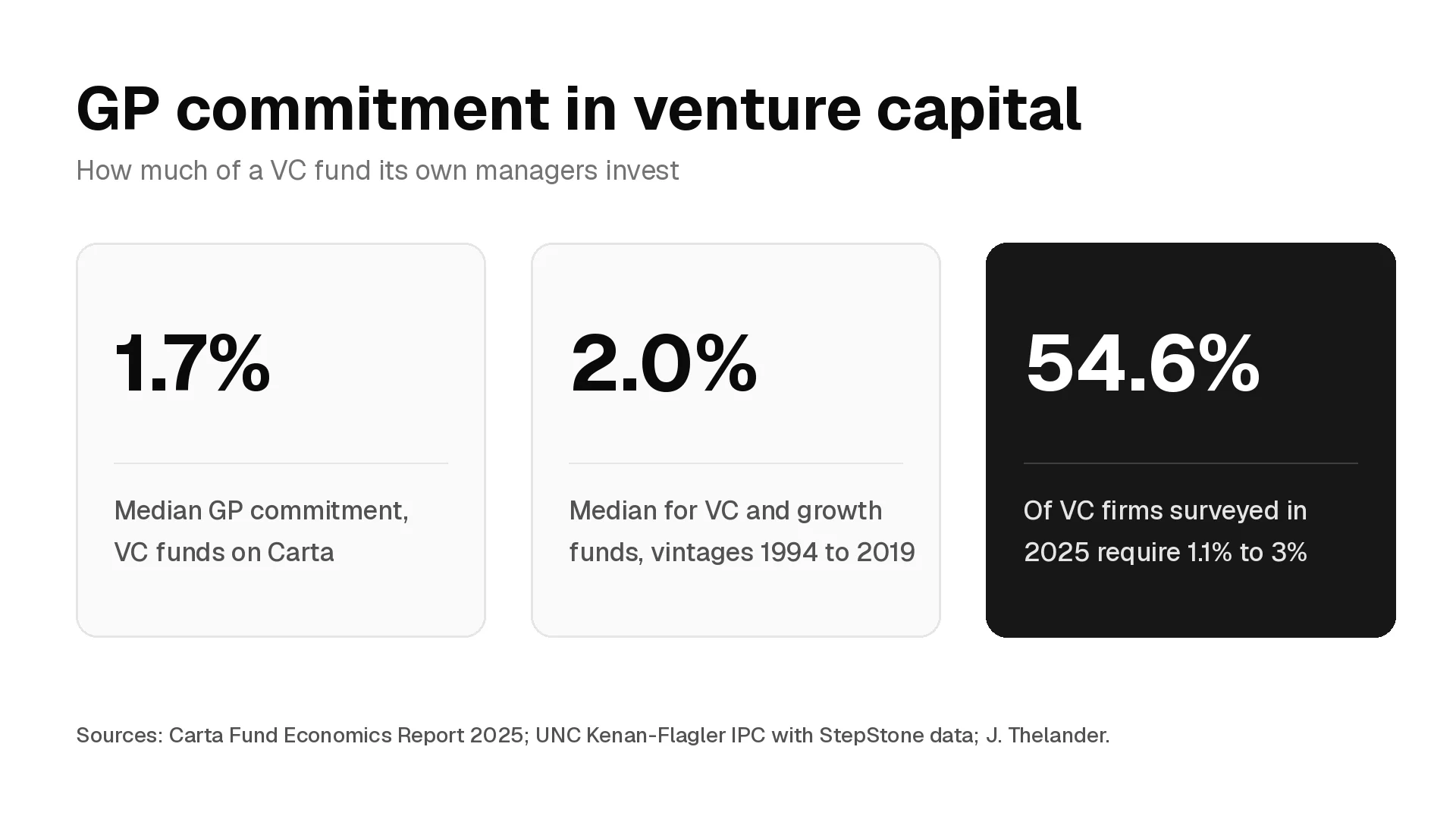
What a GP commitment is, how large it is in venture capital, how GPs fund it, where it sits in the LPA, what the returns evidence says, how firms split it across partners and principals, and what to ask before you accept a role with carry.
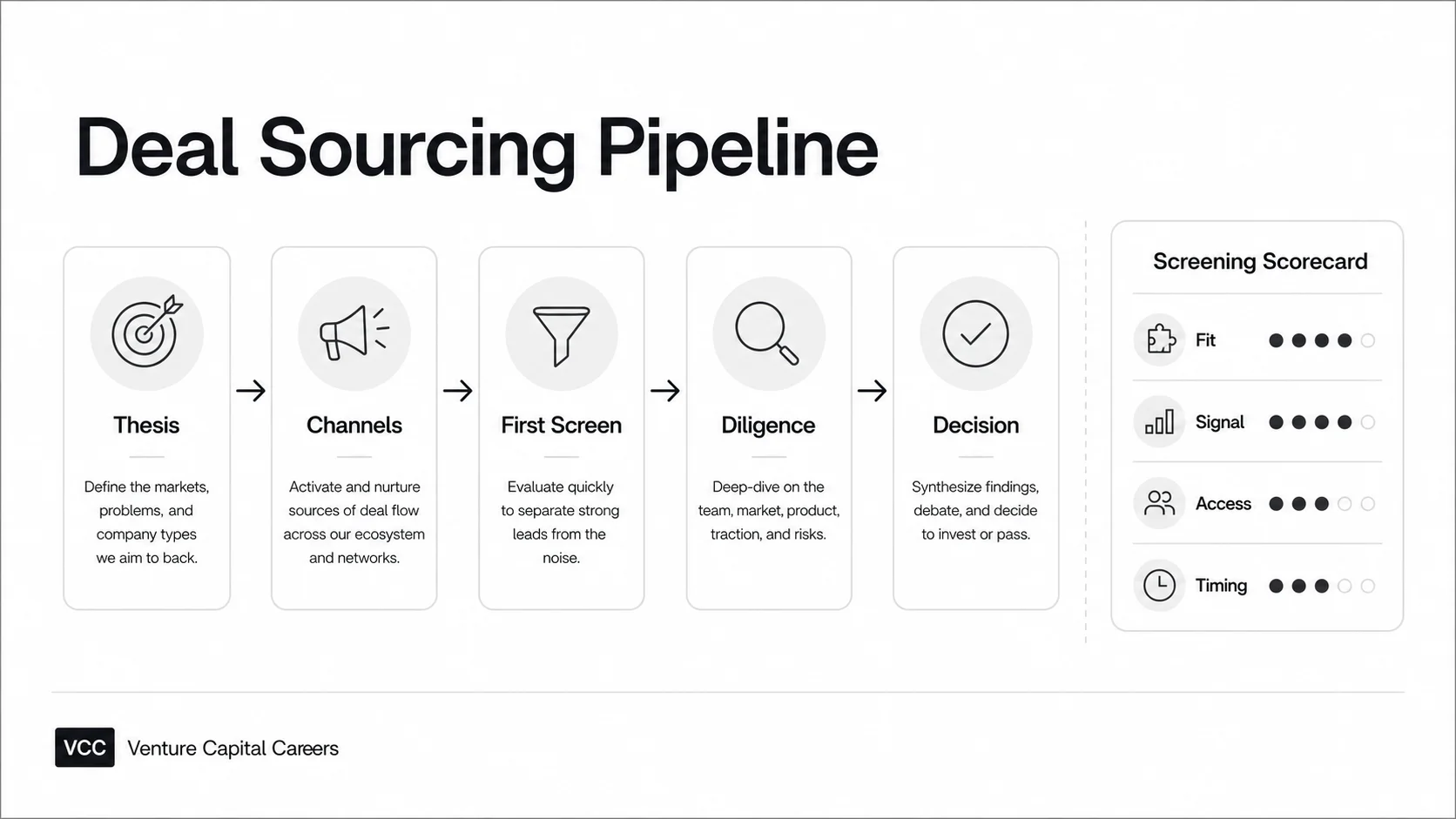
Most closed VC deals start with a relationship. See where deals come from by stage, how to work each sourcing channel, which signals show up early, and how analysts run a weekly sourcing process.
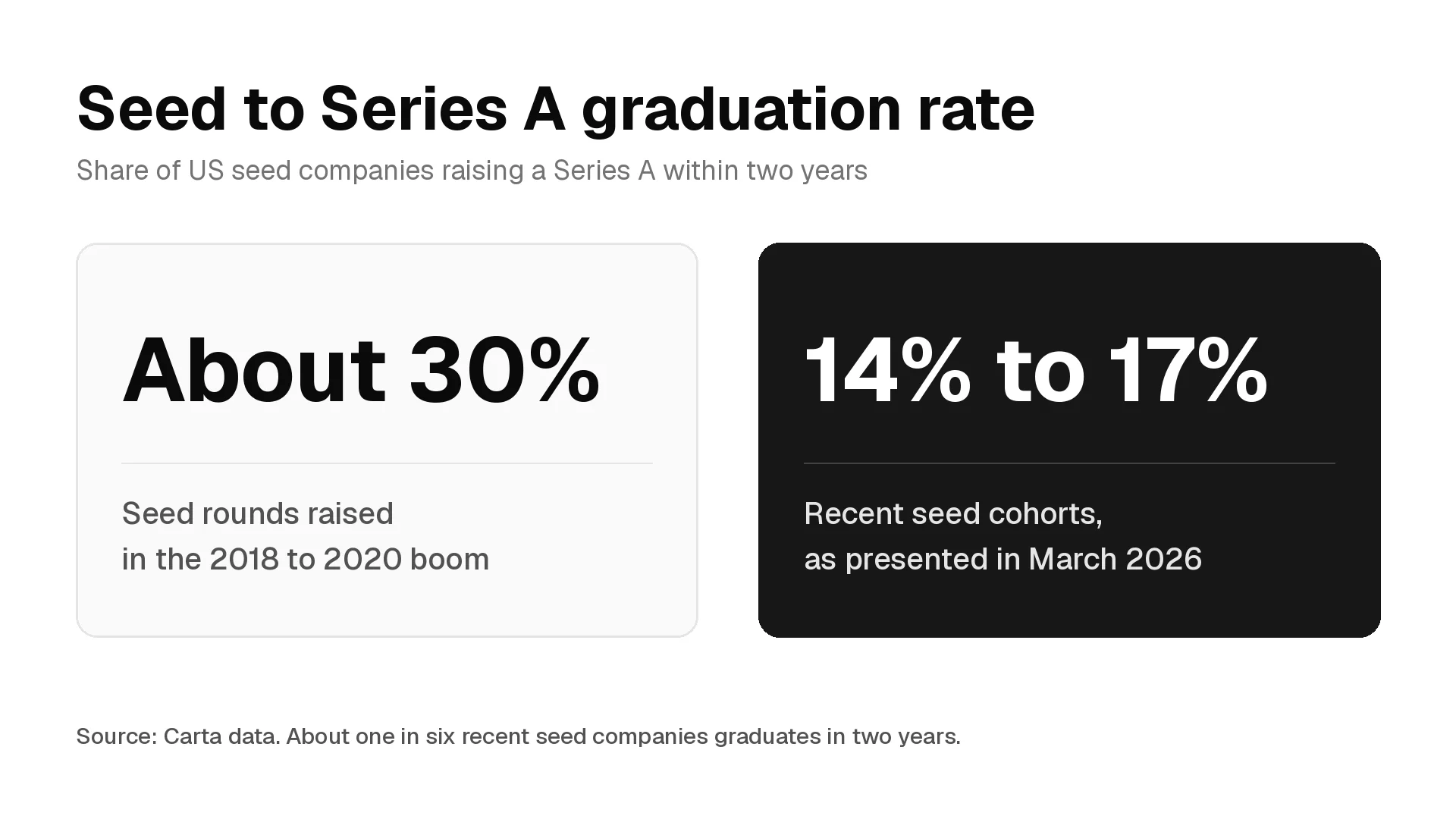
Seed to Series A graduation rates by cohort from Carta and Crunchbase, how long the jump takes, why rates fell after 2021, why published figures disagree, and how seed and Series A firms use the rate for reserves, LP reporting, portfolio reviews and interviews.