
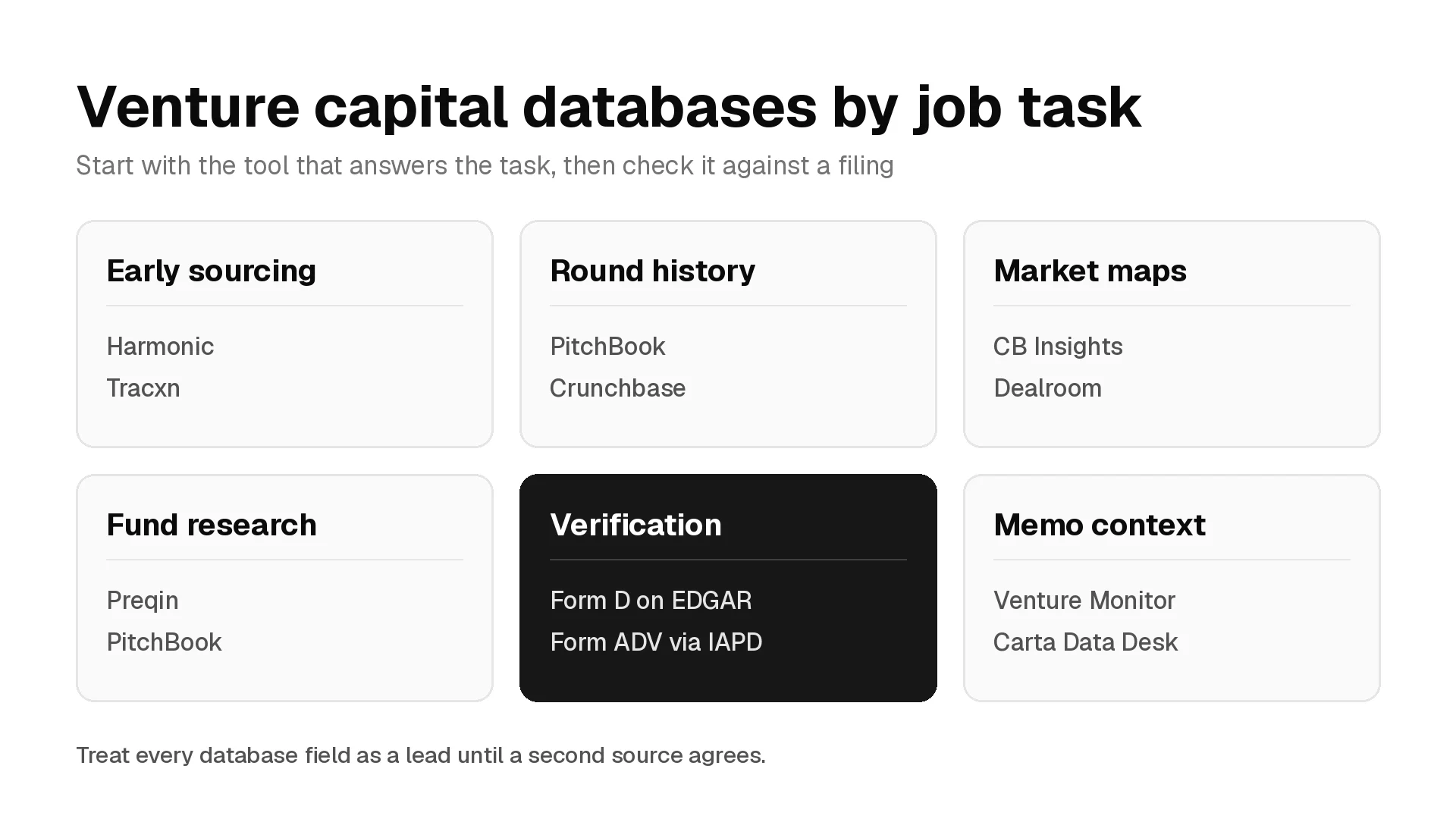
For most venture capital work, PitchBook is the deepest database of private companies, deals, investors and funds, and Crunchbase is the fastest broad lookup of companies and rounds. CB Insights, Dealroom, Tracxn and Harmonic each do one job better than either, and Preqin covers fund and LP data. None of them is the final word. Regulatory filings, the company's own announcements and the people involved are how you confirm a record before it goes into a memo.
Pick the database for the task, not the brand. Sourcing a seed company before it announces a round, mapping a market, checking a company's round history and researching a fund you might join are four different jobs, and the best tool is different for each.
Types of venture capital databases
"VC database" covers four kinds of product. Most mistakes come from using one kind to answer another kind's question.
| Type | What it answers | Examples |
|---|---|---|
| Company and deal databases | Who founded it, who invested, which rounds, how much, when | PitchBook, Crunchbase, Tracxn, Dealroom |
| Market intelligence platforms | Which companies make up a market, who is growing, how a sector is trending | CB Insights, Dealroom, Tracxn |
| Early-signal sourcing tools | Which companies just formed, hired, launched or grew before a round is public | Harmonic, plus alerts inside the larger platforms |
| Fund and LP databases | Which funds a firm has raised, who backed them, how they performed | Preqin, PitchBook |
Founder-facing investor lists such as Signal by NFX and OpenVC are a fifth category. They help founders find investors to pitch. They are not built for an analyst researching companies, though they can show how a firm presents its focus to founders.
The main venture capital databases compared
Access models below are what each vendor's own site offered on 22 October 2026. Prices are not listed: they depend on seats, modules and contract length, and quotes change.
| Database | Best VC use | Strength | Watch for | Access |
|---|---|---|---|---|
| PitchBook | Round history, investors, valuations where reported, fund records | Depth across companies, deals, investors and funds | Cost; academic accounts are limited | Firm licence or university licence |
| Crunchbase | Quick company and round lookups, lists, alerts | Breadth and speed | Thin investor detail; check key fields | Self-serve plans with free trial, or sales |
| CB Insights | Market maps, sector research, company scoring | Market-level analysis and rankings | Built for research, not investor lookup | Free trial or demo |
| Dealroom | Ecosystem and regional mapping | Ecosystem views of startups, investors and rounds | Coverage varies by region | Demo |
| Tracxn | Sector taxonomies and company tracking | Fine-grained sector trees | Taxonomy labels are the vendor's, not the market's | Free sign-up or demo |
| Harmonic | Finding companies before a public round | Signals such as new hires and fresh rounds | Signals need judgment, not just alerts | Demo |
| Preqin | Funds, LPs, benchmarks | Fund-manager and LP coverage | Less useful for company work | Demo |
PitchBook
PitchBook is widely licensed by VC firms, banks, LPs and universities for private-market research. It covers companies, deals, investors and funds, and its fund records make it useful when you need a firm's fund history as well as its portfolio. For a junior investor it is usually the first stop for a company's full round history and cap-table participants. Many universities license it for students, with limits covered below.
Crunchbase
Crunchbase is the fastest way to check who backed a company and roughly when. Its breadth makes it good for building first-pass lists and setting alerts. Treat investor and round fields as leads, not facts, until a second source agrees.
CB Insights
CB Insights is a market-intelligence platform first. It is strongest when the task is "show me every company in this space and how they compare": market maps, sector rankings and company scores. It is weaker as a quick lookup for who sits on a cap table.
Dealroom
Dealroom organizes companies, investors and rounds by ecosystem. It is useful for regional work and for maps that need a country or city view.
Tracxn
Tracxn's draw is its sector taxonomy: deep trees of sub-sectors with the companies in each. That speeds up a first-pass landscape. The labels are Tracxn's own, so rename categories in your work to match how buyers in the market describe them.
Harmonic
Harmonic is built for sourcing. It tracks signals such as a company raising a round or making a key hire, so investors can find companies early. Pair it with your own thesis. A feed of signals without a point of view becomes a list of noise.
Preqin
Preqin, now part of BlackRock, covers fund managers, LPs and benchmarks across alternative assets. In VC it matters most for fundraising, LP and fund-strategy work. It is less relevant to day-to-day company research.
Founder-facing investor lists
Signal by NFX and OpenVC are free tools for founders to find and approach investors. If you are on the investing side, they are worth a look only for how firms and partners describe their own focus.
Which database to use for each VC task
Start with the tool that answers the task, then check the record against a source that does not come from the same vendor.
| VC task | Start with | Cross-check with | Free option |
|---|---|---|---|
| Sourcing companies before a round | Harmonic, Tracxn, Crunchbase alerts | Founder conversation, product, hiring pages | New Form D filings on EDGAR, LinkedIn |
| A company's round history and investors | PitchBook, Crunchbase | Form D, company and investor announcements | Crunchbase free tier, EDGAR |
| Market map or landscape | CB Insights, Tracxn, Dealroom | Company websites, customer conversations | Your own spreadsheet built from the free sources |
| Comps and valuation context | PitchBook | Aggregate medians from published reports | Carta Data Desk, PitchBook-NVCA Venture Monitor |
| Researching a fund or firm | PitchBook, Preqin | Form ADV via IAPD, fund Form D filings, firm site | IAPD, EDGAR, VCC companies directory |
| Fund performance and benchmarks | Preqin, PitchBook | LP reports, the fund's own disclosures | Published benchmark reports |
| Market context for a memo | PitchBook-NVCA Venture Monitor, Carta Data Desk | Company-level evidence from diligence | Both are published openly |
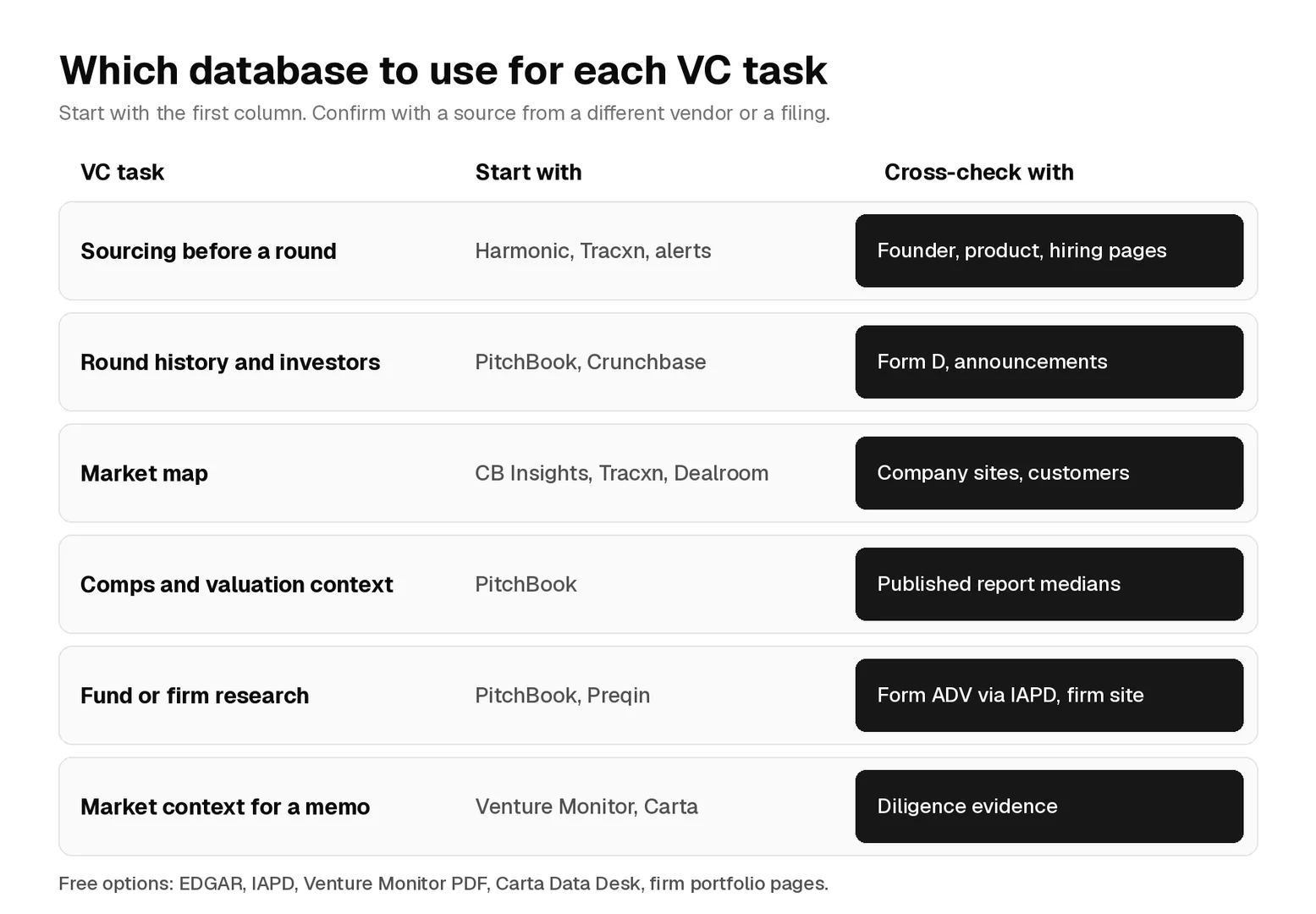
Three notes on the map. For deal sourcing, the database is the start of the work: the edge comes from the thesis and the outreach, not from the list everyone else can export. For a market map, the database gives you names, but the categories have to come from how customers buy. For fund research, read returns with the fund performance metrics in mind: a database shows a TVPI, not whether the marks behind it are realistic.
Free venture capital data sources
You can do serious VC research without a paid seat. The free stack is slower and needs more judgment, but it is often more reliable than a database field because it comes from the company or the regulator.
- Form D on SEC EDGAR. A company selling securities under Rule 504 or Rule 506 of Regulation D must file a Form D notice no later than 15 calendar days after the first sale in the offering. The filing lists related persons such as executive officers and directors, the total offering amount and the amount sold, and it must be amended for material mistakes and certain changes. Search it on EDGAR by company name.
- Form ADV through IAPD. The SEC's Investment Adviser Public Disclosure search shows filings for advisers regulated by the SEC or the states, including many VC managers. It is the fastest free way to check a firm's regulatory status and filing history. See how to read Form ADV for what each part tells you.
- PitchBook-NVCA Venture Monitor. The quarterly report on US venture activity is published as a free PDF; the Q3 2026 edition is the current one. Use it for deal, exit and fundraising context in a memo.
- Carta Data Desk. Carta publishes research on how private companies raise and grow, drawn from its platform. Useful for aggregate context, not company-level facts.
- Firm websites and portfolio pages. The firm's own portfolio page, team page and fund announcements are the primary record of what it says it backs.
- The VCC companies directory. Thousands of VC and investment firms with profiles and open roles, so firm research and job search sit in one place.
What the free stack cannot give you: valuations, full cap tables, company financials, and a clean, searchable history across thousands of companies. That is what a paid seat buys.
How accurate venture capital databases are
Every database is built from some mix of press releases, regulatory filings, company or investor submissions, web signals and analyst research. Each source fails in its own way. Five errors show up again and again:
- Round labels that do not match the documents. A "Series A" in one database is a "seed extension" in another. Stage names are a convention, not a legal term.
- Amounts that mix tranches or notes. A headline number may combine an equity round with earlier SAFEs or notes, or count a tranche that has not closed.
- Undisclosed amounts recorded as zero or left blank. Sorting by amount raised then hides real companies.
- Stale investor lists. A firm that led a round may have sold its stake or stopped following on. A partner listed on a profile may have left.
- Dates that reflect the announcement, not the close. Press timing and legal timing can be months apart.
Form D has limits too. It reports amounts offered and sold, not the valuation. Companies that raise under an exemption that needs no Form D, such as Section 4(a)(2) on its own, do not file one. And one funding round can show up as several filings or amendments.
How to verify a funding round
Before a round goes into a memo, a market map or an interview answer, run four checks. Together they catch most of the errors above.
- Database record. Pull the round from PitchBook or Crunchbase: date, amount, stage, lead, participants.
- Filing. Search EDGAR for the company's Form D. Compare the date of first sale, the amount sold and the related persons. A director on the filing who works at a VC firm often points to the lead or a board-seat investor.
- Announcement. Find the company's or lead investor's own announcement. It confirms the lead and the stage label they use.
- People. Check the partner's profile or the firm's portfolio page, and ask the founder if you are in a process. Write down which sources agree and which do not.
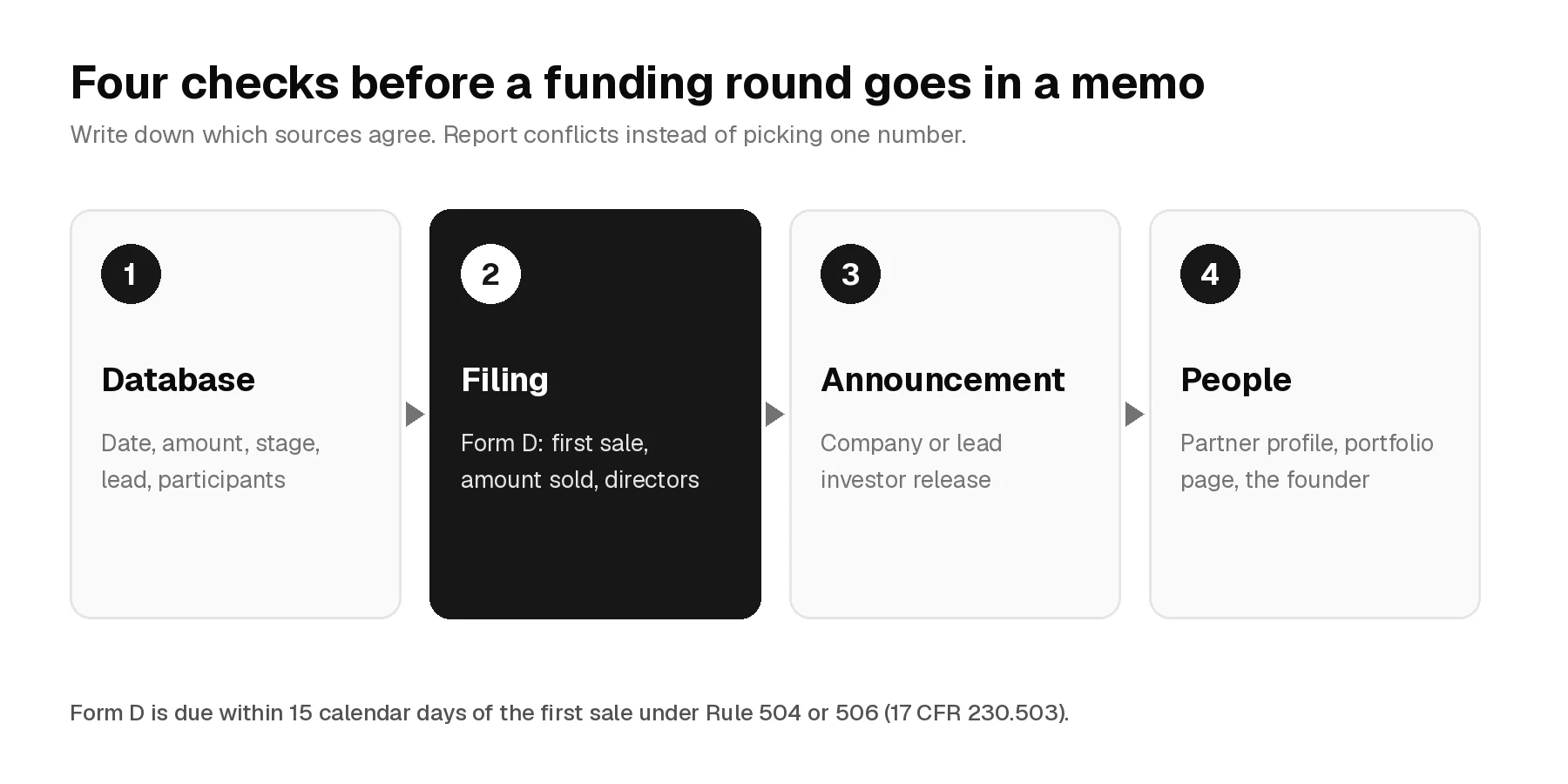
When sources conflict, report the conflict instead of picking the number you like. The same habit carries into due diligence, where every figure in the memo should trace to a document. "Crunchbase shows $12M; the Form D shows $9.5M sold to date" is more useful to a partner than a clean wrong number.
How to choose a venture capital database
If your firm is choosing a database, or you are deciding what to learn first, these questions settle most cases:
- What task takes most of the team's research time? Sourcing, market maps, round history and fund research point to different tools.
- Which stage and region does the firm invest in? Pre-seed coverage and regional coverage vary more between vendors than late-stage US coverage.
- Does the firm need fund and LP data? If not, a fund-data product is wasted spend.
- How many seats, and who uses them? Pricing usually scales by seat. A seat for the analyst doing the work is worth more than one for a partner who logs in twice a quarter.
- Does it connect to the firm's CRM and spreadsheets? Exports and integrations decide whether the data gets used.
- What are the export limits? A tool that blocks the export you need for a market map is the wrong tool.
- Can you trial it on a live task? Run one real research question through two vendors and compare the answers.
Student and academic database access
Many universities license PitchBook for students, and library terms set clear limits. Yale's library describes access as for non-commercial academic research, bans use in offering or soliciting investments, and caps downloads at 10 a day and 25 a month, with one row of Excel data counting as one download. Vanderbilt's library says its licence is for academic, curricular use and not for internships or commercial ventures. PitchBook's own university access guide also lists Fund Returns and IRR among the features student accounts do not include.
What that means for candidates:
- Use a student account to learn the platform, for coursework and for preparing for interviews about markets you study.
- Do not use it for work you do for a firm, including an internship. Ask the firm for its own access.
- For a take-home case, ask the firm what data it expects you to use. If it says "public sources only," the free stack above is the answer.
- Access usually ends when you graduate, so do not plan a job search around it.
Databases in VC recruiting and the junior job
Interviewers rarely ask which database you prefer. They ask how you would find companies, how you checked a number, or how you built a map. Database fluency shows up in the answer.
In a take-home case. Name your sources in a footnote, flag every figure you could not confirm, and show one cross-check. A case that says "Series A amount per Crunchbase; Form D shows the same company sold a lower amount to date" signals the habit firms want. See the case study interview guide for the rest of the structure.
On a resume. Name the output, not the tool. For example, "Built a 140-company climate software map from PitchBook and company sites; three companies sourced into partner meetings" beats "Proficient in PitchBook, Crunchbase." The VC resume guide has more line examples.
In an interview answer on sourcing. A strong answer covers the thesis first, then the tools, then how you got the meeting. For example: "I would start from the thesis, pull companies with a recent senior engineering hire and no announced round from a signals tool, check the founders' backgrounds, and reach out with a specific point about their product. The database gets me the list. The outreach gets me the meeting."
On the job. Much of the junior research work runs through these tools: building lists for partners, checking rounds before IC and updating market maps. The analyst day in the life shows where that work fits. Before you accept an offer, ask which databases the firm pays for and who gets a seat. It tells you how the firm sources and how much of the research it expects you to do by hand.
If you are researching firms to apply to, start with the VCC companies directory, then check open roles on the VC job board. You can set up job alerts for new analyst and associate postings.
FAQ
What is the best venture capital database?
For most VC work, PitchBook is the deepest single database and Crunchbase is the fastest broad one. CB Insights is stronger for market maps, Harmonic for early sourcing signals and Preqin for fund and LP data. The best choice depends on the task.
Is PitchBook or Crunchbase better for VC analysts?
PitchBook for full round histories, investors, valuations where reported and fund records. Crunchbase for quick lookups, first-pass lists and alerts. Many analysts use both and check either one against filings.
Are there free venture capital databases?
Yes. SEC EDGAR (Form D), the SEC's IAPD adviser search, the PitchBook-NVCA Venture Monitor, Carta Data Desk research, firm portfolio pages and the VCC companies directory are all free. Crunchbase also offers a free trial.
How accurate is Crunchbase or PitchBook data?
Good enough to start research, not good enough to put in a memo unchecked. Round labels, amounts, dates and investor lists are the fields that most often need a second source such as a Form D filing or the company's own announcement.
Can I use my university's PitchBook account for an internship?
Usually not. University licences are typically limited to academic, non-commercial use, and some libraries name internships as excluded. Ask the firm for its own access.
How do I research a VC firm before an interview?
Read the firm's portfolio and team pages, check its Form ADV through IAPD, look up recent fund announcements and Form D filings, and review its profile and open roles in the VCC companies directory. Then read the partners' public writing on the sectors you will discuss.
Related posts
Venture capital due diligence is how a VC firm tests a startup before investing. The average deal takes 83 days to close and 118 hours of diligence. Process, checklist, red flags, and timing by stage.
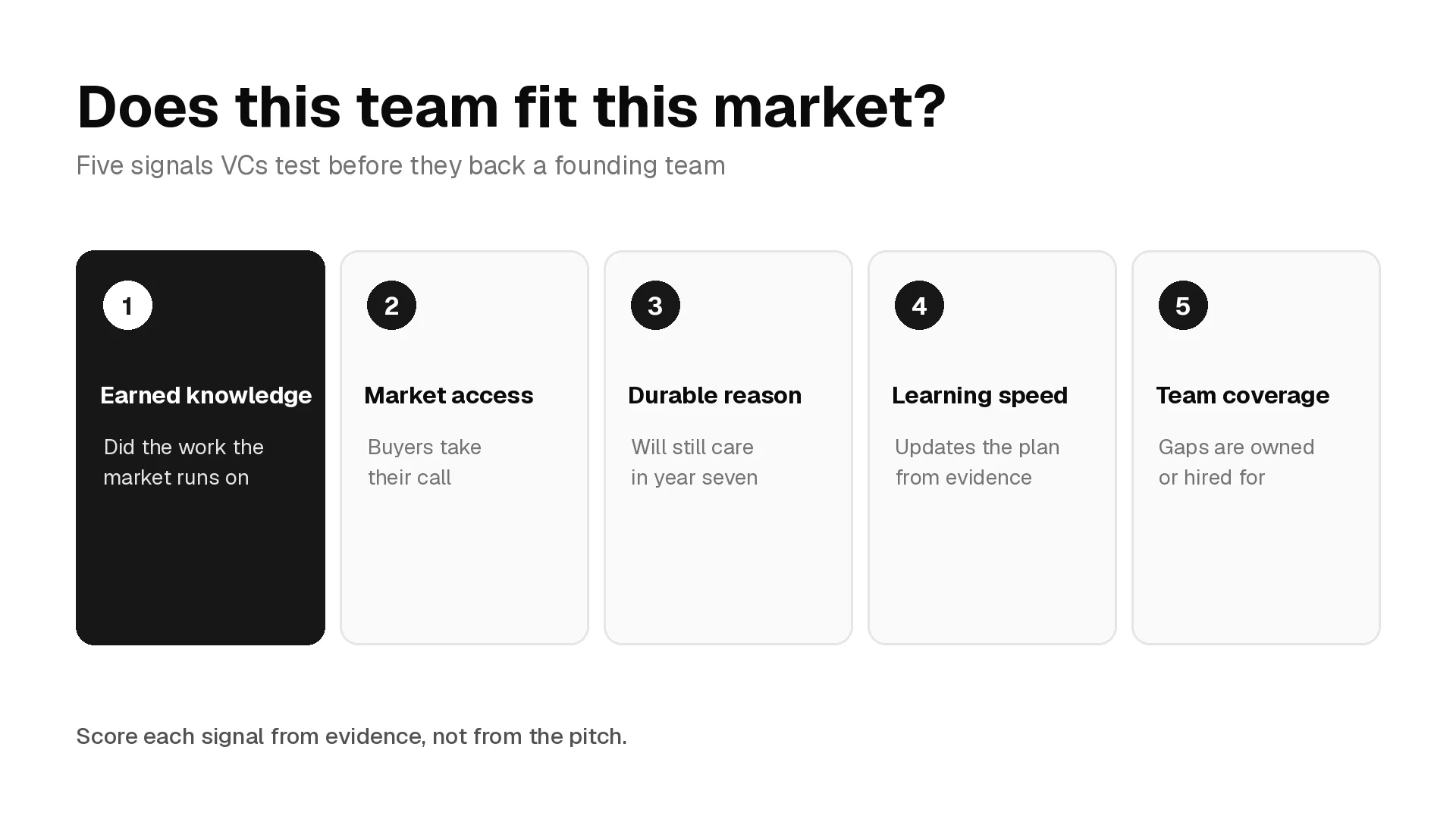
Founder-market fit is the match between what a founding team knows, can access and cares about, and what its market demands. How VCs weigh it, test it with evidence, score it, and write it into a memo or interview answer.
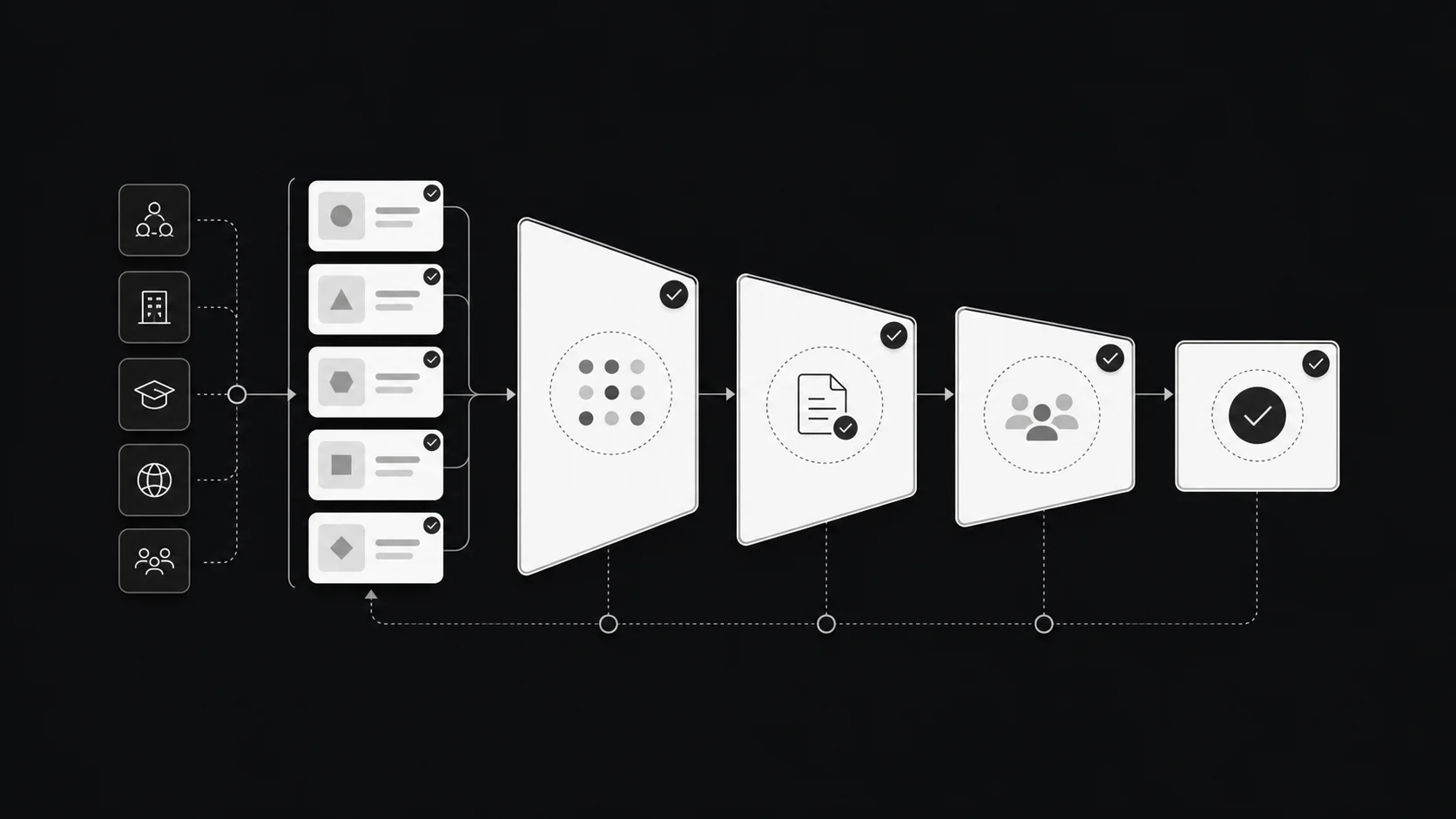
Deal flow is the stream of investment opportunities a venture firm receives and the funnel that sorts them. For every deal closed, firms consider about 101 companies.