
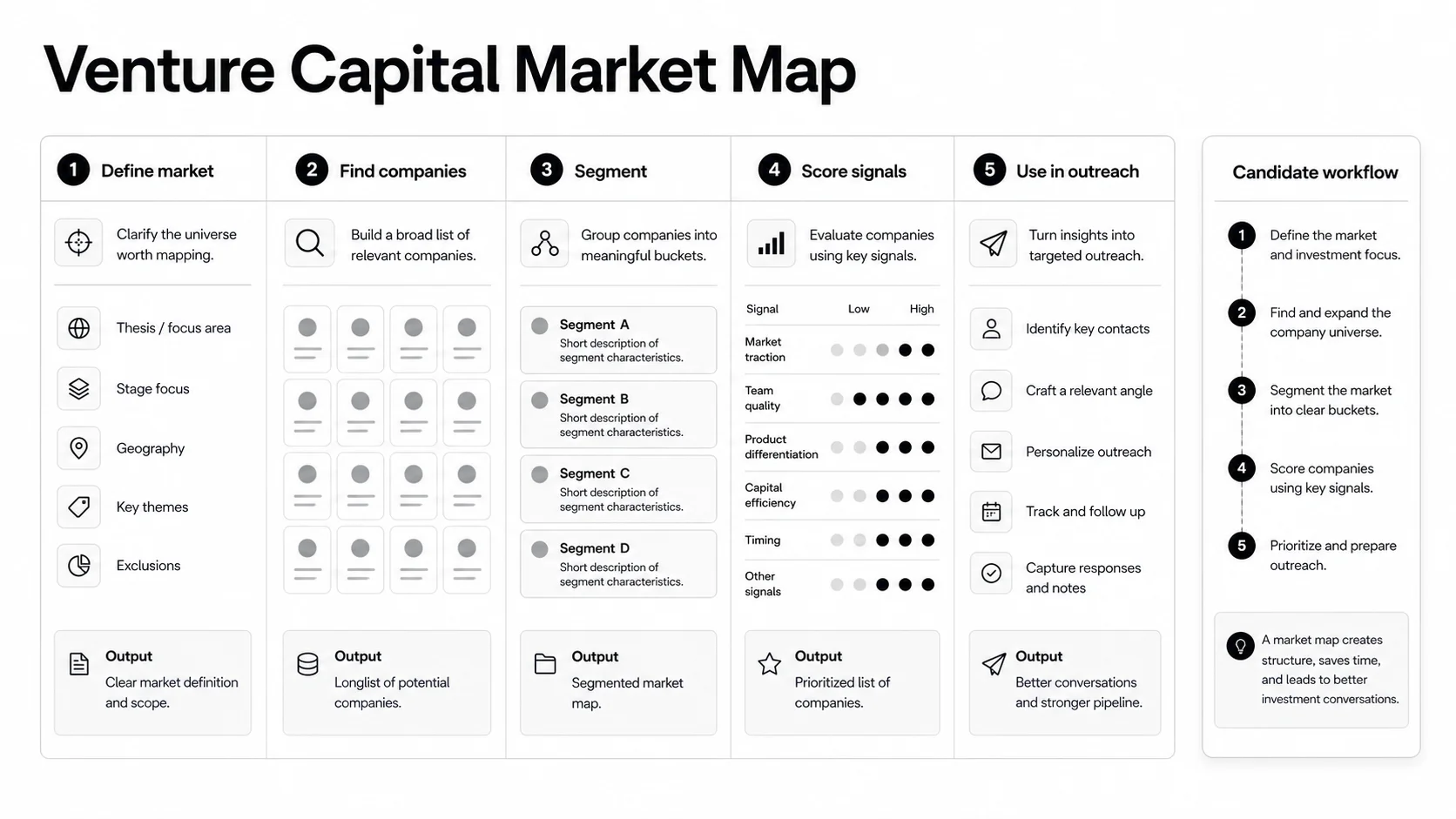
A venture capital market map is a structured view of the companies, segments, and signals inside a market. Good maps help investors understand where value is forming, which companies matter, and where a firm might have a sourcing or thesis advantage.
For VC candidates, a market map is also one of the best proof-of-work exercises you can create. It shows that you can define a sector, find relevant companies, organize them intelligently, and turn research into a point of view. That is more useful than sending a generic note saying you are interested in venture capital.
What a venture capital market map is
A venture capital market map organizes a sector into useful categories so an investor can see the competitive landscape. It can be a spreadsheet, a Notion database, a slide, a Miro board, or a simple table. The format matters less than the thinking behind it.
The map should answer five questions:
- What market are we actually studying?
- Which companies belong in the universe?
- How should those companies be segmented?
- Which companies look most interesting, and why?
- What should we do next: source, monitor, interview, or ignore?
The common mistake is treating a market map as a logo collage. A polished slide with 80 startup logos can still be useless if the categories are vague, the company list is stale, or the map does not lead to a decision.
When to build a VC market map
Build a market map when you need to make sense of a sector before you have perfect information. In venture capital, that happens often.
For a candidate, a market map is useful before a networking call, a case-study interview, or a targeted application. It gives you something specific to discuss beyond your resume. For a junior investor, it can support thesis development, sourcing, diligence preparation, and partner meeting discussion. For a startup operator moving into VC, it can translate operating knowledge into investor-style research.
The map does not need to be exhaustive. It needs to be decision-useful. A focused map of 30 well-chosen companies with clear segmentation is usually better than a messy list of 300 companies.
Step 1: define the market before collecting companies
Start with scope. If the market is too broad, every later step gets noisy.
Use a working definition like this:
| Scope field | What to decide | Example |
|---|---|---|
| Category | What problem or workflow is the market about? | AI sales development tools |
| Customer | Who buys or uses the product? | B2B sales teams at software companies |
| Stage | Which company maturity matters? | Seed to Series B |
| Geography | Which market matters for the question? | US and Europe |
| Business model | Which models are included or excluded? | SaaS, usage-based software, services-enabled software |
| Exclusions | What looks adjacent but does not belong? | Generic CRM, outsourced lead-gen agencies |
Write the exclusions clearly. Exclusions are not busywork. They protect the map from becoming an everything list.
If you are building the map for a VC interview, choose a market where you can explain why it matters now. The reason might be new technology, budget movement, regulation, founder activity, customer pain, or a shift in distribution. A market map without a timing argument is just a taxonomy.
Step 2: build the company universe
After scope, collect companies. Do not start with categories yet. First build the universe.
Useful sources include:
- VC portfolio pages in the sector.
- Accelerator batches and demo day lists.
- Product Hunt, GitHub, app marketplaces, and review sites where relevant.
- Customer communities, founder posts, and industry newsletters.
- Funding databases or startup directories if you have access.
- Search queries that combine the problem, customer, and product category.
For each company, capture a minimum set of fields:
| Field | Why it matters |
|---|---|
| Company name | Basic identifier |
| Website | Source for product positioning |
| Segment hypothesis | Initial bucket before cleanup |
| Customer | Shows who the product is built for |
| Stage or funding signal | Helps separate early experiments from scaled players |
| Key proof point | Traction, customers, hiring, product depth, or founder credibility |
| Why it matters | One sentence explaining relevance |
Do not spend hours perfecting logos at this stage. Logos can make the final slide readable, but they do not make the research better. Build the company list first; polish the visual only after the logic works.
Step 3: segment the market
Segmentation is where the market map becomes useful. The goal is not to find clever labels. The goal is to group companies in a way that helps an investor see where competition, whitespace, and momentum sit.
Common segmentation patterns include:
- Job to be done: what workflow the product handles.
- Customer type: SMB, mid-market, enterprise, developer, finance team, clinical buyer.
- Business model: SaaS, marketplace, infrastructure, data network, services-enabled software.
- Product layer: data, workflow, automation, analytics, compliance, distribution.
- Maturity: emerging, scaling, incumbent, adjacent entrant.
- Wedge: the narrow entry point the company uses before expanding.
Test each segment by asking: would this bucket help a partner decide which companies to meet, which thesis to explore, or which question to ask in diligence? If the answer is not clear, the bucket is probably decorative.
Step 4: score the companies
Once the map is segmented, add a scoring layer. This does not need to be a complex model. A simple 1 to 3 or low/medium/high score is enough if the criteria are clear.
Useful VC market-map signals include:
| Signal | What to look for |
|---|---|
| Market traction | Customer adoption, usage, revenue clues, community pull, or visible demand |
| Team quality | Founder-market fit, prior company experience, technical depth, or unusual insight |
| Product differentiation | Clear wedge, defensibility, workflow depth, or data advantage |
| Capital efficiency | Ability to make progress without relying only on large funding rounds |
| Timing | Why this market should matter now rather than five years ago |
| Fit with fund | Stage, geography, check size, sector focus, and portfolio adjacency |
The score is not meant to pretend you have perfect diligence. It is meant to help you prioritize. If two companies sit in the same segment, the scoring layer should make clear which one deserves outreach, deeper research, or a mention in an interview.
Step 5: turn the map into sourcing and interview material
A market map should produce an output. Otherwise, it becomes research theater.
For sourcing, the output is a prioritized list of companies and reasons to contact them. A weak reason is "interesting AI company." A better reason is "early-stage workflow automation company selling to revenue teams, strong founder-market fit, and positioned in a segment where most incumbents are horizontal."
For interviews, the output is a point of view. You should be able to explain:
- how you defined the market;
- which companies you included and excluded;
- which segments look crowded;
- where the most interesting whitespace appears;
- which company you would research further;
- what you would ask the founder or customer next.
For networking, the output is a specific conversation starter. If a firm invests in developer tools, fintech, AI infrastructure, healthcare software, or climate, send a concise note that references a market you mapped and one question you are still trying to answer. That is much stronger than asking for a general coffee chat.
Market map quality checklist
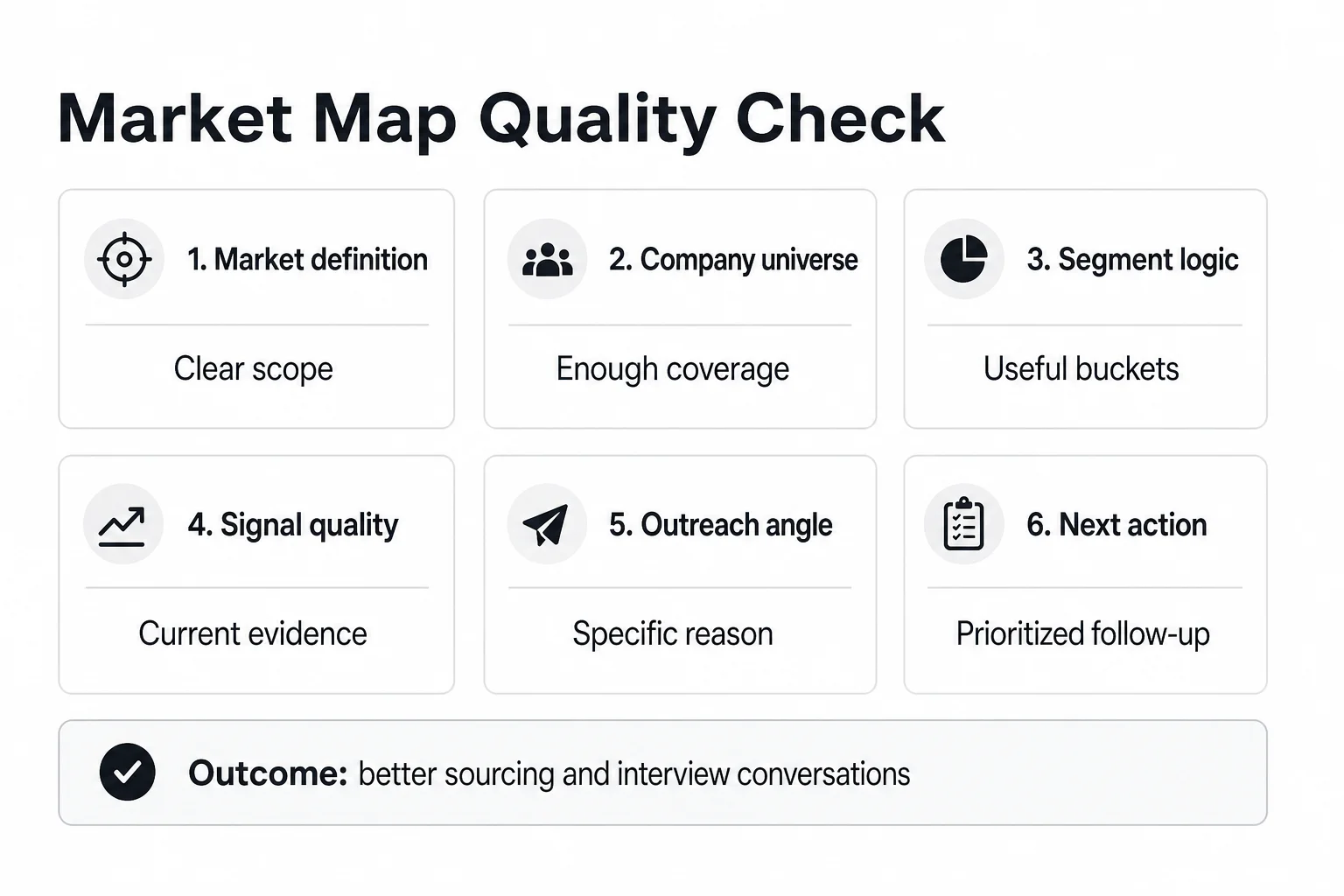
Before you share a market map, check it against six standards.
| Check | Pass condition |
|---|---|
| Clear scope | The category, customer, stage, geography, and exclusions are explicit. |
| Enough coverage | The map includes enough companies to make patterns visible. |
| Useful buckets | Segments help the reader compare companies and make decisions. |
| Current evidence | Company status, funding, hiring, and positioning are reasonably current. |
| Specific angle | The map supports a thesis, sourcing path, or interview answer. |
| Next action | The reader knows which companies to source, monitor, or research next. |
If the map fails one of these checks, revise the research before polishing the slide.
Common mistakes when building a VC market map
The first mistake is starting with a slide template instead of a question. The map should answer a specific question, not just fill a rectangle with logos.
The second mistake is using categories that sound smart but do not change the decision. If every company could plausibly sit in three different boxes, the segmentation is not doing enough work.
The third mistake is confusing funding with quality. Funding can be a useful signal, but it is not the same as customer love, product depth, or market timing.
The fourth mistake is ignoring fund fit. A great company can still be irrelevant to a specific fund if the stage, geography, check size, or thesis does not match.
The fifth mistake is overbuilding the model. A market map is not a full investment memo. If the map becomes a spreadsheet with 40 fields nobody can explain, simplify it.
How VCC readers can use the workflow
Use Venture Capital Careers as the research layer around your market map.
Start with the VC companies directory to identify firms that invest in the market you are studying. Then use the VC job board to see which roles mention sourcing, market research, thesis development, portfolio support, or sector coverage. If you want to keep tracking relevant roles, use candidate sign-up.
If you are preparing for interviews, pair the market map with the VC case study interview guide and the venture capital investment memo guide. If you are using the map for outreach, connect it to the venture capital networking guide and the venture capital deal sourcing guide.
For broader role context, read the venture capital career path guide before deciding whether your market map should position you for analyst, associate, platform, operating, or portfolio-focused roles.
FAQ
How many companies should be in a VC market map?
There is no fixed number. For candidate proof of work, 30 to 80 relevant companies is often enough. For a serious internal sourcing project, the universe may be larger. Quality matters more than count: the map should reveal segments, patterns, and priorities.
Should a VC market map be a spreadsheet or a slide?
Use both if needed. A spreadsheet is better for research, fields, filtering, and scoring. A slide is better for communicating the final landscape. Build the spreadsheet first, then make the slide after the segmentation and priorities are clear.
What makes a market map impressive in a VC interview?
The best interview market maps show judgment. They define scope, explain exclusions, segment companies logically, identify interesting companies, and connect the research to a thesis or sourcing action. A beautiful slide without a point of view is less impressive than a simple table with sharp reasoning.
Can I use public VC market maps as examples?
Yes, but treat them as reference material rather than templates to copy. Public maps show how investors frame sectors, but your map should reflect your own question, scope, and segmentation logic.
How often should a market map be updated?
Update it when the market changes or when you plan to use it. For fast-moving categories, review the company list, funding signals, hiring signals, and positioning before any interview, outreach campaign, or investment discussion.
Build a map that leads to action
A strong venture capital market map is not just a visual. It is a thinking tool.
Define the market tightly, build a credible company universe, segment it in a way that supports decisions, score companies with clear signals, and turn the work into sourcing, interview, or networking action. That is how a market map becomes useful proof that you can think like an investor.
Related posts
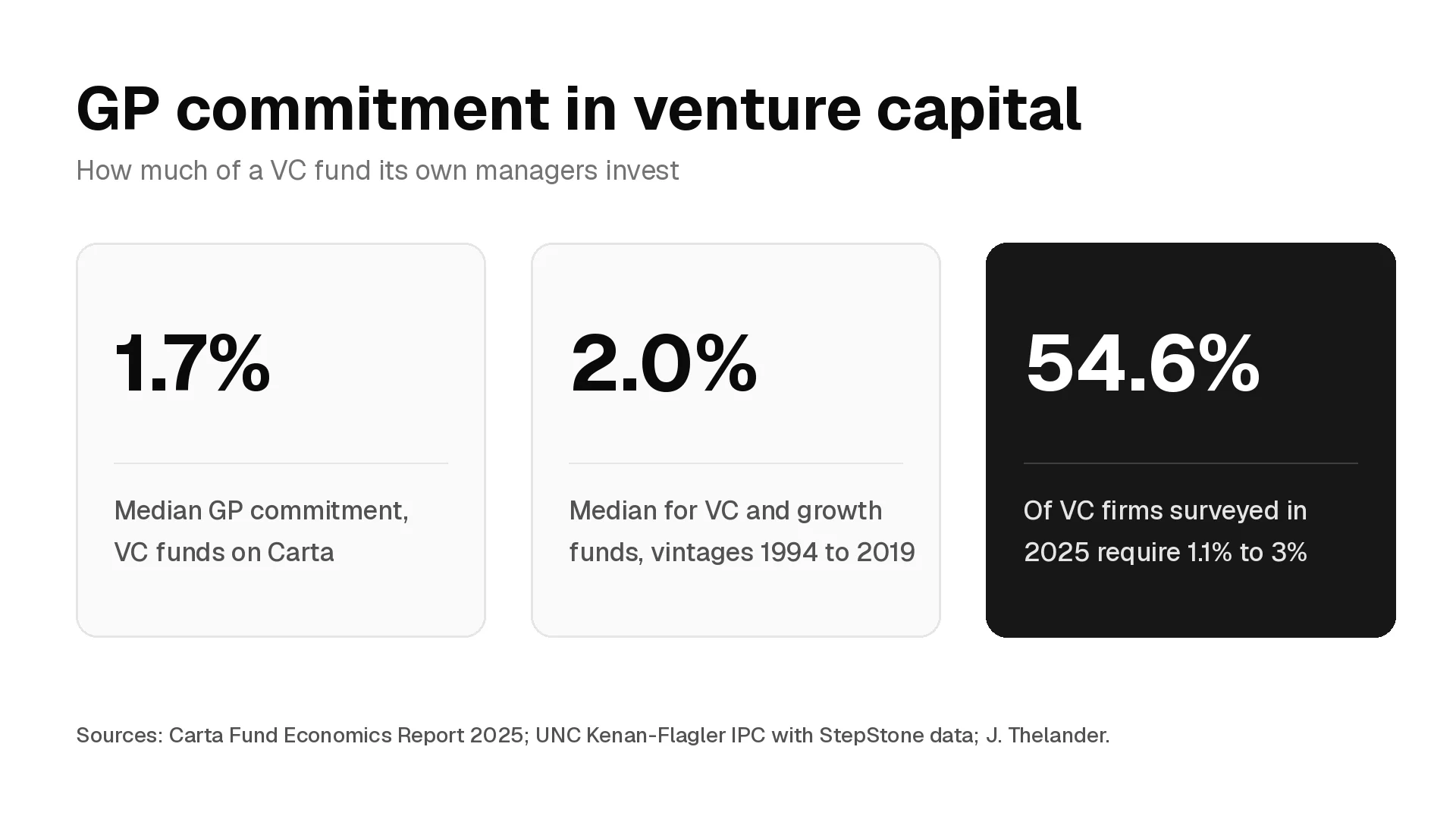
What a GP commitment is, how large it is in venture capital, how GPs fund it, where it sits in the LPA, what the returns evidence says, how firms split it across partners and principals, and what to ask before you accept a role with carry.
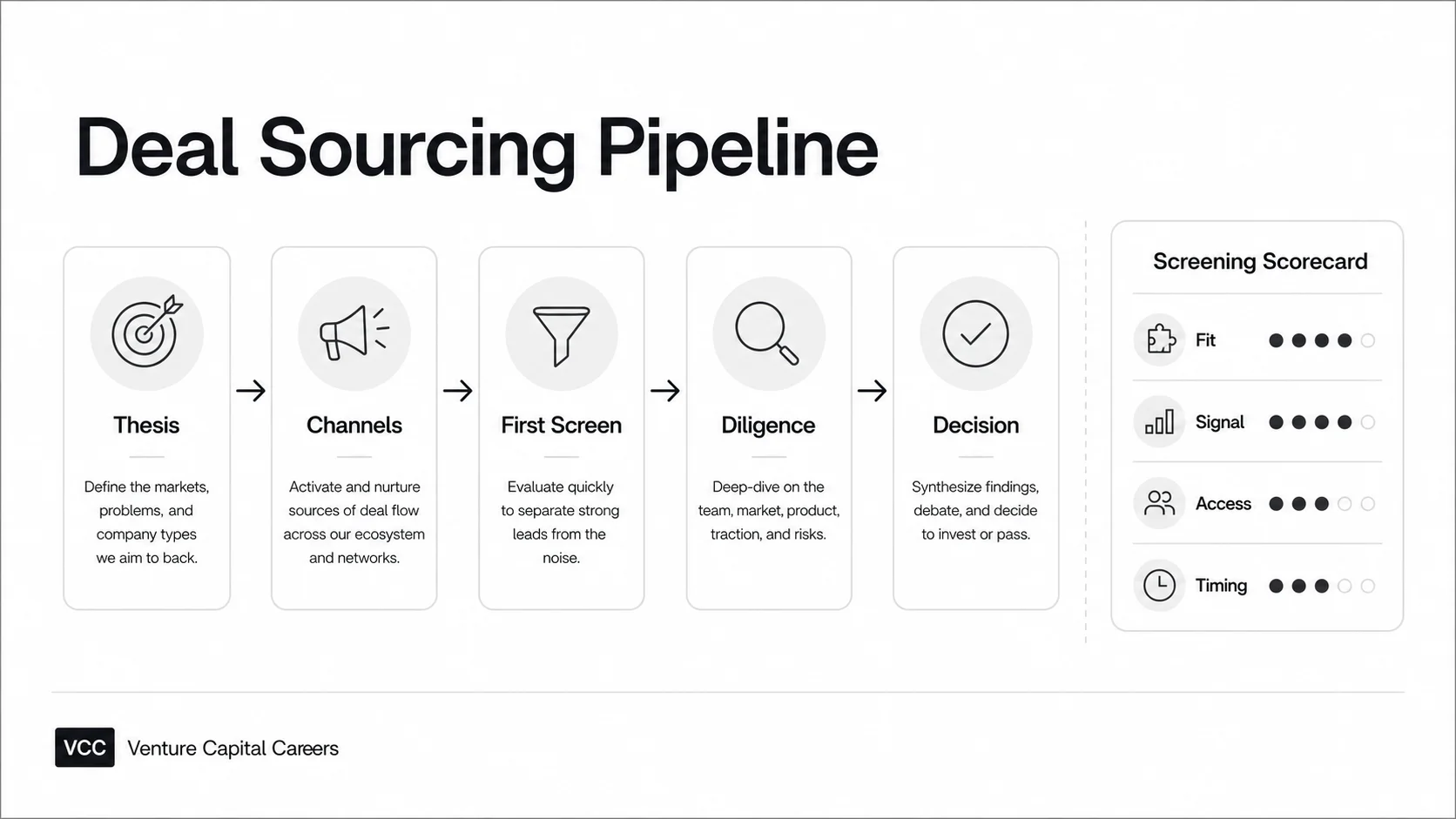
Most closed VC deals start with a relationship. See where deals come from by stage, how to work each sourcing channel, which signals show up early, and how analysts run a weekly sourcing process.
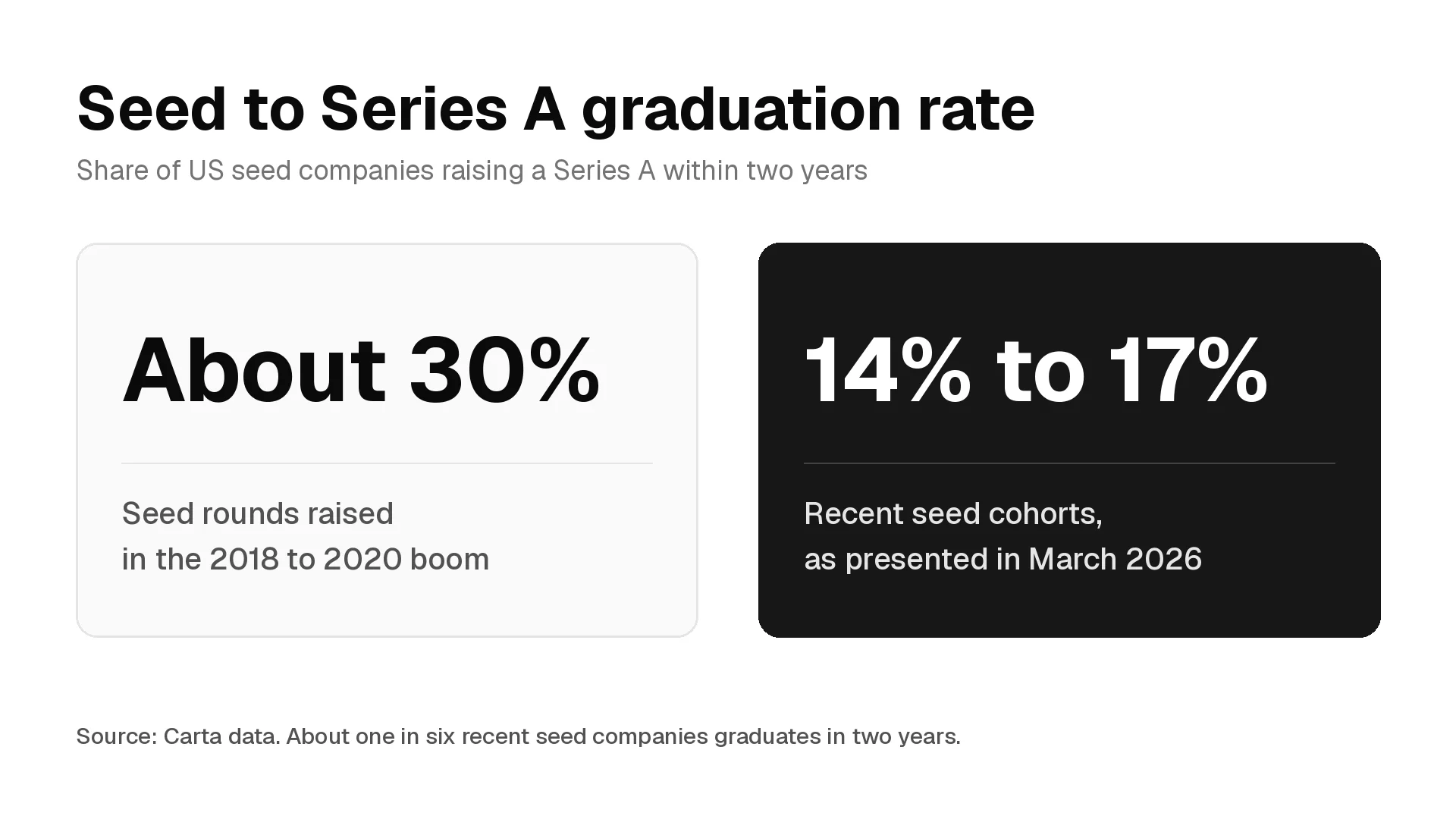
Seed to Series A graduation rates by cohort from Carta and Crunchbase, how long the jump takes, why rates fell after 2021, why published figures disagree, and how seed and Series A firms use the rate for reserves, LP reporting, portfolio reviews and interviews.