Venture Capital Analyst Job Description: Responsibilities, Skills, and Template
Use this venture capital analyst job description template to define the role, responsibilities, skills, interview process, and candidate profile for a VC firm.
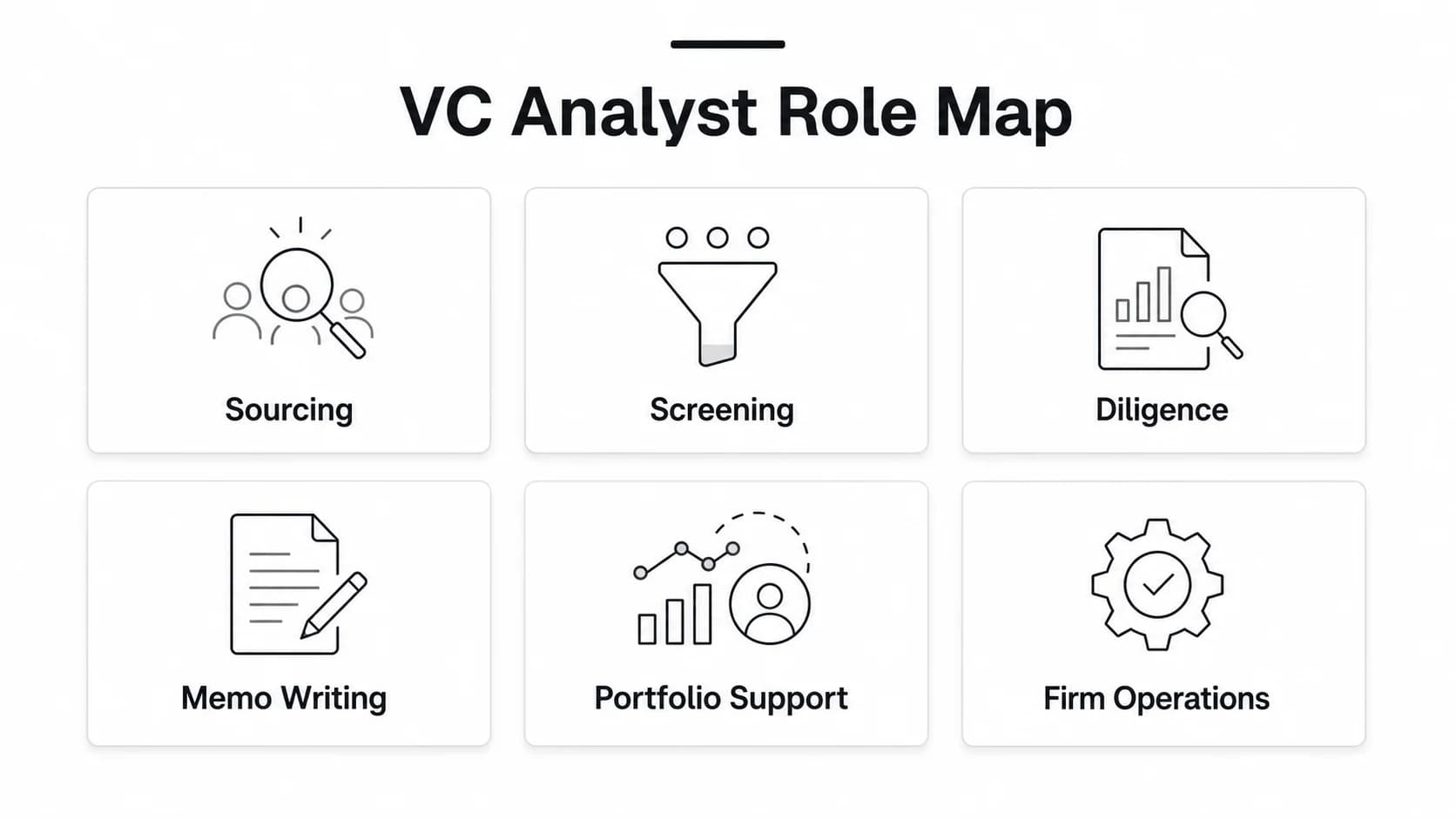
A venture capital analyst helps a VC firm find, evaluate, and support startup investments. The role usually combines market research, deal sourcing, founder outreach, diligence support, investment memo writing, financial analysis, and portfolio-company tracking. At some funds, the analyst is mostly a sourcing engine. At others, the analyst is a junior investor who supports every step from first screen to investment committee.
For candidates, the job description tells you what the fund actually values: network building, analytical judgment, startup fluency, sector depth, or execution support. For employers, it is the document that turns a vague "hire a smart junior investor" plan into a role candidates can understand.
If you are hiring, you can post the role on Venture Capital Careers. If you are applying, browse open VC roles on the Venture Capital Careers job board.
What a venture capital analyst does
A VC analyst is a junior member of the investment team. The analyst's job is to increase the firm's coverage of founders, markets, and potential investments while helping senior investors make better decisions.
The exact role depends on the fund:
| Fund type | Analyst emphasis | What the job description should make clear |
|---|---|---|
| Pre-seed or seed fund | Sourcing, founder calls, market maps, thesis development | Whether the analyst is expected to originate deals and build founder relationships |
| Series A or multi-stage fund | Screening, diligence, competitive research, memo support | How much of the role is sourcing versus investment analysis |
| Growth-stage fund | Financial analysis, cohort data, market sizing, deal execution | Modeling expectations and data-room fluency |
| Sector specialist fund | Technical market research, expert calls, sector theses | Required domain knowledge and technical credibility |
| Platform-heavy fund | Portfolio support, talent/revenue research, founder resources | Whether the analyst supports portfolio projects as well as new investments |
The strongest job descriptions are specific about this split. "Analyze startups" is too vague. "Build market maps, screen 30-50 inbound companies per month, support diligence on two to four active deals, and draft memo sections for investment committee" gives candidates a much clearer picture.
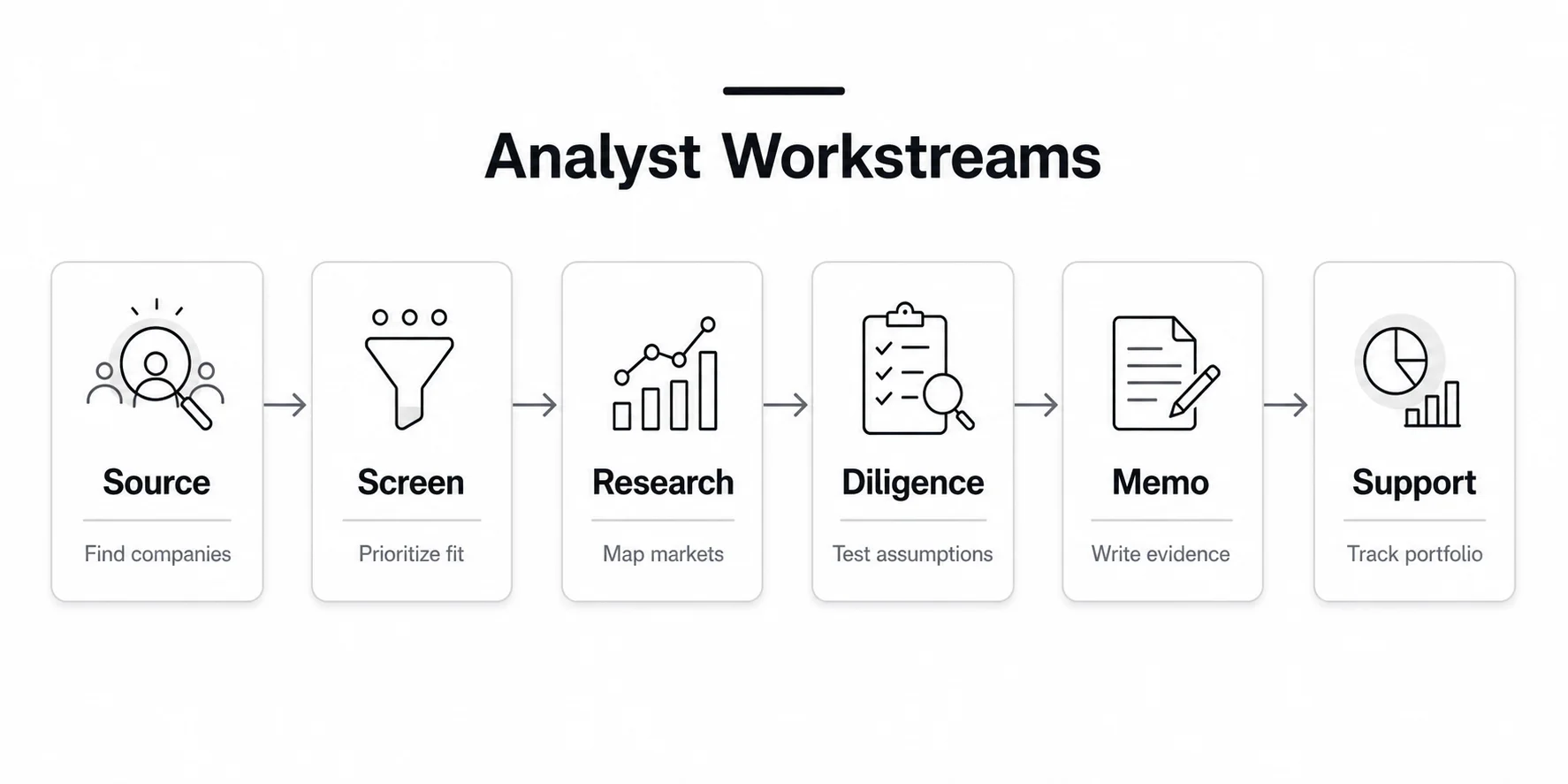
Venture capital analyst responsibilities
Use responsibilities that reflect the fund's actual operating model. A small seed fund and a late-stage growth platform should not publish the same analyst role.
| Workstream | Responsibilities to include | What strong performance looks like |
|---|---|---|
| Deal sourcing | Build market maps, identify promising startups, track founder activity, attend events, maintain CRM hygiene, surface warm-introduction paths | The analyst consistently adds relevant companies to the pipeline, not just raw volume |
| Initial screening | Review pitch decks, evaluate traction, summarize business models, compare competitors, flag fit against fund strategy | Partners can quickly decide whether to take a first call |
| Market research | Map sectors, estimate market size, track funding activity, identify customer segments, monitor emerging categories | Research leads to sharper theses and better founder questions |
| Diligence support | Prepare diligence questions, review data rooms, analyze customer and competitor signals, synthesize risks | The team gets a clearer yes/no view before investment committee |
| Financial analysis | Build or review basic operating models, cap tables, valuation scenarios, cohort metrics, and unit economics | Analysis explains the investment question instead of producing spreadsheet noise |
| Investment memos | Draft company overview, market, product, team, traction, competition, risks, and recommendation sections | Memo writing is concise, evidence-led, and decision-oriented |
| Portfolio support | Track portfolio updates, prepare board or LP reporting inputs, research hiring and go-to-market questions | Founders and partners get useful follow-through after the investment |
| Firm operations | Maintain pipeline notes, prepare weekly investment meetings, update dashboards, support events or community programs | The investment process is easier to run because the analyst keeps information clean |
Link the responsibility list to the role's seniority. If the analyst will own first calls, say so. If the analyst only prepares research for partners, say that too. Candidates can handle demanding roles; they are more likely to self-select correctly when the expectations are explicit.
VC analyst vs associate
Titles vary by firm, but analyst and associate are not always interchangeable.
| Dimension | VC analyst | VC associate |
|---|---|---|
| Typical seniority | Entry-level or early-career investment team role | More experienced junior investor, often post-banking, consulting, startup, or MBA |
| Core work | Research, sourcing support, screening, memo sections, pipeline operations | Sourcing ownership, diligence workstream leadership, deal execution support |
| Founder exposure | Often participates in first calls or supports follow-up | More likely to run founder calls and manage diligence streams |
| Decision influence | Builds evidence for senior investors | Helps shape recommendation and investment committee discussion |
| Hiring bar | High potential, analytical ability, startup fluency, communication | Proven investment judgment, stronger pattern recognition, more independent execution |
If your fund uses "analyst" for a role that is actually associate-level, make that clear in the qualifications and responsibilities. Otherwise, you may attract candidates who are either too junior for the seat or too senior for the compensation and scope.
Candidates comparing role levels should also read the broader venture capital career path before applying.
Skills and qualifications to include
A VC analyst job description should separate must-have requirements from nice-to-have signals. Overloading the role with every possible background narrows the candidate pool without necessarily improving quality.
Required skills
- Market research: ability to map a sector, identify competitors, understand customer pain, and explain why a market might become venture-scale.
- Analytical judgment: ability to turn incomplete startup data into a clear view of upside, risk, and what must be true.
- Written communication: ability to write concise notes, founder summaries, and investment memo sections.
- Founder-facing communication: comfort with outreach, first calls, follow-up questions, and professional relationship building.
- Financial fluency: basic understanding of revenue models, unit economics, cap tables, valuation, and funding rounds.
- Startup curiosity: habit of following new companies, products, categories, and founder networks before being asked.
- Operating discipline: ability to maintain CRM records, meeting notes, research docs, and pipeline updates without losing detail.
Preferred qualifications
- Investment banking, consulting, private equity, growth equity, startup, product, strategy, data, or sector-specific experience.
- Evidence of startup research, angel/scout activity, founder community involvement, or sector thesis work.
- Experience with financial modeling, market sizing, cap tables, cohort analysis, or customer research.
- Technical or sector fluency if the fund invests in areas such as AI, healthcare, climate, fintech, cybersecurity, or deep tech.
- MBA or graduate degree only if the role genuinely requires it. Many analyst roles should not require an MBA.
Evidence candidates can show
Good candidates often prove fit through work samples rather than credentials alone:
- A market map for a sector the fund cares about.
- A short investment memo on a startup.
- A founder outreach note that shows judgment and relevance.
- A teardown of a product, pricing model, or go-to-market motion.
- A resume that shows sourcing, research, analysis, and startup exposure.
For application materials, point candidates to the VC analyst resume guide and VC analyst cover letter guide.
Venture capital analyst job description template
Use this template as a starting point, then replace the placeholders with your fund's stage, sector, location, compensation, and process. The best version should sound like your firm, not like a generic finance posting.
About the firm
`[Firm name]` is a venture capital firm investing in `[stage]` companies across `[sectors/geographies]`. We partner with founders building `[types of companies or markets]` and support them across fundraising, hiring, go-to-market, product strategy, and company-building decisions.
About the role
We are hiring a Venture Capital Analyst to join our investment team. You will help identify promising startups, build market maps, evaluate companies, support diligence, and prepare investment materials for the partnership. This role is suited to someone who is intellectually curious, analytically rigorous, founder-aware, and excited to build judgment in early-stage or growth-stage investing.
Responsibilities
- Source and screen startups that fit our investment strategy.
- Build market maps and sector research on priority themes.
- Review pitch decks, founder updates, financial data, and product materials.
- Prepare first-pass company summaries and investment memo sections.
- Support diligence through market, customer, competitor, team, product, and financial analysis.
- Track deal pipeline activity and maintain clean CRM notes.
- Join founder calls and prepare follow-up questions for senior investors.
- Monitor portfolio company updates and support reporting or research projects.
- Help prepare investment committee materials, weekly deal meetings, and thematic research.
Required qualifications
- Strong written and verbal communication.
- Demonstrated interest in startups, technology, company building, or venture capital.
- Ability to synthesize messy information into clear recommendations.
- Comfort with spreadsheets, market research, and basic financial analysis.
- Strong attention to detail and follow-through.
- Ability to build relationships with founders, operators, investors, and internal team members.
- Work authorization and location expectations: `[insert details]`.
Preferred qualifications
- Experience in venture capital, startups, investment banking, consulting, private equity, growth equity, product, strategy, or a relevant technical field.
- Evidence of sector research, deal sourcing, angel/scout activity, founder community involvement, or investment writing.
- Experience with market sizing, financial modeling, cap tables, cohort analysis, or data-room review.
- Sector knowledge in `[priority sectors]`.
- Familiarity with tools such as CRM systems, spreadsheets, financial databases, data rooms, and research platforms.
Compensation and benefits
Include a concrete salary range where legally required or where transparency helps candidate quality. Clarify bonus, carry participation, healthcare, retirement benefits, learning budget, travel expectations, remote/hybrid policy, and any portfolio-company exposure. If carry is not available at the analyst level, say so plainly rather than implying it.
Example:
- Salary range: `[range and currency]`
- Bonus: `[eligible / not eligible / discretionary]`
- Carry: `[eligible / not eligible / considered at later levels]`
- Location: `[office / hybrid / remote expectations]`
- Travel: `[expected frequency]`
- Benefits: `[healthcare, retirement, parental leave, learning, events, other]`
Hiring process
- Introductory conversation with the hiring manager or recruiting lead.
- Investment team interview focused on background, startup interest, and fund fit.
- Work sample, case study, market map, or short investment memo.
- Partner interview focused on judgment, communication, and long-term fit.
- References and offer process.
Link candidates to relevant preparation resources, such as VC interview questions and venture capital skills.
Application instructions
Ask candidates for only what you will actually review. A focused process might include:
- Resume or LinkedIn profile.
- Short note explaining interest in the fund.
- One startup, market, or thesis the candidate finds compelling and why.
- Optional writing sample or investment memo.
If you are ready to recruit, post the role on Venture Capital Careers, a VC-specific job board for candidates already looking for investment and platform roles.
How to calibrate the role before posting
Before publishing the job, answer these questions internally:
| Calibration question | Why it matters |
|---|---|
| Is this role primarily sourcing, diligence, portfolio support, or research? | Candidates need to know how success will be measured. |
| What stage does the fund invest at? | Seed and growth analysts do different work. |
| Which sectors matter most? | Sector-specific funds should say whether domain fluency is required. |
| Will the analyst speak with founders directly? | Founder exposure changes the seniority and communication bar. |
| How technical is the financial analysis? | A light screening role and a late-stage modeling role need different profiles. |
| Who will manage the analyst? | Candidates should understand whether they report to a partner, principal, associate, or platform lead. |
| What does success look like in 90 days? | This forces the team to define practical expectations. |
| Is there a path to associate? | Analyst candidates care about progression, even if promotion is not guaranteed. |
A vague job description attracts broad interest but creates noisy applications. A specific one may reduce volume while improving fit.
Hiring process for a VC analyst
The interview process should test judgment, communication, and work quality without asking candidates to complete unpaid consulting projects for the fund.
Use a practical sequence:
- Screen: confirm motivation for VC, fund fit, work authorization, location, and compensation expectations.
- Investment conversation: ask how the candidate thinks about a company, market, or category.
- Work sample: use a short market map, memo exercise, pitch-deck screen, or startup analysis with clear time limits.
- Team interview: test collaboration, writing, and founder-facing communication.
- Partner round: evaluate judgment, curiosity, and long-term fit.
- References: verify reliability, communication, and analytical quality.
Avoid case prompts that require confidential founder information or excessive unpaid labor. A good analyst assessment should show how the candidate thinks, not how much free diligence they can complete.
How candidates should read a VC analyst job description
Candidates should look past the title and inspect the operating model.
Green flags:
- Clear explanation of stage, sectors, and fund strategy.
- Specific responsibilities by workstream.
- Honest compensation, location, travel, and promotion context.
- A practical interview process.
- Evidence that analysts get feedback and exposure to investment decisions.
Potential warning signs:
- "Must source proprietary deals" with no network support or mentorship.
- Associate-level responsibilities with analyst-level title and pay.
- No clarity on whether the role is investing, platform, operations, or sales.
- A take-home case with no time limit or unclear use of candidate work.
- Vague promises about carry or promotion.
If the role looks aligned, tailor your materials to the actual work. A sourcing-heavy analyst role needs evidence of founder access and market coverage. A diligence-heavy role needs research, modeling, and memo evidence. A sector-specialist role needs proof that you understand the market, not just finance.
Post or find VC analyst roles
Venture Capital Careers is built specifically for venture capital hiring. Candidates can browse open analyst, associate, platform, operations, and investment roles on the VC job board. Hiring teams can reach a targeted VC audience through Venture Capital Careers employer postings.
As of the latest live check, the employer page lists one-time job posts: Standard Post at $199/post for 30 days and Featured Post at $299/post for 30 days with top-of-board placement.
FAQs
What does a venture capital analyst do?
A venture capital analyst helps a VC firm source startups, screen opportunities, research markets, support diligence, draft investment memo sections, maintain pipeline data, and track portfolio updates. The role is junior, but strong analysts can materially improve a fund's market coverage and decision quality.
Is venture capital analyst an entry-level role?
It can be, but not always. Some funds hire analysts directly from university or early-career finance, consulting, startup, or technical roles. Other funds use "analyst" for a role that requires prior investing, banking, consulting, product, or operating experience. The job description should make the seniority explicit.
What skills matter most for a VC analyst?
The most important skills are market research, analytical judgment, concise writing, founder communication, startup curiosity, financial fluency, and operating discipline. Technical sector knowledge can matter more at specialist funds.
Should a VC analyst job description require an MBA?
Usually no. MBA requirements are more common for associate or post-MBA investor roles. For analyst roles, practical evidence of startup judgment, research ability, writing, and sourcing potential is often more relevant than a graduate degree.
Should the job description mention salary and carry?
Yes. Include the salary range where legally required and wherever transparency will improve candidate fit. Be explicit about bonus and carry eligibility. If carry is not available for analysts, say that directly and explain whether it can become available at later levels.