Venture Capital Analyst Cover Letter: Template, Example, and Writing Tips
Write a concise VC analyst cover letter that ties your background to fund fit, sourcing, research, and investment analysis. Includes a template, sample letter, and checklist.
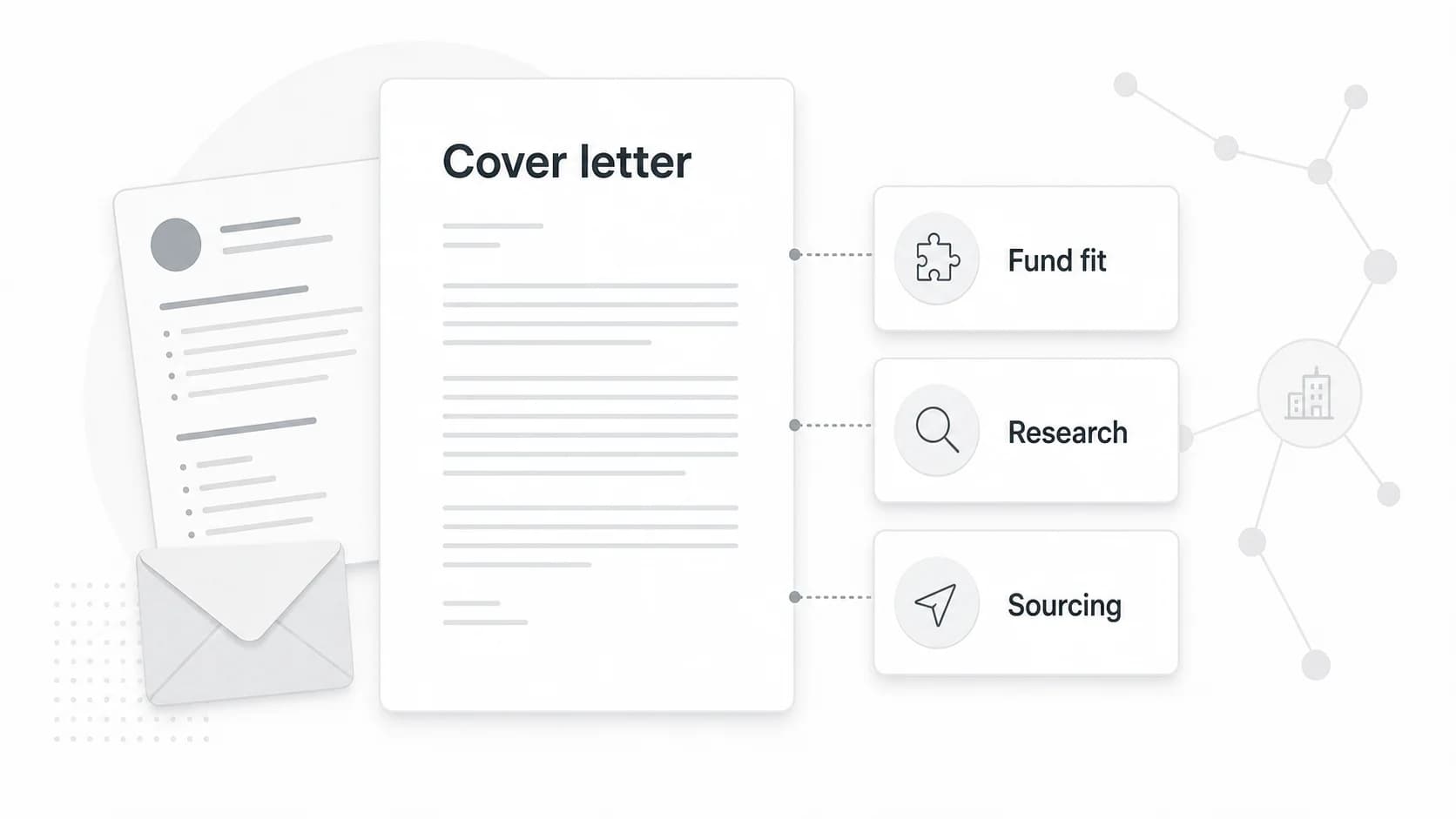
A venture capital analyst cover letter is a short application letter that explains why you fit a specific VC analyst role, why the fund is a credible match for your interests, and what evidence from your background proves you can do the work.
For a VC analyst application, that evidence should point to the actual job: market research, sourcing, financial analysis, investment memos, diligence, startup judgment, and clear written communication. A generic "I am passionate about startups" letter is not enough.
The cover letter should support your resume, not repeat it. Harvard's career office describes a cover letter as a narrative introduction that should explain your qualifications and interest while keeping the employer's needs in mind. The Guardian's careers coverage emphasizes the same practical standard: keep it short, tailored, and focused on why the employer should interview you. For VC roles, that means concise, specific, and tied to the fund.
What is a venture capital analyst cover letter?
A venture capital analyst cover letter is a one-page note that connects your background to a junior investing role. It should answer four questions quickly:
- What role are you applying for?
- Why this fund?
- What have you done that proves you can help source, evaluate, and support startups?
- What should the hiring team do next?
The "why this fund" section matters more in VC than in many generic roles. Funds differ by stage, sector, geography, portfolio support model, and partner style. A seed fintech fund, a deep-tech fund, and a growth equity platform will not respond to the same evidence.
Before writing, read the job description closely. The venture capital analyst job description breaks down the work analysts are usually hired to do: researching markets, identifying companies, preparing analysis, supporting diligence, and helping the investment team make decisions.
Do VC cover letters matter?
Usually, the resume, warm intro, work samples, and interview performance matter more. A cover letter rarely rescues a weak application.
But it can still matter in specific cases:
- The posting requires one.
- You are applying to a smaller fund where partners read applications directly.
- You are cold-applying without a referral.
- You come from a nontraditional background and need to explain the bridge into VC.
- Your sector interest is unusually relevant to the fund.
- You are applying outside the U.S., where cover letters may receive more attention.
Mergers & Inquisitions makes a useful finance-recruiting point: in investment banking, cover letters often matter less than resumes and networking, but a poor one can still hurt you. Treat the VC cover letter the same way. It is a downside filter first and an upside signal second.
VC analyst cover letter structure
Keep it to one page. If you are sending it as an email body, keep it even shorter.
| Section | Purpose | Include | Avoid |
|---|---|---|---|
| Opening | State the role and hook | Role title, fund name, one specific reason for fit | "To whom it may concern" if you can find a name |
| Fund fit | Show you understand the investor | Stage, sector, portfolio, thesis, geography, or platform angle | Generic praise like "leading venture firm" |
| Evidence | Prove analyst readiness | Market maps, memos, models, sourcing, startup work, deal exposure | Repeating every resume bullet |
| Close | Make the next step easy | Resume attached, interview interest, contact details | Overconfident claims or long thanks |
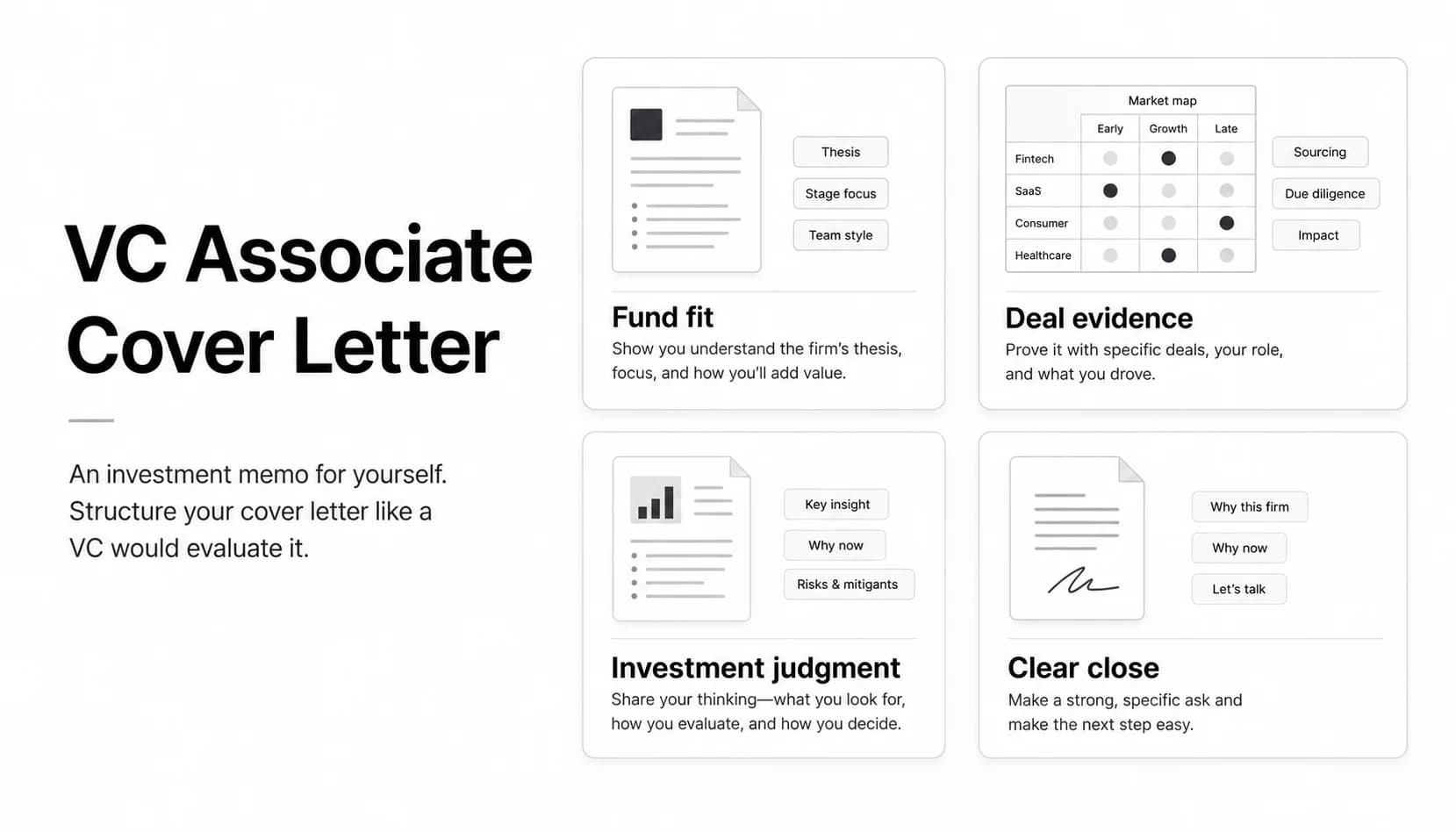
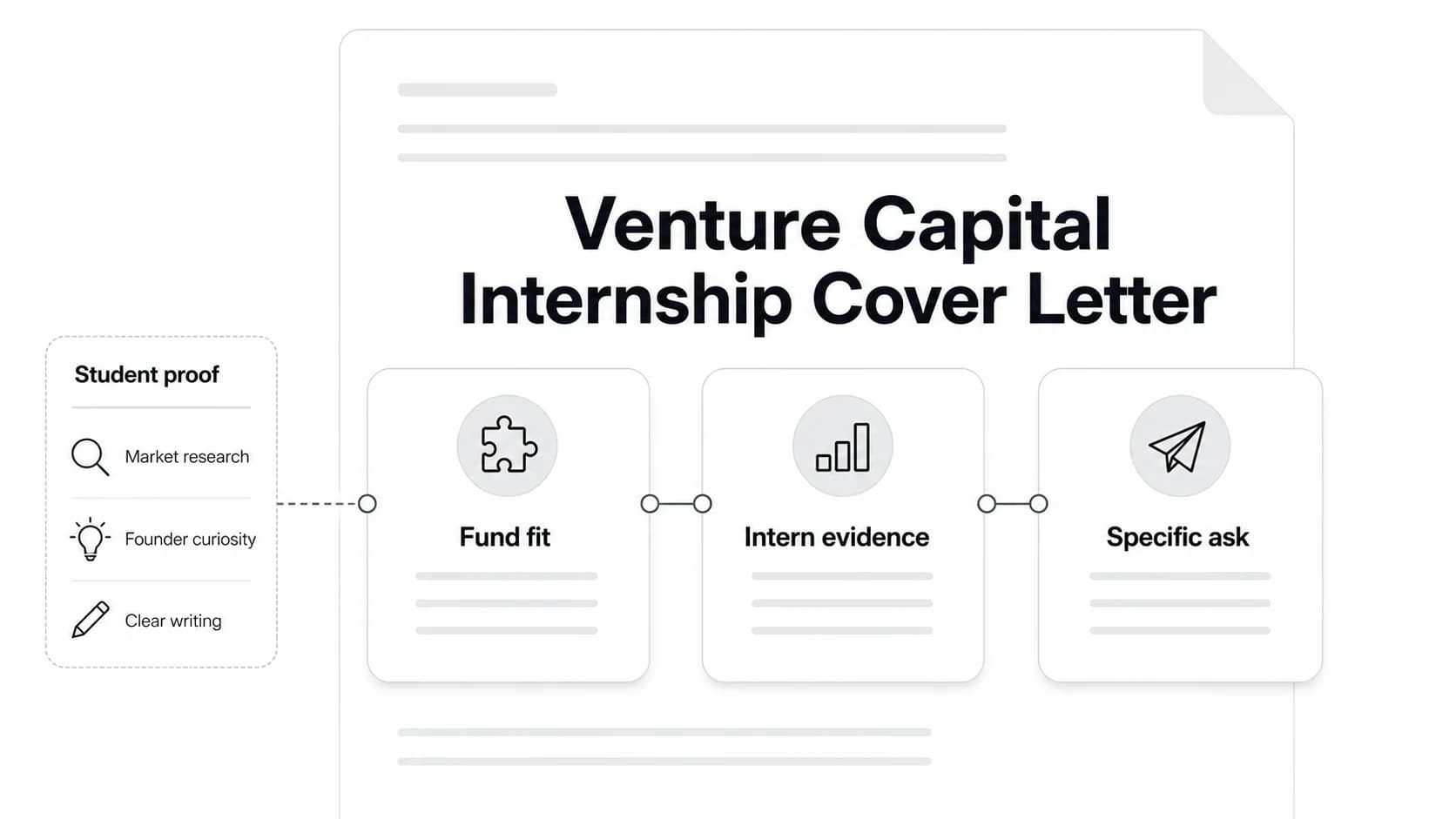
Think of the letter as a short investment memo about you. The opening is the thesis. The middle is evidence. The close is the ask.
Venture capital analyst cover letter template
Dear [Name],
I am applying for the [Venture Capital Analyst / Investment Analyst] role at [Fund]. I am interested in [Fund] because of your work in [stage / sector / thesis / portfolio theme], especially [specific portfolio company, market, article, or investment theme]. My background in [banking / consulting / startup operations / research / student investing] has prepared me to contribute to sourcing, market research, and investment analysis from day one.
In my current role at [Company / University / Fund / Startup], I [specific achievement tied to VC analyst work]. For example, I [built a market map, analyzed a sector, sourced companies, wrote investment memos, built financial models, supported diligence, worked with founders]. This experience strengthened my ability to [skill 1], [skill 2], and [skill 3] - the same skills required to evaluate early-stage companies and support an investment team.
I am particularly drawn to [Fund]'s focus on [specific thesis or portfolio area]. I have followed [portfolio company / market trend / partner writing] and would be excited to bring my experience in [relevant sector or function] to a team investing in [specific market]. I have attached my resume and would welcome the opportunity to discuss how my background could support your investment work.
Sincerely,
[Your Name]
Venture capital analyst cover letter example
Dear Ms. Patel,
I am applying for the Venture Capital Analyst role at Northstar Ventures. I am interested in Northstar because of the firm's focus on seed-stage infrastructure software, especially your investments in developer tools and data platforms. My background in technology investment banking and independent market research has prepared me to contribute to sourcing, market mapping, and investment analysis from day one.
At Harbor Capital, I supported three software transactions by building comparable-company analyses, summarizing customer calls, and preparing diligence materials for senior bankers. Outside work, I published a 40-company market map on AI developer infrastructure and interviewed eight founders to understand budget ownership, deployment friction, and expansion behavior. That project helped me sharpen the same skills a VC analyst uses every week: identifying interesting companies, forming a sector view, and turning messy qualitative inputs into a clear memo.
I am particularly drawn to Northstar's view that infrastructure software markets are often won through developer adoption before top-down enterprise sales. I would be excited to bring my software banking experience, founder research, and writing discipline to a team investing behind that thesis. I have attached my resume and would welcome the opportunity to discuss how I could support your investment team.
Sincerely,
Alex Chen
How to tailor each paragraph
Opening paragraph
The opening should do three things in two or three sentences:
- Name the role.
- Name the fund.
- Give one credible reason you fit.
Weak opening:
I am passionate about venture capital and believe I would be a great fit for your firm.
Stronger opening:
I am applying for the Venture Capital Analyst role at Northstar Ventures because your seed-stage infrastructure thesis matches the market research I have been publishing on AI developer tools.
The stronger version gives the reader a role, a firm, a stage, a sector, and a proof point.
Fund-fit paragraph
Do not flatter the fund. Show that you understand it.
Useful angles include:
- Stage: pre-seed, seed, Series A, growth.
- Sector: fintech, AI infrastructure, climate, healthcare, consumer, enterprise.
- Geography: U.S., Europe, Southeast Asia, LatAm, local ecosystems.
- Portfolio pattern: technical founders, vertical SaaS, marketplaces, open-source, regulated industries.
- Platform model: recruiting, GTM, community, founder education, portfolio operations.
Use the Venture Capital Careers companies directory to research firms before you write. Look for portfolio companies, fund stage, and related investor roles so your letter is anchored in something specific.
Evidence paragraph
Pick one or two proof points. Do not summarize your entire resume.
Strong proof points for VC analyst roles include:
- Built a market map.
- Wrote investment memos.
- Sourced startups for a student fund, accelerator, angel syndicate, or VC firm.
- Built financial models or valuation work in banking, PE, or growth equity.
- Worked at a startup and can explain customers, product, GTM, or unit economics.
- Published sector research.
- Helped with customer calls, reference calls, diligence, or competitor research.
The venture capital resume guide goes deeper on turning those experiences into resume bullets. Your cover letter should pull the best one or two and explain why they matter for this fund.
Closing paragraph
Keep the close direct. You do not need a dramatic finish.
Good close:
I have attached my resume and would welcome the opportunity to discuss how my software research and transaction experience could support your investment team.
Avoid:
- "I know I am the perfect candidate."
- "I will transform your firm."
- Long summaries of your passion.
- Multiple asks in the same paragraph.
What to emphasize by background
| Background | Emphasize | Translate it into VC language |
|---|---|---|
| Investment banking / PE | Models, diligence, transactions, process discipline | You can analyze companies quickly and write clearly under deadline |
| Consulting | Market sizing, competitive analysis, customer research | You can form a market view and structure ambiguous problems |
| Startup operator | Product, GTM, customers, metrics, founder empathy | You understand how companies are built from the inside |
| Student / intern | Campus fund, internships, research, founder network | You have already done VC-adjacent work without waiting for the title |
| Nontraditional candidate | Sector depth, community, technical skill, writing | You bring a differentiated sourcing or judgment edge |
If your background is light on finance, do not pretend otherwise. Lean into your wedge. A healthcare operator applying to a healthtech fund should lead with domain insight. A software engineer applying to an AI infrastructure fund should lead with technical judgment. A student applying to a generalist seed fund should lead with research output, sourcing hustle, and evidence of curiosity.
Common VC cover letter mistakes
Writing a generic passion letter
VC firms hear "I am passionate about startups" constantly. Replace passion with evidence:
- A sector memo you wrote.
- A founder community you helped build.
- A startup you worked for.
- A market map you created.
- A deal or company you sourced.
Repeating your resume
The cover letter should not walk through every job. Select the strongest evidence and explain the connection to the fund.
Over-explaining your life story
If you are changing careers, explain the bridge in a few sentences. Save the full story for interviews.
Praising the fund without specifics
"Your impressive portfolio" is weak. "Your investments in developer-first infrastructure companies such as [Company] match my research on open-source GTM" is stronger.
Making claims you cannot defend
Do not say you have "deep VC experience" if you have only taken a course. Be precise: "I wrote three investment memos for my university venture fund" is more credible.
Sending the same letter to every fund
You can reuse the structure. You should not reuse the fund-fit paragraph unchanged.
Private equity vs venture capital cover letters
Private equity and venture capital cover letters overlap, but the emphasis changes.
A private equity cover letter usually leans more heavily on transaction experience, modeling, leverage, valuation, and operational improvement. A venture capital cover letter should still show analytical ability, but it should also show curiosity about early markets, founder judgment, sourcing ability, and comfort with incomplete information.
If you are applying to both PE and VC roles, keep separate versions. The same generic "investment analyst" letter will read too vague for both.
For broader career positioning, compare the paths in private equity vs venture capital and the venture capital career path.
Quick checklist before you send
Before submitting, check every line against this list:
- The first paragraph names the exact role and fund.
- The fund-fit paragraph includes at least one specific thesis, sector, stage, geography, partner, or portfolio reference.
- The evidence paragraph connects your background to analyst work.
- The letter is one page or shorter.
- The letter does not repeat your resume line by line.
- The tone is direct and professional.
- The greeting uses a real name if available.
- There are no typos, broken links, or wrong firm names.
- The resume and cover letter tell the same story.
Then make sure the resume is ready. Start with the venture capital analyst resume examples if you need an analyst-specific reference.
After the cover letter: find the right VC roles
The best cover letter is still only one part of the application. Your odds improve when you apply to funds where your background has a clear reason to matter.
Use the Venture Capital Careers job board to browse open VC roles, then use the companies directory to research firms before tailoring your application. When you start getting calls, prepare with the venture capital interview questions guide.
FAQ
What is a VC cover letter?
A VC cover letter is a short job-application letter that explains why you are interested in a venture capital role, why the fund fits your background, and what evidence shows you can contribute to sourcing, research, diligence, and investment analysis.
How long should a venture capital analyst cover letter be?
One page or less. If the application asks for a note in an email or text box, use three or four short paragraphs.
Should I submit a cover letter if it is optional?
Usually yes if you can write a specific one. It is especially useful for smaller funds, cold applications, and nontraditional backgrounds. If you only have time to send a generic letter, focus on improving the resume or finding a warm intro first.
Should I mention specific deals or portfolio companies?
Yes, if the reference is accurate and relevant. Mentioning a portfolio company is useful when it supports a real point about your fit. Do not name-drop a deal you cannot discuss or pretend to know confidential details.
Can I reuse the same VC cover letter?
Reuse the structure, not the substance. The role, fund-fit paragraph, and evidence should change for each serious application.
What if I have no finance experience?
Lead with the strongest adjacent evidence: startup operating experience, technical expertise, sector research, student investing, founder relationships, or published market analysis. Then show that you understand the analyst work and are building the missing finance skills.