
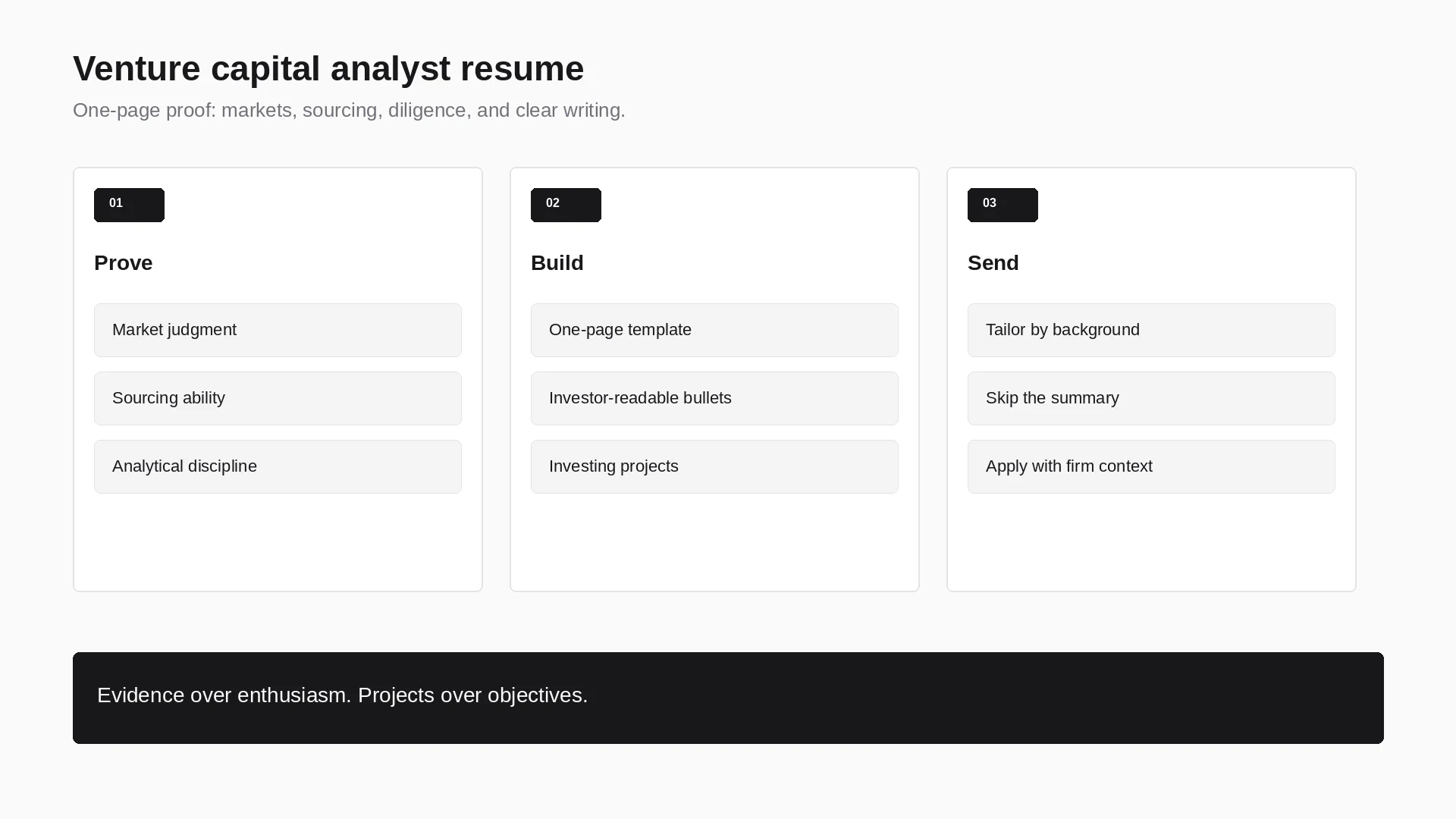
A venture capital analyst resume is a one-page proof document. It should show that the candidate can research markets, find promising companies, support diligence, write clearly, and finish analytical work without making partners or associates re-explain the basics.
Analyst screens rarely turn on finance credentials alone. Union Square Ventures' 2026 analyst program emphasizes curiosity, self-direction, and relationship-building alongside open applications. That signal matters for the resume: show how the candidate thinks, what they have already researched or built, and why they would be useful inside a fund.
Use this page for analyst, investment analyst, pre-MBA investing, student venture, or junior platform-adjacent applications. For associate, principal, or broader investor formats, use the venture capital resume guide. For the role path itself, see how to become a venture capital analyst.
What a VC analyst resume needs to prove
A VC analyst resume should prove five things quickly:
| What the fund screens for | What to show on the resume |
|---|---|
| Market judgment | Market maps, thesis work, sector research, customer interviews, trend analysis |
| Sourcing ability | Founder outreach, company databases, startup scouting, campus fund work, deal leads |
| Analytical discipline | Financial modeling, valuation basics, diligence memos, KPI analysis, transaction work |
| Writing and synthesis | Investment memos, research briefs, board summaries, published analysis |
| Execution | Fast turnaround, clean process, stakeholder communication, follow-through |
The venture capital analyst job description spells out the day-to-day work. The resume should mirror that work. Passion for startups is not evidence. Research, sourcing, diligence, or founder-facing output is.
Venture capital analyst resume template
Keep the resume to one page unless the fund asks for a longer CV. Use a simple structure:
| Section | What to include | What to avoid |
|---|---|---|
| Header | Name, email, phone, city, LinkedIn, personal site or writing portfolio if useful | Full mailing address, headshot, unrelated social links |
| Education | School, degree, graduation year, GPA if strong, investing clubs, relevant coursework | Long course lists, high school details unless still early in college |
| Experience | Internships, banking, consulting, startup, product, data, investing, research, operating roles | Task lists with no outcomes |
| Investing projects | Campus fund work, angel scouting, market maps, investment memos, startup research | Unvalidated "interests" with no work product |
| Skills | Excel, financial modeling, SQL/Python if real, research tools, languages, sector expertise | Generic "leadership" or tools that cannot be defended in an interview |
Copy-ready analyst resume structure
Replace every bracket with specific evidence:
| Section | Template |
|---|---|
| Header | [Name], [Email], [Phone], [City], [LinkedIn], [Portfolio or writing link] |
| Education | [School], [Degree], [Major], [Year] / Relevant: [student fund / thesis / research / finance coursework] |
| Experience | [Firm / Company], [Role], [Dates] / - [Action verb] [market/company/deal work] by [method], resulting in [output or decision] |
| Investing projects | [Project], [Dates] / - Built [market map / memo / sourcing list] covering [sector], including [number] companies and [specific insight] |
| Skills | Financial modeling, market research, startup diligence, Excel, SQL/Python, sector tools, languages |
If the application also asks for a letter, pair the resume with a targeted venture capital analyst cover letter. The two documents should tell the same story without repeating each other line by line.
How to write analyst resume bullets that get read
Strong VC analyst bullets follow one pattern:
Did [specific work] on [market/company/deal] using [method], producing [decision, output, metric, or insight].
GoingVC's resume advice makes the same point: quantified evidence beats vague enthusiasm. A bullet about growing users by a measurable amount tells a hiring manager more than a bullet about being passionate about innovation.
| Weak bullet | Stronger VC analyst bullet |
|---|---|
| Interested in fintech and venture capital | Built a 75-company market map of vertical fintech infrastructure, segmented by buyer, funding stage, and go-to-market motion |
| Helped with due diligence | Summarized 12 customer interviews and competitor findings for a Series A diligence memo on SMB payments software |
| Conducted market research | Analyzed pricing, adoption drivers, and incumbent gaps across 30 AI developer-tool startups for a seed-stage thesis |
| Worked on financial models | Built revenue cohort and burn-rate analysis for three software companies to support investment committee materials |
| Communicated with founders | Sourced 18 founder conversations through university and operator networks; converted four into partner screening calls |
For more ways to translate experience into VC language, use the venture capital skills guide.
Replace the summary with an investing projects section
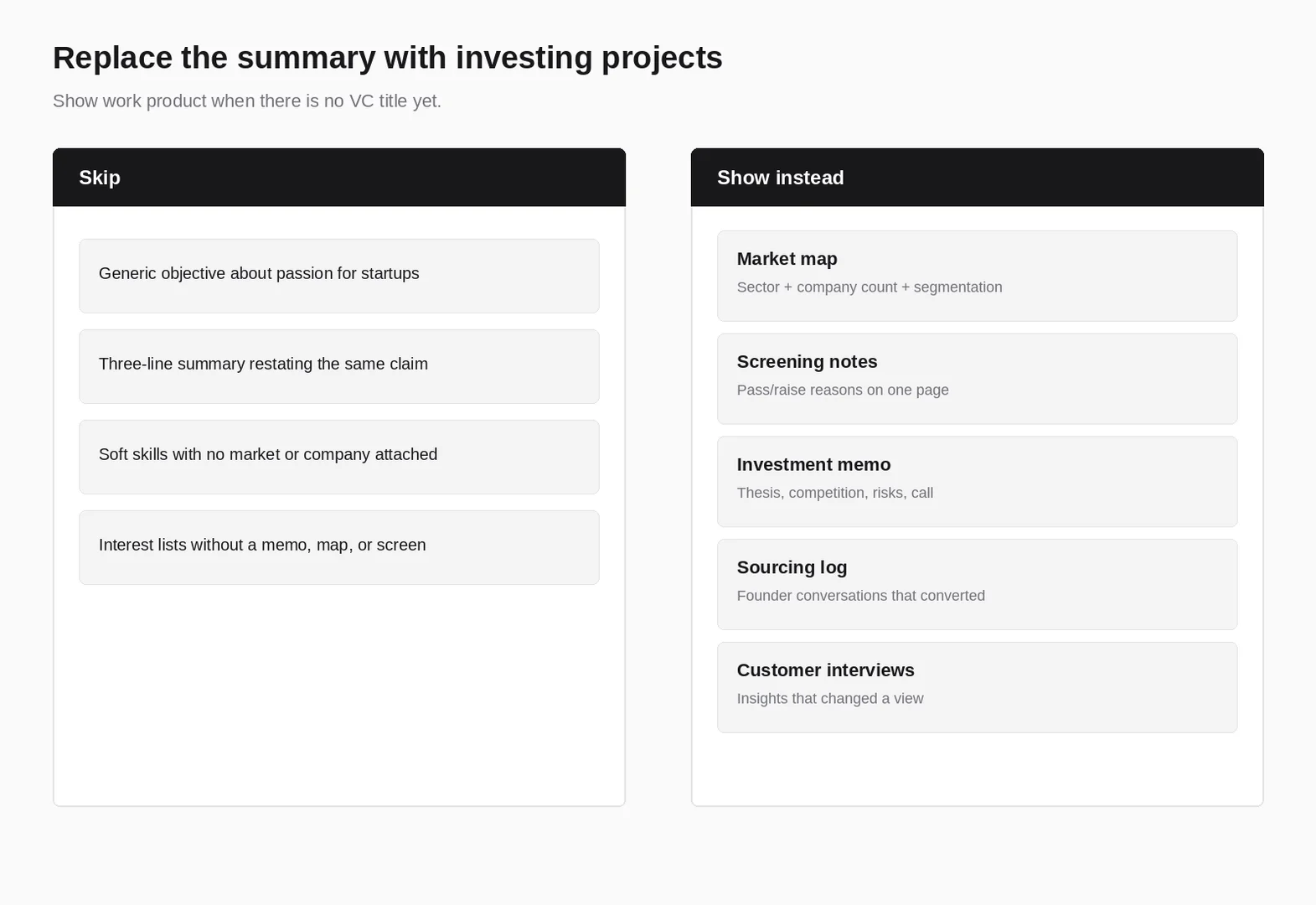
A summary or objective usually wastes the most valuable real estate on an analyst resume. Partners and associates skim for work product, not a self-description.
Use an Investing projects section instead. It is the place to show analyst-shaped output when the candidate does not yet have a venture capital job title.
| Work product | What to list | What "good" looks like |
|---|---|---|
| Market map | Sector, company count, segmentation axes | Buyer, stage, GTM, or tech-stack cuts that change who looks interesting |
| Screening notes | Number of companies reviewed and decision frame | One-pagers with pass/raise reasons, not a pile of saved decks |
| Investment memo | Thesis, market, competition, risks, recommendation | A written argument someone else could diligence |
| Sourcing log | Channels, founder conversations, handoffs | Outreach that turned into screens, not vanity CRM counts |
| Customer / founder interviews | Interview count and insight used | Notes that changed a product, thesis, or diligence view |
| Model or KPI analysis | What was modeled and for what decision | Cohorts, burn, unit economics, or comps tied to a live question |
Rules for the section:
- Prefer two to four projects with concrete outputs over a long interest list.
- Name the sector, method, and artifact. "Researched AI" is not a project.
- Link a short writing sample or research site in the header if the work is public and clean.
- If a campus fund, scout program, or angel network produced the work, put that affiliation in the project title.
- If the strongest proof still lives under Experience, keep the best bullets there and use Investing projects for overflow that would otherwise disappear.
This section is also how an investment analyst resume becomes a VC analyst resume. Public-markets or banking work can stay in Experience. The projects block is where startup maps, founder conversations, and early-stage judgment show up.
VC analyst resume example
This example is realistic without inventing a famous-fund pedigree. Adapt the structure, not the exact facts.
| Section | Example |
|---|---|
| Header | Maya Chen, maya@email.com, New York, NY, linkedin.com/in/mayachen, mayachen.com/research |
| Education | Columbia University, B.A. Economics, 2026 Columbia Venture Partners, Investment Team Relevant coursework: corporate finance, statistics, entrepreneurship |
| Experience | Fintech Startup, Strategy Intern - Built a 120-company map of embedded finance vendors across payroll, vertical SaaS, and creator platforms; identified three partnership targets for VP Strategy review. - Interviewed eight SMB customers on onboarding friction and summarized findings in a two-page memo used by product and growth. - Analyzed activation and retention data in Excel to isolate two customer segments with higher expansion potential. |
| Investing projects | Student Venture Fund, Analyst - Screened 40 pre-seed and seed companies across B2B software, climate, and fintech; prepared one-page screening notes for weekly investment meetings. - Wrote a seed-stage memo on API-first compliance infrastructure covering market size, buyer pain, competitive map, and investment risks. - Sourced founder conversations through alumni, demo days, and operator referrals. |
| Additional experience | Boutique Investment Bank, Summer Analyst - Built public-company comps and transaction summaries for software and business-services pitches. - Prepared customer, market, and valuation exhibits for senior bankers under tight turnaround. |
| Skills | Market mapping, diligence memos, financial modeling, Excel, SQL basics, founder outreach, B2B software research |
Each line points to a fund-relevant output: a map, memo, screen, customer interview, model, or founder conversation.
Tailor the resume to your background
Different candidates need different evidence. Do not force every resume to look like an investment banking resume.
| Background | Lead with | Translate into VC language |
|---|---|---|
| Student / intern | Campus fund, research, startup internships, founder network | Show sourcing, research, and writing before a full-time investing title |
| Investment banking | Deals, modeling, diligence, sector exposure | Show market judgment and startup interest, not only transaction execution |
| Consulting | Market work, customer research, strategic analysis | Show thesis formation and comfort with incomplete company data |
| Startup operator | Growth, product, sales, data, founder/customer proximity | Show company-building judgment from inside the machine |
| Founder / builder | Product launches, users, revenue, fundraising, pivots | Show commercial judgment and humility, not only founder identity |
| Data / technical | Analysis, tooling, AI/data markets, technical diligence | Show where technical depth helps the fund understand a market |
If the target level is still unclear, compare active analyst and associate postings on the Venture Capital Careers job board, then research funds through the companies directory.
Common VC analyst resume mistakes
Writing a generic finance resume
"Financial analysis," "market research," and "strategic thinking" are too broad on their own. Tie each skill to a company, market, memo, model, founder conversation, or investment decision.
Leading with a summary instead of proof
A three-line summary that restates "analytical student interested in venture capital" burns space that could hold a market map, memo, or sourcing result. Put the proof in Experience and Investing projects.
Overstating deal experience
If the candidate supported a deal, be precise about the role. A junior analyst can write "built comparable-company analysis for a software sell-side pitch" or "summarized customer calls for diligence." Do not imply leadership of an investment that did not happen.
Hiding the best VC evidence
Some candidates bury the strongest proof under campus leadership or generic internships. If there is a market map, sourced startup list, memo, founder interview set, or early-stage growth result, make it visible.
Listing too many skills
Only list skills that can be defended in an interview. Python, SQL, valuation, or sector expertise will get follow-up questions.
Sending the same resume to every fund
Tailor emphasis by stage and sector. A pre-seed AI fund, a growth fintech fund, and a healthcare-focused firm should not see the same proof points in the same order.
After the resume: apply with context
A good resume gets stronger with context. Before applying:
- Read the role carefully and mirror the work the fund actually describes.
- Research the firm's stage, sectors, partners, and portfolio through the companies directory.
- Browse open roles on the Venture Capital Careers job board.
- Create a Venture Capital Careers profile for a cleaner application workflow.
- Prepare the story before the first screen with the venture capital interview questions guide.
If applying cold, a short networking note can help the resume get read. Keep the email specific and evidence-led, then attach the resume only when it supports a clear ask.
FAQ
How long should a venture capital analyst resume be?
One page. Analyst candidates are screened quickly, and a concise resume forces prioritization of the strongest evidence. Senior investors may use a deal sheet; analyst candidates usually should not need one.
What should a VC analyst resume include?
Education, relevant experience, investing projects, market research, sourcing or founder-facing work, analytical skills, and writing or memo work that shows investment judgment.
Is an investment analyst resume the same as a VC analyst resume?
Not exactly. An investment analyst resume can emphasize public markets, banking, or asset management. A VC analyst resume should emphasize startups, market maps, sourcing, founder/customer research, diligence, and early-stage judgment.
Should the resume include a summary or objective?
Usually no. Use that space for Experience or Investing projects. A summary only helps if it states a concrete sector focus and a specific work-product claim the rest of the page proves.
Should I include a GPA?
Include it if it is strong or if applying as a student or recent graduate. If work experience is stronger than the GPA, lead with the work.
Do I need prior VC experience?
No. Many analyst candidates come from banking, consulting, startups, product, data, student funds, or founder networks. The resume should show adjacent proof that analyst work is already happening without the title.
Should I use a designed resume template?
Use a clean, readable layout. Avoid heavy graphics, multi-column designs that parse poorly, and templates that make the page look busy. Investors care more about evidence than design flourishes.
Related posts
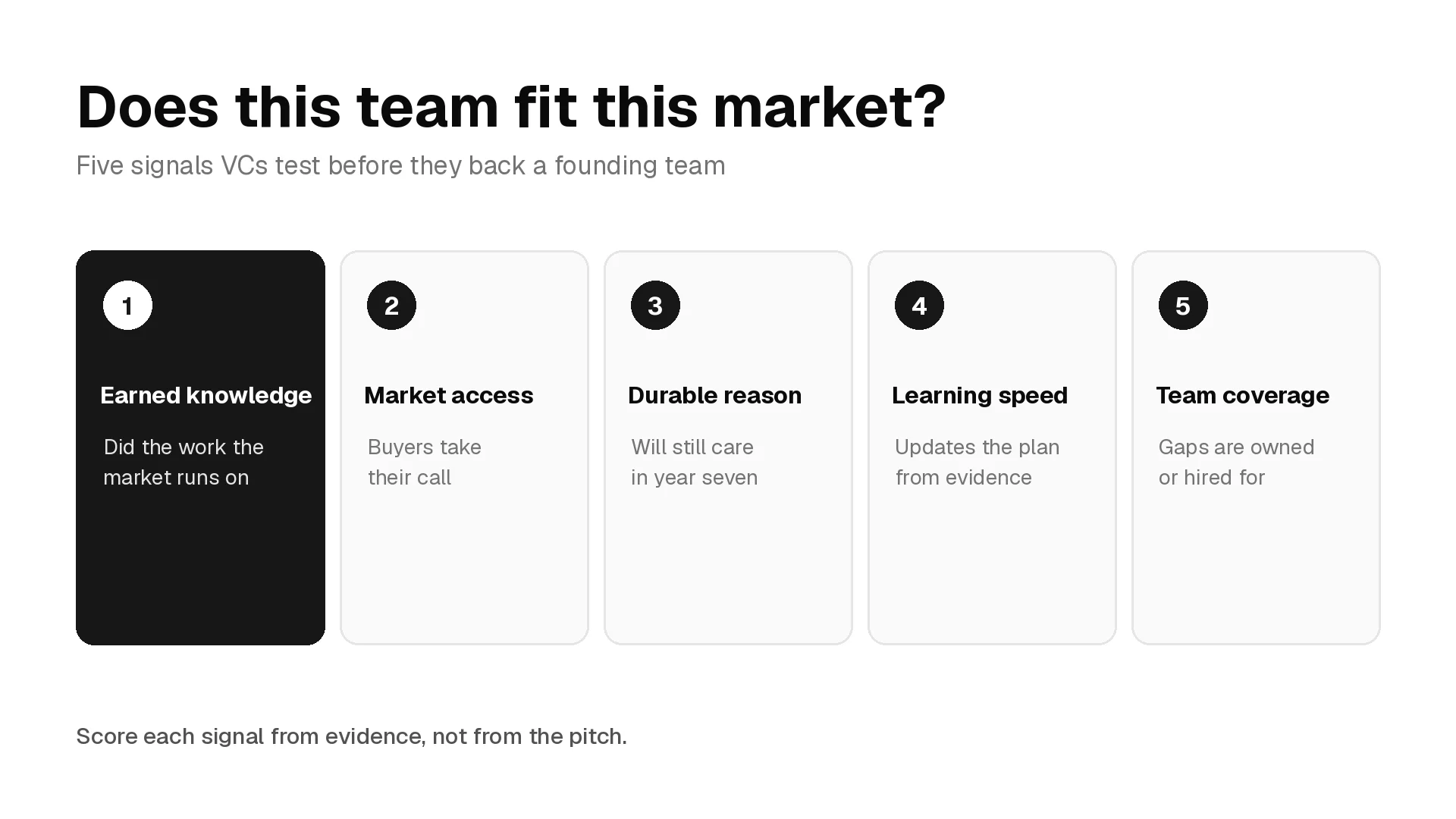
Founder-market fit is the match between what a founding team knows, can access and cares about, and what its market demands. How VCs weigh it, test it with evidence, score it, and write it into a memo or interview answer.
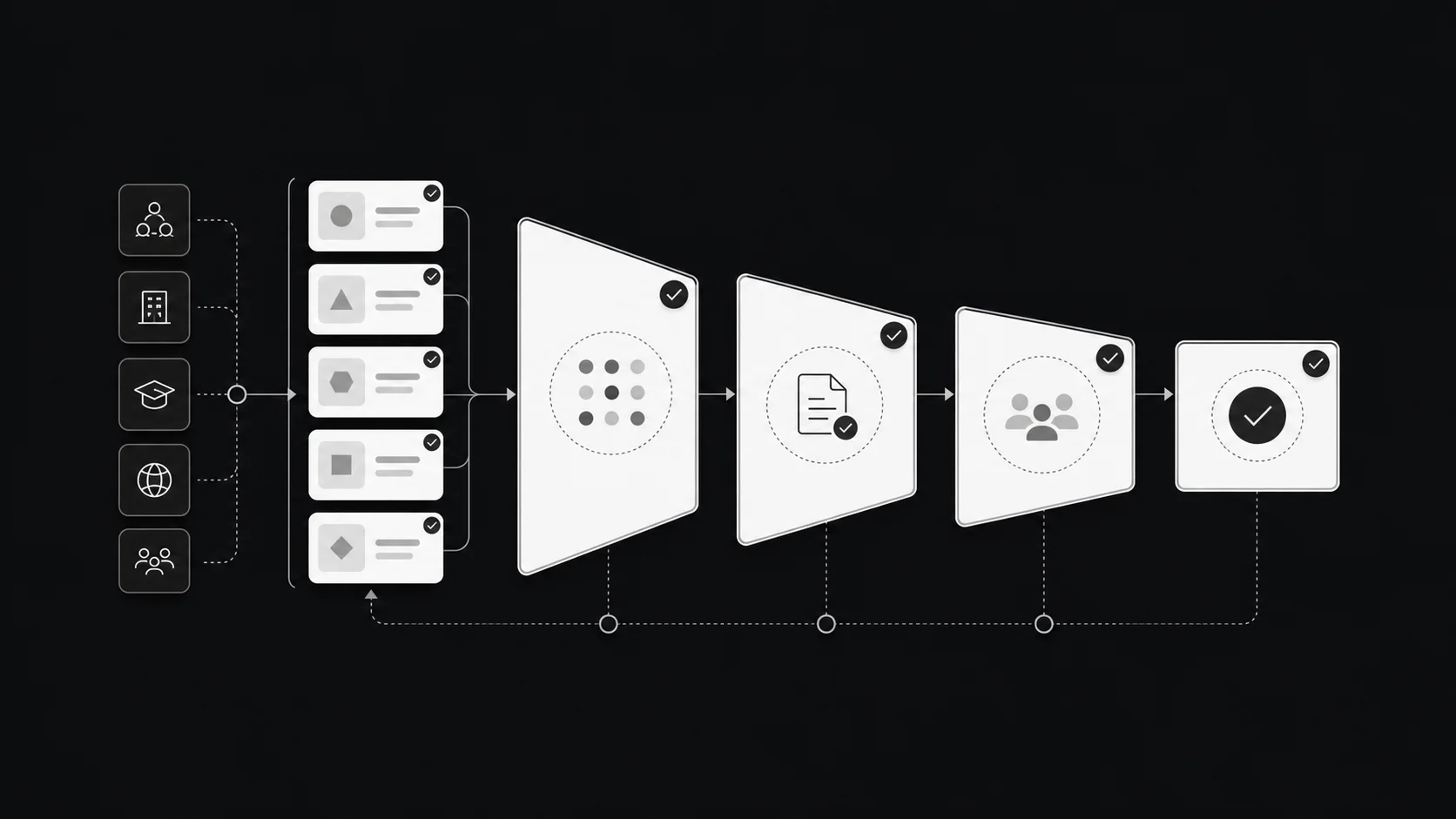
Deal flow is the stream of investment opportunities a venture firm receives and the funnel that sorts them. For every deal closed, firms consider about 101 companies.
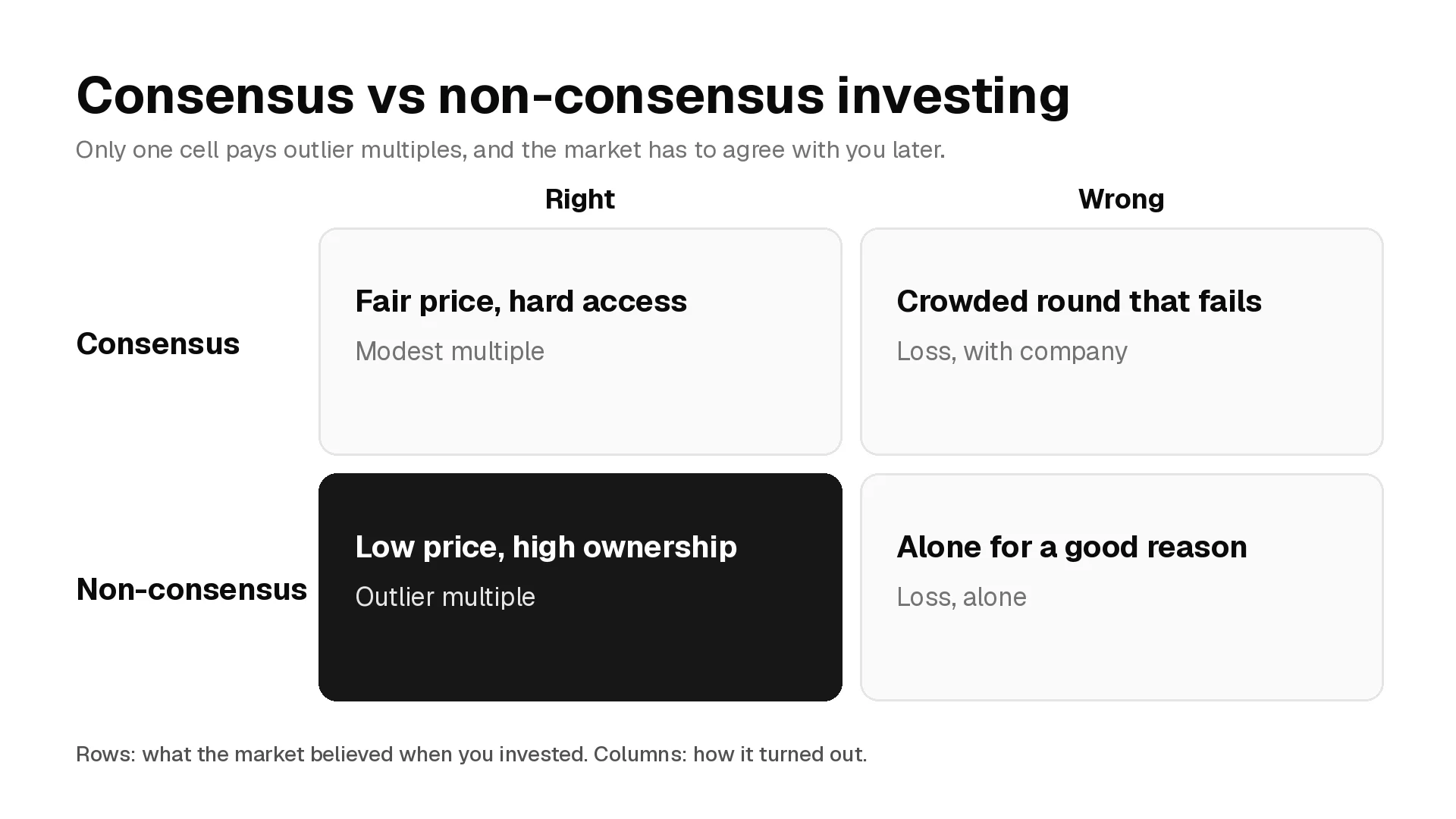
Non-consensus investing means backing a company most investors have passed on or not yet seen, for a reason you can state and test. How the 2x2 works, why firms drift toward consensus, how investment committees vote, and how analysts and associates bring a non-consensus deal.