
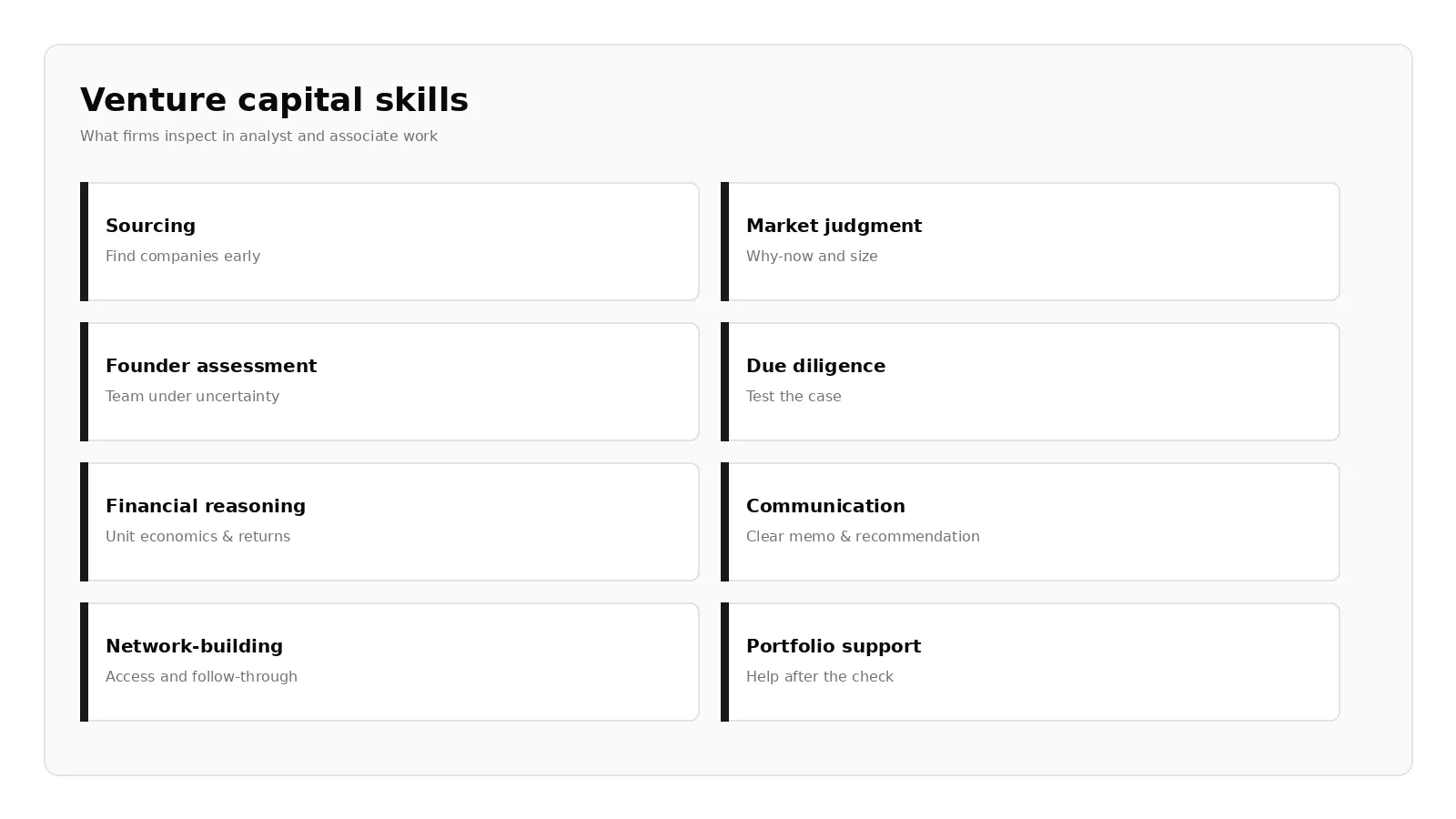
Venture capital skills are the abilities that help an investor find promising startups, judge them under uncertainty, win founder trust, and support portfolio companies after investment. The core stack is sourcing, market analysis, due diligence, founder judgment, financial reasoning, memo writing, communication, and network-building.
For analysts and associates, the bar is not sounding interested in startups. It is producing useful investment work before a partner has to ask twice: a market map, a credible founder read, a clear why-now, a short investment memo, and a clean pass when the answer is no.
The core venture capital skills
| Skill | What it means in VC | How to prove it |
|---|---|---|
| Sourcing | Finding companies before they are obvious | Thesis-led startup list with founder notes |
| Market judgment | Explaining why a category can become large | Market map with segmentation and timing |
| Founder assessment | Evaluating ambition, clarity, resilience, and fit | Structured founder calls and reference notes |
| Due diligence | Testing product, market, financial, and legal risks | Diligence checklist and memo |
| Financial reasoning | Business quality, valuation, dilution, return paths | Unit economics, scenarios, fund-return logic |
| Communication | Turning messy research into a crisp recommendation | One-page investment memo |
| Network-building | Earning access to founders, operators, and co-investors | Useful introductions and follow-up quality |
| Portfolio support | Helping companies after the check clears | Hiring, customer, partnership, or GTM examples |
Soft skills show up in this work. Curiosity without a market map is still curiosity. Analytical ability without a memo is still unfinished work. Firms hire for craft they can inspect.
Skill priorities by stage
The same skill names matter at every stage. The weight changes.
| Skill | Seed / early emphasis | Growth / later emphasis |
|---|---|---|
| Sourcing | Very high | Medium |
| Founder assessment | Very high | High |
| Market judgment / why-now | Very high | High |
| Customer and product diligence | High | Very high |
| Financial modeling and cohorts | Medium | Very high |
| Competitive and moat analysis | Medium–high | Very high |
| Portfolio operating support | Medium | High |
| Process, CRM, and writing speed | High for juniors | High for juniors |
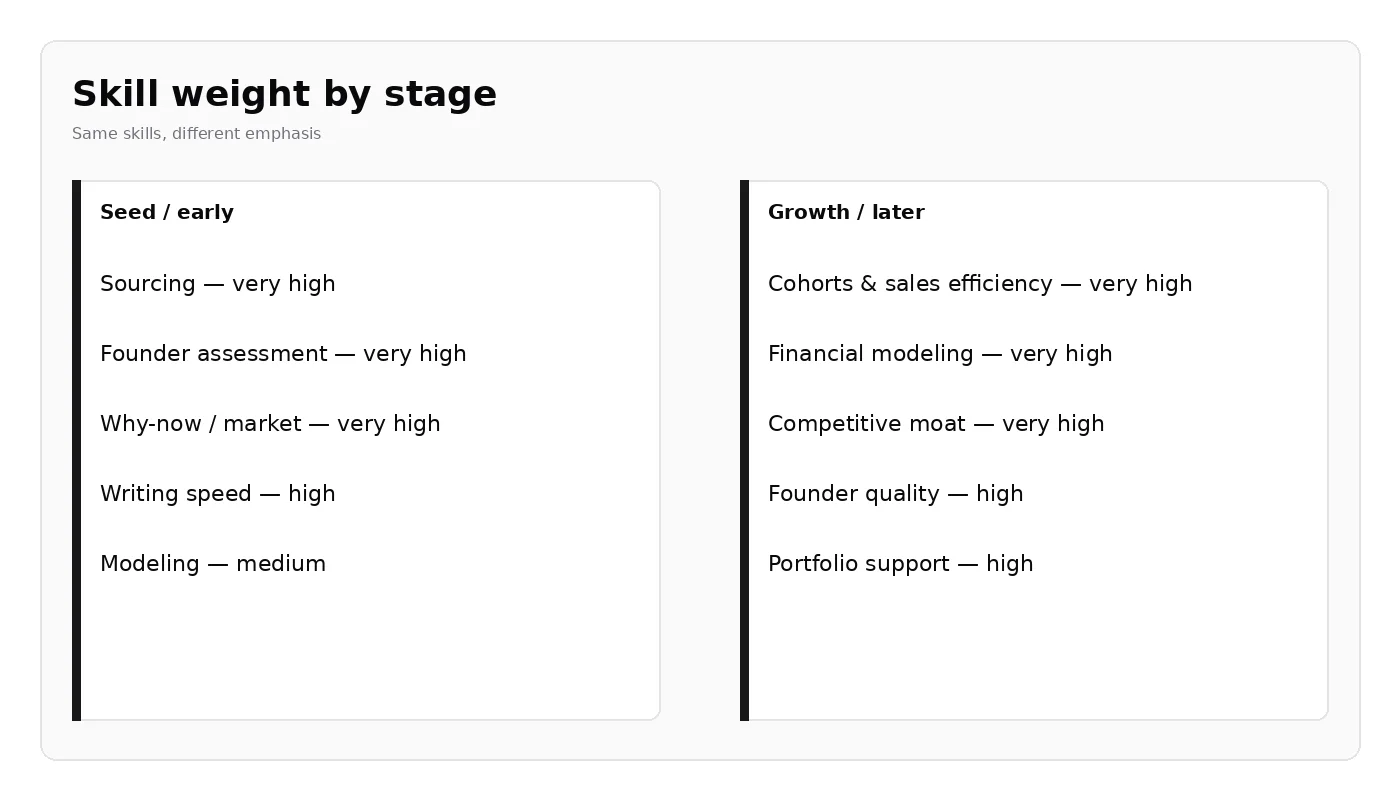
Early-stage seats reward thesis-driven sourcing and founder reads. Later-stage seats reward cohort quality, sales efficiency, margins, and financing judgment. Pick the seat type before stacking skills for an application.
Investment judgment
The central venture capital skill is judgment: deciding whether an uncertain company could matter enough to return meaningful capital to the fund.
Judgment mixes pattern recognition with evidence. The data is usually incomplete: early revenue, a small customer set, a young product, a market that has not settled, founders still learning in public. Strong investors separate a temporary mess from a fatal flaw.
Useful judgment questions:
- Is the founding team unusually capable for this problem?
- Is the market large, urgent, and changing now?
- Does the product solve a painful problem better than alternatives?
- Can the model scale with attractive margins or strong retention?
- What has to become true for a fund-returning outcome?
- Which risks can be tested before investment, and which must be accepted?
Financial modeling matters as one input. A spreadsheet can show a return case. It cannot tell you whether a founder will recruit a strong team, whether customers will change behavior, or whether the market will compound for a decade. Learn the numbers. Do not hide behind them. A strong memo states the qualitative bet as clearly as the quantitative case.
Sourcing and network-building
Sourcing is finding the right companies early enough to matter. At early stage, the best opportunities often come from founder referrals, operator networks, university labs, accelerators, open-source communities, niche industry circles, or a researched outbound thesis.
Good sourcing is not a large list. It is a point of view about where exceptional companies are likely to form.
A practical sourcing workflow:
- Pick one market you can study deeply.
- Define the change creating company formation: regulation, platform shift, cost curve, buyer behavior, infrastructure, or talent migration.
- Map companies, founders, customers, incumbents, and likely acquirers.
- Rank startups by why-now, founder-market fit, traction quality, and fund fit.
- Write short notes on why each company should or should not be contacted.
For a junior candidate, this is one of the easiest skills to show before a hire. Build a credible market map, write thoughtful outreach, and show you can find companies a fund would plausibly want to meet.
For the broader workflow, see venture capital deal sourcing.
Analytical and diligence skills
Due diligence tests whether the investment case survives evidence. Stage changes the work. Seed diligence often centers on founder quality, market urgency, customer pain, and product insight. Growth diligence spends more time on cohort retention, sales efficiency, margins, competitive dynamics, and exit scenarios.
A junior investor should be able to:
- Size a market without fake precision
- Read customer interviews for pain, urgency, and willingness to pay
- Compare a startup against incumbents and adjacent startups
- Understand revenue quality, gross margin, burn, runway, and fundraising needs
- Flag legal, regulatory, technical, or concentration risks
- Explain which risks are acceptable for the stage
The usual output is an investment memo or partner discussion. It is not a research dump. It states the recommendation, the reason to believe, the reason to worry, and the next diligence questions.
For process detail, use venture capital due diligence.
Communication and persuasion
VC is a writing and conversation job. Time goes to founders, partners, operators, LPs, recruiters, lawyers, customers, and other investors. Strong analysts make other people smarter by organizing the work clearly.
Partners need a clear view under ambiguity:
- What is the company?
- Why now?
- Why this founder?
- Why could this be a large outcome?
- What evidence supports the case?
- What could break it?
- What should the firm do next?
Founder conversations are different. Direct questions without turning the call into an interrogation. Challenge assumptions, listen for how a founder thinks, and leave the founder better off even when the firm passes.
Portfolio support and operating judgment
Work continues after the term sheet. Investors often help with hiring, customer introductions, follow-on fundraising, strategic planning, executive recruiting, board preparation, and later financing decisions.
Operating judgment is the ability to help a founder make better decisions. A former founder, product leader, salesperson, engineer, or recruiter may bring context a finance-only candidate lacks. Not every investor needs an operator resume. Every investor needs a way to add value beyond capital.
Examples:
- Introducing a founder to relevant customers or design partners
- Helping define the first sales hire profile
- Reviewing a fundraising narrative before a Series A process
- Connecting a company with specialist advisors
- Building benchmarks for pricing, retention, or sales efficiency
- Helping think through follow-on financing tradeoffs
Translate operating experience into investor value. "I worked in product" is weaker than "I can evaluate product velocity, roadmap discipline, and customer discovery quality on technical founder calls."
Modern funds also lean harder on specialization and talent help. Domain depth in a complex category, plus the ability to help founders hire, is a real differentiator when generalist finance skills are common.
Skills needed for a venture capital analyst
Analyst skills are more execution-focused than partner-level skills. Analysts usually research markets, source companies, prepare screening notes, support diligence, draft memos, track pipeline, and help partners prepare for founder meetings.
| Analyst skill | What firms want to see |
|---|---|
| Market research | Explain a category clearly and name important companies |
| Sourcing discipline | Find relevant startups and explain fund fit |
| Writing | Turn research into a concise memo |
| Financial basics | Read startup metrics; understand dilution, valuation, runway |
| Founder curiosity | Ask useful questions without pretending to know everything |
| Follow-through | Details, deadlines, and CRM hygiene partners can trust |
A common mistake is optimizing only for technical finance questions. Those matter more at later-stage and growth funds. Early-stage firms often care as much about sourcing, independent thinking, and clear writing.
Map skills to role expectations with the venture capital analyst job description and the broader VC career path.
How to read VC job descriptions for skills
Postings rarely say "show us your market map." They use compressed language. Decode the verbs before you rewrite your resume.
| JD language | Skills they are screening | Proof that matches |
|---|---|---|
| "Source proprietary deal flow" / "build pipeline" | Sourcing, network-building | Market map, outreach log, warm intro examples |
| "Conduct market research" / "develop investment thesis" | Market judgment | One-page thesis, category map, why-now note |
| "Support due diligence" / "customer calls" | Diligence, founder assessment | Interview guide, call notes, risk checklist |
| "Financial modeling" / "unit economics" | Financial reasoning | Simple model, cohort notes, dilution scenarios |
| "Prepare investment memos" / "IC materials" | Communication | Memo sample with clear recommendation |
| "Portfolio support" / "help founders hire" | Operating judgment, network | Concrete intros, hiring screens, GTM help |
| "Sector expertise" / "technical background" | Specialization | Domain projects, prior operating work, published notes |
If a posting lists every skill, prioritize the first three bullets and the fund's stage. Mirror those in your top resume lines and work samples.
Skill evidence ledger
Use this ledger to turn skills into application evidence. Four skills with real proof beat eight skills described as adjectives.
| Skill | What good looks like | Resume line pattern | Interview prompt to prep | Work sample |
|---|---|---|---|---|
| Sourcing | Ranked list with why-contact / why-pass | "Mapped N startups in [sector]; introduced X to investors" | Walk through how you built the list | Thesis + ranked pipeline sheet |
| Market judgment | Clear segmentation and timing | "Wrote thesis on [category]; flagged pricing and buyer risks" | Why this market, why now | One-page market map |
| Founder assessment | Structured notes, not vibes | "Ran founder screens with scorecard and references" | How you evaluate a founding team | Founder interview guide |
| Diligence | Risks tested vs risks accepted | "Built customer and competitive diligence for [deal/project]" | What would make you pass | Diligence checklist + memo |
| Financial reasoning | Stage-appropriate math | "Modeled runway, dilution, and return paths for [scenario]" | Walk through unit economics | Simple model + assumptions page |
| Communication | Recommendation in one page | "Drafted memos used in weekly investment discussions" | Summarize a company in two minutes | One-page investment memo |
| Portfolio support | Specific help, not "advised" | "Introduced portfolio/startup to N design partners; screened sales hire" | How you help after the check | Intro log or hiring rubric |
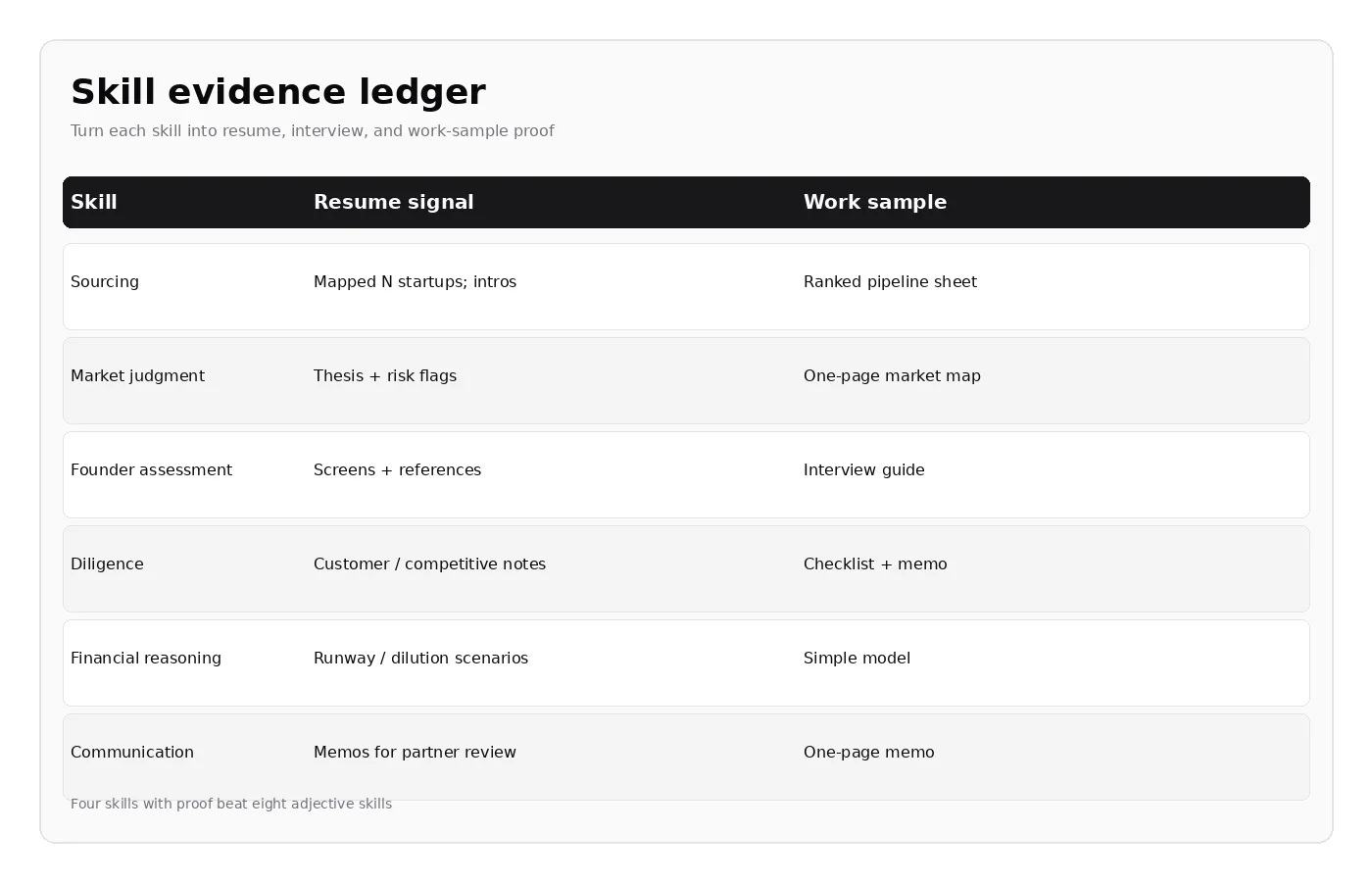
Attach two work samples when a firm invites materials. Prefer a market map plus a memo over a long biography.
How to improve venture capital skills
Improve by doing the work before someone pays you to do it full time. Reading helps. Active reps matter more: sourcing, writing, calling, comparing, deciding.
Weekly practice loop:
- Choose one sector and write a one-page thesis.
- Add five startups to a market map.
- Pick one company and write a short investment memo.
- List three diligence questions for the founder.
- Compare the company against two competitors or substitutes.
- Write a clear pass reason if you would not invest.
- Get critique from a founder, operator, investor, or mentor.
Over time, keep a small portfolio: two market maps, three concise memos, a founder interview guide, and a written view on one sector you know better than most applicants. The goal is not to pretend you are already a partner. The goal is to show curiosity, taste, analytical discipline, writing ability, and willingness to form a view.
When you apply, pair this evidence with a focused VC resume and prepare examples for common venture capital interview questions.
What do venture capitalists look for?
When evaluating startups, investors usually weigh founder quality, market size, product insight, traction, business model, competitive advantage, and a credible path to a large outcome. Seed weights founder and market more heavily. Growth weights retention, sales efficiency, margins, and market leadership more heavily.
When evaluating candidates, firms look for clear thinking, unusual curiosity, judgment, network quality, analytical discipline, writing ability, and the maturity to work with founders. The common thread is trust. Founders need to believe you understand their company. Partners need to trust your work.
Frequently asked questions
Do you need an MBA to work in venture capital?
No. Some investors have MBAs, and some firms recruit post-MBA associates, but an MBA is not a universal requirement. Startup operating experience, investing experience, technical expertise, investment banking, consulting, product, or strong sector knowledge can all be credible paths. For entry routes, see how to become a venture capitalist.
Is financial modeling important in venture capital?
Yes, with stage caveats. Later-stage and growth roles usually require stronger modeling. Early-stage roles often emphasize market judgment, founder assessment, sourcing, and memo writing. Still learn cap tables, dilution, unit economics, runway, valuation, and fund-return math even when the model is not the whole decision.
What skills are most important for a VC analyst?
Market research, sourcing, concise writing, financial basics, diligence support, founder curiosity, and reliable execution. Analysts win trust by producing clear work that helps partners decide.
Can operators break into venture capital?
Yes, when operating experience translates into investment value. Product operators can evaluate roadmap and customer discovery. Sales leaders can assess go-to-market quality. Engineers can diligence technical risk. Recruiters and people leaders can help with portfolio talent.
How long does it take to get good at venture capital?
Years, because feedback loops are long. A company can look weak early and become exceptional, or look exciting and fail. Juniors should focus first on controllable skills: sourcing discipline, research quality, writing clarity, and learning from each decision.
Next steps
Browse open roles on the VC job board, research firms in the companies directory, and create an account when you are ready to track applications. Bring skill evidence, not a generic interest statement.
Related posts
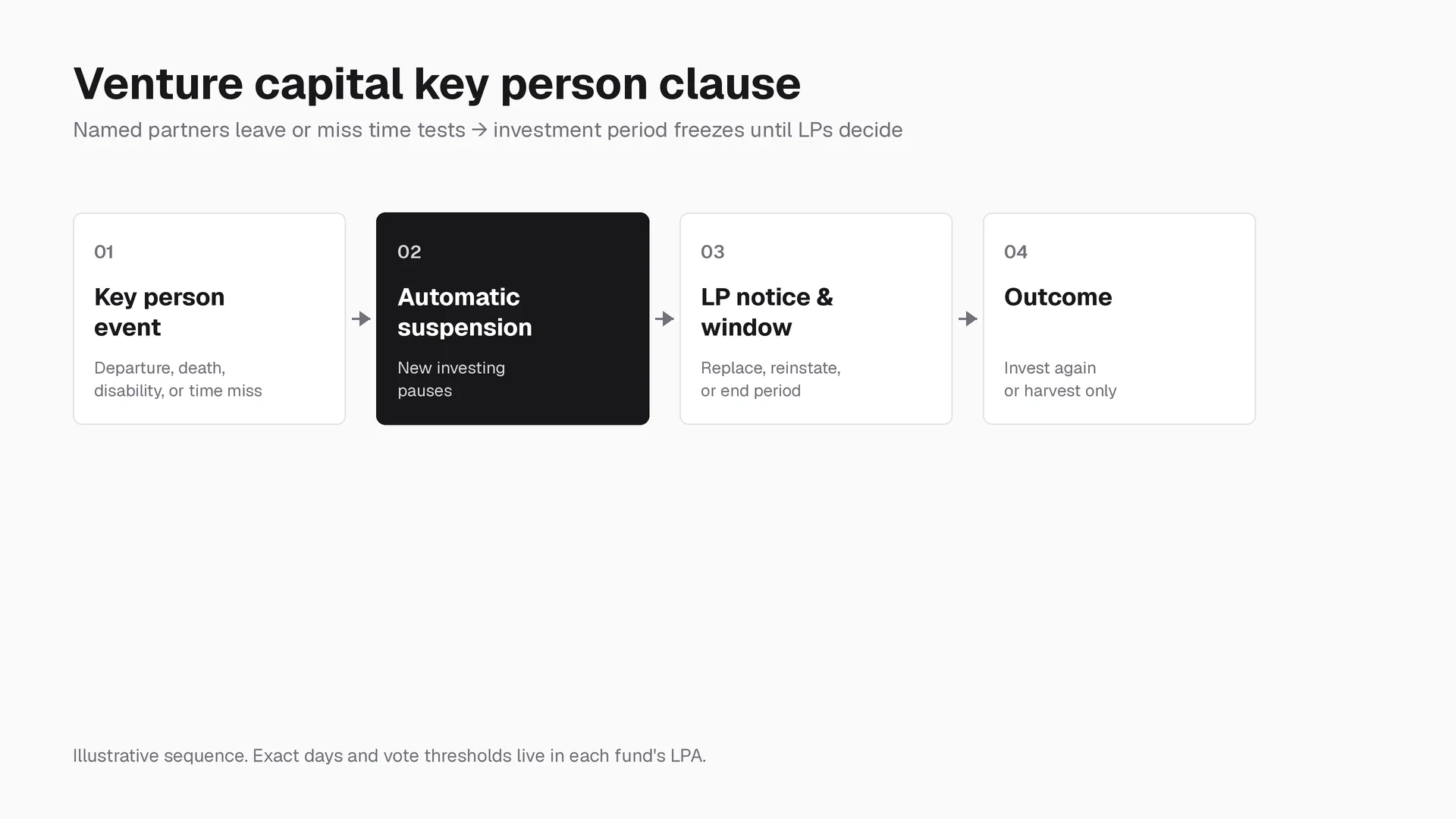
A key person clause names the partners a venture fund depends on and can freeze new investing if they leave. Here is how the trigger works, what still happens during a suspension, and what it means for your job search and seat.
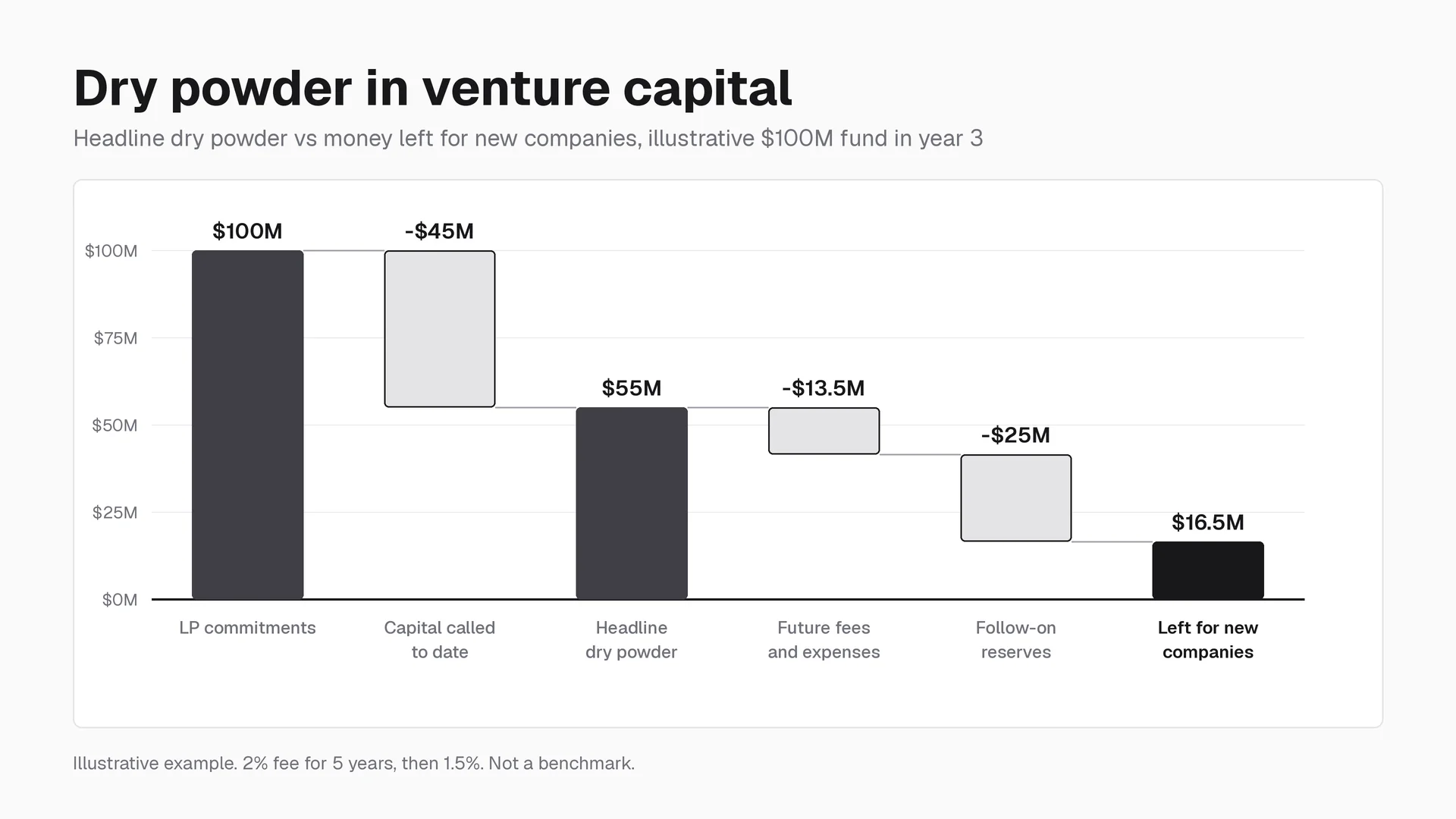
Dry powder in venture capital explained: the formula, a worked $100M fund example showing how little headline dry powder is left for new companies, current US and global data, and what a firm's dry powder tells you about hiring and the junior job.
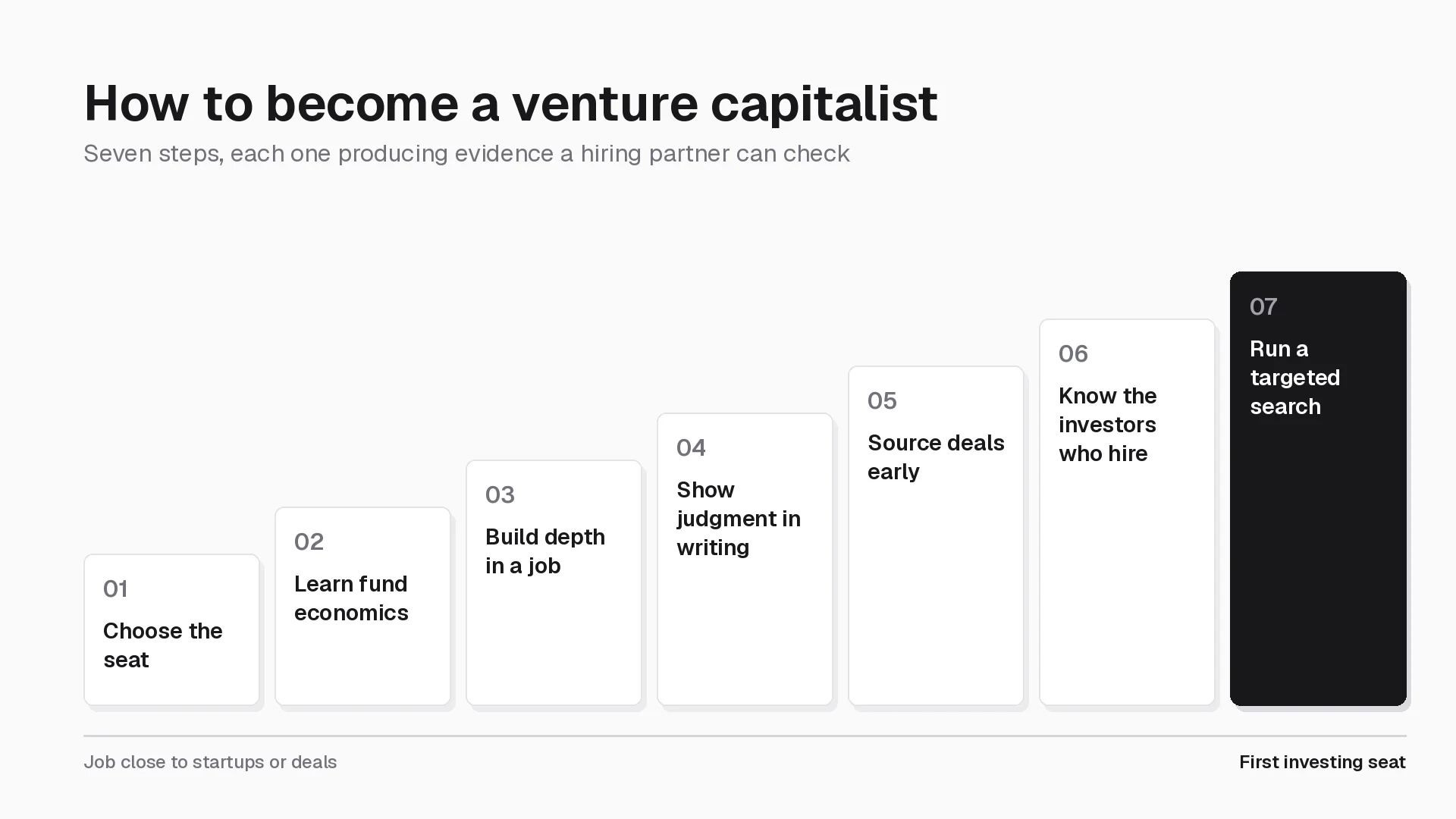
How to become a venture capitalist in seven steps: choose the seat, build depth, prove judgment in writing, source early, and run a targeted search. Includes entry paths by background, how fund size limits hiring, MBA placement data, and licensing.