
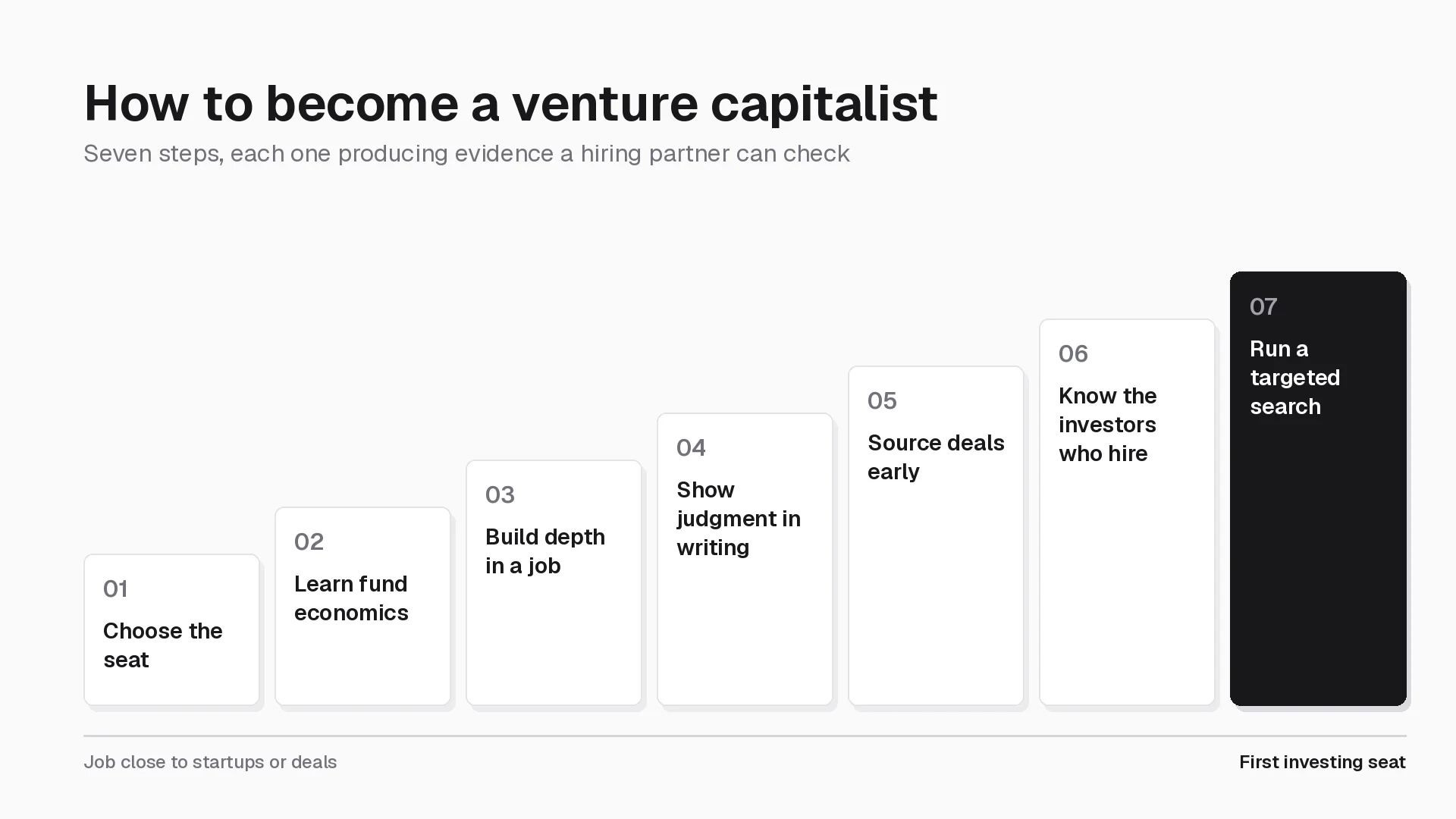
You become a venture capitalist by getting hired into an investing seat at a venture fund, or, much later, by raising a fund of your own. Firms hire people who already show investment judgment and bring something the partners lack: founder access, domain depth, or deal skills. The usual sequence is a job close to startups or deals, written proof that you can pick companies, a record of sourcing, and relationships with the investors who make hiring decisions. Most people take several years to land a first seat. Reaching partner usually takes a decade or a prior founder outcome.
The seven steps below follow that sequence. Each one produces evidence a hiring partner can check.
What a venture capitalist does
A venture capitalist invests other people's money in young private companies in exchange for equity. The fund raises capital from limited partners (LPs) such as endowments, pensions, foundations, family offices, and funds of funds. It backs startups, helps them grow, and returns cash to LPs when those companies are acquired or go public. A VC therefore has two customers. LPs need returns that justify a ten-year lockup, and founders need capital and help that justify giving up ownership.
The work splits into five workstreams. The mix changes with seniority and stage.
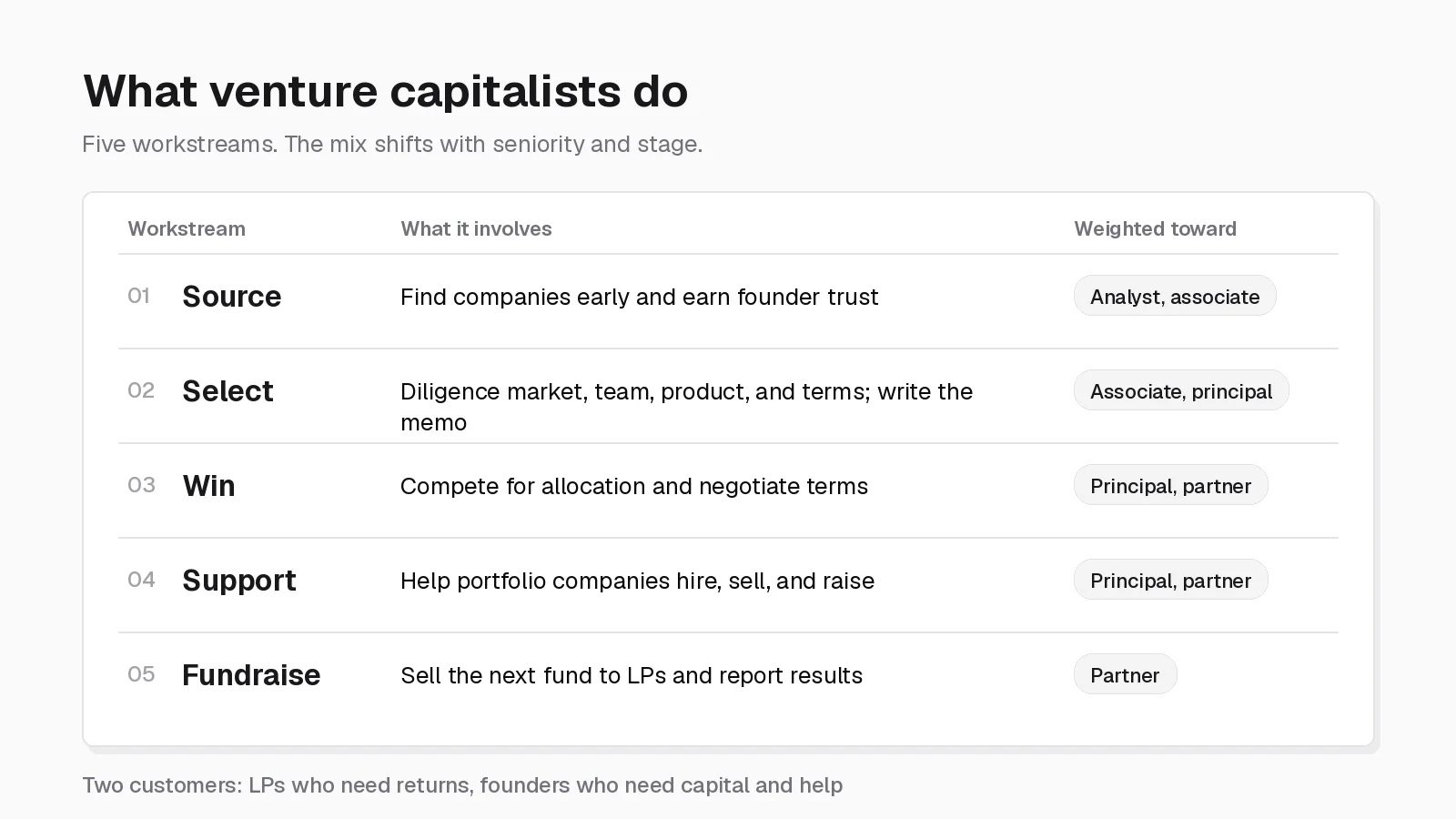
- Source. Find companies before they are obvious and earn founder trust early.
- Select. Diligence the market, team, product, and terms. Write the memo and argue it inside the partnership.
- Win. Compete for allocation in hot rounds and negotiate terms without losing the deal.
- Support. Help portfolio companies hire, sell, and raise the next round. Partners take board seats.
- Fundraise. Partners sell the next fund to LPs and report performance on the current one.
Analysts and associates spend most of their week on sourcing calls, market research, and diligence support. Principals own deals end to end. Partners decide, sit on boards, and raise the fund. A seed generalist lives in founder meetings and thin data. A growth investor spends more time on metrics, competitive processes, and models. Each rung of the venture capital career path shifts time from finding companies toward deciding on them.
How to become a venture capitalist in seven steps
1. Decide which venture capitalist you want to be
"Venture capitalist" covers four different jobs with different timelines. Choose one before you start networking, because each needs different proof.
| End state | What success looks like | Typical way in | Hard truth |
|---|---|---|---|
| Junior investor (analyst or associate) | Paid seat sourcing and running diligence for partners | Banking, consulting, startup operating roles, MBA, domain specialist | Seats are scarce and many are filled through referrals |
| Principal or partner at an existing firm | Leads deals, takes board seats, shares in carry | Internal promotion or a lateral move with a track record | Titles vary by firm, and so does real decision authority |
| General partner of your own fund | Sets the thesis, raises from LPs, runs the firm | Prior investing record, a founder exit, or unusual deal access | Raising a first fund is a long sales process to LPs |
| Adjacent role (scout, angel, venture partner) | Deal flow and network without full-time fund duties | Domain access and judgment | Rarely a guaranteed path to a full-time seat |
If you need a salary next quarter, aim for a seat or a platform role. Raising a fund only makes sense once you have a track record or LP relationships.
2. Learn how a venture fund makes money
Interviewers expect you to explain the business you want to join. A fund usually charges LPs an annual management fee to run the firm and keeps a share of profits as carried interest, commonly 20%. Returns follow a power law. A few companies return the fund and most return little or nothing, so investors look for outcomes large enough to matter at the fund's size.
Know where the money sits in the fund lifecycle: fundraising, investing, reserves for follow-ons, and harvesting. The same logic explains how many people a firm can afford to hire, covered in the fund-size section below.
3. Build depth in a job close to startups or deals
Firms hire people who make the partnership better at something specific. That depth usually comes from a full-time job: investment banking or consulting for deal and analysis skills, product, engineering, or go-to-market roles at a startup for operating judgment, or scientific training for specialist funds. Pick a sector you can follow for years. A candidate who knows developer tools, clinical diagnostics, or payments infrastructure in detail is easier to place than a generalist who "loves startups."
Some firms hire a venture capital analyst straight out of college, usually larger firms with structured programs, and a VC internship during school is how many of those analysts get noticed.
4. Show investment judgment in writing
A degree shows that you can learn. Written work shows how you pick companies. Build a small portfolio of work a partner can read in fifteen minutes.
| Artifact | What good looks like | What it proves |
|---|---|---|
| Investment thesis | One or two pages: a market change, why now, and what a winning company looks like | You have a point of view and can defend it |
| Market map | 15 to 40 companies segmented by customer or approach, with gaps marked | You can survey a space and see where the opportunity sits |
| Two investment memos | A real or practice company, a clear yes or no, the risks, and what would change your mind | You can reach a decision, which is the core of the job |
| Founder-call notes | What you asked, what you learned, and how your view moved | You can run a conversation with a founder and learn from it |
Publishing one piece on LinkedIn or a newsletter helps. Sending it directly to the investors who cover that sector usually helps more.
5. Source deals before anyone hires you
Sourcing is the part of the job candidates can do before they have it. Keep a log of companies you find early, why they matter, and what happened next. Then send the best two or three to investors who invest in that stage and sector. A log showing that you spotted companies before their seed or Series A is one of the strongest signals a junior candidate can show. Scout programs and angel syndicates formalize this work and put a firm's name next to your log.
6. Build relationships with the investors who hire
Many junior seats are filled through referrals, so networking decides who gets considered. Start with associates and principals at funds that match your sector and stage. They are closer to hiring needs and more likely to reply than senior partners. Lead with something useful: a founder introduction, a market map they can use, or a short note on a portfolio company's market. Ask for advice, not a job. Keep the first cold email short and specific, and follow up with something new rather than a reminder.
7. Run a targeted search and prepare for interviews
Build a target list of 20 to 40 firms filtered by stage, sector, geography, and fund size. Use the companies directory to check each firm's focus and portfolio, and the VC job board for open roles. For each firm, write one sentence on why you are a fit. Then prepare for an interview loop that usually covers your background, market views, a company you would back, and often a memo or case study. Rehearse answers to the common VC interview questions out loud. Run outreach, applications, and practice as a weekly routine until you get a job in venture capital.
Which entry path fits your background
There is no single feeder degree or employer, but the routes in are consistent. The table shows the realistic first seat for each background and what usually goes wrong.
| Background | Realistic first seat | Evidence that carries over | Common trap |
|---|---|---|---|
| Investment banking or private equity | Analyst or associate, strongest at growth and later-stage funds | Modeling, process, deal exposure | Answering every question like a banker and showing no feel for founders |
| Consulting | Associate, platform, or corporate venture | Structured analysis, industry depth | No opinion on which companies will win |
| Startup operator (product, growth, sales) | Early-stage associate, platform, later operating partner | Shipped results, founder network | Assuming the title transfers and skipping written judgment |
| Software engineer | Technical associate at infrastructure, AI, or developer-tools funds | Technical diligence | No commercial view of customers and markets |
| Founder with an exit or hard-won lessons | Partner at a newer fund, venture partner, scout | Pattern recognition, credibility with founders | Waiting for brand-name funds and ignoring smaller firms |
| MBA | Post-MBA associate or principal | Recruiting calendar, alumni network, summer internship | Treating on-campus recruiting as the whole market |
| PhD or MD | Specialist associate at life sciences, deep tech, or climate funds | Scientific judgment on technical risk | No business translation and no sourcing habit |
| No finance or startup experience | Operating job first, then corporate venture, scout, or platform | Domain depth you can show | Buying certificates in place of proof |
Life sciences is the main exception to the general pattern. Early-stage biotech funds often hire PhDs and MDs without banking or consulting experience, while later-stage healthcare funds lean toward finance backgrounds.
Use fund size to find firms that can afford a junior seat
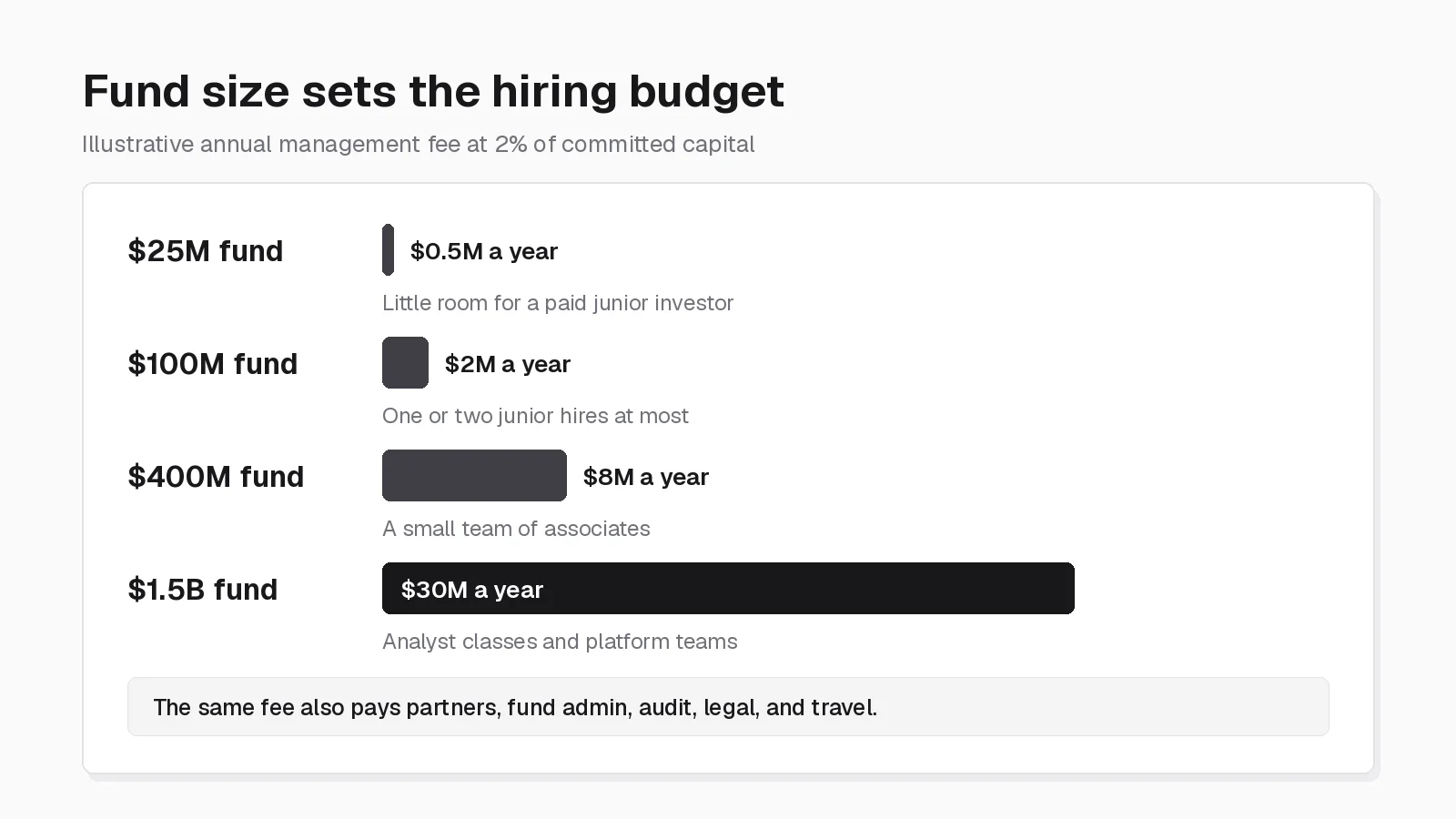
A venture firm pays its people out of the management fee, so fund size sets a ceiling on headcount. Fees are often around 2% of committed capital a year during the investment period. Terms vary, and many funds step the fee down later. The arithmetic below is illustrative, using a 2% fee, but it explains why many small funds never post a junior role.
| Fund size | Annual fee at 2% | What the fee has to cover | What it usually allows |
|---|---|---|---|
| $25M | $0.5M | Partner pay, fund administration, audit, legal, insurance, travel, software | Little or no room for a paid junior investor. Scouts, fellows, or part-time help are more likely |
| $100M | $2M | The same costs for two or three partners | Room for one or two junior hires at most, often added after a new fund closes |
| $400M | $8M | A full partnership plus operations and finance staff | A small investing team with associates, sometimes a platform hire |
| $1.5B | $30M | Multiple partners, specialist teams, back office | Analyst or associate classes, platform teams, structured recruiting |
Three adjustments make the arithmetic more useful.
- Count every active fund. A firm investing out of its third fund may still collect fees on the first two, so total assets under management matter more than the latest fund alone.
- Watch for new fund closes. A newly closed fund adds a new fee stream. Firms add seats when they have that new budget and more checks to write, so recent fund announcements are a reasonable hiring signal.
- Separate budget from need. A large fund that writes a few big checks a year may run a lean team. A seed fund writing 30 checks a year needs sourcing help even if it cannot pay much.
To use this, add fund size and the date of the last close to your target list, and focus outreach on firms with both a recent close and a stage you fit. If a small fund offers a scout or fellowship role, treat it as a way to build a track record rather than a path to a full-time salary.
Match your proof to a seat type
Firm prestige is a poor first filter. Seat type decides which evidence counts and which backgrounds win.
| Seat type | What the week looks like | Strong fit | Weak fit |
|---|---|---|---|
| Seed or early-stage generalist | Sourcing, founder calls, thin data, written judgment | Founders take you seriously and you write clear yes or no calls | You mainly want modeling work |
| Growth or later-stage | Heavier diligence, metrics, competitive processes | Banking, PE, or operator metrics depth | You avoid quantitative work |
| Corporate venture | Parent-company strategy plus investing judgment | You can translate corporate priorities into investment cases | You want full investment autonomy on day one |
| Platform, talent, or research | Hiring, content, community, and research next to the investing team | You save partners time and treat it as a real job | You see it only as a back door into investing |
Decision rules for the next 12 months:
- If your best proof is founder access and shipped product or sales results, target early-stage and platform seats first.
- If your best proof is modeling and deal process, target growth and multi-stage teams first.
- If your best proof is domain depth in bio, climate, AI infrastructure, or defense, target specialist funds and aligned corporate venture arms.
- If you need income and your investing proof is thin, take an operating, research, or corporate venture role that builds evidence instead of waiting for a brand-name offer.
Skills firms hire for and how interviews test them
Firms hire people who widen a partner's access to founders or improve the quality of decisions under time pressure. The venture capital skills below each show up somewhere in the interview loop.
| Skill | How interviews test it | How to show it before the interview |
|---|---|---|
| Sourcing | "Walk me through three companies you would look at this month" | A sourcing log and companies you flagged early |
| Judgment | "Pitch a company you would back and one you would pass on" | Memos with a clear decision and named risks |
| Market analysis | Market-sizing questions, "why now" follow-ups | A market map and thesis in one sector |
| Analytical floor | Reading a deck or simple model and spotting what does not add up | Clean unit economics in your memos |
| Writing | Take-home memo or written case | Published or shared writing a partner can skim |
| Founder empathy | "How would you help this founder in the first 90 days?" | Operating experience, founder references |
| Reliability | References and follow-up during the process | Fast, finished, error-free work throughout the process |
Do you need an MBA, a degree, or a certification?
No degree, license, or certification is required to work as a venture capitalist. Common undergraduate backgrounds are business, economics, engineering, and computer science, because they lead to either analytical tools or technical depth.
An MBA is a common route, but it does not guarantee a seat. At Stanford GSB, venture capital accounted for 6% of the Class of 2025's full-time job acceptances, at a median base salary of $212,500, according to the school's 2025 MBA employment report. At Wharton the figure was 2.8%, at a median of $170,000, per its 2025 career report. Summer internships run higher than full-time hiring at both schools (14% at Stanford, 6.5% for Wharton's Class of 2026). A VC summer internship is a common step, but it is not the same as a full-time offer. Whether to use an MBA to move into venture capital or break in without an MBA depends on what the degree adds to your specific path.
The CFA charter is built for public-markets investing. It signals discipline but rarely decides a venture hire. Courses can teach vocabulary and modeling. They do not replace a thesis, a sourcing record, or relationships. If you want structured learning, compare options in venture capital courses and judge each one by the work samples it leaves you with.
How venture capital firms hire
Venture firms are small partnerships, and most hire when they need to rather than on a fixed calendar. The usual triggers are a departure, a newly closed fund, or a new strategy such as a growth fund or sector practice. Some larger firms run analyst programs or pre-MBA associate cycles with more predictable timing, and MBA recruiting follows the school calendar, so the VC recruiting timeline depends on your route.
Roles reach candidates through three channels:
- Referrals. A partner or associate recommends someone they already know. This is why step 6 matters.
- Recruiters. Larger firms sometimes use search firms, mainly for pre-MBA associate and senior roles.
- Public postings. Firm career pages, partner posts on LinkedIn and X, and job boards.
A typical process runs from a few weeks to a few months. It starts with a screening call, moves through meetings with most of the investing team, and often includes a take-home memo, market map, or case. It ends with references. Interviewers focus heavily on fit and market views. Technical questions on cap tables, valuation, and SaaS metrics come up, especially at growth funds.
Run public channels alongside the referral work:
- Browse the VC job board and shortlist by stage and sector, not brand alone.
- Check each firm's focus, portfolio, and fund details in the companies directory before you apply.
- Create an account to get alerts so new roles reach you while you keep building proof.
What venture capitalists earn
Pay combines base salary, an annual bonus, and, from roughly principal level up, carried interest. Junior cash pay is usually below elite banking and private equity. The upside comes from carry, which typically vests over several years and usually pays out only after LPs get their capital back. The MBA medians above ($212,500 at Stanford, $170,000 at Wharton) are base salaries for post-MBA hires. Analyst pay is lower, and partner pay depends heavily on fund size and performance, which is why venture capital salary ranges are wide at every level.
Is venture capital the right career for you?
The job suits people who enjoy learning new markets quickly, meeting many founders, and making calls on thin information. It frustrates people who want fast feedback or a clear promotion ladder.
| What the job rewards | What it costs |
|---|---|
| Curiosity across new markets and technologies | Saying no to almost every founder you meet |
| Judgment you can defend in writing | Feedback that takes years, because fund lives run about a decade |
| Relationships that compound over time | Few senior seats and slow, uncertain promotion |
| Helping founders through hard moments | A sales job, selling the firm to founders and the fund to LPs |
| Long-run upside through carry | Lower junior cash pay than banking or private equity |
If the cost column sounds worse than the reward column, operating roles at startups, growth equity, or corporate development may fit better. Weeks fill with founder meetings, partner meetings, and events, and venture capital hours vary with stage and seniority.
Mistakes that keep candidates out
- Applying only through job postings. Many seats are filled through referrals before or instead of a public post.
- Leading with credentials instead of judgment. An MBA or banking stint opens a conversation. Memos and a sourcing log carry it.
- Staying a generalist. "I love startups" does not tell a partner what you will add. A sector or a function does.
- Asking for a job in the first message. Ask for advice, bring something useful, and let the request come later.
- Ignoring fund size and stage. Pitching a growth fund with seed-stage instincts, or a $25M fund for a full-time salary, wastes both sides' time.
- Treating scout or platform roles as a back door. Do the work well. Those roles turn into investing seats only when the output is strong.
When raising your own fund makes sense
Raising a fund is a legitimate way to become a venture capitalist. It is a poor default plan for someone who has never seen a full investment cycle. Consider it only when most of these are true:
- You have deal access that LPs cannot get through an established firm.
- You can state a specific thesis and why it works now.
- Founders and co-investors will take reference calls for you.
- You understand fund structure, fees, reserves, reporting, and regulatory filings such as Form ADV.
- You can live through a fundraise that may take a year or more without a reliable salary.
If those conditions are not met, take a seat, build a scout record, or invest small amounts as an angel. Angel investing tests selection skill with your own money. Managing LP capital adds fiduciary duties, reporting, and a fund-level return target, which is the real gap between a venture capitalist and an angel investor.
Frequently asked questions
How long does it take to become a venture capitalist?
Career changers often spend a year or more building proof and relationships before a first seat, longer if they need operating experience first. Moving from a junior seat to partner often takes a decade or more, and many people leave before that point. Founders with a strong exit can join at partner or venture partner level much sooner.
Do you need a license to be a venture capitalist?
No personal license or exam is required to work as an investor at a venture fund. Regulation applies to the firm. A manager that advises only venture capital funds can be exempt from SEC registration under section 203(l) of the Investment Advisers Act if its funds meet the SEC's definition of a venture capital fund in 17 CFR 275.203(l)-1. That definition caps non-qualifying investments at 20% of committed capital and limits borrowing to 15% for no more than 120 days. Those managers still report to the SEC on Form ADV as exempt reporting advisers.
Can you become a venture capitalist right out of college?
Yes, but the seats are few. Some larger firms hire analysts from undergraduate programs, usually candidates with VC or startup internships and a clear sector interest. Most people join after a few years in banking, consulting, or a startup. A VC or startup internship during school is the usual way to get noticed for those seats.
Do you need investment banking experience?
No. Banking helps at growth and process-heavy firms. Early-stage funds often prefer operators, technical specialists, or people with founder access.
Can you become a VC without an MBA?
Yes. Operators, engineers, scientists, and founders join venture firms without one. An MBA is worth the cost when its network, brand, or recruiting calendar fills a specific gap in your path.
Is scouting enough to become a VC?
Scouting builds a sourcing record and relationships, but it rarely leads straight to a full-time seat. Treat it as evidence for later applications, alongside written work and a target list.
Do you have to live in Silicon Valley?
No, but location matters. Venture firms are local businesses, and most hire where their partners and founders are. Aim for the market where you already have a network and where your target funds invest.
Next steps
- Pick your end state: junior seat, partner track, own fund, or an adjacent role.
- Write down your strongest proof and the seat type it fits.
- Ship a thesis, a market map, and two memos in one sector.
- Start a sourcing log and share the best companies with investors in that sector.
- Build a target list with stage, sector, fund size, and last fund close using the companies directory.
- Watch new roles on the VC job board and set up alerts.
Related posts
Deal flow is the stream of investment opportunities a venture firm receives and the funnel that sorts them. For every deal closed, firms consider about 101 companies.
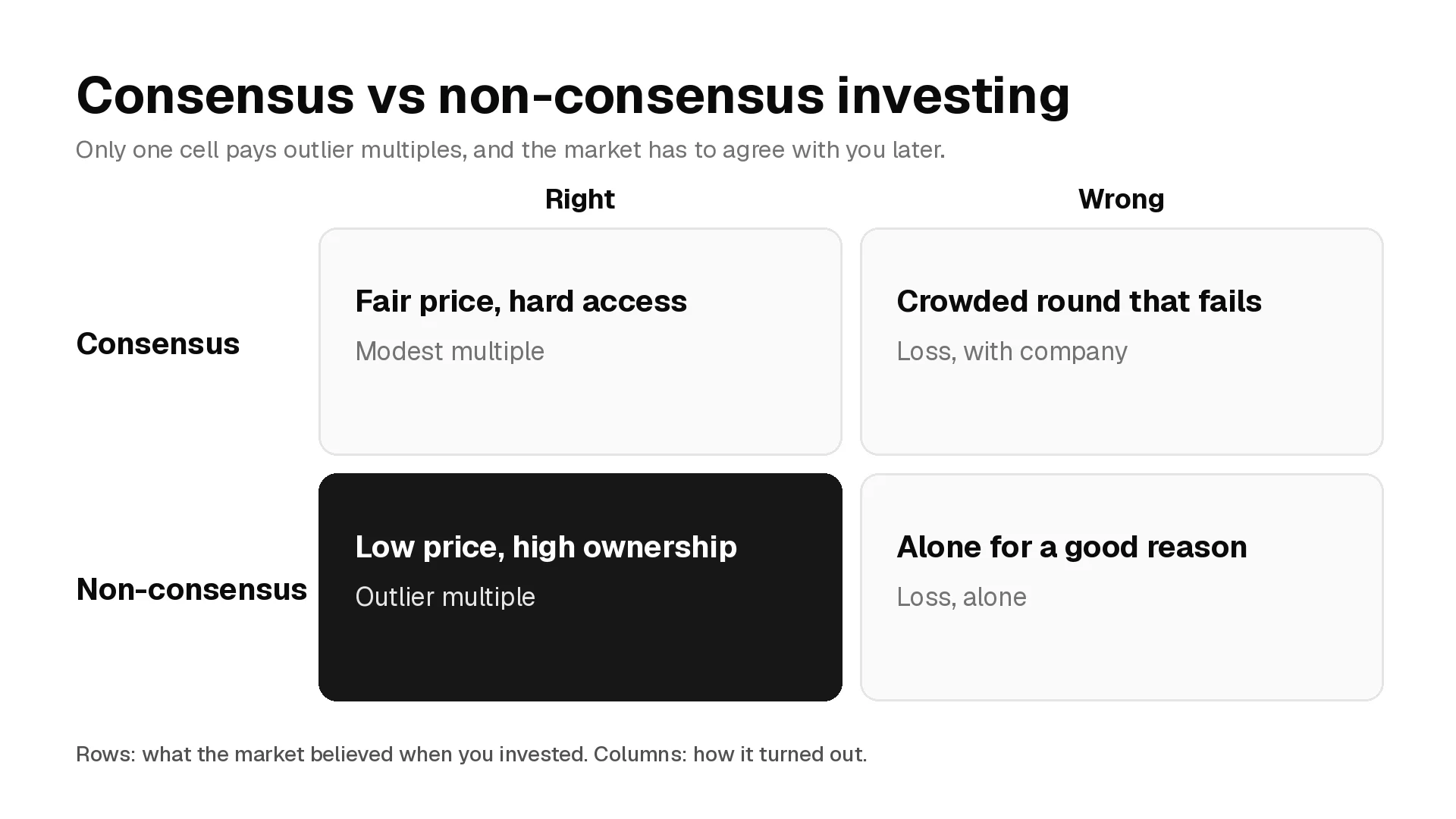
Non-consensus investing means backing a company most investors have passed on or not yet seen, for a reason you can state and test. How the 2x2 works, why firms drift toward consensus, how investment committees vote, and how analysts and associates bring a non-consensus deal.
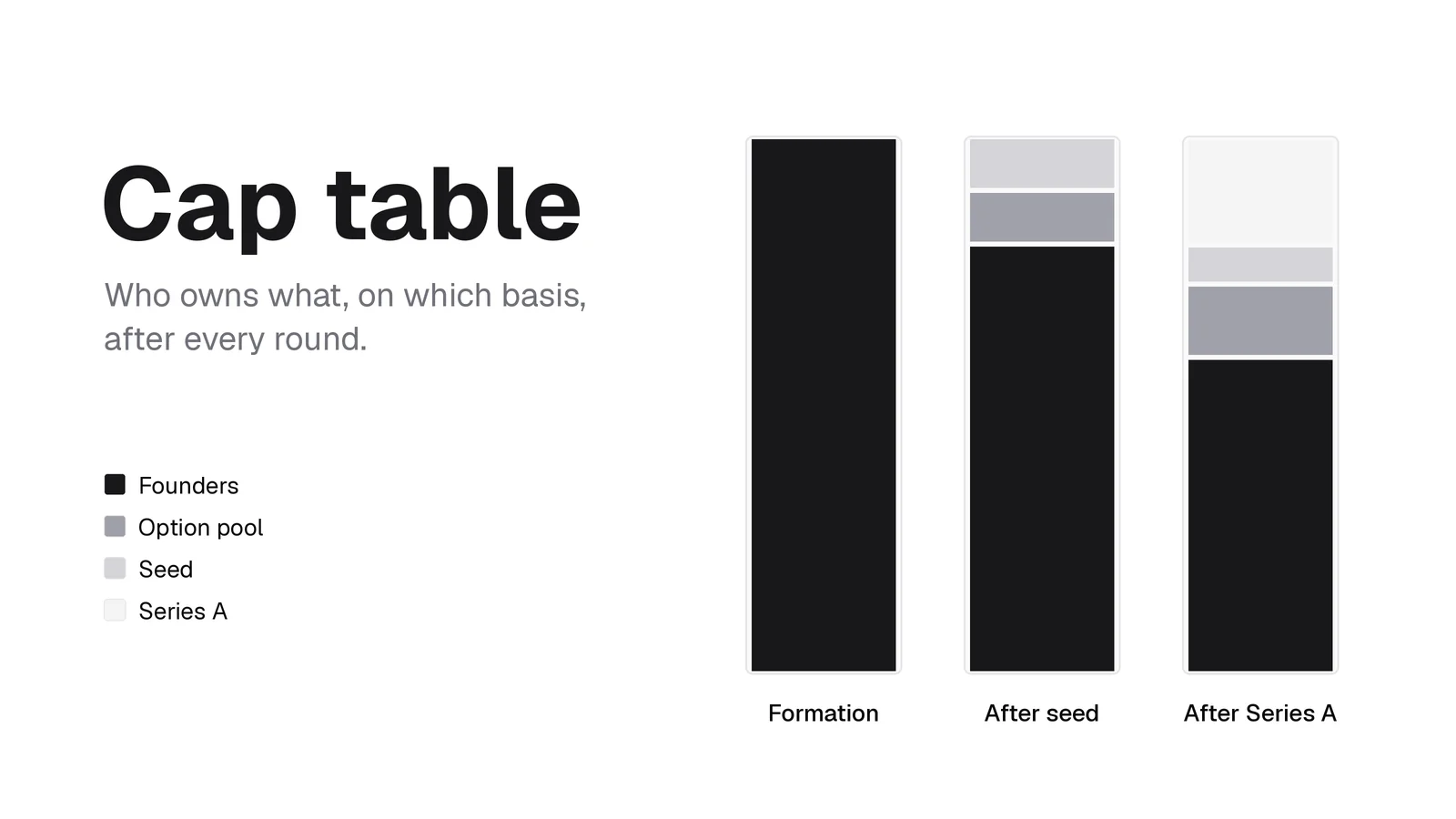
A cap table records who owns a company's shares, options, warrants, and convertible securities, and what percentage each holder owns on a stated basis.