
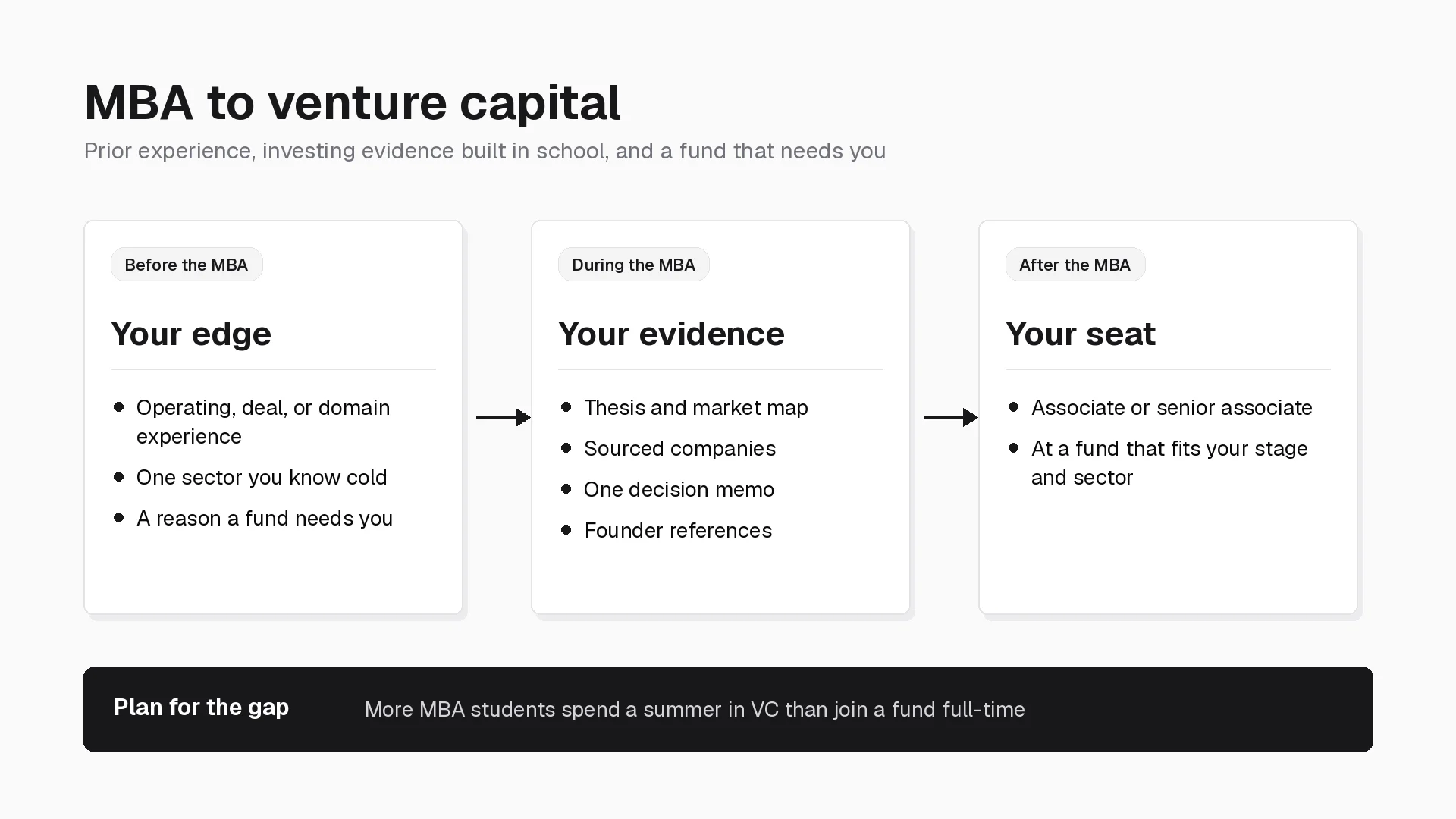
Yes, you can move from an MBA to venture capital, but only a small slice of each class does it. Venture capital took 6% of full-time job acceptances in the Stanford GSB Class of 2025 and 2.8% at Wharton. The candidates who convert pair pre-MBA experience a specific fund needs with investing work done during the program.
The degree adds alumni, founders, investment clubs, summer internships, and two years to change direction. It does not prove that you can source companies, form an investment view, or earn a founder's trust. Business school is where you turn your prior career into that proof for a short list of funds.
Strong MBA candidates arrive with a specific edge: a fintech operator who can name overlooked infrastructure companies, a healthcare consultant with a credible market thesis, or a banker who can underwrite later-stage businesses without losing sight of product and founder quality.
Can you get into venture capital after an MBA?
An MBA-to-VC move is realistic when three things line up.
- Fund fit. Your sector knowledge, operating experience, network, or transaction skills match what a particular fund needs.
- Visible evidence. You can show work that resembles the job, such as a market map, an investment memo, a sourced-company list, or a founder reference.
- Timing. You are in the conversation when a small investment team has budget and a defined need.
The degree helps with the first two. It cannot control the third. Most venture funds have small teams and no fixed campus calendar. A seat opens when a fund closes new capital, expands into a sector, promotes an investor, or needs help with sourcing and diligence. A narrow, continuous search beats waiting for a recruiting window.
Post-MBA candidates with prior experience usually target associate or senior associate roles. Titles vary by fund, so judge the work, the decision authority, and the apprenticeship rather than the title. The venture capital career path lays out how those seats differ, and the VC associate guide covers what the role expects.
How many MBA graduates go into venture capital
Leading MBA programs publish an annual employment report, many of them under the MBA CSEA reporting standards, and many list venture capital as its own line. Those reports are the only reliable answer to "how many MBAs go into VC," and they show a small, volatile number.
| Program and class | VC share of full-time acceptances | Median base salary in VC | What else the report shows |
|---|---|---|---|
| Stanford GSB, Class of 2025 | 6% | $212,500 | 426 graduates; 16% started a business and 13% were company-sponsored, so neither group appears in the job tables |
| Wharton, Class of 2025 | 2.8% | $170,000 | 879 students and 529 reported acceptances, so 2.8% is roughly 15 people |
Three habits make these numbers useful.
Turn the percentage into a headcount. Multiply the VC share by the number of reported acceptances, not by the class size. A 3% line in a class of 500 job-takers is about 15 people, which is a cohort you can find and talk to before you apply.
Check whether VC stands alone. Some reports fold venture capital into a combined private equity and venture capital line. At Stanford and Wharton, private equity took roughly three to five times the VC share of full-time jobs, so a combined line mostly measures buyout hiring. Use the VC-only line when one exists.
Read more than one year. Wharton's VC share of accepted full-time jobs ran 3.0%, 1.2%, 2.3%, 3.3%, 3.4%, and 2.8% for the classes of 2020 through 2025, per its career statistics. A single year can halve or double with the fundraising market, so judge a program on the range.
For pay beyond the first year, use the venture capital salary guide. Report medians cover base salary only and exclude carried interest.
Why a VC summer internship is not a full-time offer
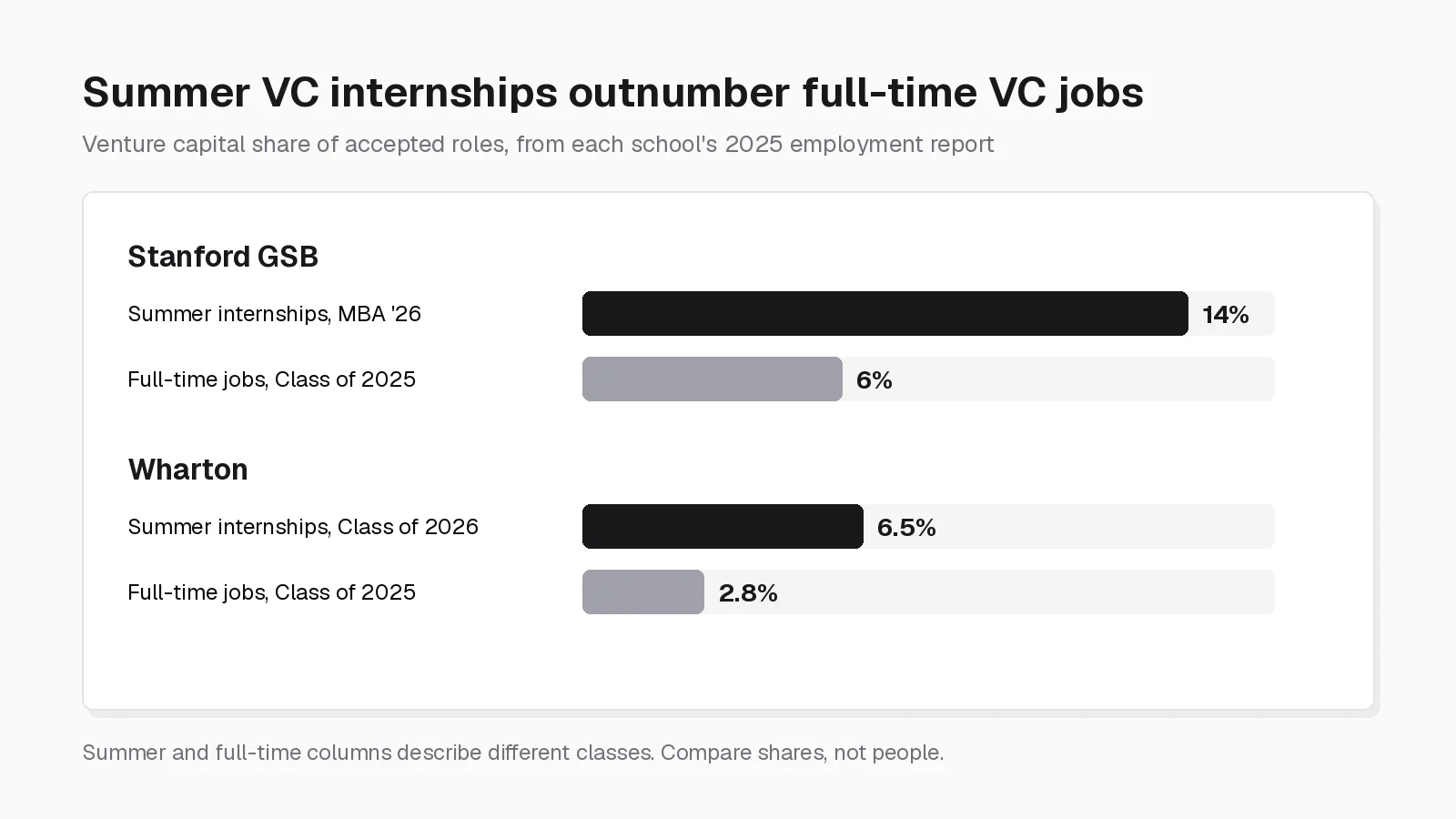
The same reports show a second pattern. Venture capital takes a much larger share of MBA summer internships than of full-time jobs.
| Program | VC share of summer internships | VC share of full-time acceptances |
|---|---|---|
| Stanford GSB | 14% (MBA '26 summer) | 6% (Class of 2025) |
| Wharton | 6.5% (Class of 2026 internships) | 2.8% (Class of 2025) |
The two columns describe different classes, so they are not a conversion rate. The pattern still holds at both schools. More students spend a summer in venture capital than join it full-time. At Wharton, 6.5% of 776 internship acceptances is roughly 50 VC summers, against roughly 15 full-time VC acceptances in the class before.
That gap changes how to use the summer.
- Treat the internship as evidence, not a job offer. Leave with sourced companies, a memo that went to a partner meeting, and two references who watched you work.
- Ask about hiring plans early. In the first weeks, ask whether the fund expects to add a post-MBA investor and what would make that hire happen. A fund between raises may have no seat to offer, however strong the summer.
- Line up the second-year search before you leave. Plan for a second-year offer to come from in-term work, relationships, and funds that hire when a need appears, rather than counting on the summer fund to convert you.
- Keep a non-VC summer in view. A summer in a startup operating role, corporate venture capital, or a sector you want to invest in can produce stronger evidence than a short, unpaid fund stint.
For the mechanics of landing the summer role itself, use the venture capital internship guide and the VC internship interview questions.
Is an MBA worth it for venture capital?
An MBA is a weak investment if the only thesis is "top funds hire MBAs." The reports above show only a few percent of each class getting there. It can be a strong bridge when it changes the people, experiences, and fallback roles available to you.
Use four tests before treating VC as the reason to enroll.
| Test | Question | A strong "yes" looks like |
|---|---|---|
| Access gap | Will the program put you near investors, founders, and markets you cannot reach now? | Alumni at your target funds, venture labs, student funds, and an active startup ecosystem nearby |
| Evidence opportunity | Can you do credible investing work during the program? | A fund internship, in-term fund work, independent sourcing and diligence, or a body of written investment work |
| Downside option | If a VC role does not appear, does the MBA improve another path you would value? | A startup operating, corporate development, consulting, banking, product, or growth role that builds a later VC edge |
| Cost | Do tuition plus forgone income still make sense in the downside case? | The decision works without assuming entry into a well-known fund |
The MBA is more likely to pay off when you need a network reset, a move to a new city, a business foundation, or structured time to reposition a strong but poorly translated background. It is weaker when you already work in venture, already have direct access to funds, or would take on cost that only makes sense under the VC outcome.
If you are still deciding whether to apply at all, the guide to breaking into venture capital without an MBA covers the routes that skip the degree.
How to judge an MBA program for venture capital
The best MBA for VC is the one that gives you access to the funds you would fit. Brand and a headline placement percentage matter less than that. Score each program you are considering on the evidence below.
| Criterion | Where to find it | What a strong answer looks like |
|---|---|---|
| VC headcount | Employment report, industry table | A VC-only line you can convert into a number of people |
| Summer VC share | Employment report, internship table | Funds hire interns from the program, a sign they recruit there |
| Source of offers | Employment report, "source of job acceptance" table | A high graduate-facilitated share means students find their own roles; at Stanford it was 46% of full-time acceptances |
| Geography | Your target-fund list | The school sits near the cluster of funds you want, or runs treks and terms there |
| VC curriculum | Course catalogue | Venture finance and hands-on courses with real deals, such as the venture capital track in Kellogg's PE and VC specialization, which pairs Entrepreneurial Finance and Venture Capital with a Venture Lab course |
| Investing vehicles | Club and center pages | A student-run fund, a venture fellows program that places students at funds during the term, or a club that runs diligence projects |
| Alumni at your funds | Team pages of your Tier 1 funds | Named alumni at funds that match your stage and sector |
| Cost and downside | Tuition, aid, and forgone salary | The program still makes sense if your first job is not in VC |
Ask current students two questions the report cannot answer. Which funds hired first-years for the summer, and how did those students get the role? Who in the last two classes went to VC full-time, and from which pre-MBA backgrounds?
A school with a lower VC share can be the better choice if its alumni sit at the exact seed or sector funds on your list. Prestige moves the first conversation. Fund fit decides the offer.
For course options outside a degree, the list of venture capital courses covers programs you can take before or alongside an MBA.
Match your pre-MBA background to the right fund
Your prior career is the most credible reason a fund might choose you over another MBA. The work is to translate that background into a specific investing advantage.
| Pre-MBA background | Where it can fit | Evidence to build during the MBA | Likely gap to close |
|---|---|---|---|
| Investment banking or private equity | Growth-stage, sector-focused, capital-intensive, or complex-deal funds | A market thesis, product-led diligence, founder references, and early-stage judgment | Assessing teams and markets without mature-company models |
| Management consulting | Thesis-driven, sector-focused, corporate VC, or platform-heavy funds | Original sector research, sourced companies, and short investment recommendations | Moving from polished analysis to a clear yes or no under uncertainty |
| Startup operator | Early-stage funds investing in your function or sector | Founder network, product and customer insight, sourced companies, and portfolio-support examples | Financial and portfolio-construction fluency |
| Engineer, scientist, clinician, or domain expert | Deep-tech, healthcare, climate, biotech, enterprise, or specialist funds | A technical market map, expert calls, product diligence, and a plain-language memo | Commercial judgment and writing for non-specialists |
| Founder | Seed funds, founder-led funds, accelerators, or venture studios | An honest postmortem, founder references, a thesis, and examples of helping other founders | Selectivity rather than automatic founder affinity |
| Public sector, nonprofit, research, or another nontraditional path | Regulated, impact, defense, education, healthcare, or emerging-market funds | A narrow thesis, a relevant network, sourced opportunities, and finance fundamentals | An explicit link to returns and the fund's mandate |
The matching unit is stage, sector, and task, not "finance versus non-finance." A former enterprise software product manager may be unusually credible at a seed fund evaluating developer tools. The same candidate may have little edge at a late-stage consumer fund. A banker with software deals may be strong at growth underwriting but still need to prove early-stage sourcing and product judgment.
Write a one-sentence positioning statement.
I help [type of fund] evaluate and win [type of company] because I have [specific experience or access], and I can show it through [evidence].
Example: "I help seed-stage climate funds evaluate industrial decarbonization companies because I spent four years selling into plant operators, and I can show it through a market map, five founder relationships, and two investment memos."
If the statement could apply to 500 funds, it is a biography, not a position. Narrow it until it names a fund type you can list.
Candidates from common feeder roles can go deeper with the playbooks for investment banking to venture capital, consulting to venture capital, and startup operator to venture capital. The MBA-specific task is to use the program to close the gap that remains.
Build proof that you can already do the work
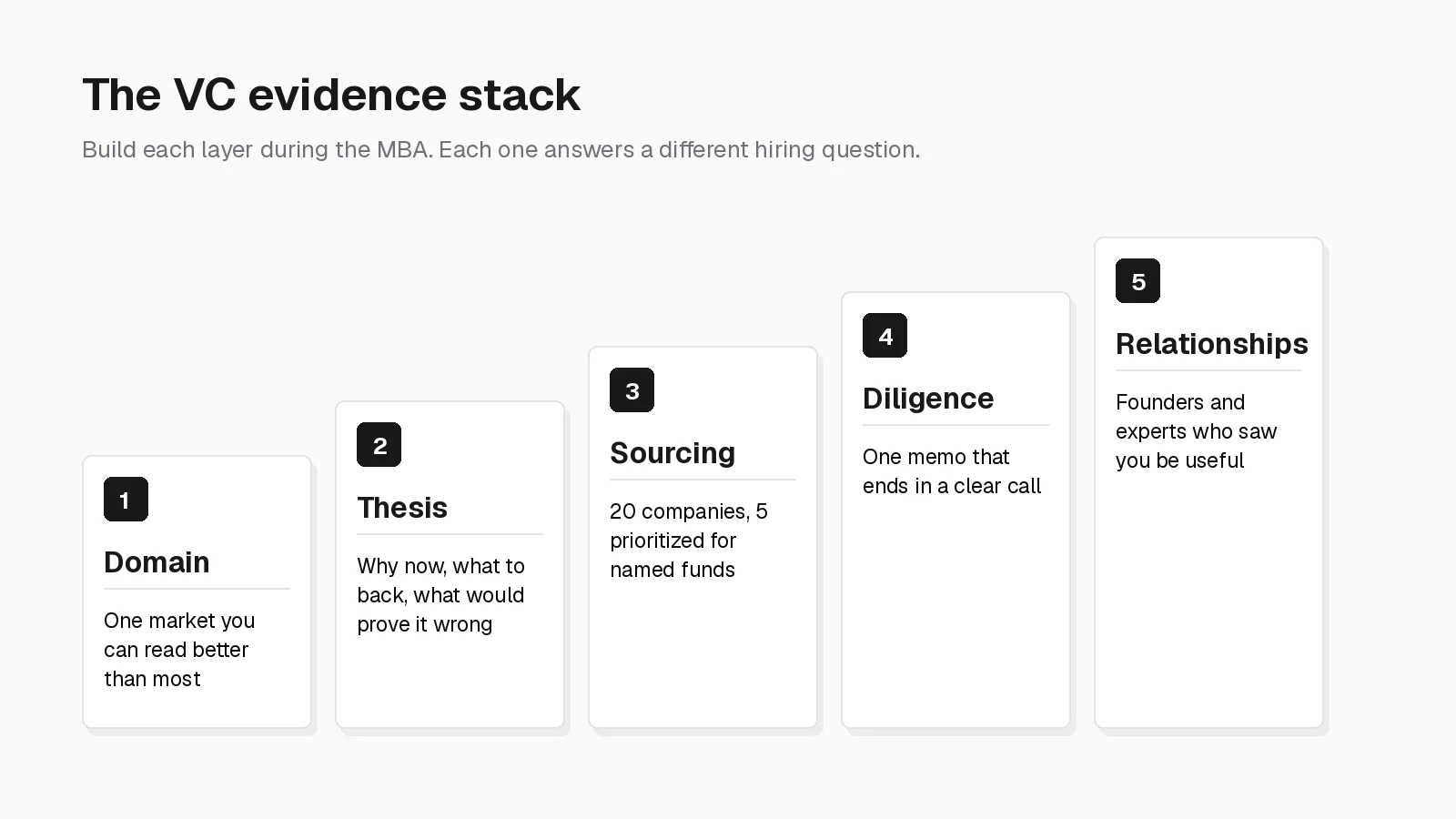
Interest is cheap. Funds want evidence of how you think, what you notice, and whether you create useful opportunities. Build it in five layers.
| Evidence | Minimum useful version | What it demonstrates |
|---|---|---|
| Domain | A clear view of one market, customer, or technology based on direct experience and research | You have a reason to see what others miss |
| Thesis | A two-page argument covering the change, why now, investable categories, risks, and disconfirming signals | You can form and revise an investment view |
| Sourcing | A list of 20 relevant companies, five prioritized, each with a reason it fits a named fund | You can turn a thesis into deal flow |
| Diligence | One short investment memo covering market, team, product, traction, risks, and a recommendation | You can make a decision, not just describe a company |
| Relationships | Founder, operator, customer, or expert references who have seen you be useful | You can earn trust in the ecosystem |
One memo that makes a clear call and names what would change your mind beats ten company summaries. A focused venture capital market map beats a logo collage with no inclusion rule.
Match the evidence to the fund. A pre-seed investor weighs proprietary sourcing, founder judgment, and an early thesis. A growth investor weighs cohort economics, competitive position, and financing scenarios. A corporate venture team weighs strategic relevance and how you work with internal stakeholders.
Personal angel investing is not required. Writing checks to look investable adds financial and ethical risk. A documented fantasy portfolio, sourcing notes, a student-fund role, or supervised diligence show the same judgment, and the thinking is visible.
Use the program for investing repetitions
Most of the value of an MBA for VC sits outside the classroom. Pick resources that each produce a piece of the evidence stack.
| Resource | What to get from it | Evidence it produces |
|---|---|---|
| VC club | Treks, speaker series, alumni lists, diligence projects | Introductions at target funds and a first sourced-company list |
| Student-run fund or venture fellows program | Screening and diligence on real deals; some programs place students with funds during the term | Memos that went to an investment decision and a reference from an investor |
| In-term fund work | Part-time sourcing or diligence for a fund during the semester | Repetitions and a relationship with a team that may hire |
| Venture Capital Investment Competition (VCIC) | Student teams diligence real startups and pitch an investment to VC judges | A diligence process and investment pitch judged by practitioners |
| Venture finance and lab courses | Term sheets, cap tables, fund economics, and real company projects | The vocabulary VC interviews test, plus a project to discuss |
| School incubator and founder classmates | Early access to companies before they raise | Sourcing judgment and founder references |
Join one investing vehicle and run it seriously rather than sampling four. A partner remembers the student who sent a sharp screen on a company the fund later met, not the one with the longest club list.
Post-graduation fellowships are a separate route with their own timing; see the guide to the venture capital fellowship.
Build a target-fund list before you network
"Venture capital" is not a target market. A seed healthcare fund and a multi-stage consumer investor may share titles but hire for different networks, judgment, and daily work. Build a list with these fields.
| Field | What to record |
|---|---|
| Fund | Firm name and a stable profile URL |
| Stage | Pre-seed, seed, Series A, multi-stage, growth, or corporate VC |
| Sector | The actual investment focus, not the website slogan |
| Geography | Where the fund invests and where the team sits |
| Portfolio fit | Two or three investments that reveal the thesis |
| Role type | Investing, sourcing, platform, fellowship, internship, or operating |
| Your edge | The domain, network, function, or geography you add |
| Warm path | Alumni, founder, classmate, professor, operator, or none yet |
| Evidence to send | The thesis, company, market map, or memo most relevant to this fund |
| Next action | Research, request an introduction, send an insight, follow up, or monitor |
Start the universe in the Venture Capital Careers companies directory, then check each firm's current website, team, portfolio, and stage. Do not personalize an email from a stale description.
Sort the list into three tiers.
- Tier 1, clear fit. Your evidence maps to the fund's stage and thesis, and you have a plausible path to an introduction.
- Tier 2, credible stretch. The fit is real, but you need a stronger artifact, a new connection, or more relevant experience.
- Tier 3, monitor. The fund is attractive, but the case for hiring you is not yet specific.
Spend most of your time on Tier 1. An emerging manager whose reach your network extends can be a better first seat than a famous platform where your background is interchangeable.
Run the search on an MBA timeline
VC hiring rewards being ready at an unpredictable moment. Build the assets and relationships before a role appears, and plan the two years around the summer-to-full-time gap.
| Stage | Primary objective | Deliverables |
|---|---|---|
| Pre-MBA | Translate your background and close knowledge gaps | One positioning statement, one sector thesis, a finance and accounting refresh if needed, and a first list of 30 funds |
| First term | Test the thesis and build relationships | Ten investor conversations, five founder or customer calls, one market map, and a seat on a student investing vehicle |
| Spring | Produce decision-quality work and secure the summer | One strong memo, a prioritized company list, targeted internship outreach, and interview practice |
| Summer | Accumulate real repetitions | Sourcing, diligence, or portfolio work with clear learning goals, two references, and an early read on the fund's hiring plans |
| Second year | Convert evidence into focused recruiting | In-term fund work, an updated thesis, two tailored work samples, a smaller Tier 1 list, and outreach tied to fund needs |
| Post-MBA | Keep optionality while the search continues | A bridge role that builds your edge, a maintained founder and investor network, current artifacts, and alerts for relevant openings |
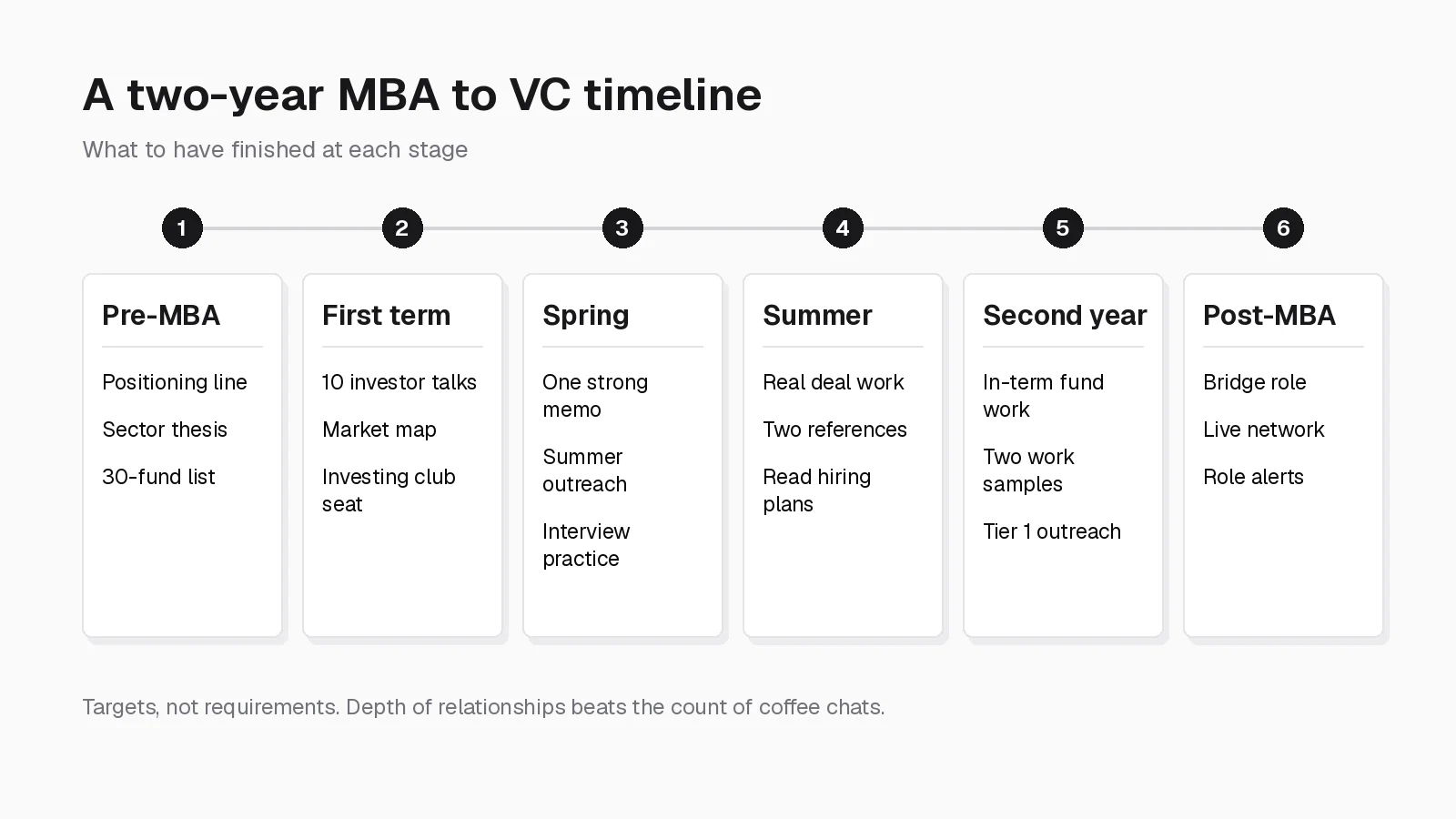
The numbers are operating targets, not requirements. Three relationships that produce candid feedback and introductions beat ten shallow coffee chats.
Keep a weekly rhythm so the search does not collapse into occasional networking.
- One new founder, operator, customer, or expert conversation
- One meaningful investor follow-up
- One update to the thesis, market map, or company list
- One hour reviewing current firms and roles
- One written note on what changed in your view
Browse the VC job board from the first term onward. Listings show how funds describe the work and which evidence they ask for, even when the timing is wrong. For when funds tend to hire across a year, see the venture capital recruiting timeline.
Network by making the conversation useful
The first message needs a reason to talk that is more specific than your career goal. Weak outreach asks an investor to explain venture capital or review a resume. Strong outreach connects your background to the fund and brings something to discuss.
- A company that matches the fund's thesis
- A short market observation from customer or operator experience
- A question about how the fund weighs two competing risks
- A market map with a stated inclusion rule
- A memo excerpt with one disputed assumption you want challenged
Keep the request small. Ask for 15 minutes to pressure-test a view, not open-ended mentorship. Afterward, send a short note on what changed in your thinking and, when it is warranted, one useful update a few weeks later.
A practical message has four parts.
- Relevance. One sentence connecting your experience to the investor's focus.
- Evidence. One concrete observation, company, or artifact.
- Question. One decision-relevant question that proves you did the work.
- Ask. A bounded request for feedback or a short call.
The venture capital networking guide covers relationship strategy, and the VC networking email templates give copy to adapt. Rewrite the evidence and the question for each investor. Swapping the name is not personalization.
Track each relationship in your fund list. "Connected" is not a status. Record the last useful exchange, what the person cares about, what you promised, and the next follow-up.
Prepare for the VC interview process
VC interviews vary by fund, but the evidence you built should supply most of the material. Prepare six assets.
- Career logic in two minutes. Why your background, why investing, why now, and why this fund.
- A fund-specific thesis. What the firm believes, where you agree or disagree, and what change could open a new opportunity.
- A market view. One sector you know well enough to define investable categories, risks, and timing.
- A sourced company. Why it fits the fund, what makes it non-obvious, and what you would learn next.
- An investment recommendation. A clear yes, no, or not yet, backed by a short memo or case.
- A relationship example. How you earned trust with a founder, operator, customer, or difficult stakeholder.
An investment answer is not a book report. State the decision, name the two or three variables that drive it, and say what would prove you wrong. If you cannot explain why a promising company is wrong for a particular fund, your fund research is still too shallow.
Work through the venture capital interview questions for the common formats, then rehearse the decision itself with the VC case study interview guide. Ask a classmate or practitioner to attack the recommendation, not polish the slides.
What to do if direct post-MBA entry does not work
If no VC seat appears by graduation, take a bridge role that improves at least one of three assets.
- Domain access. Deeper knowledge of a market, technology, customer, or geography.
- Founder trust. Direct experience building, selling, hiring, or solving operating problems.
- Investing repetitions. More sourcing, diligence, market analysis, transactions, or portfolio work.
Compare the options against that rule.
| Bridge path | What it can add | Watch-out |
|---|---|---|
| High-growth startup operating role | Founder empathy, domain depth, customer insight, and an ecosystem network | Pick work close to product, customers, strategy, or growth, not a logo with no relevant responsibility |
| Corporate venture capital | Investment process, strategic diligence, and sector access | Check whether the team makes investment decisions or mainly manages partnerships |
| Accelerator, fellowship, or venture platform role | Founder network, sourcing, events, and exposure to many companies | Confirm the work builds evidence for the investing tasks you want |
| Entrepreneur-in-residence or chief-of-staff role at a portfolio company | Operating depth inside a VC-backed company and a relationship with its investors | Agree on scope up front so the role is not just project overflow |
| Growth, strategy, or corporate development | Market analysis, transaction experience, and executive decision exposure | Keep building early-stage judgment and founder relationships outside the day job |
| Banking, consulting, or growth equity | Analytical rigor and sector coverage | Another credentialed role does not by itself fix sourcing or founder trust |
The best bridge is not always the one closest to a fund on paper. It is the one that compounds your edge and leaves time to stay active in the ecosystem.
While in the bridge job, keep the VC search specific. Maintain a thesis, help founders where you can, update the target list, and keep watching open venture capital roles. The next move should rest on better evidence than the last attempt.
Common MBA-to-VC mistakes
Treating the school brand as proof
Brand increases access. It does not demonstrate sourcing, judgment, or founder trust. Convert every networking advantage into an artifact, a relationship, or a real repetition.
Reading a combined PE and VC number as a VC number
A school that sends 15% of its class into "PE/VC" may send only a few percent into venture. Use the VC-only line and turn it into a headcount.
Assuming the summer fund will convert you
More MBA students spend a summer in VC than join it full-time. Run the second-year search as if the summer offer will not come, and treat a return offer as upside.
Networking across the entire industry
Broad outreach produces generic conversations. Narrow by stage, sector, geography, and role, then bring evidence relevant to that slice.
Writing generic investment memos
A memo on a famous company rarely proves sourcing or a differentiated view. Choose a company that fits a target fund and explain what is not obvious, what the key risk is, and what would change the decision.
Waiting for on-campus recruiting
Small teams hire when a need appears, not when the school calendar says they should. Build relationships and work samples early enough to be remembered when timing changes.
Using personal capital as a resume tactic
Do not make speculative investments you cannot afford or understand to claim angel experience. Research, sourcing, student-fund work, and supervised diligence show judgment without the financial risk.
Frequently asked questions
Do you need an MBA to work in venture capital?
No. Funds hire former founders, operators, bankers, consultants, engineers, scientists, product leaders, and other domain experts with and without MBAs, through the same routes to becoming a venture capitalist. The degree helps most when it improves access, translates your background, and creates chances to build investing evidence. The without-an-MBA guide covers the other routes.
How many MBA graduates go into venture capital?
A small share. Venture capital took 6% of full-time acceptances in Stanford GSB's Class of 2025 and 2.8% at Wharton, which is roughly 15 Wharton graduates. Wharton's share moved between 1.2% and 3.4% from 2020 to 2025.
Which MBA is best for venture capital?
The one that gives you access to the funds you fit. Compare programs on VC headcount in the employment report, summer VC share, alumni at your target funds, location, investing vehicles such as student funds, and cost. A school with a lower VC share can be the better pick if its alumni sit at the seed or sector funds on your list.
Does a VC summer internship lead to a full-time offer?
Sometimes, but not reliably. At Stanford GSB and Wharton, the VC share of summer internships was more than twice the VC share of full-time jobs. Use the summer to build evidence and references, and run the second-year search in parallel.
How much do MBA graduates earn in venture capital?
Median base salary for venture capital was $212,500 for Stanford GSB's Class of 2025 and $170,000 at Wharton, per their employment reports. Both are base salary only and exclude bonuses and carried interest. The venture capital salary guide covers pay by level.
What VC role can an MBA graduate target?
Associate and senior associate are common targets, but titles vary. Some candidates enter through fellowships, internships, corporate VC, platform roles, or operating roles. Judge responsibilities, exposure to investment decisions, mentorship, and progression rather than the title. The VC associate job description shows what the seat involves.
Can a non-finance MBA candidate break into VC?
Yes, especially when operating, technical, scientific, geographic, or customer expertise fits a fund's thesis. Close the finance gap with coursework and practice, but keep the background that makes you different.
Turn the MBA into an investing track record
The useful question is not whether the diploma qualifies you. It is whether the program helps you become a more credible investor for a specific fund.
Start with one domain, one thesis, and a focused list of firms. Build evidence before asking for a role, and plan for the gap between a VC summer and a VC offer. Use the companies directory to research funds, browse the VC job board to see current role requirements, and create a Venture Capital Careers account to get alerts when relevant roles open.
Related posts
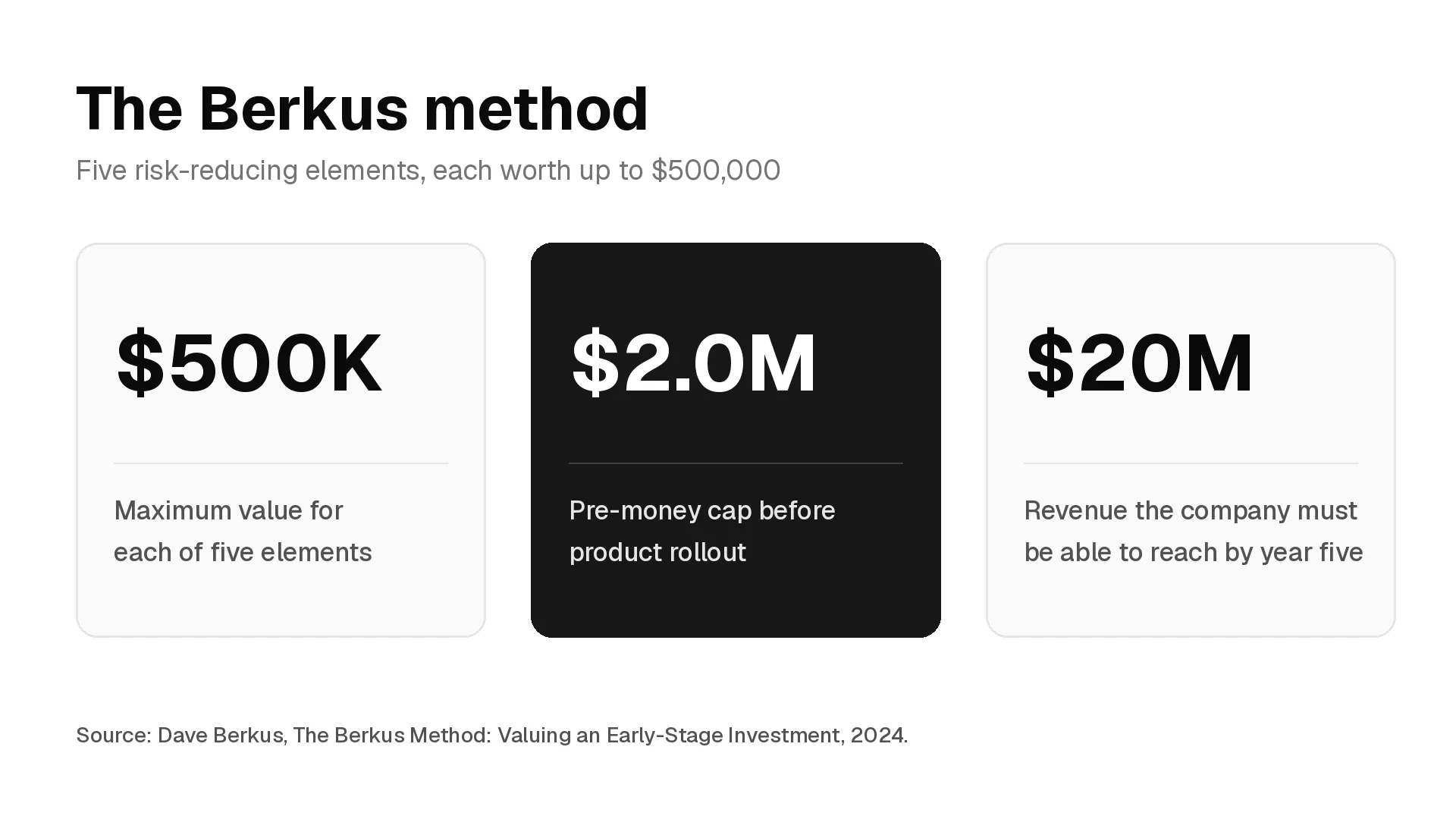
How the Berkus method values a pre-revenue startup, how to score each of the five elements, a worked example with ownership and 10x checks, how the $500,000 caps compare with current seed prices, and how VC analysts use it in memos and interviews.
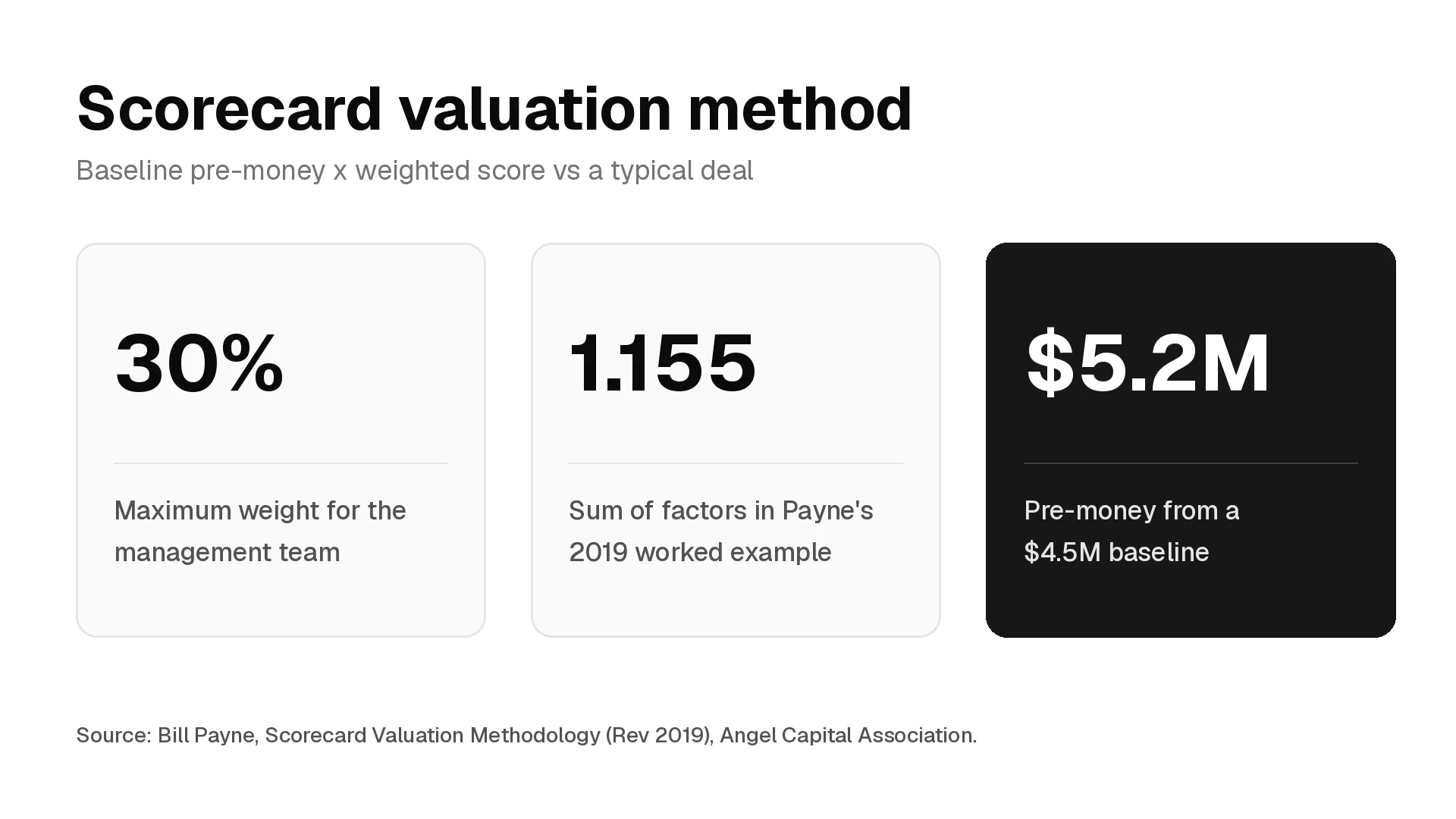
How the scorecard valuation method works, Bill Payne's seven factor weights, his worked example with the arithmetic checked, how to choose the baseline with current seed data, how sensitive the answer is, and how VC analysts use it in memos and interviews.
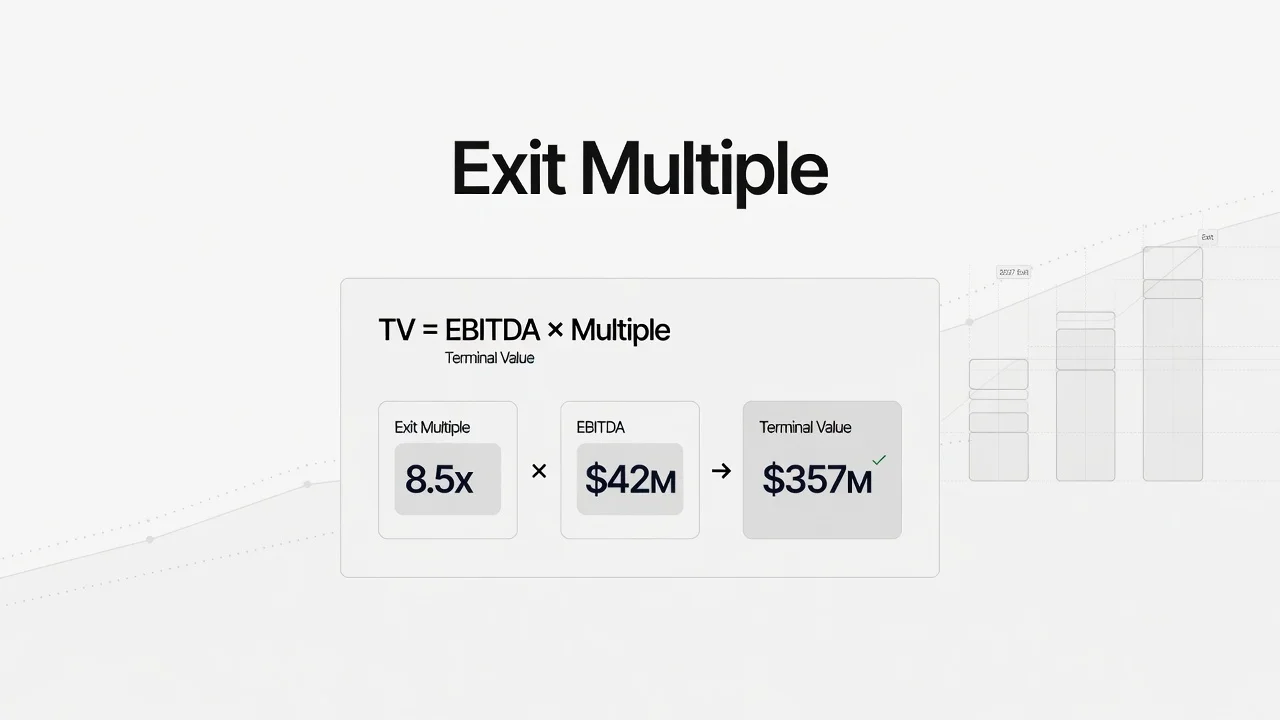
Exit multiple formula, a worked DCF terminal value example with a sensitivity grid, the implied growth cross-check, January 2026 industry multiples, and how VC investors use exit multiples.