
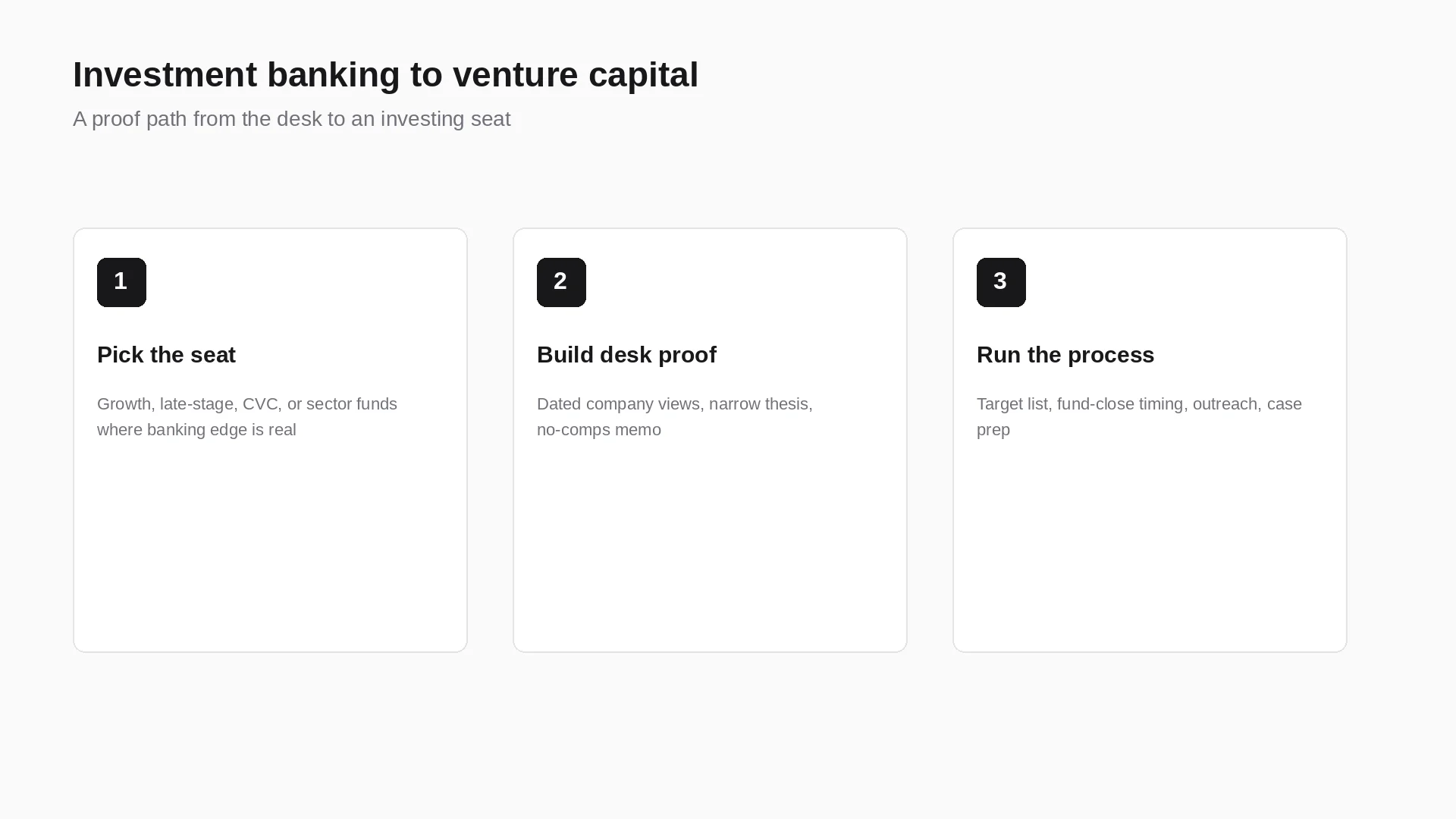
Investment bankers can move into venture capital, but the path is uneven and relationship-driven. Banking proves process stamina, financial literacy, and sector exposure. VC seats still require evidence banking rarely forces into the open: independent market taste, founder fluency, and the ability to source companies before a process exists.
The strongest banker-to-VC candidates do not lead with modeling skill. They show they can name a market with specific companies in it, write a recommendation that ends in invest or pass, and talk to founders without sounding like confirmatory diligence.
Use this process if you are an investment banking analyst or associate targeting a VC analyst, associate, growth, late-stage, sector, corporate venture, or adjacent investing seat.
Can investment bankers get jobs in venture capital?
Yes. Banking is a recognized background for venture capital, especially at growth, late-stage, crossover, fintech, software, healthcare, climate, and other sector funds where diligence and financial judgment matter. Firms understand what a banking seat trains.
Banking is not a complete VC apprenticeship. In banking, the firm usually controls the mandate and you execute. In VC, juniors are often paid to create opportunities, form a view before the market settles, and live with multi-year feedback loops.
Translate banking signals into investor language:
| Banking signal | Why VC firms care | Where it can fall short |
|---|---|---|
| Financial modeling | You can read business models, capitalization, dilution, and downside cases | Early-stage companies often lack the history a full model needs |
| Deal execution | You know how diligence, counsel, and closings move | Many VC seats also score sourcing and founder judgment |
| Industry coverage | You can build market maps and understand buyers | You still need a view on startups, timing, and venture-scale outcomes |
| Client communication | You can write clearly and handle senior stakeholders | Founder calls reward curiosity more than scripted process |
| Work ethic | You can handle volume and ambiguity | Effort alone does not prove investment taste |
For the career comparison between the two industries (work, pay, and day-to-day), see investment banking vs venture capital. This page stays on the move itself.
Why the IB-to-VC move is harder than IB-to-PE
Private equity recruiting has a machine: headhunters, on-cycle timing, modeling tests, and associate classes sized in advance. Venture hiring usually does not.
| Dimension | IB → PE | IB → VC |
|---|---|---|
| Process shape | On-cycle, headhunter-run | Off-cycle, network and fund-driven |
| Openings | Defined associate classes | Often one seat at a time |
| What gets tested | LBO/deal judgment | Market view, sourcing, founder judgment |
| Team size | Large execution orgs | Small investment teams |
| Deal flow source | Bankers and auctions | Networks, founders, scouts, self-generated work |
VC firms are small. A fund may have a handful of investors and hire when a new vehicle closes, a partner leaves, or a thesis needs coverage. That is why volume applications convert poorly and why specificity beats a generic "interested in venture" story.
What transfers from banking, and what to unlearn
Transfers well
Market research. Buyer lists, comps, and sector pages become thesis work: which submarkets are expanding, which customers are underserved, which incumbents are vulnerable, and which startups are credible.
Diligence discipline. Verifying claims, reconciling numbers, and pressure-testing assumptions matter when you evaluate growth, margins, retention, concentration, burn, and financing risk.
Memo writing under time pressure. Pitch books and VC memos are different formats. Clear narrative under constraint still transfers.
Professional judgment. Sensitive information, deadlines, and senior stakeholders make you lower operational risk than an untested candidate.
Unlearn before interviews
Valuation as the whole answer. Early-stage venture often cannot be solved with a polished DCF. Survey research on how institutional VCs make decisions (Gompers, Gornall, Kaplan, and Strebulaev, NBER Working Paper 22587) found limited use of net present value methods relative to multiples, IRRs, and qualitative factors, with management team quality rated as central. Use that as a calibration check: growth seats still need models, but early-stage seats buy judgment about people and markets.
Advisor distance. A pitch book presents options. An investment memo picks a path and names what would have to go wrong.
Waiting for a process. Banking delivers deal flow. Many junior VC seats exist to find companies. Nothing on a generic banking CV proves proprietary access until you build it.
Thoroughness without a decision. Seed and Series A cases reward a falsifiable view after limited information. A diligence dump can lose the room even when every fact is correct.
Which VC seats actually hire bankers
Do not target every VC role the same way.
| Seat type | Banker fit | Why it can work | Watch out for |
|---|---|---|---|
| Growth / late-stage VC | High | Revenue, cohorts, unit economics, and financing analysis matter | Can look closer to growth equity or crossover |
| Growth equity | High | Overlap with diligence and growth modeling | Less startup-native than early-stage VC |
| Sector-focused VC | Medium to high | Coverage experience can become a thesis | Needs startup views, not only public comps |
| Corporate venture (CVC) | Medium to high | Process, diligence, and corp-dev fluency | Strategic mandates can muddy a portable track record |
| Venture debt | Medium to high | Credit and analytical fit | Adjacent to VC, not always an investing-partner path |
| Seed / Series A investing | Medium | Research and communication help | Sourcing and founder judgment dominate |
| Platform / portfolio / capital markets | Variable | Finance and capital-markets support is useful | Not automatically an investing seat unless the firm says so |
If your coverage is software, fintech, healthcare, climate, consumer, industrials, or infrastructure, start with funds that invest there. Build the shortlist in the companies directory, then cross-check open roles on the VC job board.
Which banking groups position you best
Group choice matters more for VC than for PE, because many funds hire sector fluency rather than a generic process skill.
TMT / software / internet. Strongest overlap with growth and multi-stage funds. ARR, retention, payback, and rule-of-40 language already matches how those teams diligence companies. Deal processes also put you in rooms with founders, CFOs, and existing backers.
Healthcare / life sciences. Clean path into healthcare VC and biotech-adjacent funds when you can speak licensing, milestones, clinical or regulatory context, and financing windows alongside scientific partners.
Fintech, climate, industrials, defense-adjacent tech. Same logic at smaller scale: domain fluency plus a named thesis beats a generalist "I like investing" pitch.
Turn deal experience into a venture story. Weak: "Worked on the sale of a vertical software company." Stronger: "Ran sell-side work for a payments platform with high gross retention and expanding net retention, which is why vertical payments at Series B looks systematically underpriced to me." Same facts. The second version shows a view.
How to reposition your banking experience
Do not paste "interested in venture capital" onto a PE-shaped resume. Rewrite around markets, judgment, and startup relevance.
| Banking-style bullet | VC-style rewrite |
|---|---|
| Built DCF, LBO, and comps for a software client | Analyzed revenue quality, retention, margin structure, and public/private software comps to evaluate strategic alternatives and category positioning |
| Supported a sell-side process for a fintech company | Mapped the fintech buyer and investor landscape, synthesized competitive positioning, and framed diligence questions on acquisition and regulatory exposure |
| Created management presentation and buyer materials | Built an investor-facing narrative around market size, product differentiation, customer proof, and growth levers |
| Worked on Series B financing materials | Evaluated financing dynamics, dilution, investor fit, and milestones needed for the next institutional round |
Keep transaction proof. Make the investor-relevant parts legible. Then tighten the full document with the venture capital resume guide.
Build a target list (and watch fund closes)
"Every brand-name fund" is not a strategy. Filter first:
| Filter | Question |
|---|---|
| Stage | Seed, Series A, growth, late-stage, or crossover? |
| Sector | Does your coverage map to the thesis? |
| Role level | Analyst, associate, fellow, scout, platform, or senior-only? |
| Evidence fit | Can you discuss two portfolio companies with a real view? |
| Network path | Alumni, clients, founders, lawyers, bankers, or operators who can introduce you? |
| Fund timing | Has the firm recently closed a fund, or is it near the end of an investment period? |
Start with 30 to 50 firms, then cut to 10 to 15 where the case is strongest. For each finalist, write a one-page note: what they invest in, two portfolio companies you understand, one market thesis, two startups they might want to meet, and why your banking seat is relevant.
Fund timing matters because VC hiring often follows dry powder and fund closes more than a campus calendar. Track recent closes and funds near the end of an investing period. That is closer to a recruiting calendar than spraying applications across quiet partnerships.
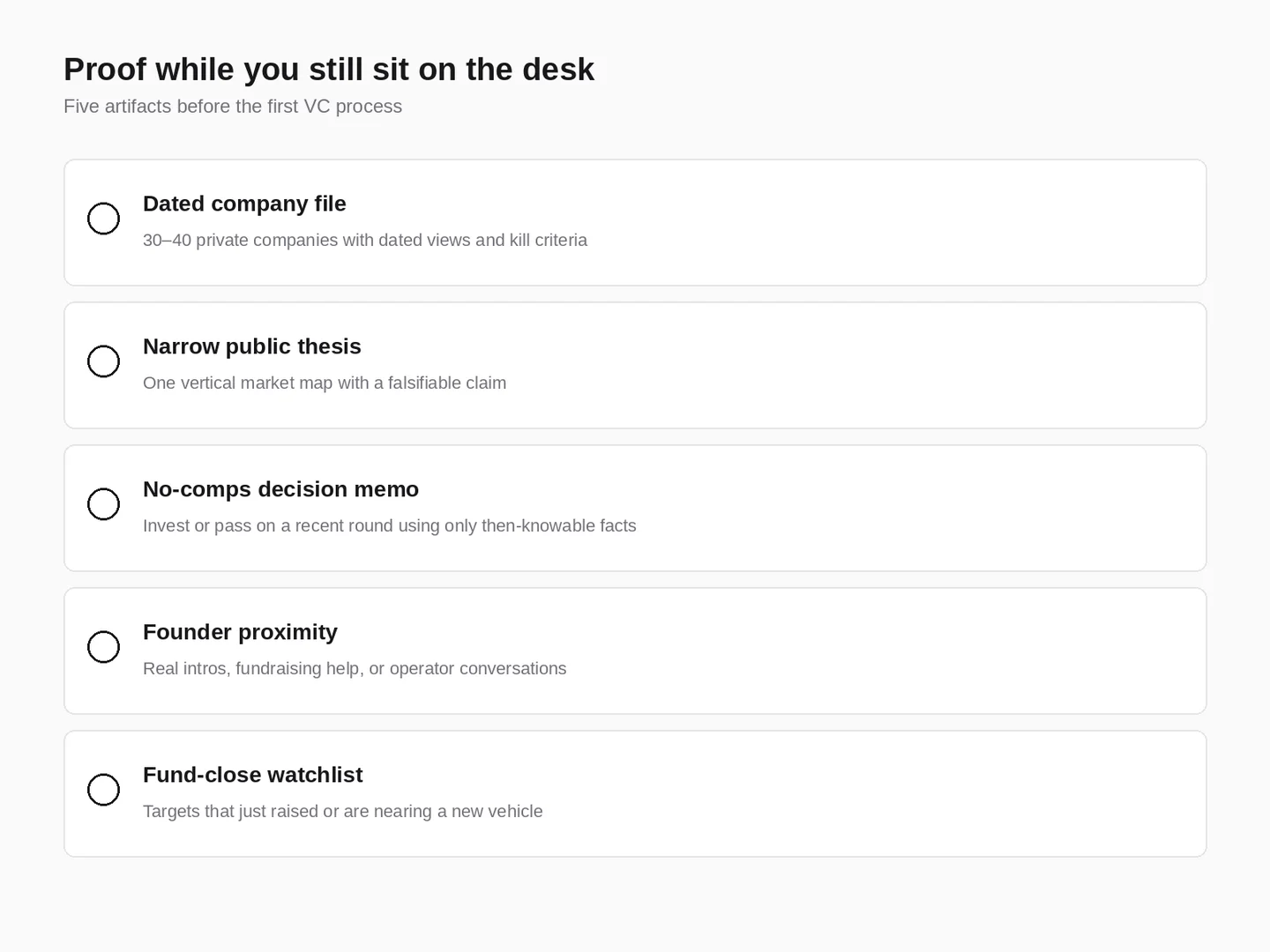
Build proof while you still sit on the desk
This is the gap most banker applications leave open. Credentials get a first look. Proof gets a second meeting.
Build a small evidence portfolio before you need it:
- Dated company file. Keep 30 to 40 private companies you met or studied in coverage. For each, write a short dated note: what you believed, why, and what would change your mind. Revisit outcomes later. That loop is interviewable judgment.
- One public, narrow thesis. Publish or circulate a short market map with a claim, not a logo dump. Depth in one vertical beats a year of funding-round summaries.
- One decision memo with no comps page. Rebuild a recent seed or Series A in a sector you covered using only what was knowable then. End in invest or pass. Name three things that must be true and one kill shot.
- Founder proximity. Unpaid fundraising help, thoughtful intros, or operator conversations beat more coffee chats with other bankers.
- Fund-close watchlist. Maintain a living list of target funds that just raised or are approaching a new vehicle. Pair that list with warm paths, not cold volume.
Scout programs, angel syndicates, and student or fellowship funds can help when available. They are not required if the five artifacts above are real.
Network like an investor, not like a generic job seeker
Many VC seats never post broadly. Outreach should give the other person something to react to.
Weak: "I am an investment banking analyst interested in venture capital and would appreciate 15 minutes to learn about your career."
Stronger: "I have been mapping vertical software for specialty healthcare clinics and noticed your investments in adjacent workflow tools. I would value your perspective on how funds evaluate go-to-market quality in that category."
Aim senior enough that the person can influence hiring, but still collect perspective from associates who live the seat. Use venture capital networking email templates for structure, then personalize around a market, portfolio company, or sourcing idea.
Bring a company or idea into early conversations when you can. Interest from one process can also create urgency in another, but only if the underlying work is real.
Prepare for VC interviews
Bankers who prepare a PE interview and walk into a VC process fail for predictable reasons.
| Interview area | What they test | How to prepare |
|---|---|---|
| Why VC, why now | Motivation and job understanding | Tie the answer to markets and company building, not hours |
| Market thesis | Independent judgment | Prepare 2 to 3 sectors with customer pain, timing, competitors, and named startups |
| Market map | Structured taste | Make a claim about where value accrues; avoid logo grids with no argument |
| Company you would back | Decision quality | Pick something non-obvious; state what must be true; name the kill risk |
| Sourcing | Ability to create deal flow | Show how you find companies and who you talk to |
| Case / memo | Investment thinking | Practice a recommendation with risks, not a diligence encyclopedia |
| Founder conversation | Curiosity and trust | Ask about pain, usage, hiring, distribution, and what has been hard |
Stay fluent on growth, margins, retention, ownership, and dilution. Do not let technical answers crowd out taste. For case rounds, use the venture capital case study interview guide with venture capital interview questions.
A 30-day IB-to-VC transition plan
| Timeline | Output |
|---|---|
| Days 1-3 | Pick 2 sectors where coverage gives a real edge |
| Days 4-7 | Build a 30 to 50 firm list with stage, sector, geography, and fund-timing notes |
| Days 8-12 | Write a one-page thesis per sector |
| Days 13-16 | Identify 10 startups per sector; write short notes on why each could matter |
| Days 17-20 | Rewrite the resume around investor-relevant work |
| Days 21-24 | Send targeted outreach with a market or sourcing angle |
| Days 25-27 | Complete one case and one no-comps decision memo |
| Days 28-30 | Review open roles, refine the shortlist, follow up with a sharper angle |
At day 30 you should have more than interest: a shortlist, a thesis, startup examples, a revised resume, outreach in motion, and a repeatable interview story.
Common mistakes bankers make
Leading with technical skill only. Modeling helps. It is not the whole hire at early-stage funds.
Sounding like confirmatory diligence with founders. Ask about customer pain, product usage, hiring, distribution, pricing, and what has been unexpectedly hard.
Targeting only famous funds. Brand-name firms are competitive and hire irregularly. Sector-focused, emerging, regional, growth, and CVC seats can be cleaner fits.
Ignoring sourcing. Even diligence-heavy JDs often sit inside a culture that expects you to find companies.
Using a PE resume. Banking resumes can win PE or corporate development screens and still miss VC.
Overstating startup experience. If you have not worked at a startup, do not invent it. Show learning speed and respectful founder conversations instead.
Treating platform roles as secret investing seats. Platform, talent, and capital-markets roles can be excellent ways into the industry. Unless the firm states a conversion path, assume the job is the job.
FAQ
Can I move from investment banking to VC after one year?
Possible, but harder than after a fuller analyst stint. You need evidence beyond the bank brand: sector focus, investor conversations, and a clear reason for moving now.
Is investment banking or consulting better for VC?
Neither wins by default. Banking helps with transaction analysis and financial discipline. Consulting helps with market structure. Funds care more about stage fit, sector fit, sourcing, and judgment. For the consulting path, see consulting to venture capital.
Do I need startup experience?
No, but exposure helps. Market maps, founder conversations, product and GTM study, investment notes, and real sourcing can substitute when they are specific.
Should bankers target growth equity instead of early-stage VC?
Growth equity or late-stage VC is often the cleaner first move if you like data-rich diligence. Early-stage can work with stronger sourcing and founder-judgment proof.
What should I put on my resume?
Prioritize market mapping, business model analysis, growth drivers, customer quality, competitive positioning, financing dynamics, and diligence questions. Keep transactions. Do not let process execution crowd out judgment.
Will compensation drop?
Often, at least in cash for several years. Carry can matter later and is uneven at junior levels. Model the cash cut explicitly so the interview answer does not sound naive. For broader progression context, see the venture capital career path and venture capital salary guide.
Find VC roles that match your banking edge
The best banker-to-VC move is specific. Pick the stages and sectors where coverage creates an unfair starting point, then show proof that you can think like an investor while you still sit on the desk.
Research firms in the companies directory, browse open roles on the VC job board, and create an account so alerts match the shortlist. Then tighten the VC resume, send targeted networking emails, and prepare for the case-study interview before the first process starts.
Related posts
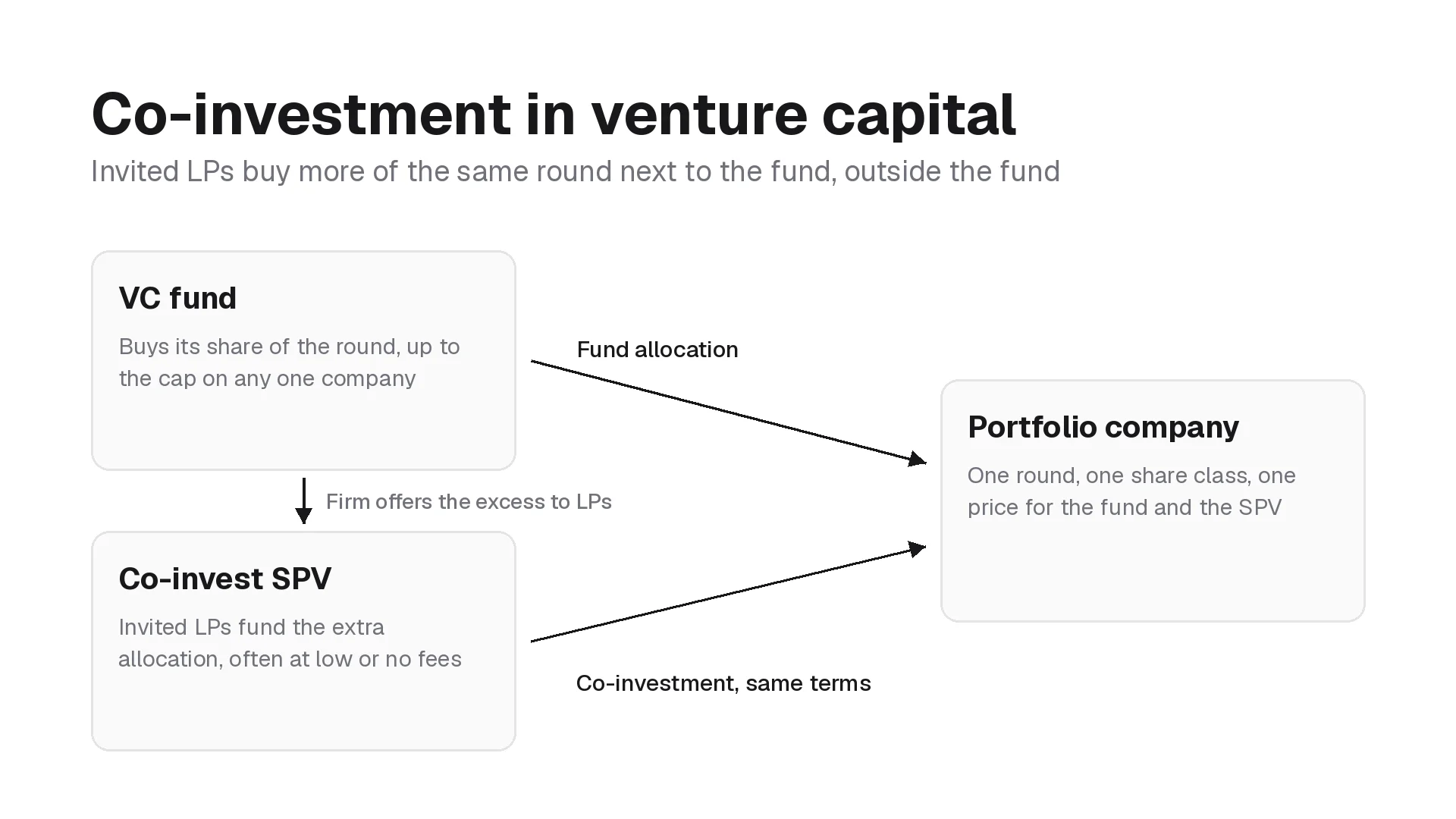
A venture capital co-investment lets LPs put money into one startup next to the fund, outside the fund, usually at lower fees. Here is how the offer works, what the terms cost, why late-stage venture co-investments carry extra risk, and what co-investment means for people who work at VC firms.
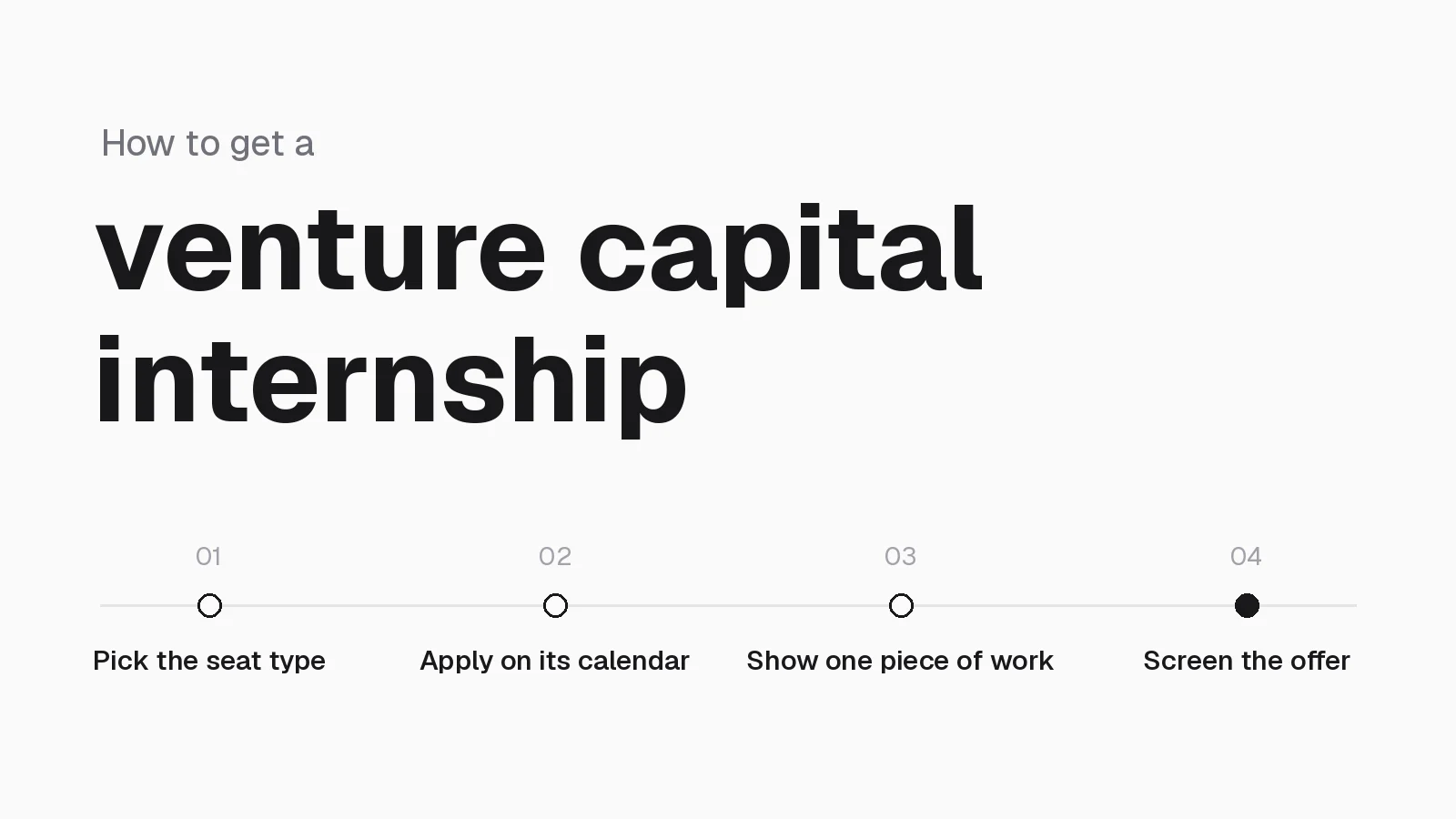
How to get a venture capital internship: the five internship types, which firms hire interns, when structured programs and small funds recruit, what interns are paid and when unpaid is legal, outreach with proof, interview questions, and how to screen an offer.
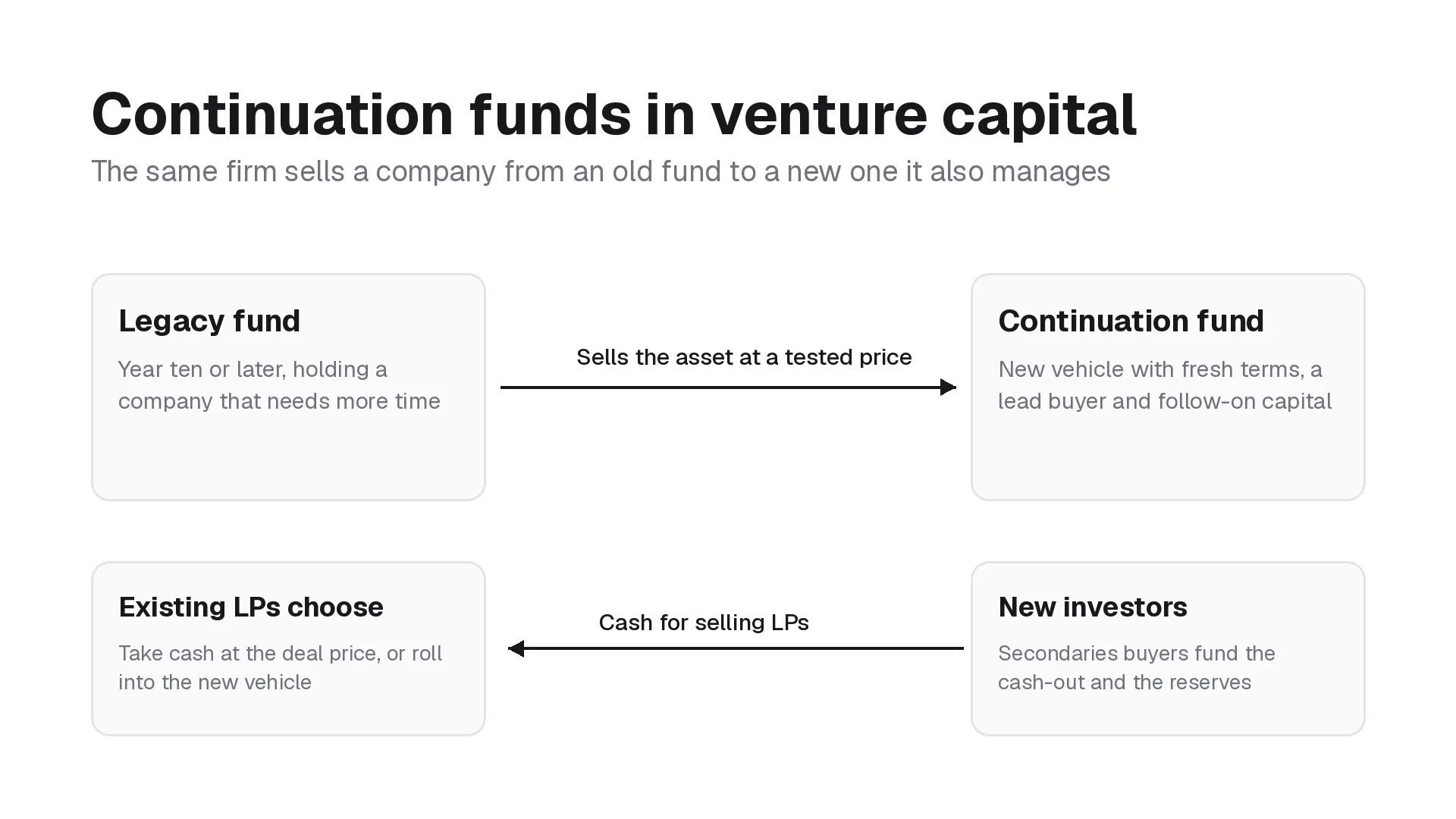
A continuation fund lets a VC firm sell a company from an old fund to a new vehicle it also manages, while LPs choose cash or a roll. Here is how the deal works, how price, fees and carry are set, and what it changes for people who work at the firm.