A venture capital fellowship is a time-boxed program that puts you inside investor work: sourcing companies, writing memos, practicing diligence, and building a network that can later refer you into full-time roles. Some programs last a week of immersion. Others run for months or two years with curriculum, partner feedback, and alumni access.
The right fellowship helps you test whether venture capital fits before you chase analyst or associate seats. The wrong one becomes an expensive line on a resume with little hiring signal.
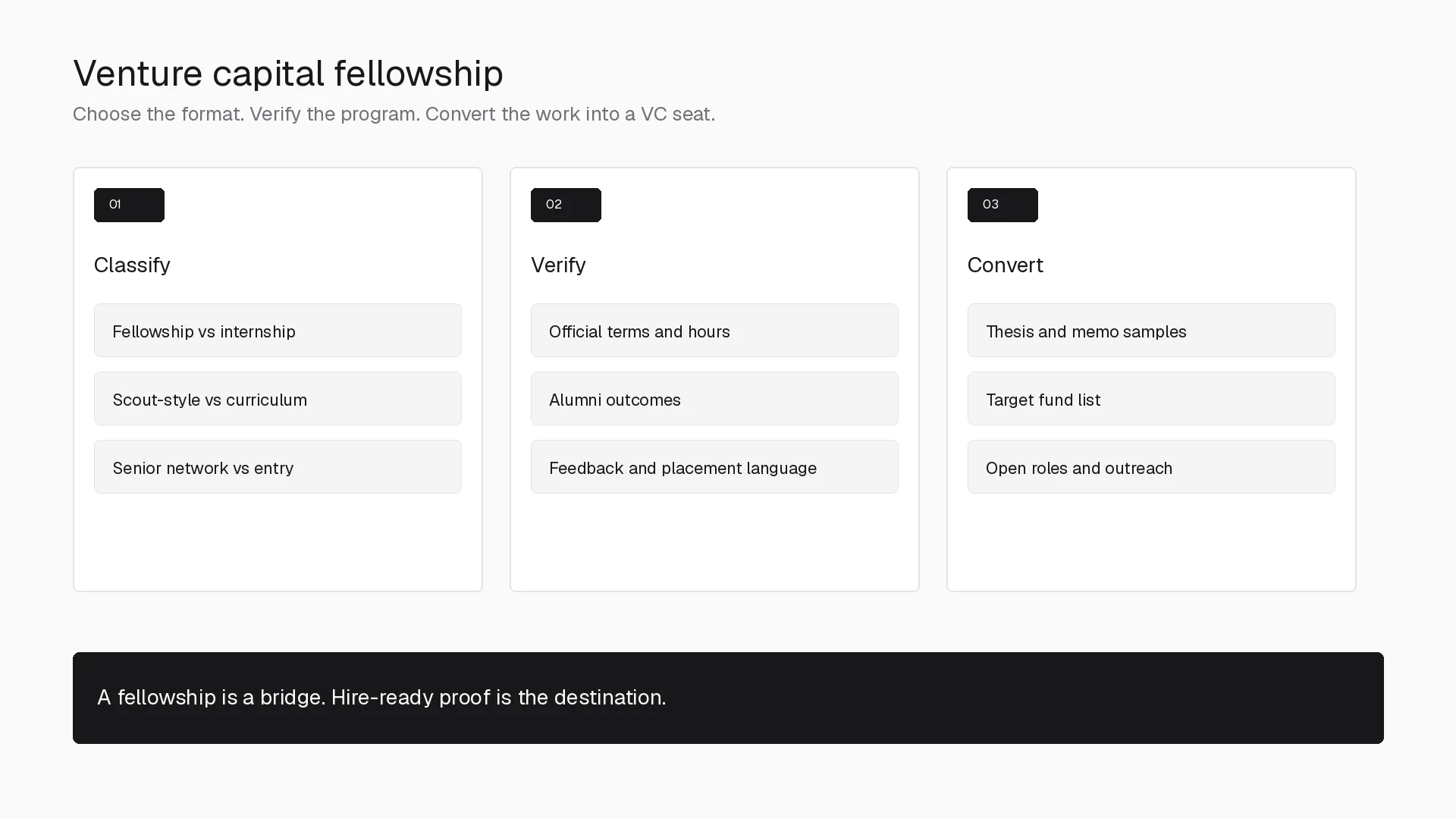
Use this guide to classify fellowship formats, verify a program before you commit, apply with a real edge, and convert the work into a live VC job search.
What is a venture capital fellowship?
A venture capital fellowship is a structured training and network program for people who want exposure to venture investing. Formats vary, but most combine some mix of:
- VC curriculum and masterclasses
- Investment memo practice
- Market mapping or thesis work
- Startup sourcing or deal review
- Mentorship from investors
- Cohort and alumni networking
- Career support or visibility into open roles
The strongest programs do more than explain what a VC does. They give reps: evaluating companies, writing down an opinion, getting feedback, and meeting people who can judge that work.
That matters because VC hiring is not purely credential-driven. Firms want evidence that a candidate can find interesting companies, understand markets, earn founder trust, and communicate a clear investment view. A fellowship can create that evidence when used actively.
Fellowship vs internship vs scout program
These three labels get mixed together in search results. They are not the same product.
| Path | What it usually is | Best when | Watch-outs |
|---|---|---|---|
| VC fellowship | Cohort or curriculum program with mentorship and practice work | You need structured reps, feedback, and a peer network | Quality varies widely; some are lecture-heavy |
| VC internship | Time-bound seat inside one firm with day-to-day tasks | You want firm-specific experience and a conversion path | Often competitive; may be more admin than investing |
| Scout program | Sourcing-focused role, sometimes with referral economics | You already have founder access or community reach | Can be light on training and feedback |
A fellowship is usually built around learning and cohort signal. An internship is usually built around delivering work for one fund. A scout role is usually built around bringing companies. Some programs blur the lines. Read the weekly work description, not the marketing label.
For a pure internship path, see how to get a venture capital internship. For scout-shaped entry, see how to become a venture capital scout.
The main types of VC fellowship programs
Compare programs by format before comparing logos.
| Fellowship type | Best fit | Typical strengths | Watch-outs |
|---|---|---|---|
| Long-form investor fellowship | Early-career or switching candidates who need repeated practice | Curriculum, cohort, mentor access, memo reps | Time load can be high; outcomes depend on how active you are |
| Senior investor network | Current or emerging investors who want a deeper peer network | Reputation, long-term community, investor development | Poor fit if you have no investing exposure yet |
| Student firm placement | MBA, undergrad, or university-affiliated candidates | Structured entry, local firm access, campus credibility | Eligibility may be narrow |
| Short intensive | Strong candidates who want concentrated ecosystem exposure | Fast network expansion | Less time to build a visible track record |
| Scout-style or fund-embedded | Operators, community builders, and founders with sourcing edge | Real deal flow and network building | Can be light on formal training |
Kauffman Fellows is an example of a senior, network-heavy model built around a multi-year education program and long-term venture community. Included VC is a global part-time fellowship with masterclasses, mentoring, and career clinics. Alumni Ventures describes its Venture Fellow Program as a year-long remote professional extracurricular with no prior VC experience required.
Those are different products. Treat them that way.
How VC fellowships are usually compensated
Do not assume a fellowship is a paid job. Compensation models vary:
- Unpaid / credential-based: the value is training, brand, and network
- Stipend: a fixed payment for a defined period
- Tuition or program fee: you pay for access to curriculum and community
- Placement-linked: the program may help place fellows into paid firm projects or internships
- Carry or deal economics: uncommon for early programs and often oversold in marketing
Before you budget around a number from a blog post, confirm the current terms on the official program page. Stipends, fees, scholarships, and carry language change by cohort. If a page is vague about money, ask for written terms before accepting.
How to choose a VC fellowship
Start with fit, not brand. A famous program is not automatically useful if it does not match your stage, time budget, or career goal.
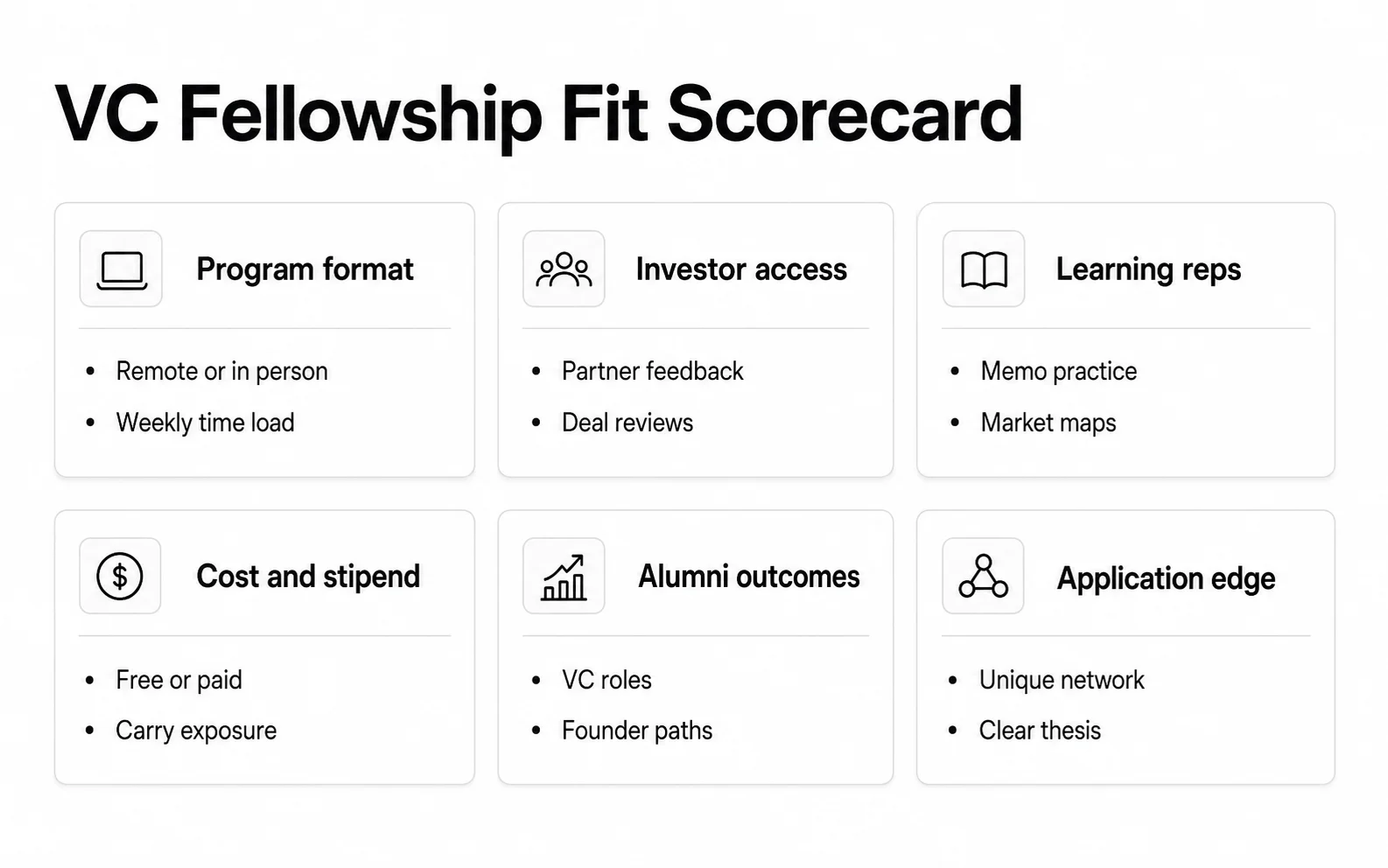
Use these questions before you apply:
| Question | Why it matters | Strong signal |
|---|---|---|
| What is the weekly time load? | You need enough time to do real work, not just attend sessions | Clear schedule, expected hours, and deliverables |
| Who gives feedback? | Partner or investor feedback beats passive lectures | Memo reviews, IC simulations, office hours, mentor access |
| What work product will you leave with? | You need proof of judgment for future interviews | Investment memos, market maps, sourcing notes, thesis projects |
| What do alumni do next? | Outcomes reveal whether the program creates career signal | Alumni in analyst, associate, platform, founder, or scout roles |
| Is it free, paid, or stipend-supported? | Cost changes the ROI | Transparent fees, scholarship policy, or stipend terms |
| Is the network relevant to your target market? | A fintech fellowship is less useful if your wedge is climate | Investors and alumni in your target stage, sector, or geography |
Indexes that list many programs can help you discover formats. They should not become a mass-application list. Pick the few programs where your background creates an actual edge.
How to apply with a real edge
Most fellowship applications test the same underlying question: can you become useful to a venture investor?
Your application should show more than interest in startups. It should prove that you bring a differentiated lens.
Build a sharp thesis
Choose one market where you have a reason to know more than the average applicant. That could be healthcare workflow software, AI developer tools, climate adaptation, vertical SaaS for logistics, fintech infrastructure, or another market you understand from work or community access.
Write a short thesis that answers:
- Why this market is changing now
- What kind of startup could win
- Which customers have urgent pain
- What signals would make you believe or disbelieve the opportunity
- Which companies you would track first
A specific market view beats a vague claim that you are passionate about VC.
Write one investment memo before you need it
Many programs ask for a sample memo or case-style response. Even if they do not, write one. Use the venture capital investment memo guide to structure the company, market, product, traction, risks, and recommendation.
You do not need to be right about everything. You do need clear thinking, intellectual honesty, and a point of view.
Show a sourcing edge
Strong fellowship candidates can reach companies or communities the program does not already see. Examples:
- You work in a niche startup function and know the pain points
- You run a community, newsletter, podcast, or event series
- You have founder access in a specific geography
- You publish market maps or teardown notes
- You have operating experience in a sector the fund cares about
If the application only says you want to learn VC, it is weak. If it says you can help a fund understand a market and reach those founders, it becomes more credible.
What fellows actually do in a week
Expect the mix to shift by program and by deal cycle. A useful week usually includes some combination of:
- Sourcing: scanning communities, demo days, product launches, and university networks, then logging companies worth a second look
- Triage: applying simple kill criteria so partners only see the strongest names
- Diligence support: market sizing, competitor maps, customer notes, and memo drafts
- Learning sessions: term sheets, portfolio support, fund strategy, or IC simulations
- Network time: mentor office hours, alumni calls, and founder introductions
Ask for a sample week before you accept. If the program cannot describe week three, month three, and the exit state, treat that as a yellow flag.
How to verify a fellowship before you commit
Program pages sell access. Your job is to diligence the program the way a VC diligences a company.
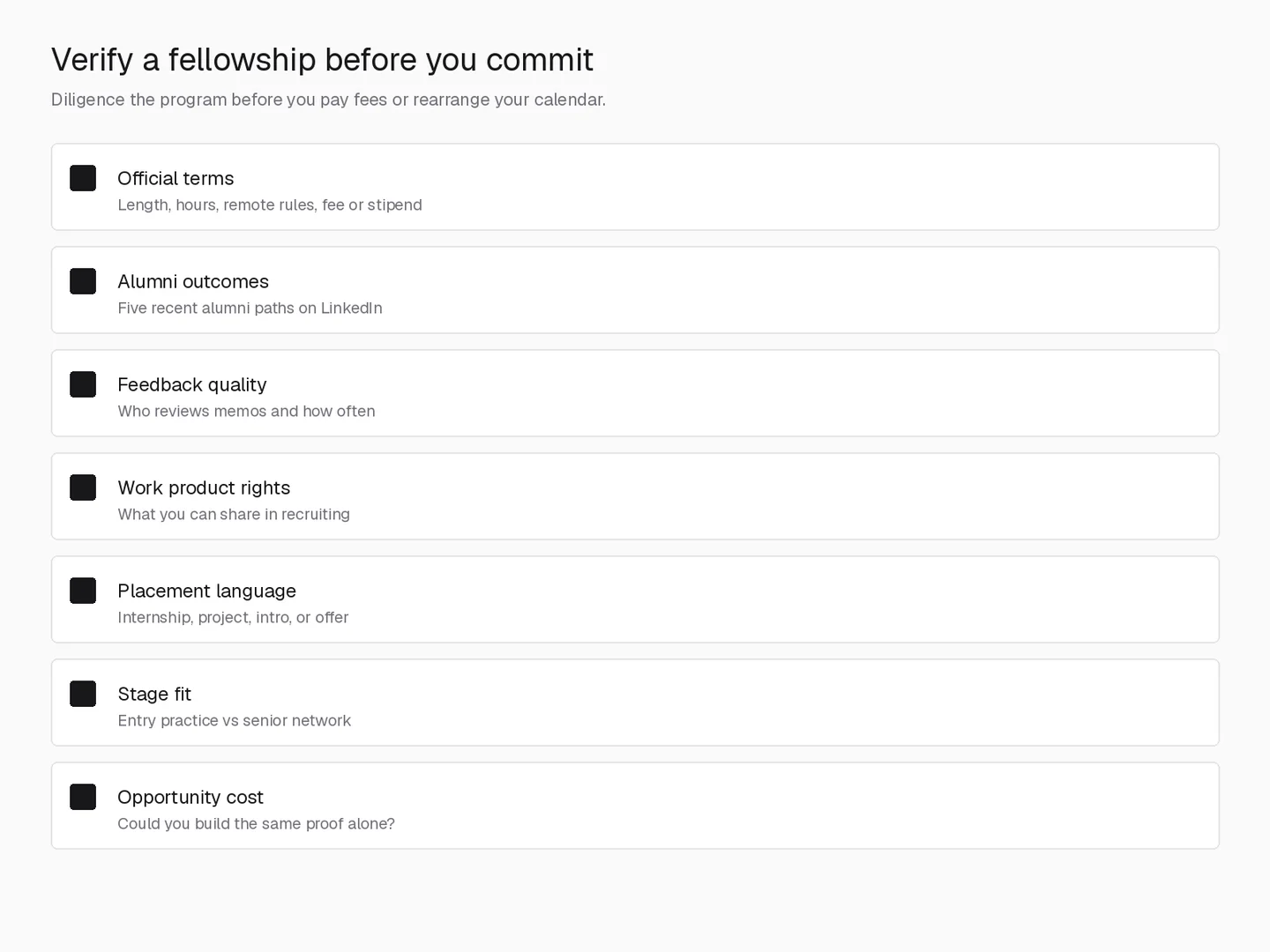
Run this checklist before you pay a fee, quit other work, or list the program as your plan:
- Official terms. Confirm length, weekly hours, location or remote rules, fee or stipend, and application deadlines on the program's own site, not a secondary listicle.
- Alumni outcomes. Find five recent alumni on LinkedIn. Note whether they landed investor seats, platform roles, scout work, founder paths, or unrelated jobs.
- Feedback quality. Ask who reviews memos and how often. A named mentor with office hours beats "access to our network."
- Work product ownership. Clarify whether you can share anonymized memos, market maps, or thesis notes in recruiting.
- Placement claims. If the program advertises firm placements or hire rates, ask what "placement" means: paid internship, volunteer project, intro email, or full-time offer.
- Stage fit. Senior network programs for partners and principals are poor substitutes for entry-level practice. Entry programs with no investor feedback are poor substitutes for hiring signal.
- Opportunity cost. Compare the hours and fees against building the same proof alone: one memo, one market map, ten founder conversations, and a targeted outreach list.
If the answers are vague, expensive, or mismatched to your stage, pass. A smaller program with real feedback can beat a famous brand where you stay passive.
How a fellowship can turn into a VC role
A fellowship rarely guarantees a job. Treat it as a signal-building platform.
Leave with three assets:
- A clear investing wedge
- Two or three work samples that show judgment
- A network of people who can credibly refer you
Then convert those assets into a job search:
- Build a target list of funds by stage, sector, and geography using the Venture Capital Careers companies directory
- Track open roles on the Venture Capital Careers job board
- Compare role requirements against the VC analyst job description and VC associate job description
- Use fellowship work in outreach as a short reason a fund should talk to you, not as an attachment dump
- Follow up with alumni, mentors, and cohort peers when relevant roles appear
If you are still early, a fellowship may lead to an internship, analyst role, scout program, platform role, or startup operating role. If you already have strong operating or investing experience, it may help you lateral into associate, principal, or fund-building paths. For the broader ladder, read the venture capital career path guide.
VC fellowship programs to research
This is not a ranking. Program availability, eligibility, cost, and application windows change often. Use these examples to understand the range of formats:
| Program example | Format signal | Good research question |
|---|---|---|
| Kauffman Fellows | Multi-year investor education and network model | Am I already far enough along in investing for this network to compound? |
| Included VC | Part-time global fellowship with curriculum, mentoring, and career support | Can I commit the weekly hours and use the community actively? |
| Alumni Ventures Venture Fellow Program | Year-long remote program with no prior VC experience required | Does this give practical reps and a credible resume signal? |
| McCombs Venture Fellows | MBA firm-placement model with curriculum and firm work | Am I eligible, and does firm placement match my goals? |
| Student firm or campus programs | University-linked sourcing and diligence seats | Does the local network match my target stage and sector? |
| Short intensives | Concentrated ecosystem immersion | Do I need a burst of exposure or longer apprenticeship? |
If you find a program through a secondary list, open the official page before applying. Confirm dates, eligibility, fees, expected time commitment, and whether recent alumni outcomes match the story you need for hiring.
Common mistakes
Applying without a wedge. A generic applicant who likes startups is forgettable. A candidate with a clear sector view is easier to remember.
Optimizing only for brand. A smaller fellowship with direct partner feedback may be more useful than a famous program where you stay passive.
Ignoring time load. Some programs expect serious weekly work. If you cannot commit, you will not get the benefit.
Treating the fellowship as the outcome. The fellowship is a bridge, not the destination. Build work samples, relationships, and job-market signal while you are inside it.
Skipping verification. Paying tuition or rearranging your calendar on blog summaries is how people buy the wrong program.
Using the same application everywhere. Different programs value different things: diversity of background, technical expertise, sourcing edge, student status, operator experience, or fund-building ambition.
FAQ
Are venture capital fellowships worth it?
They can be worth it if the program gives investor feedback, a relevant network, and work product you can use in recruiting. They are less useful if they are mostly passive lectures, expensive without clear outcomes, or unrelated to your target VC path.
Do I need finance experience for a VC fellowship?
Not always. Some programs are designed for candidates without prior VC experience. You still need to show judgment, curiosity, and a reason you can add value, such as operating experience, technical depth, community access, or a sector thesis.
Do VC fellowships lead to jobs?
Some fellows move into VC, startup, platform, scout, founder, or fund roles. A fellowship is not a job guarantee. It improves your odds when you leave with visible work, real relationships, and a clear target list.
What should I include in a VC fellowship application?
Include a concise story, a clear market wedge, evidence of startup or community access, and a sample of how you think about companies. If a program asks for a memo, keep it structured and decisive.
How many VC fellowships should I apply to?
Apply to a focused set where your background fits the program. Three targeted applications usually beat fifteen generic ones.
How is a VC fellowship different from a VC internship?
A fellowship is usually cohort- and curriculum-based. An internship is usually a seat inside one firm with day-to-day deliverables. Some programs combine both. Read the weekly work and conversion path before you decide.
Your next step on Venture Capital Careers
If you are using a fellowship to break into VC, do not wait until the program ends to start your job search. Browse current venture capital jobs, research firms in the VC companies directory, and create alerts through Venture Capital Careers.
Then turn fellowship work into recruiting material: a sharper venture capital resume, a better memo, and more specific outreach. The goal is not only to complete a fellowship. The goal is to become easier for a VC firm to hire.
Related posts
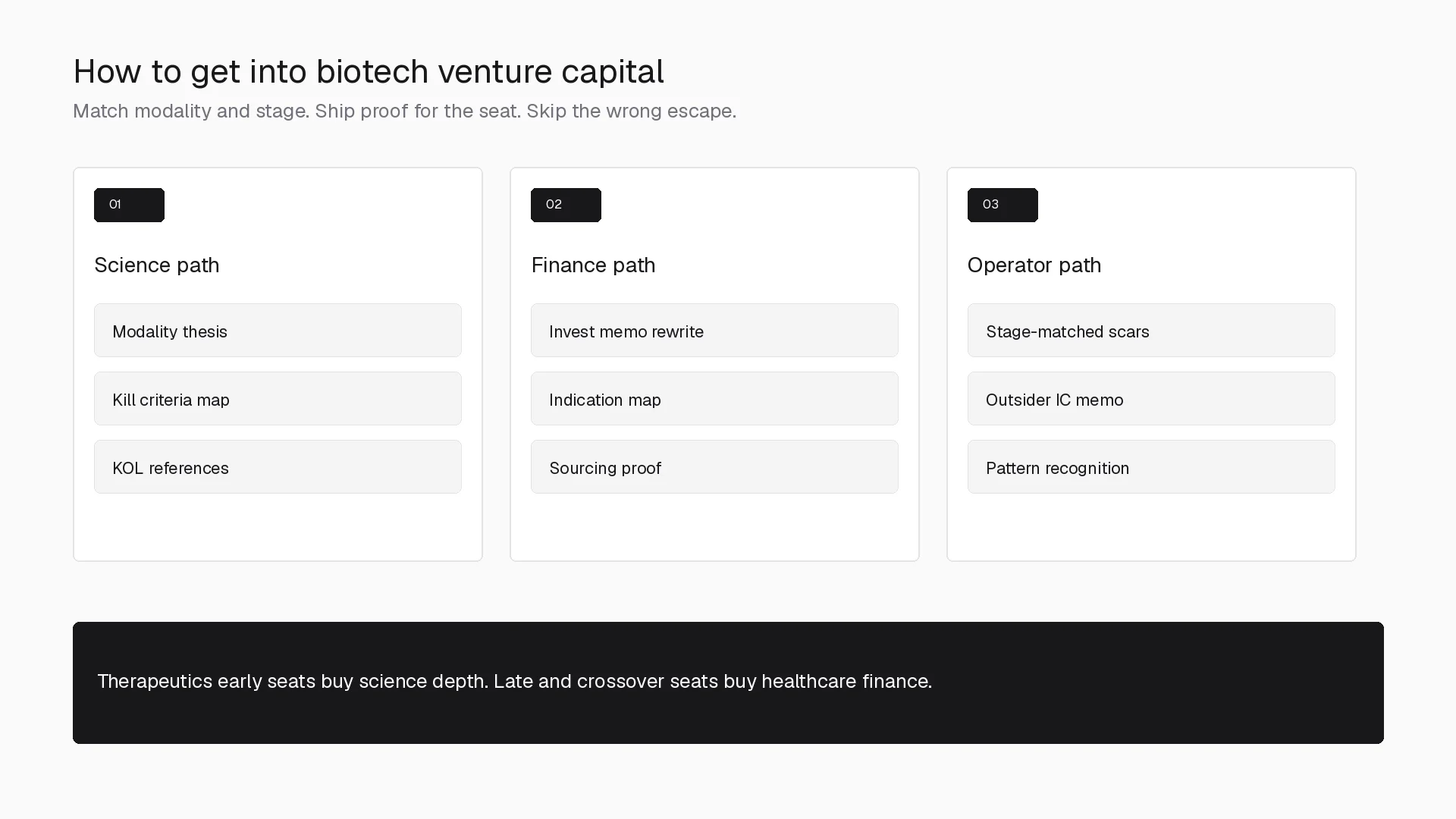
A practical guide to getting into biotech venture capital: seats by stage and modality, which backgrounds win, what proof to build, and when not to go.
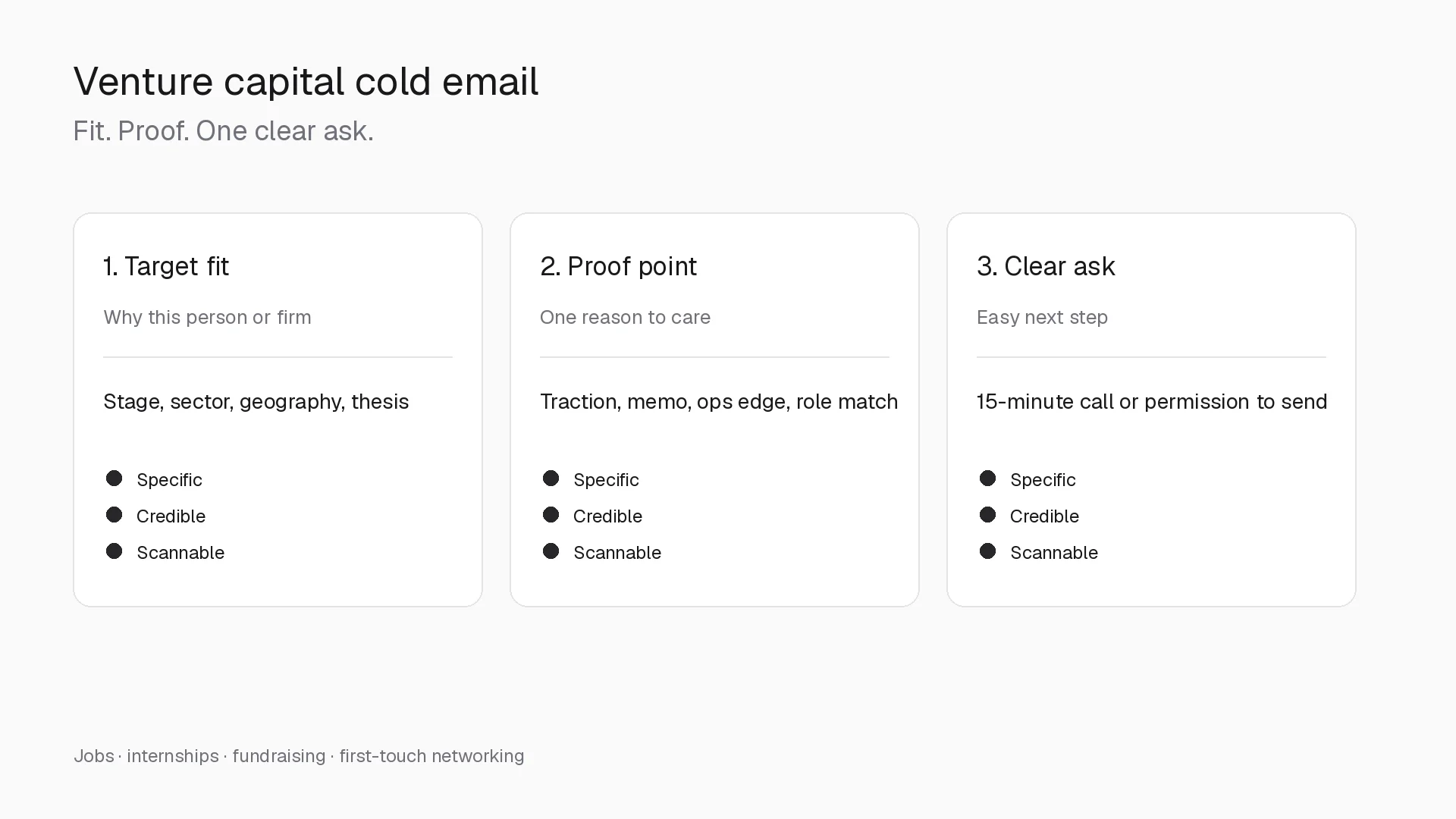
VC cold email templates for jobs, internships, and fundraising. Pick the right goal, research the firm in ten minutes, and send a short email with one clear ask.
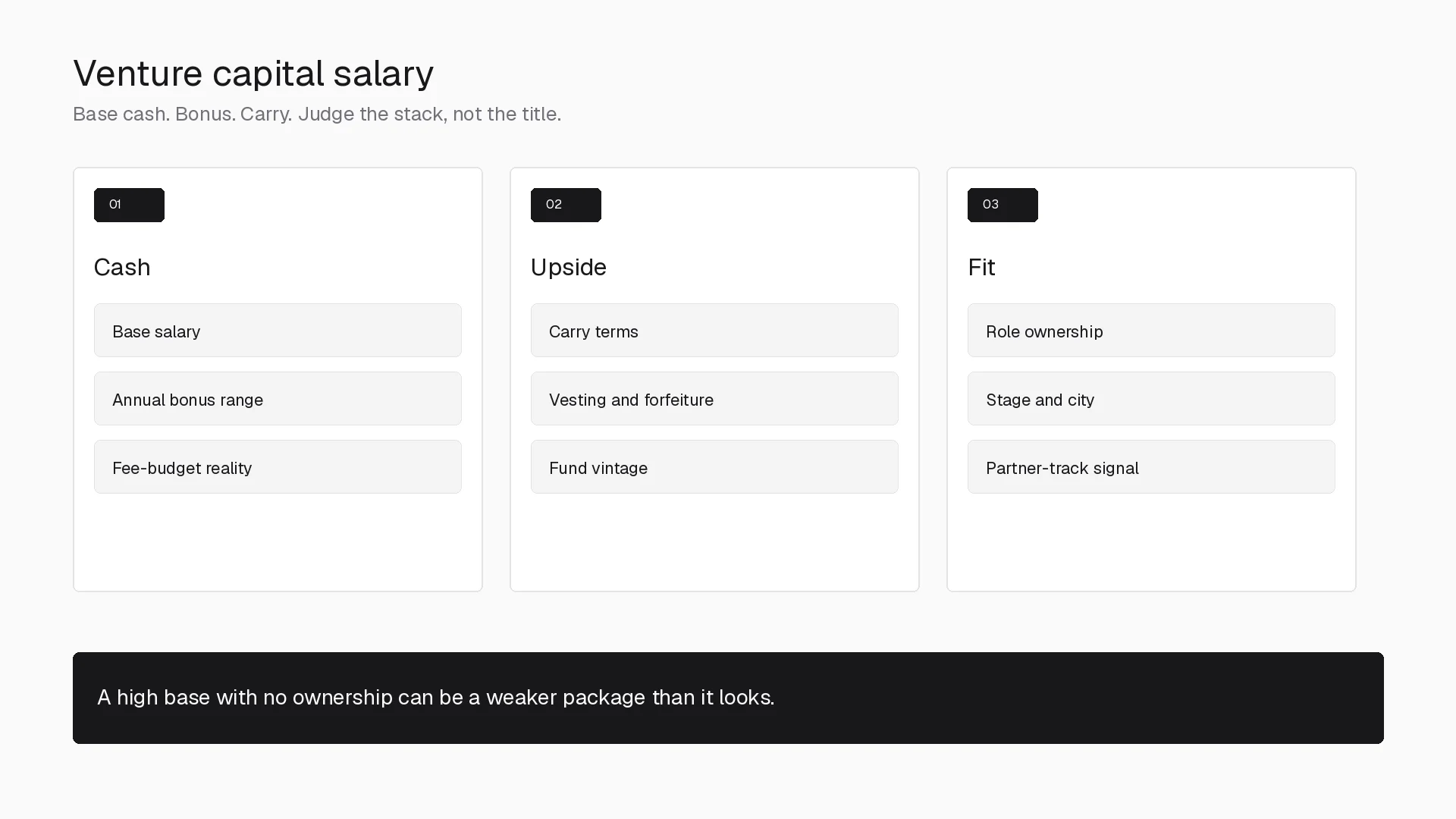
US venture capital salary ranges by role, how bonus and carry work, what moves pay by fund size and stage, and how to triangulate a VC compensation offer.