
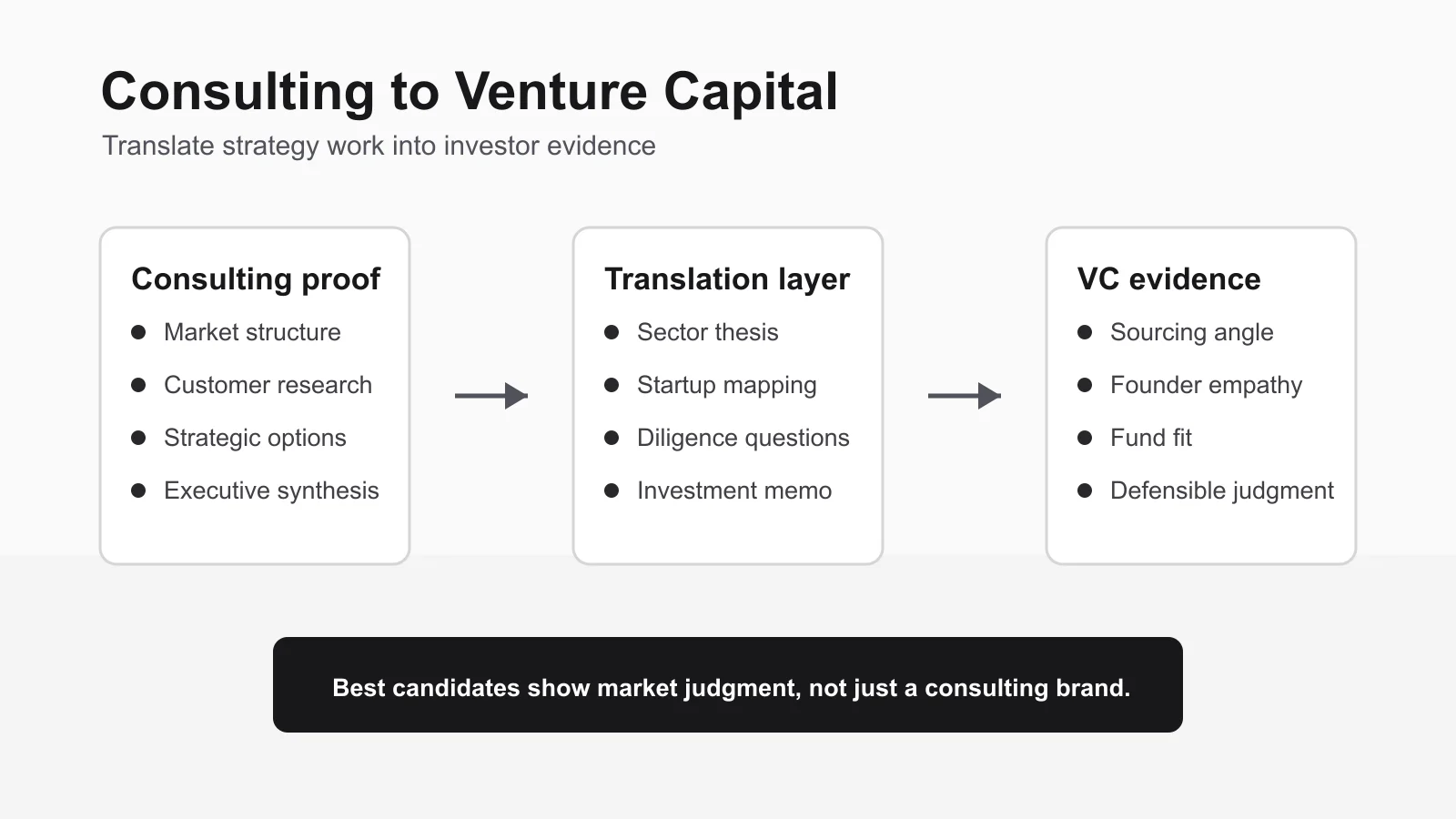
Consultants move into venture capital through four main routes: a post-MBA associate seat, a sector-focused or corporate venture fund, an operating role at a venture-backed company, or a growth equity or platform side door. Consulting supplies market mapping, customer research, synthesis, and executive communication. Funds still need proof consulting does not create on its own: sourcing, a defended investment view, and fluency with founders.
The candidates who get offers do not pitch themselves as generalist problem solvers. They arrive with a sector thesis, a list of startups they would meet, and a short memo that takes a position. Side-by-side pay and hours live in consulting vs venture capital; the search system behind any VC move is in how to get a job in venture capital.
Can consultants move into venture capital?
Yes. Consulting is a credible background when projects touch software, healthcare, fintech, climate, industrial technology, AI, or other markets where startups attack incumbents.
The catch is that consulting is a different apprenticeship. A consultant is paid to structure an answer for a client. A VC investor is paid to find companies, judge whether they can become outliers, win allocation, and support them for years. Translate the experience into investor language:
| Consulting signal | Why VC firms care | Where it falls short |
|---|---|---|
| Market research | Breaks down categories, customers, competitors, growth drivers | Still needs a view on startup timing and venture-scale outcomes |
| Customer interviews | Learns from buyers and users quickly | Founder conversations are less scripted and depend on trust |
| Strategic synthesis | Finds what matters and says it clearly | A VC memo needs a recommendation, not options |
| Commercial diligence | Tests market size, customer quality, competition | Early-stage companies have little data |
| Executive communication | Writes and presents to senior people | VC also requires sourcing and long relationships |
Why VC firms hire fewer consultants than operators and bankers
Venture teams are small. A fund with five or six investors may hire one junior person every few years, and it fills that seat with the profile that fixes its biggest gap. Three things push consultants down that list.
Operators bring founder credibility. An ex-product lead or early employee has built the thing founders are building. Founders take their calls, which helps sourcing and winning deals.
Bankers bring transaction reps. Growth and later-stage funds want people who already model, read cap tables, and run a process. Banking proves that in a way a strategy deck does not.
Consulting reads as advice, not ownership. Partners worry a consultant will present three balanced options when the job requires one call. The fix is evidence: a memo with a stance, startups sourced before they were obvious, and a sector where the candidate knows more than the partner does.
That is why the realistic routes below lean on sector depth, an MBA reset, or an operating detour rather than a direct jump from a generalist practice to a top-brand fund.
What transfers from consulting (and what does not)
Transfers well
Market mapping. If you have mapped a category, segmented customers, studied competitors, or sized a market, you already have part of the VC toolkit. In recruiting, that becomes a sector thesis: which customer pain is urgent, why now, which incumbents are exposed, and which startups are credible.
Customer research. Consultants often know how to run interviews, synthesize buyer needs, and separate stated preferences from real constraints. In VC, that helps with customer diligence and founder conversations.
Synthesis under ambiguity. Good consultants turn messy information into a clear story. Funds value that when analysts and associates write market notes, investment memos, portfolio updates, and internal recommendations.
Professional communication. Consulting teaches stakeholder management, clean writing, and tradeoff communication. That lowers execution risk in a junior investing or platform seat.
Does not transfer cleanly
Recommendation without ownership. Consulting recommendations often come with options, caveats, and client constraints. VC requires a sharper investment stance: should we spend time, take a meeting, pass, continue diligence, or invest?
Sourcing. Consultants usually receive work through firm projects. Junior VC roles may require you to create deal flow through market maps, founder outreach, events, communities, and referrals.
Founder empathy. Client service helps, but founder conversations are different. Founders are not buying a consulting project; they are deciding whether to trust you with sensitive company context.
Startup pattern recognition. Consulting can be too incumbent-focused. Funds want to know whether you understand early product pull, distribution wedges, capital efficiency, hiring constraints, and why small companies can beat larger ones.
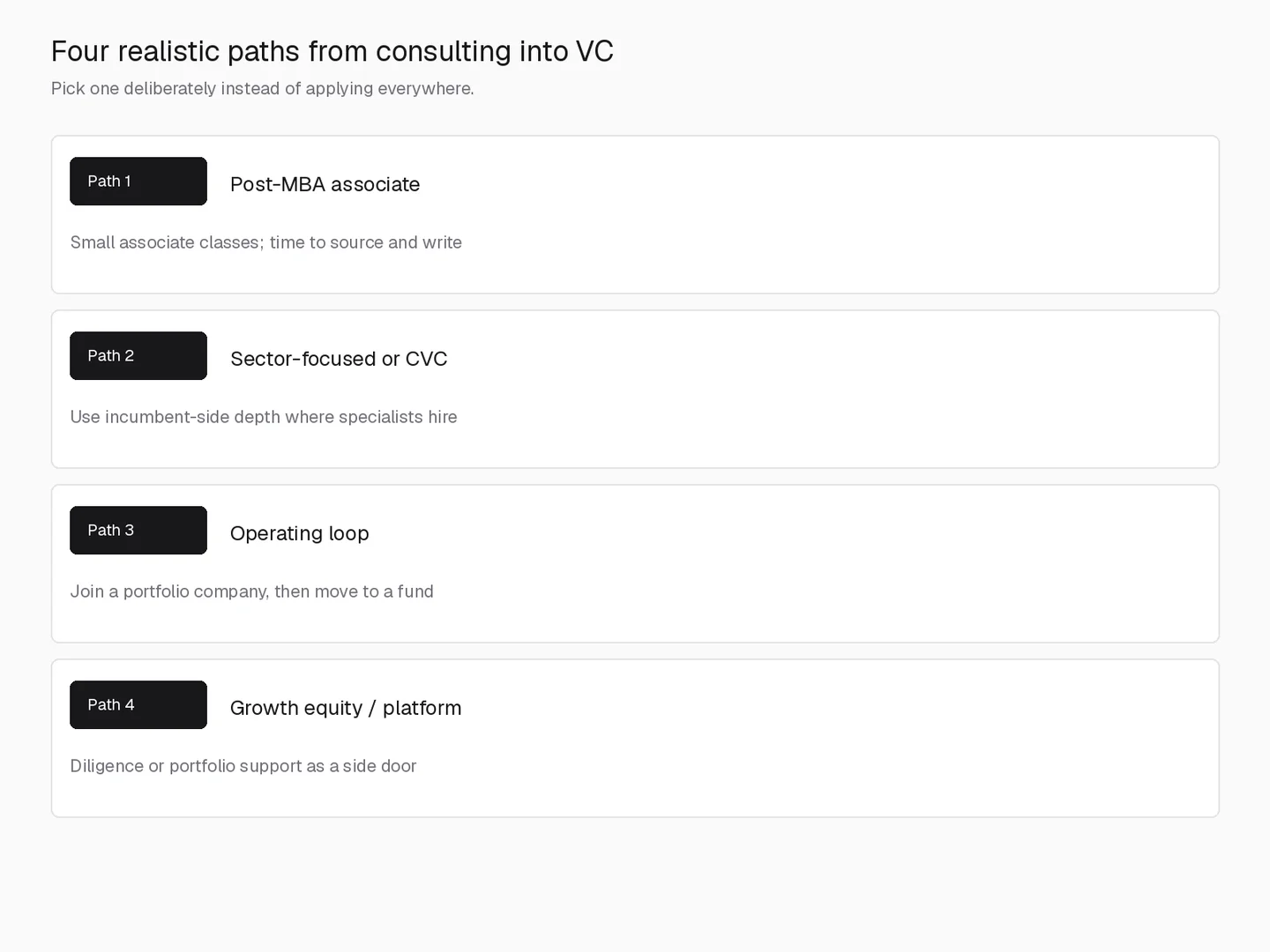
Four realistic paths from consulting into VC
There is no on-campus funnel from consulting into venture. Four routes produce most consultant hires, and each one asks for different proof.
Path 1: Post-MBA associate seat
Larger funds and growth-oriented firms sometimes hire a small post-MBA class. Business school can buy two useful assets: time to source, write, and network without billable staffing, and access to alumni already inside funds. This route is real and competitive. It is a structured window, not a guarantee.
Path 2: Sector-focused or corporate venture fund
This is often the highest-probability direct move. Healthcare, climate, fintech, industrial technology, defense, and other specialist funds need people who understand the incumbent side of a market. Corporate venture arms hire on similar logic. The trade is often brand prestige for a seat, a portfolio, and a track record you can move on later.
If your consulting work has a clear sector edge, start there. A healthcare consultant should map healthcare and life sciences funds. A fintech consultant should map fintech, payments, banking infrastructure, and vertical SaaS funds. A climate consultant should build a list around climate, energy, industrial, and infrastructure investors. Incentives and decision speed differ at a corporate venture capital arm, so ask how investment committee works before accepting.
Path 3: Operating loop through a portfolio company
Join a venture-backed company in strategy, operations, product, or go-to-market; spend two to three years there; then move to a fund as a senior associate, principal, or operating/platform hire. The loop is longer, but it answers the objection that you have never built anything and opens founder networks that stay closed to pure consultants. Prefer companies whose investors match the funds you eventually want to join.
Path 4: Growth equity or platform as a side door
Growth equity sits between buyout and venture, often hires in larger classes, and rewards commercial diligence consultants already do. Platform and portfolio roles hire consultants for go-to-market, talent, research, and operating support. Ask directly whether the seat is on an investing track or a distinct operating track before you treat it as a bridge.
Pick one path deliberately. Applying everywhere usually reads as unclear judgment.
Which funds and seats hire consultants
Fund type matters more than fund brand. The most famous firms hire rarely and favor operators and repeat founders. Specialist, emerging, and corporate funds hire more often and value incumbent-side market knowledge.
| Fund or seat type | Consultant fit | Why it can work | Watch out for |
|---|---|---|---|
| Top-brand multi-stage fund | Low | Post-MBA classes exist at a few firms | Very few seats; operator and founder profiles win most |
| Sector-focused fund (health, climate, fintech, industrial) | High | Consulting projects become sector theses | Needs startup examples, not only incumbent analysis |
| Corporate venture arm | Medium to high | Corporate strategy context fits | Decision speed and carry differ from institutional VC |
| Growth-stage investing | Medium to high | Commercial diligence transfers directly | More financial analysis and ownership |
| Platform or portfolio team | Medium to high | Strategy, go-to-market, talent work transfers | Not every platform role is investment-track |
| Seed or Series A generalist | Medium | Customer pain and timing work helps | Founder judgment and sourcing dominate |
Titles and promotion timing are mapped in the venture capital career path. Build the firm list by stage and sector from the companies directory, then check it against open roles on the VC job board.
How VC pay compares to consulting pay
Expect a lateral or lower cash package, especially from a senior consulting role. Junior VC compensation is base salary plus a discretionary bonus, and many analyst and associate seats carry no carried interest. Carry usually starts at senior associate, principal, or partner level, vests over years, and pays only if the fund returns capital above its hurdle, often eight or more years after the first check.
So the trade is cash certainty for an option on long-dated upside, and that option is worth little at a weak fund. Ask three questions before accepting: is carry offered at this level, what is the vesting schedule, and how have prior funds performed. Current ranges by title are in the venture capital salary guide, and carry mechanics are in carried interest.
When to leave consulting to recruit for VC
Two to four years is the most common window for a direct or MBA-linked move. Before about two years, sector depth and client stories are thin. After five or six, junior VC cash can look worse than the current package, and the story gets harder without deep sector credibility, founder relationships, or an operating-loop plan.
Time the search against the promotion clock. The year before an up-or-out review is often the cleanest exit, because the candidate leaves on a strong review rather than a stalled one.
VC roles open with little warning and close fast. Build the target list, thesis, and memo before a posting appears.
What to staff on in your last year of consulting
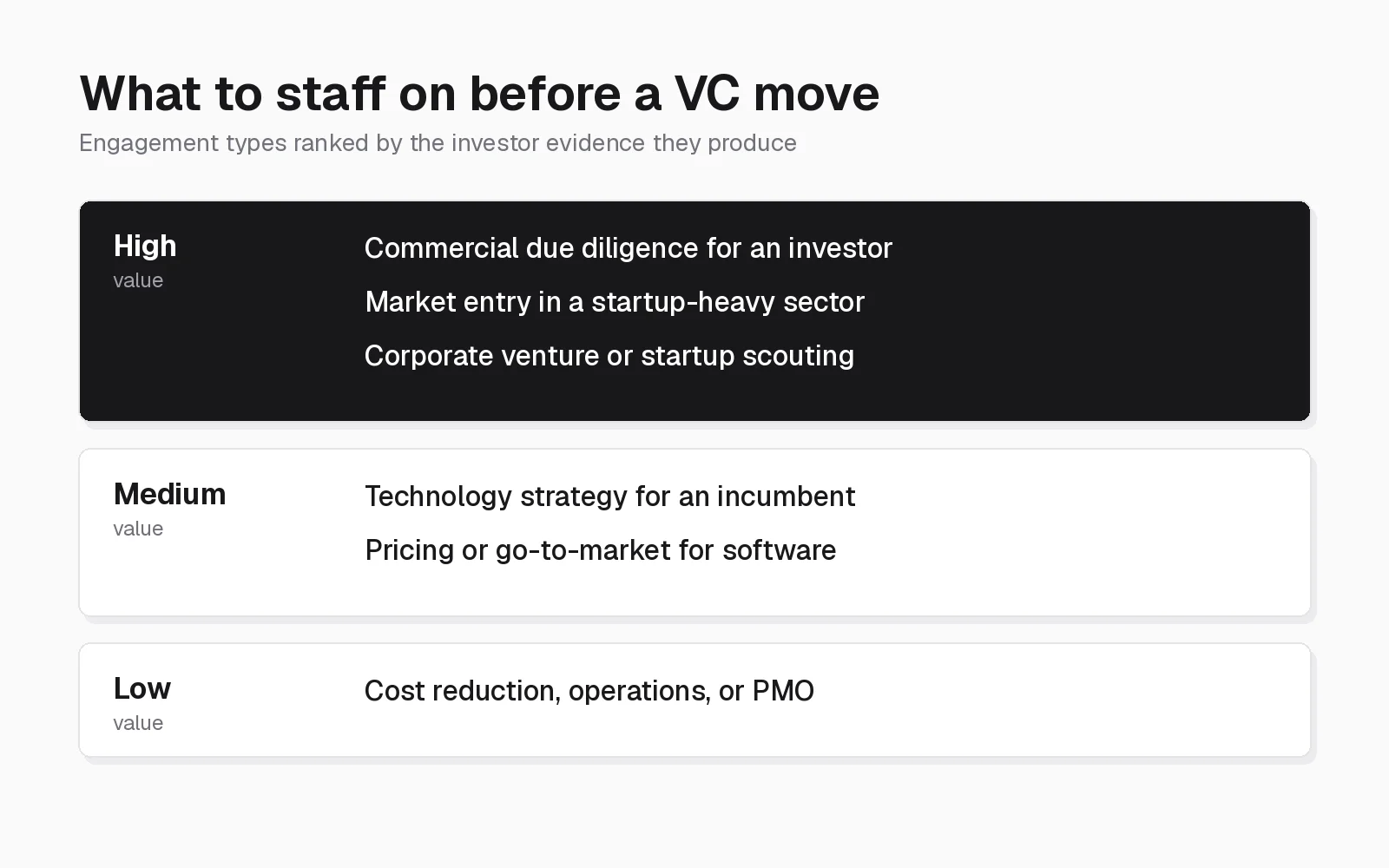
The final 12 months in consulting are the cheapest time to build VC evidence, because the firm pays for the research. Staffing choices decide whether a candidate walks in with a sector thesis or a list of process work.
| Engagement type | VC evidence it produces | Value for a VC move |
|---|---|---|
| Commercial due diligence for a growth or PE investor | Investor framing, market sizing, customer calls, a go or no-go view | High |
| Market entry or new-product strategy in a startup-heavy sector | Category map, buyer pain, where new entrants win | High |
| Corporate venture, innovation, or partnership scouting | Startup lists, founder meetings, build-buy-partner calls | High |
| Technology or digital strategy for an incumbent | Why incumbents are slow, which workflows are exposed | Medium |
| Pricing or go-to-market work for a software company | Unit economics, sales motion, retention drivers | Medium |
| Cost reduction, operations, or PMO | Execution reps, little market or startup signal | Low |
Three moves help inside the firm. Ask staffing for one sector and stay in it long enough to own a point of view. Volunteer for diligence work for investor clients, since it is the closest consulting analog to a VC memo. Keep a private log of every startup that appears in a project, because that list becomes sourcing material later. Respect confidentiality: client names and non-public data never go into a VC application, only the market insight built from public sources.
How to convert a consulting project into VC recruiting evidence
Most consultants under-prepare here. They say they did "market research for a software client" and expect the interviewer to do the translation. Do the translation yourself with one strong project.
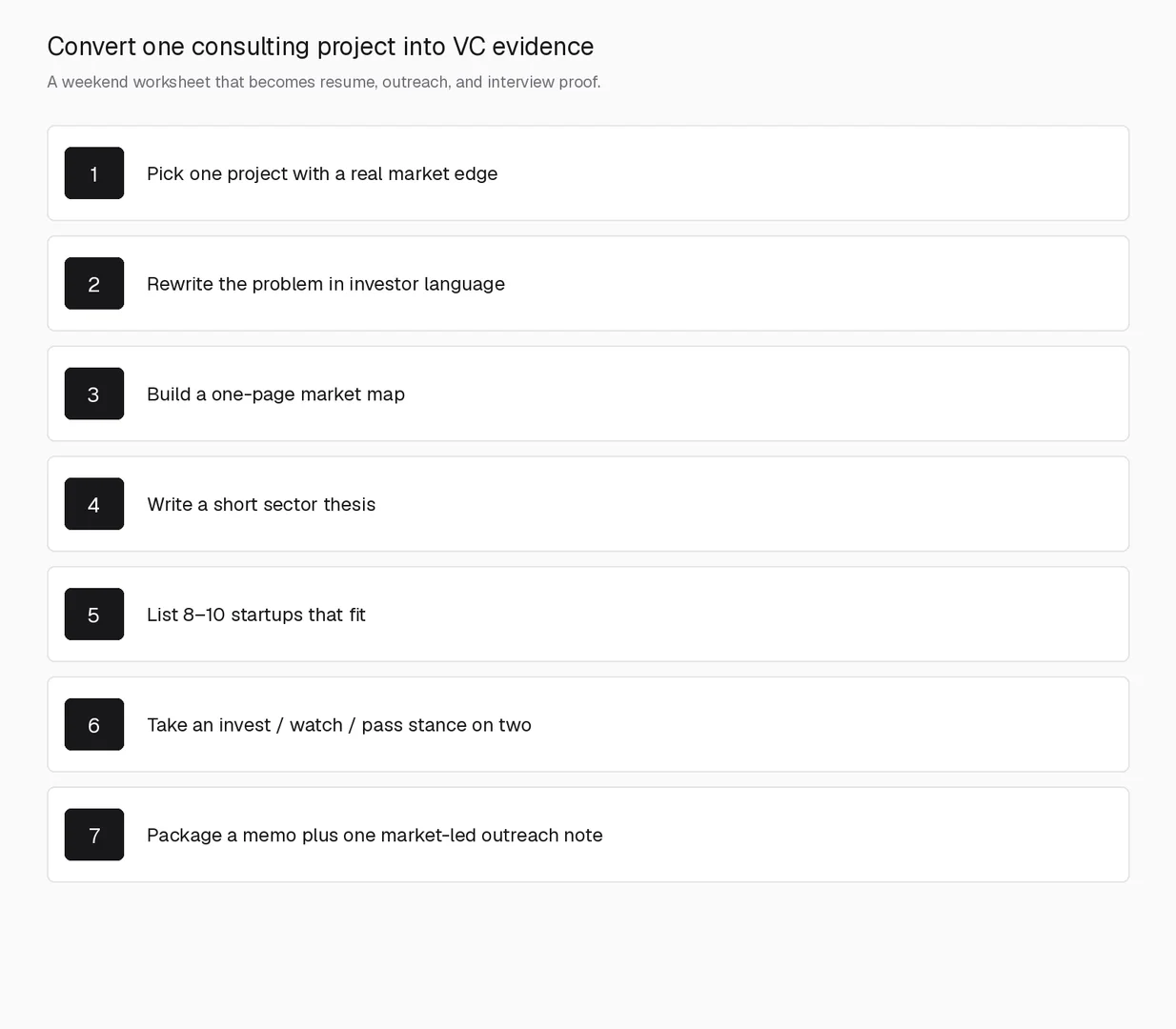
Use this weekend worksheet:
- Pick one project with a real market edge (category, customers, competitors, regulation, or go-to-market). Avoid pure process or slide-production work.
- Rewrite the problem in investor language. What customer pain was urgent? Why now? Who pays? Who loses if a new entrant wins?
- Build a one-page market map. Segments, incumbents, substitutes, distribution channels, and where startups can wedge in.
- Write a short thesis. Three to five sentences on the transition you believe is underway and what company shape wins.
- List 8 to 10 startups that fit the thesis. For each, note stage, wedge, and one reason to meet or pass.
- Take an investment stance on two of them. Invest, watch, or pass, with the single biggest risk and the evidence that would change your mind.
- Package the proof. Turn the stance into a one- to two-page memo and one outreach note that leads with the market observation, not a request for career advice.
That packet becomes resume bullets, networking substance, interview stories, and case prep. It is also the clearest answer to "why would a consultant add sourcing or judgment here?"
How to rewrite your consulting resume for VC
Your resume should not read like a consulting resume with "venture capital" added to the summary. Rewrite it around markets, customers, strategy, and investment relevance.
| Consulting-style bullet | VC-style rewrite |
|---|---|
| Conducted market research for B2B software client | Mapped B2B software category, segmented customer pain points, and identified adoption drivers relevant to new-entrant opportunities |
| Built growth strategy for healthcare services company | Analyzed healthcare workflow bottlenecks, reimbursement constraints, and competitive positioning to assess where technology-enabled models could scale |
| Supported commercial due diligence for private equity client | Evaluated customer quality, market growth, competitive risk, and expansion levers to inform investment diligence |
| Created executive presentation for senior client team | Synthesized market, customer, and competitor evidence into a board-level recommendation with clear tradeoffs and next steps |
The VC-style version does not exaggerate your role. It makes the investor-relevant parts legible. After the first draft, use the venture capital resume guide to tighten structure and show judgment rather than only process.
Build a target list and run the search
Most consultants make the first list too broad. "Every well-known VC fund" is not a recruiting strategy.
Build the list around five filters:
| Filter | What to ask |
|---|---|
| Sector | Does the fund invest in markets where your consulting work gives you a real edge? |
| Stage | Does the fund invest seed, Series A, growth, or later? |
| Role type | Is the seat investing, platform, portfolio, research, scout, fellow, or operating? |
| Evidence fit | Can you discuss the firm's portfolio with specific market insight? |
| Network path | Do you have alumni, clients, founders, operators, or consultants who can introduce you? |
Start with 30 to 50 firms, then narrow to the 10 to 15 where your background creates the strongest case. For each firm, write a short note:
- What the fund invests in
- Two portfolio companies you understand
- One market thesis you can defend
- Three startups the firm might plausibly want to meet
- One reason your consulting background is relevant
Run outreach like an investor, not like a generic informational-interview campaign.
Weak angle:
I am a consultant interested in venture capital and would appreciate 15 minutes to learn about your career.
Stronger angle:
I have been mapping vertical software companies serving specialty healthcare practices and noticed your investments in adjacent workflow tools. I would value your perspective on how funds evaluate customer pull in that category.
The second version gives the investor something to react to. Structure matters less than substance; the venture capital networking email templates handle the format, and the market observation does the work.
Screen live openings on the VC job board and firm pages in the companies directory.
What the VC interview process looks like
Most VC processes run four to six rounds over two to eight weeks, though small funds compress or stretch this.
| Stage | What they test | How to prepare |
|---|---|---|
| Screen with a principal or talent lead | Why VC, why this fund, why now | A two-minute story linking consulting work to the fund's sectors |
| Market and thesis conversation | Independent judgment | Two or three sectors with customer pain, timing, incumbents, and named startups |
| Sourcing exercise | Ability to create deal flow | Bring startups found independently and why each fits the fund |
| Case study or investment memo | Investment thinking under limited data | Practice a written invest or pass memo with the main risk named |
| Partner and founder-style conversations | Curiosity, trust, fit | Ask sharp questions without a consulting interview script |
Drop three consulting habits before the case round. Do not open with a generic framework, do not present three equal options, and do not hedge the conclusion. State invest or pass early, then defend it. Practice formats in the venture capital case study interview guide and the venture capital interview questions bank.
A 60-day consulting-to-VC transition plan
| Timeline | Output |
|---|---|
| Days 1-5 | Pick one path and two sectors where your consulting work gives you a real edge |
| Days 6-12 | Build a target list of 30 to 50 firms; narrow to 10 to 15 priority funds |
| Days 13-20 | Complete the project→evidence worksheet for one consulting engagement |
| Days 21-28 | Rewrite resume and LinkedIn around investor-relevant work |
| Days 29-40 | Send targeted outreach; run informational conversations with a market angle |
| Days 41-50 | Practice one VC case and one investment memo; refine two startup notes |
| Days 51-60 | Review open roles, follow up with sharper substance, and keep the memo packet current |
At the end you should have more than interest: a chosen path, a firm shortlist, converted project evidence, a revised resume, outreach in motion, and a repeatable interview story.
Common mistakes consultants make
Leading with the consulting brand only. A strong firm name helps, but it does not prove you can source, pick, or win investments.
Sounding too client-service oriented. Funds want helpful partners, but they also want judgment. Do not stop at "I helped executives decide." Show what you believe about a market.
Confusing venture capital with venture consulting. "Venture capital consulting" usually means fundraising advisory, legal support, or corporate innovation services. If you want an investing or platform seat inside a fund, keep the story focused on deal sourcing, diligence, portfolio support, and investment decisions.
Targeting famous funds only. Brand-name firms are highly competitive and may hire irregularly. Sector-focused, emerging, regional, specialist, and corporate venture seats can be better fits for consulting backgrounds.
Ignoring sourcing. Consultants can over-index on analysis. Bring examples of companies you found before they were obvious.
Using a generic resume. A consulting resume may be strong for corporate strategy or private equity diligence, but VC needs evidence of market thinking, startup curiosity, and investment judgment.
Skipping the path decision. Applying to post-MBA associate, CVC, platform, and seed generalist seats with the same story usually reads as unclear fit.
Frequently asked questions
Is consulting a good background for venture capital?
It can be. Consulting is strongest when it gives you sector depth, market research, customer insight, diligence experience, and executive communication. It is weaker when your evidence is only project management or slide production.
Is consulting or investment banking better for VC?
Neither is automatically better. Consulting can help with market structure, customer research, and strategy. Banking can help with transaction analysis and financial discipline. Firms care more about fund fit, sourcing ability, investment judgment, and the specific evidence you bring.
Do I need an MBA to move from consulting to VC?
Not always. An MBA can help for associate classes and network access. Direct moves still happen through sector-focused funds, corporate venture, platform seats, and operating loops. Choose the path that matches your evidence, not the prestige narrative alone.
Do I need startup experience?
No, but startup exposure helps. You can build credible exposure by mapping a market, talking to founders, studying product and go-to-market patterns, writing investment notes, and sourcing companies for investors.
Should consultants target platform roles?
Sometimes. Platform and portfolio roles can be good fits if your consulting work involved go-to-market, operations, talent, strategy, data, or customer research. Confirm whether the role is a path toward investing or a distinct operating track.
What should I put on my resume?
Prioritize investor-relevant work: market maps, customer insights, diligence questions, category growth, competitive positioning, business model analysis, and strategic recommendations. Keep project context, but do not let process execution crowd out judgment.
Is it easier to go from consulting to private equity or venture capital?
Private equity is usually the easier move. Buyout funds run structured associate recruiting and value the commercial diligence consultants already do. Venture hires fewer people, less predictably, and leans harder on sourcing and startup judgment. Growth equity sits in between.
Do venture capital firms use case interviews?
Yes, but not consulting-style cases. Expect a company deep dive, a market map, a written memo, or a pitch of a startup you would back. The test is a defended invest or pass call, not a structured framework.
How long should you stay in consulting before recruiting for venture capital?
Two to four years is the common window. Less than two often means thin sector stories. Past five or six, junior VC cash can trail your package unless you target senior or sector-specialist seats.
Find VC roles that match your consulting edge
The consulting-to-VC move works when it is specific. Pick the path and sectors where consulting gave an unfair head start, convert one project into investor evidence, then recruit against that story.
Research firms in the companies directory, browse open roles on the VC job board, and create a free account to track new openings.
Related posts
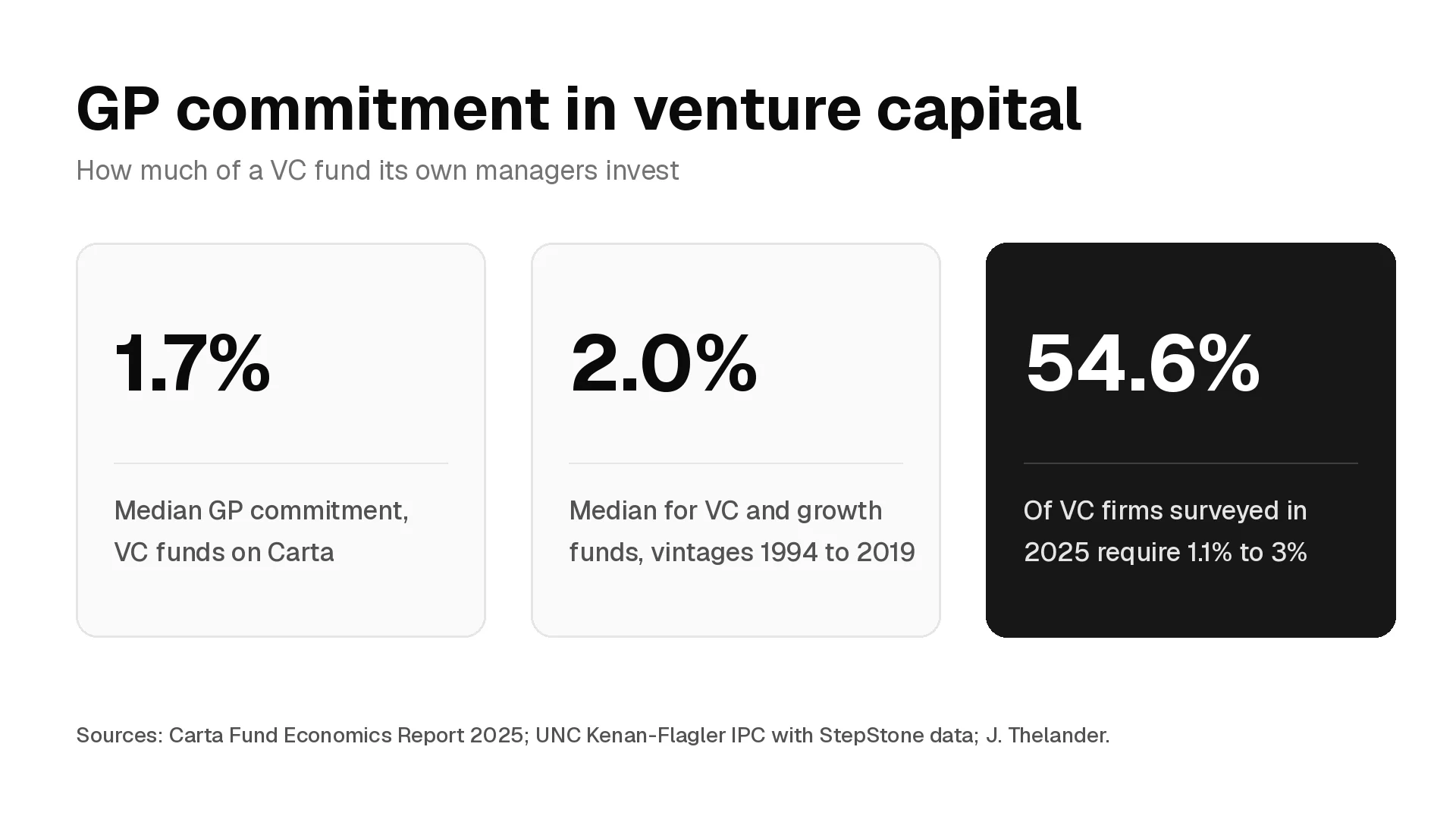
What a GP commitment is, how large it is in venture capital, how GPs fund it, where it sits in the LPA, what the returns evidence says, how firms split it across partners and principals, and what to ask before you accept a role with carry.
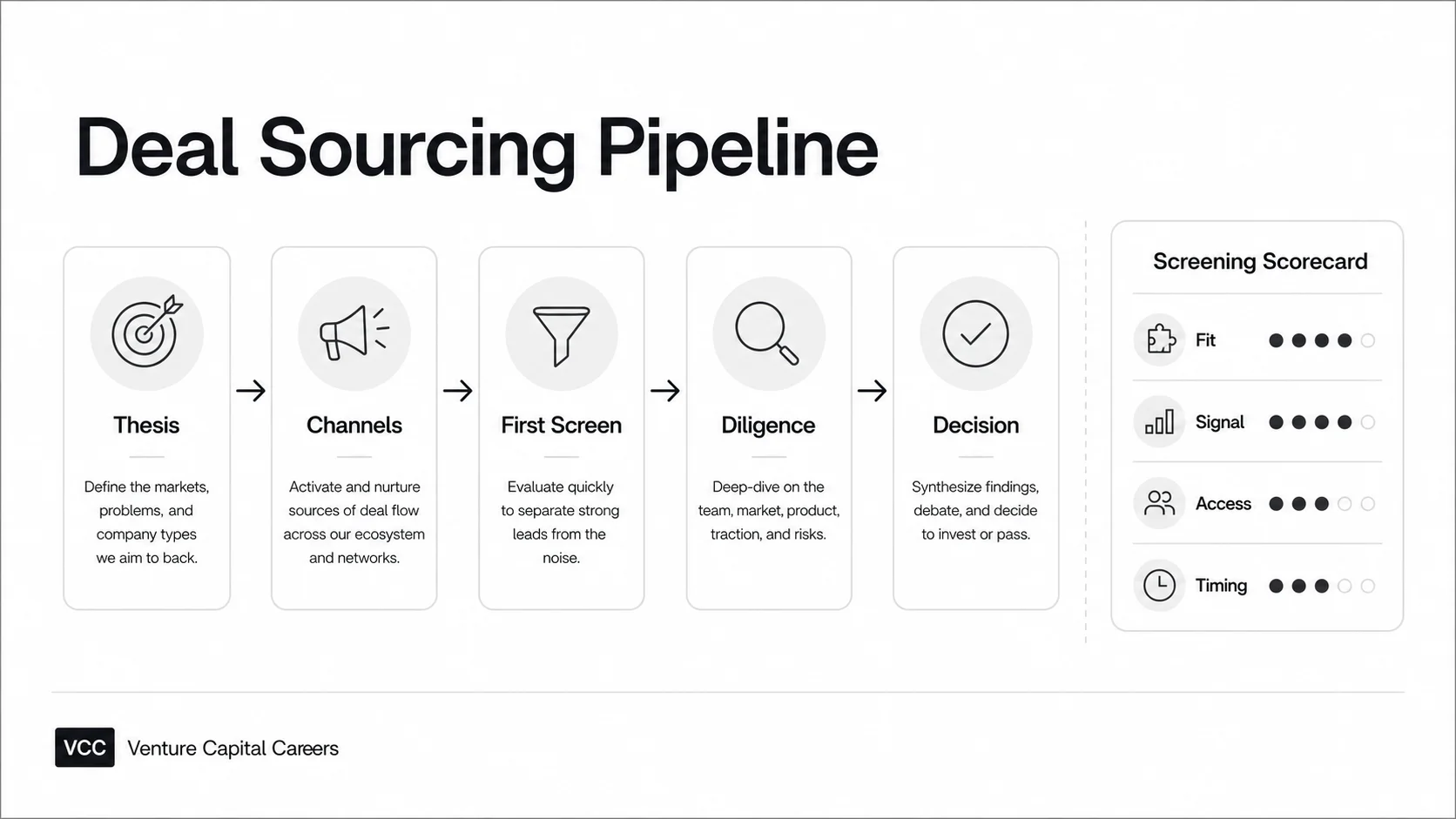
Most closed VC deals start with a relationship. See where deals come from by stage, how to work each sourcing channel, which signals show up early, and how analysts run a weekly sourcing process.
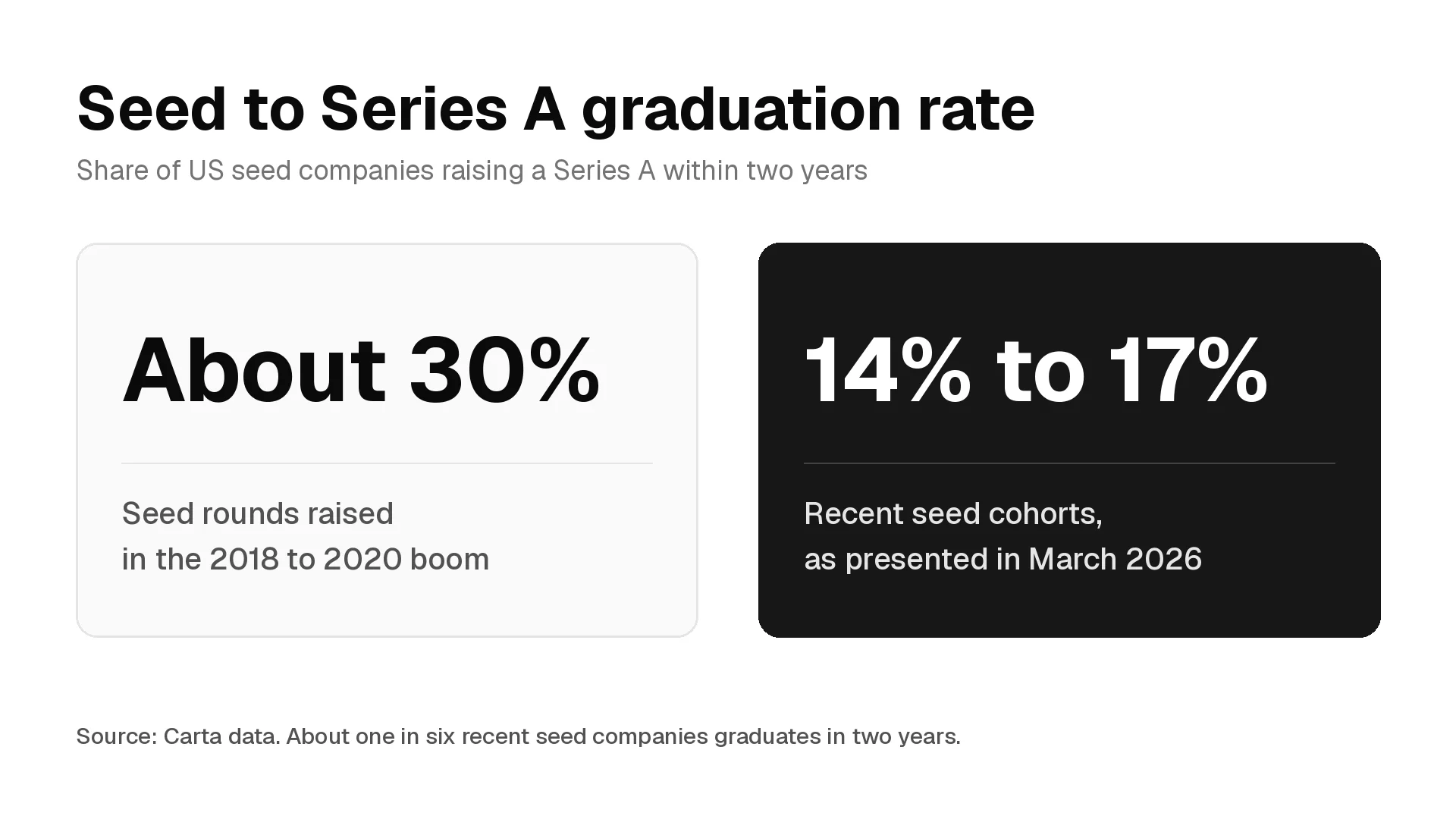
Seed to Series A graduation rates by cohort from Carta and Crunchbase, how long the jump takes, why rates fell after 2021, why published figures disagree, and how seed and Series A firms use the rate for reserves, LP reporting, portfolio reviews and interviews.