
Biotech venture capital hires for scientific judgment under commercial constraints. The funds that matter most still underwrite molecules, devices, diagnostics, and platforms where clinical, regulatory, and reimbursement risk can wipe out years of work. That is why advanced degrees show up so often on partner pages, and why a strong tech-VC resume alone rarely transfers cleanly.
If you want a general break-in map first, start with how to become a venture capitalist or how to get a job in venture capital. This page is the sector-specific version: which seats exist, which backgrounds win, what proof to build, and when biotech VC is the wrong escape from academia or medicine.
Biotech VC is a different hiring market
Tech venture capital can hire pattern recognition from operators, bankers, product leaders, and scouts. Early-stage biotech and broader life-science funds still ask a harder first question: can you tell whether the science is real, novel, and investable before the company has revenue?
That changes the job and the hiring bar.
| Dimension | Typical tech VC junior seat | Typical biotech / life-science VC seat |
|---|---|---|
| Core risk | Market, product, distribution | Science, clinical path, regulation, reimbursement |
| Diligence language | Users, retention, GTM, unit economics | Mechanism, trial design, endpoints, IP, CMC |
| Common feeder | Banking, consulting, product, founder ops | MD/PhD, healthcare IB/ER, life-science consulting, biotech ops |
| Junior headcount | Thin, but more associate seats than biotech | Often top-heavy; few true junior roles |
| Modeling intensity | Varies by stage | Higher at late-stage / crossover; lower at pure incubation |
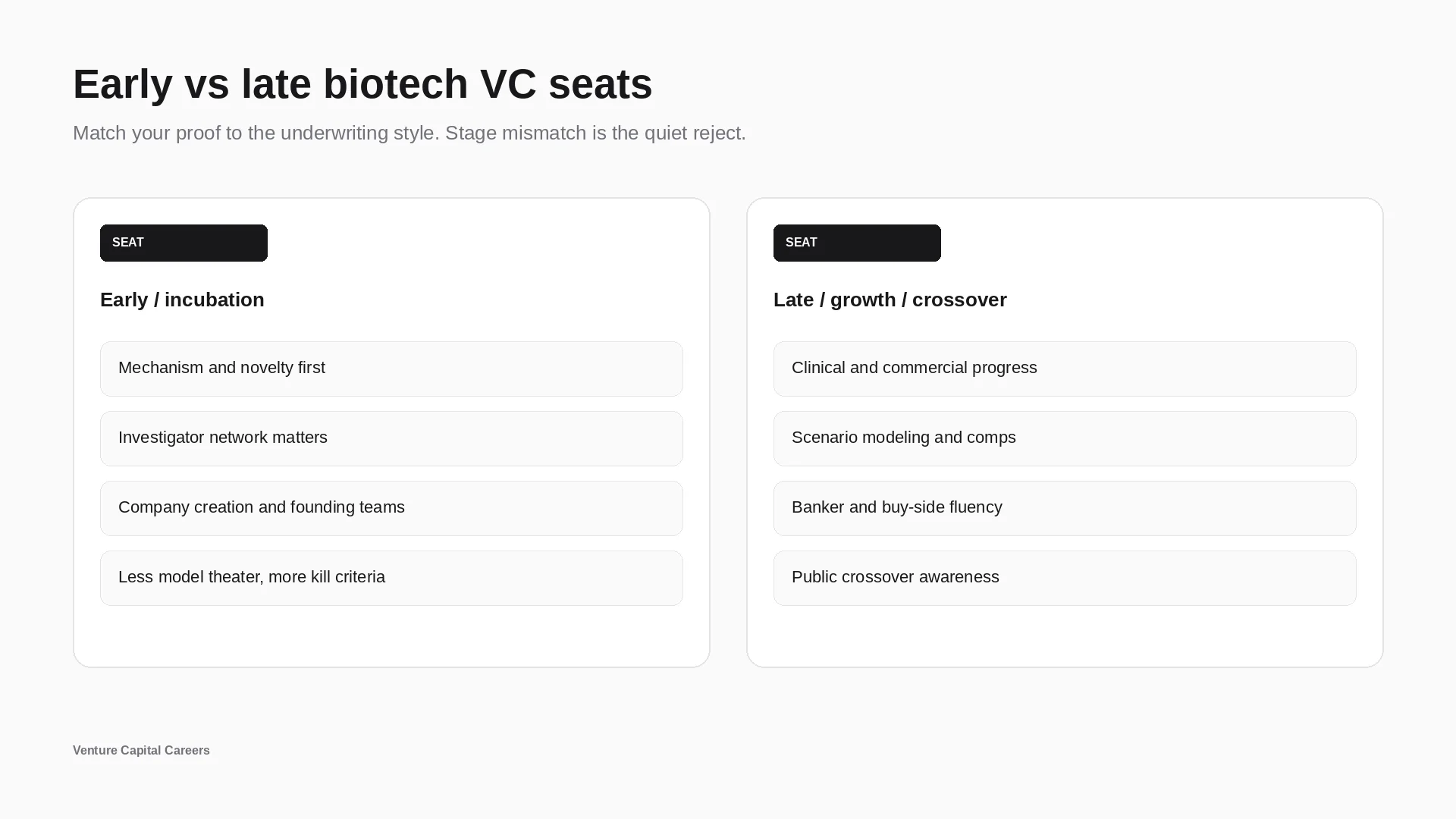
Late-stage, growth, and crossover life-science funds look more like healthcare finance. Early-stage incubators look more like company creation around science. Mixing those stories is how candidates sound senior and still miss.
Pick the seat before you pick the brand
"Biotech VC" is not one job. Name the seat before you chase logos.
| Seat | What you actually do | Who underwrites you | Weak fit when |
|---|---|---|---|
| Early-stage / incubation investor | Source or create companies, diligence science, help recruit founding teams | Deep domain credibility and network in labs or clinics | Your proof is only late-stage modeling |
| Associate / principal on a specialist fund | Screen deals, build memos, run KOL calls, support IC | Science literacy plus commercial judgment | You want a generalist consumer tech brand |
| Late-stage / growth / crossover | Diligence clinical and commercial progress, model scenarios, support public crossover work | Healthcare finance chops | Your only edge is a thesis without numbers |
| Platform / talent / BD at a life-science fund | Help portfolio companies hire, partner, or raise | Operator proof in biotech companies | You pitch yourself as an investor on day one |
| Entrepreneur in residence | Time-boxed embed while exploring a company or thesis | Prior founder or operator trust | You need a durable salary ladder now |
If the posting is really portfolio support, read it as platform work. If the firm incubates companies and calls every scientist a "partner," ask who owns the check and who owns the science diligence.
Use the companies directory to see whether a fund's recent investments match the stage and modality you can defend. Brand alone is a weak filter.
Three paths that actually work
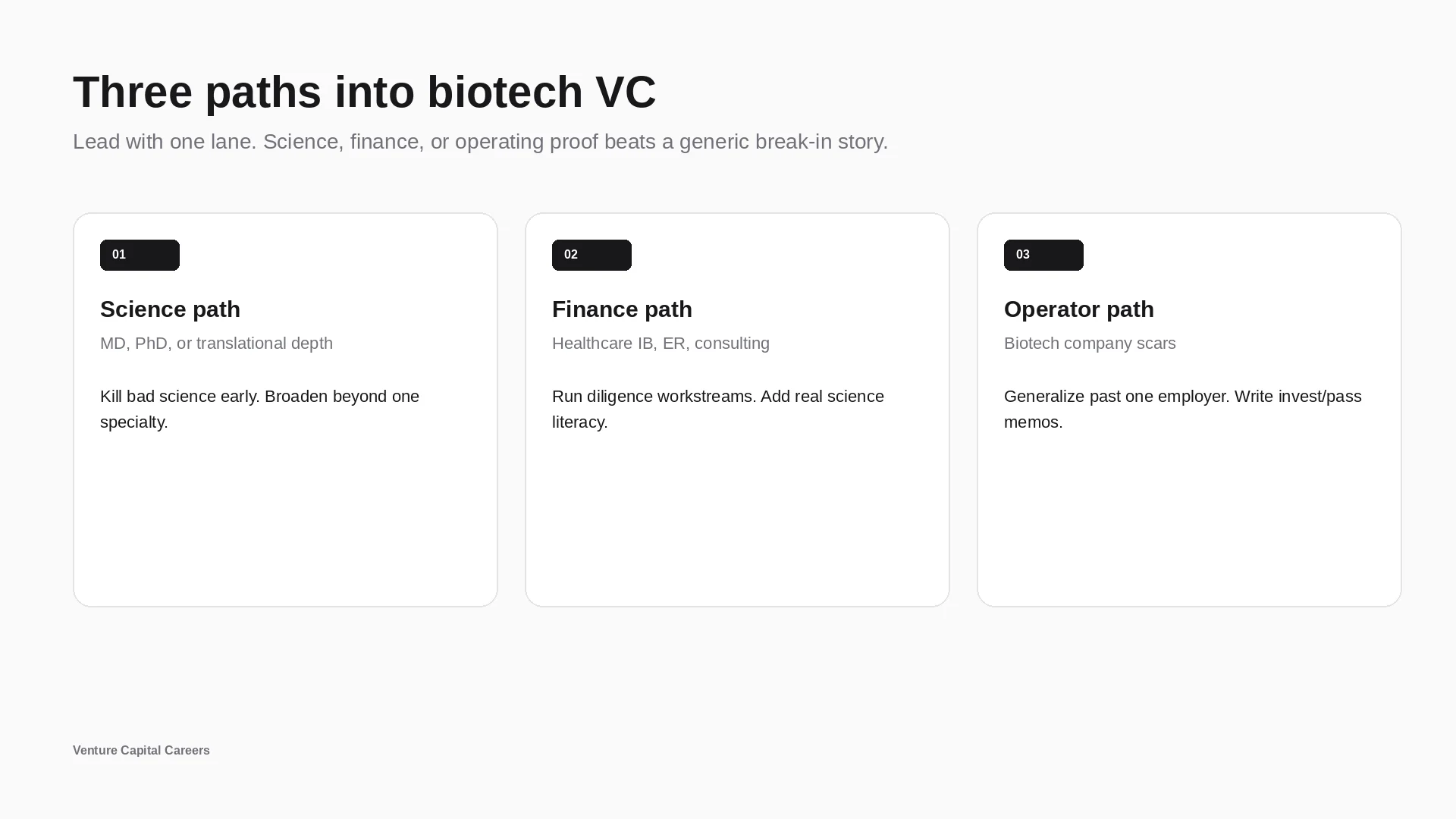
Most durable entries still fall into three buckets. You can combine them, but you should lead with one.
1. Science path
Common profiles: PhDs with published work in a hot modality, MDs with clinical credibility, physician-scientists, and translational researchers who already advise companies.
What funds buy: the ability to kill bad science early, speak with investigators as peers, and spot where a mechanism is fashionable rather than fundable.
What funds still need from you: commercial instincts, communication that is not a journal club, and evidence you can work in a partnership that ships decisions on incomplete data.
Residency and fellowship choices matter. Extra clinical years help if your target funds underwrite that specialty. They hurt if you already know you want investing and the years only delay network building. An entrepreneur-in-residence stint can be a cleaner bridge than another training year when the goal is company creation, not a hospital ladder.
2. Finance path
Common profiles: healthcare investment banking, biotech equity research, life-science consulting, corporate development or corporate venture at a pharma or medtech parent.
What funds buy: process, modeling, competitive maps, and the ability to run a diligence workstream without getting lost in the science theater.
What funds still need from you: enough scientific literacy to ask real questions, not just restate a banker book. Late-stage and crossover seats are the natural landing zone. Pure early-stage incubators will still overweight domain depth.
If this is your lane, the investment banking to venture capital and consulting to venture capital guides still apply. Add healthcare deal samples and a modality thesis on top.
3. Startup / operator path
Common profiles: early biotech employees, heads of translational research, clinical operations leaders, founding scientists who shipped a program, and operators from funds' portfolio companies.
What funds buy: scars from the stage they invest in, hiring judgment, and founder trust.
What funds still need from you: evidence you can generalize beyond one company and write an investment recommendation, not only an operating plan. The startup operator to venture capital path is the closest sibling.
A successful company exit can skip steps. A failed company with clear lessons can still work if references are strong and the learning is specific.
Proof of work by background
Generic enthusiasm for "curing disease" does not move a hiring partner. Ship artifacts that match the seat.
Science-path packet
- One modality thesis (8–12 pages or a tight memo): what changed, who wins, what fails, what you would not fund
- Annotated map of 15–25 companies or labs in that modality, with kill criteria
- Two written diligence notes on public or hypothetical programs, including trial-design risks
- A shortlist of investigators and operators who would take a reference call for you
- Optional: a fellowship or part-time diligence project with dated deliverables
Finance-path packet
- One healthcare deal or coverage memo rewritten as an investment recommendation
- A simple probability-adjusted revenue sketch for a clinical-stage asset, with explicit assumptions
- Competitor and indication map that a partner could skim in ten minutes
- Proof you can source: a warm pipeline of companies or bankers who already send you deals
- Resume that leads with healthcare outcomes, not generic banking language (VC resume guide)
Operator-path packet
- Three operating problems you fixed at the stage the fund holds, with metrics and references
- One "would I have invested?" memo on a company you know from the inside, written as an outsider
- Evidence of cross-company pattern recognition, not only loyalty to one employer brand
Keep the packet short. Partners do not want a second dissertation. They want signal that you can help them say no faster.
How recruiting really happens
Biotech VC recruiting is relationship-heavy and seat-scarce. Many specialist firms are top-heavy: more partners than true associates. Junior openings often appear after a fundraise, a partner departure, or when an incubator needs more diligence throughput.
Practical implications:
- Cold applications without a warm context underperform even more than in tech VC
- Timing follows fund cycles and partner bandwidth, not a campus calendar
- MBA to venture capital can help for some late-stage seats; it rarely replaces domain depth for early-stage science roles
- Geographic clusters still matter: Boston, San Francisco Bay Area, San Diego, New York, London, and a handful of European hubs concentrate both companies and investors
Build the list of target funds from recent investments and partner backgrounds, then use the Venture Capital Careers job board to catch the seats that do get posted. Set job alerts so you are not relying on memory when a rare associate search opens.
What interviews and case work test
Expect the usual story, "why this firm," and strengths questions from the general venture capital interview questions set. Then expect sector tests.
| Interview block | What they are testing | Strong signal |
|---|---|---|
| Scientific breadth | Can you leave your narrow specialty? | Clean explanation of adjacent modalities and known failure modes |
| Mechanism and clinical path | Can you stress-test a program? | Specific questions on endpoints, comparators, and CMC risk |
| Market and indication | Is the commercial story real? | Patient counts, pricing logic, and competitive standard of care without hand-waving |
| Firm and portfolio fluency | Did you do the work? | Opinions on recent investments and why the firm passed on obvious peers |
| Case / verbal IC | Can you recommend under uncertainty? | Clear invest / pass, kill criteria, and next diligence steps (case study interview) |
| Modeling (late-stage) | Can you translate science into scenarios? | Transparent assumptions, not false precision |
Bring a point of view. Neutral summaries of a company's website read as internship energy. Partners hire people who will argue inside the partnership without becoming theatrical.
When biotech VC is the wrong move
Skip or delay the jump when:
- Your real goal is immediate cash compensation comparable to clinical practice or senior pharma roles. Junior VC cash is often lower, and carry is slow and uneven. Check the salary guide for ranges, then read documents before you romanticize the upside.
- You want a structured promotion ladder. Partnership politics dominate. Performance alone does not create a seat.
- Your science depth is narrow and you refuse to broaden. Early-stage funds need range.
- You are using VC as a soft landing from a stalled academic job search without proof packets or network. The hiring bar does not care that you are tired of grant cycles.
- You actually want operating ownership inside one company. Join a portfolio company or raise your own. The fund seat is leverage across many companies, not CEO authority.
- Every target firm is a generalist tech brand with one biotech logo on the website. You will interview for a different job than the one you prepared for.
Healthcare investment banking, biotech equity research, life-science consulting, and operating roles can be better intermediate steps. They are not failures. They are often the missing commercial chapter on a science CV.
A 90-day plan
Days 1–30: Choose a lane
- Pick one modality or indication cluster you can defend
- Pick early-stage versus late-stage / crossover as your primary seat type
- List 20 funds whose last 10 investments match that lane
- Draft the thesis outline and the first company map
Days 31–60: Ship proof
- Finish one thesis memo and two diligence notes
- Run ten expert or operator conversations, not ten "informational interviews" with no agenda
- Rewrite your resume around healthcare outcomes and investment judgment
- Start two warm threads into each of your top ten funds through mutuals, founders, or bankers
Days 61–90: Convert
- Ask for diligence project work, scout-style coverage, or a formal search timeline
- Practice a 10-minute IC recommendation on a live public company in your lane
- Apply to posted roles on the job board without abandoning the warm path
- Drop funds that only want free consulting with no hiring intent
Ninety days will not manufacture an MD. It will show whether you are building an investable profile or collecting coffee chats.
Frequently asked questions
Do I need an MD or PhD to get into biotech VC?
For many early-stage science-led funds, yes or the equivalent depth from a long translational career. For late-stage, growth, crossover, and some device-focused seats, healthcare finance and operating backgrounds can win without a terminal science degree if your literacy is real.
Can I move from tech VC into biotech VC?
Sometimes, if you already cover health tech with clinical credibility or you rebuild a science packet. Pure consumer or SaaS investing experience is a weak substitute for mechanism risk.
Are there analyst roles?
Yes, but fewer than candidates expect. Many firms stay top-heavy. When analyst or associate seats open, competition includes people with advanced degrees and prior diligence reps.
How important is modeling?
Critical for late-stage and crossover. Secondary for pure early-stage incubation, where science diligence and company creation dominate. Still learn enough to read a forecast without bluffing.
Is an EIR better than an associate role?
They solve different problems. An EIR is usually time-boxed and company-creation oriented. An associate role is a salaried investing apprenticeship. Choose based on whether you need runway to start a company or reps inside a fund.
Where should I look for open roles?
Warm network first. Then watch specialist fund career pages and the Venture Capital Careers job board, and research targets in the companies directory. Use job alerts so rare postings do not pass you by.
Biotech VC rewards people who can hold science and commerce in the same sentence. Pick the seat, ship proof that matches it, and treat the fund's actual portfolio as the scorecard.
Related posts
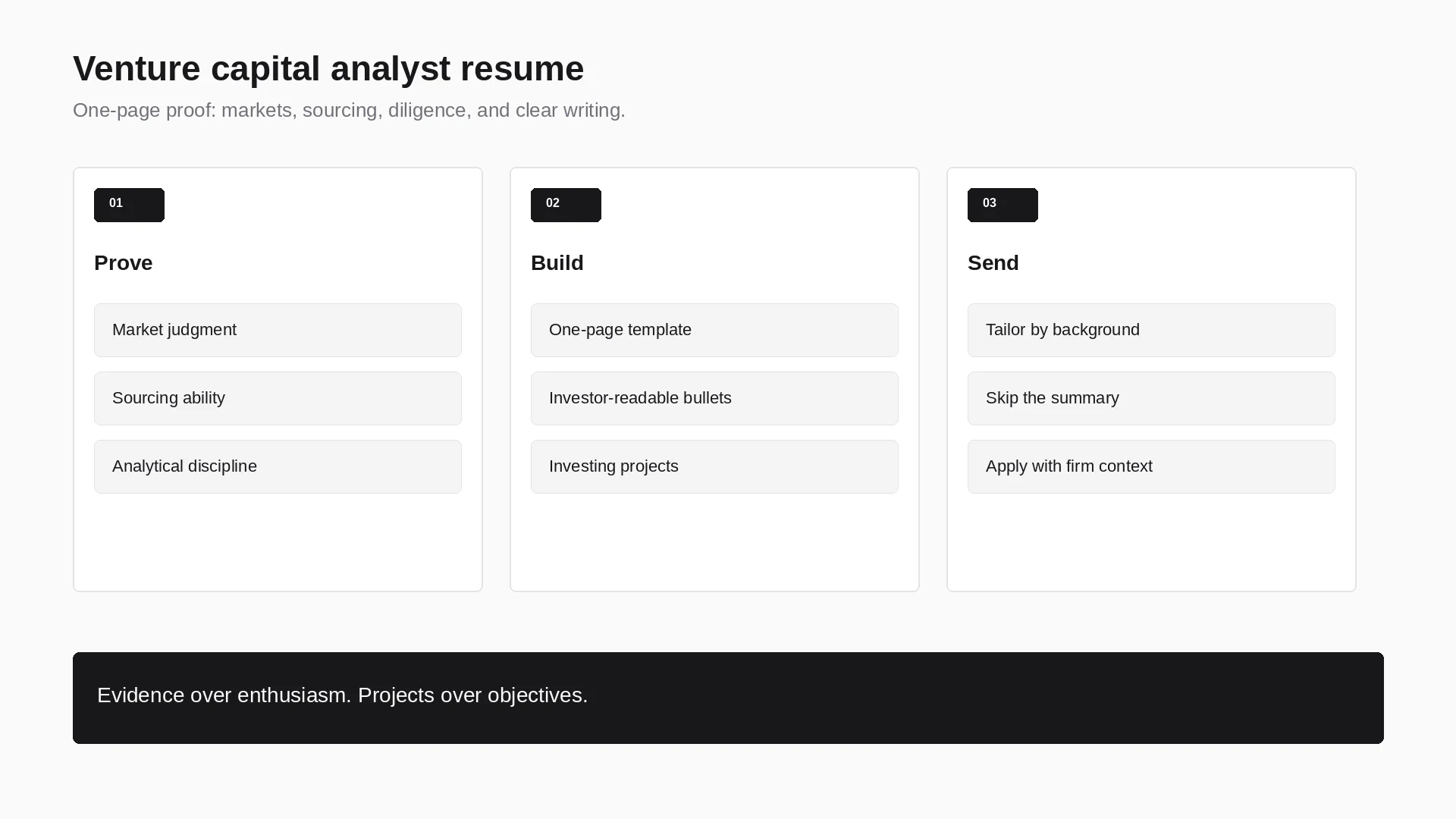
A VC analyst resume is a one-page proof document. Template, bullet formula, investing projects section, examples, and next steps for analyst applications.
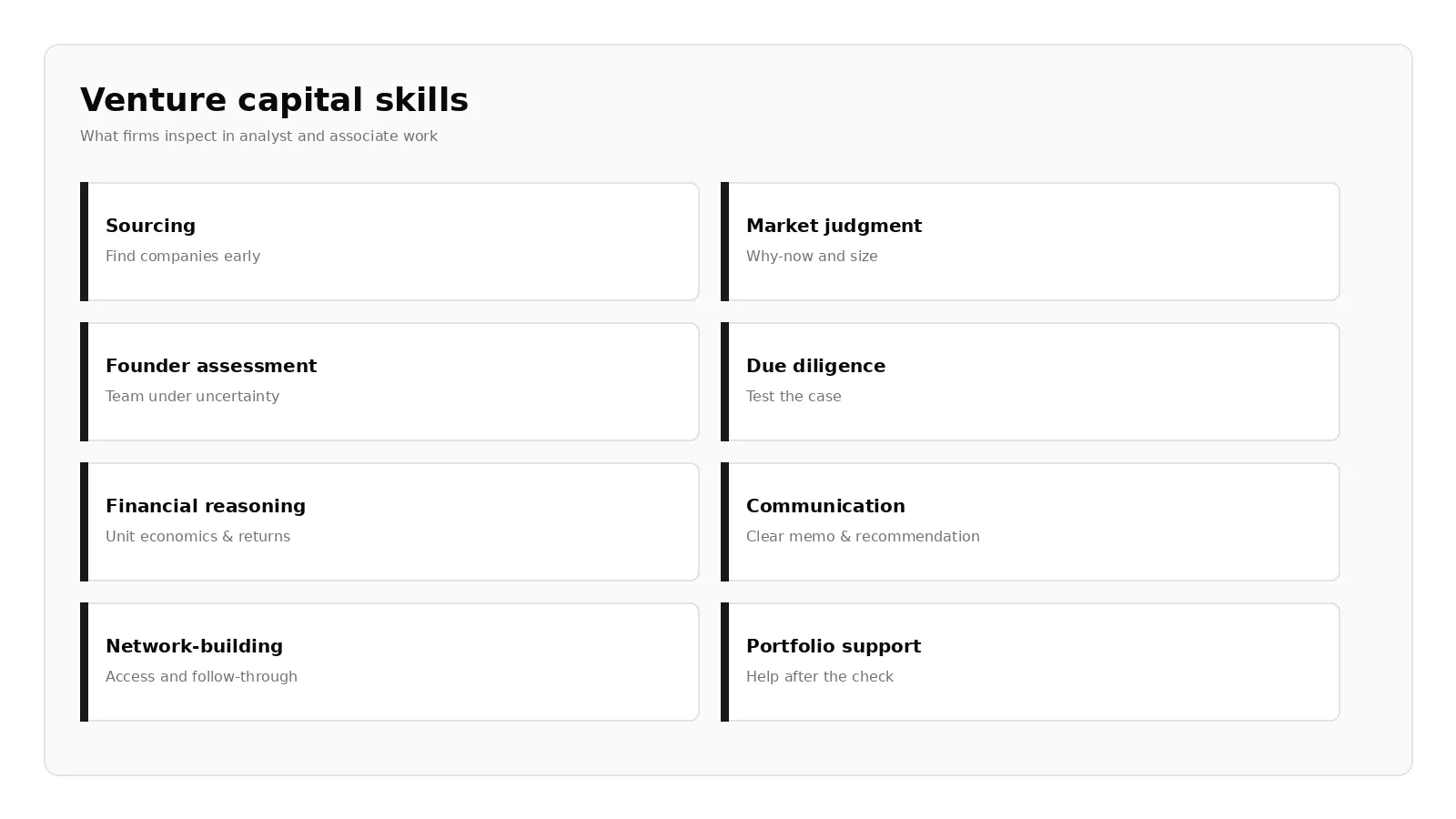
Core venture capital skills for analysts and investors: sourcing, diligence, founder judgment, memos, and a proof ledger you can use when applying.
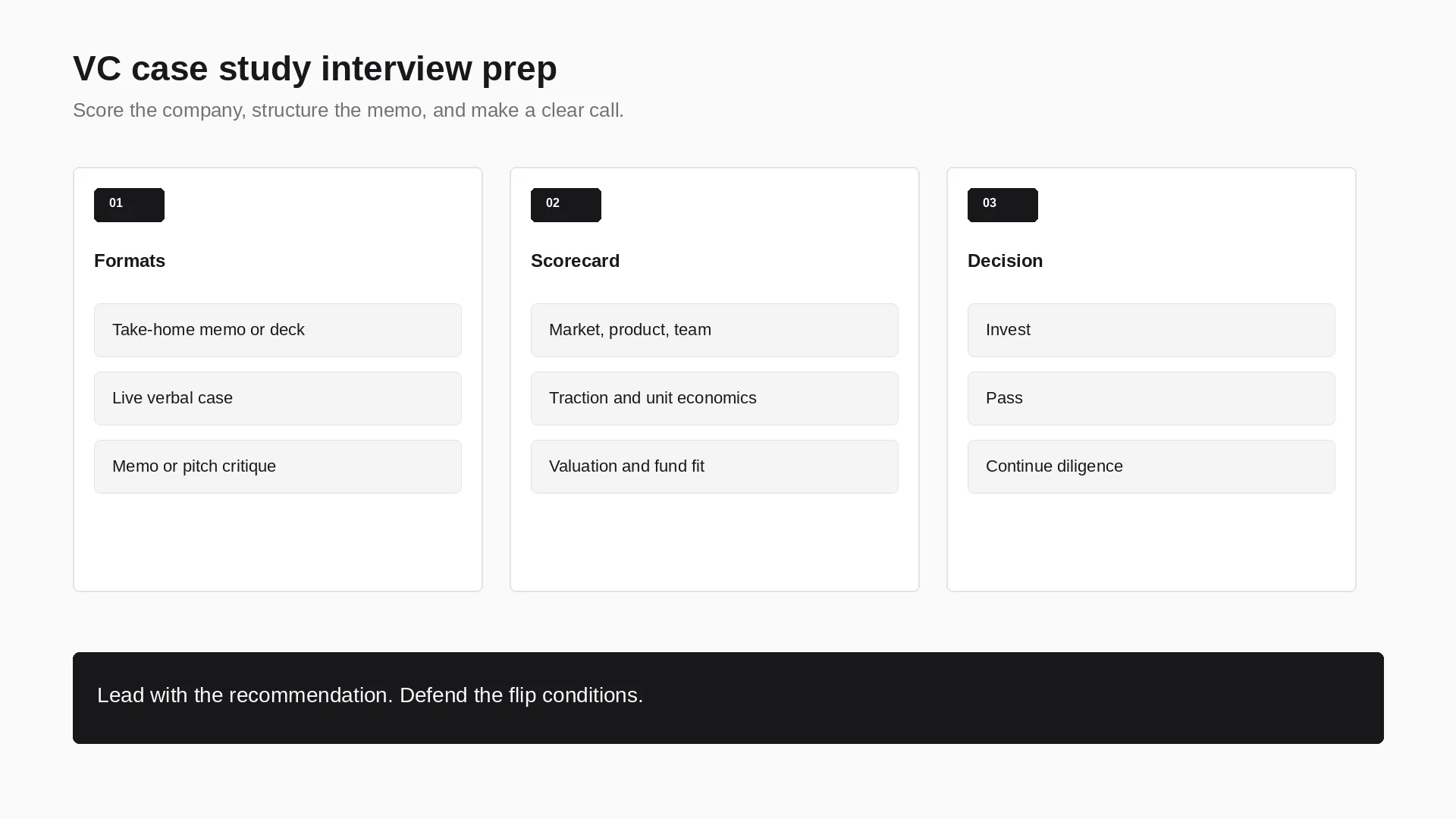
Prepare for a VC case study interview with formats, a stage-aware scorecard, memo structure, return math, and an invest/pass/continue-diligence decision tree.