
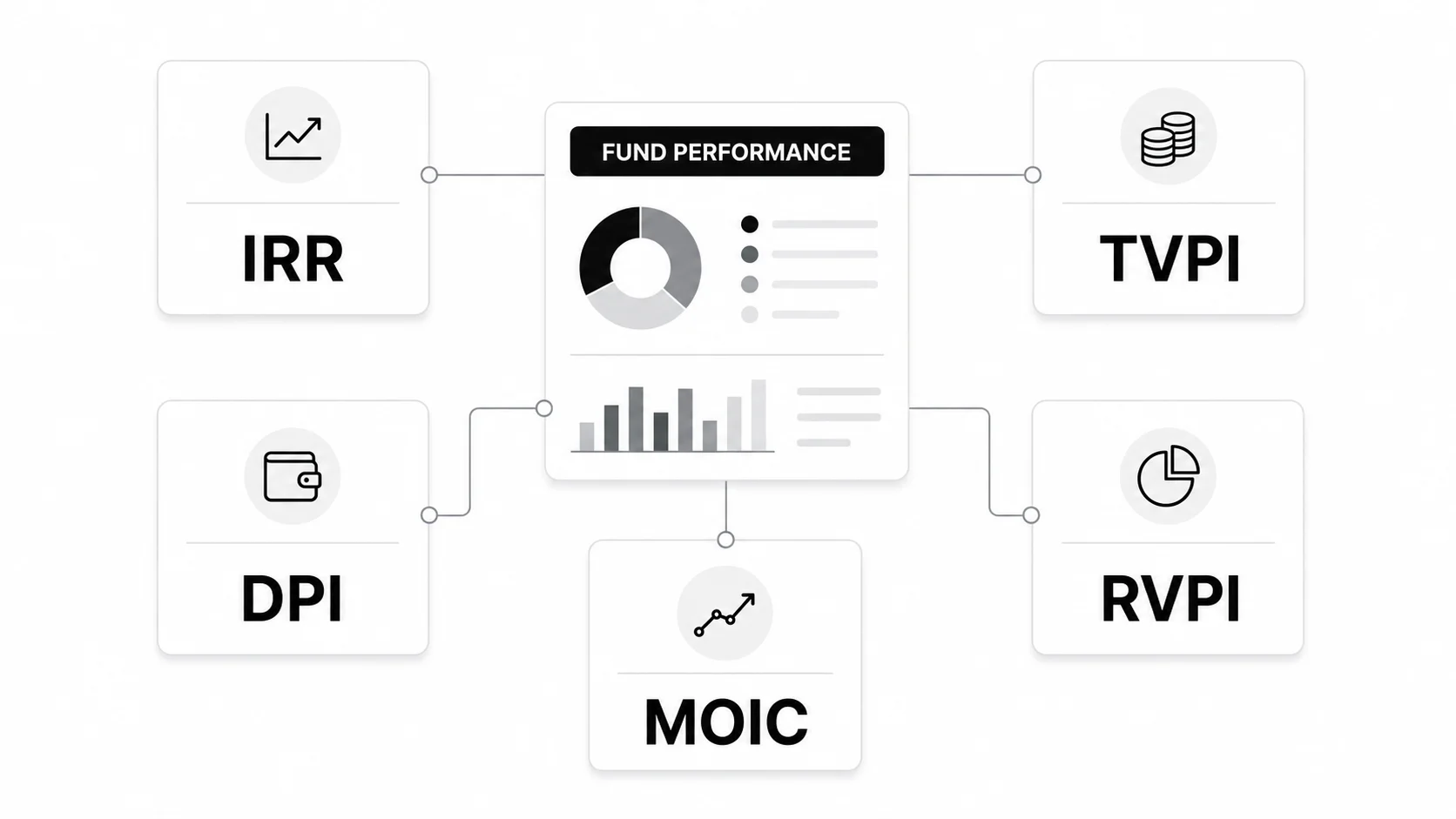
The five core venture capital fund performance metrics are IRR, TVPI, DPI, RVPI, and MOIC. They do not compete for one “best” answer. DPI measures cash returned, RVPI measures value still held, TVPI combines the two, MOIC compares value with investment cost, and IRR adds the timing of cash flows.
A metric becomes decision-useful only when you can name four things: its gross or net basis, its realized or unrealized mix, its time period, and its peer set. Read a fund scorecard in that order and the acronyms become a coherent account of value, liquidity, and risk.
VC fund performance metrics at a glance
Before reading a return, identify four things: whether it is gross or net, how much is realized or unrealized, whether it accounts for time, and which peer set makes the comparison fair. Those four lenses prevent most errors.
The five core metrics answer different questions:
| Metric | Question it answers | Simplified formula | Includes unrealized value? | Time-aware? | Main trap |
|---|---|---|---|---|---|
| DPI | How much cash have LPs received? | Distributions / paid-in capital | No | No | Penalizes young funds before exits |
| RVPI | How much value remains in the portfolio? | Residual value / paid-in capital | Yes | No | Depends on current valuation marks |
| TVPI | What is total realized plus unrealized value? | (Distributions + residual value) / paid-in capital | Yes | No | Can look strong while cash returns are weak |
| MOIC | How many dollars of value exist per dollar invested? | Total value / invested capital | Usually | No | Denominator and gross/net basis vary |
| IRR | How quickly did the cash flows create value? | Discount rate that sets cash-flow NPV to zero | Sometimes, for interim IRR | Yes | Sensitive to cash-flow timing and methodology |
The denominators matter as much as the acronyms:
- Paid-in capital is capital contributed by LPs to the fund. It can include amounts used for investments, fees, expenses, and other fund purposes depending on the reporting definition.
- Invested capital is the cost allocated to portfolio investments. It is commonly used for gross portfolio MOIC and may exclude fees and expenses.
- Distributions are cash or securities returned to LPs.
- Residual value is the current net value of investments still held. At fund level it is usually represented by NAV after relevant liabilities.
If you need the entity and cash-flow foundation first, start with how a venture fund is structured. Performance metrics sit on top of that architecture.
How the five core metrics work
DPI: cash returned to investors
DPI = cumulative distributions / paid-in capital
A DPI of 0.6x means LPs have received 60 cents for every dollar contributed. A DPI of 1.0x means they have received an amount equal to paid-in capital; it does not necessarily mean the fund is finished or that every distribution is profit in an accounting sense.
DPI is the cleanest evidence of realization because it does not rely on the valuation of companies still held. It is also backward-looking. Seed funds may report little or no DPI for years while companies mature. The useful question is not “Is DPI low?” but “Is DPI appropriate for this vintage and strategy, and is it progressing?”
RVPI: value still on paper
RVPI = residual value / paid-in capital
RVPI measures the value that remains in the portfolio relative to LP contributions. A 1.4x RVPI means the current residual value equals $1.40 for each dollar paid in.
RVPI is most informative when paired with the composition of NAV. Ask when the largest positions were last priced, whether valuations reflect recent financing rounds or model-based estimates, and how much residual value is concentrated in the top one to three companies. Two funds can report the same RVPI while carrying very different realization risk.
TVPI: cash plus residual value
TVPI = (distributions + residual value) / paid-in capital
Because the denominators match, TVPI = DPI + RVPI. If DPI is 0.6x and RVPI is 1.4x, TVPI is 2.0x.
TVPI is the fastest headline view of total value, but it is not a verdict. A 2.0x TVPI composed of 1.6x DPI and 0.4x RVPI is mostly realized. The same 2.0x TVPI composed of 0.1x DPI and 1.9x RVPI is mostly dependent on future exits and current marks.
MOIC: value relative to investment cost
MOIC = total investment value / invested capital
MOIC is especially useful at the deal or portfolio level. If a fund invested $2 million in a company and has received $1 million while retaining a stake valued at $5 million, the deal's gross MOIC is 3.0x: $6 million of realized and unrealized value divided by $2 million of cost.
MOIC and TVPI can look similar, but they are not automatically interchangeable. Gross MOIC commonly uses investment cost and excludes the fees, expenses, and carried interest that sit between portfolio performance and the LP's net result. Net TVPI uses paid-in capital and the LP's share of distributions and NAV.
Use one rule whenever someone quotes MOIC: name the numerator, denominator, reporting level, and gross/net basis. Without those four details, the multiple is ambiguous.
IRR: return adjusted for timing
IRR is the discount rate that makes the net present value of all dated cash flows equal to zero. Unlike a multiple, it rewards earlier value creation and distributions.
Two funds can both turn $10 million into $20 million and therefore show a 2.0x multiple. The fund that returns meaningful cash in year three will generally report a higher IRR than one that returns everything in year ten. The final multiple is the same; the time value and reinvestment opportunity are not.
Interim IRR can include ending NAV as if the residual portfolio were a terminal cash flow on the measurement date. That makes it partly dependent on unrealized value. IRR may also change materially depending on whether reporting shows the effect of a subscription facility, because a facility can delay the date on which LP capital is called.
Use spreadsheet XIRR for irregularly dated cash flows. Do not estimate IRR from TVPI alone: the snapshot does not contain enough timing information.
A worked VC fund performance example
Assume a venture fund reports the following at quarter-end:
| Item | Amount |
|---|---|
| Paid-in capital from LPs | $10 million |
| Cumulative distributions to LPs | $4 million |
| Residual value / ending NAV | $16 million |
| Total value | $20 million |
The fund-level multiples reconcile cleanly:
| Metric | Calculation | Result | Interpretation |
|---|---|---|---|
| DPI | $4m / $10m | 0.4x | LPs have received 40 cents per dollar paid in |
| RVPI | $16m / $10m | 1.6x | $1.60 per paid-in dollar remains in NAV |
| TVPI | ($4m + $16m) / $10m | 2.0x | Total realized and unrealized value equals twice paid-in capital |
The identity checks: 0.4x DPI + 1.6x RVPI = 2.0x TVPI. More important, 80% of the reported value remains unrealized. The next questions should focus on the $16 million NAV: its concentration, valuation dates, financing-round evidence, and likely paths to liquidity.
You still cannot calculate two other metrics from this snapshot:
- IRR requires dates. The report must show when capital was called, when distributions occurred, and the measurement date for ending NAV.
- Gross MOIC requires an investment-cost basis. Paid-in capital is not necessarily equal to capital invested in portfolio companies because fees, expenses, recycling, and other cash flows can intervene.
Now compare two simplified outcomes with the same total value:
| Scenario | Cash-flow pattern | Final multiple | Timing conclusion |
|---|---|---|---|
| Earlier liquidity | $10m contributed at inception; $5m distributed in year 3; $15m distributed in year 10 | 2.0x | Higher IRR because some capital returns earlier |
| Later liquidity | $10m contributed at inception; $20m distributed in year 10 | 2.0x | Lower IRR because all value arrives at the end |
The example is deliberately synthetic. Its job is to show the logic: multiples describe magnitude, while IRR adds timing.
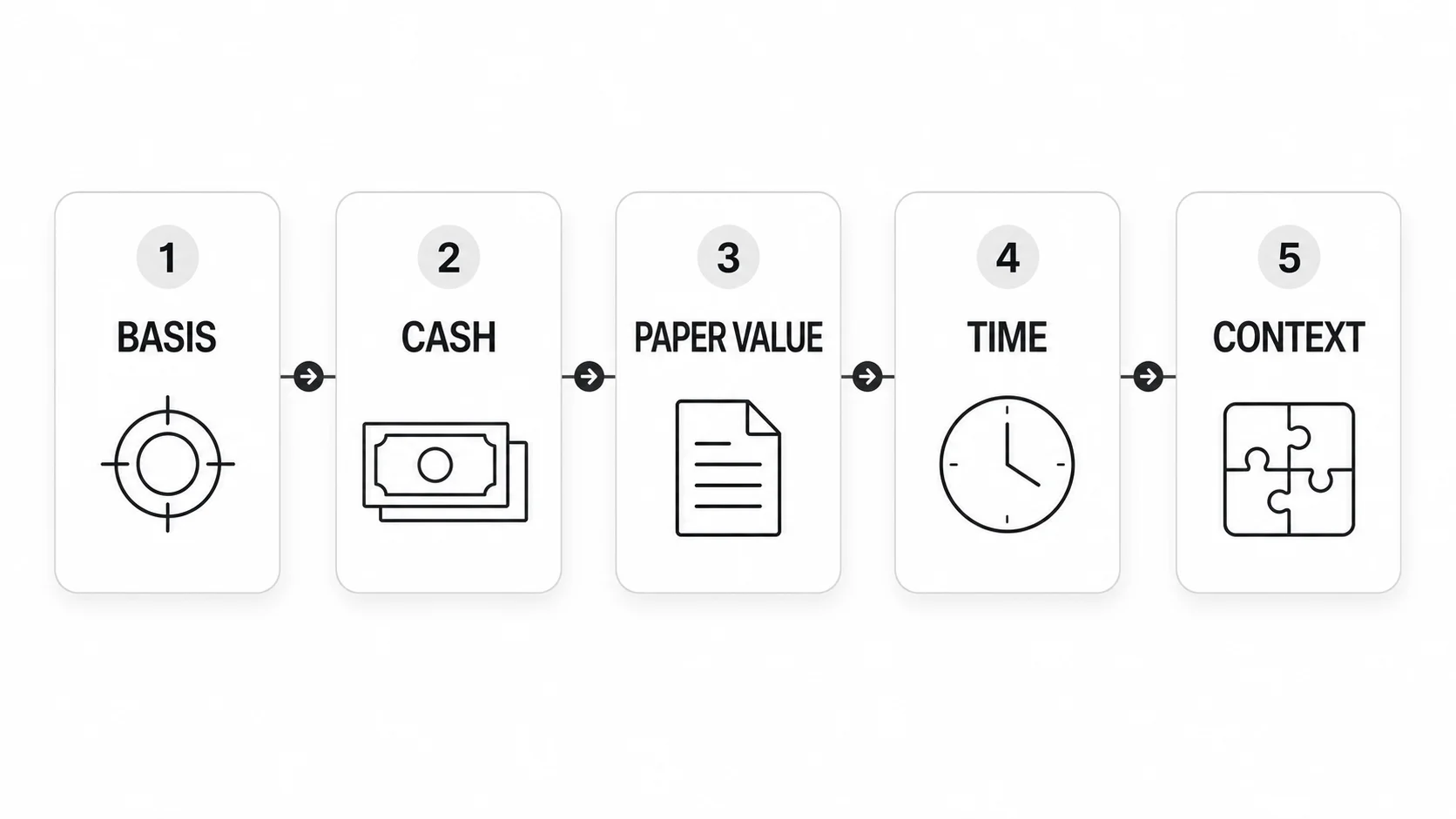
The five-step framework for reading a fund scorecard
1. Confirm the reporting basis
Write down the measurement date, reporting level, gross/net basis, and subscription-facility treatment before comparing numbers. The current ILPA Performance Template is useful precisely because it standardizes calculation inputs and distinguishes relevant gross and net views, including performance with and without the impact of fund-level subscription facilities.
A number labelled “IRR” or “multiple” without methodology is not ready for comparison.
2. Start with cash
Read DPI and the distribution history. Cash confirms realization and reduces dependence on current marks. Then ask whether distributions came from full exits, partial exits, dividends, secondary sales, or other transactions. The source of DPI affects what remains in the portfolio.
3. Audit the paper value
Move to RVPI and the underlying NAV. Identify the largest unrealized positions, their last valuation dates, recent operating evidence, and the firm's write-down policy. A concentrated 1.5x RVPI driven by one late-stage company is a different risk from 1.5x spread across a dozen marked-up investments.
This is where venture capital portfolio review and valuation work connect to LP return reporting.
4. Add time
Read IRR beside TVPI or MOIC. If IRR is high but the multiple is modest, look for small early distributions or delayed LP capital calls. If the multiple is strong but IRR is low, value may have taken a long time to mature. Neither pattern is automatically good or bad; each needs a cash-flow explanation.
5. Use the right peer set
Compare a fund with peers that share a relevant vintage year, strategy, geography, fund size, and reporting methodology. A 2022 seed fund should not be judged against a 2014 growth fund simply because both are called venture capital.
Cambridge Associates' private investment benchmarks report performance by vintage and on a net fund-level basis, illustrating the discipline required for a useful comparison. Recent vintages are also less seasoned: interim rankings can move as valuations change and exits occur.
What the metric combinations actually signal
Ratios generate questions, not automatic verdicts. Use combinations to decide where to look next.
| Pattern | What it may signal | Best follow-up question |
|---|---|---|
| High TVPI, low DPI | Reported value is mostly unrealized | Which companies drive RVPI, when were they last priced, and what are the credible liquidity paths? |
| Rising DPI, falling RVPI, stable TVPI | Portfolio value is converting from paper to cash | Did distributions come from strong full exits, partial sales, or early sales that reduced remaining upside? |
| High IRR, modest TVPI | Early cash flows are lifting the annualized rate | How much of IRR comes from one early distribution, and what multiple did the total portfolio create? |
| Strong gross MOIC, weaker net TVPI | Fees, expenses, carry, or denominator differences separate portfolio and LP outcomes | Are both numbers calculated on comparable cash flows and the same measurement date? |
| Flat TVPI, concentrated RVPI | The headline is stable but the remaining outcome depends on few positions | What percentage of NAV sits in the top three companies, and how would a markdown change TVPI? |
| Low DPI, low RVPI in a mature fund | Both realized and remaining value may be weak | What losses, write-downs, extensions, or unrealized positions explain the shortfall? |
The direction of travel matters too. A single quarter is a snapshot. A time series shows whether NAV is converting into distributions, whether write-ups are reversing, and whether a fund is moving through the expected lifecycle. Pair the ratios with the underlying cash flows and portfolio evidence before forming a conclusion.
A ten-minute analyst review workflow
This sequence works for an interview case, a quarterly report, or the first pass on a fund data room.
- Minutes 0–2: label the basis. Record measurement date, currency, fund or portfolio level, gross or net, interim or realized, and treatment of subscription facilities.
- Minutes 2–4: reconcile the scorecard. Confirm that DPI plus RVPI equals TVPI. Investigate rounding only after checking whether the fields use the same scope and date.
- Minutes 4–6: inspect residual value. Calculate how much total value remains in NAV, then identify its concentration and valuation age.
- Minutes 6–8: compare magnitude with time. Read TVPI or MOIC beside IRR. Explain any gap using distribution timing, capital-call timing, and remaining NAV.
- Minutes 8–10: choose peers and write questions. Match vintage, strategy, geography, fund size, and methodology. Write three questions that would change the conclusion.
A useful output is short: one sentence on realized performance, one on unrealized risk, one on time efficiency, and three follow-up questions. That is more decision-ready than a page of copied ratios.
These skills appear across investment, fund finance, operations, portfolio monitoring, and investor-relations work. VCC's overview of the skills VC firms look for and the venture capital career path can help you map the analysis to a role. When you are ready to use it in practice, browse open VC roles or research venture capital firms.
Common mistakes when evaluating VC fund returns
- Calling TVPI “cash return.” TVPI includes residual value. DPI is the cash-return ratio.
- Comparing gross MOIC with net TVPI. One may describe portfolio investments before fees and carry; the other describes LP value after fund-level economics.
- Ignoring vintage year. Young and mature funds should not have the same realization profile.
- Treating IRR as a multiple. IRR is an annualized rate driven by dated cash flows; it does not tell you dollars returned per dollar invested.
- Assuming every reported IRR uses the same call dates. Subscription facilities can affect LP cash-flow timing, which is why methodology disclosure matters.
- Trusting RVPI without looking through NAV. Valuation age, concentration, and write-down discipline determine how much confidence to place in paper value.
- Quoting a benchmark without its source date and methodology. The peer set and calculation basis are part of the benchmark, not footnotes.
The correction is consistent: label the basis, separate cash from paper value, add time, and compare like with like.
Frequently asked questions
Which VC fund performance metric matters most?
No single metric is sufficient. DPI is the strongest evidence of realized cash, TVPI gives total current value, RVPI shows how much remains dependent on future exits, and IRR adds timing. The most useful metric changes with the fund's age and the decision being made.
What is a good TVPI for a venture capital fund?
A TVPI is only “good” relative to a matched peer set and reporting basis. Compare funds with similar vintage years, strategies, geographies, sizes, measurement dates, and gross/net methodologies. A young fund's TVPI can change materially as valuations and ownership evolve, so avoid applying one universal threshold.
Is DPI more important than IRR?
DPI is harder to dispute because it measures value already distributed. IRR adds important information about timing, but it can be influenced by early distributions, delayed capital calls, and interim NAV. Mature funds should be able to support their IRR with meaningful DPI; young funds may not yet have that realization history.
Is MOIC the same as TVPI?
Not necessarily. MOIC usually compares total investment value with invested capital and is often reported gross at deal or portfolio level. TVPI compares LP distributions plus residual value with paid-in capital and is commonly reported net at fund level. They can converge under specific definitions, but never assume equivalence without checking the numerator, denominator, level, and gross/net basis.
Can TVPI be less than DPI?
Normally no when both use the same scope, date, and denominator, because TVPI equals DPI plus RVPI and residual value should not be negative. If a report appears to show TVPI below DPI, check for different dates, scopes, denominators, or data errors.
Why can IRR change when no company exits?
Interim IRR can include ending NAV as a terminal value. A write-up, write-down, new capital call, fee, or change in the measurement date can therefore change IRR even without a new exit. Review the dated cash-flow schedule and valuation movements before attributing the change to realized performance.
Read the scorecard in the right order
Start with the basis, separate cash from paper value, add timing, and finish with a matched peer set. That sequence turns IRR, TVPI, DPI, RVPI, and MOIC from isolated ratios into a disciplined view of fund performance.
For interview preparation or live fund work, apply the ten-minute review to one scorecard and force yourself to write the three questions that would change your conclusion. That habit is more valuable than memorizing one “good” return threshold.
Related posts
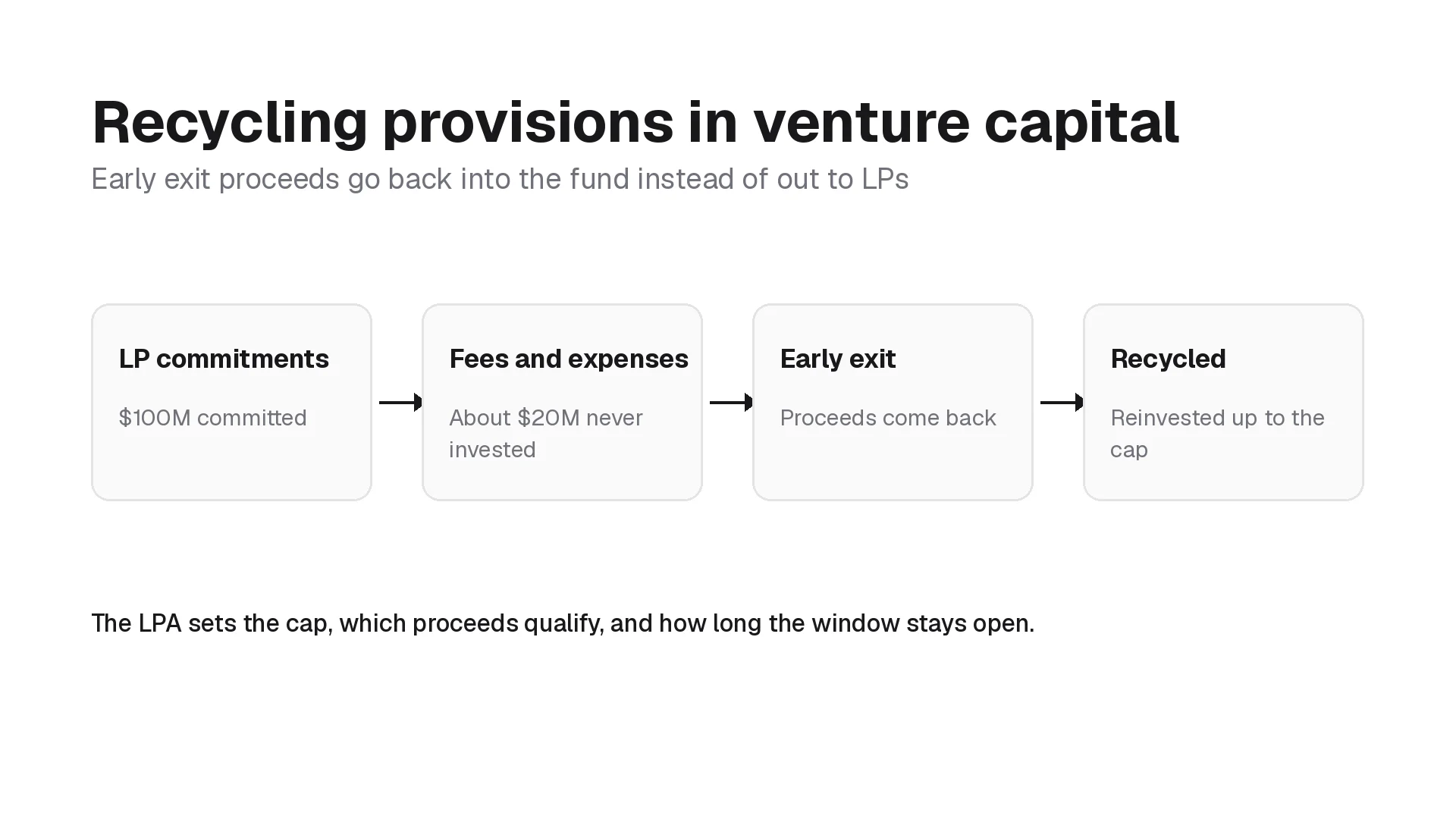
A recycling provision lets a VC fund reinvest early exit proceeds instead of distributing them. Here are the standard LPA terms, a worked example with the 1.0x break-even, the effect on DPI and IRR, and who handles recycling inside a firm.

How consultants move into venture capital: four realistic paths, which funds hire consultants, pay trade-offs, timing, what to staff on before leaving, project-to-evidence worksheet, resume, and interview process.
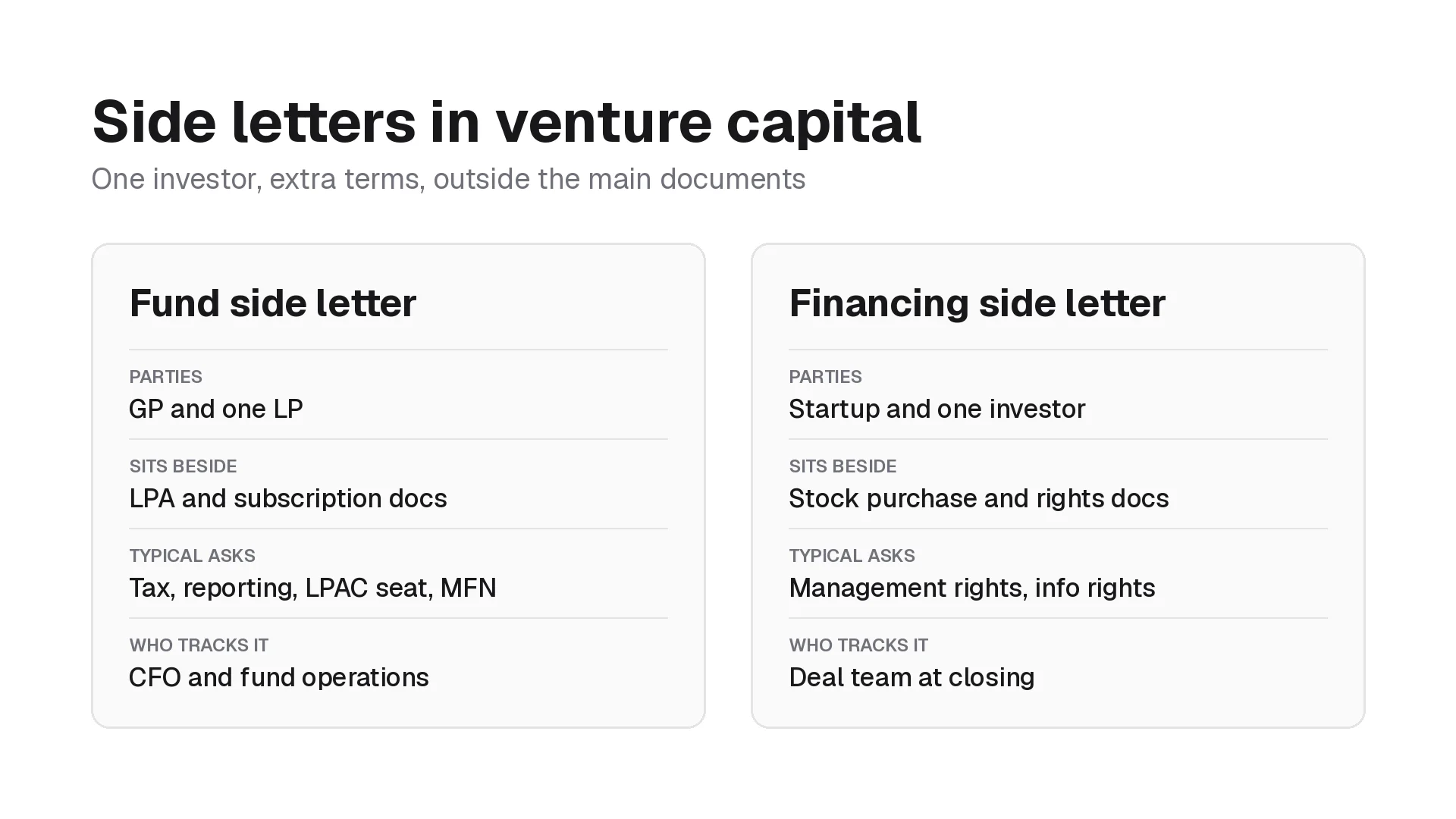
A side letter gives one investor terms the main documents don't give everyone else. Here is how fund and startup side letters differ, how MFN elections and management rights letters work, and who handles side letters inside a VC firm.