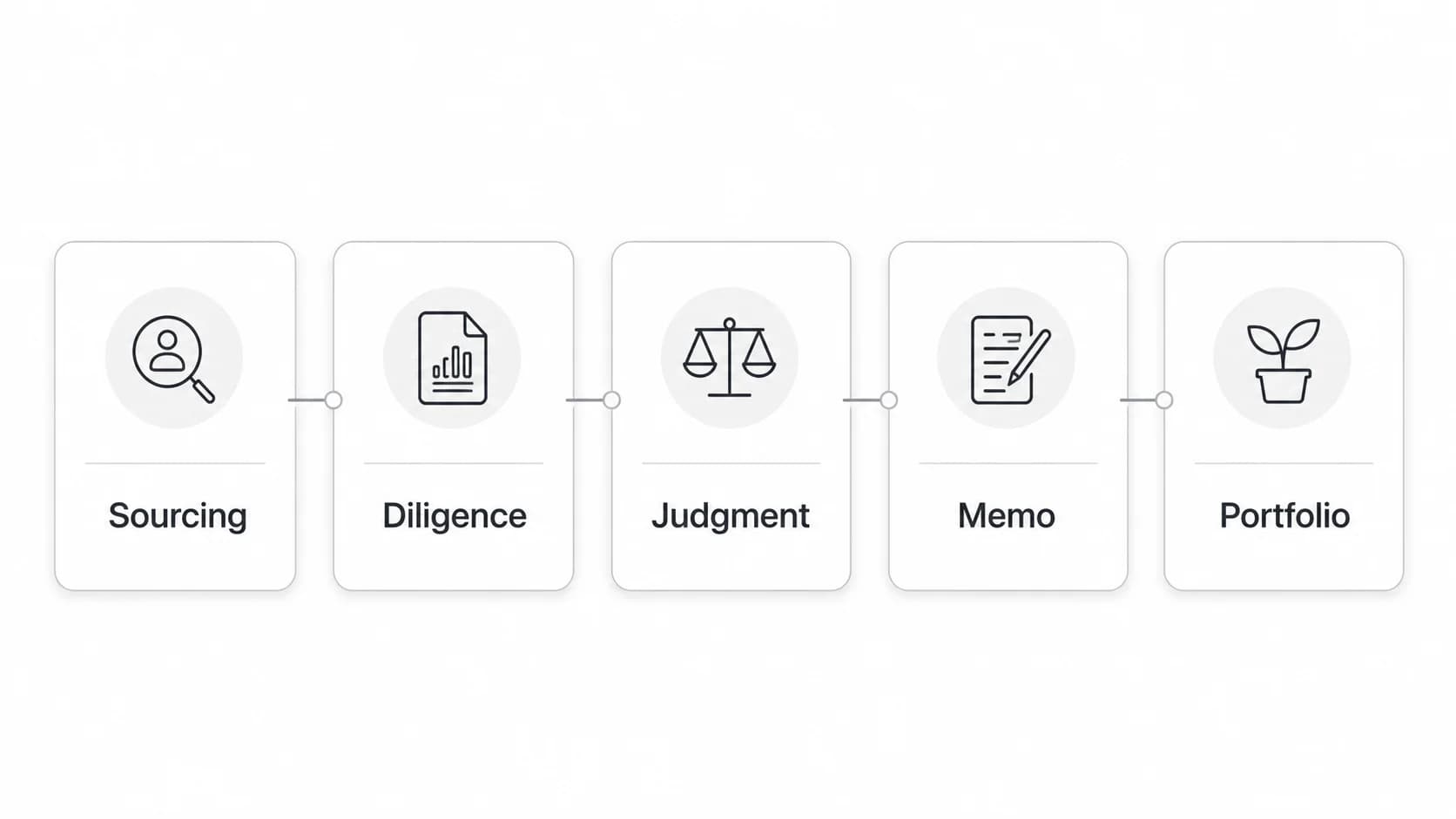
Consulting to Venture Capital: How to Make the Move
Learn how consultants can move into venture capital, which skills transfer, how to reposition your resume, build a VC firm target list, network, and prepare for interviews.
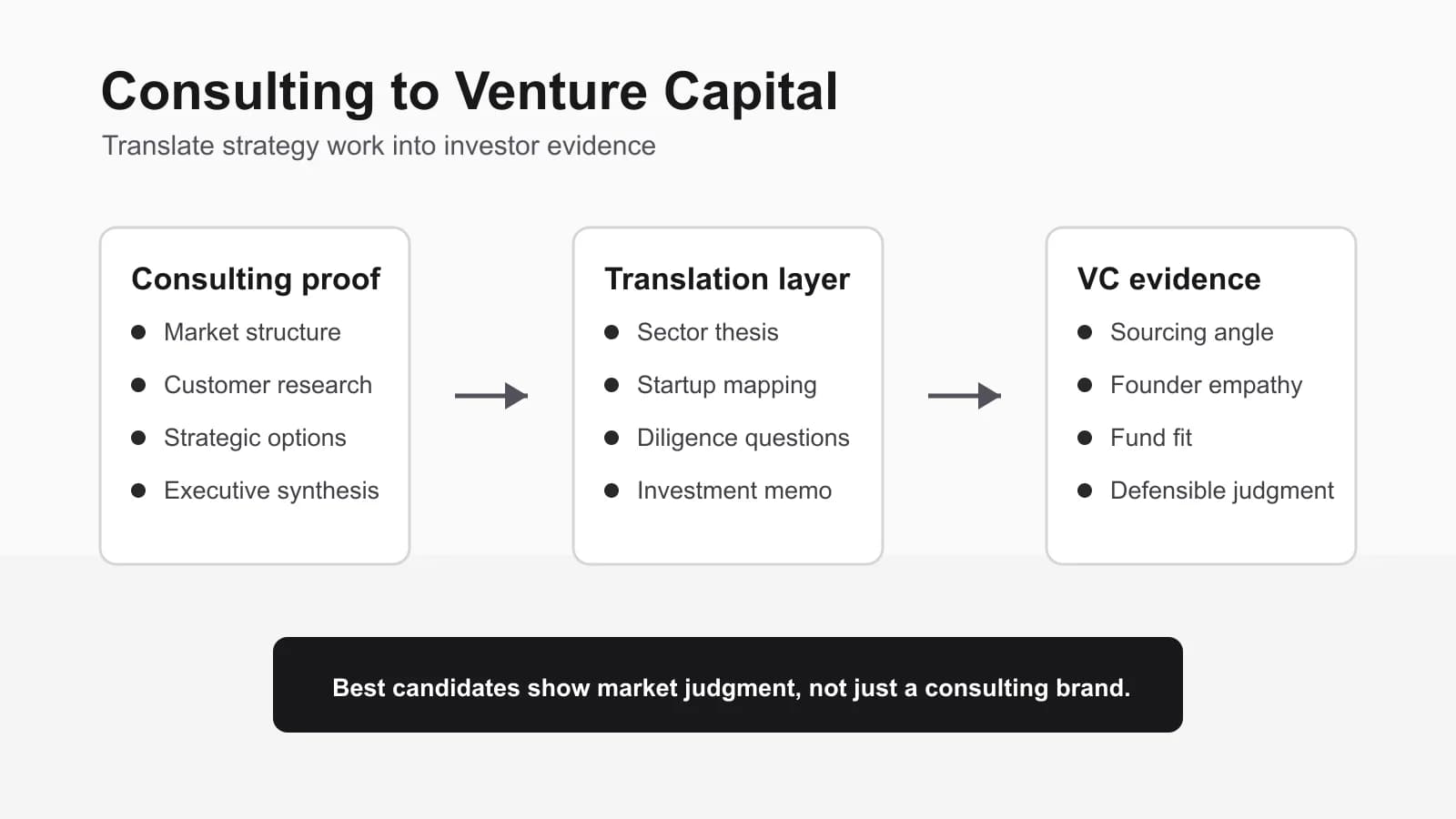
Consultants can move into venture capital, but the move is not automatic. Consulting gives you useful raw material: market research, customer interviews, strategic problem solving, executive communication, and comfort with ambiguous business questions. VC firms still need to see something consulting does not always prove: sourcing instinct, investment judgment, founder empathy, and a clear view on why a startup can become venture-scale.
The strongest consultant-to-VC candidates do not pitch themselves as generalist problem solvers. They show that they can map a market, identify promising startups, explain timing, ask useful founder questions, and write an investment recommendation with a point of view.
Use this guide if you are a management consultant, strategy consultant, commercial due-diligence consultant, corporate strategy professional, or operator-adjacent consultant trying to move into a VC analyst, associate, platform, portfolio, growth, or sector-focused role.
Can consultants get jobs in venture capital?
Yes. Consulting can be a credible background for venture capital, especially when your projects touch software, healthcare, fintech, climate, consumer, industrial technology, marketplaces, AI, data infrastructure, or other sectors where startups compete with incumbents.
The challenge is that consulting is not the same apprenticeship as VC. In consulting, you are usually paid to advise a client, structure an answer, and help a team decide what to do. In VC, you are paid to find companies, decide whether they can become outliers, win access to founders, and support investments over a long period.
That difference changes how you should recruit. You need to translate consulting experience into investor language:
| Consulting signal | Why VC firms care | Where it can fall short |
|---|---|---|
| Market research | You can break down categories, customers, competitors, and growth drivers | You still need a view on startup timing and venture-scale outcomes |
| Customer interviews | You can learn from buyers and users quickly | Founder conversations are less scripted and require trust-building |
| Strategic synthesis | You can identify what matters and communicate it clearly | A VC memo needs a recommendation, not just options |
| Commercial diligence | You can test market size, customer quality, and competitive position | Early-stage companies often have limited data and more uncertainty |
| Executive communication | You can write and present to senior stakeholders | VC also requires sourcing, conviction, and long-term relationship building |
The goal is not to pretend consulting was investing. The goal is to show that your consulting work gave you a foundation for investor judgment.
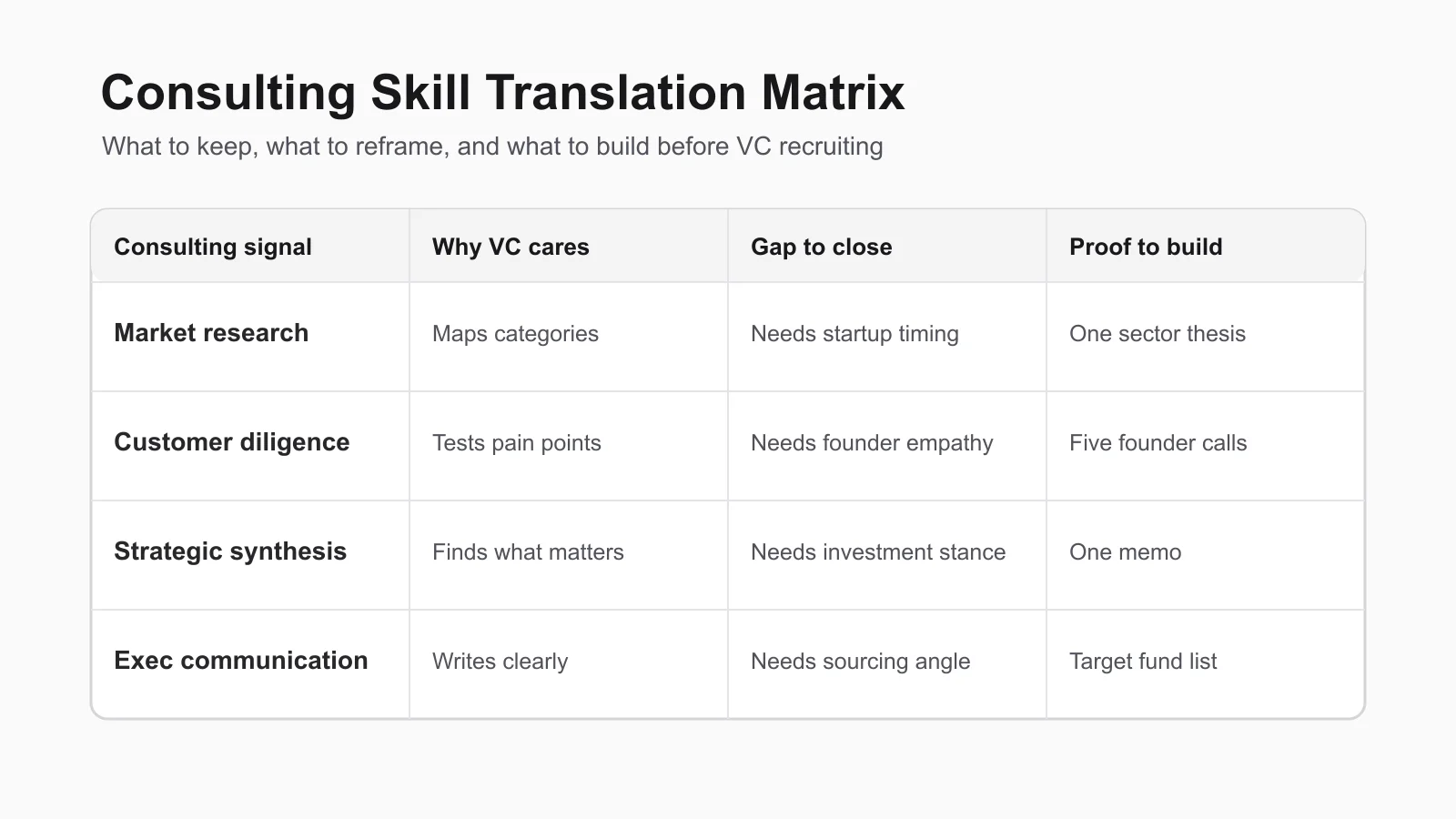
What transfers from consulting and what does not
The most useful consulting skills are not always the ones candidates emphasize first.
Transfers well
Market mapping. If you have mapped a category, segmented customers, studied competitors, or sized a market, you already have part of the VC toolkit. In recruiting, that becomes a sector thesis: which customer pain is urgent, why now, which incumbents are exposed, and which startups are credible.
Customer research. Consultants often know how to run interviews, synthesize buyer needs, and separate stated preferences from real constraints. In VC, that helps with customer diligence and founder conversations.
Synthesis under ambiguity. Good consultants can turn messy information into a clear story. VC firms value that when analysts and associates write market notes, investment memos, portfolio updates, and internal recommendations.
Professional communication. Consulting teaches you to manage senior stakeholders, write clean slides, and communicate tradeoffs. That lowers execution risk in a junior investing role.
Does not transfer cleanly
Recommendation without ownership. Consulting recommendations often come with options, caveats, and client constraints. VC requires a sharper investment stance: should we spend time, take a meeting, pass, continue diligence, or invest?
Sourcing. Consultants usually receive work through firm projects. Junior VC roles may require you to create deal flow through market maps, founder outreach, events, communities, and referrals.
Founder empathy. Client service helps, but founder conversations are different. Founders are not buying a consulting project; they are deciding whether to trust you with sensitive company context.
Startup pattern recognition. Consulting can be too incumbent-focused. VC firms want to know whether you understand early product pull, distribution wedges, capital efficiency, hiring constraints, and why small companies can beat larger ones.
Which VC roles are the best fit for consultants?
Consultants should not target every VC role the same way. Your best fit depends on the type of consulting work you did and the evidence you can show.
| VC role type | Consultant fit | Why it can work | Watch out for |
|---|---|---|---|
| Sector-focused VC | High | Consulting projects can become sector theses | You need startup examples, not only incumbent analysis |
| Growth-stage VC | Medium to high | Commercial diligence and market analysis are useful | You may need more financial and ownership analysis |
| Platform or portfolio role | Medium to high | Strategy, GTM, talent, and operations work can transfer | Not every platform role is an investment-track role |
| Generalist analyst role | Medium | Research range and synthesis help | Sourcing and startup obsession matter a lot |
| Seed or Series A VC | Medium | Customer pain and market timing work can help | Early-stage roles require stronger founder judgment and sourcing |
| Corporate venture capital | Medium | Corporate strategy context may fit | Decision speed and incentive structure can differ from institutional VC |
If your consulting work has a clear sector edge, start there. A healthcare consultant should look at healthcare and life sciences funds. A fintech consultant should map fintech, payments, banking infrastructure, and vertical SaaS funds. A climate consultant should build a target list around climate, energy, industrial, and infrastructure investors.
Use the Venture Capital Careers companies directory to build a firm list by stage, sector, and geography, then compare it with open roles on the VC job board.
How to reposition your consulting experience
Your resume should not read like a consulting resume with "venture capital" added to the summary. Rewrite it around markets, customers, strategy, and investment relevance.
| Consulting-style bullet | VC-style rewrite |
|---|---|
| Conducted market research for B2B software client | Mapped B2B software category, segmented customer pain points, and identified adoption drivers relevant to new entrant opportunities |
| Built growth strategy for healthcare services company | Analyzed healthcare workflow bottlenecks, reimbursement constraints, and competitive positioning to assess where technology-enabled models could scale |
| Supported commercial due diligence for private equity client | Evaluated customer quality, market growth, competitive risk, and expansion levers to inform investment diligence |
| Created executive presentation for senior client team | Synthesized market, customer, and competitor evidence into board-level recommendation with clear tradeoffs and next steps |
Notice the shift. The VC-style version does not exaggerate your role. It makes the investor-relevant parts legible.
After you draft the first version, use the venture capital resume guide to tighten the structure and make sure your bullets show judgment rather than only process.
Build a target list of VC firms
Most consultants make the first list too broad. "Every well-known VC fund" is not a recruiting strategy.
Build your target list around five filters:
| Filter | What to ask |
|---|---|
| Sector | Does the fund invest in markets where your consulting work gives you a real edge? |
| Stage | Does the fund invest seed, Series A, growth, or late-stage? |
| Role type | Is the role investment, platform, portfolio, research, scout, fellow, or operating? |
| Evidence fit | Can you discuss the firm's portfolio with specific market insight? |
| Network path | Do you have alumni, clients, founders, operators, or consultants who can introduce you? |
Start with 30 to 50 firms, then narrow to the 10 to 15 where your background creates the strongest case. For each firm, write a one-page note:
- What the fund invests in
- Two portfolio companies you understand
- One market thesis you can defend
- Three startups the firm might plausibly want to meet
- One reason your consulting background is relevant
That note becomes the raw material for outreach, interviews, and case studies.
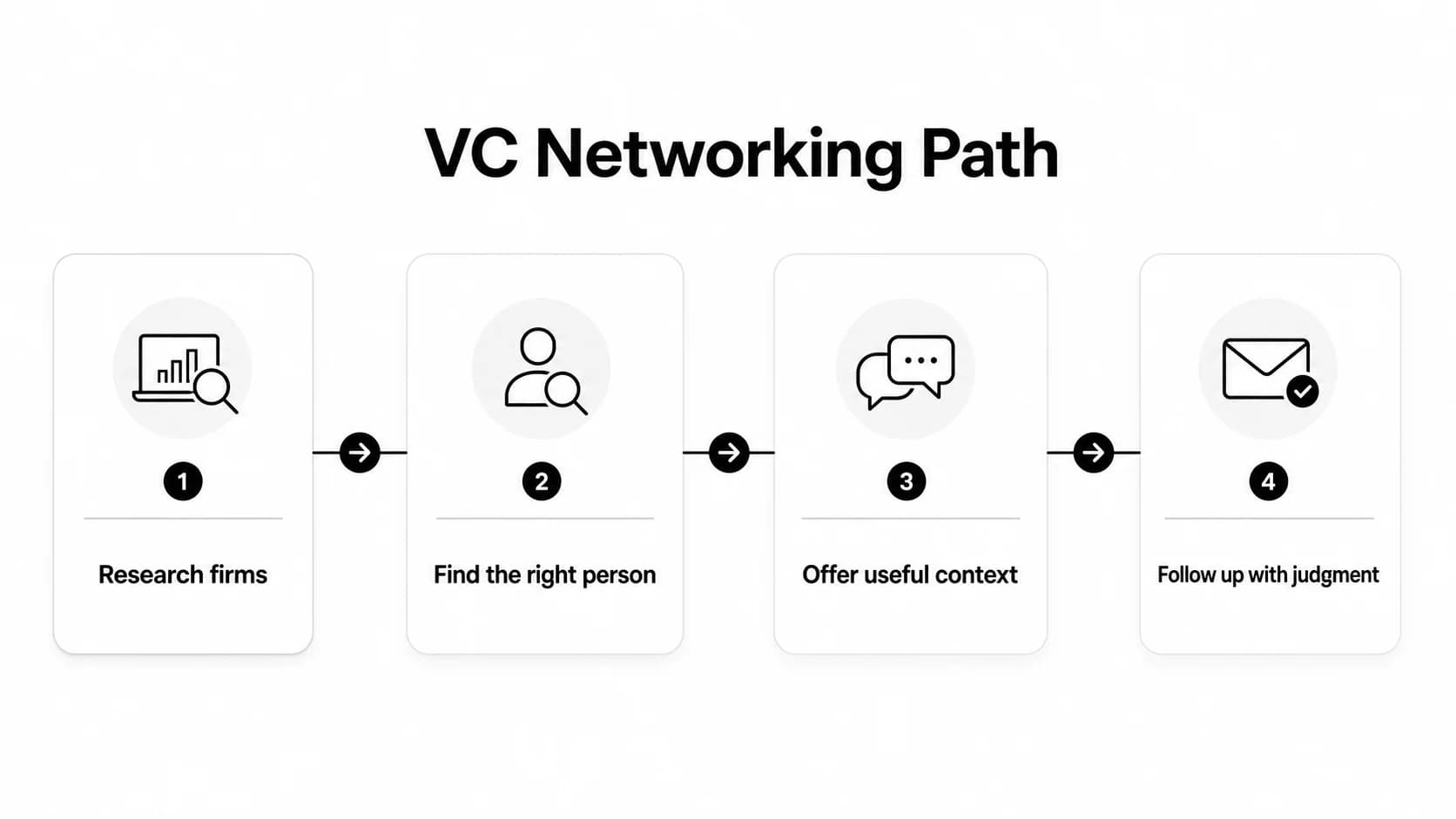
Network like an investor, not like a generic job seeker
VC recruiting is relationship-heavy because many roles are small, irregular, or never posted broadly. Your outreach should show that you are already thinking like an investor.
Weak angle:
> I am a consultant interested in venture capital and would appreciate 15 minutes to learn about your career.
Stronger angle:
> I have been mapping vertical software companies serving specialty healthcare practices and noticed your investments in adjacent workflow tools. I would value your perspective on how funds evaluate customer pull in that category.
The second version gives the investor something to react to. It shows market curiosity and makes the conversation less generic.
Use the venture capital networking email templates to shape the email, but personalize the substance around a market, portfolio company, or sourcing idea.
Prepare for VC interviews
A consultant moving into VC should prepare for five interview categories.
| Interview area | What they are testing | How to prepare |
|---|---|---|
| Why VC, why now | Motivation and understanding of the job | Explain why investing, startups, and long-term company building fit your path |
| Market thesis | Independent judgment | Prepare 2 to 3 sectors where you can discuss customer pain, timing, incumbents, and startups |
| Sourcing | Ability to create deal flow | Bring examples of startups you found and why they fit the fund |
| Case study | Investment thinking | Practice evaluating a startup, writing a recommendation, and defending risks |
| Founder conversation | Curiosity and trust | Practice asking clear questions without sounding like a consulting interview script |
The biggest mistake is preparing only "why I want VC" answers. You need examples that prove you can think about markets and startups without a client prompt.
For case rounds, use the venture capital case study interview guide. For broader prep, pair it with venture capital interview questions.
A 30-day consulting-to-VC transition plan
Use a 30-day sprint to create proof that you are serious.
| Timeline | Output |
|---|---|
| Days 1-3 | Pick 2 sectors where your consulting work gives you a real edge |
| Days 4-7 | Build a target list of 30 to 50 VC firms using stage, sector, geography, and portfolio fit |
| Days 8-12 | Write a one-page market thesis for each sector |
| Days 13-16 | Identify 10 startups per sector and write short notes on why each could matter |
| Days 17-20 | Rewrite your resume around investor-relevant consulting work |
| Days 21-24 | Send targeted outreach to investors, associates, principals, founders, and operators |
| Days 25-27 | Practice one VC case study and one investment memo |
| Days 28-30 | Review open roles, refine your target list, and follow up with a sharper angle |
At the end, you should have more than interest. You should have a target list, two theses, startup examples, a revised resume, outreach in motion, and a repeatable interview story.
Common mistakes consultants make
Leading with the consulting brand only. A strong firm name helps, but it does not prove you can source, pick, or win investments.
Sounding too client-service oriented. VC firms want helpful partners, but they also want judgment. Do not stop at "I helped executives decide." Show what you believe about a market.
Confusing venture capital with venture consulting. Some search results use "venture capital consulting" to mean fundraising advisory, legal support, or corporate innovation services. If you want an investing role, keep your story focused on deal sourcing, diligence, and investment decisions.
Targeting famous funds only. Brand-name firms are highly competitive and may hire irregularly. Sector-focused, emerging, regional, and specialist funds can be better fits.
Ignoring sourcing. Consultants can over-index on analysis. Bring examples of companies you found before they were obvious.
Using a generic resume. Your consulting resume may be strong for corporate strategy or private equity diligence, but VC needs evidence of market thinking, startup curiosity, and investment judgment.
FAQ
Is consulting a good background for venture capital?
It can be. Consulting is strongest when it gives you sector depth, market research, customer insight, diligence experience, and executive communication. It is weaker when your evidence is only project management or slide production.
Is consulting or investment banking better for VC?
Neither is automatically better. Consulting can help with market structure, customer research, and strategy. Banking can help with transaction analysis and financial discipline. VC firms care more about fund fit, sourcing ability, investment judgment, and the specific evidence you bring.
Do I need startup experience?
No, but startup exposure helps. You can build credible exposure by mapping a market, talking to founders, studying product and go-to-market patterns, writing investment notes, and sourcing companies for investors.
Should consultants target platform roles?
Sometimes. Platform and portfolio roles can be good fits if your consulting work involved go-to-market, operations, talent, strategy, data, or customer research. Just confirm whether the role is a path toward investing or a distinct operating track.
What should I put on my resume?
Prioritize investor-relevant work: market maps, customer insights, diligence questions, category growth, competitive positioning, business model analysis, and strategic recommendations. Keep project context, but do not let process execution crowd out judgment.
Find VC roles that match your consulting edge
The best consulting-to-VC move is specific. Pick the sectors where your background gives you an unfair starting point, then build evidence that you can think like an investor.
Use the Venture Capital Careers companies directory to research firms and the VC job board to find open roles. Then tighten your VC resume, send targeted networking emails, and prepare for the VC case-study interview before the process starts.