
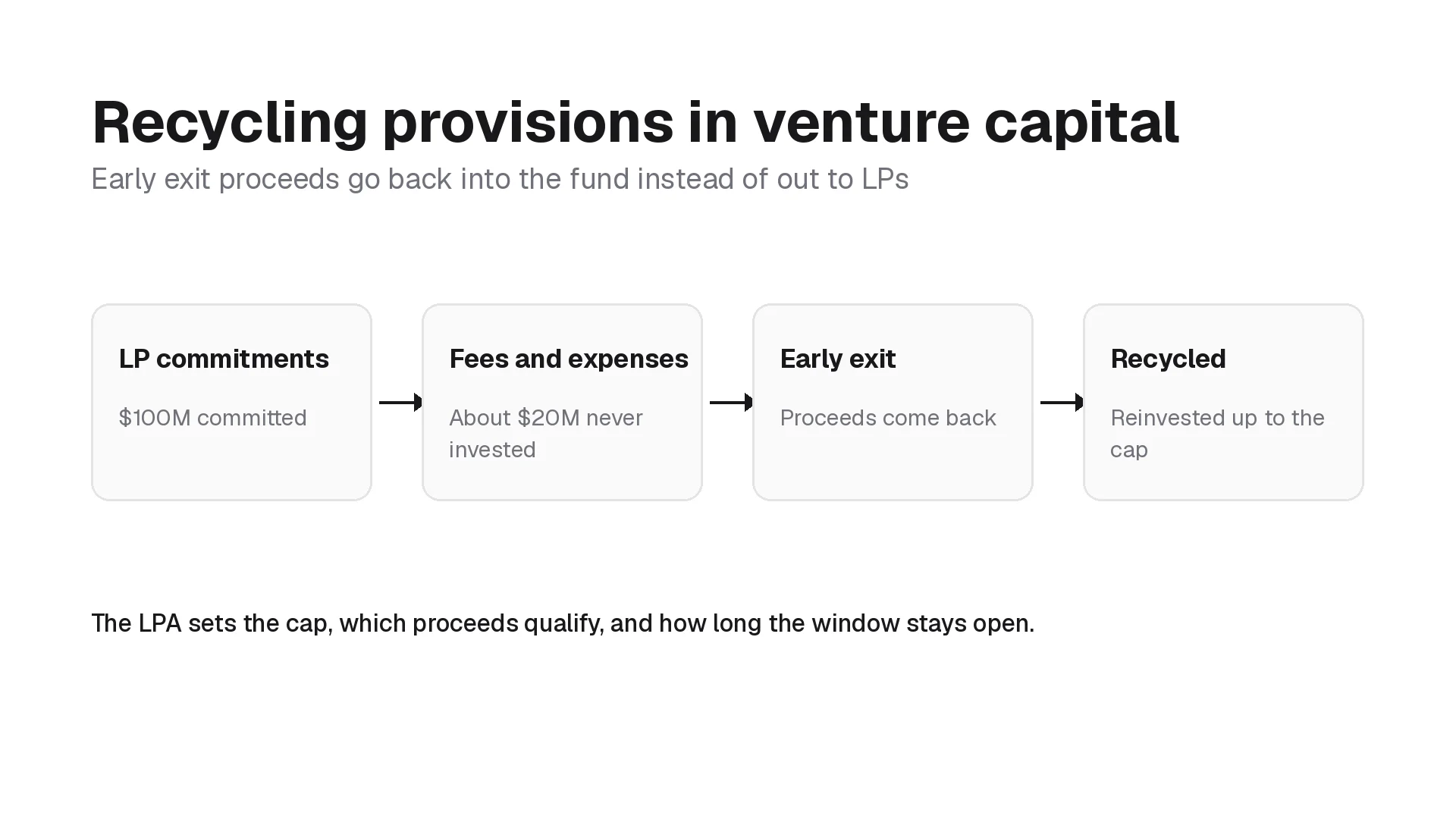
A recycling provision is the clause in a venture fund's limited partnership agreement (LPA) that lets the general partner (GP) reinvest money from early exits instead of distributing it to limited partners (LPs). It exists to make up for management fees. A fund that spends about 20% of commitments on fees can use recycling to put close to 100% of commitments to work. The clause sets how much can be recycled, which proceeds count, and how long the window stays open.
Recycling sounds like fund plumbing, and it is. It also decides how much capital an associate can plan to deploy, why a fund's DPI stays low for years, and what your carry is worth. Fund finance teams track it every quarter, and interviewers use it to check whether a candidate understands fund math beyond "2 and 20."
What a recycling provision is
Recycling means the fund keeps realized proceeds and invests them again rather than sending the cash to LPs. Without the clause, a GP generally has to distribute proceeds from a sale. With it, the GP can hold some of that cash and write new checks or fund follow-ons.
Two names describe the same practice. "Management fee recycling" ties the cap to the fees the fund has paid. "Recycling of investment proceeds" ties it to a percentage of commitments. In both cases the cash being recycled is exit proceeds, not fee money. Recycling does not cut the management company's fee income.
Recycling is often confused with a recallable distribution. They reach a similar place by different routes.
| Recycling | Recallable distribution | |
|---|---|---|
| What happens to the cash | Fund keeps it and reinvests | Fund sends it to LPs, then can call it back |
| LP receives cash first? | No | Yes |
| How it shows in DPI | Lower DPI while recycling | DPI rises, then a later call adds to paid-in capital |
| Typical limits | Cap, time window, eligible proceeds | Purpose, time window, and notice at distribution |
| Where you find it | LPA recycling or reinvestment clause | LPA recall clause and the distribution notice |
The notice point matters in practice. Some LPAs only let a GP recall a distribution if the original distribution notice said the amount was recallable. Miss that line in the notice and the fund may lose the right to re-draw the cash.
Why VC funds recycle capital
The main reason is fee drag. Management fees and fund expenses come out of LP commitments, so a fund never invests everything it raises. On a $100 million fund charging 2% a year for ten years, about $20 million goes to fees and only about $80 million reaches companies. Real fee schedules usually step down after the investment period, so the exact figure varies, but the gap is real.
Recycling closes that gap. If an early exit returns $20 million and the LPA allows it, the GP can invest that $20 million again. The fund ends up investing roughly what LPs committed.
The second reason is reserves. Breakout companies need follow-on capital later in a fund's life, and many smaller funds under-reserve. Recycled proceeds give the GP more money for pro rata in its best companies without raising a separate opportunity fund or SPV. Fred Wilson has written that Union Square Ventures recycles early, smaller exits and that a $200 million fund that invests $250 million at 3x returns 3.75x on the LPs' $200 million.
Worked example: when recycling helps and when it hurts
Take the $100 million fund above, with 20% carried interest and $80 million invested at 3.0x gross. That produces $240 million. Early in the fund, $20 million of that comes back from one exit. Here is what happens to LPs under four outcomes on the recycled $20 million. All figures are illustrative and ignore timing.
| Scenario | Total value | Profit over $100M paid in | GP carry (20%) | LP proceeds | LP net multiple |
|---|---|---|---|---|---|
| No recycling | $240M | $140M | $28M | $212M | 2.12x |
| Recycle $20M, earns 0.5x | $230M | $130M | $26M | $204M | 2.04x |
| Recycle $20M, earns 1.0x | $240M | $140M | $28M | $212M | 2.12x |
| Recycle $20M, earns 1.5x | $250M | $150M | $30M | $220M | 2.20x |
| Recycle $20M, earns 3.0x | $280M | $180M | $36M | $244M | 2.44x |
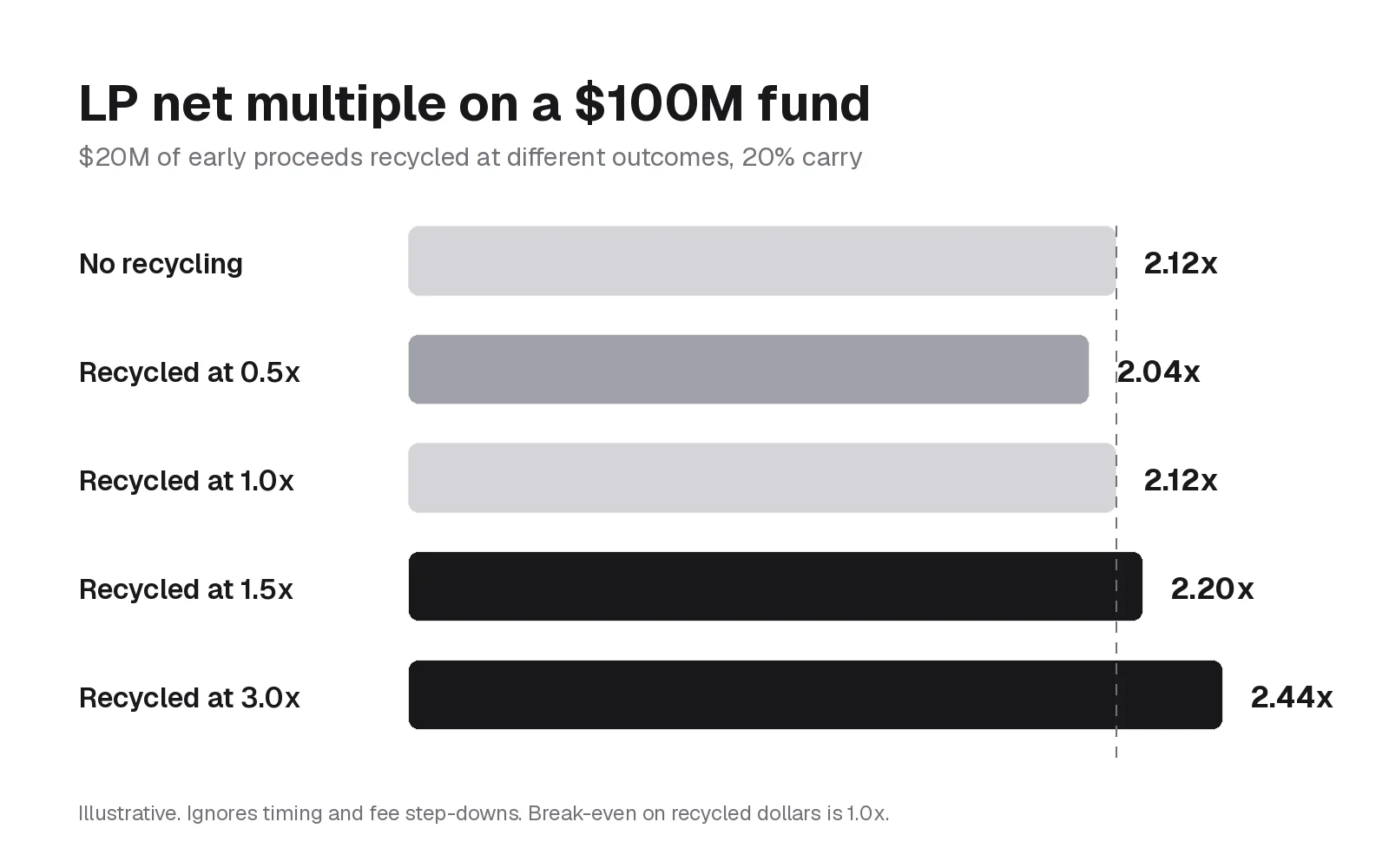
The break-even is 1.0x on the recycled dollars, and that is before the cost of time. Recycling is not free money. It is a second bet with money that would otherwise have gone home. A GP who recycles into a weak follow-on makes LPs worse off and delays their cash.
Standard recycling terms in the LPA
Recycling is not automatic. The GP only has the rights the LPA spells out. Most clauses answer five questions.
| Term | What it controls | Common drafting |
|---|---|---|
| Cap | Total amount that can be recycled | Up to the fees and expenses paid, or roughly 20% to 25% of commitments; sometimes written as "invested capital up to 120% or 125% of commitments" |
| Eligible proceeds | Which dollars can be recycled | Only the cost basis of the exited investment, cost plus fees and expenses, or in rarer cases all proceeds |
| Time window | When recycling is allowed | Usually the investment period; some LPAs allow later recycling for follow-ons only |
| Holding period | Which exits qualify | Proceeds from investments held less than a set number of months or years |
| Permitted uses | What recycled cash can fund | New investments, follow-ons, fees and expenses, or only some of these |
Two drafting details change outcomes more than people expect. First, a cap written as "125% of commitments" means the same as a 25% recycling cap; it describes total invested capital, not the recycled slice. Second, cost-basis-only drafting sends gains to LPs and keeps only the original check. A clause that lets a GP recycle gains for the full fund life is aggressive, and LPs usually push back.
Other LPA limits apply on top. An LP's drawn commitment usually cannot exceed its original commitment, concentration limits still apply per company, and investment-period rules on new deals still bind. A fund with a generous recycling clause can still fall short of its target because these limits bite first.
How recycling affects TVPI, DPI and IRR
Recycling moves the three headline fund performance metrics in different directions.
- TVPI and net multiple. Usually up, if recycled dollars earn more than 1.0x. This is the reason to recycle.
- DPI. Down in the early years. Cash that would have gone to LPs is reinvested, so DPI sits near zero longer and the J-curve looks deeper.
- IRR. Often down. Holding cash in the fund and extending the hold period lowers a time-weighted return even when the multiple improves.
This is why LPs judge recycling differently. An endowment that benchmarks on net multiple tends to like it. An LP that needs distributions to fund new commitments, or that reports IRR to a board, may not. When you read a fund's quarterly report, check the recycling line before you call a low DPI a red flag.
LP concerns: tax, liquidity and credit facilities
Recycling has costs that sit with LPs.
- Phantom income. A US fund is usually a partnership, so LPs owe tax on their share of a realized gain in the year it happens. If the GP recycles the cash, taxable LPs can owe tax on money they never received. Tax-exempt LPs feel this less, which is one reason LP bases react differently.
- Liquidity planning. LPs model distributions to pay future capital calls. Recycling delays those distributions, so the LP has to fund calls from elsewhere.
- Extended fund life. Recycling late in the investment period can stretch the fund toward its extension options.
- Credit facilities. If the fund has a subscription line, lenders may exclude recallable capital from the borrowing base. Amending recycling terms can also require lender consent.
GPs who want broader recycling mid-fund usually need an LPA amendment, and the consent threshold depends on the amendment clause. Some LPs negotiate recycling limits or reporting in a side letter instead.
Recycling versus reserves and dry powder
These three ideas get blurred in interviews.
- Reserves are committed capital the GP earmarks for follow-ons in existing companies. See portfolio strategy for how firms size them.
- Dry powder is committed capital that has not been called yet.
- Recycling adds investable capital on top of commitments, funded by exit proceeds.
A fund's recycling plan feeds its reserve plan. If the model assumes 20% recycling and early exits never come, reserves are short and the GP has to choose which companies to support.
Who works on recycling inside a VC firm
This is where recycling becomes a job skill rather than a glossary term.
| Role | What they do with recycling |
|---|---|
| CFO or fund controller | Tracks the recycling cap, eligible proceeds and time window; decides which exit proceeds are held versus distributed; prepares distribution notices with recall language |
| Fund accounting and fund operations | Books recycled amounts, reconciles capital accounts, and checks each LP's drawn commitment against its limit |
| Investor relations | Explains low DPI and recycling activity to LPs; handles side letter reporting requests |
| Partners | Decide whether to recycle or distribute after each exit; set the recycling assumption in the fund model at fundraising |
| Associates and principals | Use the deployable capital number, not the headline fund size, when they plan follow-ons and new checks |
| Fund formation counsel | Drafts the clause and any amendment |
If you are evaluating a firm, ask how much of the current fund it expects to recycle and whether early exits have already hit the model. A firm counting on 25% recycling that has seen no early liquidity has less real capacity than its fund size suggests. That affects how many new deals the team can do. If you have carried interest, good recycling raises the profit pool your carry comes from.
How to answer a recycling question in an interview
A typical prompt is "What is recycling and why would a fund do it?" A strong answer takes about 45 seconds:
Recycling lets a fund reinvest proceeds from early exits instead of distributing them, up to a cap in the LPA, often around the amount paid in fees. It makes up for fee drag, so a $100 million fund can invest close to $100 million instead of $80 million. It usually raises TVPI if the recycled dollars beat 1x, but it lowers early DPI, can hurt IRR, and creates phantom income for taxable LPs. I'd want to know the cap, whether only cost basis is recyclable, and the time window.
Add one line on reserves if you have time. That shows you connect recycling to portfolio construction.
FAQ
Is recycling standard in venture capital funds?
It is common but not universal, and the terms vary enough that you have to read the LPA. Check the cap, the eligible proceeds and the time window.
Does recycling increase fund size?
No. LP commitments stay the same. Recycling increases the total amount invested over the fund's life.
Can a GP recycle profits?
Only if the LPA allows it. Many clauses limit recycling to the cost basis of the exited investment, so the gain still goes to LPs.
Does recycling reduce management fees?
No. Fees are set by the LPA's fee clause. Recycling uses exit proceeds and does not change the management company budget.
Are recycled investments different from regular investments?
Legally they are fund investments like any other. Some fund models track them separately because their timing and expected returns differ.
Next steps
Recycling sits next to the fee and carry mechanics in management fees, capital calls and the fund lifecycle. For interview prep, work through our venture capital interview questions.
If you want to work on fund finance or investing teams, browse venture capital firms, see open VC roles, or create a free account to get new jobs as they post.
Related posts
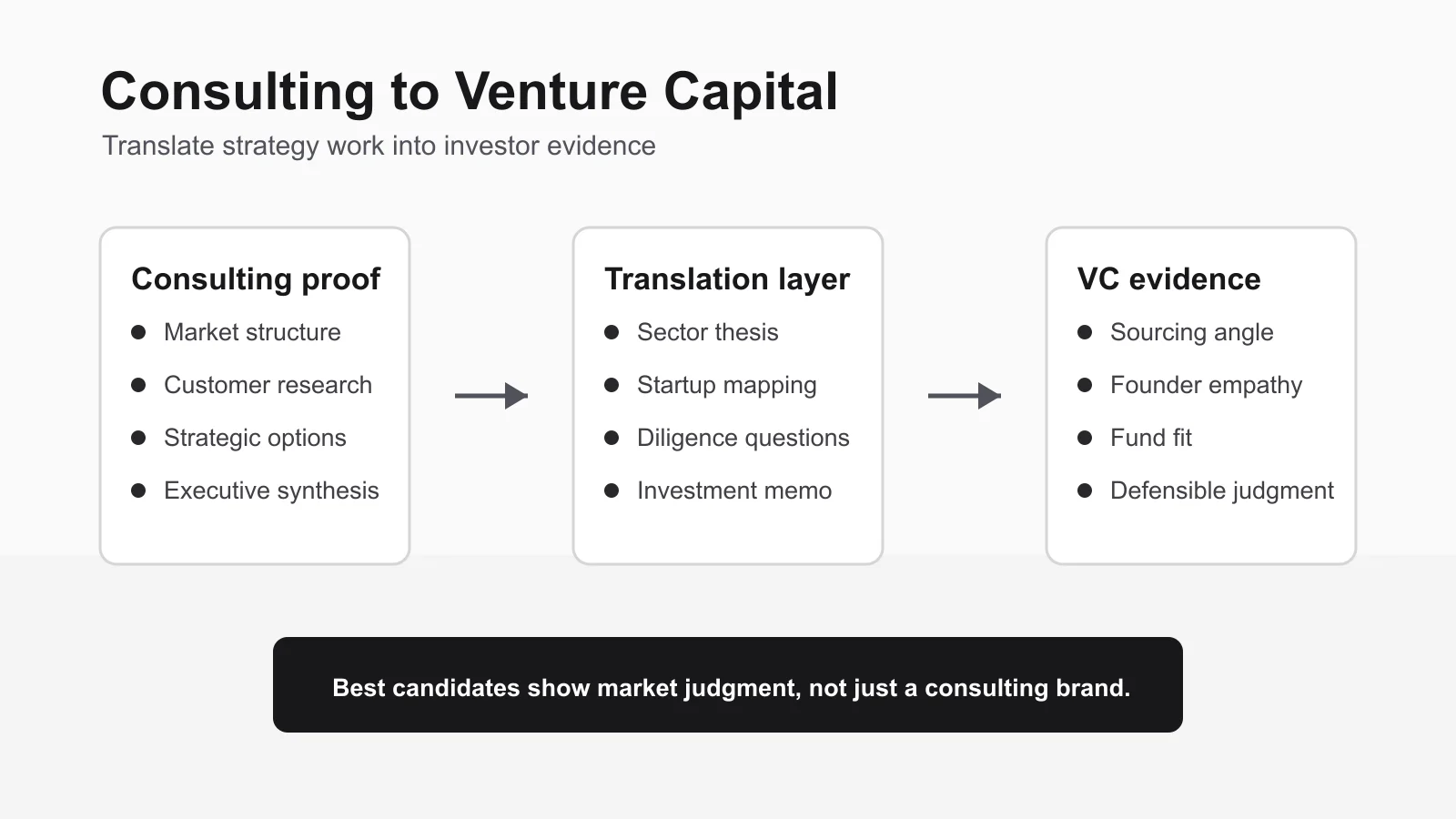
How consultants move into venture capital: four realistic paths, which funds hire consultants, pay trade-offs, timing, what to staff on before leaving, project-to-evidence worksheet, resume, and interview process.
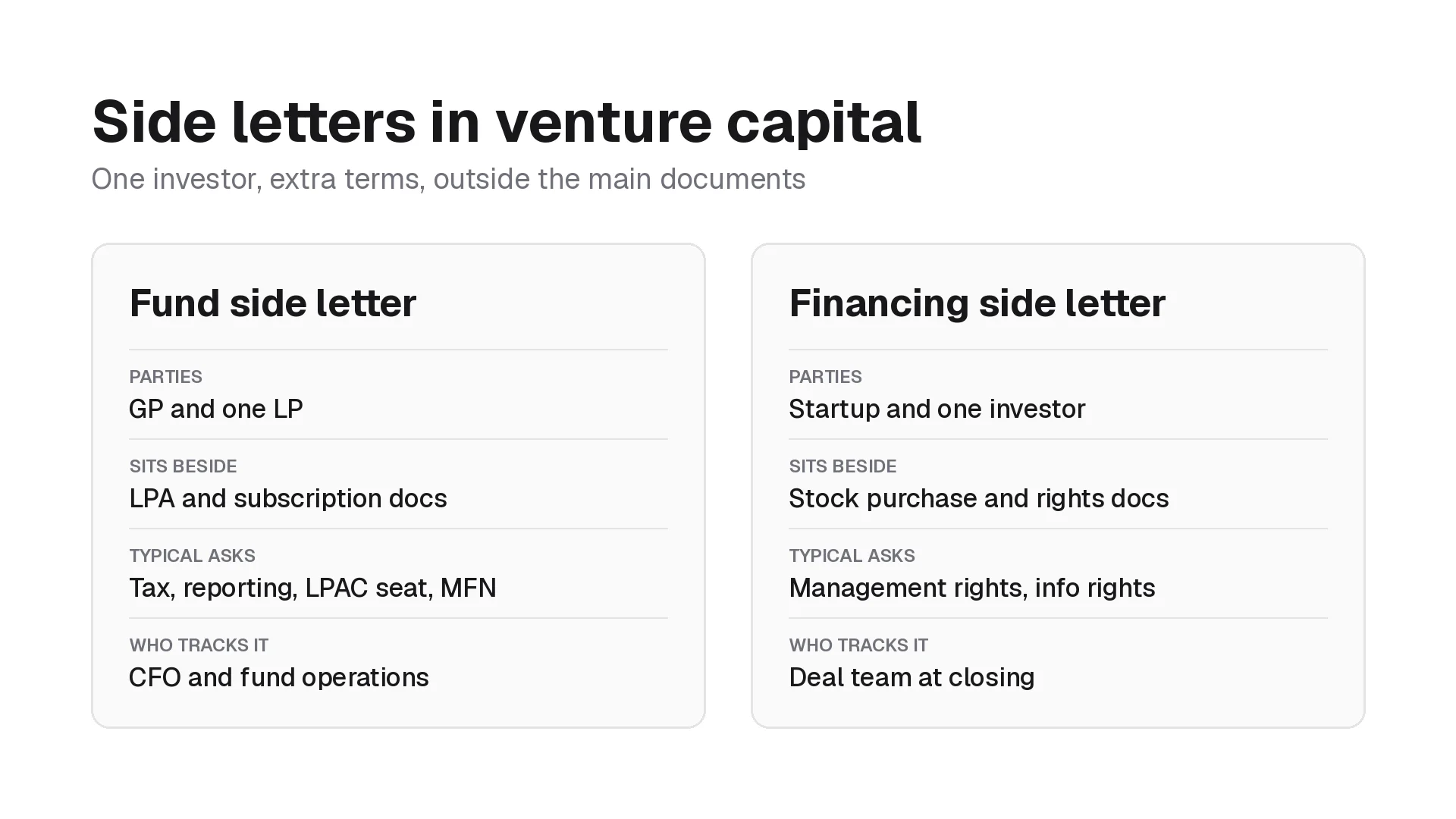
A side letter gives one investor terms the main documents don't give everyone else. Here is how fund and startup side letters differ, how MFN elections and management rights letters work, and who handles side letters inside a VC firm.
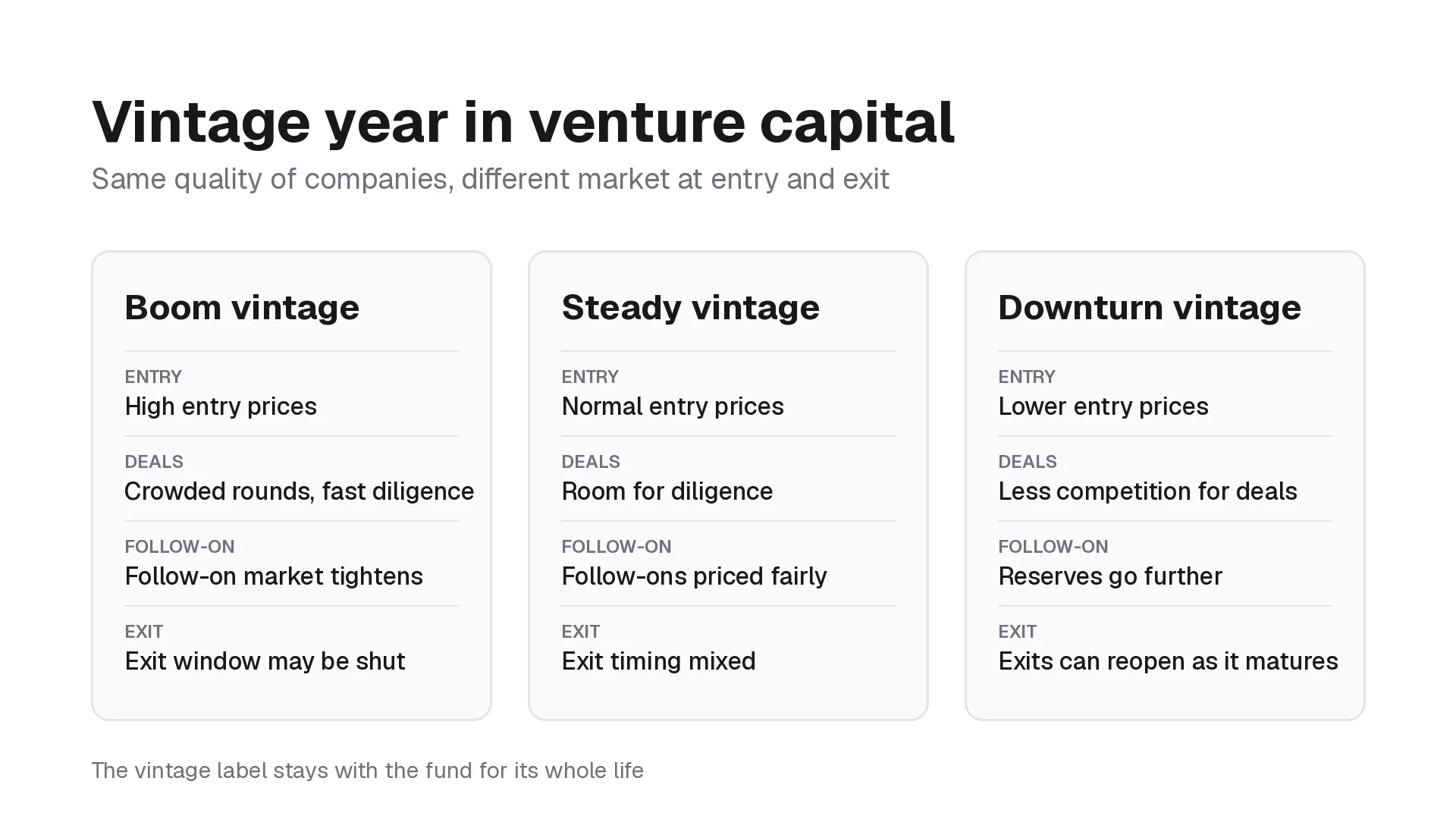
A vintage year is the year a venture fund starts investing, and it decides which funds you can fairly compare. Here is how vintage gets assigned, why it moves returns, and what it means for the job, carry, and interviews at a VC firm.