
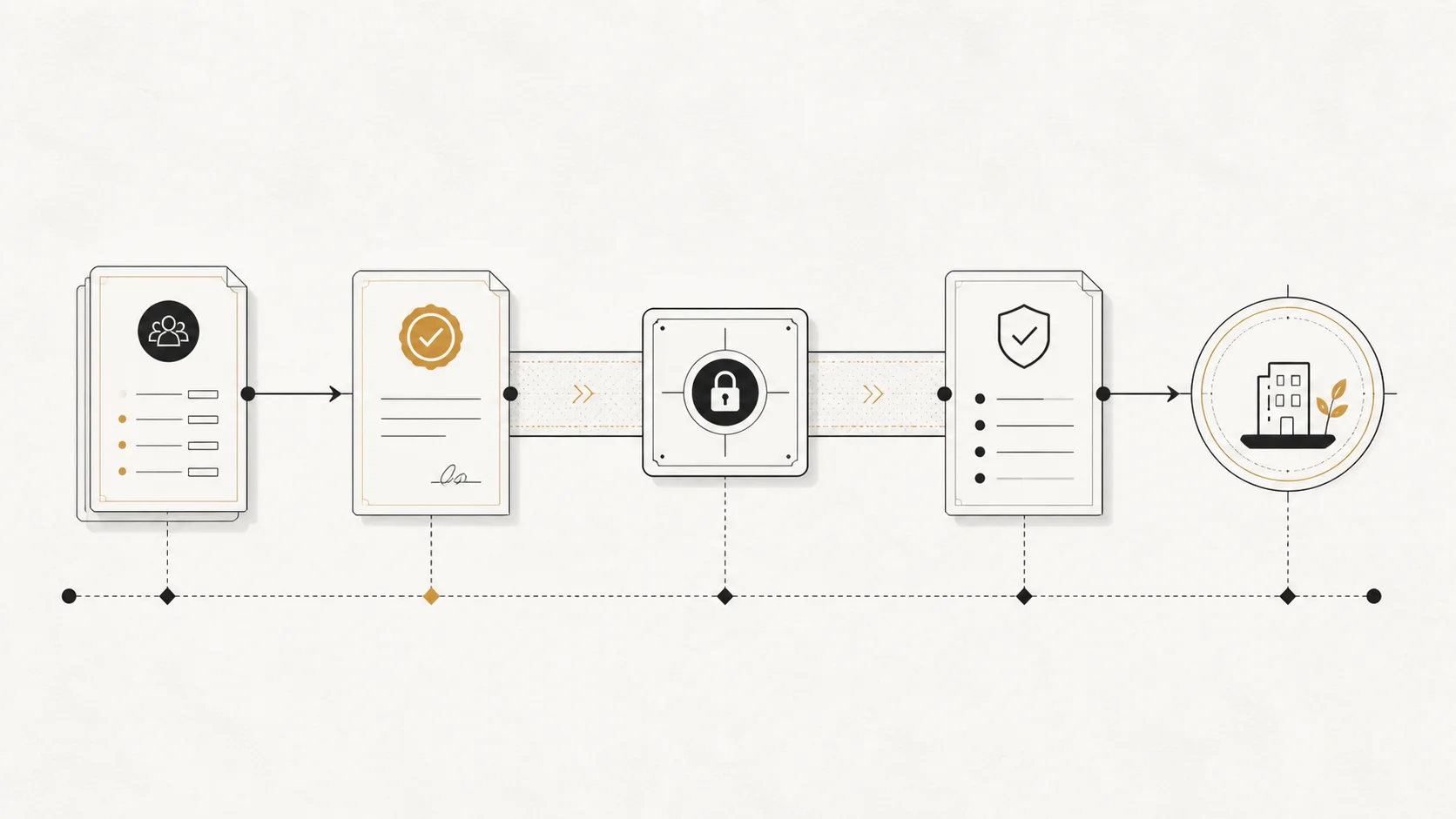
A venture capital capital call is a formal request from a fund's general partner (GP) for limited partners (LPs) to transfer part of the money they already committed. It is not a new fundraising round and it does not increase the LP's commitment. It converts a portion of uncalled capital into paid-in capital.
Suppose an LP commits $1 million to a VC fund and contributes $250,000 at the first close. The LP has $250,000 of paid-in capital and $750,000 of uncalled capital. If the fund later issues a 10% call, the LP owes $100,000. Once the wire is received and recorded, paid-in capital rises to $350,000 and uncalled capital falls to $650,000.
The governing documents control the actual mechanics. The limited partnership agreement (LPA), subscription documents, and side letters may define notice periods, permitted uses, allocation rules, recall or recycling provisions, and remedies for non-payment. Treat every generic example as a model, not a substitute for those documents or professional advice.
Capital call terms that are easy to confuse
| Term | Practical meaning |
|---|---|
| Committed capital | The total amount an LP has legally agreed to provide over the fund's life. |
| Called capital | The portion the GP has formally requested under the fund documents. |
| Paid-in capital | Contributions the fund has received and recorded from the LP. |
| Uncalled capital | The remaining commitment that has not yet been called. It is a contractual funding source, not cash already in the fund's bank account. |
| Distribution | Cash or property the fund returns to LPs. It moves in the opposite direction from a capital call. |
| Recallable or recycled capital | Proceeds a fund may be allowed to call again under specific LPA provisions. It is not automatically available in every fund. |
That distinction explains why a $100 million fund does not normally keep $100 million in cash. LPs commit the amount; the GP calls it in tranches as investments, fees, expenses, and other authorized needs arise. For the entity relationships behind that process, see venture capital fund structure and limited partner vs general partner.
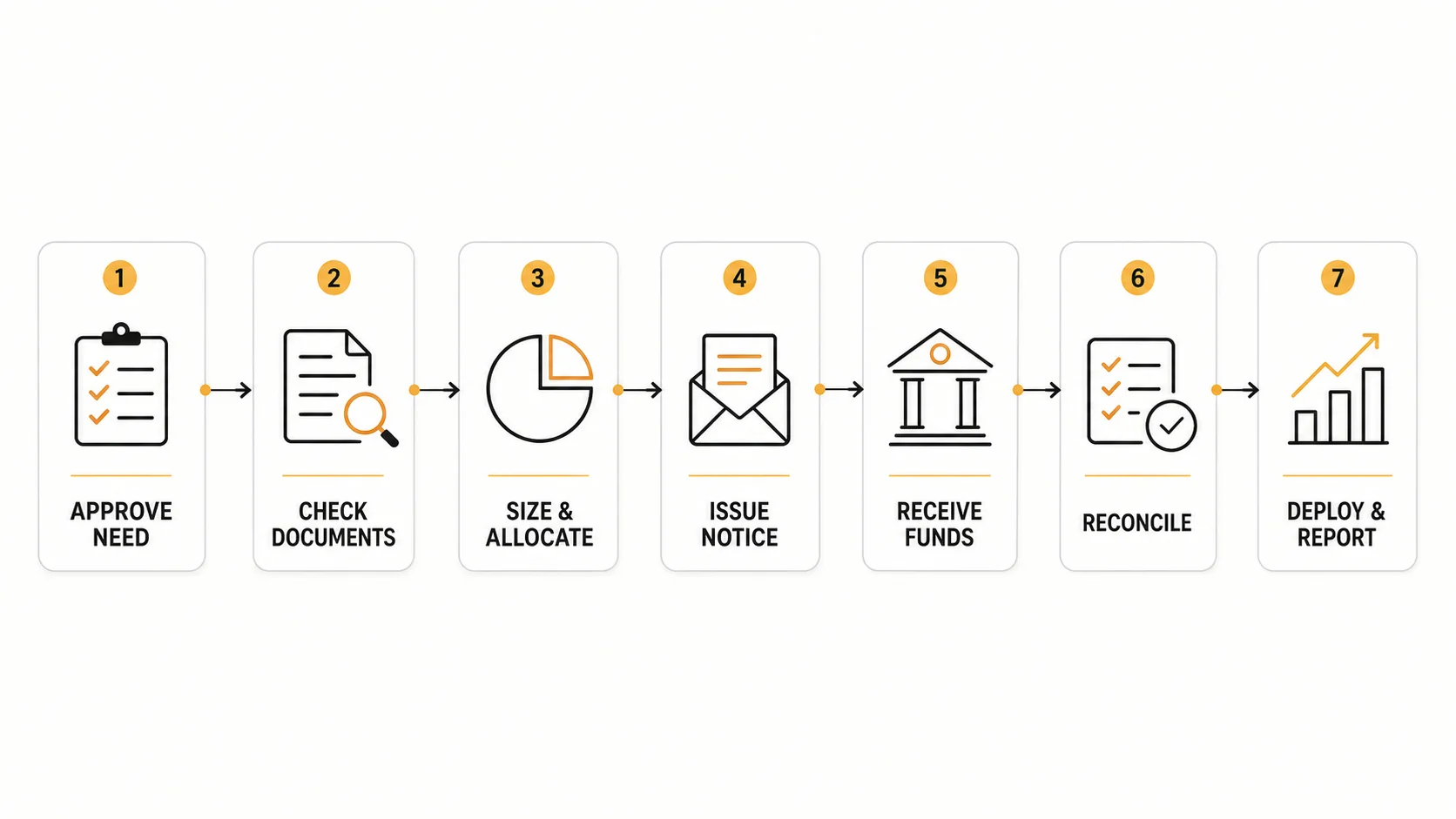
The venture capital capital call process in seven steps
A call is complete when the approved need, legal authority, cash receipts, investor ledger, and deployment records agree. Sending the notice is only the midpoint.
| Step | Primary owner | Key control | Output |
|---|---|---|---|
| 1. Confirm the need | Investment team and finance | Tie the request to an approved deal, fee, expense, reserve, or other authorized use | Cash-needs schedule |
| 2. Check documents | Finance, administrator, and counsel | Confirm permitted use, notice period, allocation rules, side letters, and remaining commitments | Call requirements memo |
| 3. Size and allocate | Finance or fund administrator | Reconcile the total need, buffer, fund cash, and each LP's pro-rata share | LP allocation schedule |
| 4. Review and authorize | GP signatory and designated reviewer | Perform a second-person tie-out of amounts, dates, purpose, and bank details | Approved notice package |
| 5. Issue and monitor | Administrator or investor relations | Deliver through the approved channel, retain evidence, and track questions or acknowledgments | Live funding tracker |
| 6. Receive and reconcile | Treasury, finance, and administrator | Match cash to LP, amount, currency, and fund; investigate exceptions | Reconciled receipts and exception log |
| 7. Deploy and report | Finance and investment team | Use cash only for authorized purposes; update capital accounts and reporting | Closed call and updated books |
1. Confirm an approved cash need
Start with the investment or expense—not a convenient percentage. A new deal should have the required investment committee approval. Finance then combines the closing amount with approved follow-ons, fees, expenses, and a defensible operating buffer, subtracting cash already available.
2. Review the governing documents
Check the LPA, subscription agreements, amendments, and side letters before calculating allocations. A side letter may change notice, reporting, excuse, exclusion, or other terms for one LP. The review should also confirm whether the fund remains inside its investment period and whether the proposed use is allowed.
3. Size and allocate the call
For a simple pro-rata call:
LP amount due = LP commitment ÷ total fund commitments × total call
Real funds may need adjustments for later closes, excuse rights, parallel vehicles, alternative investment vehicles, defaults, fee offsets, or other document-specific terms. That is why the allocation schedule must tie both to the fund total and to each investor's remaining commitment.
4. Review and authorize the notice
Separate preparation from approval. A reviewer should recalculate totals, confirm due dates and authorized purposes, compare investor details with the register, and verify payment instructions under the fund's established security procedure.
5. Deliver and monitor
Send notices through the channel permitted by the fund documents—often a secure investor portal or another controlled method. Track delivery, LP questions, and upcoming deadlines. An informal heads-up may help LP liquidity planning, but it does not replace the formal notice.
6. Receive and reconcile
Match every receipt to the correct LP and fund. A familiar amount is not enough: confirm sender, value date, currency, bank account, reference, and any deduction or shortfall. Maintain an exception log until every item is resolved.
7. Deploy and report
Once receipts and records reconcile, deploy the money for the approved use, update each LP's paid-in and uncalled balances, post the required accounting entries, retain evidence, and include the activity in investor reporting. The broader recordkeeping sits inside venture capital fund accounting.
Worked example: a $25 million VC fund calls capital
Assume a $25 million early-stage fund has three LPs. The investment committee approves a new $1.5 million initial investment. Finance also expects a $300,000 follow-on, $100,000 of authorized fund expenses, and a $100,000 operating buffer. The fund needs $2 million after considering cash already on hand.
The call equals 8% of total commitments:
$2,000,000 ÷ $25,000,000 = 8%
| LP | Commitment | Pro-rata share | Amount due on 8% call |
|---|---|---|---|
| LP A | $10,000,000 | 40% | $800,000 |
| LP B | $8,000,000 | 32% | $640,000 |
| LP C | $7,000,000 | 28% | $560,000 |
| Total | $25,000,000 | 100% | $2,000,000 |
If the fund had already called 24% of commitments, this call takes cumulative called capital to 32%. For LP A, cumulative called capital rises from $2.4 million to $3.2 million, leaving $6.8 million uncalled.
| LP A ledger | Before call | Current call | After funding |
|---|---|---|---|
| Commitment | $10,000,000 | — | $10,000,000 |
| Paid-in capital | $2,400,000 | $800,000 | $3,200,000 |
| Uncalled capital | $7,600,000 | ($800,000) | $6,800,000 |
The useful control is not the 8% arithmetic; it is the three-way tie-out:
- The approved uses total $2 million.
- The LP allocation schedule totals $2 million.
- Reconciled bank receipts total $2 million.
If one number differs, the call is not closed. The team should resolve the difference before treating all cash as available for deployment.
This example assumes a simple pro-rata allocation. Actual fund terms may change the calculation. Portfolio pacing and reserves also belong in the broader venture capital portfolio strategy, not in the capital-call formula alone.
What a capital call notice should contain
A notice should let the recipient answer four questions quickly: Which legal fund is calling? Why is money due? How was my amount calculated? When and through which verified channel must it arrive?
The Institutional Limited Partners Association's updated Capital Call & Distribution Template organizes standardized detail into fund-level information, LP-level information, transaction detail, and supplemental calculations. ILPA released version 2.0 in 2025 and provides phased implementation guidance for funds adopting its related reporting standards. A fund should follow its own governing documents and advisers; the ILPA resource is an industry template, not a replacement for the LPA.
| Notice area | Fields a reviewer should expect |
|---|---|
| Fund-level information | Exact legal fund name, vehicle, currency, issue date, due date, total call, and authorized purpose |
| LP-level information | LP legal name, commitment, ownership or allocation basis, current amount due, cumulative contributions, and remaining unfunded commitment |
| Transaction detail | New or follow-on investment, management fee, fund expense, reserve, facility repayment, or other permitted use, with amounts |
| Supplemental calculation | Reconciliation from prior unfunded commitment through the current call and any distribution or recallable-capital adjustments |
| Operations | Approved contact, secure delivery method, payment reference, and verified settlement instructions |
Treat wire instructions as a separate control
Capital-call notices are attractive targets for payment fraud because they legitimately request large transfers. LPs should verify new or changed instructions through the fund's established independent channel. GPs should not normalize unexplained bank changes sent only by email. The operational rule is simple: no one should have to choose between meeting a deadline and verifying where the money is going.
Keep the purpose specific
“For investment purposes” is less useful than a clear breakdown. A notice can protect confidentiality while still distinguishing a new investment, follow-on, fees, expenses, facility repayment, and buffer. That detail helps LP treasury teams forecast cash and helps the fund reconcile the call to its own approvals.
When should a VC fund issue a capital call?
The best timing is rarely “as late as possible.” A GP is balancing deal certainty, LP liquidity, idle cash, operational workload, and the cost or complexity of any bridge facility.
| Approach | Useful when | Main risk |
|---|---|---|
| Call early | Closing certainty matters and the pipeline is firm | Cash may sit idle if the deal slips or fails |
| Call close to closing | Documents and timing are reliable | A delayed LP wire can put the closing at risk |
| Batch several needs | The fund has predictable investments, fees, or expenses | Larger or less frequent calls can surprise LPs and overfund near-term needs |
| Use a subscription facility, then call | The LPA permits it and short-term liquidity improves execution | Interest, fees, disclosure, leverage, and timing effects add complexity |
Silicon Valley Bank's capital-call guidance emphasizes a regular, well-communicated cadence and advance notice rather than optimizing only for reported IRR. That is the right priority. Calling later shortens the period during which LP capital is counted as paid in and can mechanically increase IRR, but it does not make the portfolio companies more valuable.
The decision should answer five questions:
- How certain are the amount and closing date?
- What notice does the LPA require, and what practical lead time do these LPs need?
- How much cash will remain idle if the transaction moves?
- Would batching reduce work without creating an oversized call?
- If a facility is involved, are its cost, authority, repayment, disclosure, and performance effects understood?
IRR is only one lens. Use venture capital fund performance metrics to distinguish timing-sensitive measures from the underlying value and cash returned by the fund.
What happens after the notice is sent
The notice starts a controlled collection process. Finance or the fund administrator should maintain a tracker with the LP, amount due, due date, delivery evidence, acknowledgment, amount received, value date, exception status, and final resolution.
Handle receipts by exception type
| Receipt pattern | Immediate response |
|---|---|
| On time and exact | Match to the LP and fund, verify bank settlement, then post and clear the item |
| Early | Record and safeguard the cash under the fund's accounting policy; do not assume the economic recognition date without advice |
| Short or net of charges | Confirm the reason, quantify the balance, contact the LP, and keep the item open |
| Late | Confirm whether the issue is operational, escalate under the documented process, and protect the deal cash forecast |
| Wrong currency or account | Quarantine the exception, contact treasury/administrator, and avoid improvised transfers |
| Unidentified sender | Do not guess; trace the payment before assigning it to an LP ledger |
The fund should reconcile at three levels:
- Bank: settled cash equals verified receipts.
- Investor: each receipt matches the correct LP and notice.
- Fund: total receipts, called capital, paid-in capital, and remaining unfunded commitments agree with the general ledger and investor register.
A practical closed-call test is: every LP line is paid, validly adjusted, or documented as an active exception; the bank and allocation schedule agree; investor ledgers are updated; and the approved deployment can be traced to the call.
That last requirement matters. A clean notice with a broken ledger is not a clean capital call. Neither is a fully funded bank account with unresolved investor allocations.
Missed calls, defaults, and other exceptions
An unpaid call may be a formal default, but the team should not jump there before establishing the facts. The LPA and related documents define when default occurs, any cure period, and the remedies available.
Use a controlled escalation ladder:
- Confirm that the notice went to the correct contact and that the amount, date, and instructions were accurate.
- Ask whether the problem is administrative, banking-related, disputed, or a genuine liquidity failure.
- Notify the fund administrator, finance lead, GP decision-maker, and counsel under the fund's incident process.
- Document the timeline and apply any cure procedure exactly as authorized.
- Reforecast the closing and decide whether other permitted liquidity is needed.
- Apply only remedies supported by the governing documents and advice.
Depending on those documents, remedies may include interest, suspension of rights, dilution or forfeiture, a forced transfer or sale, set-off, or legal enforcement. They are intentionally serious because one LP's failure can affect the fund and other investors. They are not universal terms to be applied from a generic checklist.
Capital-call control checklist
Before the notice
- Approved use and closing timeline documented.
- Available fund cash and buffer recalculated.
- LPA, subscriptions, amendments, and side letters reviewed.
- LP allocation schedule ties to the total need and remaining commitments.
- Notice date, due date, purpose, and investor details independently checked.
- Bank instructions verified under a separate security protocol.
- Preparer and approver are different people where the team permits.
During funding
- Delivery evidence and LP questions tracked.
- Receipts matched daily as the deadline approaches.
- Short, late, early, misdirected, and unidentified payments logged as exceptions.
- Deal-team cash forecast updated without assuming unresolved money will arrive.
After funding
- Bank, allocation schedule, investor register, and general ledger reconciled.
- Paid-in and unfunded commitment balances updated.
- Cash deployed only for authorized uses.
- Notice, approvals, correspondence, receipts, and reconciliations retained.
- Activity included in the appropriate LP and fund reporting.
The checklist is a control map, not a legal form. A fund's professional advisers and governing documents determine the final process.
What capital-call work looks like in a VC career
Capital calls sit between the investing and operating sides of a firm. The handoffs reveal more about a role than the phrase “support fund operations” in a job description.
| Team | Capital-call responsibility |
|---|---|
| Investment team | Supplies approved deal amounts, closing dates, follow-on needs, and changes to the pipeline |
| Finance or fund operations | Owns cash forecasting, allocation review, treasury controls, reconciliations, books, and reporting |
| Fund administrator | Prepares or processes notices, maintains investor records, tracks receipts, and supports reporting under manager oversight |
| Counsel | Interprets the LPA, side letters, permitted uses, notice rules, and default or exception questions |
| Investor relations | Gives appropriate advance context, answers LP questions, and coordinates communication |
| GP signatory | Authorizes the call and remains accountable for the process |
Candidates should ask which vehicles a role supports, who prepares and who approves notices, whether treasury is in-house, how exceptions are escalated, and what systems hold the investor ledger. The venture capital fund accounting and venture capital career path articles provide the broader context.
You can research firms in the Venture Capital Careers companies directory and then browse open VC roles with a clearer view of the work behind “fund operations.”
Frequently asked questions
Is a capital call a new investment commitment?
No. It is a request to fund part of an existing commitment. An increase in commitment is a separate transaction.
Can a fund call all committed capital at once?
The documents may permit a large or full draw, but most closed-end funds call capital as needed to limit idle cash and align funding with investments and expenses. The LPA and circumstances control.
How long do LPs have to fund a capital call?
There is no universal deadline. Many market examples use roughly 10 to 15 business days, but the notice period in the governing documents is authoritative.
Can a capital call include management fees and expenses?
Often, yes, when the governing documents authorize those uses. The notice should separate the components clearly enough for the LP and fund records to reconcile.
What is the difference between a capital call and a distribution?
A call moves committed money from the LP to the fund. A distribution moves cash or property from the fund back to the LP.
Does a subscription line replace capital calls?
No. It can bridge short-term fund liquidity, usually against uncalled commitments. The facility is later repaid under its terms, often using proceeds from a capital call.
Can a fund call capital after the investment period?
Possibly. Many LPAs restrict new investments after the investment period but still allow calls for follow-ons, fees, expenses, liabilities, or other specified purposes. The fund documents decide the boundary.
From notice to a clean close
The discipline is straightforward even when the documents are not: connect an approved use to legal authority, allocate it accurately, communicate it clearly, verify the money, and make the investor records agree. Before drafting a real notice, run one sample need through the seven steps and the control checklist. Any uncertainty you find there is cheaper to resolve before the funding clock starts.
Related posts
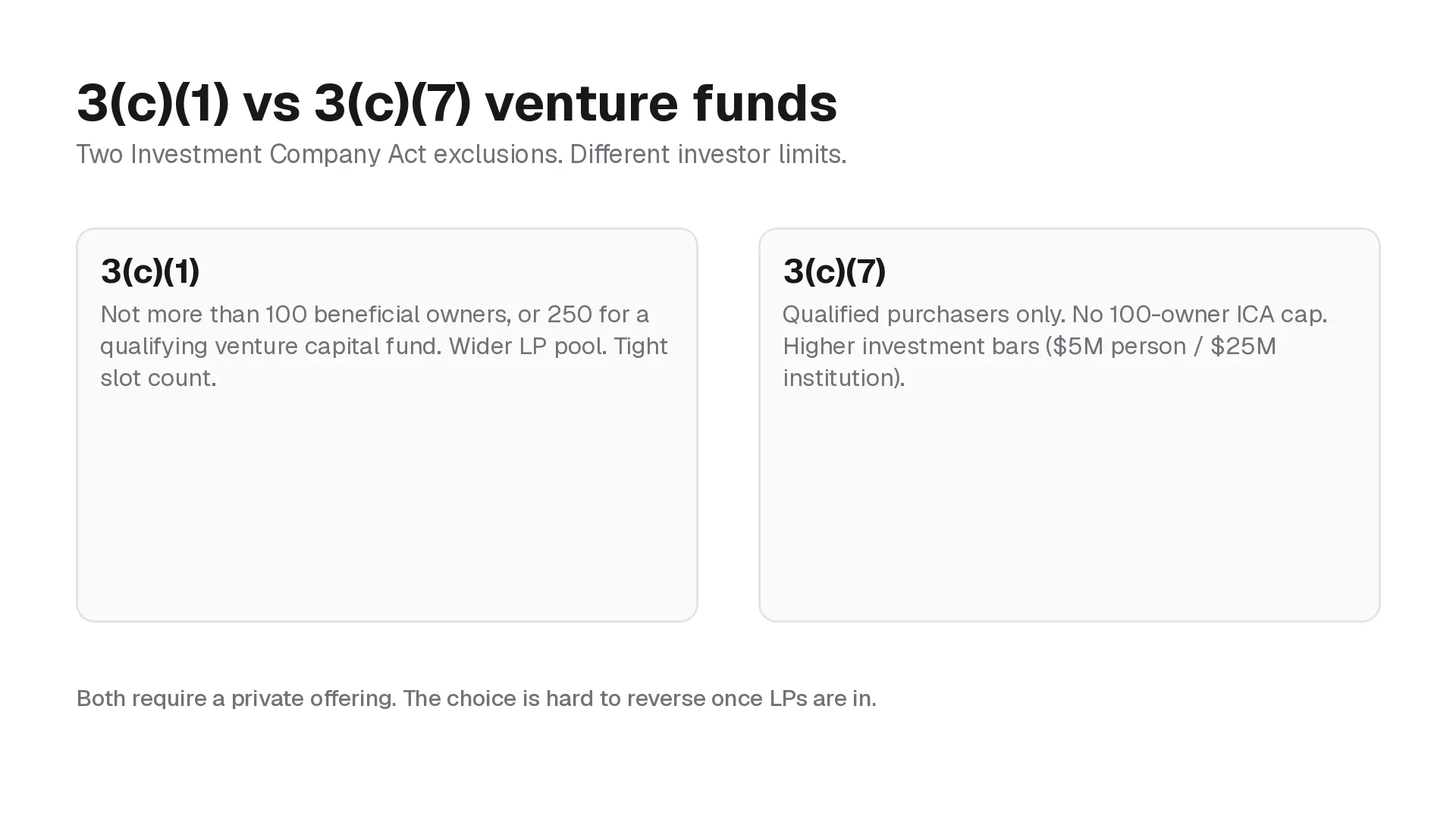
U.S. venture funds usually avoid Investment Company Act registration through 3(c)(1) or 3(c)(7). One caps how many people can own the fund. The other admits only qualified purchasers. Here is the difference, a worked slot example, and what it means for people who work at VC firms.
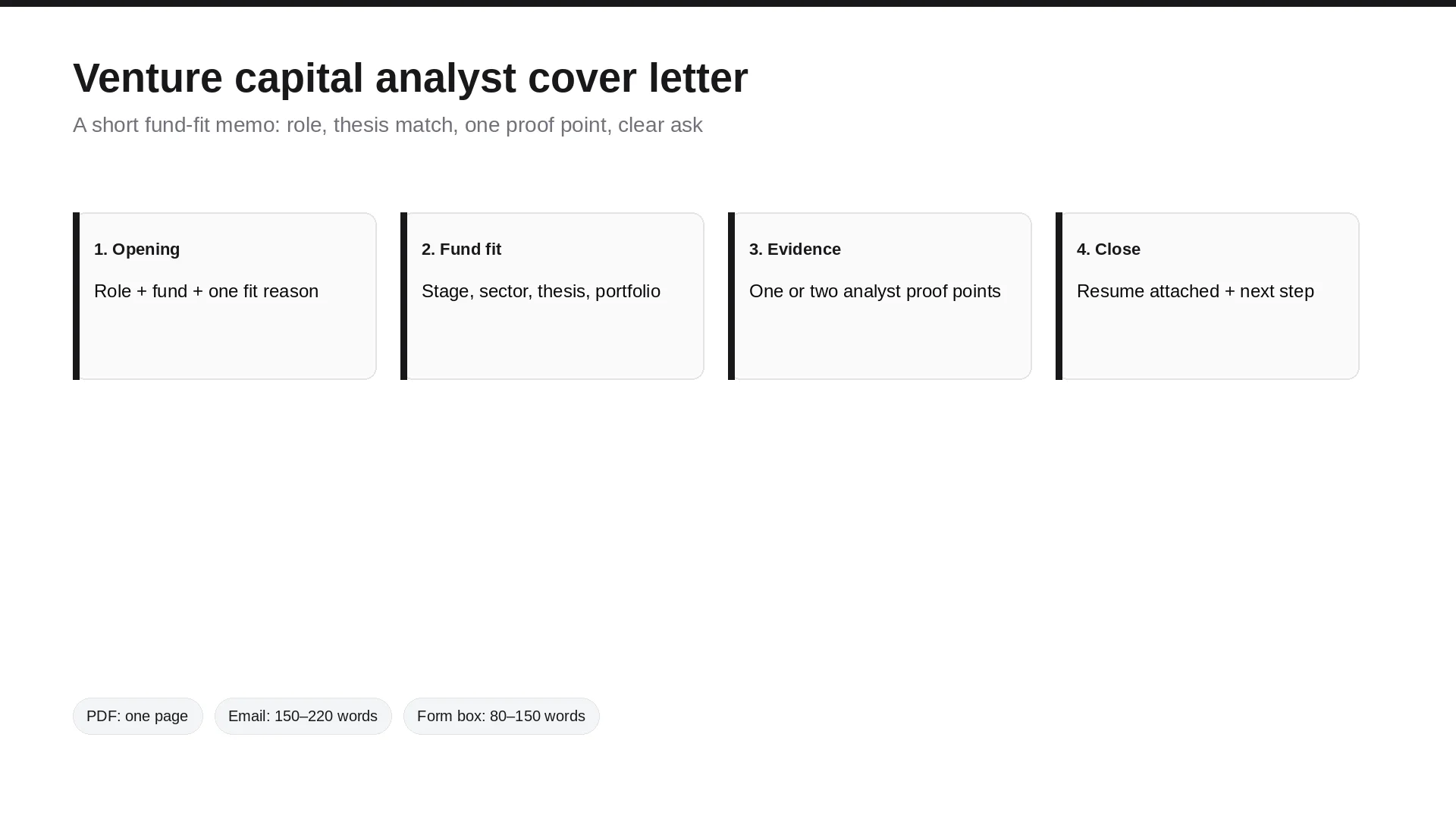
Write a concise VC analyst cover letter that ties your background to fund fit, sourcing, research, and investment analysis. Includes a template, sample letter, channel lengths, alternate application prompts, and checklist.
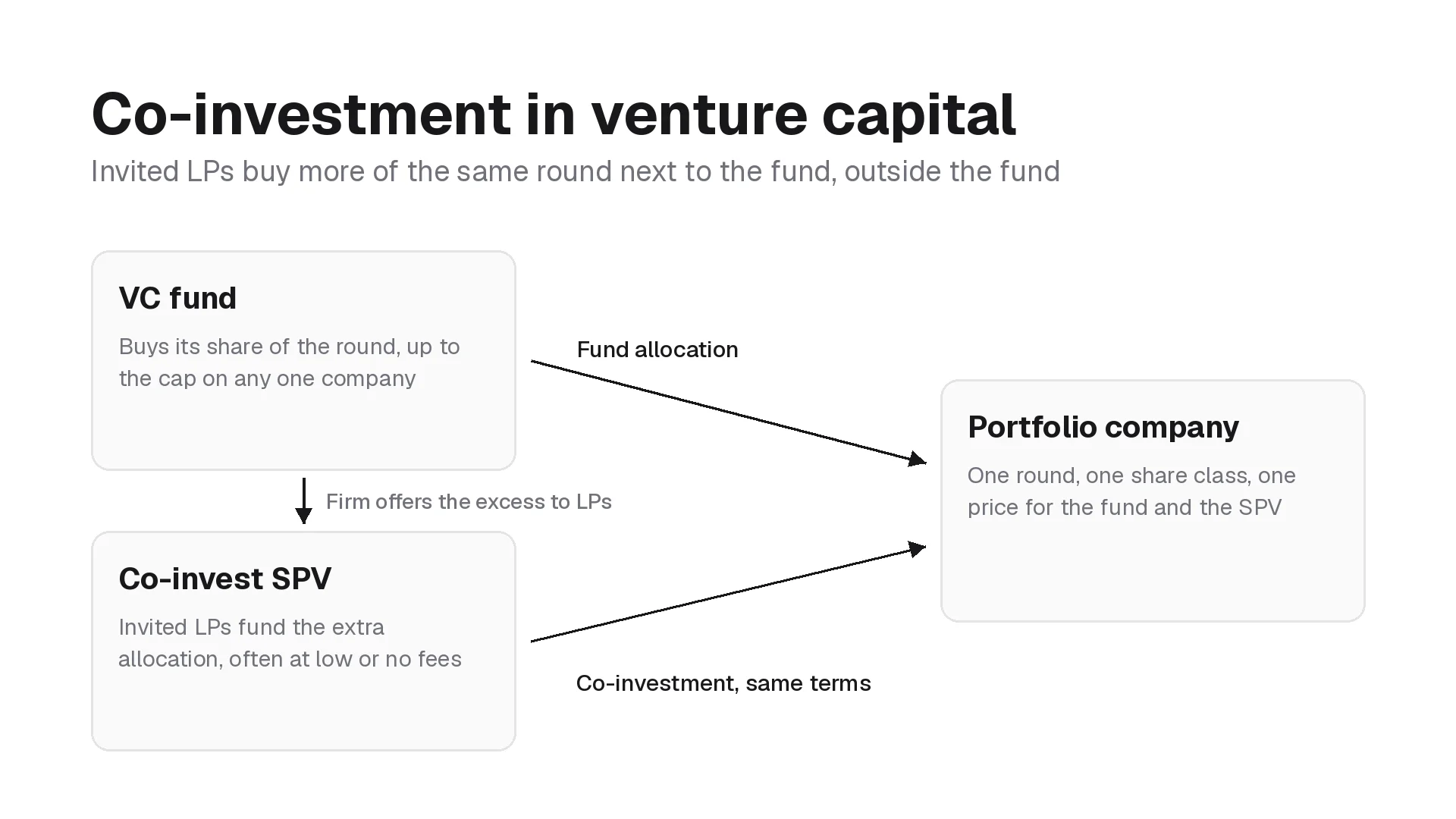
A venture capital co-investment lets LPs put money into one startup next to the fund, outside the fund, usually at lower fees. Here is how the offer works, what the terms cost, why late-stage venture co-investments carry extra risk, and what co-investment means for people who work at VC firms.