
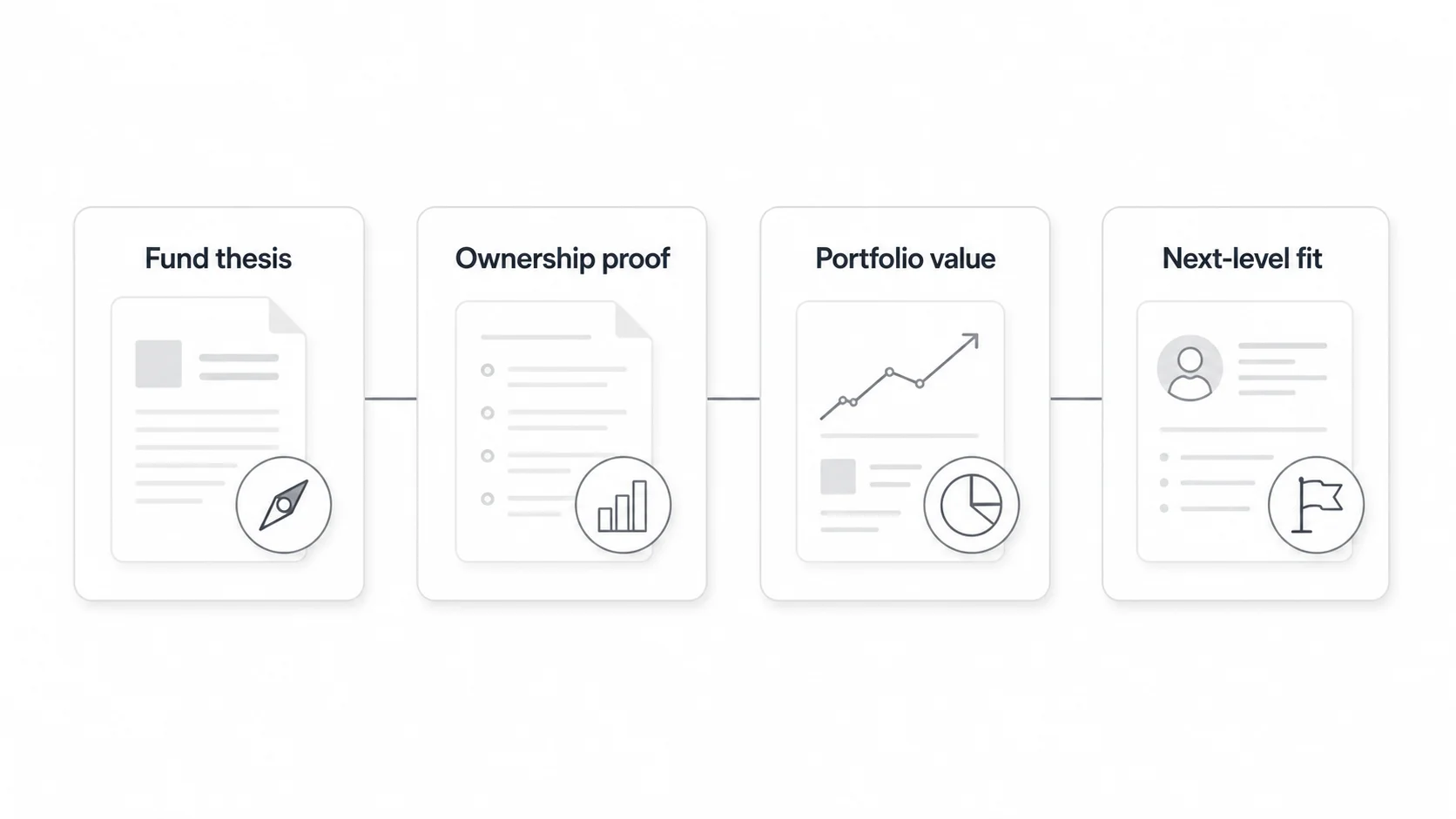
A venture capital Principal cover letter should make a one-page investment case for your candidacy. It needs to show why this fund fits your point of view, where you have exercised Principal-level ownership, and what you can contribute beyond executing assigned work.
The strongest letters use two or three defensible examples from sourcing, investment judgment, deal leadership, portfolio support, or firm building. They do not rely on generic passion or impressive metrics the candidate cannot substantiate. Use the framework, template, and example below to turn your record into a precise, fund-specific narrative.
What a venture capital Principal cover letter must prove
A venture capital Principal cover letter should prove that you can do more than support an investment process. It should show where you exercised judgment, took ownership, and made the investment team or portfolio stronger.
The title is not standardized. Before writing, compare the posting with the actual scope described in the venture capital Principal job description. A Principal at one fund may lead diligence and negotiate term sheets; at another, the same title may still be primarily a senior execution role. Write to the mandate, not the label.
Use this evidence ladder to assess your strongest examples:
- Sourced: You found or developed a relationship with an opportunity.
- Evaluated: You formed a view on the market, company, team, or terms.
- Led: You owned a material workstream or coordinated the process.
- Influenced the decision: Your analysis or judgment changed how the firm assessed the opportunity.
- Closed: You helped move the investment through terms, diligence, syndication, or final approval.
- Supported the portfolio: You helped a company recruit, raise, sell, govern, or make a strategic decision.
- Built the firm: You strengthened a thesis, sourcing channel, team, brand, operating process, or LP-facing capability.
You do not need all seven in one letter. Choose two or three that best match the role.
| Principal responsibility | Evidence that belongs in the letter | Weak substitute |
|---|---|---|
| Sourcing | A repeatable channel, relationship, or thesis that produced relevant opportunities | “I have a strong network” |
| Investment judgment | A differentiated view you formed and how it affected a decision | “I am passionate about startups” |
| Diligence leadership | A workstream you scoped, prioritized, or directed | A list of models or databases used |
| Deal execution | Terms, stakeholders, or process risks you helped resolve | “I assisted with transactions” |
| Portfolio support | A specific operating or financing problem you helped address | Generic claims of founder empathy |
| Ecosystem relationships | Founder, operator, co-investor, or expert relationships tied to the fund's strategy | Follower counts or event attendance |
| Firm contribution | A thesis, process, talent, platform, or fundraising contribution | Vague leadership adjectives |
The strongest letter is not the one with the most impressive nouns. It is the one where the reader can see what you owned, how you thought, and why that pattern should transfer to this fund.
Use a four-paragraph structure
Keep the letter to one page. Four short paragraphs are usually enough to make the case without repeating your resume.
| Paragraph | Job | What to include |
|---|---|---|
| 1. Investment thesis | Establish why this fund and why you | Role, fund, one specific view on its strategy, and your relevant edge |
| 2. Ownership proof | Show that you have operated at the required level | One or two examples covering sourcing, judgment, execution, or portfolio work |
| 3. Future contribution | Translate the record into value for this fund | The sectors, networks, operating expertise, or firm-building capability you would bring |
| 4. Close | Make the next step easy | Direct interest in a conversation, resume attachment, and contact details |
Your opening should contain more than admiration. A useful test is whether it includes all three of these elements:
- Fund-specific point of view: what you understand about the firm's stage, sector, geography, portfolio pattern, or way of working.
- Relevant investment edge: the market knowledge, network, judgment, or operating experience you bring.
- Ownership proof: a compact signal that you have led work rather than merely observed it.
Avoid spending the first paragraph reciting your years of experience. The hiring team can read that on your resume. Use the space to explain why your record fits this mandate.
Choose evidence you can defend
Specificity helps only when the claim is accurate, attributable, and discussable in an interview. Do not borrow the surface style of a strong letter—large deal values, precise returns, famous portfolio companies—if you cannot explain your role in each result.
Use these rules:
- Name your contribution before the outcome. “Led commercial diligence” is clearer than “delivered a successful investment.”
- Separate team results from individual actions. Use “our team invested” for the transaction and “I led” only for work you owned.
- Respect confidentiality. Describe the stage, sector, and problem without naming a company when the information is not public.
- Use ranges or scope when exact figures are sensitive. For example, “a Series B investment in the tens of millions” may be enough if the amount is not public.
- Do not claim investment-committee authority you did not have. You can say you presented a recommendation, answered objections, or changed the diligence plan without implying a vote.
- Treat paper marks carefully. Do not present an unrealized valuation change as a realized return.
| Risky claim | More defensible version |
|---|---|
| “I generated a 4x return on Company X.” | “I sourced Company X, led the market and customer work supporting our investment, and remained involved through its next financing.” |
| “I led a $40 million investment.” | “I led the commercial diligence workstream and coordinated our recommendation for a growth-stage investment.” |
| “I built the firm's fintech portfolio.” | “I developed the payments thesis, sourced five opportunities that reached partner review, and supported two completed investments.” |
| “I advised the board.” | “As a board observer, I prepared materials and supported management on executive hiring and follow-on financing.” |
| “I have proprietary deal flow.” | “My relationships with vertical-software operators produced a repeatable pipeline of founder introductions in the sector.” |
If a sentence would require a long correction in an interview, rewrite it now. Precision sounds more senior than exaggeration.
Venture capital Principal cover letter template
Use the structure, but replace every bracketed field with evidence from your own record.
Dear [Name],
I am applying for the Principal role at [Fund]. Your focus on [stage, sector, geography, or portfolio pattern] matches the work I have led in [relevant market or capability]. In my current role as [title] at [organization], I have [one-line ownership proof], and I would bring that combination of [edge 1] and [edge 2] to [specific part of the fund's strategy].
Over the past [period], I have [sourced/evaluated/led] [relevant scope of work]. One example is [public or confidentiality-safe investment example], where I [your specific action], [judgment or problem you owned], and [defensible result or decision impact]. I also [second proof point tied to sourcing, portfolio support, or firm building]. These experiences have prepared me to [responsibilities from the actual posting].
I am particularly interested in [Fund]'s approach to [specific thesis, portfolio pattern, or operating model]. My experience in [sector/network/operating capability] could help the team [future contribution], while my record in [investment capability] would allow me to contribute to [sourcing, investment work, portfolio support, or firm building] from the outset.
I have attached my resume and would welcome a conversation about how my investment experience and [specific edge] could support [Fund]'s next phase. Thank you for your consideration.
Sincerely,
[Name]
[Email] | [Phone] | [LinkedIn, optional]
Do not preserve placeholders that are not relevant. A sector-specialist fund may care more about technical judgment and founder access; a multistage platform may care more about transaction leadership and portfolio support.
Venture capital Principal cover letter example
The firm, candidate, investments, and results below are fictional. They demonstrate structure, not facts to copy.
Dear Ms. Alvarez,
I am applying for the Principal role at Meridian Seed Partners. Meridian's focus on vertical software for operationally complex industries matches the thesis work and founder network I have built across logistics and field services. As a Senior Associate at Northline Ventures, I have sourced investments, led commercial diligence, and supported founders through follow-on financings; I would bring that combination of sector judgment and process ownership to Meridian's seed strategy.
During the past three years, I built Northline's logistics-software market map and developed relationships with operators, founders, and industry experts across the category. That work produced six opportunities that reached partner review and one completed seed investment. For that investment, I originated the relationship, designed the customer-reference plan, and reframed our initial concern about market size around a broader workflow expansion case. After closing, I supported the founder on the first finance-lead search and preparation for the next round. Separately, I introduced a quarterly portfolio review that gave our team a clearer view of hiring, runway, and financing priorities across twelve companies.
Meridian's investments suggest a preference for products that enter through a narrow operational wedge and expand into a system of record. My experience evaluating adoption in low-software-penetration industries would help the team test that pattern during sourcing and diligence. I could also contribute an operator network in logistics and field services while continuing to develop the portfolio-review discipline required in a small, collaborative fund.
I have attached my resume and would welcome the opportunity to discuss how my sector work, sourcing record, and portfolio experience could support Meridian's next fund. Thank you for your consideration.
Sincerely,
Jordan Lee
The example works because each claim has a job. The market map supports sourcing. The customer work shows judgment. The finance hire demonstrates portfolio contribution. The quarterly review shows firm building. None of those points is a decorative responsibility list.
Tailor the letter to your path
The evidence burden changes depending on how you are approaching the Principal role.
Promotion-track investor
If you are moving from Senior Associate or Vice President, show the work you already perform above your title. Lead with examples where you originated an opportunity, shaped the recommendation, coordinated others, or became the trusted point of contact for a founder.
Your main risk is writing an associate letter: many tasks, little ownership. Replace “supported” and “assisted” with precise descriptions of what you scoped, decided, or led—but only where true.
Lateral investor
If you already invest at a VC, corporate venture, growth equity, or adjacent fund, explain why your record transfers to this firm's mandate. A growth investor applying to an early-stage fund may need to show comfort with limited data and founder assessment. A corporate venture investor may need to explain financial-return discipline and autonomy from strategic business units.
Your main risk is assuming the title means the same thing everywhere. Address the new fund's stage, decision process, portfolio model, and expectations directly.
Senior operator or domain expert
If you are entering from product, engineering, go-to-market, healthcare, climate, or another operating field, your domain depth is an edge—not a substitute for investing evidence. Show how it improves sourcing, company evaluation, or portfolio support. Add proof that you can form and communicate an investment view: angel work, investment memos, advisory work, market maps, or formal participation in diligence.
Your main risk is presenting operating seniority as automatic readiness for investment ownership. Make the bridge explicit and honest.
| Path | Lead with | Prove next | Avoid |
|---|---|---|---|
| Promotion-track investor | Work already owned above title | Independent judgment and leadership | Associate task inventory |
| Lateral investor | Relevant investment record | Transfer to new stage, sector, or model | Assuming titles and authority match |
| Senior operator/domain expert | Differentiated market and founder insight | Repeatable investing process | Treating operating seniority as IC experience |
Research the firm in 15 minutes
A tailored letter does not need a paragraph of praise. It needs one defensible connection between the firm's strategy and your record.
Before drafting, check:
- Stage: pre-seed, seed, Series A, growth, or multistage.
- Sector: stated focus and the pattern visible across recent investments.
- Geography: where the fund invests and where its team has networks.
- Portfolio pattern: business model, buyer, technical moat, founder profile, or go-to-market motion that appears repeatedly.
- Partner writing: a thesis, interview, podcast, or memo that reveals how the firm thinks.
- Platform model: whether investors are expected to help with recruiting, go-to-market, community, follow-on capital, or other portfolio work.
- Mandate: decision rights, sourcing expectations, board exposure, carry, and the path beyond Principal.
Use the Venture Capital Careers companies directory as a starting point, then verify the details on the firm's own site and in the job description. Your letter should not imply that a fund has a thesis merely because it made one investment in a category.
Turn the research into one sentence you could not send to another firm:
Your investments in workflow software for regulated service businesses match the customer research and sourcing network I have built across insurance and compliance operations.
If replacing the firm name leaves the sentence equally plausible, the tailoring is not finished.
Turn a resume bullet into a Principal narrative
Your venture capital resume records the facts. The cover letter should explain the judgment inside the strongest facts and why it matters to the target fund.
Use this sequence:
Resume fact → judgment exercised → result → relevance to this fund
Resume bullet:
Led diligence for three enterprise-software investments.
Weak cover-letter rewrite:
In my current role, I have led diligence for three enterprise-software investments, built financial models, interviewed customers, and presented findings to the investment committee.
Stronger Principal narrative:
I led commercial diligence for three enterprise-software investments, including one where conflicting customer feedback initially obscured the expansion case. I segmented the references by buyer maturity and reframed our work around implementation time and budget ownership, giving the team a clearer basis for its final decision. That experience is directly relevant to your focus on vertical software sold into operational buyers.
The stronger version does not add more accomplishments. It reveals the problem, the judgment, and the transfer to the new role.
Common mistakes in a VC Principal cover letter
Rewriting the resume in paragraphs
Select two proof points and explain the judgment behind them. A chronological walk through every role makes the reader search for your thesis.
Leading with generic passion
“I am passionate about startups” does not differentiate a senior investor. Replace it with a market view, sourcing edge, or portfolio capability connected to the fund.
Listing analyst-level tasks
Research, modeling, and diligence matter, but a Principal letter should show how you scoped, prioritized, reviewed, or used that work to make a decision.
Inflating ownership
Do not turn team investments into personal deals, paper marks into realized returns, observer rights into board authority, or a presentation into an investment-committee vote.
Assuming the title travels cleanly
Principal authority varies by firm. Address the posting's actual mandate and show why you fit it.
Writing an investment autobiography
One page is enough. A long deal history obscures the two or three patterns the hiring team should remember.
Reusing the same fund-fit paragraph
Reuse your process, not the result. Research each fund and rewrite the point of view, evidence selection, and future contribution.
Final checklist before you send
- [ ] The exact role and fund appear in the opening.
- [ ] The opening contains a fund-specific point of view, relevant edge, and ownership signal.
- [ ] Two or three proof points match the actual Principal mandate.
- [ ] Every “I led” claim describes work you truly owned.
- [ ] Team outcomes and personal contributions are separated.
- [ ] Confidential companies and figures are handled appropriately.
- [ ] The letter explains judgment instead of repeating resume bullets.
- [ ] The future-contribution paragraph is specific to the fund.
- [ ] The letter fits on one page and closes with one clear ask.
- [ ] Names, titles, company names, dates, and attachments are correct.
Once the materials are ready, you can browse current venture capital roles and use the same mandate-first test: compare what the title suggests with what the job description actually asks you to own.
Frequently asked questions
How long should a venture capital Principal cover letter be?
Keep it to one page, usually four short paragraphs. Seniority is not a reason to include every investment. Select the evidence most relevant to the fund's mandate.
Should I submit a cover letter if it is optional?
Submit one when it adds information the resume cannot: why this fund, how your investment edge fits its strategy, or how a nonstandard background transfers to the mandate. A generic letter adds little. Follow the application instructions if the firm says not to include one.
Should I name deals and portfolio companies?
Name a company only when the relationship and facts are public and you can describe your role accurately. Otherwise, use a confidentiality-safe description such as stage, sector, and the work you owned.
How should I discuss confidential investments?
Describe the problem and your contribution without revealing protected details. You can often state the sector, stage, diligence question, stakeholder group, or scope of your work. Avoid exact figures or company names when they are not public.
Can I apply for a Principal role without previously holding the title?
Yes, if your record matches the mandate. A promotion-track investor should show work already owned above title. A lateral investor should explain transfer across strategies. A senior operator should connect domain expertise to repeatable sourcing, evaluation, and portfolio contribution without implying investment authority they did not have.
Should the letter be an email or an attachment?
Follow the firm's instructions. If none are given, a clean PDF is conventional for an application portal; a concise version can work in the email body for a direct introduction. Keep the substance consistent and make sure the resume is attached when requested.
Related posts
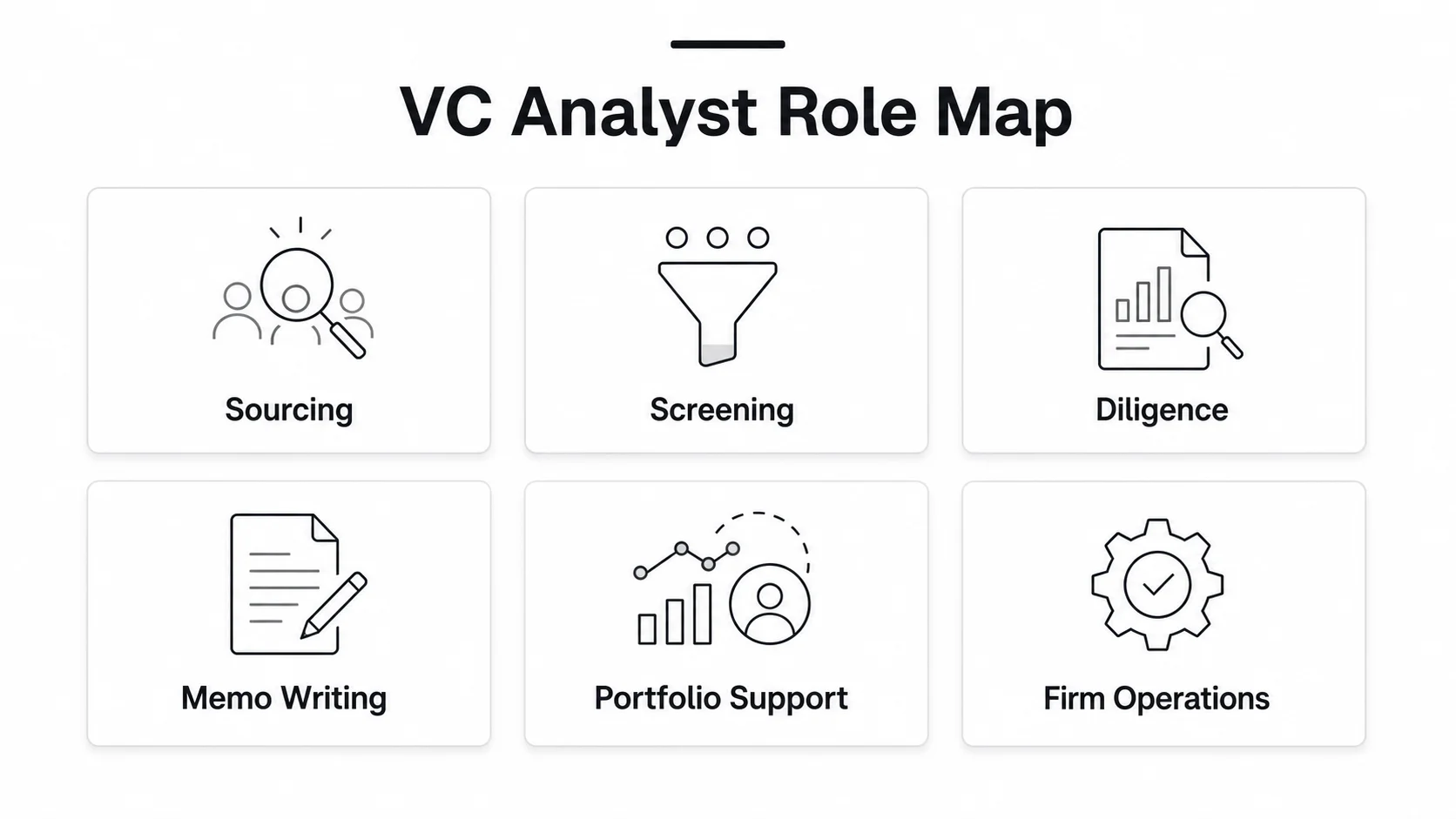
Copy-ready VC analyst job description template with responsibilities, skills, sourcing vs diligence seat signals, interview scorecard, and how candidates should read a posting.
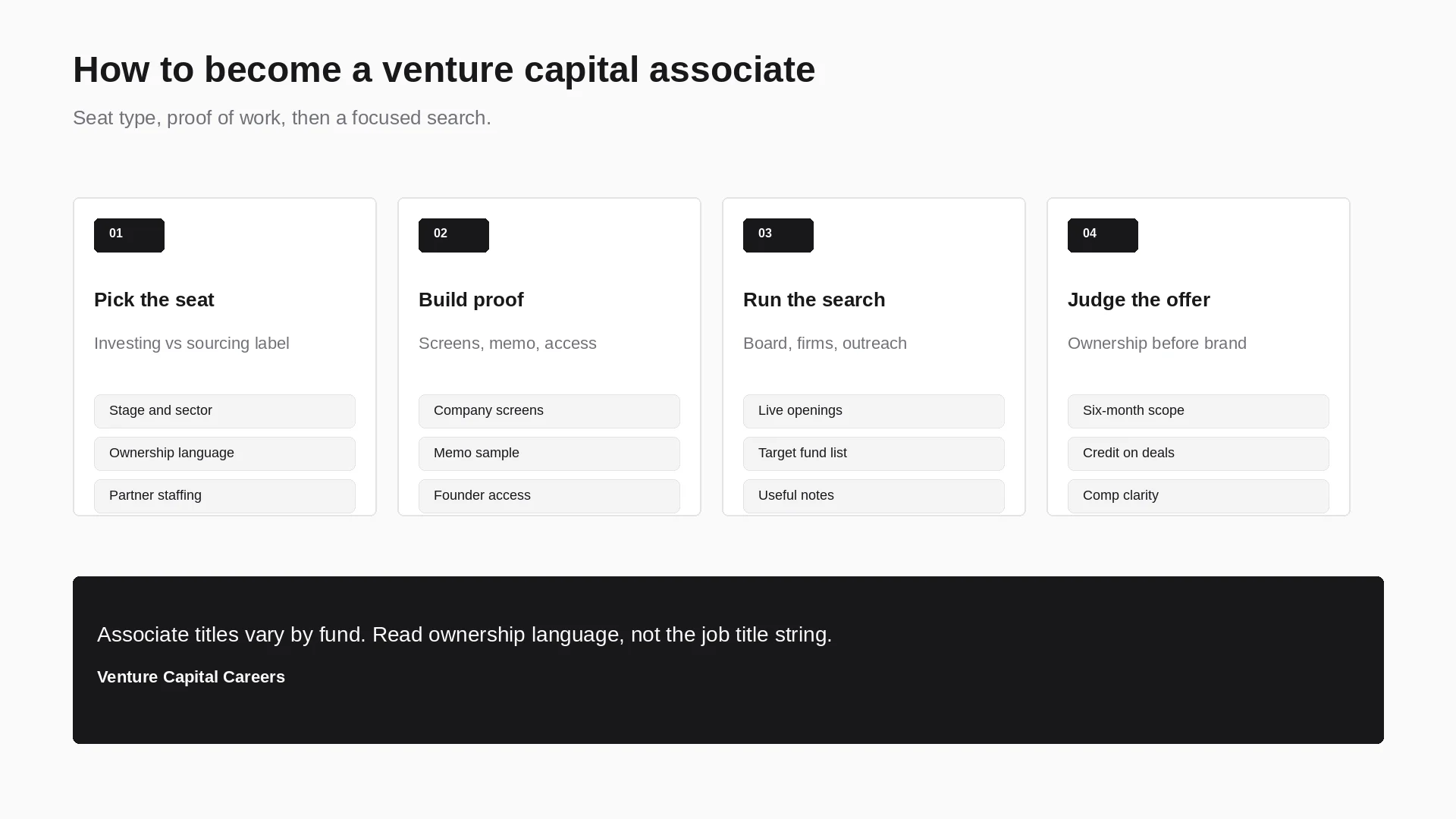
A practical guide to becoming a venture capital associate: what the seat is, which paths convert, how to prove you can do the work, and how to screen real associate openings.
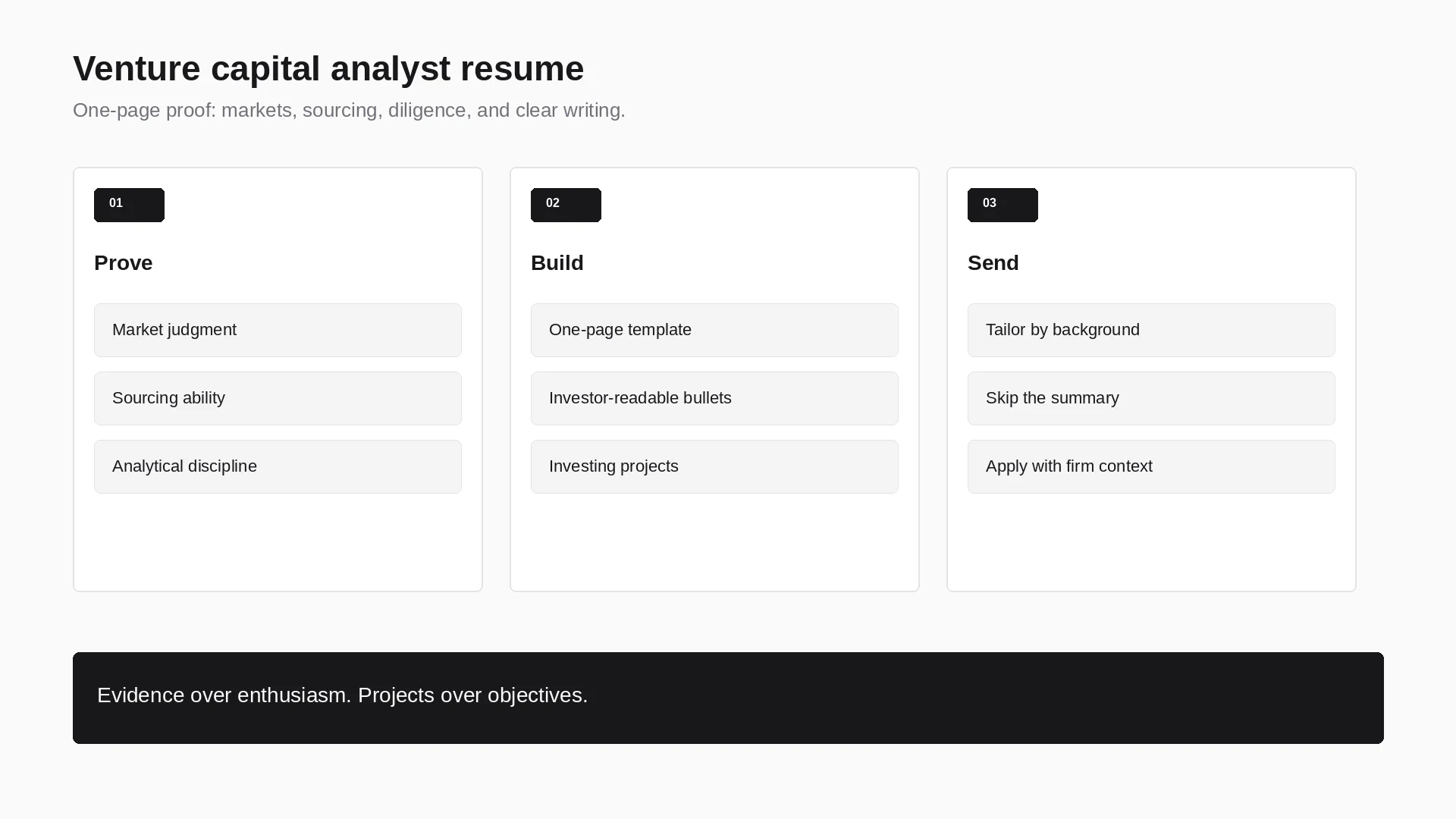
A VC analyst resume is a one-page proof document. Template, bullet formula, investing projects section, examples, and next steps for analyst applications.