
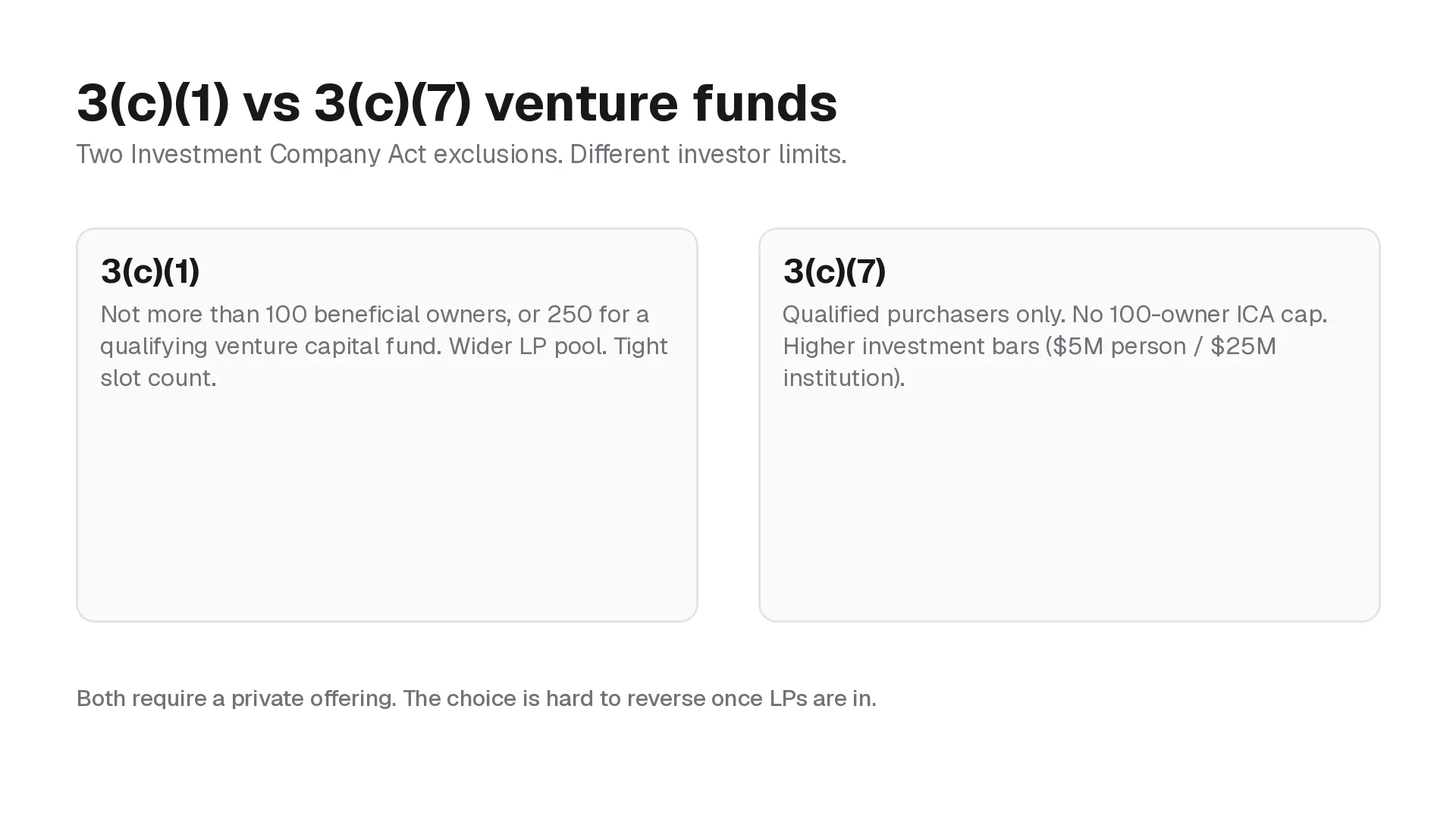
A U.S. venture capital fund almost always avoids registering as an investment company by relying on one of two exclusions in the Investment Company Act of 1940. Section 3(c)(1) caps how many people can own the fund. Section 3(c)(7) removes that headcount cap but lets in only qualified purchasers. The choice sets who can write checks, how big the LP base can get, and how hard it is to change course later.
If you work at a VC firm, or you are deciding which firm to join, the exclusion on the fund you touch is not trivia. It tells you what the LP universe looks like, how crowded fundraising can get, and what "Fund II" can and cannot fix.
Why VC funds care about 3(c)(1) and 3(c)(7)
The Investment Company Act treats a business that invests primarily in securities as an investment company. A venture fund would usually fit that definition. Registration brings a heavy compliance load that private funds are not built to carry.
Section 3(c)(1) and Section 3(c)(7) of the Act carve private funds out of that definition when they meet the statute's tests and do not make a public offering of their interests. Most U.S. venture funds pick one path and build the fund structure, subscription docs and LP outreach around it.
The exclusion is about the fund. It does not, by itself, answer whether the management company must register as an investment adviser. Those are separate analyses counsel runs in parallel.
What a 3(c)(1) fund is
A 3(c)(1) fund may sell interests privately to a limited number of beneficial owners. Under 15 U.S.C. § 80a-3(c)(1), the fund's outstanding securities (other than short-term paper) must be beneficially owned by not more than one hundred persons. For a qualifying venture capital fund that meets the statute's extra conditions, that ceiling rises to 250 persons.
The hard part is the count, not the headline number. Look-through rules can treat an entity investor as more than one owner when it was formed to invest in the fund, or when it is itself a private fund that owns more than a threshold stake. Managers who treat "100 LPs" as 100 subscription agreements often discover they have fewer free slots than they thought.
In practice, most 3(c)(1) venture funds also limit the raise to accredited investors under the Securities Act offering exemption they use, usually Rule 506(b) of Regulation D. Accredited is a Securities Act concept. It is not the same test as the Investment Company Act owner count.
What a 3(c)(7) fund is
A 3(c)(7) fund may sell interests privately only to qualified purchasers. The statute does not impose the 100-owner cap. The trade is investor wealth and sophistication instead of headcount.
Qualified purchaser is defined in 15 U.S.C. § 80a-2(a)(51). The two thresholds candidates hear most often are:
- a natural person who owns not less than $5,000,000 in investments, and
- a person acting for its own account or the accounts of other qualified purchasers who owns and invests on a discretionary basis not less than $25,000,000 in investments.
Family companies and certain trusts have their own tests in the same section. "Investments" is a defined concept under Commission rules. It is not the same as net worth, and a primary residence does not count the way it sometimes does in accredited-investor math.
A 3(c)(7) fund still cannot make a public offering. There is also a practical ceiling from Exchange Act holder-of-record rules that can force public-company-style registration once a private issuer crosses high holder counts. Institutional venture funds almost never bump into that ceiling. They hit the qualified-purchaser wall first.
Knowledgeable employees of the adviser can often hold interests under separate Commission rules without using a qualified-purchaser slot. That carve-out matters for how partners and staff invest alongside LPs, but it is fact-specific.
3(c)(1) vs 3(c)(7) at a glance
| Topic | 3(c)(1) | 3(c)(7) |
|---|---|---|
| Core limit | Not more than 100 beneficial owners (250 for a qualifying venture capital fund) | Interests sold only to qualified purchasers |
| Typical LP pool | Accredited investors, including many individuals and smaller family offices | Institutions and high-net-investment individuals who clear the QP tests |
| Headcount room | Tight; look-through burns slots fast | No 100-owner ICA cap |
| Common first-fund choice | Yes | Less common for a first close when the GP still needs angel and founder LPs |
| Switching later | Hard if non-QP LPs are already in | Starting here locks out most accredited-only LPs |
| What the docs emphasize | Owner-count and look-through representations | QP questionnaires and investment tests |
Accredited investor vs qualified purchaser
These labels get swapped in conversation. They answer different statutes.
| Label | Statute | What it usually gates | Rough individual bar (high level) |
|---|---|---|---|
| Accredited investor | Securities Act / Regulation D | Who can buy in many private placements | Income or net-worth tests (primary residence treated differently than under QP) |
| Qualified purchaser | Investment Company Act § 2(a)(51) | Who can buy into a 3(c)(7) fund | $5,000,000 in investments for a natural person |
A person can be accredited and still fail the qualified-purchaser test. That is why a 3(c)(1) fund can raise from a wider set of people, and why a 3(c)(7) fund often needs larger minimum tickets so the LP base stays institutional.
How the exclusion shapes fundraising
The exclusion and the offering exemption travel together. Most venture funds still use Rule 506(b): no general solicitation, mostly accredited buyers, Form D filings. Rule 506(c) allows general solicitation if every purchaser is verified as accredited, which changes marketing and verification work for IR and counsel.
Slot math is where associates and IR feel 3(c)(1) every day.
Worked example
The numbers below are illustrative, not market data.
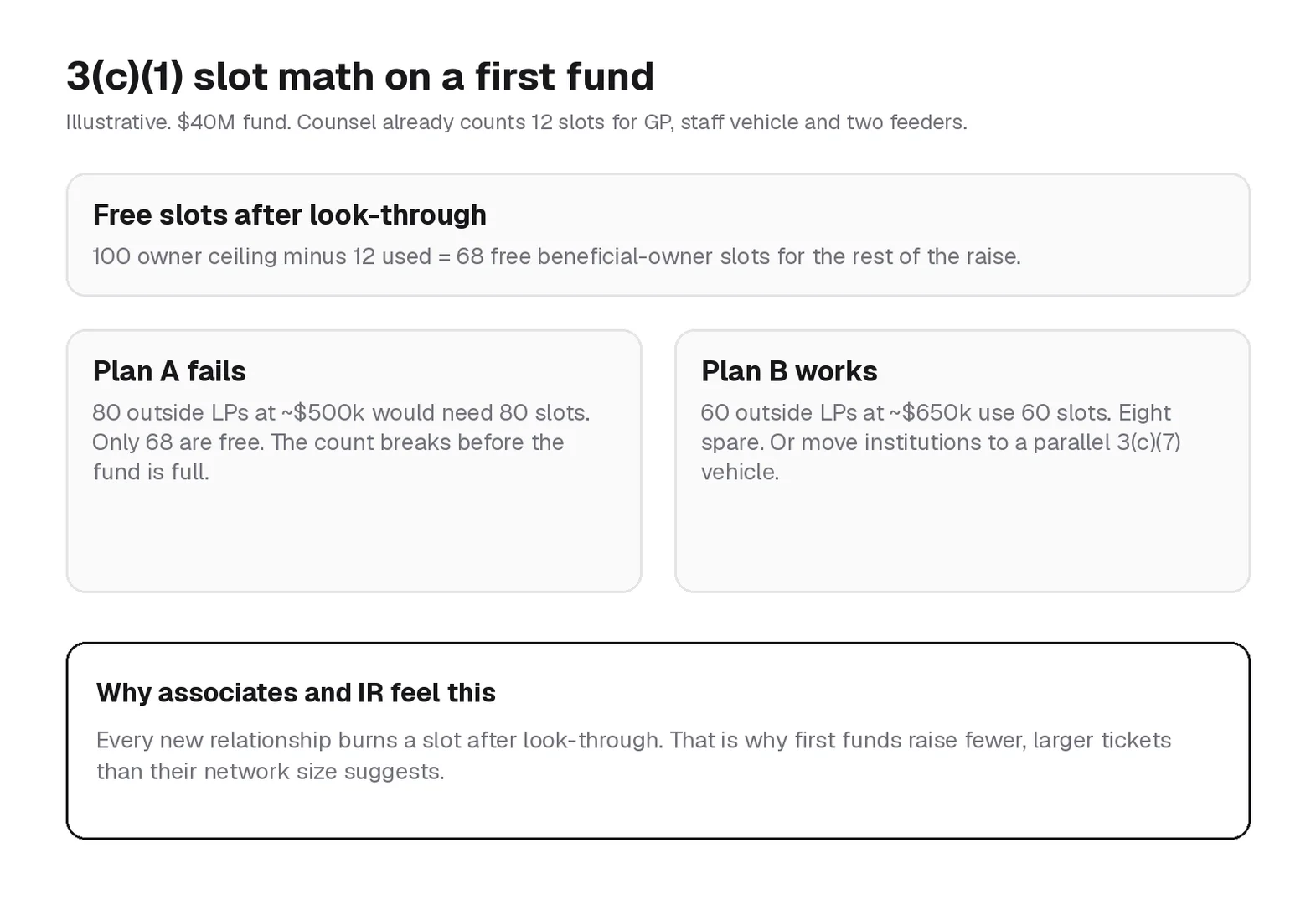
A first-time GP plans a $40 million 3(c)(1) fund and wants room for 80 outside LP relationships after look-through. The GP entity, a small employee vehicle and two "formed for the purpose" feeders already consume 12 beneficial-owner slots under counsel's count. That leaves 68 slots for the remaining raise.
| Plan | Slots used | Outside LP relationships left | What breaks |
|---|---|---|---|
| Target 80 outside LPs at ~$500k average | 12 + 80 = 92 | Would need 80; only 68 free | Owner count before the fund is full |
| Cut to 60 outside LPs at ~$650k average | 12 + 60 = 72 | 68 free, 8 spare | Workable if larger tickets clear |
| Open a parallel 3(c)(7) vehicle for institutions | 3(c)(1) stays small | Institutions move off the count | Two sets of docs, two closes, more ops |
The table is why emerging managers often raise fewer, larger commitments than their LinkedIn network suggests, or stand up a separate vehicle for institutions. An SPV for a single deal is a different instrument. It can still need its own Investment Company Act analysis.
Why the choice is hard to reverse
There is no clean mid-life switch from 3(c)(1) to 3(c)(7) that keeps accredited-but-not-qualified LPs in the same vehicle. To live as a 3(c)(7) fund, every remaining investor has to be a qualified purchaser (or fit a narrow carve-out). First funds that filled early slots with angels, operators and small family offices usually cannot make that jump.
Sponsors who expect institutional tickets in Fund II often plan a new 3(c)(7) vehicle instead of rewriting Fund I. That is a fund lifecycle and vintage decision as much as a legal one. The old fund keeps its exclusion. The new fund starts fresh.
Running both exclusions in related vehicles is possible with careful structuring. Integration and "formed for the purpose" issues are exactly where counsel earns its fee. Do not treat a blog table as a substitute for that memo.
What 3(c)(1) vs 3(c)(7) means if you work in venture capital
Who does the work
| Role | Where the exclusion shows up |
|---|---|
| Investor relations / fundraising | LP questionnaires, slot tracking, which vehicle to offer a prospect |
| Fund operations / finance | Subscription packages, capital account setup, owner-count monitoring |
| Partners / principals | Minimum ticket design, whether to open a parallel vehicle, Fund II structure |
| Associates and analysts | Diligence on a firm's funds when you join; explaining the LP base in interviews |
| Counsel (internal or outside) | Exclusion memo, look-through analysis, adviser registration overlay |
Questions to ask a firm before you join
- Is the active fund 3(c)(1), 3(c)(7), or do you run both in parallel?
- How many beneficial-owner slots are left in the current fund, after look-through?
- What is the typical LP (endowment, fund of funds, family office, individuals), and what is the minimum commitment?
- If the firm plans Fund II, will it keep the same exclusion or change?
- How does staff co-invest interact with knowledgeable-employee rules on a 3(c)(7)?
Answers tell you whether the firm still has room to add strategic LPs, whether IR work will be slot triage or institutional relationship management, and whether your carry sits in a vintage that can still grow its LP base. Pair that with how much dry powder remains to deploy.
How to answer it in an interview
A clean answer sounds like this:
"Most U.S. venture funds avoid Investment Company Act registration through 3(c)(1) or 3(c)(7). 3(c)(1) limits beneficial owners, generally to 100, or 250 for a qualifying venture capital fund, so the GP watches look-through counting and often takes accredited investors. 3(c)(7) drops the headcount cap but admits only qualified purchasers, which for an individual generally means at least $5 million in investments. First funds often start on 3(c)(1) because the LP pool is wider. Switching later is hard if non-QP LPs are already in, so larger firms sometimes raise a new 3(c)(7) vehicle instead of converting."
That shows you know the statute labels, the tradeoff, and the career-relevant consequence. More interview drills live in our venture capital interview questions guide.
Browse open roles on the VC job board and research firms in the companies directory while you map which funds use which exclusion.
Frequently asked questions
Is 3(c)(1) the same as accredited-investor only?
No. 3(c)(1) is an Investment Company Act owner-count exclusion. Accredited investor is a Securities Act idea used in the offering. Many 3(c)(1) funds take only accredited investors, but the two tests are not identical.
Can a fund be both 3(c)(1) and 3(c)(7)?
Not as a single pool that relies on both exclusions at once for the same interests. Sponsors sometimes run parallel vehicles, one under each exclusion, with counsel watching integration and look-through.
Does 3(c)(7) mean unlimited LPs?
There is no 100-owner ICA cap, but every LP must be a qualified purchaser (with narrow carve-outs), and other securities laws can still constrain very large holder counts. In venture, QP eligibility binds first.
What is a qualifying venture capital fund for the 250-owner limit?
It is a statutory category under 3(c)(1) with extra conditions, including an aggregate capital contributions and uncalled commitments ceiling that the Commission adjusts over time. Funds that do not meet those conditions stay on the 100-owner limit. Confirm the current dollar threshold with counsel.
Does the fund exclusion replace adviser registration?
No. Whether the management company must register as an investment adviser is a separate question from whether the fund is excluded from the investment company definition.
Next steps
- Read how GP, LP and fee layers fit together, then come back to which exclusion sits on top.
- If you are comparing firms, start with the companies directory and open VC roles.
- Create a free account at venturecapitalcareers.com/auth/join to track roles while you study fund documents.
This page is general education, not legal advice. Fund formation and investor eligibility need qualified counsel.
Related posts
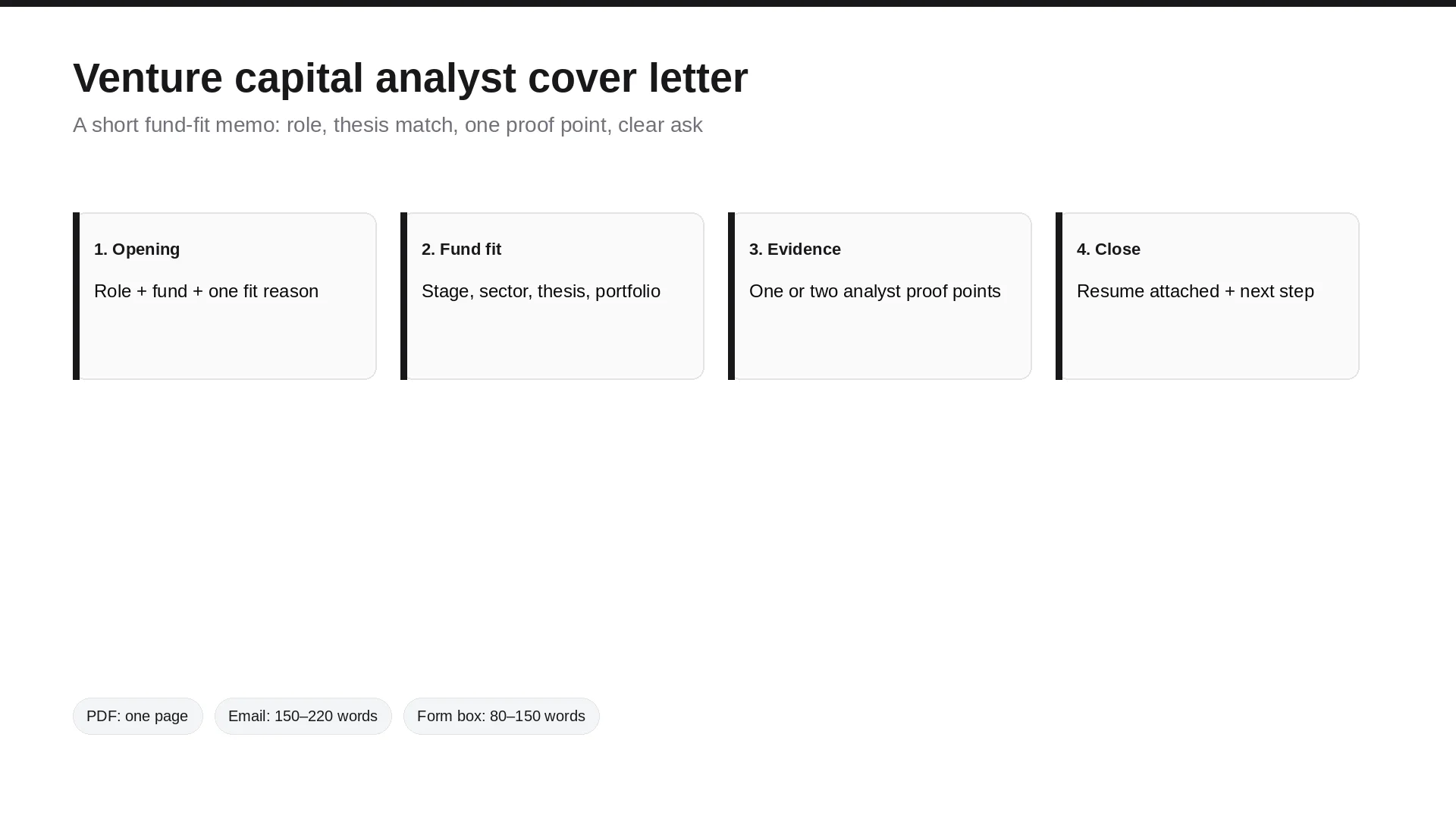
Write a concise VC analyst cover letter that ties your background to fund fit, sourcing, research, and investment analysis. Includes a template, sample letter, channel lengths, alternate application prompts, and checklist.
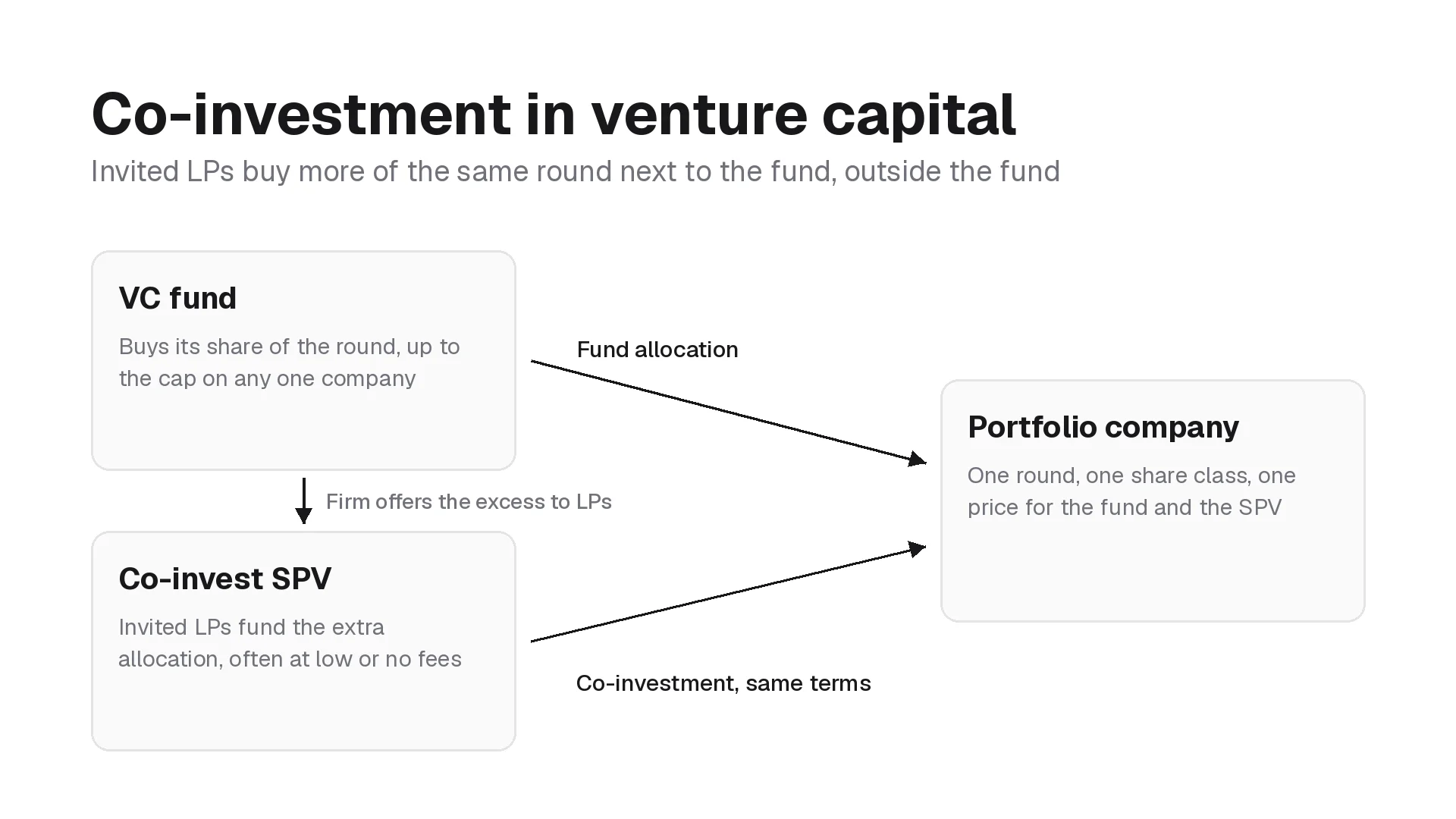
A venture capital co-investment lets LPs put money into one startup next to the fund, outside the fund, usually at lower fees. Here is how the offer works, what the terms cost, why late-stage venture co-investments carry extra risk, and what co-investment means for people who work at VC firms.
How to get a venture capital internship: the five internship types, which firms hire interns, when structured programs and small funds recruit, what interns are paid and when unpaid is legal, outreach with proof, interview questions, and how to screen an offer.