
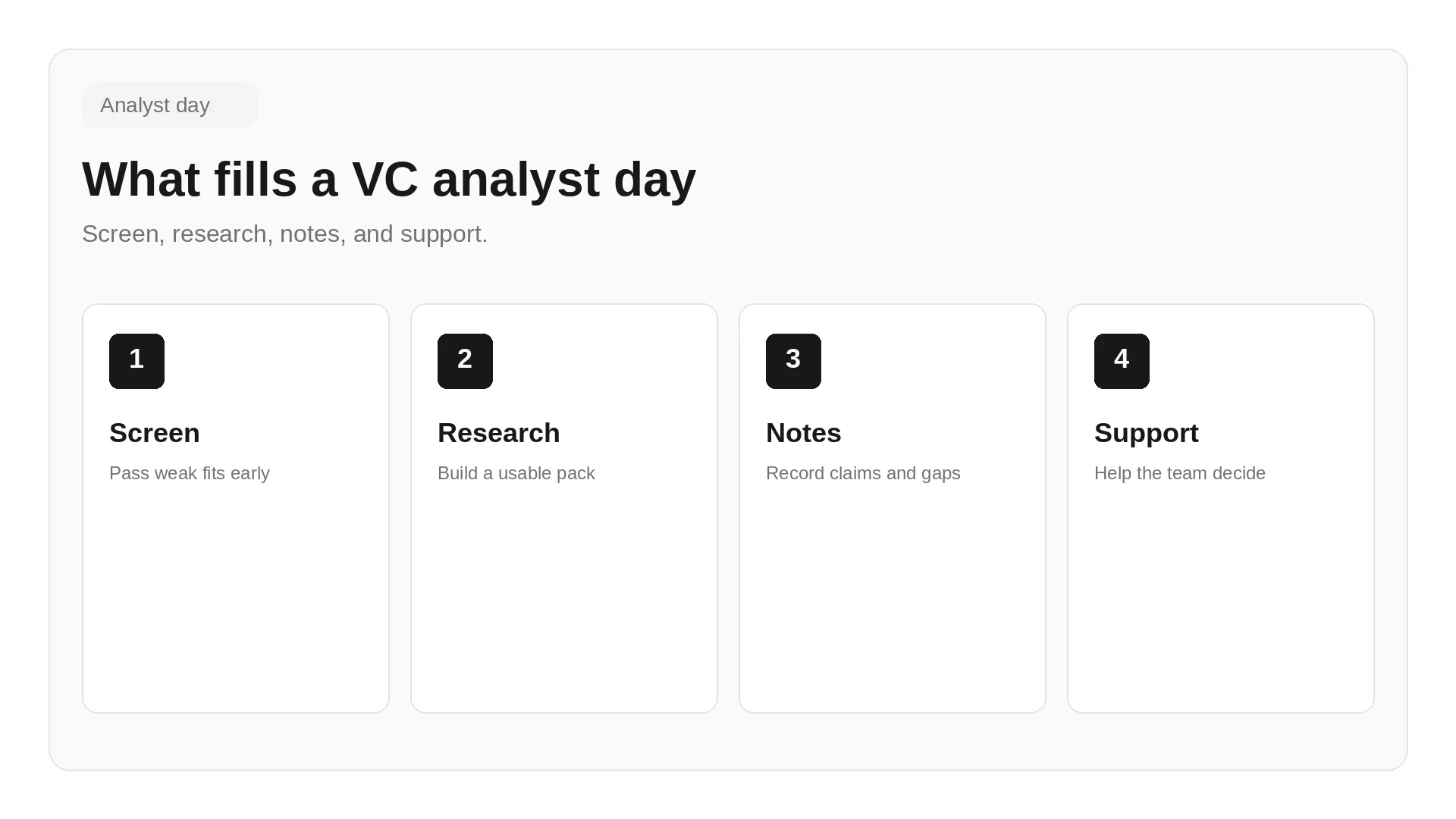
A venture capital analyst day is evidence work. You screen inbound companies, map markets, sit in on founder conversations, and turn that material into notes a more senior investor can use. The calendar looks busy. The real job is deciding what is worth a partner's time.
Treat the sample day below as a composite. Fund stage, team size, and whether a deal is live can reorder every block.
A timestamped day in the life of a VC analyst
| Time | What often happens | Why it matters |
|---|---|---|
| 8:00-9:00 | News, inbox, and overnight decks | Analysts protect partner attention by passing weak fits early and flagging the few companies that deserve a look |
| 9:00-10:00 | Pipeline update or assigned priorities | The day fails when every inbound request feels equal |
| 10:00-12:00 | Join founder calls, take notes, run assigned follow-ups | The output is a clean record of what was claimed, what was missing, and what to check next |
| 12:00-13:00 | Working lunch: notes, CRM updates, or a short research block | Vague memory is not a work product |
| 13:00-15:30 | Market map, competitor pack, customer or expert call, memo section | This is where evidence gets built |
| 15:30-17:00 | Partner review, next-step assignment, IC exhibit cleanup | Analysts hand off a usable pack, not a dump of tabs |
| 17:00-18:30 | Portfolio data pulls, event prep, leftover admin | Support work fills the edges unless a live deal has already taken the afternoon |
| Evening | Variable reading, one event, or a time-zone diligence call | Useful only when it creates a company, a contact, or a clearer view |
A live deal day looks different. A partner asks for a competitor set by morning. A founder sends a data room that was supposed to be complete. A customer reference has to happen across time zones. Recurring screening gets postponed rather than deleted. For workload ranges, use the venture capital hours guide rather than treating any one calendar as a promise.
Listen for these checkpoints in interviews:
- What can the analyst pass without a meeting?
- What gets escalated the same day?
- What does a good screening note look like at this fund?
- Which work is owned end to end, and which work is staffed as support?
If the team cannot answer those questions, the seat may be activity-heavy and learning-light.
What the analyst produces
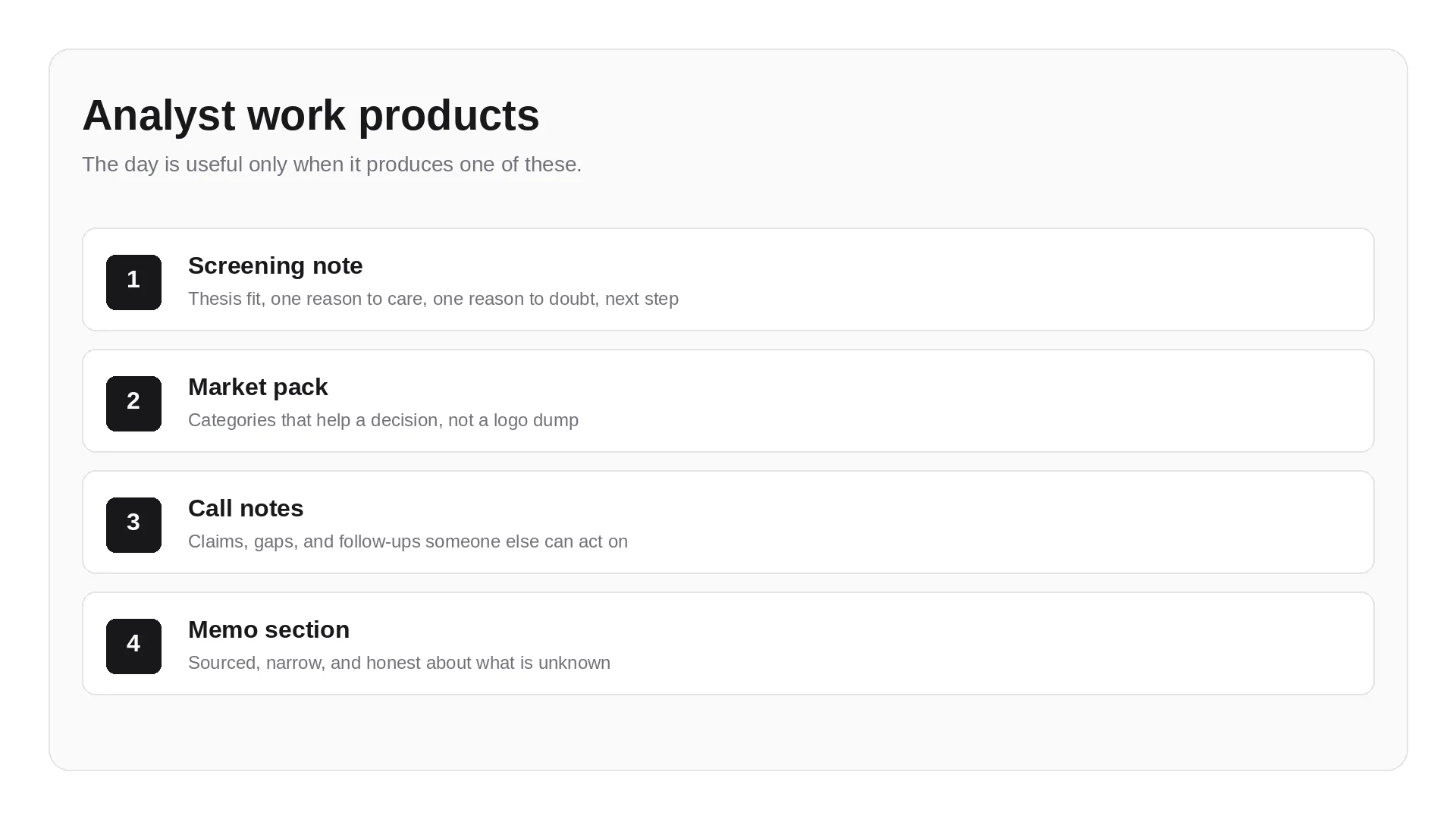
The title is junior. The useful products are not.
| Product | What it is | What good looks like |
|---|---|---|
| Screening note | A short pass or advance on an inbound or sourced company | A thesis fit, one reason to care, one reason to doubt, and a next step |
| Market or competitor pack | A map of the category, buyers, and alternatives | Categories that help a decision, not a slide dump of logos |
| Call notes | A record of claims, gaps, and follow-ups | Someone else can act without sitting in the meeting |
| Memo section | Market, product, team, or risk pages inside a larger case | Sourced, narrow, and honest about what is still unknown |
| CRM hygiene | Status, owner, and why the company is still open | The pipeline stays honest |
Two failure modes show up often.
Inbox theater. The analyst stays busy opening decks and never writes a decision-ready note.
Research theater. The analyst builds a long pack that does not change what the team will do next.
A healthy day balances both. Screening protects time. Deep work converts time into evidence someone can use.
How the analyst day changes by fund type
Firm type changes the texture of the day more than the job title does.
Seed and early-stage
Seed analyst days often lean toward inbound volume, first-meeting support, founder quality, and lighter financial modeling. Diligence still matters, but the evidence set may be team, early customer pull, product insight, and market timing rather than long operating histories. Small teams can also mean more admin in the same afternoon.
Growth and later-stage
Growth analyst days usually include denser data rooms, more process, deeper commercial or financial work, and longer exhibit cycles. The calendar can look like a transaction team week when a live process is underway. Relationship work still matters, but more of the day sits inside assigned workstreams.
Small fund versus platform fund
| Dimension | Smaller fund pattern | Platform fund pattern |
|---|---|---|
| Breadth | One person may touch screening, research, notes, and portfolio on the same day | Work may be narrower, with clearer handoffs |
| Access | Faster proximity to partners and founders | More process, more stakeholders, sometimes less direct ownership early |
| Spikes | Absences and live deals hit harder because leverage is thin | Spikes still happen, but coverage can absorb some load |
| Career signal | Breadth and ownership stories | Process excellence and sharp work inside a lane |
Some funds do not hire analysts at all. The first investing seat is an associate title with a mix of research and coordination. Believe the week, not the label. The analyst versus associate comparison is the better place for mandate and promotion signals.
In interviews, ask for the last week of the person who held the seat. A week description beats a brand description.
Program seats versus career analyst seats
Many larger U.S. funds still treat the analyst role as a two-year program. The seat is real investing work. It is also designed as training. People leave for business school, an operating role, or an associate seat elsewhere. That is not a failure of the day. It is how the role is built.
A smaller set of funds hire career analysts or keep strong juniors without a fixed exit date. The day can look similar. The evaluation is different. Program seats reward accuracy, speed, and coachability. Career seats add a sharper test: can this person start owning a slice of sourcing or diligence without constant assignment?
Ask which pattern you are joining before you treat the title as a ladder. For how the ladder is used in hiring, see the venture capital career path and how to become a venture capital analyst.
How interviews test the work you would do all day
Analyst interviews are less about charm and more about whether you can do Tuesday.
| Skill the day trains | How it shows up at work | How interviews often test it |
|---|---|---|
| Fast, honest screening | Passing a weak fit without a long memo | "Would you take this meeting?" on a short company prompt |
| Structured notes | Capturing claims, gaps, and next checks | Case notes or a written follow-up after a mock call |
| Market packaging | Building a map someone can decide from | A market-sizing or competitor exercise |
| Source discipline | Knowing what you verified versus what you assumed | "What would change your mind?" |
| Communication up | Updating a partner without dumping raw tabs | A 60-second brief on a company or market |
| Composure under assignment | Reordering the day when a live deal lands | A behavioral story about conflicting asks |
Prepare one example each for a pass decision, a research question that changed your view, a note or memo rewrite after pushback, and a follow-through you finished without being chased. For the broader interview set, use the venture capital interview questions guide. For role scope beyond the day, read the venture capital analyst job description.
Use the day to evaluate analyst seats
Reverse the day-in-the-life question. Once you know what the work looks like, ask whether a specific seat produces that work in a useful way.
- What share of the week is inbound screening versus assigned research versus portfolio support versus admin?
- Who sets priorities when two partners want work for the same meeting?
- How often does the analyst join founder conversations, and who writes the note?
- What does a good screening note look like here, and who edits it?
- What happened in the last live-deal crunch, and what got dropped?
- Is this a two-year program, a longer junior seat, or an undefined mix?
- How does a junior investor get feedback after a weak note or a weak call?
Then do concrete research:
- Browse open analyst roles and compare the stated work with the day mapped here.
- Research firms for stage, portfolio shape, and team size.
- Cross-check workload claims with the hours guide and timing with the recruiting timeline.
If the day energizes you because you like turning messy information into a clean pack, analyst work can be a strong first seat. If you want to own recommendations and lead founder conversations from week one, look at the actual mandate before you accept the title. Some associate days still look like analyst days. Some analyst days already look like associate work.
FAQ
What does a venture capital analyst do day to day?
Most analyst days mix inbound screening, assigned research, call notes, memo or exhibit work, and some portfolio or firm support. The exact mix depends on fund stage, team size, and whether a deal is live.
What does a typical day look like for a VC analyst?
A useful composite day starts with news and deck triage, moves into calls and deep research, then ends with partner review, support tasks, and variable evening work. No single timestamped schedule is universal.
How is an analyst day different from an associate day?
Analyst days usually center on producing reliable evidence. Associate days add more ownership of recommendations and coordination. Titles vary, so ask for last week's calendar from the person in the seat.
Do all VC firms have analysts?
No. Many small and seed funds skip the title and hire associates as the first investing seat. The work can still include research and screening. The title is not the job.
Are VC analyst days nine-to-five?
Often no. Many teams have flexible core hours with uneven evenings around calls, events, or live deals. Ask separately about office expectations, event load, and weekend norms.
How should candidates prepare for interviews using this day view?
Prepare stories that show screening judgment, clean notes, sourced research, and follow-through. Tie each story to a decision or a next check, not only to activity.
Related posts
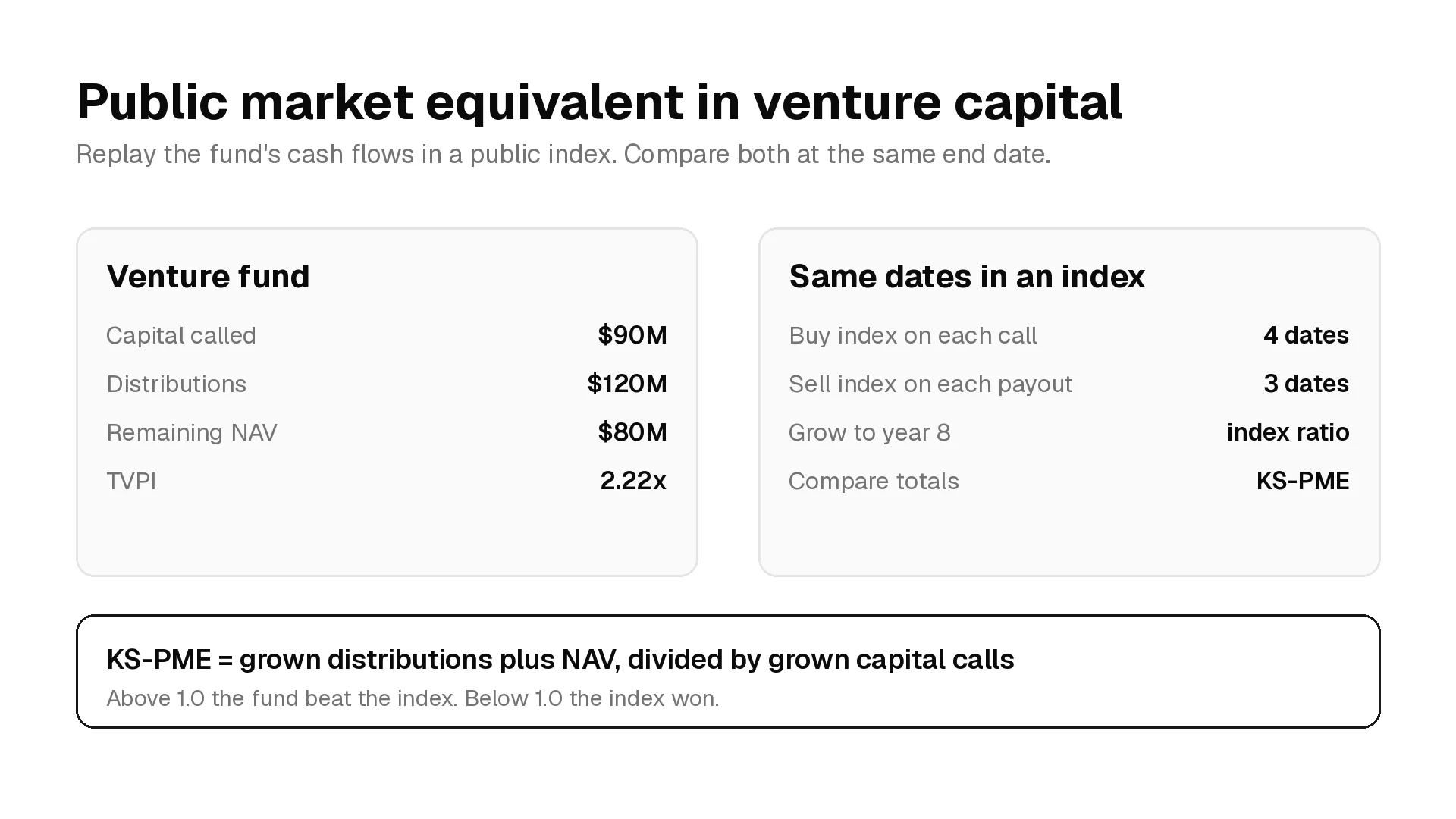
PME asks whether a venture fund beat a public index on the same cash-flow dates. A worked KS-PME and direct alpha example, five methods compared, current Cambridge Associates data, and what it means if you work at a VC firm.
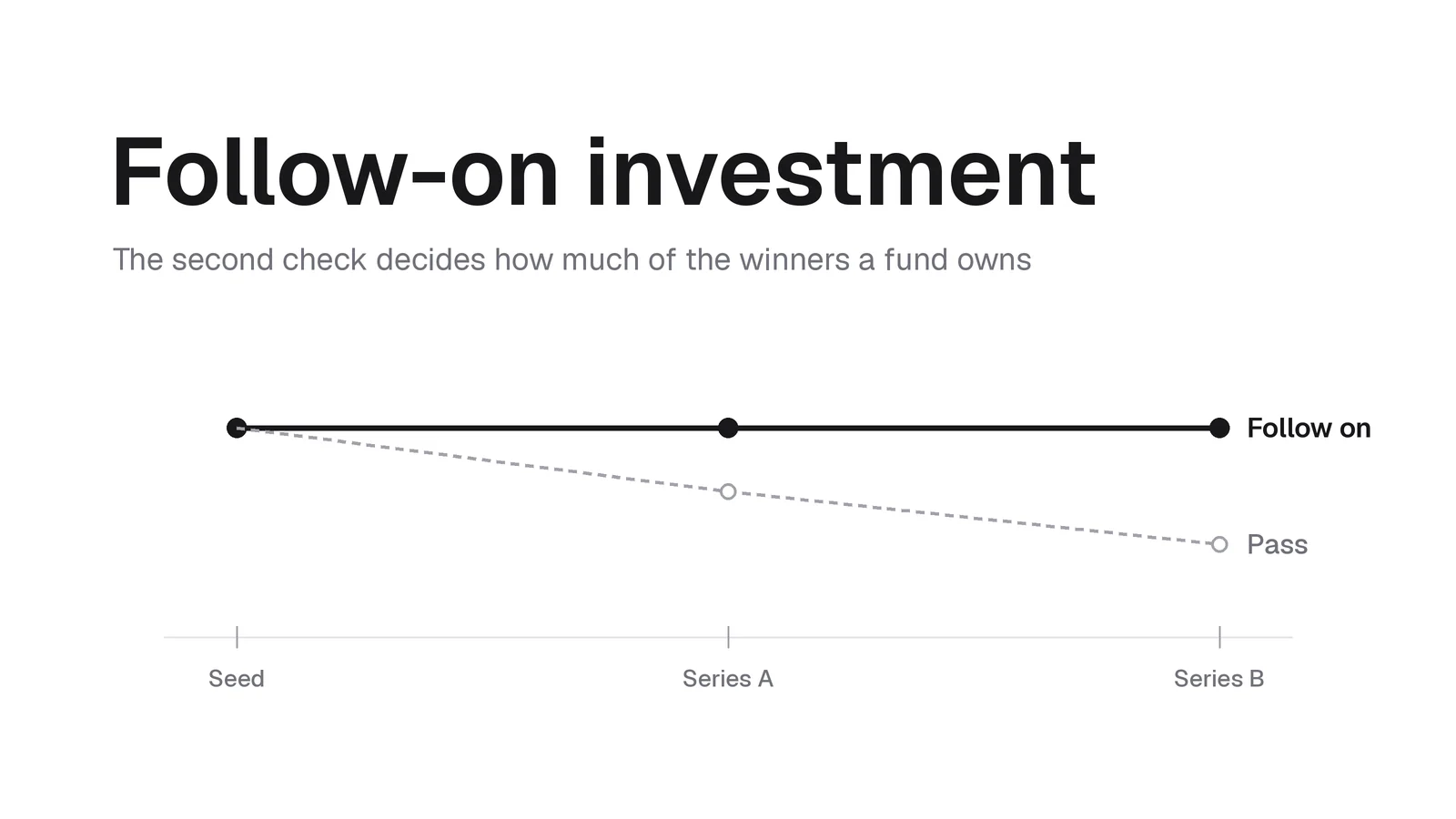
A follow-on investment is more capital from an existing investor in a company's later round. How pro rata, reserves, signaling, and the follow-on decision work, with two-round ownership math.
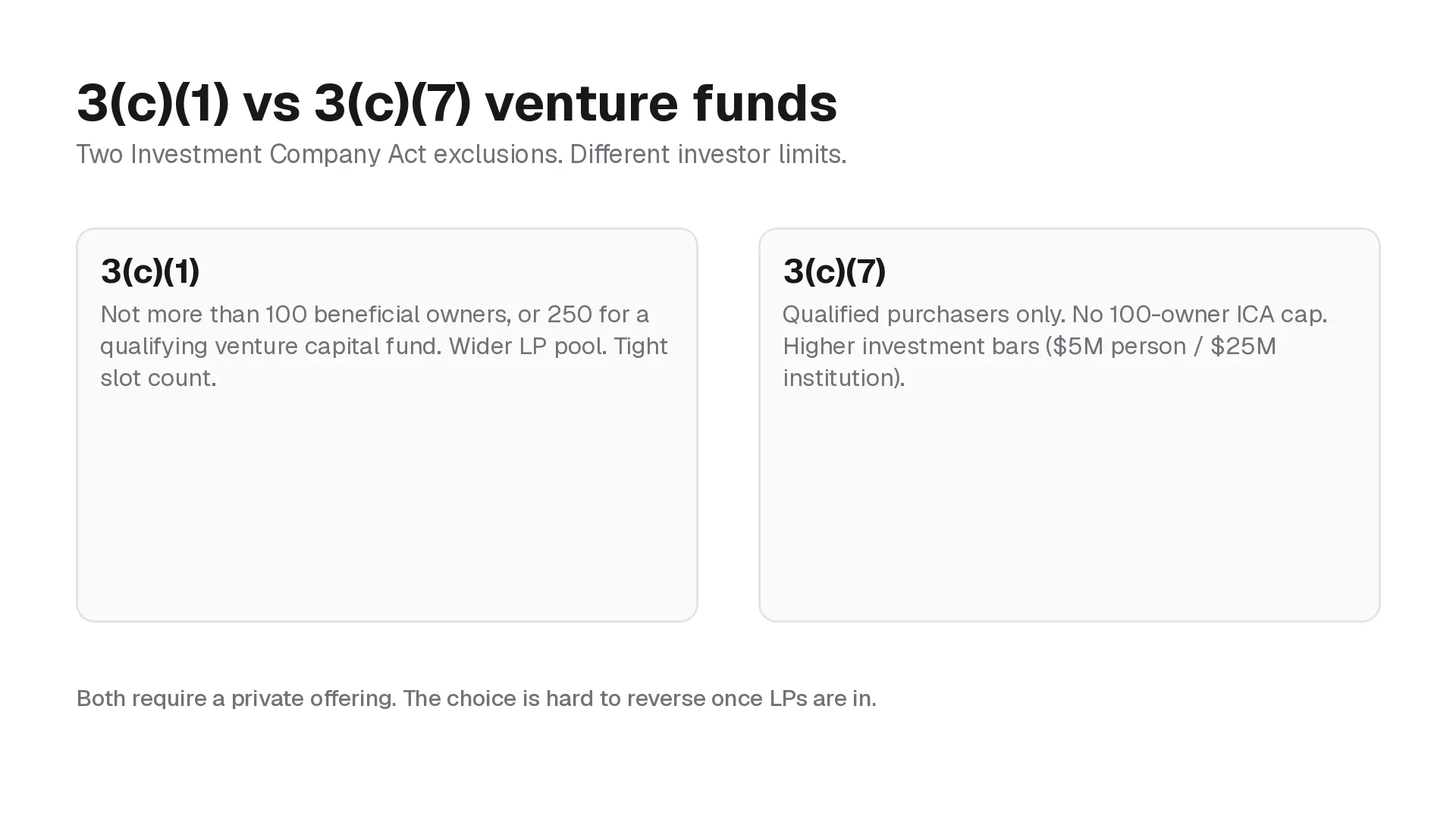
U.S. venture funds usually avoid Investment Company Act registration through 3(c)(1) or 3(c)(7). One caps how many people can own the fund. The other admits only qualified purchasers. Here is the difference, a worked slot example, and what it means for people who work at VC firms.