

A venture capital associate is usually more senior than an analyst. The more useful distinction is how the work changes: analysts primarily gather, test, and structure evidence; associates increasingly frame judgment, manage parts of the investment process, and represent the fund in external conversations.
Titles are not standardized. A small seed fund may give an analyst direct founder access and meaningful sourcing responsibility. A larger platform may call someone an associate while narrowing the role to one stage of diligence. Compare the mandate, access, outputs, and accountability before comparing labels.
Venture capital analyst vs associate at a glance
| Dimension | VC analyst | VC associate |
|---|---|---|
| Typical level | Entry-level or early-career investment role | Early-to-mid-level investment role |
| Core contribution | Produces reliable research and analysis | Turns analysis into a recommendation and keeps work moving |
| Sourcing | Builds lists, maps markets, reviews inbound opportunities, supports outreach | Develops theses and relationships, qualifies opportunities, may own a sourcing channel |
| Diligence | Collects data, benchmarks companies, analyzes markets and metrics | Scopes the work, challenges assumptions, coordinates calls, prioritizes risks |
| Founder interaction | Prepares briefs, joins calls, captures evidence and follow-ups | May lead early calls, test the thesis, and manage next steps |
| Investment memo | Builds sections, exhibits, models, and source packs | Shapes the narrative, recommendation, risks, and decision questions |
| Investment committee | Prepares materials and observes or answers factual questions | Presents parts of the case and defends a view, depending on the fund |
| Portfolio work | Tracks metrics, research, hiring lists, and requests | Coordinates projects, introductions, reviews, and follow-through |
| Autonomy | Usually works within a defined question and review loop | Owns a scoped process with senior review |
| Main development goal | Become consistently accurate, fast, and insightful | Build trusted judgment, ownership, and relationship credibility |
For deeper descriptions of each seat, compare VCC's venture capital analyst job description and venture capital associate job description.
The title is not the job
Analyst and associate titles still matter: they affect expectations, compensation discussions, and how a role appears on a résumé. But they are weak evidence of the actual seat. Fund stage, strategy, team size, and partner operating style can change the job more than the title does.
At a small pre-seed fund, a junior investor might source companies, run first calls, draft memos, and support portfolio recruiting. At a larger growth fund, the same title may emphasize market research, cohort analysis, and execution inside a bigger deal team. A corporate venture group may use titles inherited from its parent company. A solo-GP fund may collapse several levels into one role.
Use four questions to diagnose the real level:
- Mandate: Which problems are you expected to solve without being assigned each step?
- Access: Are you present for founder calls, diligence debates, investment committee, and portfolio discussions?
- Outputs: Do you contribute data and exhibits, own a complete workstream, or produce the recommendation?
- Accountability: When a process stalls or a conclusion is weak, are you responsible for fixing it?
A broad analyst role with strong decision access and frequent feedback can teach more than an associate role limited to list building. The reverse also holds: an analyst title attached to associate-level ownership without matching authority, progression, or economics may be title compression rather than a learning opportunity.
The practical rule is simple: ask for examples of work the last person in the role owned. Concrete examples expose scope faster than a polished title or generic list of responsibilities.
How the work changes from analyst to associate
The two roles often touch the same workflow. Seniority appears in how the question is framed, how much ambiguity the person absorbs, and who owns the recommendation.
| Workstream | Analyst contribution | Associate contribution |
|---|---|---|
| Market mapping | Builds the company universe, taxonomy, evidence, and data quality checks | Defines the market question, chooses segments, identifies the investable wedge, and recommends where to focus |
| Screening | Reviews decks against agreed criteria and records findings | Calibrates the screen, investigates exceptions, and decides what deserves partner attention |
| Financial analysis | Cleans data, builds scenarios, checks assumptions, and explains model mechanics | Chooses decision-relevant cases, tests sensitivities, and links the output to ownership and return questions |
| Diligence | Researches customers, competitors, founders, and market structure | Prioritizes risks, coordinates workstreams, runs calls, and updates the investment view |
| Memo | Drafts research, exhibits, comparable evidence, and model sections | Owns the argument, material risks, open questions, and recommendation |
| Sourcing | Builds target lists, tracks relationships, monitors signals, and supports outreach | Develops a thesis or channel, earns responses, qualifies companies, and maintains the relationship |
| Portfolio support | Produces metrics, research, recruiting lists, and follow-up materials | Scopes the request, coordinates stakeholders, and owns delivery of a useful outcome |
Consider the same three tasks.
Market map: an analyst may assemble 150 companies, remove duplicates, tag segments, and document sources. An associate decides whether the useful conclusion is “the category is crowded,” “one workflow is structurally underserved,” or “the thesis should be abandoned.”
Founder call: an analyst prepares the brief, captures evidence, and follows up on missing information. An associate may structure the call, probe the weakest assumption, decide whether the answer changes the screen, and communicate next steps.
Investment memo: an analyst makes the evidence auditable. An associate makes the decision legible. Both are valuable, and a strong associate cannot skip the analyst discipline underneath the argument.
The best transition is not from spreadsheets to meetings. It is from completing assigned analysis to deciding which analysis matters, what it means, and what should happen next. VCC's investment memo guide and deal-sourcing guide show those work products in more depth.
A realistic week in each role
There is no universal VC schedule. Deal activity, partner priorities, portfolio requests, events, and fundraising can reorder a week quickly. A useful comparison focuses on work patterns rather than a fictional hour-by-hour calendar.
An analyst's week might include screening inbound decks, building a sector map, updating a model, researching a founder's market, preparing an expert-call brief, and turning meeting notes into clean follow-ups. The analyst is closest to the evidence. Good performance means the team can trust the work, trace the sources, and understand the conclusion without repairing the analysis.
An associate may touch the same opportunities while carrying more coordination and judgment. The week might include leading an initial founder call, scoping customer references, reviewing the analyst's market map, drafting the investment case, aligning open questions with a principal or partner, and ensuring the team reaches a clear next decision. Good performance means ambiguity becomes an organized process rather than more activity.
That difference changes the skill mix.
| Skill | Analyst signal | Associate signal |
|---|---|---|
| Research | Finds reliable evidence and documents it cleanly | Identifies which evidence would change the decision |
| Analysis | Builds accurate, explainable work | Selects the right cases and interprets tradeoffs |
| Writing | Produces concise summaries and defensible exhibits | Creates a decision narrative with risks and a recommendation |
| Communication | Asks precise questions and closes follow-ups | Leads conversations, handles pushback, and sets next steps |
| Prioritization | Delivers defined work on time | Re-scopes work when time or evidence changes |
| Sourcing | Builds coverage and follows outreach systems | Develops credibility, relationships, and repeatable channels |
| Judgment | Flags inconsistencies and uncertainty | Takes a view while making uncertainty explicit |
Candidates can use VCC's venture capital skills guide to translate these signals into interview evidence. The important shift is not knowing more VC vocabulary. It is becoming more reliable when the question is incomplete.
How to evaluate an analyst or associate offer
When a fund offers a different title from the one you expected, do not decide from status anxiety alone. Score the actual role. Use 0 for absent or unclear, 1 for limited, and 2 for strong evidence.
| Factor | 0 points | 1 point | 2 points |
|---|---|---|---|
| Mandate | Tasks are generic or undefined | Some workstreams are named | Clear problems and outputs you will own |
| Decision access | No exposure beyond assigned work | Occasional meetings or readouts | Regular founder, diligence, IC, or portfolio access relevant to the role |
| Work-product ownership | Only list building or support | Owns sections or repeatable tasks | Owns complete analyses, memos, calls, or processes with review |
| Sourcing expectations | Vague “build a network” demand | Defined support or shared target | Clear channel, support, attribution, and success standard |
| Portfolio exposure | None despite promises | Ad hoc support | Specific portfolio workflows and examples |
| Manager and feedback | No clear manager or cadence | Informal access | Named manager, review rhythm, and examples of development |
| Progression and economics | “We'll see” | General path without evidence | Scope milestones, past examples, review timing, and clear compensation/carry discussion |
A low score does not automatically make the job bad. A tightly scoped analyst seat can be excellent if it offers rigorous training and access. The score reveals what you are actually choosing and where you need follow-up.
Ask the hiring manager:
- What did the last person in this role own after six months?
- Which meetings will I attend, and what am I expected to contribute?
- Who decides whether an opportunity advances, and what part of that decision will I own?
- How is sourcing measured, supported, and credited?
- What separates strong performance at this level from readiness for the next one?
- Can you give an example of someone whose scope expanded?
- How are title, base compensation, bonus, and any carry or long-term economics reviewed?
Be cautious when a role promises broad “investing exposure” but cannot name outputs, decision access, or a manager. Other warning signs include an undefined promotion path, a sourcing quota without infrastructure, or associate-level accountability paired with no authority. Better signs are clear work products, regular feedback, examples of progression, and access aligned with the skills you want to build.
For compensation context, use VCC's venture capital salary guide rather than assuming a title maps to one range everywhere.
Moving from analyst to associate
Promotion is not simply a reward for completing enough models or spending enough time in the seat. The underlying transition is from reliable evidence production to trusted ownership and judgment.
Use this readiness ladder:
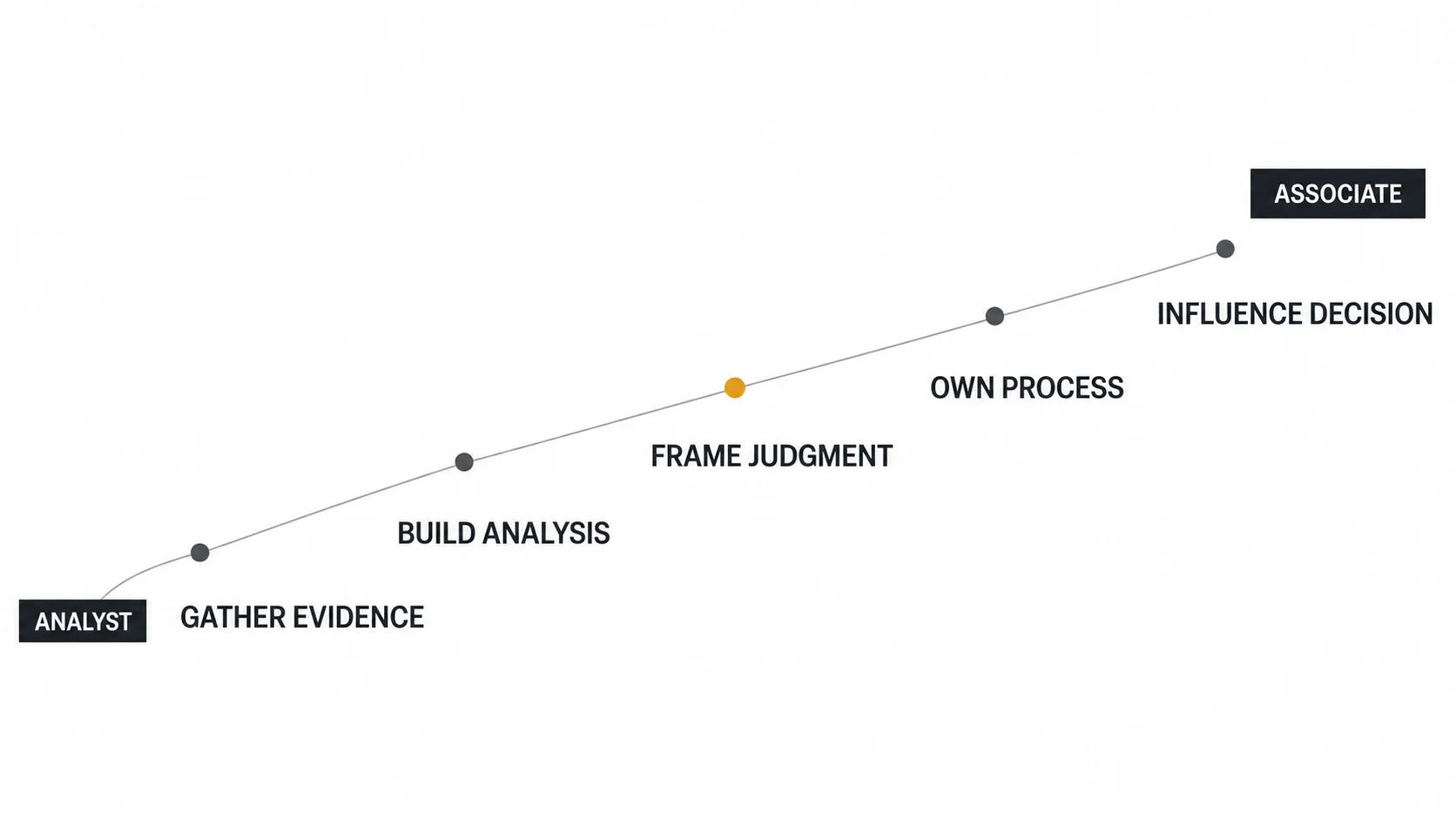
- Reliable evidence: your research, notes, and analysis are accurate and traceable.
- Independent synthesis: you explain what the evidence means without waiting for a template.
- Scoped recommendation: you take a view, identify the material uncertainty, and propose a next step.
- Owned process: you coordinate a call, diligence stream, memo, market thesis, or portfolio project through completion.
- Trusted judgment: senior investors seek your view because it improves the decision, not merely the materials.
An analyst who wants more ownership can build a 90-day development plan around that ladder. In the first month, tighten one recurring output until reviewers stop correcting basic issues. In the second, add a short recommendation and explicit open questions to the work. In the third, ask to own a bounded process—such as a market map, first-pass screen, expert-call program, or one memo section—from scope through readout.
The plan should match the fund. If sourcing drives advancement, build a specific sector or community channel. If the team values diligence, become excellent at turning noisy customer evidence into a clear risk assessment. If the fund is thesis-led, produce a market view that changes where the team spends time.
Which role fits you?
An analyst role is often the better fit when you need repeated practice, structured review, and exposure to several parts of the investment process. An associate role is a better fit when you can already produce high-quality analysis and are ready to own ambiguous work, external conversations, and recommendations.
Do not select an associate title merely to skip the learning curve. Do not accept an analyst title merely because VC seats are scarce. Compare the role against the scope you can handle now and the evidence you want to build next.
Browse current roles on the Venture Capital Careers job board and research fund strategy and team structure in the companies directory. Save the scorecard and apply it to each job description before you compare titles.
Frequently asked questions
Is associate always above analyst in venture capital?
Usually, but not universally. Many funds place associate above analyst, while small funds, corporate venture teams, and firms with imported title systems may structure levels differently. Verify actual work ownership and decision access.
Can a VC analyst source deals?
Yes. Analysts may build target lists, map sectors, attend events, review inbound opportunities, and conduct outreach. Associates are more likely to own a sourcing thesis or relationship channel and qualify opportunities independently, but the division varies by fund.
Do associates make investment decisions?
Associates often influence decisions by leading analysis, calls, diligence, and parts of the investment memo. Final authority usually sits with the partnership or investment committee. Ask whether the role presents recommendations and attends the actual decision forum.
Is an analyst title a step down from consulting or banking?
The title alone cannot answer that. Compare responsibility, compensation, learning, decision access, and future scope. A deliberate level reset can make sense when changing industries, but it should buy relevant experience—not simply reproduce junior work under a new label.
How long does it take to move from analyst to associate?
There is no universal timeline. Some funds use fixed-term analyst programs, some promote internally, and others hire associates from outside. Ask for the fund's real examples and the work-product milestones used in reviews.
Do VC associates receive carry?
Some do and some do not. Eligibility, amount, vesting, and the economic value of carry vary widely. Treat carry as a diligence topic and ask for the terms in writing rather than inferring them from the title.
Which role has better exit opportunities?
Associate roles can signal more ownership, but the quality of experience matters more than the label. Demonstrable sourcing, diligence, memo, portfolio, sector, and relationship work will be more useful than a senior title with narrow exposure. See the broader venture capital career path for adjacent routes.
Compare scope before status
Analyst versus associate is not only a hierarchy question. It is a choice about the kind of evidence, judgment, relationships, and accountability you will build.
Take the next role description you are considering and score it across mandate, decision access, work ownership, sourcing, portfolio exposure, feedback, and progression. If the hiring team cannot make those dimensions concrete, the title will not resolve the ambiguity.
When the scope is clear, compare open VC roles on Venture Capital Careers and create an account to continue your search.
Related posts
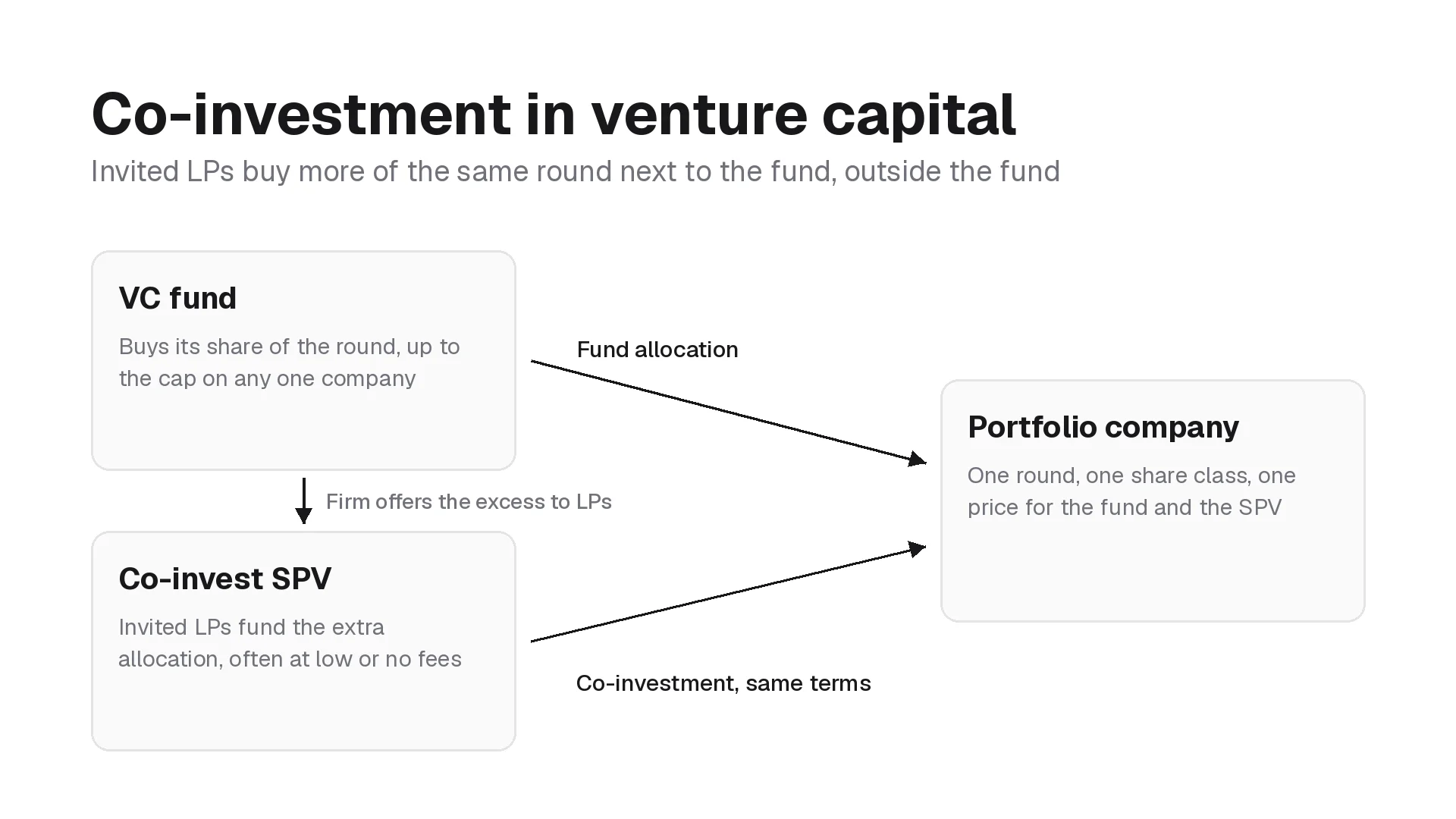
A venture capital co-investment lets LPs put money into one startup next to the fund, outside the fund, usually at lower fees. Here is how the offer works, what the terms cost, why late-stage venture co-investments carry extra risk, and what co-investment means for people who work at VC firms.
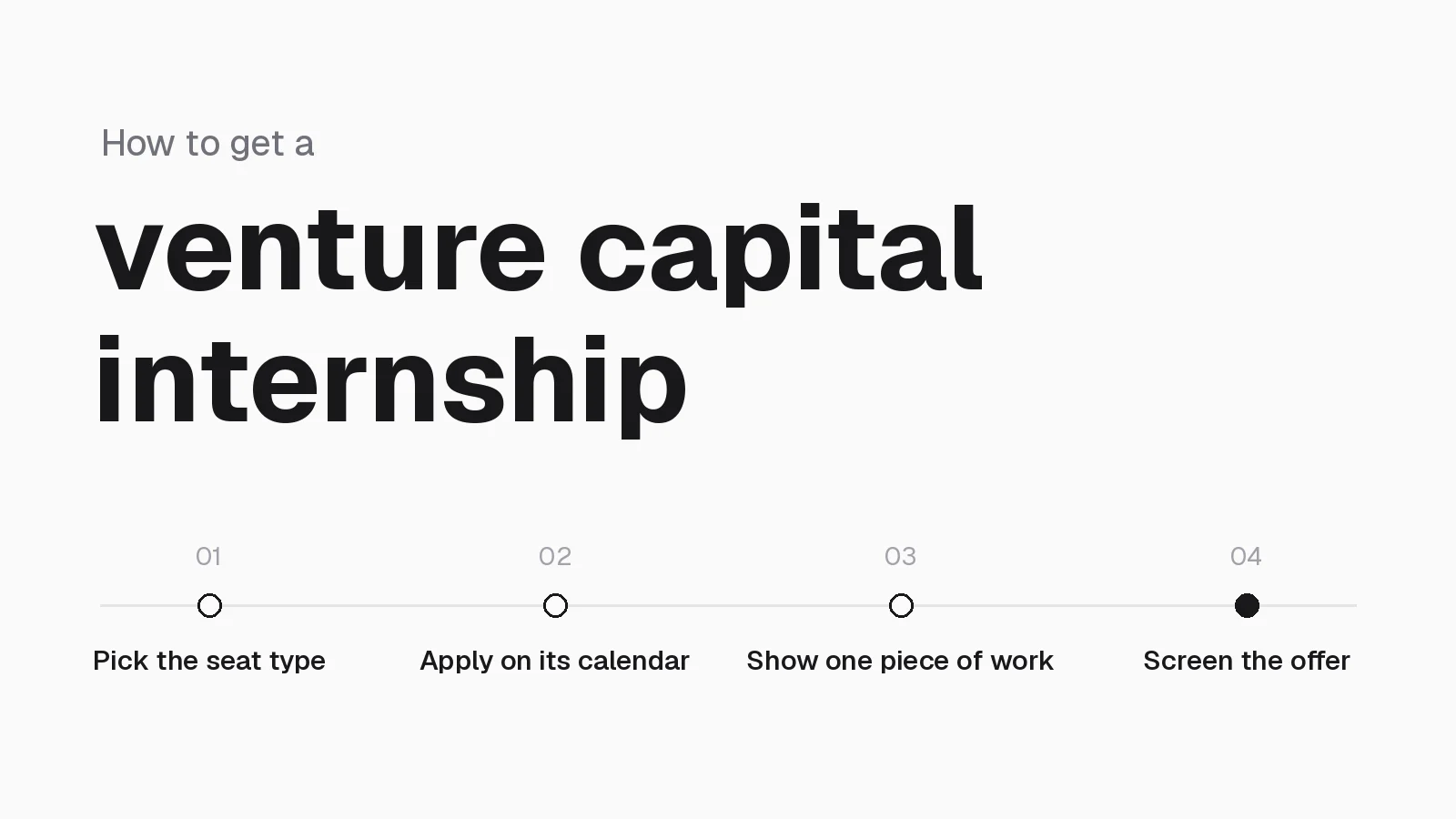
How to get a venture capital internship: the five internship types, which firms hire interns, when structured programs and small funds recruit, what interns are paid and when unpaid is legal, outreach with proof, interview questions, and how to screen an offer.
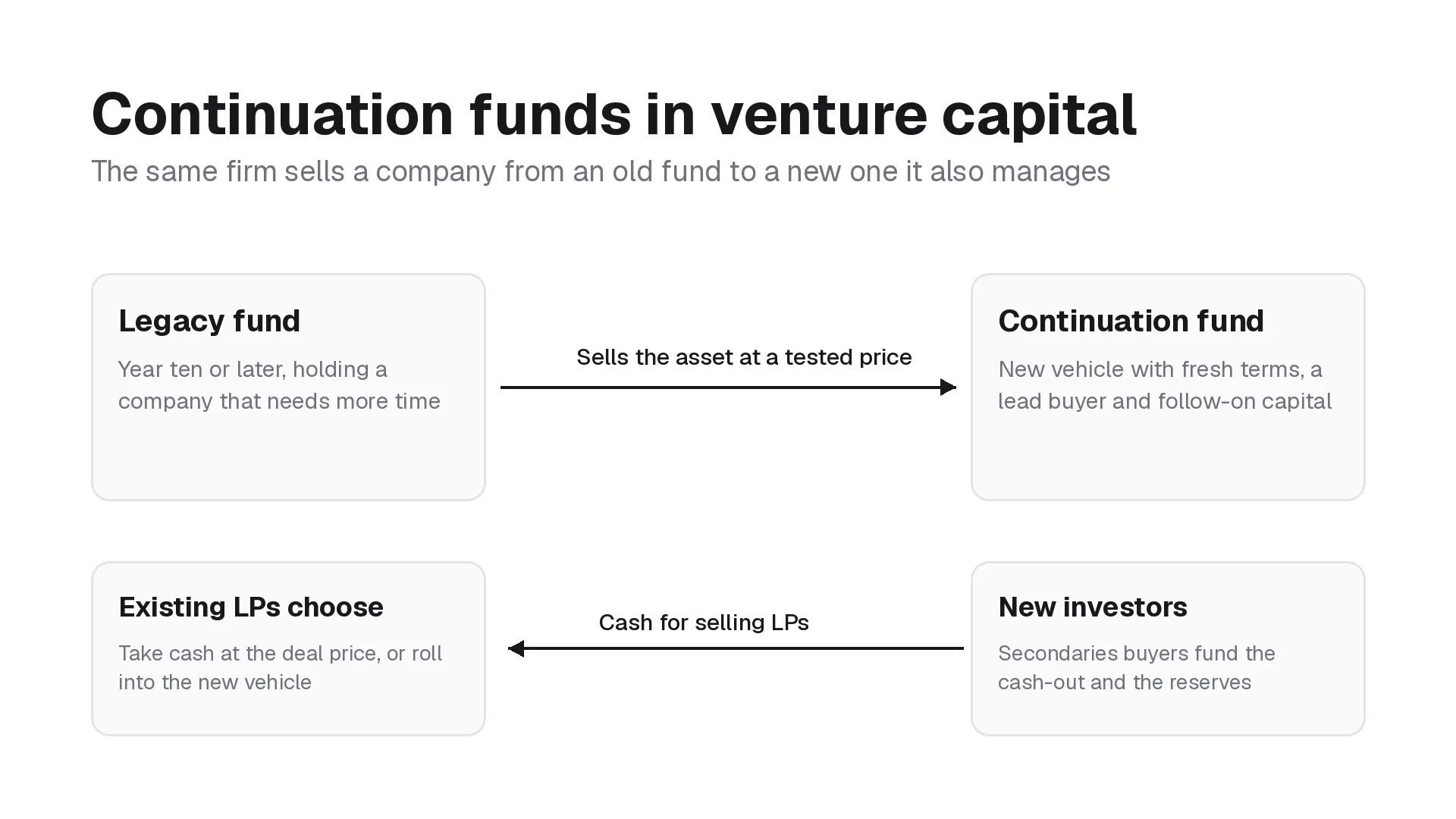
A continuation fund lets a VC firm sell a company from an old fund to a new vehicle it also manages, while LPs choose cash or a roll. Here is how the deal works, how price, fees and carry are set, and what it changes for people who work at the firm.