How to Negotiate a Venture Capital Associate Offer
A practical sequence for negotiating a venture capital associate offer, from cash benchmarks and carry documents to scope and a two-offer scorecard.
A verbal associate offer is not the close. The useful work starts after the call: you decide what is actually in the package, what is worth one clean turn, and what you should leave alone.
Use VCC's salary guide for cash ranges and the carry explainer for the instrument. Do not negotiate against a generic title average.
What you are actually negotiating
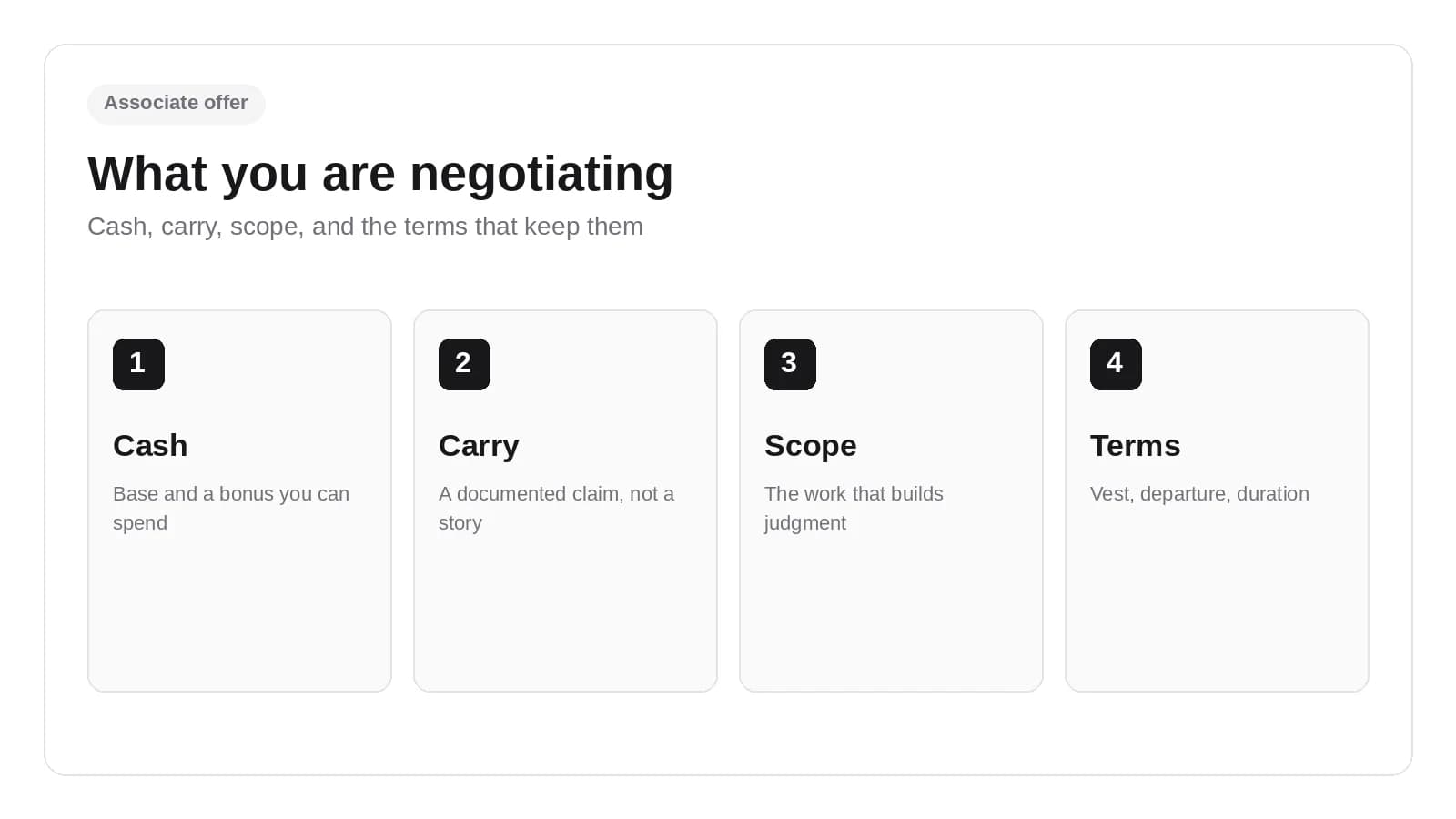
An associate offer is four conversations that firms often present as one number.
| Piece | What it is | Why it matters at associate level |
|---|---|---|
| Cash | Base salary plus a realistic bonus | This is the only money you can spend this year |
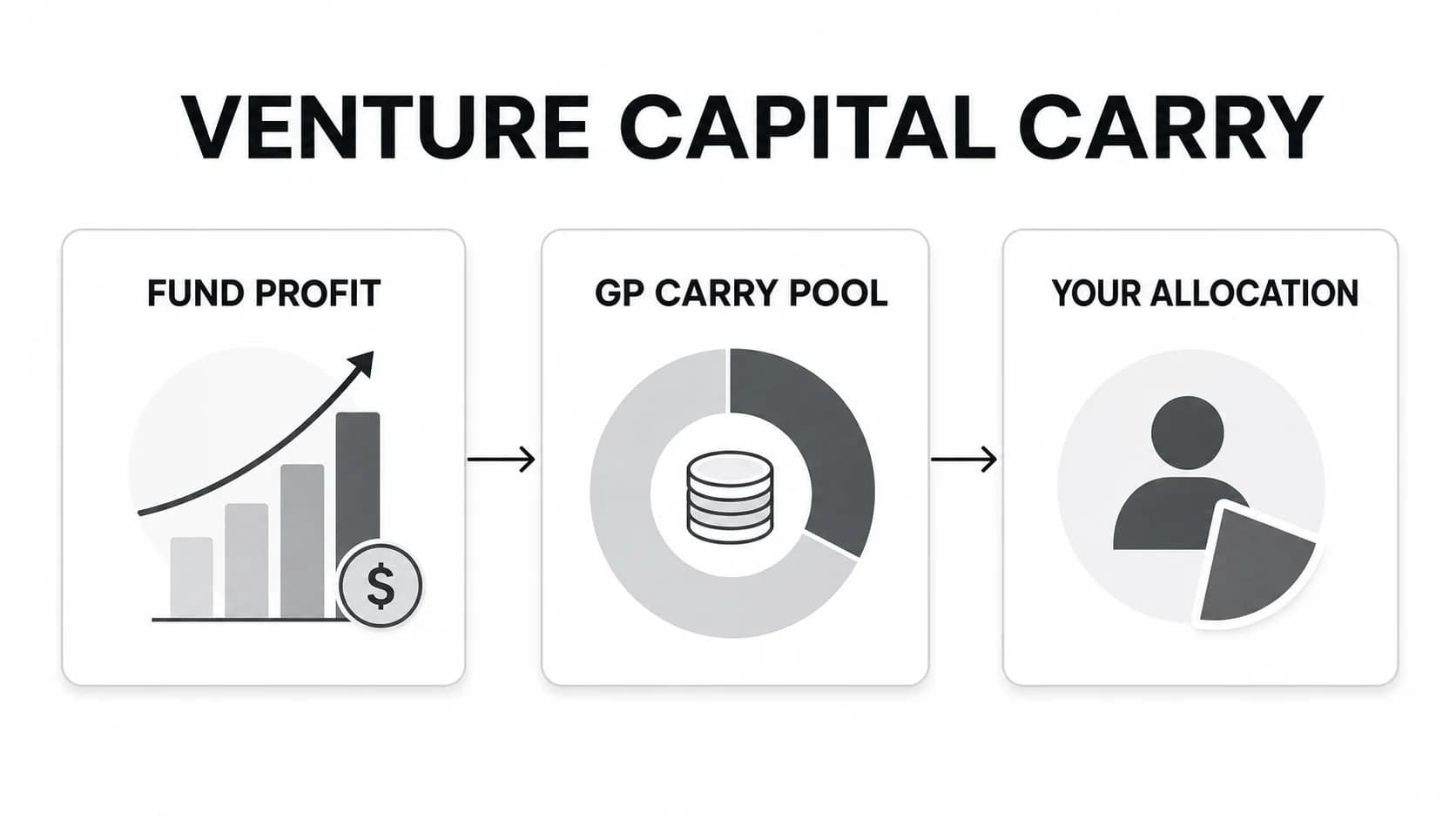
| Carry | A share of future fund profits, if any | It can be real, deferred, tiny, or oral theater |
| Scope | What you own: sourcing, memos, boards, a sector | Scope often compounds faster than a $10k bump |
| Terms | Vesting, departure, title, duration, next-fund rights | These decide whether the upside survives a move |
Many candidates negotiate against opaque labels. The fix is not a louder ask. It is a sharper package. Partner playbooks about GP commits and 5-20% pool splits do not apply here. Associate leverage is narrower, and the firm will usually give you one or two document turns before someone asks whether you want the seat.
Treat cash as the floor. Treat carry as contingent upside. Treat scope as the career term. If any of those three is vague, you do not have an offer yet. You have a conversation.
Benchmark the offer before you talk numbers
Do the homework before the verbal offer, not after. Size the firm's ability to pay from management fees and assets under management, not brand adjectives. A $800m fund and a $150m fund that both call themselves "tier two" do not have the same salary budget.
Use this order:
- Identify fund size, current fund year, stage, and city. Research the firm on the companies directory before you argue numbers.
- Separate pre-MBA from post-MBA, and investment-team from platform, before you open a survey. Title compression is the main reason public averages blow up. Public salary sites often disagree on the same title, sometimes by a wide margin.
- Compare annual cash first. VCC's salary guide is the internal benchmark. Organize the comparison by fund size and stage rather than brand adjectives.
- Put carry in a second column. If the documents are missing, value it at zero for the comparison.
- Write down the non-cash terms you actually care about: duration, promotion test, observer access, sector ownership, remote or relocation help.
Do not invent a personal "market number" from a headline median. A credible comparison sounds like: post-MBA associate, $1b multi-stage fund, San Francisco, cash plus a documented carry grant in the current fund. "Associates make $225k" is not a comparison.
If the fund is small and fee-constrained, cash may be sticky. That is not a reason to skip the conversation. It is a reason to move the conversation to carry documentation and scope.
The documents to request after a verbal offer
The offer letter is usually the summary, not the carry plan. Ask for the packet before you spend your one real turn.
Request, in writing:
- Offer letter with base, bonus target or history, title, start date, and reporting line
- Carry grant summary that names the vehicle, percentage, and denominator
- LLC or carry-plan agreement for the entity that will hold the interest
- Assignee or grant agreement that assigns your slice and states vesting
- If you are joining mid-fund, a recent capital-account or quarterly snapshot so "points" have a context
If the firm cannot send a formal agreement during the offer window, ask for a redacted plan, a written term summary, and a date when the grant will be approved. An oral percentage with no vehicle is not carry. VCC's carry guide is explicit about that distinction: quoted, granted, vested, and distributed are four different states.
Read the packet for four traps:
- The letter mentions a plan that the attachments never define.
- Vesting starts at a later committee date, not your start date.
- Departure language zeros unvested carry and is silent on vested carry.
- The grant is for a future fund that has not closed.
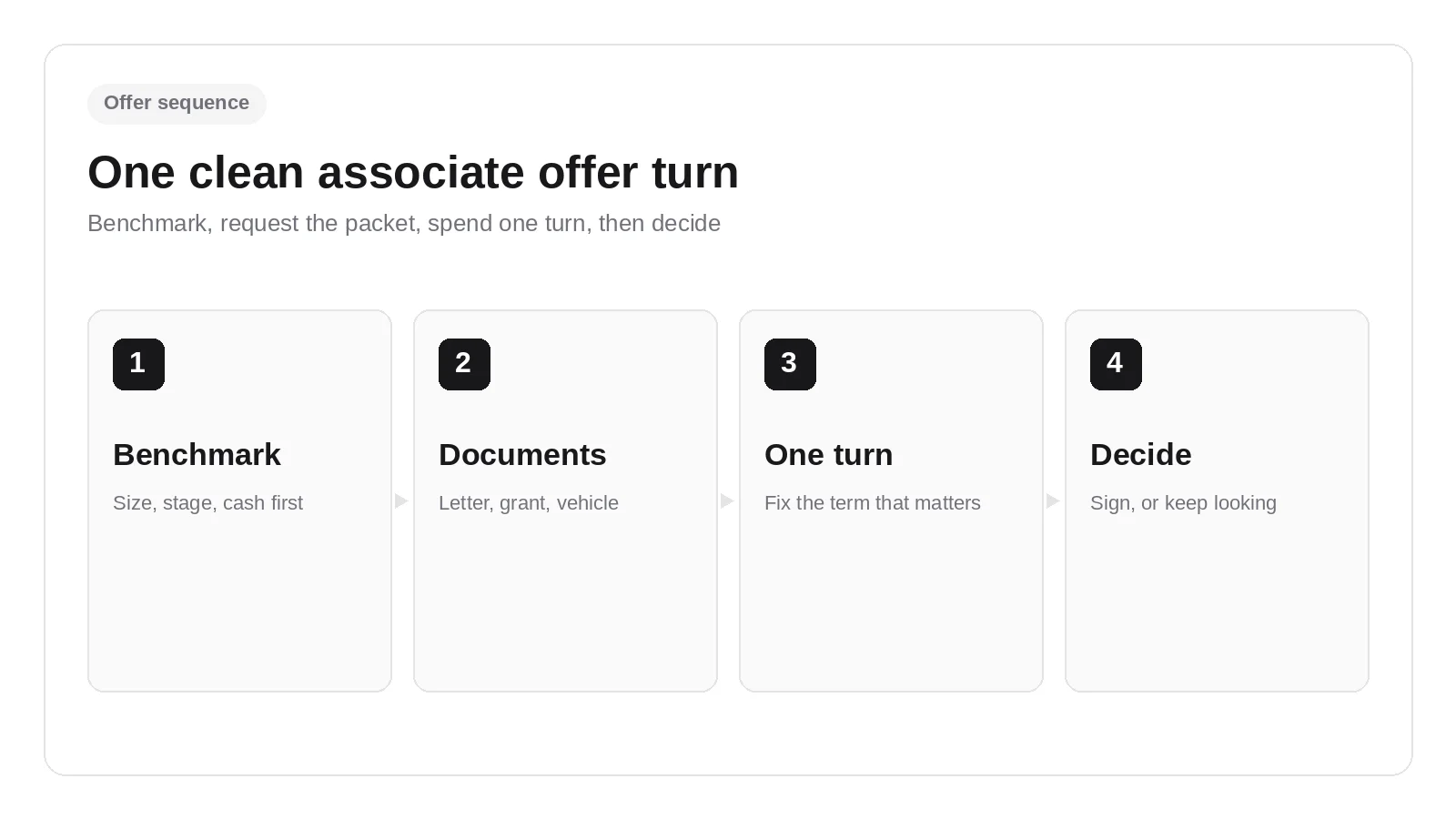
You typically get one or two turns. Use the first turn for missing documents and unclear denominators. Use the second, if you get it, for the one or two terms that change the decision.
How to negotiate cash, bonus, and timing
Cash is the easiest number to compare and the hardest one for a small fund to move. Ask from evidence, not from appetite.
A clean cash conversation sounds like this:
"I am excited about the seat. On cash, I am benchmarking against funds of similar size and stage, not a generic associate average. Is there room to move base to [number], or to make the bonus target explicit in the letter?"
If base is fixed, try the levers that do not break the fee budget:
- Write the bonus target and any guaranteed period into the letter
- Ask for a six-month cash review rather than a two-year wait
- Ask for a start-date or relocation adjustment if the city is expensive
- Ask whether a signing amount is available when the gap is about a move, not about ego
Fabricating a competing offer is a fast way to lose the seat. If you have a real alternative, say so once, in writing, with the actual constraint. If you do not, do not invent one.
Bonus language matters more than people think. "Eligible for a discretionary bonus" is not a number. "Target 20% of base, based on firm and individual performance, paid after year-end" is a number you can evaluate. If the firm has paid bonuses below target in recent years, that is part of the cash picture.
Do not spend the whole turn on a $10k base fight if the letter is silent on bonus, review timing, and carry. Those three usually change the job more.
How to negotiate carry without treating a percentage as a paycheck
The associate carry conversation is a diligence conversation first. Ask which fund, what percentage of which pool, vesting, departure, whole-fund versus deal-by-deal, clawbacks, capital contribution, and what the firm means by points.
Ask those questions even if you like the cash. Many funds will include associate carry if asked and will not volunteer the paperwork. The ask is normal. Getting annoyed at the ask is a signal.
Value the grant in three columns:
| View | What you record | How you use it |
|---|---|---|
| Headline | The percentage they said on the call | Do not compare offers with this alone |
| Documented | Vehicle, denominator, vest, departure, fund vintage | This is the only version that counts |
| Decision | A steeply discounted figure, often zero in year one | This is what you use to choose the job |
A 0.25% grant in a defined current fund, with a four-year vest and a one-year cliff, is a real term. A "you'll be in the carry pool" sentence is not. If the recruiter cannot answer the denominator question, keep the decision value at zero.
What you can often move at associate level:
- Getting a written grant in the current fund, not a handshake about Fund II
- Starting the vest on your start date
- Clarifying what happens to unvested and vested carry if you leave or the firm does not raise again
- A review of the allocation at the next fund close
What you usually cannot move: turning a tiny associate slice into principal economics. Do not use a partner-negotiation article as your script. You will sound unprepared for the seat.
Negotiate the job, not just the money
At smaller funds especially, scope is the term that changes the next three years. Sourcing ownership, a board-observer seat, and a sector lane can beat a small cash bump. That is true when the firm will actually give you those things, not just describe them.
Ask for examples, not slogans.
- When did the last associate lead a founder call alone?
- Who writes the first full memo, and who rewrites it?
- How many observer seats or portfolio projects does the current associate own?
- Where did the last five associates go, and how many were promoted?
- Is this a two-year program or a seat that can become principal?
If the answers are vague, believe the vagueness. A "partner-track" label with no promoted associates is a fixed-term apprenticeship. That can still be a good job. It is a bad job only if you priced it as a long-term ownership path.
Write the scope you care about into the follow-up email, even if the offer letter will not include every item. "I want to own the [sector] map and take the first draft of memos on deals I source" is a negotiation. "I want more responsibility" is not.
For role shape beyond compensation, use the associate job description and the analyst vs associate comparison. For whether you want the job at all, use How to get a job in venture capital.
What not to do in an associate offer conversation
These mistakes show up in bad closes.
Negotiate the title average. Never negotiate a VC offer against a generic title number.
Lead with carry theater. Asking "do I get carry?" and stopping there wastes the turn. Ask which fund and which denominator.
Spend both turns on title. Title structures often track experience. If you do not have the experience the firm maps to "senior associate," pushing the word can burn goodwill you need for documents.
Bluff. Some firms ask for written proof of a competing number. A fake offer ends the process.
Ignore fee math. A $50m emerging fund cannot copy an $8b platform cash package. If cash is tight, move to documentation, review timing, and scope.
Accept oral carry and a messy letter. If clarifying questions about carry frustrate the firm, pause. Transparency is table stakes.
Use a partner script. GP commits, key-man, and 15% pool splits are a different job.
A scorecard for comparing two associate offers
Use one page. Do not add the carry headline to year-one cash.
| Question | Offer A | Offer B | Winner |
|---|---|---|---|
| Annual cash you believe, not the bonus story | |||
| Bonus is written, with a target or history | |||
| Carry is documented for a named current fund | |||
| Denominator, vest, cliff, and departure are clear | |||
| Role duration and promotion test are specific | |||
| You will own work that builds judgment, not only lists | |||
| Last associates' outcomes are visible | |||
| The letter matches the call |
Then decide with a rule:
- If cash does not work without a heroic carry outcome, decline or keep looking. Browse open VC roles rather than stretching a broken package.
- If cash works and carry is documented, prefer the seat with clearer ownership and a real promotion or exit path.
- If cash works and carry is oral, treat the job as a cash-and-learning seat. Price it that way.
A slightly lower cash package can be rational when the fund offers documented carry, genuine deal ownership, and a visible route to principal. A higher cash package can still be a poor trade if the associate never presents a recommendation.
FAQ
How do you negotiate a VC associate offer?
Benchmark against fund size, stage, and seniority first. Compare annual cash, then diligence the carry documents, then negotiate one or two terms that change the job: a written bonus, a documented grant, review timing, or real scope. Do not spend the process on a generic title average.
Can you negotiate salary at a VC firm?
Yes, but the room depends on fee income. Larger funds and post-MBA seats usually have more cash flexibility. Smaller funds often hold base and move on bonus language, review timing, carry paperwork, or scope.
Do VC associates get carry, and can you ask for it?
Sometimes. Carry becomes more common at associate than at analyst, and it is often small, deferred, or missing. Asking whether the role includes a grant, and requesting the vehicle and vesting in writing, is a normal offer question.
What documents should you request after a verbal VC offer?
Ask for the offer letter, the carry grant summary, the carry-vehicle agreement, and the assignment or grant document. If you are joining mid-fund, ask for a recent capital-account or quarterly snapshot so the grant has context.
How many times can you turn a VC offer?
Often once, sometimes twice. Use the first turn to fix missing documents and unclear terms. Use the second, if it exists, for the one change that would make you sign.
Should you take a lower-cash associate offer for better experience?
Yes, when the cash still works for a year and the seat offers ownership, mentorship, and a documented path. No, when the firm wants you to treat undefined carry as current pay.
What is the difference between evaluating an offer and negotiating one?
Evaluation is deciding whether the package is coherent. Negotiation is asking for a specific change. Do the first before the second. Use the salary guide and carry guide to evaluate the package, then negotiate the one or two terms that change the job.