
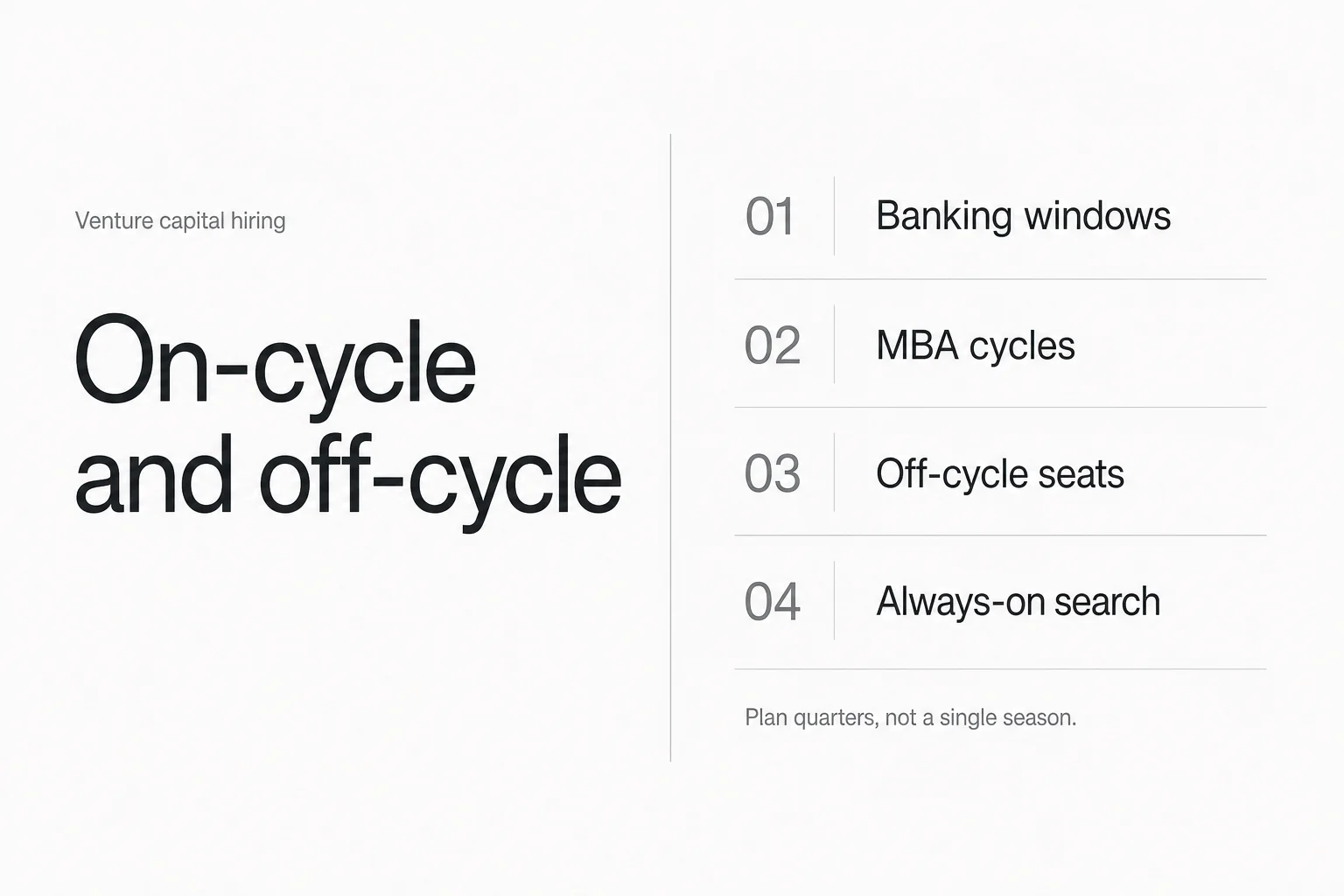
Venture capital recruiting does not run like investment banking campus season. Most funds hire when a seat opens, a fund closes, or a partner finally has bandwidth—not on a fixed annual clock. A useful timeline is therefore not a single national calendar. It is a set of tracks: on-cycle processes at some multi-stage and growth firms, and off-cycle, relationship-driven hiring everywhere else.
If you plan as if there is one “VC recruiting week,” you will miss months of quiet work that actually produce offers. If you plan as a continuous system—proof-of-work, targeted outreach, and rapid response when a role appears—you match how funds actually hire.
For the full break-in operating system (paths, artifacts, interviews), use how to get a job in venture capital. This page is the timing layer: when to push, when to build, and how calendars differ by background.
On-cycle vs off-cycle VC recruiting
| Track | Who runs it | When it tends to move | What it feels like | Who it fits |
|---|---|---|---|---|
| On-cycle / structured | Larger multi-stage platforms, some growth equity shops, a minority of brand funds with formal associate programs | Often aligned with banking/PE windows (varies by firm and year—watch your network, not a rumor spreadsheet) | Applications, headhunters, compressed interviews, clearer deadlines | Bankers, pre-MBA associates, some consultants |
| Off-cycle / unstructured | Most seed and early-stage funds, many sector specialists, most lean teams | Anytime a need appears; often after fundraise, departure, or thesis expansion | Slow relationship build, then sudden urgency | Operators, founders, domain experts, many MBAs, career switchers |
Practitioner guides consistently describe pure early-stage hiring as closer to off-cycle PE: network-driven, informal, and variable in length—from a few weeks when a firm is desperate to many months when it is not.
Rule of thumb: assume you are in off-cycle mode unless a specific firm tells you otherwise. Treat any on-cycle process as a bonus sprint, not your only plan.
Timeline by background
Investment banking / PE → VC
| Window | Focus |
|---|---|
| Months −9 to −6 | Pick stage/sector fit; rebuild resume for judgment and domain, not chore lists; start light outreach |
| Months −6 to −3 | Watch for structured growth/VC processes; run parallel off-cycle outreach to early-stage funds that match your edge |
| Peak sprint | When a process opens, clear your calendar—interview loops can compress |
| Always-on | Keep a thesis, market map, and 2–3 memos ready; off-cycle seats ignore banking calendars |
Deeper transition notes: investment banking to venture capital.
MBA → VC
| Period | Focus |
|---|---|
| Pre-MBA / summer before | Positioning statement; target fund list; first thesis draft |
| MBA1 fall–spring | Clubs, student funds, founder projects; alumni coffee with a point of view |
| Internship cycle | Treat a fund internship as evidence, not a trophy—own real work |
| MBA2 | Full search: on-cycle where relevant + continuous off-cycle; fallback roles that still build a VC edge |
MBA-specific playbook: MBA to venture capital.
Operators, founders, and domain experts
There is rarely a single “season.” Expect:
| Phase | Duration (typical) | Work |
|---|---|---|
| Exploration | 1–3 months | Fund map, thesis, first founder conversations |
| Signaling | Ongoing | Public or private proof: maps, memos, helpful intros |
| Relationship lag | Often 2–10+ months at a given firm | Repeated usefulness before a seat exists |
| Active loop | 2–8 weeks when a role opens | Interviews, case/memo, references |
Your calendar is relationship latency + readiness, not a campus OCR date.
Internships
Internship recruiting is more seasonal at larger platforms and more ad hoc at small funds. Start outreach one to two cycles earlier than you think, and keep a live view of openings on the VC job board rather than waiting for a single posting wave.
A realistic 6–12 month search calendar
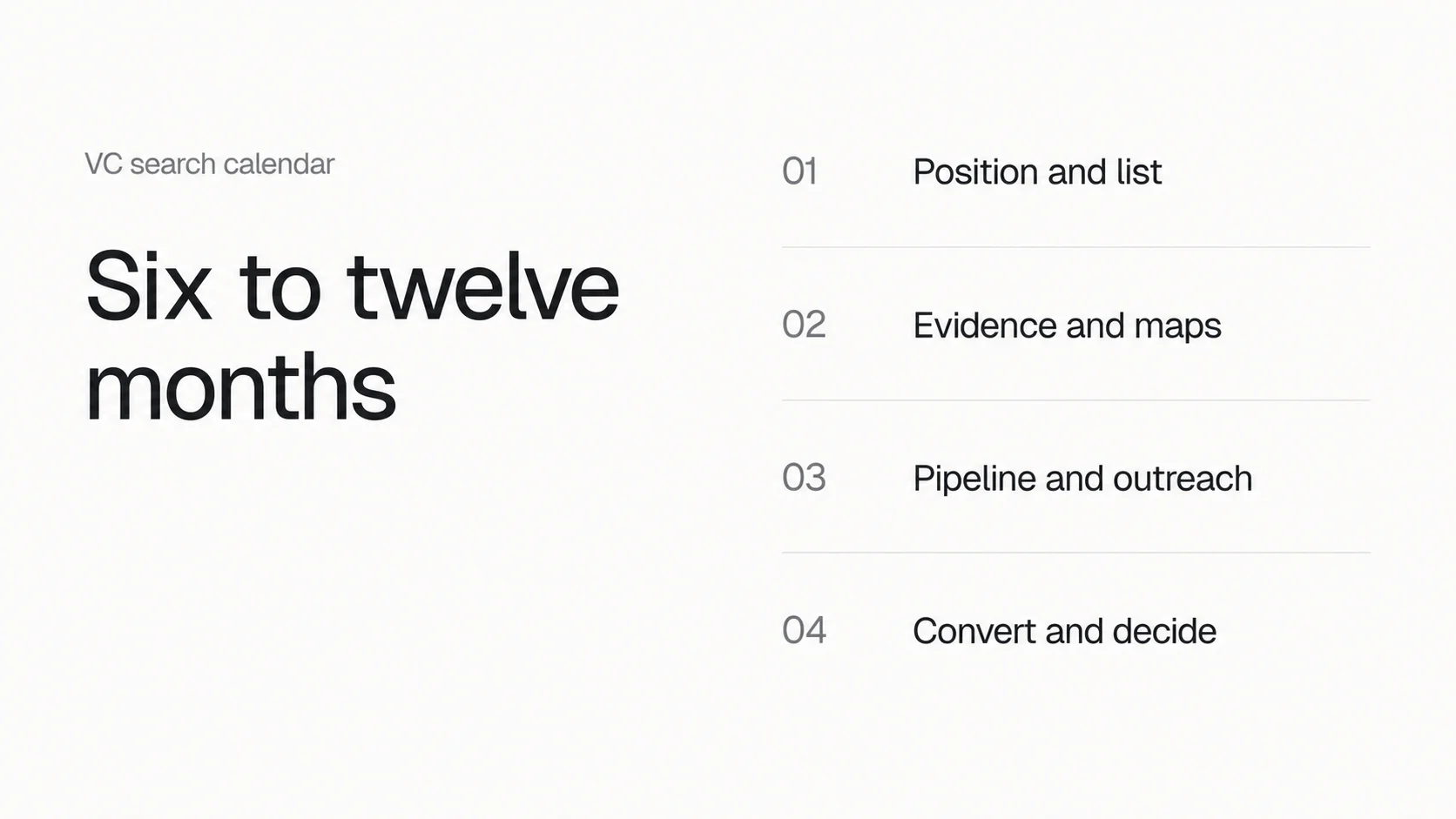
| Months | Primary objective | Output you should hold |
|---|---|---|
| 0–1 | Positioning | Track choice, 20–40 fund list, one-page thesis |
| 1–3 | Evidence | Market map, two memos, weekly founder or expert notes |
| 2–6 | Pipeline | Steady outreach, intros, first interviews |
| 4–9 | Conversion | Loops, cases, references; double down on responsive segments |
| 6–12 | Decision | Offer comparison, or revise track (e.g. platform vs investing) |
Many serious searches take one to several quarters alongside a full-time job. Faster outcomes happen when evidence and network were already strong.
What to do in “dead” months
Slow hiring is not a pause button. Dead months are when you become hireable.
Weekly rhythm (example)
| Block | Time | Work |
|---|---|---|
| Research | 2h | Fund notes, market map updates |
| Sourcing reps | 2h | Companies + one-line “why interesting” |
| Outreach | 2h | Value-first notes and follow-ups |
| Applications | 1–2h | Live roles the week they appear |
| Materials | 1–2h | Memo, resume, case prep |
Metrics that matter: artifacts shipped, conversations booked, intros earned—not only messages sent.
Interview prep when loops appear: venture capital interview questions.
Where roles show up on this timeline
| Channel | Timing behavior | How to use it |
|---|---|---|
| Warm network | Continuous | Help first; ask when you have a sharp fit story |
| Firm career pages / partner posts | Spiky | Check weekly during active search |
| Niche boards | Spiky | Venture Capital Careers + job boards guide |
| Headhunters | Mostly structured seats | Respond fast; still run your own off-cycle book |
| Firm research | Continuous | Companies directory before every serious conversation |
Set alerts via sign up so off-cycle postings do not depend on you refreshing the homepage.
How to use a timeline without becoming rigid
- Pick a primary track (on-cycle eligible vs pure off-cycle).
- Run the always-on system every week regardless of postings.
- Sprint when a real process opens—clear time, prepare cases, follow up cleanly.
- Reassess quarterly: stage, sector, geography, investing vs platform.
- Evaluate seats on learning and ownership, not logo alone—see hours and culture notes in venture capital hours and the broader career path.
FAQs
Is there a single VC recruiting season?
No. Some firms run structured processes; most early-stage hiring is year-round and relationship-led.
How long does VC recruiting take?
From a few weeks (urgent backfill) to many months (no open seat yet). Plan in quarters.
Should I wait for on-cycle if I am a banker?
Run on-cycle where you are competitive and keep an off-cycle book. Do not idle between processes.
When should operators start?
As soon as you can ship proof-of-work. Relationship lag is the long pole—not the application form.
Do internships follow the same timeline?
Larger platforms are more seasonal; small funds are opportunistic. Start early and watch live postings.
Next steps
- Choose your track and write a one-page thesis this week.
- Build a 20–40 fund list in the companies directory.
- Turn on alerts and scan open roles on Venture Capital Careers via sign up.
- Run the weekly rhythm for 90 days before you declare the market closed.
- When interviews hit, use the interview questions drill set—and keep the break-in guide as your full system.
Venture capital hiring rewards people who are ready when a scarce seat appears. The timeline is not a single date on a poster. It is a calendar you control: build in the quiet, sprint in the noise.
Related posts
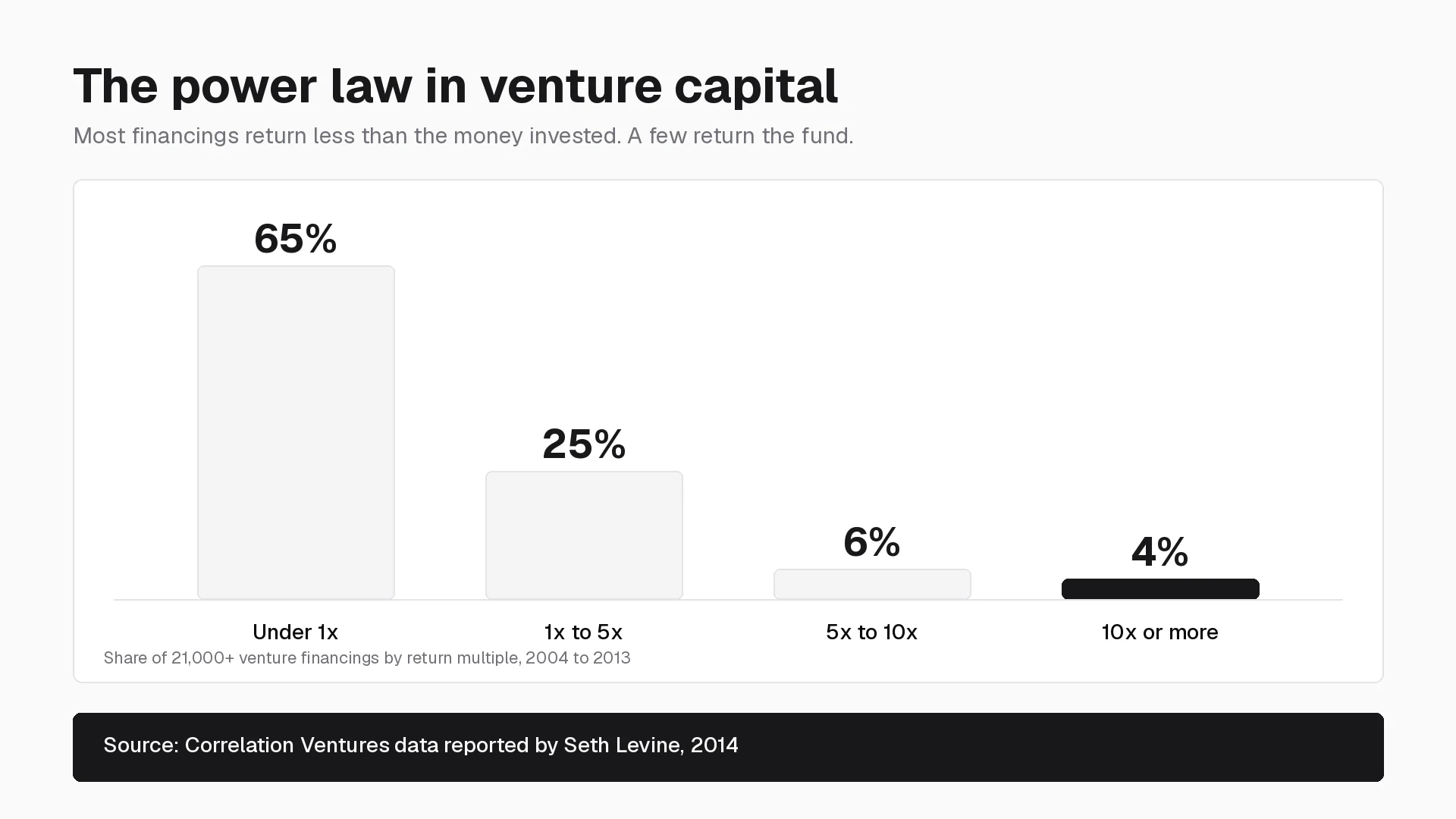
The power law in venture capital explained with primary data, a fund-returner grid by fund size and ownership, and what it changes in VC sourcing, screening, carry, and interviews.
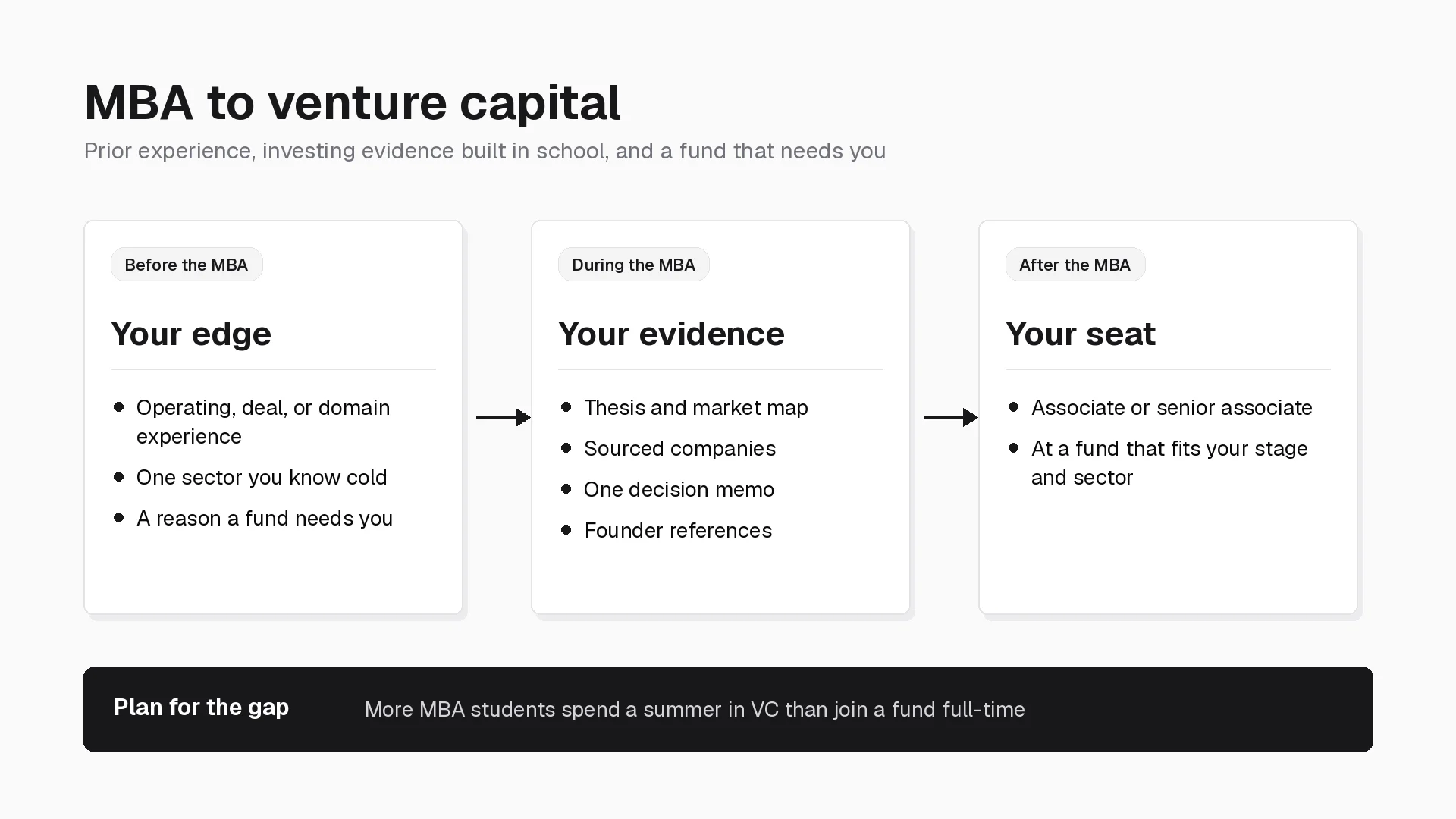
How to move from an MBA to venture capital: what employment reports show about VC placement, how to judge a program, why summer VC internships outnumber full-time offers, and a two-year recruiting plan.
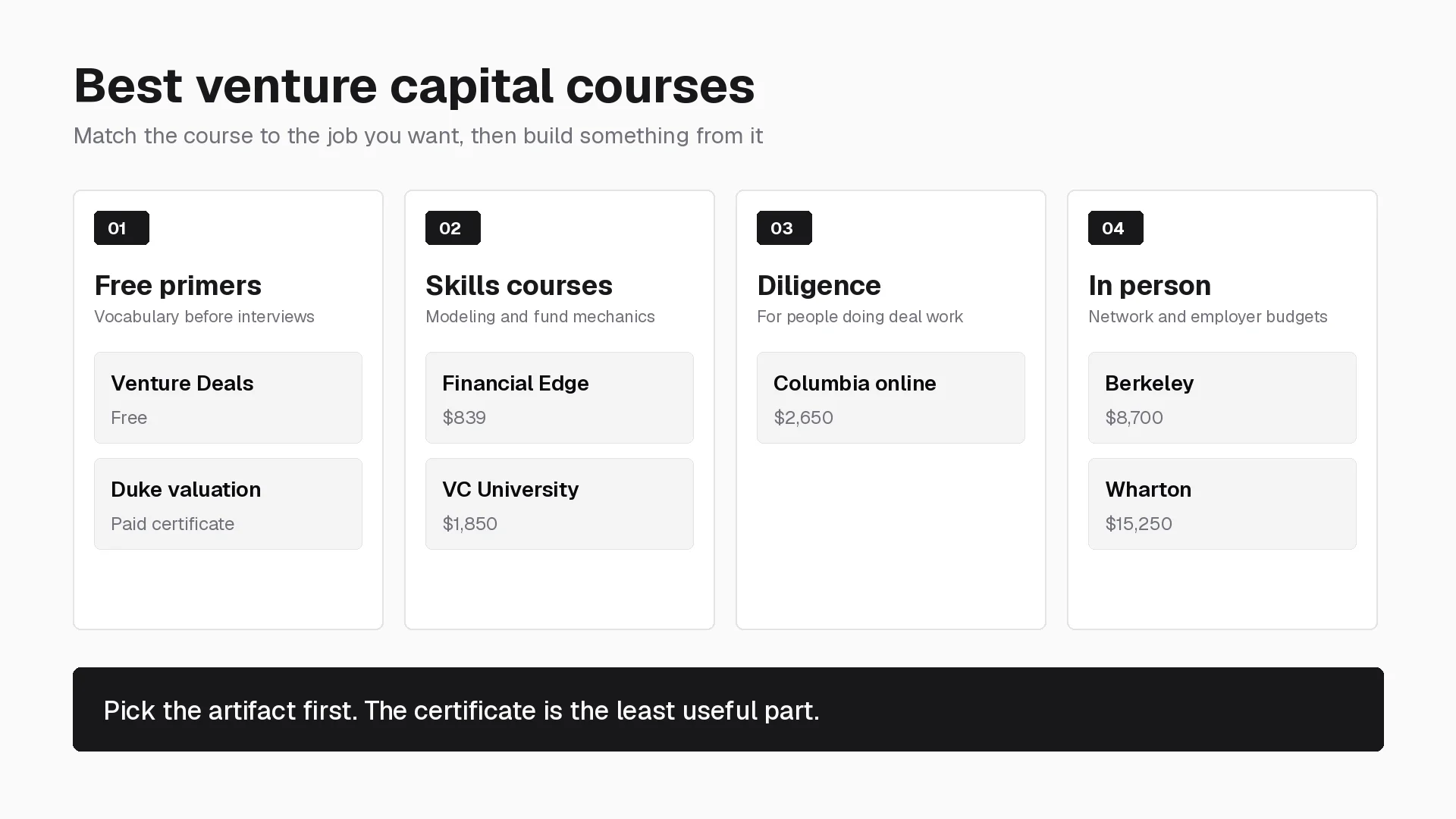
Seven venture capital courses compared on price, length, and format, with the role each fits and the artifact to build so the course helps in VC interviews.