
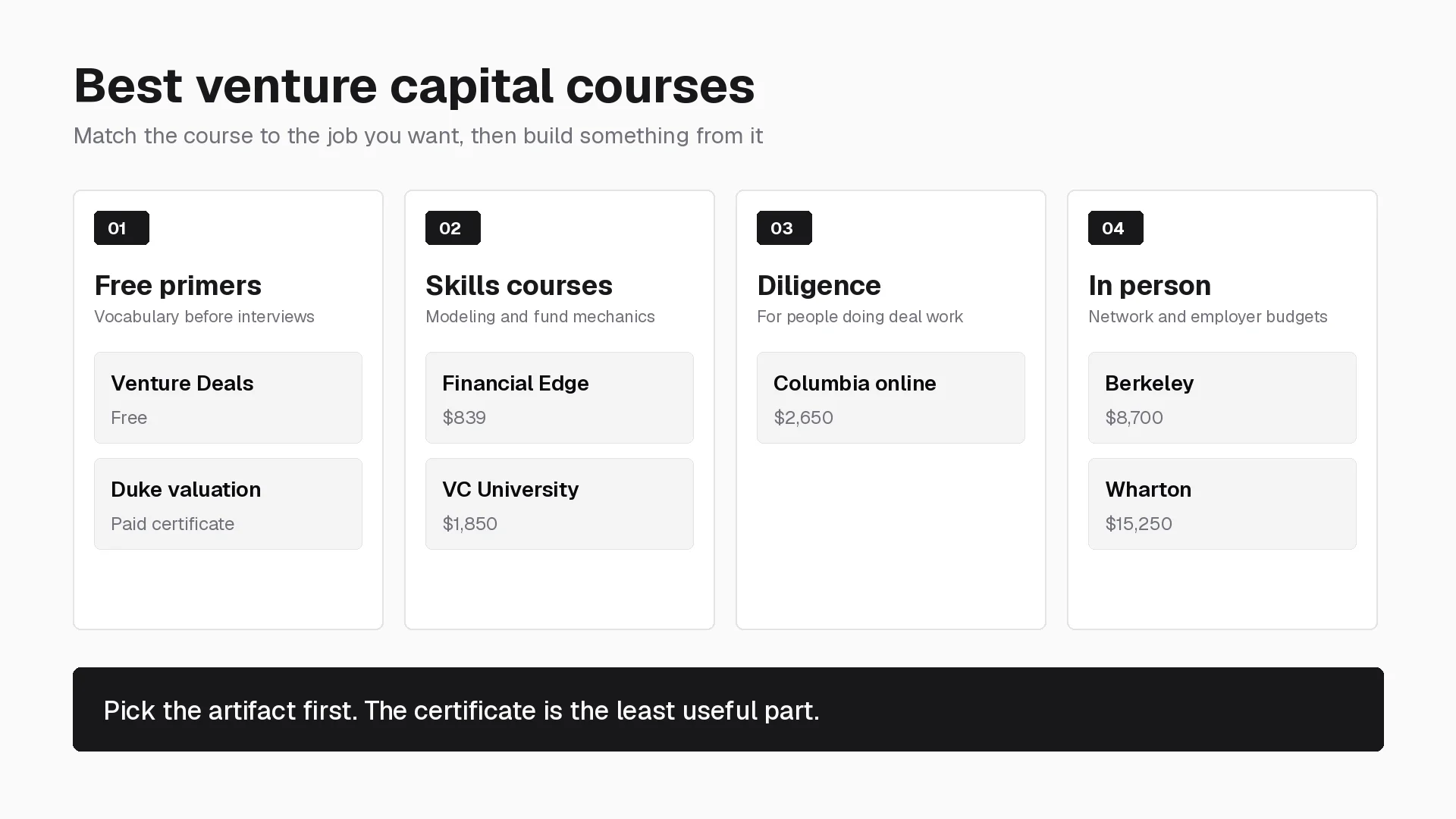
The best venture capital courses for someone chasing a VC job are the ones that leave you with work you can show. A cap table you built. A term sheet you can explain line by line. A diligence memo on a real company. For most candidates that means starting with the free Venture Deals course, adding one structured course such as VC University Online or Financial Edge's Venture Capital Associate, and treating the $8,700 to $15,250 executive programs as something an employer pays for or a deliberate network purchase.
No course is required to get hired. Many investors came in through banking, consulting, operating roles, or founding a company, and firms test what you can do in the modeling test, the case study, and the memo. A good course shortens the path to passing those tests. A certificate on its own does not.
Prices, formats, and dates below come from each provider's own page, checked on October 5, 2026. Re-check before you pay, because executive education pricing changes between cohorts.
The best venture capital courses at a glance
| Course | Provider | Format | Published length | Listed price | Best for |
|---|---|---|---|---|---|
| Venture Deals | Techstars with Kauffman Fellows | Online, self-paced, six-week window | 30 lessons, 3.5 hours of video | Free | Deal-term vocabulary before interviews |
| Startup Valuation Methods | Duke University on Coursera | Online, self-paced | About 7 hours | Paid certificate; free trial may be offered | Valuation basics and the VC method |
| VC University Online | Startup@BerkeleyLaw, NVCA, Venture Forward | Online cohort, self-paced with live office hours | About 20 hours over a 10-week schedule | $1,850; $1,500 early-bird | Career switchers who want structure and a network |
| The Venture Capital Associate | Financial Edge | Online, self-paced | 61.5 hours, 306 exercises | $839 single course | Modeling test prep |
| Venture Capital: Due Diligence (Online) | Columbia Business School Executive Education | Online, instructor-led | Seven-week cohort | $2,650 | Diligence reps for junior investors |
| Venture Capital Executive Program | Berkeley Executive Education | In person, Berkeley | 5 days, 9 hours a day | $8,700 | Meeting Bay Area investors in person |
| Venture Capital | Wharton Executive Education | In person, Philadelphia | 6 days | $15,250 with lodging and meals | Working investors with employer funding |
Cost per published hour is a useful sanity check where providers publish hours. Financial Edge works out to about $14 an hour of content. VC University Online is about $93 an hour at the general rate and $75 at early-bird. The Berkeley program is about $193 per classroom hour. You are paying very different prices for very different things, so decide what you need before you compare.
How we chose these courses
Every course here had to pass three tests.
- It teaches the investor's job. Most "best venture capital course" lists are full of founder courses about pitch decks and raising a seed round. Those help founders. They do not help you pass a VC interview. If a course's promised outcome is raising money, it is not on this list.
- The provider publishes its format and price. We only list figures we could read on the provider's own page.
- It can produce an artifact. A course earns its place when it gives you something to bring to a networking call or an interview: a model, a valuation, a memo, an annotated term sheet.
We left out private equity certificates that treat venture as a side module, and fund-formation programs built for people launching their own fund. Both are fine products for other goals. Fellowships are a separate decision; see our guide to the venture capital fellowship.
Venture Deals: best free primer on deal terms
Venture Deals is a free online course from Techstars and Kauffman Fellows, based on the book by Brad Feld and Jason Mendelson. It runs 30 lessons with about 3.5 hours of video. Content stays open for six weeks from the course's opening day, so enroll when you can finish it.
It covers the people in the venture ecosystem, what sits inside a venture fund, valuation, cap tables, term sheet economics and control provisions, and negotiation. It is built for founders, which is a feature here. You learn the terms from the side of the table you will be pitched from.
Two limits. There is no statement of completion, so there is nothing to put on a resume. And the content is introductory. Use it to get fluent before interviews, then go deeper on term sheets and the cap table interview.
Startup Valuation Methods: best low-cost valuation basics
Duke's Startup Valuation Methods on Coursera is a five-module, roughly seven-hour course rated intermediate. It walks through discounted cash flow in Excel, adjusting for a startup's probability of failure, the VC method, term sheets, option pools, anti-dilution, and the securities angels use, including capped conversion prices.
The certificate requires the paid certificate option, and Coursera says financial aid is available in select programs. Enrolling also places you in Duke's Entrepreneurial Finance specialization, though this one course is the part that matters for VC recruiting.
Take it if valuation is your weakest area. Then practice the venture capital method on a company that recently announced a round.
VC University Online: best structured course for career switchers
VC University Online comes from Startup@BerkeleyLaw, the National Venture Capital Association, and Venture Forward. It is the most complete course on this list for someone changing careers who wants both content and people.
The course has five modules: venture fund fundamentals, startup fundamentals, venture deal fundamentals, modeling venture deals with cap table exercises, and advanced topics that include venture capital careers. Expect about 20 hours of content on a recommended 10-week schedule, with five months of platform access. Cohorts get weekly live office hours for the first 8 to 10 weeks, monthly webinars, three months of PitchBook access, a Slack community for current and past cohorts, and a mentorship program that starts partway through the cohort.
Cohort 24 begins February 1, 2027. Early-bird tuition is $1,500 from December 14, 2026 through January 6, 2027, and general tuition is $1,850 after that. UC Berkeley alumni, NVCA members, and nonprofit and government employees can take one 20% discount. The program reports more than 810 full scholarships awarded, and the scholarship window for Cohort 24 runs October 7 to 14, 2026. If cost is the obstacle, apply for the scholarship before anything else on this page.
The Venture Capital Associate: best for modeling test prep
Financial Edge's The Venture Capital Associate is a self-paced micro-degree with 61.5 hours of content, 52 topics, 306 practical exercises, and five exams. The single-course price is $839 with lifetime access. Financial Edge also sells annual subscriptions to its full library.
The VC-specific modules are the reason to buy it. They cover LP and GP economics, carried interest and distribution waterfalls, cap tables across funding stages with down rounds and liquidation preferences, SAFEs versus convertible notes, SaaS operating models and metrics, VC valuation, and fund returns.
A large share of the hours is general accounting and three-statement modeling. That is useful if you are an engineer, operator, or designer without finance training. If you are a banker, skip ahead to the deal, cap table, and valuation sections. Then use our venture capital modeling test guide to rehearse under time pressure.
Columbia VC Due Diligence: best for diligence reps
Columbia Business School's Venture Capital: Due Diligence (Online) is led by Angela Lee, founder of the angel network 37 Angels. The listed price is $2,650 for the March 18 to May 6, 2027 cohort.
The six modules follow a people, problem, progress, and price framework, then add diligence on a venture fund and a closing module on lessons in diligence. The fund module is the unusual part for job seekers. Columbia describes it as diligence on a fund from two angles, as a limited partner and as a potential employee. That is exactly the work you should do on any firm before you accept an offer.
This course fits best once you are already doing deal work, as a scout, fellow, analyst, or new associate. Pair it with our venture capital due diligence checklist.
Berkeley Venture Capital Executive Program: best in-person network
The Venture Capital Executive Program at UC Berkeley is five in-person days, nine hours a day, for $8,700. Listed dates are November 2 to 6, 2026 and April 12 to 16, 2027. Faculty director Jerome Engel and Sean Foote lead the program, which lists sessions with more than 20 venture investors and Haas faculty.
Berkeley names aspiring investors who want to break into VC as part of the audience, next to entrepreneurs, corporate development leads, and asset managers. The room is mixed, so you will sit with founders and executives as well as investors. The program warns of heavy pre-work, so register at least a week ahead. You get a certificate of completion. It is not degree credit.
Buy this for the room, not the slides. The content overlaps heavily with cheaper online options.
Wharton Venture Capital: best for employer-funded investors
Wharton Executive Education's Venture Capital program costs $15,250, including meals and accommodation on the Philadelphia campus. Listed dates are November 8 to 13, 2026 and May 9 to 14, 2027.
Sessions cover LP and GP negotiation, sourcing and screening, the venture capital valuation method, term sheets from both sides, later-round financing, preferred stock valuation, and exits. Wharton says the program is designed for people who invest capital, entrepreneurs seeking funding, and government leaders. Its sample participants include venture capitalists, corporate development executives, and fund selectors at institutions.
For a candidate paying out of pocket, this is the hardest price to justify. For a corporate venture team or a new hire whose firm covers training, it is a solid, structured overview.
Which course fits your target role
| Where you are now | Take this first | Then | Skip for now |
|---|---|---|---|
| Student or new grad targeting analyst roles | Venture Deals | Duke Startup Valuation Methods | Executive programs |
| Banker or consultant targeting associate roles | Financial Edge deal, cap table, and valuation modules only | VC University Online if you want the network | Accounting modules you already know |
| Engineer, operator, or designer without finance training | Financial Edge in full, or VC University Online | Duke for valuation depth | Wharton and Berkeley |
| Scout, fellow, or new analyst already doing deal work | Columbia VC Due Diligence | Financial Edge cap table and valuation modules | Intro courses |
| Corporate venture or senior hire with a training budget | Berkeley or Wharton | Columbia for a diligence framework | Founder-oriented courses |
| Investor with several years in the seat | A recruited fellowship such as Kauffman Fellows | None needed | Most courses here |
The last row is not really a course. Kauffman Fellows recruits venture professionals already rising in their careers into a two-year program. Fellows are recruited, so it is not a break-in route.
Turn a course into proof of work
A course certificate shows you finished something. An artifact shows you can do the job. For each course, plan the artifact before you start and build it as you go.
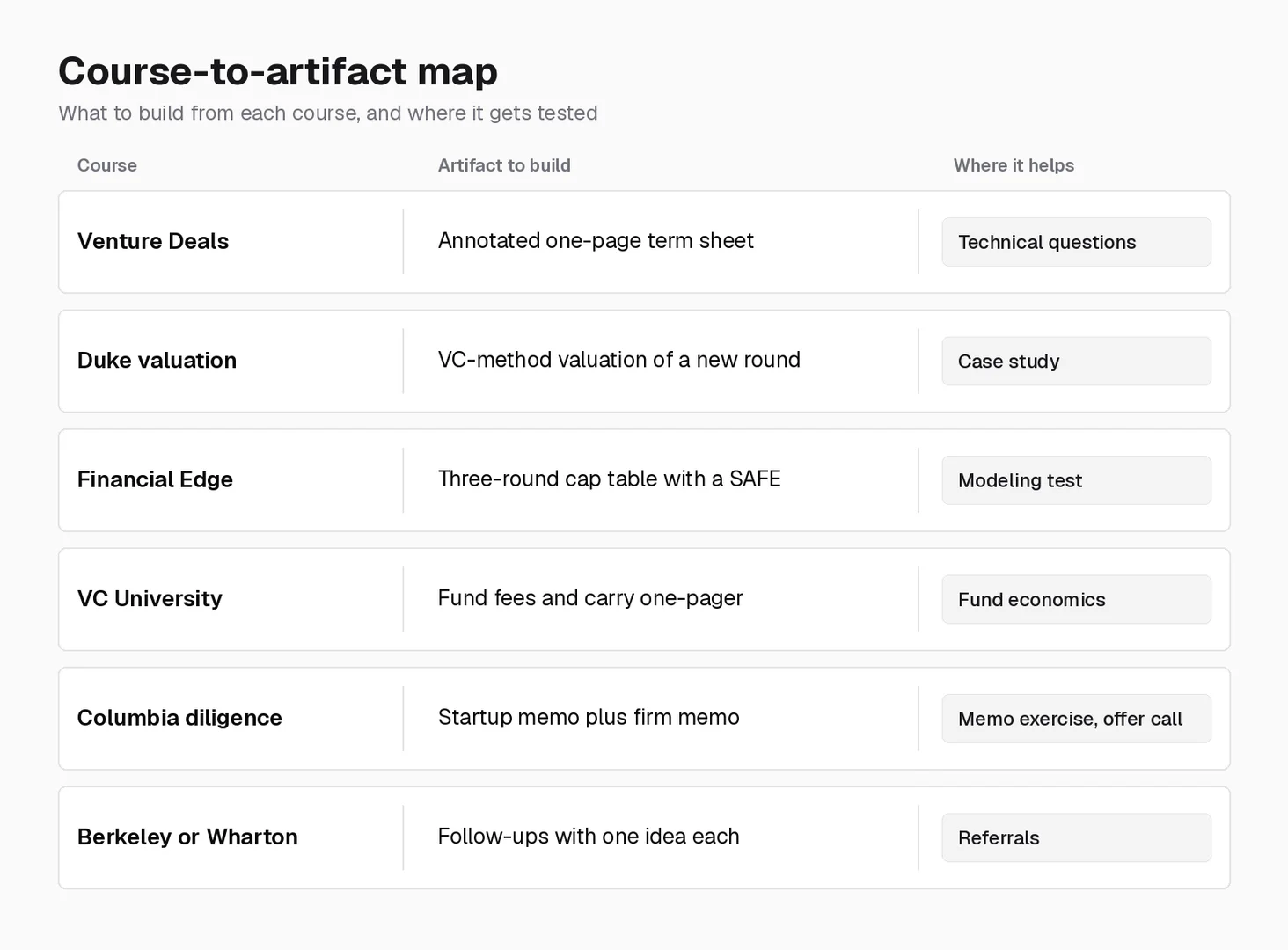
| Course | Artifact to build | Where it helps |
|---|---|---|
| Venture Deals | One-page annotated term sheet covering liquidation preference, anti-dilution, board seats, protective provisions, and pro rata rights | Technical questions and partner conversations |
| Duke Startup Valuation Methods | VC-method valuation of a company that just announced a round, with your assumptions written out | Case study and "pitch me a company" questions |
| Financial Edge | Cap table across three rounds with an option pool refresh and a SAFE conversion | Modeling test |
| VC University Online | One-page note on how a fund's fees and carry pay for its team | Questions about fund economics and carry |
| Columbia VC Due Diligence | Diligence memo on a real startup, plus a short memo on the firm you are interviewing with | Investment memo exercise and offer decision |
| Berkeley or Wharton | Follow-up notes to the investors you met, with one specific idea each | Networking that turns into referrals |
Each artifact maps to a stage you will face. The cap table goes to the modeling test. The valuation and diligence memo go to the case study interview and the investment memo. The fund economics note prepares you for fund structure and carried interest questions.
Keep each artifact to a page or a single spreadsheet tab. Partners will read a page. They will not read a course transcript.
Do VC firms care about course certificates?
Rarely, on their own. A certificate tells an interviewer you were curious enough to finish a course. It does not tell them you can source a deal, build a cap table under time pressure, or write a clear pass. Those get tested directly.
Where a course does help:
- It closes a visible gap. An engineer with no finance training who has worked through cap tables and valuation will handle the technical round better.
- It gives you something specific to talk about. "I built a three-round cap table and got the SAFE conversion wrong twice before it tied" is a better answer than "I took a course."
- Some cohorts come with people. Office hours, mentors, and alumni groups can lead to warm introductions. That only works if you follow up.
Where it does not help: a stack of certificates with nothing built from them. Our guide to breaking into VC without an MBA treats course-only resumes as weak proof for the same reason. Put one line for a course on your resume and spend the space on what you built.
Free ways to learn the same material
You can cover most of the concepts on this list for little or no money if you are disciplined about it.
- Start with Venture Deals. It is free and covers the vocabulary.
- Read a short shelf from our best venture capital books list, starting with the deal-mechanics picks.
- Listen to investors explain decisions on the best venture capital podcasts.
- Follow deal flow through the best venture capital newsletters.
- Practice the skills on real companies with a market map and a fantasy portfolio.
The free path gives you knowledge and artifacts. It does not give you a cohort or office hours. That is mostly what the paid options are selling.
Frequently asked questions
What is the best venture capital course?
For most people trying to get a VC job, VC University Online is the best single paid course because it combines venture-specific content, live office hours, and a cohort network for $1,850 or less. If your main gap is modeling, Financial Edge's Venture Capital Associate is the better buy.
What is the best free venture capital course?
Venture Deals from Techstars and Kauffman Fellows. It is free and covers fund basics, valuation, cap tables, and term sheets in about 3.5 hours of video. It has no completion statement, so treat it as preparation rather than a credential.
Is there a venture capital certification like the CFA?
No single certification is required to work as a venture investor. The certificates on this list are completion credentials from training providers and universities. They are not licenses.
Do I need a course to get a job in venture capital?
No. Firms hire on evidence: relevant experience, a point of view on markets, deal work you can show, and people who will vouch for you. Our guide on how to get a job in venture capital covers the full path. A course helps when it fixes a specific gap.
Which course helps most with the VC modeling test?
Financial Edge's Venture Capital Associate, because of its cap table, SAFE, and valuation exercises. Duke's Startup Valuation Methods is a cheaper option for valuation alone. Either way, rehearse with timed practice before the real test.
Are there scholarships for venture capital courses?
VC University offers full scholarships and reports more than 810 awarded. The application window for its February 2027 cohort runs October 7 to 14, 2026. Coursera says financial aid is available for select programs.
How long do venture capital courses take?
On this list, from about 3.5 hours of video for Venture Deals to 61.5 hours for Financial Edge. VC University recommends a 10-week schedule. The Berkeley and Wharton programs run five and six days in person.
Next steps
Pick one course from the matrix, decide the artifact before you enroll, and set a date to finish both. Then put the work to use:
- Browse open venture capital jobs to see which skills current postings ask for.
- Research VC firms and pick the companies your first artifact will cover.
- Create a candidate account so you can track analyst and associate roles as they open.
If you are still mapping the skills firms screen for, start with our breakdown of venture capital skills.
Related posts
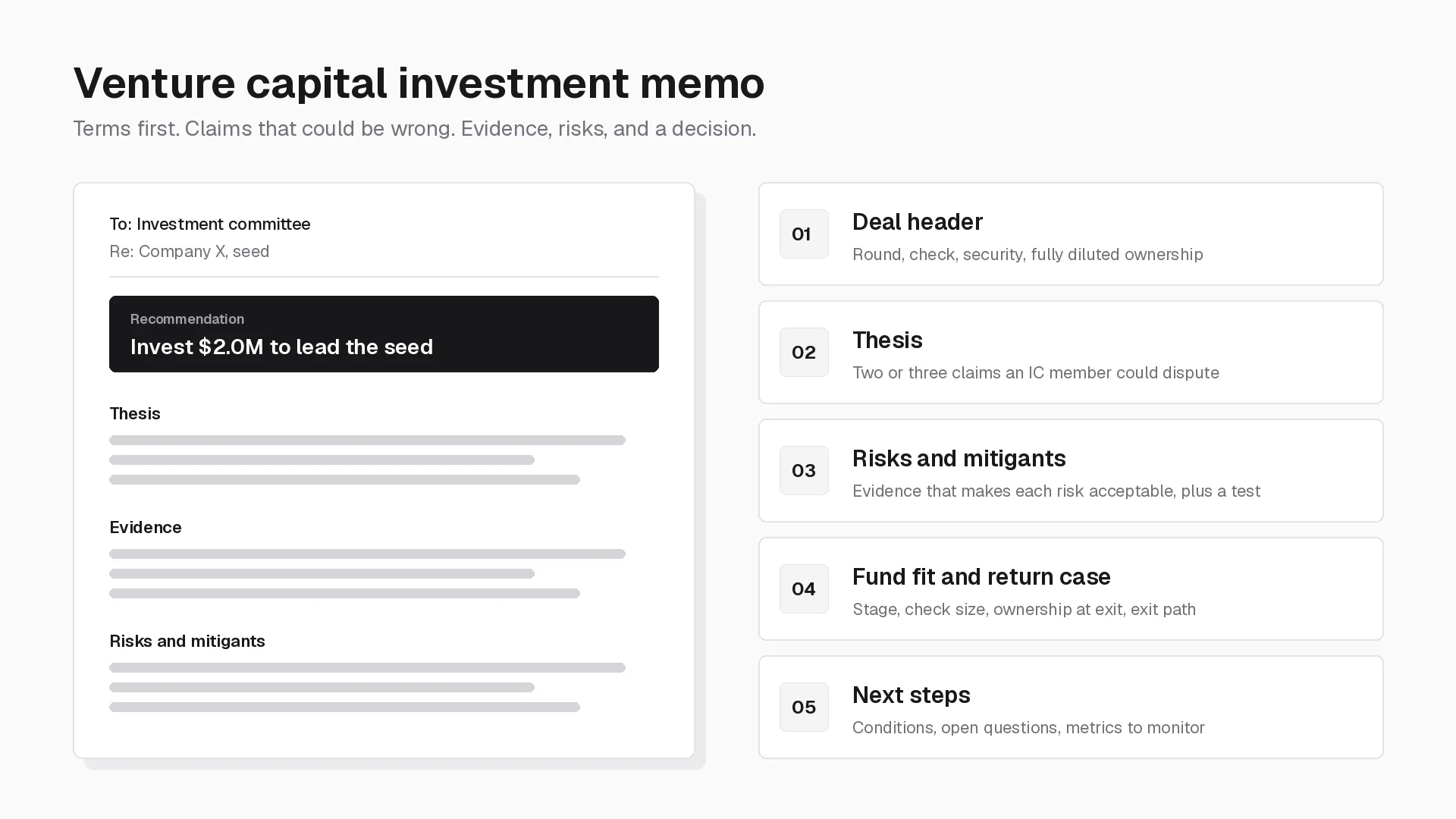
A practical guide to the venture capital investment memo: memo types and length, a deal-header template, section-by-section craft, a full one-page example, and what real Bessemer and Sequoia memos teach.
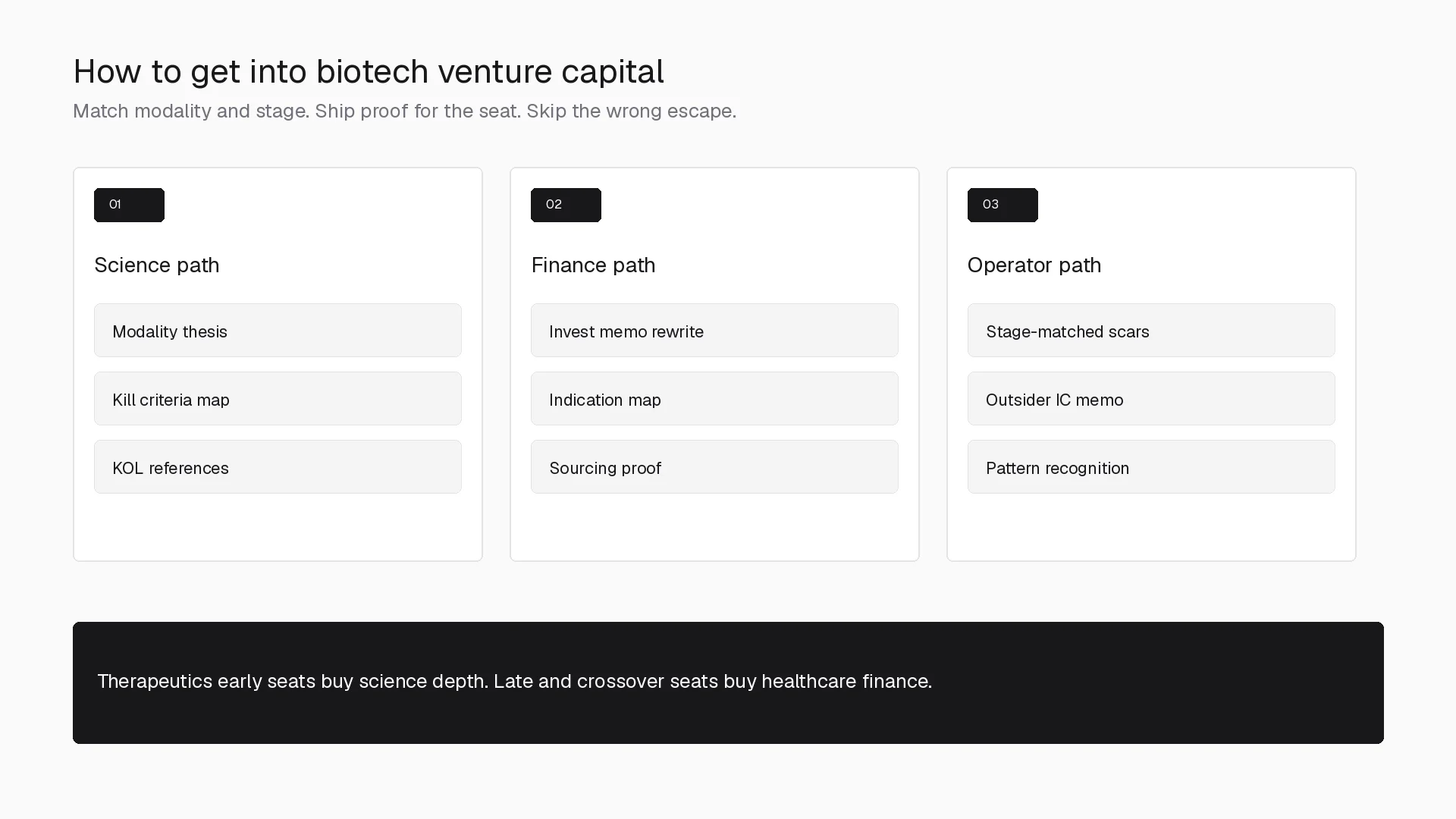
A practical guide to getting into biotech venture capital: seats by stage and modality, which backgrounds win, what proof to build, and when not to go.
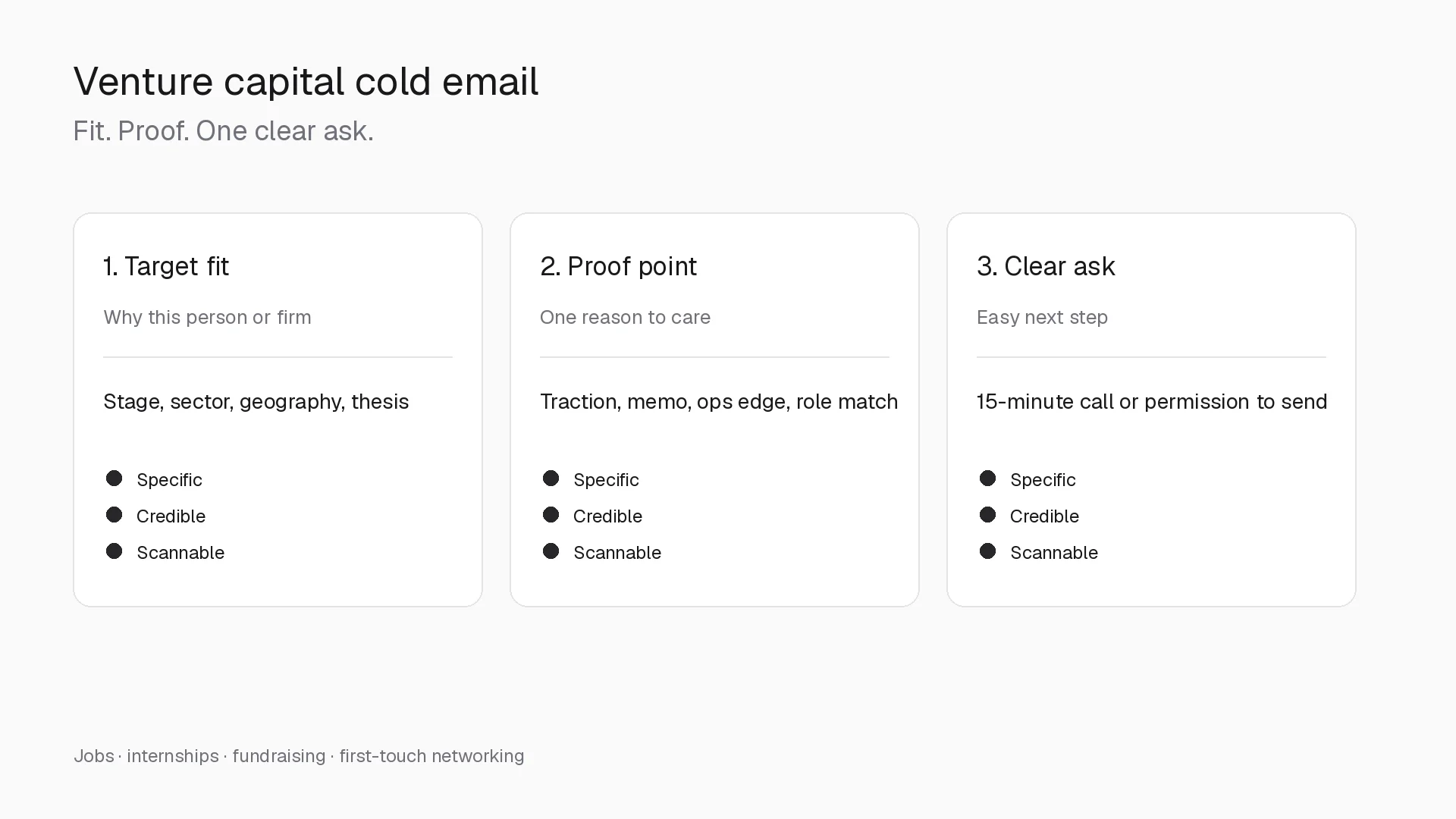
VC cold email templates for jobs, internships, and fundraising. Pick the right goal, research the firm in ten minutes, and send a short email with one clear ask.