
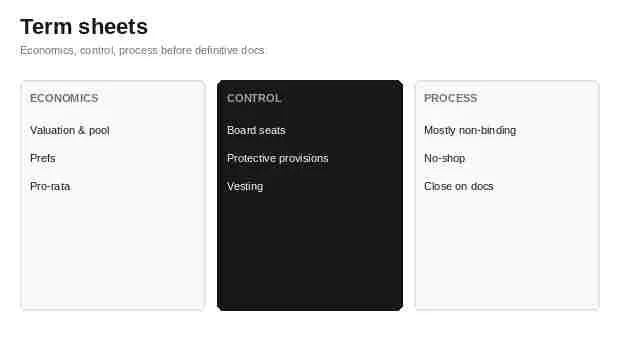
A term sheet is a short, mostly non-binding document that lists the main economic and control terms of a proposed deal before lawyers draft the definitive agreements. In venture capital, it usually sits between a verbal offer and a priced preferred-stock closing. It sets valuation, check size, liquidation preference, board seats, and related rights so both sides know whether they have a real deal before due diligence and legal fees scale up.
What a term sheet is
A term sheet summarizes the material points of an investment or other business transaction in a few pages. Typical VC term sheets cover the amount raised, price per share or pre-money valuation, security type (usually preferred stock), ownership after the round, and the investor rights that will later appear in the charter and side agreements.
The document is a negotiation blueprint, not the final contract. After both sides sign, counsel drafts the stock purchase agreement, investor rights agreement, voting agreement, and related papers that implement those terms. Industry practice also uses standard forms such as the National Venture Capital Association model documents as a shared vocabulary for what "weighted-average anti-dilution" or "1x non-participating" means.
Term sheets show up in other contexts too: bank loan term sheets, M&A letters of intent, and private placements. This page focuses on startup equity financings that VC funds and founders negotiate.
Binding vs non-binding provisions
Most commercial terms on a VC term sheet are labeled non-binding. Either side can still walk before definitive documents are signed. A few clauses are usually binding as soon as the term sheet is executed:
- Confidentiality covering negotiations and deal details
- No-shop / exclusivity for a fixed window (often 30 to 60 days) while the investor runs diligence
- Governing law for those binding sections
- Sometimes expense language if the company pays a capped amount of investor counsel fees
Ambiguous "agreement to agree" language can create disputes. Clear labels for what is binding and what is only a statement of intent reduce that risk. Signing a term sheet is a serious commitment of process and reputation. It is not the same as money in the bank.
When startups use a term sheet
Priced preferred-stock rounds are the classic setting. A lead investor proposes a term sheet after partners agree on economics. That is common from seed and Series A onward, and sometimes earlier when a fund wants preferred stock instead of a convertible instrument.
Pre-seed and early seed raises often close on a SAFE or convertible note instead. Those instruments are shorter. Teams still sometimes circulate a one-page term sheet summarizing cap, discount, MFN, and pro-rata before the SAFE is signed, but the full preferred-stock package usually waits for a priced round.
M&A processes use a related document (term sheet or letter of intent) for purchase price, exclusivity, and employee matters. The structure looks similar. The rights stack is different from a financing round.
What a typical VC term sheet includes
| Cluster | Typical contents |
|---|---|
| Offering / economics | Amount raised, price per share, pre- and post-money valuation, option pool size, security (Series preferred) |
| Economic rights | Liquidation preference, dividends, conversion, anti-dilution, participation |
| Control rights | Board seats and observers, voting, protective provisions, drag-along rights |
| Investor rights | Information rights, pro-rata rights, registration rights, ROFR / co-sale |
| Founder / employee | Founder vesting, option pool, key-person expectations |
| Process | No-shop, confidentiality, closing conditions, expenses, governing law |
Many U.S. seed and Series A term sheets run about five to ten pages. The NVCA model set is longer because it expands into full definitive agreements. Founders should model the post-money cap table before treating the headline valuation as the whole story. Option-pool "true-up" inside the pre-money valuation changes effective dilution.
Key economic terms
Valuation and price. Pre-money valuation is the agreed company value before the new cash. Post-money valuation equals pre-money plus the new investment (subject to how the option pool is counted). Price per share follows from that math and the fully diluted share count.
Option pool. Investors often require an available pool large enough for the next hiring plan, included in the pre-money so existing holders absorb that dilution. An oversized pool is a quiet valuation cut.
Liquidation preference. Standard market language for many early rounds is 1x non-participating preferred: the investor can take the preference amount back first or convert and share as common, whichever is better. Participating preferred ("double dip") and multiplies above 1x are more investor-favorable and should be modeled on exit scenarios.
Anti-dilution. Broad-based weighted average is the usual protection if a later round prices below the current round. Full ratchet is harsher and reprices the earlier round to the new low price.
Pro-rata rights. Major investors often keep the right to buy their ownership share in later rounds so they are not forced down on the cap table when the company succeeds.
Key control and governance terms
Board composition. Early boards are often three or five seats split among founders, the lead investor, and one or more independents. Losing a founder majority is a governance milestone, not a footnote.
Protective provisions. Preferred holders get vetoes on major actions such as selling the company, issuing senior stock, changing preferred rights, or taking on large debt. Narrow, specific lists are easier to operate under than vague "material transaction" vetoes.
Voting, ROFR, co-sale, and drag-along. These clauses govern how shares transfer and how a sale can be forced once a stated majority agrees. They show up again in the voting and ROFR/co-sale agreements after the term sheet.
Founder vesting. Investors routinely require time-based vesting (often four years with a one-year cliff), sometimes with credit for time already worked. Re-vesting with no credit is a harder ask and should be negotiated explicitly.
Term sheet vs SAFE, convertible note, and definitive agreements
| Document | Role | Binding economics? |
|---|---|---|
| Term sheet | Agrees headline economics and control for a priced round (or M&A) | Usually no, except no-shop / confidentiality |
| SAFE | Converts into equity later; common at pre-seed/seed | Yes once signed |
| Convertible note | Debt that converts; interest and maturity matter | Yes once signed |
| Definitive agreements | SPA, IRA, voting agreement, charter amendment | Yes; this is the close |
A term sheet is closer to a letter of intent than to a SAFE. The SAFE already is the investment contract for that round. The term sheet is the outline that becomes the preferred-stock paper.
How people on a VC desk read a term sheet
Founder explainers stop at "what each clause means." People who work deals also read the sheet as an operating plan for the next several years.
On a fund desk, analysts and associates usually:
- Rebuild ownership after the pool and the new money so the lead's ownership target is clear.
- Stress-test liquidation preference and participation on low, base, and high exit cases.
- Map board seats and protective provisions to who can block a sale, a follow-on, or a budget.
- Flag non-standard terms (full ratchet, uncapped participating preferred, long no-shop, redemption) for partners and counsel.
- Translate the sheet into the IC memo: ownership, reserves needed for pro-rata, governance risk, and whether the round is leadable.
For candidates interviewing at funds, "reading a term sheet" is a practical skill. Partners care whether you notice that a 20% pool inside a $20M pre-money is not the same deal as a 10% pool, or that a 2x participating preference changes founder outcomes in a moderate exit.
For founders comparing leads, the same reading separates a clean 1x non-participating sheet from a control-heavy package that will shape every later round. Sibling pages cover stage labels such as pre-seed, seed, and Series A. This page stays on the term sheet itself.
Frequently asked questions
What is a term sheet?
A term sheet is a short document that lists the main terms of a proposed investment or deal. In VC, it usually covers valuation, investment amount, preferred-stock rights, and board control before definitive agreements are drafted.
Is a term sheet legally binding?
Most economic terms are non-binding. Confidentiality, no-shop/exclusivity, and sometimes expense clauses are often binding once signed. The wire and stock issuance happen under the definitive agreements.
What is usually included in a startup term sheet?
Offering terms (valuation, amount, pool), economic rights (liquidation preference, anti-dilution, pro-rata), control rights (board, protective provisions), founder vesting, and process terms (no-shop, closing conditions).
How is a term sheet different from a SAFE?
A SAFE is a signed investment instrument that converts later. A term sheet for a priced round is a negotiation outline that still needs preferred-stock definitive documents before the investment closes.
Who prepares the term sheet?
The lead investor usually sends the first draft. Company counsel marks it up. Founders should model the cap table and exit waterfalls before accepting headline valuation alone.
Browse venture capital firms on Venture Capital Careers, or post a role if you hire for a fund desk that works these documents every week.
Related posts
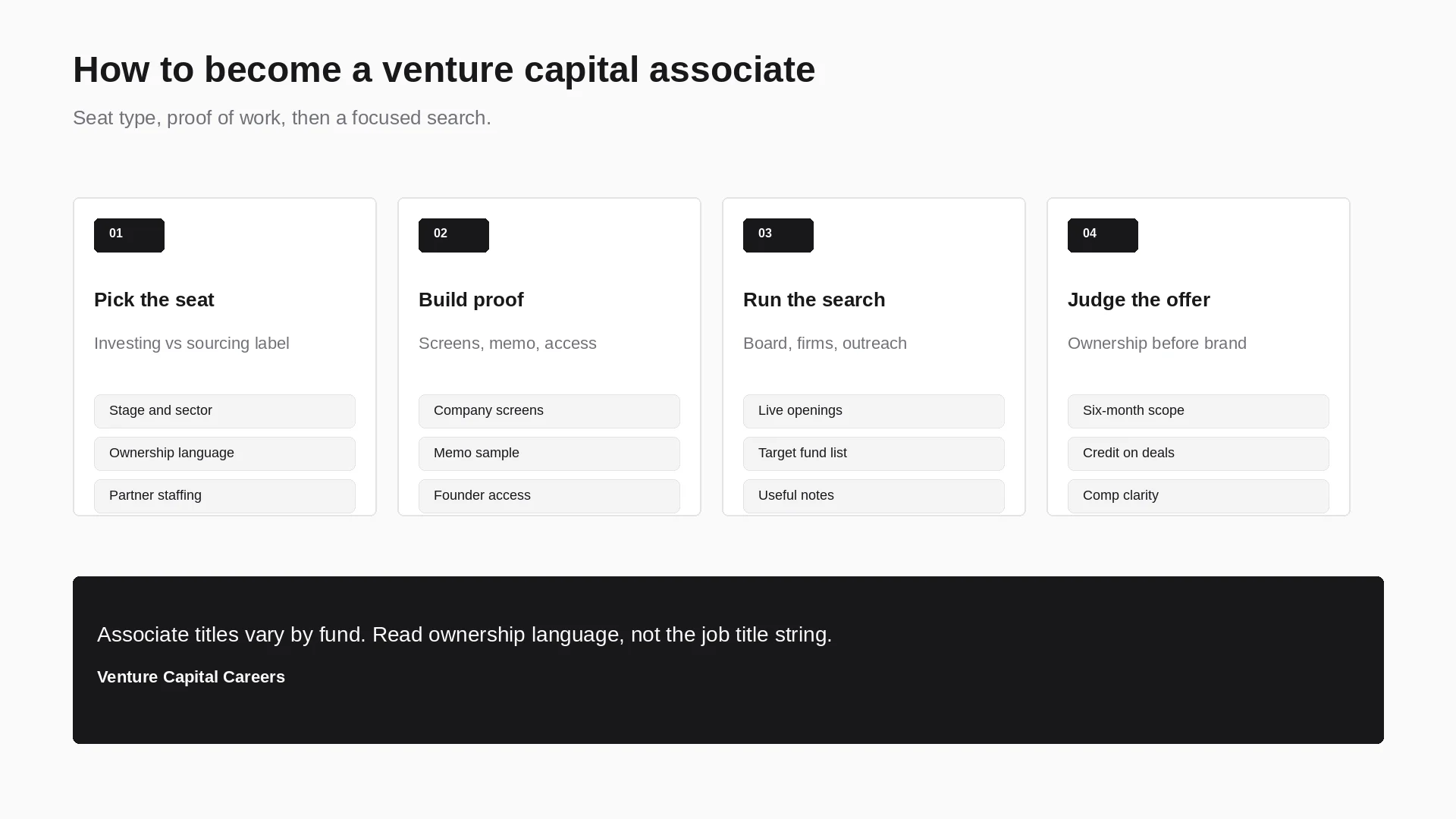
A practical guide to becoming a venture capital associate: what the seat is, which paths convert, how to prove you can do the work, and how to screen real associate openings.
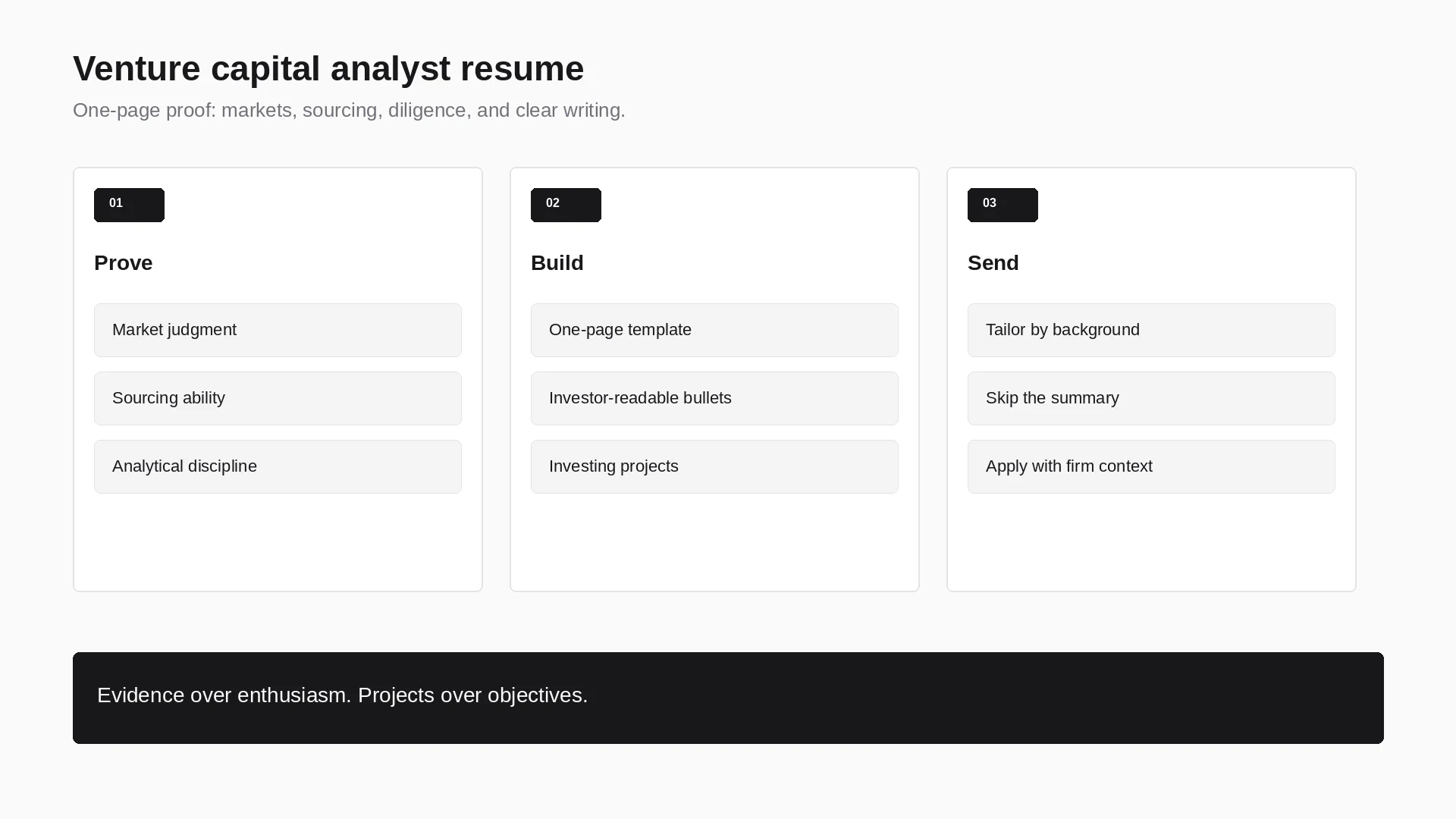
A VC analyst resume is a one-page proof document. Template, bullet formula, investing projects section, examples, and next steps for analyst applications.
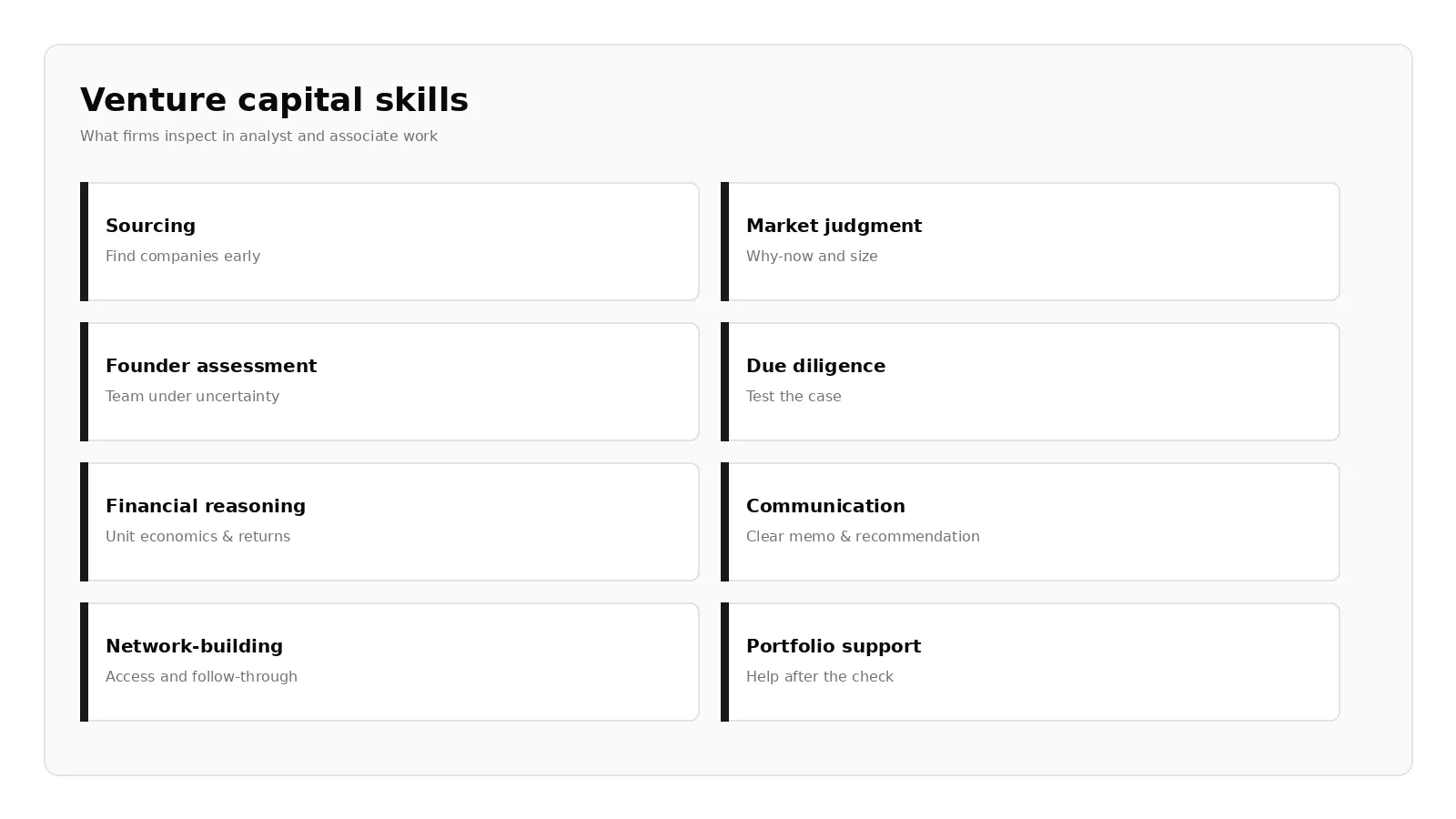
Core venture capital skills for analysts and investors: sourcing, diligence, founder judgment, memos, and a proof ledger you can use when applying.