
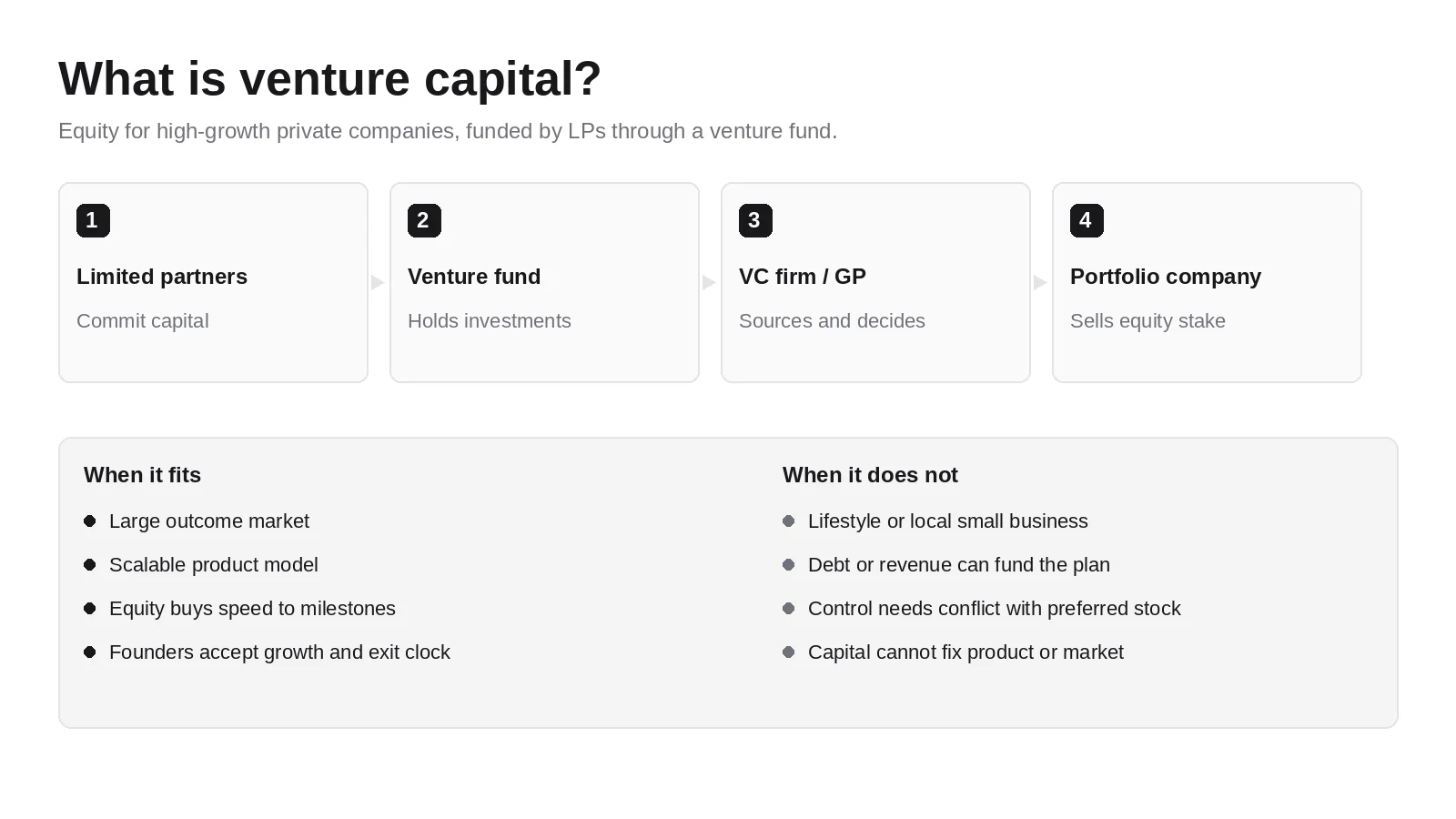
Venture capital is equity financing for private companies that can grow very large, usually provided by professional funds that buy ownership stakes rather than making loans. The money comes from limited partners, is deployed by a venture firm into a portfolio of startups, and is returned if those stakes later become liquid through an acquisition, IPO, or other exit.
That model is different from bank debt. There is no scheduled repayment of principal. Founders trade ownership and negotiated investor rights for capital and, often, board-level involvement. Investors accept that many companies will fail and that a small number of outcomes must return enough to pay for the rest of the fund.
The sections below map how the money moves and when the model fits. For the full fund lifecycle, see how venture capital works. To research firms, use the VC companies directory.
How venture capital works
A venture capital firm raises a fund from outside investors, selects startups that match the fund’s thesis, buys equity (or securities that can become equity), supports the portfolio, and aims for exits that can return cash to the fund.
The compressed cycle:
- Limited partners commit capital to a fund, typically for a partnership life measured in years rather than months.
- The general partner calls capital as investments and expenses require cash.
- The investment team sources and diligences companies, then brings deals to an investment committee.
- The fund invests for ownership, often preferred stock, under a term sheet and definitive documents.
- The firm supports the company and may reserve capital for follow-on rounds.
- An exit (acquisition, IPO, or secondary sale) can turn the stake into proceeds that flow through the fund’s distribution waterfall.
The National Venture Capital Association describes the common limited-partnership structure, capital calls, follow-on reserves, and long holding periods. Exact economics sit in each fund’s limited partnership agreement.
Deal flow is how opportunities reach the firm. How venture capital works walks the same loop with more detail on cash, ownership, and team work.
Stages of venture capital funding
Venture capital is usually staged. Check size, diligence depth, and investor profile change as the company de-risks.
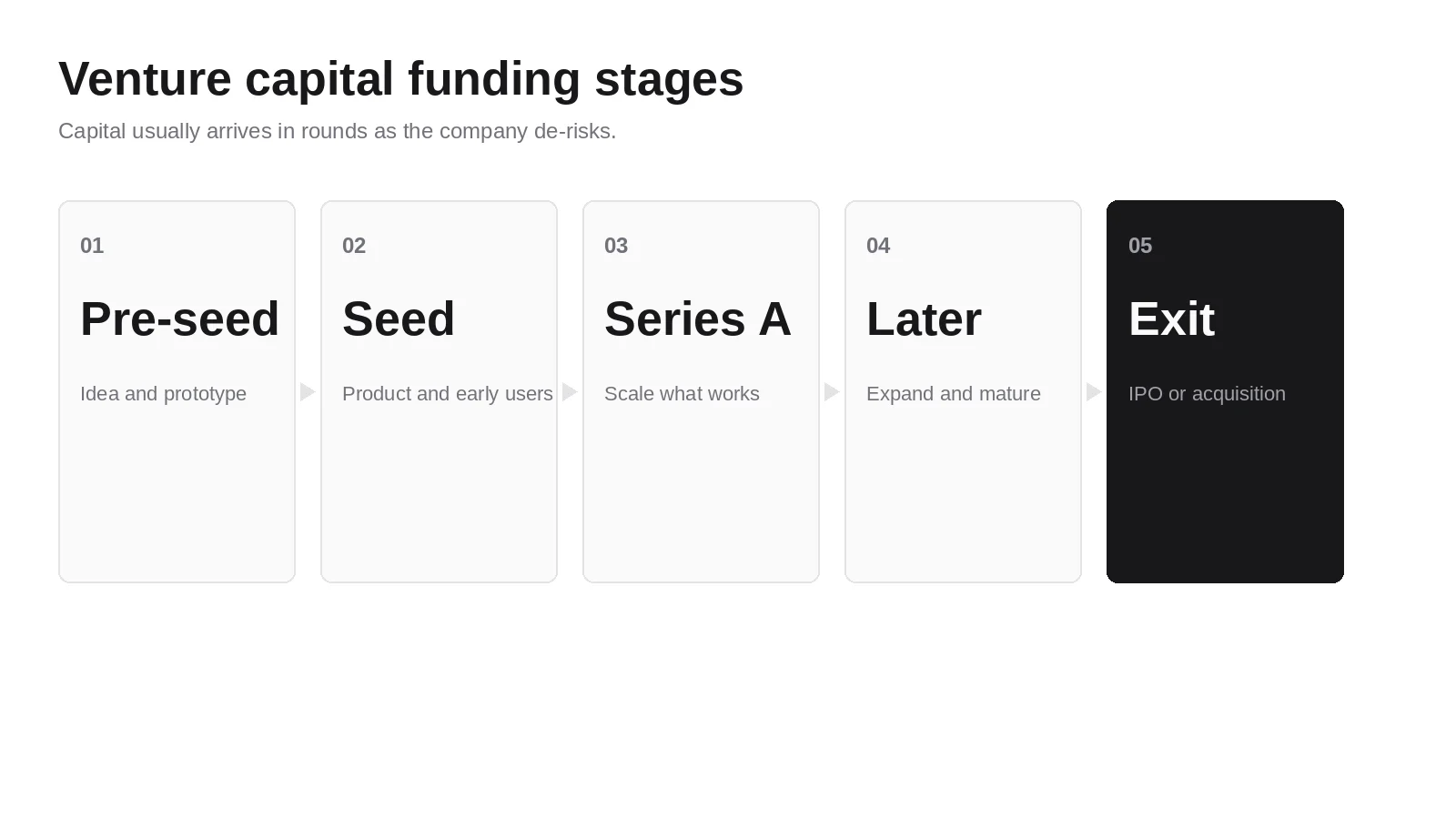
| Stage | What the company is usually doing | Typical use of proceeds | Deeper VCC page |
|---|---|---|---|
| Pre-seed | Idea, prototype, earliest team | Build product, test demand | Pre-seed funding |
| Seed | Early product and first customers | Hire, iterate, find product-market fit | Seed funding |
| Series A | Repeatable go-to-market starting to work | Scale what works | Series A funding |
| Series B and later | Proven growth engine, expanding markets or products | Scale operations, new markets, prepare for later capital | Later-stage and growth equity adjacent |
| Exit path | Company is acquired or goes public | Liquidity for shareholders | Covered in fund mechanics |
Early rounds often mix angels, accelerators, and seed funds. Institutional venture funds become more common as rounds get larger. Some instruments at the earliest stages are convertible notes or SAFEs that convert in a priced round.
Stage labels are conventions, not laws. Two “Series A” companies can look different by sector, capital intensity, and geography.
How a venture capital firm is structured
“A VC invested” hides several entities. Separating them makes the industry readable.
| Entity | Role | Economic interest |
|---|---|---|
| Limited partners (LPs) | Commit capital to the fund (pensions, endowments, foundations, family offices, insurers, funds of funds, and others) | Returns after fees, expenses, and profit-sharing terms |
| General partner (GP) | Controls the fund and investment decisions | Carried interest and related economics under the LPA |
| Management company / firm | Employs the team, brand, and operating platform | Management fees paid under fund documents |
| Venture fund | The partnership vehicle that holds investments | Portfolio outcomes |
| Portfolio company | The startup that sold equity to the fund | Growth funded by the investment |
A common compensation convention is often summarized as “2 and 20”: a management fee on committed or invested capital plus about 20% of profits as carried interest after LPs receive agreed distributions. Treat that as a reference point, not a universal rule. Terms vary by firm, vintage, and negotiation.
NVCA notes that an initial investment often leads the fund to reserve several times that check for follow-on financing, and that partnership agreements commonly run about ten years with extensions in practice.
Types of venture capital firms
Firms specialize along a few axes:
- Stage focus: pre-seed and seed specialists; early-stage multi-stage funds; growth and late-stage investors.
- Sector or thesis: healthcare, fintech, climate, enterprise software, consumer, deep tech, and other verticals.
- Geography: local, national, or global mandates.
- Corporate venture capital (CVC): investment arms that use corporate balance-sheet capital and often pursue strategic as well as financial goals. See corporate venture capital.
- Platform and operating models: some firms add talent, marketing, or go-to-market support teams alongside investing partners.
Check size, ownership targets, board appetite, and follow-on behavior follow from these choices. Browse firm profiles on the companies directory rather than treating any public list as a ranked endorsement.
Benefits and tradeoffs of venture capital
For companies
Benefits
- Access to equity capital when revenue, collateral, or history will not support enough debt.
- Ability to fund multi-year product and market bets before the business is cash-flow positive.
- Potential access to hiring help, customers, co-investors, and operating pattern recognition.
- External validation that can unlock later rounds.
Tradeoffs
- Dilution of founder and employee ownership.
- Governance: board seats, protective provisions, and information rights.
- An implicit growth and exit orientation that may conflict with a lifestyle or long-private plan.
- Time cost of fundraising and ongoing investor management.
For investors
Benefits
- Exposure to companies that can return many times invested capital if they succeed.
- Portfolio construction across many bets.
- Contractual upside through preferred terms and ownership.
Tradeoffs
- High loss rates on individual companies.
- Long duration and limited liquidity before exit.
- Dependence on a small number of outcomes to return the fund.
- Fee drag and access constraints for many would-be LPs.
Venture capital is expensive capital in ownership terms. It is often the right tool when the alternative is under-funding a business that needs speed and scale.
When venture capital fits (and when it does not)
Pros-and-cons lists do not answer the practical question: should this company raise venture capital at all?
Venture-shaped signals
VC is a better fit when most of the following are true:
- The market can support a very large outcome, not only a durable small business.
- The product can scale without linear headcount or local capacity constraints.
- The company can use outside equity to reach milestones that increase enterprise value faster than dilution destroys it.
- Founders accept that investors will push for growth, follow-on capital, and a path to liquidity.
- The round can attract investors whose stage, sector, and check size match the plan.
Non-fit signals
Pause or choose another path when:
- The business is intentionally small, local, or lifestyle-oriented.
- Unit economics cannot support venture-scale growth even with more capital.
- Debt, revenue-based financing, or customer prepayments can fund the plan with less ownership loss.
- Founders need control rights that conflict with standard preferred-stock governance.
- The “raise” is meant to paper over a product or market problem that capital cannot fix.
A company can be an excellent business and still be a poor venture investment. That distinction matters for founders choosing capital and for candidates evaluating which firms and portfolios they want to work with.
Venture capital vs angel investors, private equity, and growth equity
| Capital type | Typical company | Ownership posture | Deeper page |
|---|---|---|---|
| Angel investors | Earliest private companies | Personal capital; smaller checks | Venture capitalist vs angel investor |
| Venture capital | High-growth startups across stages | Fund capital; minority stakes common | This page |
| Growth equity | Later private companies with proven traction | Often minority growth capital | Growth equity and growth equity vs venture capital |
| Private equity | Matureer businesses, often with cash flow | Control buyouts more common | Private equity vs venture capital |
Boundaries blur at the edges. Late-stage venture, growth equity, and crossover investors can appear in the same financing. Use stage, ownership, leverage, and control rights - not marketing labels - to classify a deal.
Who works in a venture capital firm
Titles vary by firm size, but the investing ladder usually runs analyst or associate → senior associate → principal → partner or general partner. Adjacent seats include platform and talent partners, venture partners, scouts, and entrepreneurs in residence.
Junior investors spend more time on sourcing, screening, market maps, and diligence support. Partners own relationships, investment decisions, and board work. Platform teams support portfolio companies beyond the check.
For career depth, read the venture capital career path, how to become a venture capitalist, and how to get a job in venture capital. Open roles are listed on Venture Capital Careers.
Frequently asked questions
Do founders repay venture capital like a loan?
No. Venture capital is equity (or equity-like). Investors are repaid if their shares become valuable and liquid, not through scheduled principal payments. Failure usually means the equity is worth little or nothing; founders are not personally amortizing the fund’s check the way they would a personal guarantee on a bank loan, unless they separately signed other obligations.
How much ownership do venture investors take?
It depends on valuation, check size, and negotiation. There is no single correct percentage. Early rounds can look very different from late rounds. Model dilution across the full path to the outcome you care about, not only the current close.
How long does a venture fund last?
Many U.S. venture partnerships are designed around a roughly ten-year life with possible extensions. Individual company holds often last several years inside that window. NVCA emphasizes that venture is a long-duration asset class with limited interim liquidity.
What happens if a venture-backed startup fails?
The equity can go to zero. Employees and founders can lose unvested or underwater equity. The fund records a loss on that position and continues managing the rest of the portfolio. Contract details, liquidation preference, and remaining cash on the balance sheet change the ending for each stakeholder.
Is venture capital the same as private equity?
No. Both are private-market equity strategies, but they usually target different company stages, ownership levels, and value-creation playbooks. See private equity vs venture capital for the full comparison.
Next steps
If you are learning the system, continue with how venture capital works. If you are mapping firms, use the companies directory. If you are job searching, browse roles on Venture Capital Careers or create an account.
Related posts
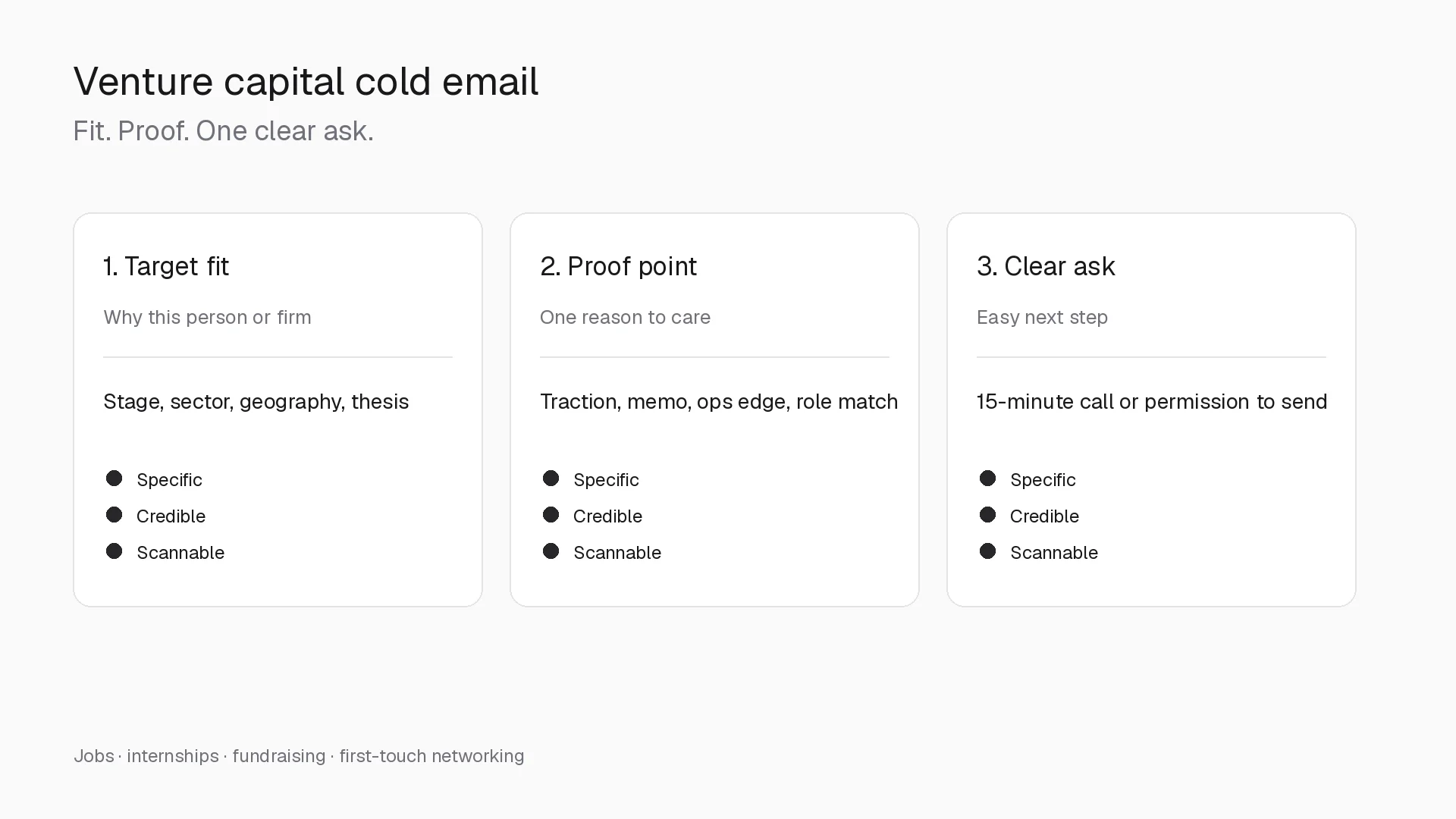
VC cold email templates for jobs, internships, and fundraising. Pick the right goal, research the firm in ten minutes, and send a short email with one clear ask.
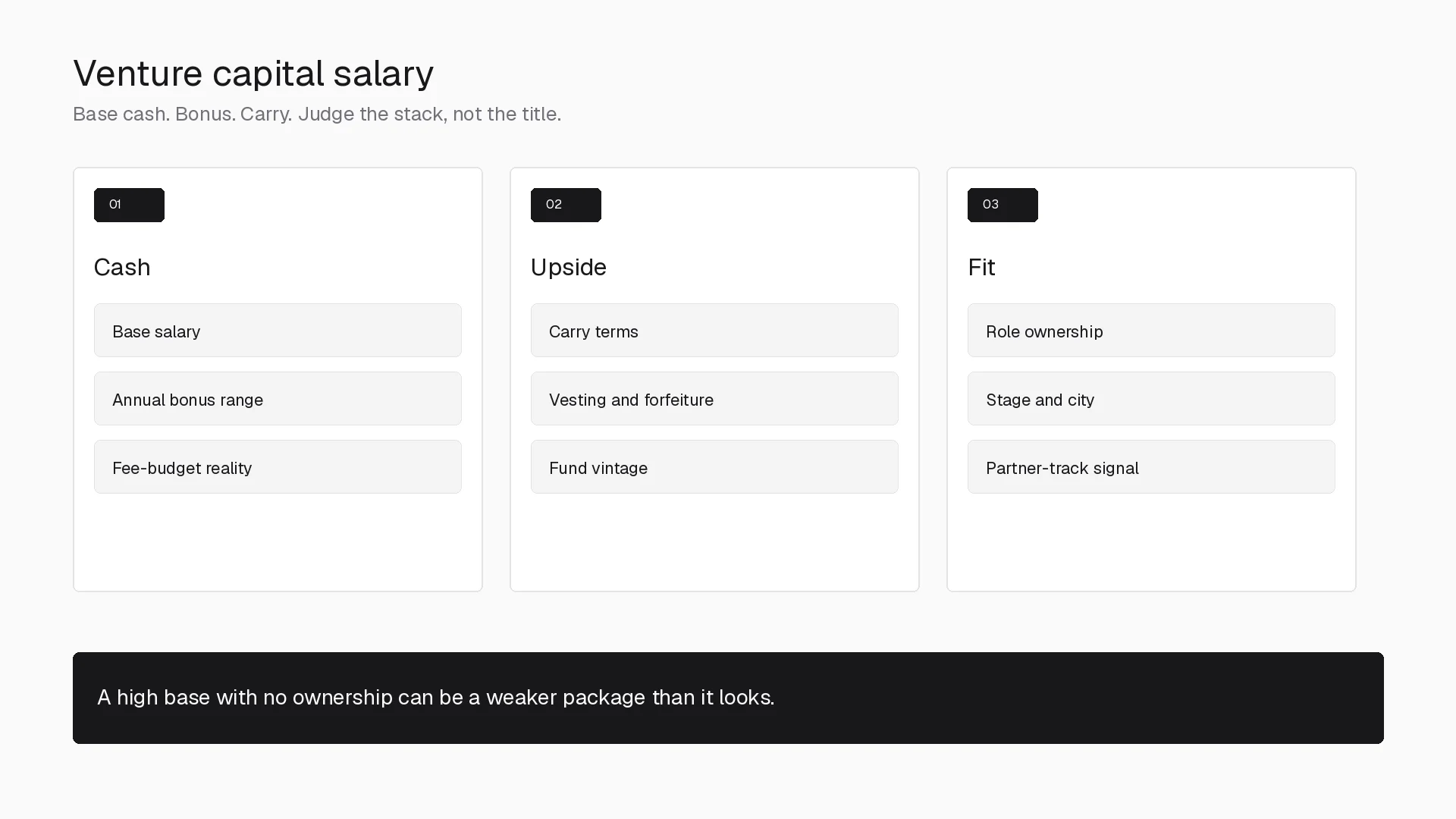
US venture capital salary ranges by role, how bonus and carry work, what moves pay by fund size and stage, and how to triangulate a VC compensation offer.
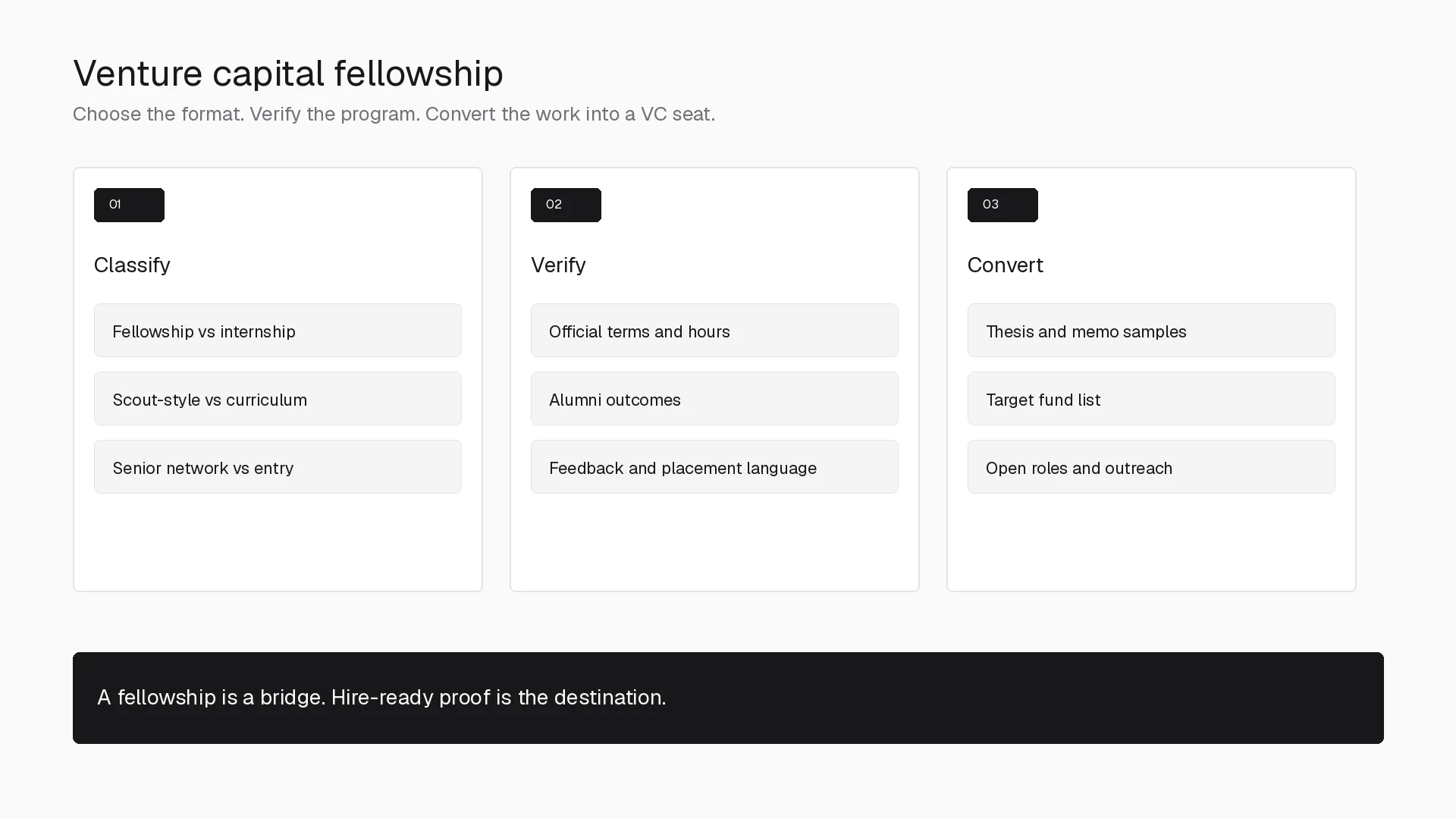
Compare VC fellowship formats, verify a program before you commit, apply with a real edge, and turn fellowship work into a venture capital job search.