
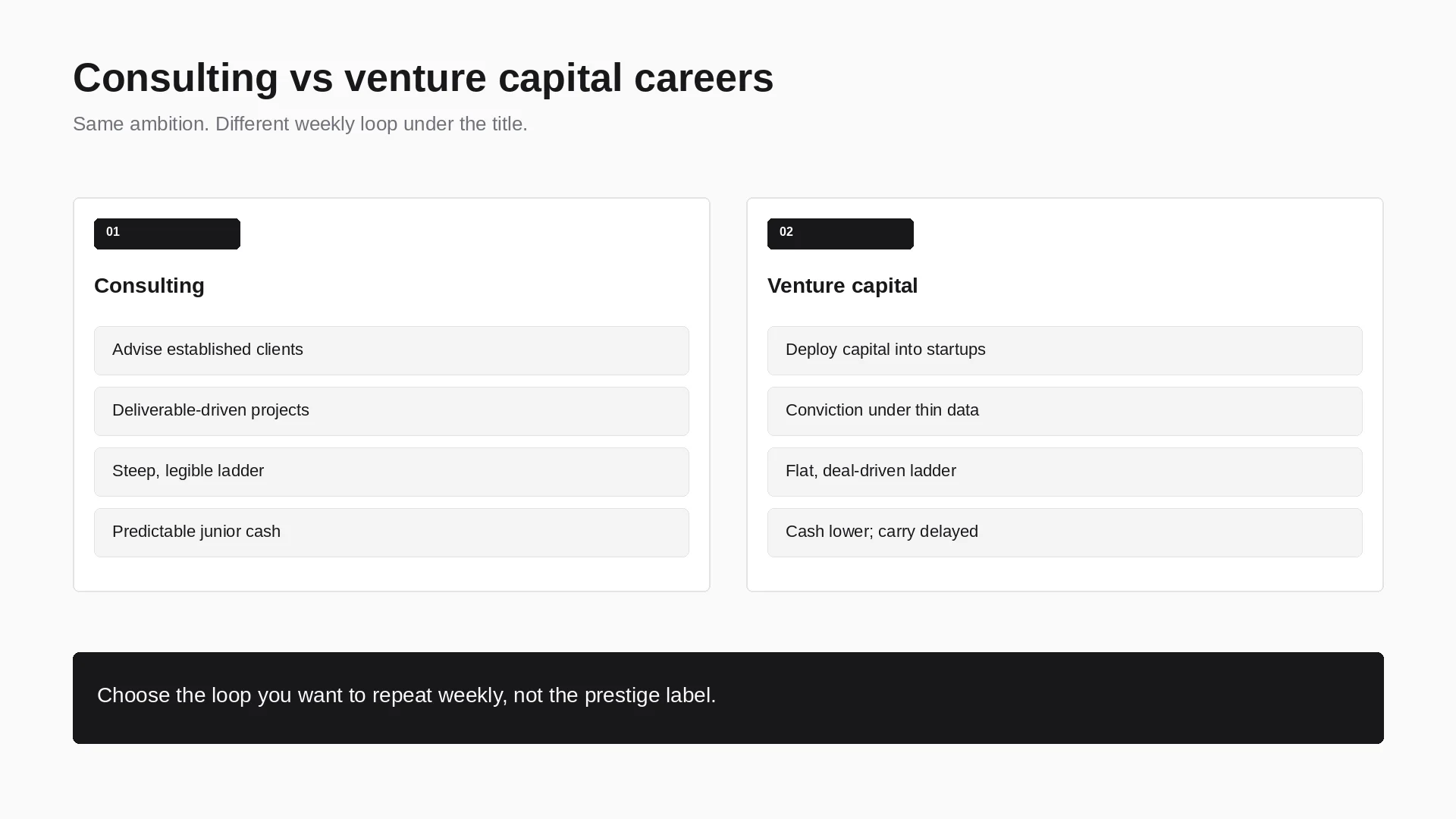
Management consulting sells structured advice to established companies. Venture capital deploys capital into startups when the evidence is still thin. Both reward analysis, communication, and comfort with ambiguity. The jobs diverge in the weekly loop you repeat.
Consulting turns messy client problems into recommendations on a deliverable calendar. Venture capital turns messy startup signals into invest-or-pass decisions, then lives with the consequences for years. Choose the seat for that loop, not for which label looks sharper on a résumé.
If you already know you want the move from consulting into investing, use the sibling playbook on consulting to venture capital. This page is for candidates comparing the careers themselves.
Consulting vs venture capital at a glance
| Dimension | Management consulting | Venture capital |
|---|---|---|
| Primary job | Advise clients on strategy, operations, growth, or organization | Source, diligence, invest, and support startups for fund returns |
| Main output | Recommendation, presentation, implementation support | Investment view, memo, deal decision, portfolio help |
| Data environment | Richer client data, stakeholder interviews, defined problem | Thin data, founder judgment, market pattern recognition |
| Career ladder | Steep and defined (analyst → consultant → manager → partner) | Flat (analyst/associate → principal → partner), fewer rungs |
| Junior cash | Usually higher and more predictable at peer MBB/strategy seats | Often lower base and bonus; upside delayed in carry |
| Long-term upside | Salary and bonus on a schedule | Carry if the fund returns well, vesting over many years |
| Recruiting | Formal campus and experienced-hire cycles, cases you can practice | Mostly network-driven; few structured seats |
| Travel and hours | Heavy travel common; long but project-bounded weeks | Less travel; more self-directed; always-on deal and network load |
| Best fit | You want structured apprenticeship, team delivery, and broad exits | You want founder contact, conviction under uncertainty, and investing craft |
These are tendencies. A sector diligence specialist at a boutique can feel closer to growth investing than a generalist associate at a tiny fund feels to "venture." Compare the actual calendar and incentives, not the brand.
What actually differs
Consulting firms are hired by clients. The power dynamic runs client → team. Your week is built around clarifying a business question, gathering evidence, and helping leadership decide. Success looks like a clear recommendation that a client can act on, delivered with a team and a timeline.
Venture firms are paid by limited partners to put capital to work. The power dynamic runs investor → company, sometimes with a board seat. Your week is built around finding companies, deciding whether the fund should spend capital and reputation, and then helping those companies after the check clears. Success looks like ownership in outliers, not a polished slide that closes a project.
That contrast shows up in incentives. Consulting revenue scales with people and projects. VC economics scale with management fees and carry on fund profits. Juniors in consulting learn delivery and client management. Juniors in VC learn sourcing, screening, and how partners actually decide.
Parallel career comparisons for other finance seats live on investment banking vs venture capital, private equity vs venture capital, hedge fund vs venture capital, and growth equity vs venture capital.
Day-to-day work
A consulting week usually has a project spine. You size a market, interview stakeholders, build analyses, pressure-test hypotheses with the team, and turn findings into slides. The problem is bounded by a client question and a decision date. Ambiguity exists, but the team and timeline keep it contained.
A VC week is deal-flow driven. You review decks, map a market, take founder calls, chase references, draft a memo, and sit in partnership debates. Most opportunities die. The next live company may arrive from a warm intro, a thesis you have been nursing, or a cold inbound that looks ordinary until it does not.
Both jobs ask you to become an "expert for a day" in unfamiliar industries. The difference is the decision. Consulting asks what the client should do. VC asks whether this fund should write a check.
For a week inside an investing seat, see a day in the life of a venture capital associate.
Compensation, hours, and carry
Do not choose from a single salary screenshot. Cash pay varies by firm tier, geography, seniority, and whether the VC seat is at a large platform fund or a three-person partnership.
The structural pattern that matters most: consulting usually wins on predictable junior cash and scheduled bonuses. VC often pays less cash early and points to carried interest as the upside. Carry is real when funds return well, but it is delayed, diluted across the team, and absent when funds underperform. Many junior seats get little or no meaningful carry.
Hours are different flavors of intense. Consulting packs travel and late slides into project cycles. VC packs fewer hotel nights and more continuous networking, evening events, and mental load from deal flow that never fully turns off.
For directional cash and package structure on the VC side, use the venture capital salary guide. For how carry works when it exists, use the carried interest guide. Ask for documents in the offer, not slogans.
Culture and recruiting
Consulting culture is team-based and hierarchical in a productive way. You learn how senior people staff, review, and sell work. Feedback arrives through staffing, utilization, and formal reviews. The apprenticeship is visible even when the hours are hard.
VC culture is flatter and more uneven. Some funds coach juniors carefully. Others expect you to create your own pipeline with little management training. You work close to partners, which is a gift when they teach and a grind when they do not.
Recruiting follows the same split. Consulting gives you a process you can practice: applications, cases, behavioral interviews, deadlines. VC hiring is mostly relationships, sector proof, and timing. A mid-sized fund may hire one or two juniors in a year. Structured campus pipelines exist at a handful of larger funds and are the exception.
Career ladder
Consulting ladders are legible. Titles map to expectations for analysis, project management, and client leadership. Promotion clocks are imperfect, but you usually know what "ready" looks like.
VC ladders are short. Analyst, associate, principal, partner covers most of the map, and some firms skip intermediate titles entirely. Advancement depends on sourcing quality, judgment, and whether partners want to share economics. Tenure alone rarely unlocks a partner seat.
If you need a map of traditional investment-team roles, use the venture capital career path.
Exit opportunities
Consulting keeps more doors open. Common exits include corporate strategy, operations, product, private equity, growth equity, startups, and, for a minority, venture itself. The breadth is the feature.
VC exits concentrate around the startup and investing ecosystem: operating roles at portfolio companies, later-stage investing, platform leadership, fund formation for a few, or another fund seat. The specialization is the feature and the constraint.
Flow between the two is asymmetric. Consulting → VC happens every year and is still a low-volume, competitive exit. VC → consulting is uncommon because consulting recruiting wants case readiness and a story that fits a client-delivery machine. If you want both experiences and are undecided, consulting first usually preserves more optionality.
If you might move from consulting to VC later
Treat that as a sequencing question, not as proof that consulting is "just a stepping stone." Build sector depth on projects, keep a public point of view on markets you actually know, and start founder and investor relationships before you need a job. The full move playbook, including how to reposition the résumé and run outreach, lives on consulting to venture capital. Corporate venture seats can be a bridge for some profiles; compare those on corporate venture capital vs venture capital.
How to screen a consulting vs VC job posting
Use this checklist before you fall in love with a title.
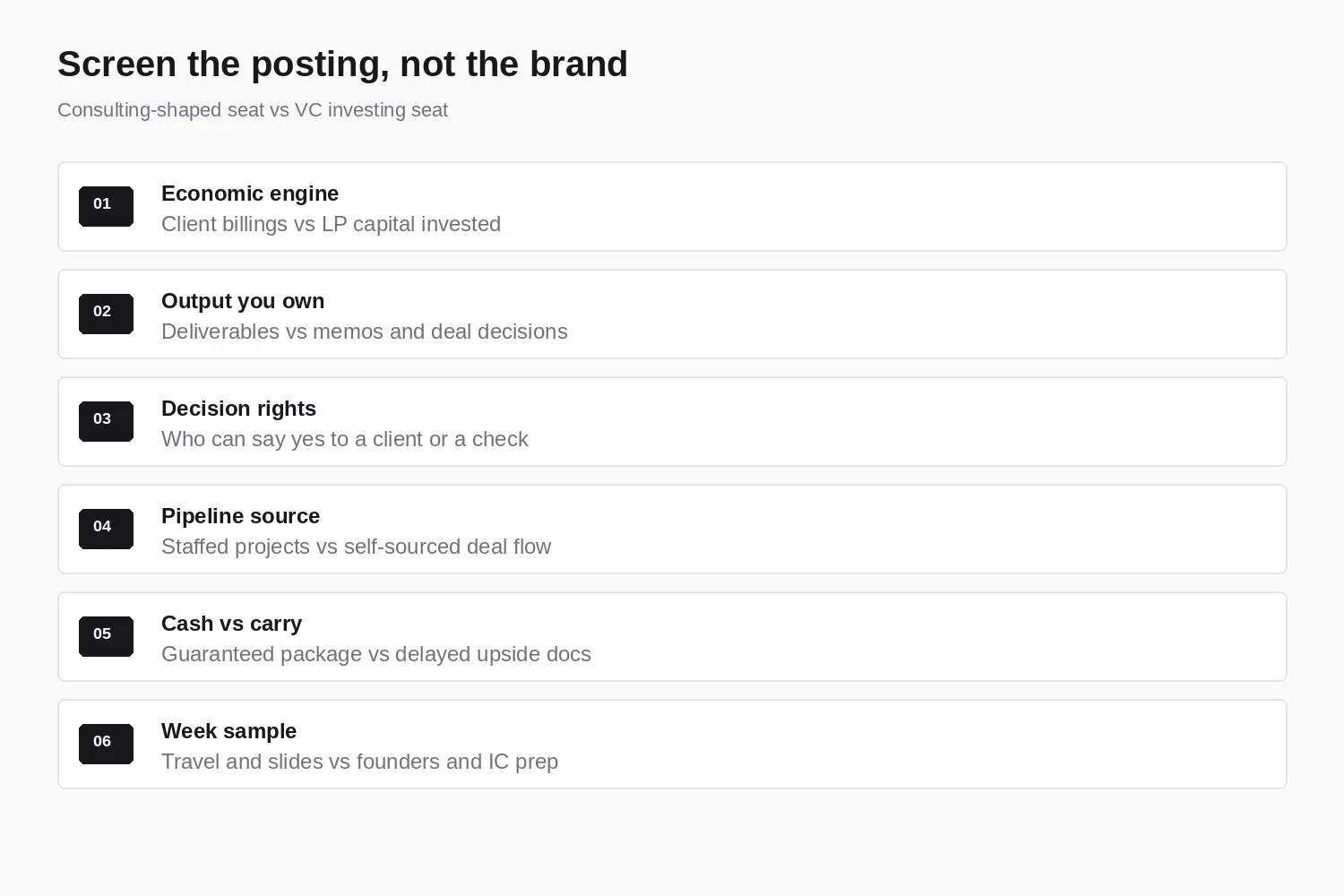
- Economic engine. Does the firm bill clients for projects, or does it invest LP capital for returns? "Venture strategy," fundraising advisory, and pitch-deck shops are not investing seats.
- Output you will own. Will your year be measured in client deliverables, or in sourced companies, memos, and investment decisions?
- Decision rights. In consulting, who reviews your work before it reaches the client? In VC, who can say invest or pass, and do juniors draft the call or only staff research?
- Pipeline source. Does work arrive through staffing, or are you expected to create deal flow?
- Team shape. Case teams of several people versus a fund with a handful of investors changes apprenticeship quality.
- Cash vs carry. Is junior pay mostly guaranteed cash, or is a large share promised as carry with unclear vesting and leave treatment?
- Week sample. Ask for a real calendar: client travel and slide reviews versus founder meetings, IC prep, and sourcing blocks.
- Exit story from alumni. Where did the last three people in the seat go? Prestige without alumni placement is a warning.
Browse live investing roles on the Venture Capital Careers job board and research firms in the companies directory before you optimize for a label.
Decision scorecard
Choose consulting if most of these are true:
- You want a structured apprenticeship with clear deliverables and team feedback.
- You optimize for predictable junior cash and a promotion ladder you can see.
- You want the broadest set of later exits across corporate, product, and investing.
- You are willing to trade travel and project intensity for that training.
Choose venture capital if most of these are true:
- You want founder contact and conviction under incomplete information.
- You accept flatter hierarchy, uneven coaching, and network-driven hiring.
- You care more about learning investing craft than maximizing early cash.
- You already follow markets and startups when nobody is grading you.
A third answer is sequencing. Start in consulting if you need optionality, then move only with sector proof and a real search system. Start in VC only if the investing loop already pulls you harder than client delivery, and you can tolerate a narrower door.
Frequently asked questions
Is consulting or venture capital better early in a career?
Consulting is usually the better default when you are undecided. It trains structured problem solving, pays more predictably early, and keeps more exit doors open. VC is better early only if you already prefer the investing loop and can get a real seat, not a loosely related "venture" title.
Does venture capital pay more than consulting?
Junior cash usually favors strong consulting seats. Senior VC can outperform through carry at funds that return well, but carry is delayed and uncertain. Compare total package documents for the specific offer.
Is it easier to break into consulting or VC?
Consulting is extremely competitive, but the process is visible and practiceable. VC has far fewer junior seats and hires mostly through networks, so access is harder even when you are qualified.
Can I move from consulting to venture capital?
Yes. It is a known path and still low volume. Sector depth, founder access, and visible investment judgment matter more than firm brand alone. Use the consulting to venture capital guide for the search system.
Can I move from venture capital to consulting?
It is uncommon. You would need case readiness and a story that fits client delivery. Do not assume the reverse move is as available as the consulting-to-VC path.
Which has better work-life balance?
VC often has less travel and slightly fewer peak hours. Consulting packs intensity into project cycles with more time on the road. Neither is a clean 9-to-5. Compare the calendar you can actually live with.
Next step
Write two columns for your next twelve months: the work you want to repeat weekly, and the skills you want on the other side. Then pick five consulting teams and five funds in sectors you care about. For each, note economic engine, junior outputs, decision rights, and alumni exits. Apply only where the calendar matches the seat you want. For a week-by-week VC search system, use how to get a job in venture capital. Browse open roles on the job board and firm profiles in the companies directory.
Related posts
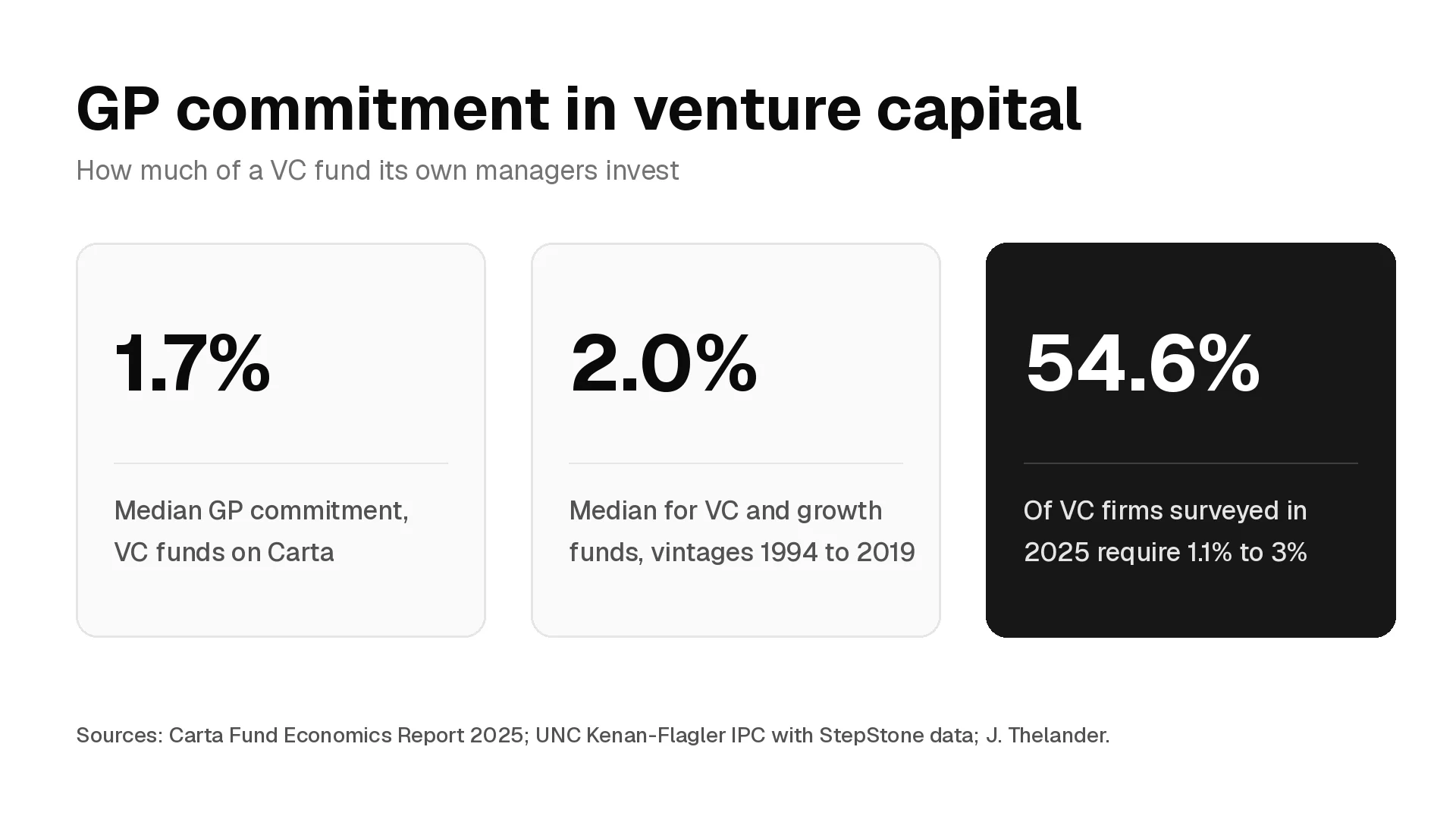
What a GP commitment is, how large it is in venture capital, how GPs fund it, where it sits in the LPA, what the returns evidence says, how firms split it across partners and principals, and what to ask before you accept a role with carry.
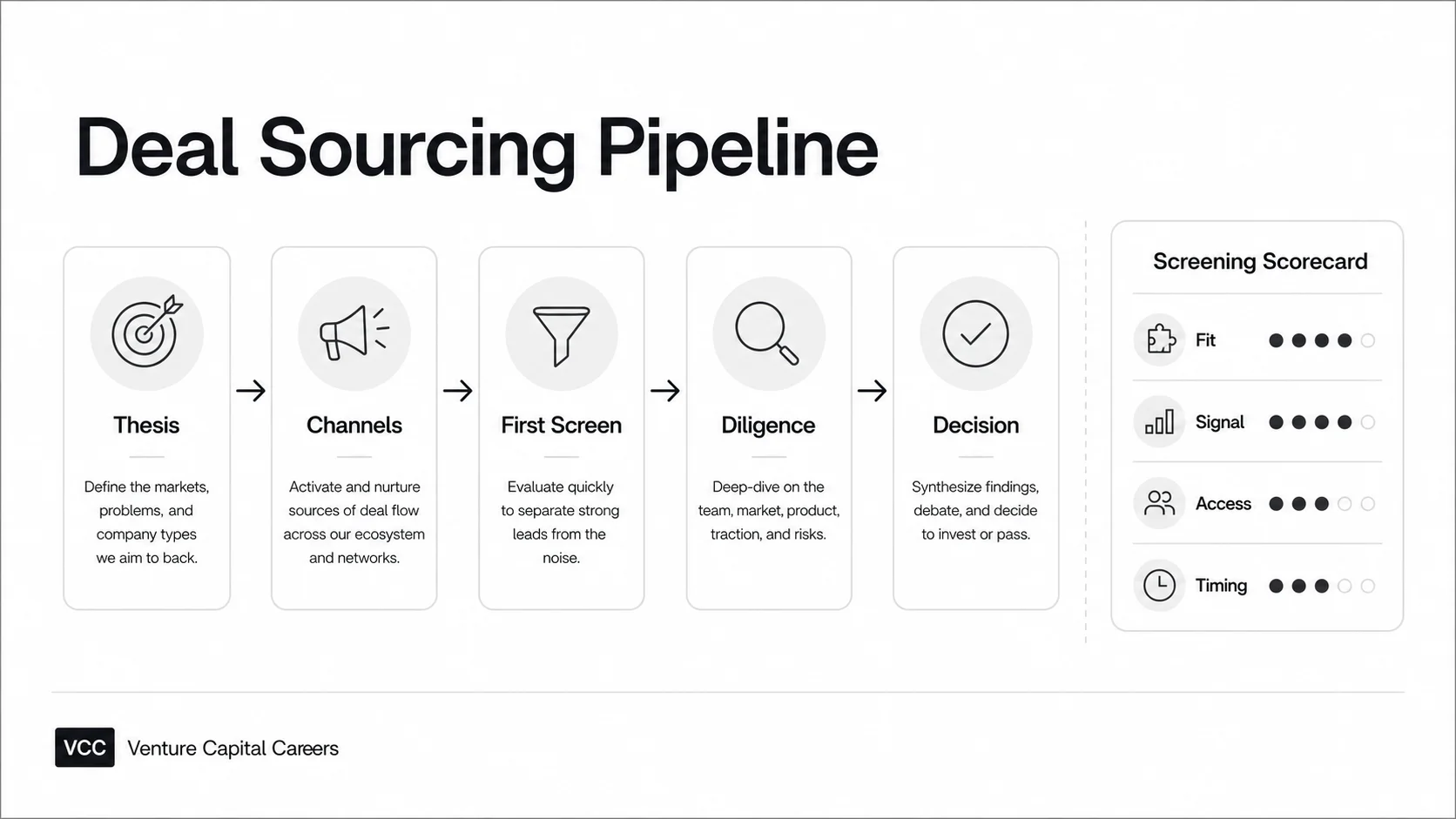
Most closed VC deals start with a relationship. See where deals come from by stage, how to work each sourcing channel, which signals show up early, and how analysts run a weekly sourcing process.
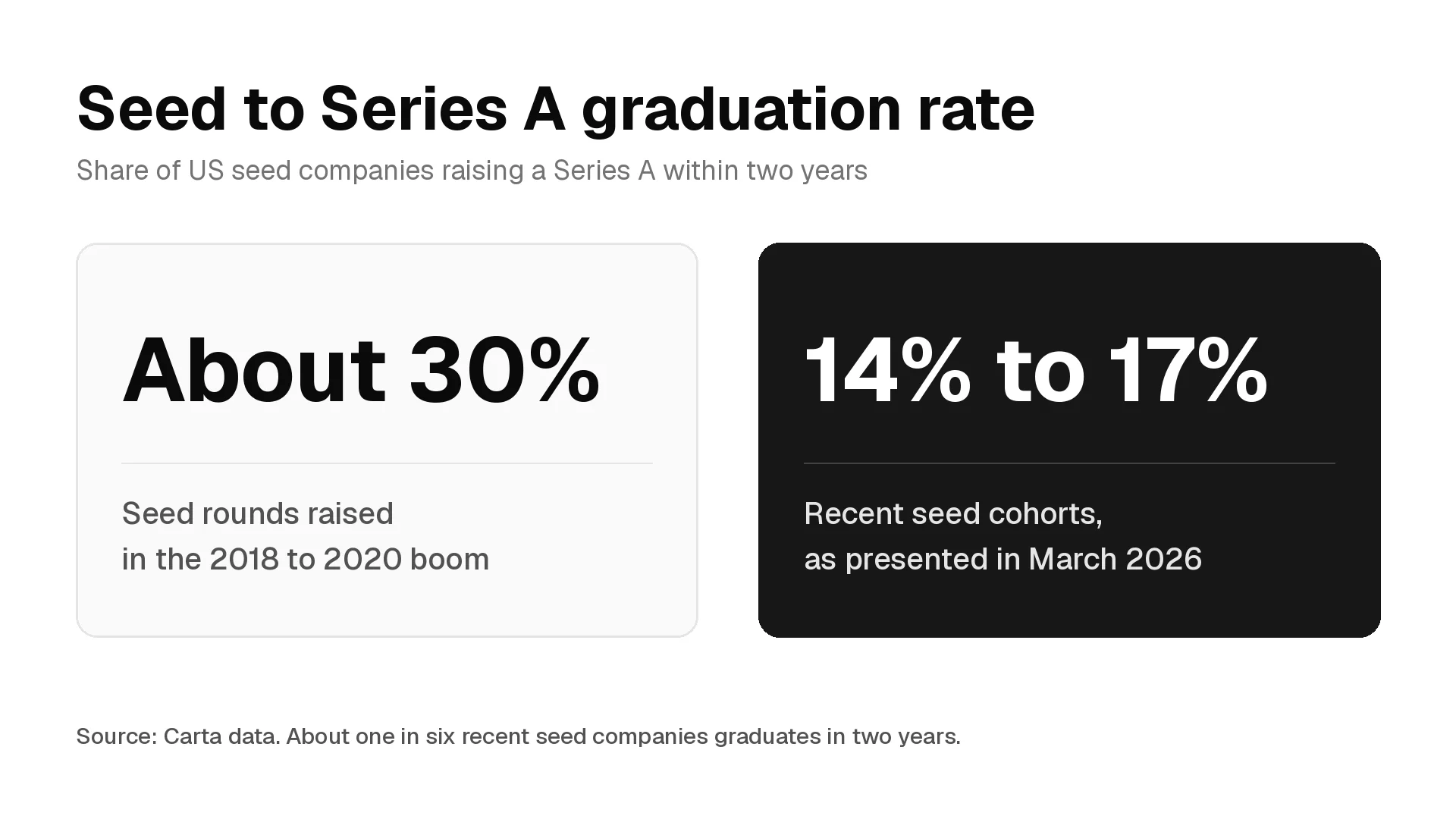
Seed to Series A graduation rates by cohort from Carta and Crunchbase, how long the jump takes, why rates fell after 2021, why published figures disagree, and how seed and Series A firms use the rate for reserves, LP reporting, portfolio reviews and interviews.