

Series A funding is usually a startup’s first institutional priced-equity round after seed. Investors provide capital—normally in exchange for preferred stock—to scale a business that has credible evidence of customer demand, not simply an interesting idea.
There is no universal revenue, valuation, or cheque-size rule that turns a financing into Series A. The useful test is whether the company can show what works, explain what the new capital will scale, and accept the ownership and governance consequences of an institutional round.
Key takeaways
- Series A normally funds scaling: a repeatable growth engine, a larger team, deeper product capability, or entry into a proven adjacent market.
- The round name is not a legal performance certificate. Business maturity, the financing instrument, and market convention all matter.
- Size the raise from milestones, cash needs, and downside runway; use market medians as context, not as a target.
- Model dilution on a fully diluted cap table, including converting SAFEs or notes and any option-pool increase.
- Prepare investor fit, data-room evidence, and non-price term-sheet decisions before outreach.
Series A funding, in one minute
A Series A round is typically the first significant institutional financing in which a startup and its investors agree a valuation and issue a new class of preferred shares. The money is intended to scale evidence produced during the seed stage: stronger retention, repeat purchases, technical validation, an efficient acquisition channel, or another proof point appropriate to the business.
Three ideas are easy to conflate:
| Question | What it tells you | What it does not tell you |
|---|---|---|
| What is the round called? | Where the financing sits in the company’s narrative and stock series | Whether the business is healthy or the terms are good |
| What security is issued? | Whether investors buy preferred stock now or hold an instrument that converts later | How effectively the company will use the money |
| What has the company proved? | Whether the capital can scale something that is beginning to work | A universal revenue or growth threshold |
The name “Series A” comes from the class of preferred stock commonly issued in the financing. In practice, round labels vary. A company may raise a large seed round, a small Series A, or an A-1 extension. Amount alone does not settle the definition.
The company receives cash and often a long-term relationship with a lead investor. Investors receive an ownership stake and negotiated rights that may cover board representation, information, future financings, major corporate decisions, and proceeds in an exit. Those rights make Series A more than a larger seed cheque.
Series A vs seed vs Series B
Funding stages are better understood by the proof available and the work the capital must fund.
| Stage | Evidence available | Main use of capital | Typical financing change | Next proof point |
|---|---|---|---|---|
| Seed funding | A credible product or technical thesis, defined customer, and early adoption or validation | Find product-market fit and a repeatable path to value | SAFEs, convertible notes, or priced seed equity; governance may remain light | Show that a specific model deserves to be scaled |
| Series A | Stronger evidence of demand, retention or repeat use, growth quality, and a scalable operating plan | Build the team and systems to scale the proven model | Priced preferred equity, a lead investor, deeper diligence, and more formal governance | Demonstrate that growth can compound with control over economics and execution |
| Series B | A larger customer or user base, more mature management, and a record of scaling | Expand market reach, capacity, product lines, or geography | Larger syndicate and more complex ownership/governance considerations | Build durable market position and later-stage operating discipline |
These are market patterns, not statutory definitions. A life-sciences company may be Series A-ready based on preclinical or regulatory progress before revenue. A bootstrapped software company may have substantial revenue before it raises institutional capital. The correct evidence depends on what must be true for that business to scale.
How much is a Series A round in 2026?
Current data is useful only when its scope stays attached. J.P. Morgan’s H1 2026 Startup Insights report shows a $15 million median Series A deal size and a $49 million median pre-money valuation, implying about 23% dilution in a simplified single close.
That is not a universal target. The report’s dashboard covers 2020 through Q1 2026, uses Federal Reserve Bank of St. Louis and PitchBook data, includes only deals with a disclosed transaction amount for deal-size statistics, and extrapolates Q1 2026 activity for the full year. The report also notes that PitchBook analysts did not review the data. “Median” describes the middle disclosed deal in the dataset; it is not the amount a founder should request or the valuation an investor should accept.
Sector, capital intensity, geography, market conditions, founder leverage, and the next milestone can move a round far from the median. A company that copies a market number before building its operating plan has the logic backwards.
Calculate the raise from milestones, runway, and dilution
Start with the operating result the round must buy. Then model the cash required to reach and measure it.
Target raise = milestone operating cost + buffer and one-off costs − cash available for the plan
Build the inputs explicitly:
- Milestone operating cost: monthly net cash use multiplied by the planning period chosen for the milestone.
- Buffer: cash reserved for delays or a downside case, defined by the board and management rather than copied from a generic rule.
- One-off costs: major hiring fees, security work, certification, manufacturing setup, or other non-recurring items required by the plan.
- Cash available: unrestricted cash and conservative cash generation that can actually fund the plan.
Consider a hypothetical software company using $550,000 of net cash each month. Management chooses an 18-month plan to prove repeatable enterprise expansion, budgets $1.1 million for contingency and one-off security work, and can allocate $1 million of existing cash to the plan.
| Input | Calculation | Amount |
|---|---|---|
| Operating plan | $550,000 × 18 months | $9.9M |
| Buffer and one-off work | Set from the downside plan | $1.1M |
| Less cash available | Existing unrestricted cash | ($1.0M) |
| Calculated target | $9.9M + $1.1M − $1.0M | $10.0M |
The $10 million result is a planning output, not proof the company can raise that amount. The team must still test whether the plan is coherent at a minimum close, whether the milestone justifies the ownership sold, and which spending can be gated if evidence arrives late.
Use pre-money valuation, post-money valuation, and a fully diluted cap table to cross-check the financing cost. If the required cash implies unacceptable dilution, the answer may be a narrower milestone, slower spending, more operating revenue, or a different capital source—not optimistic arithmetic.
Is your startup ready for Series A?
Series A readiness is the ability to support a scaling claim with evidence. A polished deck cannot compensate for uncertainty about who receives value, why they stay, or what the next dollar changes.
| Readiness question | Evidence to prepare | Red flag |
|---|---|---|
| Does the product create repeatable value? | Retention, repeat purchase, usage depth, referenceable customers, technical validation, or another outcome tied to the model | Growth depends mainly on one-off promotions, founder heroics, or an unrepeatable customer |
| Is there a credible growth engine? | Cohort trends, pipeline conversion, sales-cycle data, channel performance, marketplace liquidity, or tested distribution | The plan assumes a larger sales or marketing team will discover the channel after the round |
| Can growth become economically durable? | Gross margin or contribution logic, acquisition cost, payback reasoning, service burden, infrastructure cost, and downside cases | Top-line growth hides deteriorating retention, subsidies, or delivery costs |
| Is the market large and reachable? | Bottom-up customer count, buyer urgency, competitive position, and a believable entry wedge | A large top-down market with no mechanism for winning the first segment |
| Can the team execute the next phase? | Clear ownership of product, commercial, technical, finance, and hiring priorities; honest gaps and hiring sequence | The hiring plan adds headcount without explaining decisions or capabilities it unlocks |
| Is the financing foundation clean? | Reconciled cap table, documented grants and convertibles, assigned IP, material contracts, and reliable financial records | Undocumented equity promises, disputed IP, or numbers that change between the deck and data room |
| Does the use of funds buy a measurable result? | Milestone budget, base/downside plan, spending gates, and the proof expected before cash runs low | “Grow the team” or “expand marketing” without a falsifiable operating outcome |
Readiness does not mean every metric is perfect. It means the team understands the strongest evidence, the weakest assumption, and how the capital changes both.
Proof depends on the business model
A single annual-recurring-revenue threshold cannot evaluate every Series A company. Investors need proof that fits the value loop.
| Business model | Evidence that matters | Common false positive |
|---|---|---|
| B2B SaaS | Cohort retention, expansion, sales-cycle repeatability, implementation burden, gross-margin path | Booked annual value that has not converted into durable usage or cash |
| Marketplace | Liquidity in a defined market, repeat transactions, supply quality, take-rate and contribution logic | Gross transaction volume purchased with incentives that disappear after subsidies |
| Consumer | Retained usage, organic or efficient distribution, frequency, engagement quality, monetization path | Downloads or registrations without durable behavior |
| Deep tech or hardware | Reproducible technical performance, manufacturing feasibility, unit-cost path, design partners, certification plan | A successful prototype with no production or customer evidence |
| Life sciences | Scientific validation, development milestones, regulatory plan, clinical or preclinical evidence appropriate to stage | Treating a large addressable market as a substitute for development-risk evidence |
The decision is stronger when founders can name the next proof point in one sentence: “This round funds X work so that Y evidence exists by Z decision date.”
How the Series A process works
The process is easier to manage when each phase produces a reviewable artifact.
Set the milestone and financing plan
Define the operating result first. Build a base and downside cash plan, a minimum viable close, a target raise, and spending gates. Agree internally which assumptions would cause the team to slow hiring or change scope.
Build an investor-fit list
Research firms before asking for introductions. A recognisable logo is not enough.
| Fit factor | Question to answer |
|---|---|
| Stage | Does the firm actively lead or participate in Series A rounds? |
| Sector and business model | Has the team demonstrated useful judgment in this market without imposing a copied playbook? |
| Geography | Can the fund invest where the company is incorporated and operates? |
| Initial cheque | Does the target investment fit the firm’s current range and the round construction? |
| Ownership target | Can the firm’s desired stake coexist with the company’s dilution plan and syndicate? |
| Reserves | Does the fund typically reserve capital for follow-ons, and what does support depend on? |
| Portfolio conflicts | Could an existing investment create commercial or information conflicts? |
| Board relationship | Is the proposed partner someone the founders can work with through hard decisions? |
The Venture Capital Careers companies directory is a starting point for building the list. Verify each firm’s current stage, sector, geography, cheque size, portfolio, and team on the firm’s own site before outreach.
Prepare the narrative, model, and data room
The deck should connect customer problem, product, proof, market, growth model, team, and use of funds. The operating model should reconcile with the deck and show which assumptions drive cash. The data room should support both rather than introduce a second version of the company.
Run outreach and partner meetings
Use a concentrated process so investors evaluate roughly the same evidence at the same time. Track questions by category. Repeated objections usually reveal a weak proof point, unclear narrative, or investor-fit problem; fix the evidence rather than memorising a smoother answer.
Select a lead and evaluate the term sheet
A lead investor commonly anchors the round, sets or negotiates principal terms, and helps form the syndicate. Compare the complete relationship: partner, ownership, board role, references, reserves, and non-price terms—not only valuation.
Complete diligence, definitive documents, and closing
After a term sheet, investors and counsel test commercial, financial, technical, legal, and ownership claims. The definitive document set is longer and more consequential than the term sheet. Closing occurs after the agreed conditions and documents are complete; the company then updates its cap table, governance records, budget ownership, and reporting cadence.
No fixed timeline applies to every raise. Preparation quality, investor fit, market conditions, diligence findings, and negotiation can shorten or extend the process.
What Series A investors evaluate
The investor is testing whether the evidence supports the proposed scale-up and whether the risks are understood.
| Review area | Core question | Evidence founders should prepare |
|---|---|---|
| Customer and product | Does the product solve an urgent problem repeatedly? | Cohorts, usage, references, loss/churn analysis, product roadmap, technical results |
| Market and competition | Is the reachable opportunity large enough, and why can this company win? | Bottom-up market model, buyer map, competitors, differentiation, distribution wedge |
| Growth engine | Can acquisition or adoption repeat without founder-only effort? | Funnel and channel data, sales cycles, conversion, marketplace liquidity, partnerships |
| Economics | Does each new customer, transaction, or unit improve or damage the model? | Revenue quality, margin bridge, acquisition/service costs, payback logic, downside cases |
| Team | Can this group lead the next operating phase? | Organisation chart, role ownership, hiring plan, references, key-person risks |
| Finance | Does the model reconcile with actual cash and operating results? | Historical statements, budget vs actuals, forecast assumptions, runway and tax records as relevant |
| Cap table | Is ownership complete and understood before and after the round? | Fully diluted cap table, option grants, SAFEs, notes, warrants, side letters, pro forma model |
| Legal and IP | Can the company support its ownership and contractual claims? | Formation and board records, IP assignments, material customer/vendor contracts, disputes |
| Security and regulation | Are material obligations known and managed? | Policies, audits, incident history, licences, regulatory plan—only as relevant to the business |
The VCC venture capital due diligence checklist explains the investor workflow in more depth. For founders, the practical rule is simple: every headline claim in the deck should have supporting evidence, an owner, and a consistent number in the data room.
Build the Series A data room before outreach
A clean data room reduces avoidable delay and signals operating discipline. Access should be controlled, staged, and tailored with counsel; not every document belongs in the first investor view.
- Corporate and governance: certificate, bylaws, board and shareholder approvals, subsidiaries, and prior financing records.
- Capitalisation: current and fully diluted cap table, equity plan, grant records, SAFEs, notes, warrants, side letters, and a pro forma Series A model.
- Financial: historical statements, current cash, budget versus actuals, forecast, revenue detail, debt, tax records, and material liabilities.
- Commercial: customer concentration, contracts, pipeline evidence, churn or repeat-use analysis, pricing, partnerships, and material supplier arrangements.
- Product and technology: roadmap, architecture or technical materials appropriate to the company, development process, reliability, security, and technical diligence evidence.
- People: organisation chart, key employment and contractor agreements, option documentation, hiring plan, and material disputes.
- Legal and IP: invention assignments, patents or trademarks where relevant, licences, privacy terms, litigation, and material regulatory matters.
For US venture financings, the NVCA model legal documents show the coordinated agreements commonly used as a starting point, including the certificate of incorporation, stock purchase agreement, investors’ rights agreement, voting agreement, and right of first refusal/co-sale agreement. They are reference materials, not a substitute for company-specific legal advice.
Terms that matter beyond valuation
Headline valuation affects ownership, but control and economic rights determine how that ownership behaves. Y Combinator’s Series A term-sheet explanation makes the point directly: pricing is company-specific, while board and control provisions can create consequences founders underestimate.
| Term | Plain-English effect | Founder question |
|---|---|---|
| Board composition | Determines who appoints directors and how board decisions are controlled | Who controls the board now, and what changes if a founder leaves? |
| Liquidation preference | Sets how preferred holders participate in proceeds before or instead of common holders | What happens at an exit below, near, and above the post-money valuation? |
| Anti-dilution | Adjusts preferred-stock economics in specified lower-priced financings | Which formula applies, and what scenarios trigger it? |
| Protective provisions | Gives preferred holders approval rights over specified major actions | Which financing, sale, budget, debt, or governance decisions require investor consent? |
| Pro rata rights | Lets eligible investors maintain ownership in later rounds, subject to the documents | How much future allocation could existing investors claim? |
| Option-pool treatment | Determines the size and timing of the employee pool, which affects who bears dilution | Is the pool increase included before or after the new investment, and is the hiring plan credible? |
| Dividends | Defines whether and how preferred holders accrue or receive dividends | Are dividends cumulative, and how would they affect exit proceeds? |
| Tranches | Releases capital in stages tied to dates or milestones | Are milestones objective, achievable, and within management’s control? |
| No-shop | Restricts the company from pursuing alternative financing for an agreed period | Is the restriction proportionate to the investor’s diligence and closing plan? |
| Information rights | Requires specified financial and operating reporting | Can the company produce the information reliably, and who receives it? |
Read the complete term sheet as a package. A higher valuation paired with tighter control, a larger pre-money option-pool increase, or adverse exit economics may be worse than a lower headline price with cleaner terms. Qualified venture counsel should model the actual documents and explain how provisions interact.
A simple Series A dilution example
Suppose a company agrees a $40 million pre-money valuation and raises $10 million of new primary capital.
- Post-money valuation: $40 million + $10 million = $50 million.
- Headline new-investor ownership: $10 million ÷ $50 million = 20%.
- Existing holders collectively retain 80% immediately after the new cash in this simplified case.
That 20% is not automatically the final cap-table outcome. SAFEs or notes may convert in the financing. The option pool may be increased, often affecting pre-financing holders depending on the negotiated structure. Secondary sales, warrants, multiple closings, or other terms may also change ownership.
Model the fully diluted share count before signing:
- issued common and preferred shares;
- granted and available options;
- converting SAFEs and notes, including applicable caps or discounts;
- warrants and other rights to acquire shares;
- the proposed option-pool change; and
- the new Series A shares.
The calculation is not only “How much do founders own?” It is also “Does the remaining ownership align the team, leave room to hire, and support later financings?”
When not to raise Series A
Series A is a poor fit when the capital would mainly fund the search for product-market fit rather than scale evidence that already exists. Pause or redesign the financing if:
- the use-of-funds plan is a headcount list with no measurable operating outcome;
- weak retention, repeat purchase, technical reproducibility, or unit economics would worsen at scale;
- the target raise comes from a market median rather than a cash model;
- the cap table, IP ownership, financial records, or material contracts are not ready for diligence;
- founders do not understand the board, control, and exit implications of the proposed terms; or
- the business is unlikely to produce venture-scale outcomes and would be pressured into an unsuitable growth model.
Alternatives depend on the company. A team might narrow the seed milestone, use operating revenue, seek a strategic customer or grant where appropriate, or delay hiring. A bridge can create time but should buy a defined proof point rather than postpone the same problem. Venture debt introduces repayment and covenant risk and is not a substitute for an equity story that does not work.
The central discipline is to finance the business the company is actually building. Fundraising itself is not the milestone. As Y Combinator has argued, the durable milestone is value created for customers and the evidence that the company can keep creating it.
The first 90 days after closing
The close should trigger an operating reset, not a celebration followed by ungated spending.
- Translate the financing plan into budget ownership. Assign each major use of funds to an executive, a decision date, and an outcome measure.
- Sequence hiring. Tie roles to capabilities the next milestone requires; avoid filling the entire plan before early evidence confirms the path.
- Establish governance. Set board dates, approval thresholds, information flows, and a reporting calendar consistent with the new documents.
- Instrument the proof points. Make retention, sales, technical, marketplace, margin, or regulatory progress visible before the first formal review.
- Preserve the downside plan. Define the cash or evidence thresholds that slow hiring, narrow a market, or stop an experiment.
- Communicate with investors. Report decisions, evidence, risks, and asks—not only product releases, meetings, and headcount.
The round has done its job when the company reaches a materially stronger operating position before the cash runs low. The next financing, sustainable growth, strategic transaction, or decision not to raise again should follow from that evidence.
Series A funding FAQs
What qualifies a startup for Series A funding?
There is no single qualification. Investors usually expect credible evidence of customer or technical value, a large reachable market, a team capable of the next phase, clean financing records, and a specific plan for turning new capital into scalable results. The evidence differs by business model.
How much should founders own after Series A?
No percentage is correct for every company. Founders should model the complete post-financing cap table and ask whether the ownership sold buys enough progress, keeps the team aligned, supports hiring, and leaves room for future rounds. J.P. Morgan’s H1 2026 figures imply about 23% dilution in a simplified median Series A close, but that is descriptive context—not a recommendation or a fully diluted cap-table model.
Does a company need revenue to raise Series A?
Not always. Revenue quality is powerful evidence for many software and commercial businesses, but life sciences, deep tech, and other capital-intensive companies may be evaluated on technical, clinical, regulatory, manufacturing, or customer-validation milestones before meaningful revenue. The company still needs evidence appropriate to its risk.
Is Series A always preferred stock?
Series A is commonly a priced preferred-stock financing, which is also the source of the “Series A” name. Market usage is not perfectly uniform, so the actual security and rights in the documents matter more than the label.
How hard is it to raise Series A funding?
It is a selective, evidence-intensive process. Difficulty depends on company quality, investor fit, market conditions, preparation, and negotiating leverage. A founder cannot control the market, but can control whether the proof, model, cap table, data room, and investor list tell one consistent story.
Can existing seed investors join the Series A?
Yes, existing investors may participate, including through negotiated pro rata rights. The lead and company decide the broader allocation subject to existing rights and the final round structure.
What comes after Series A?
Possible next steps include Series B, another extension or bridge, sustainable growth without another equity round, debt or strategic capital where suitable, acquisition, or closure. Series B is appropriate when the company has stronger evidence that it can scale the model and needs capital for the next expansion—not simply because the Series A runway is ending.
Research potential investors by stage, sector, geography, and portfolio in the Venture Capital Careers companies directory, then confirm each firm’s current mandate on its own website. The right Series A partner must fit the financing and the board relationship, not just the round announcement.
Related posts
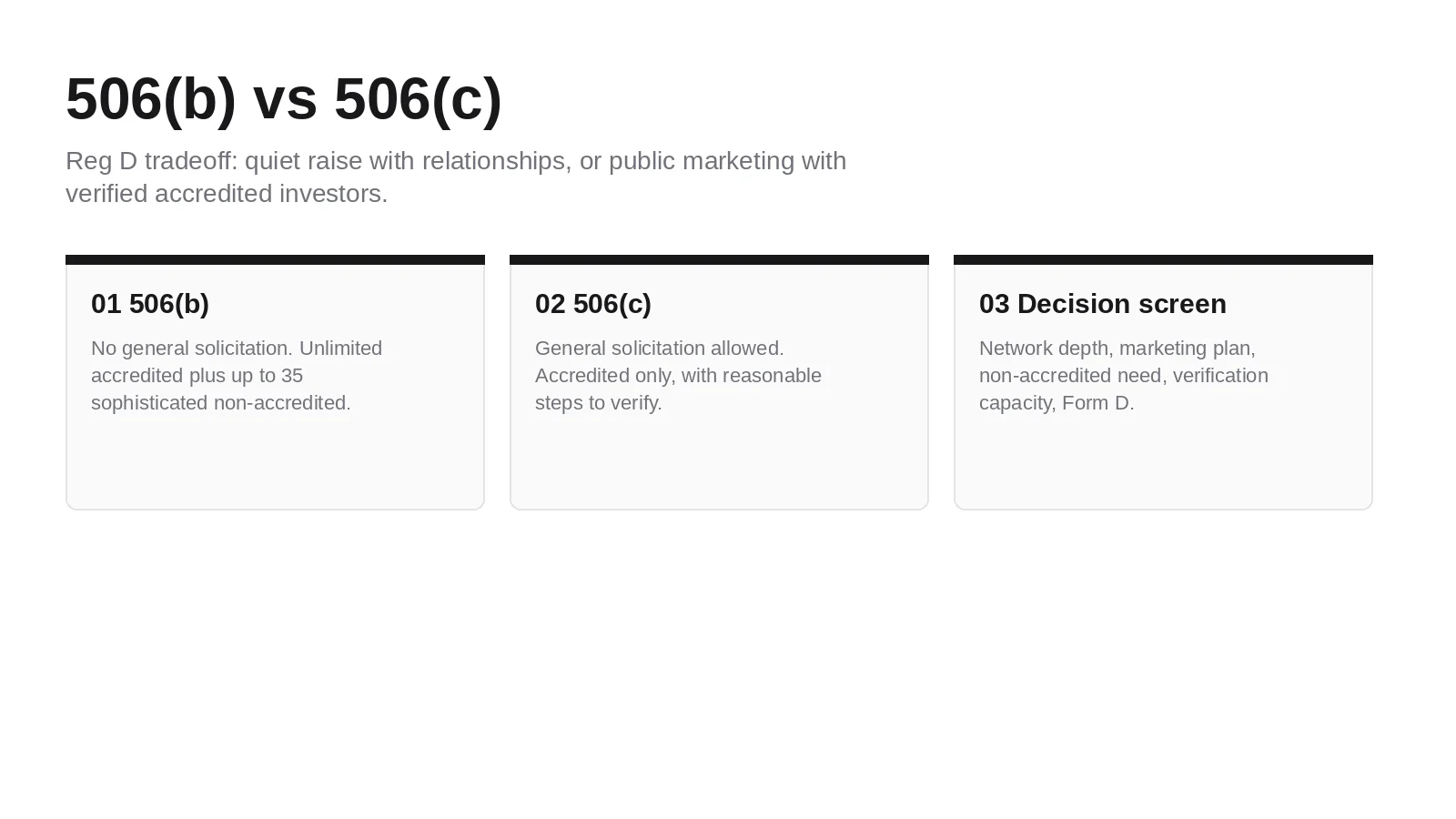
Rule 506(b) bans general solicitation but eases verification. Rule 506(c) allows advertising but requires verified accredited investors. Comparison and decision screen.
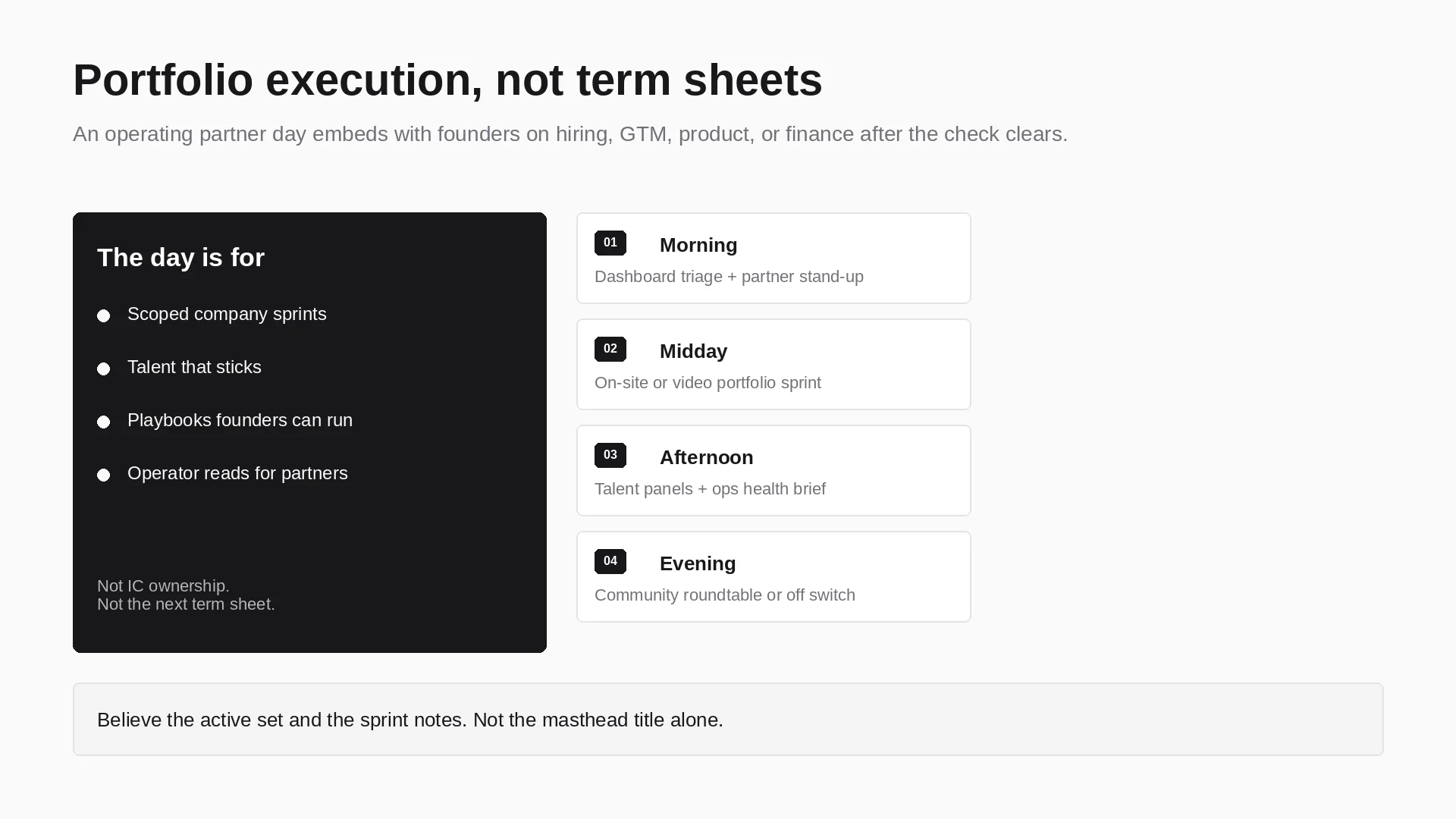
A practical day-in-the-life guide for venture capital operating partners, with a timestamped schedule, fund-type variants, role contrasts, and a path into open roles.
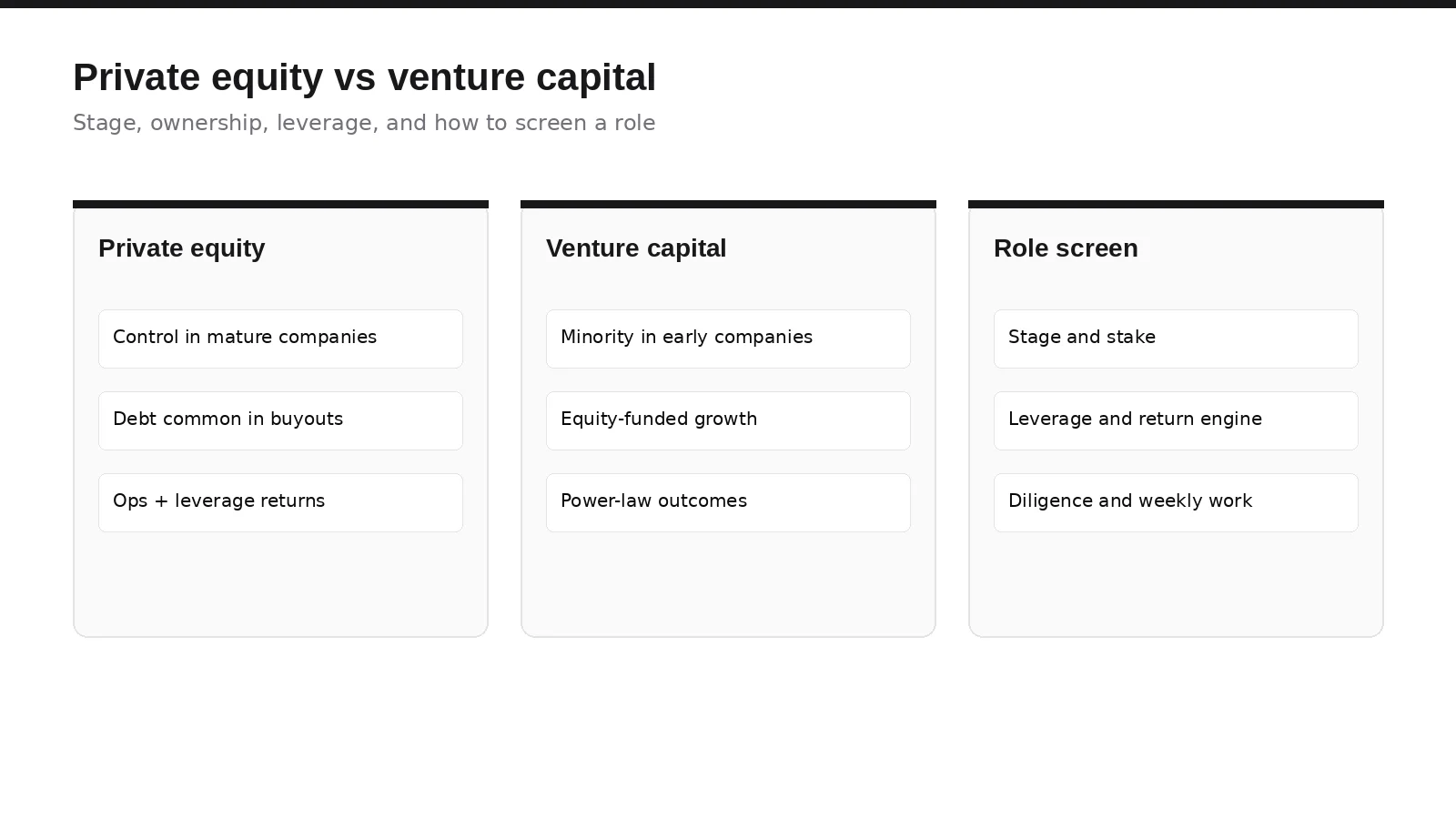
Private equity buys control in mature companies, often with debt. Venture capital takes minority stakes in early-stage companies. Comparison table, return shapes, and how to screen a role.