
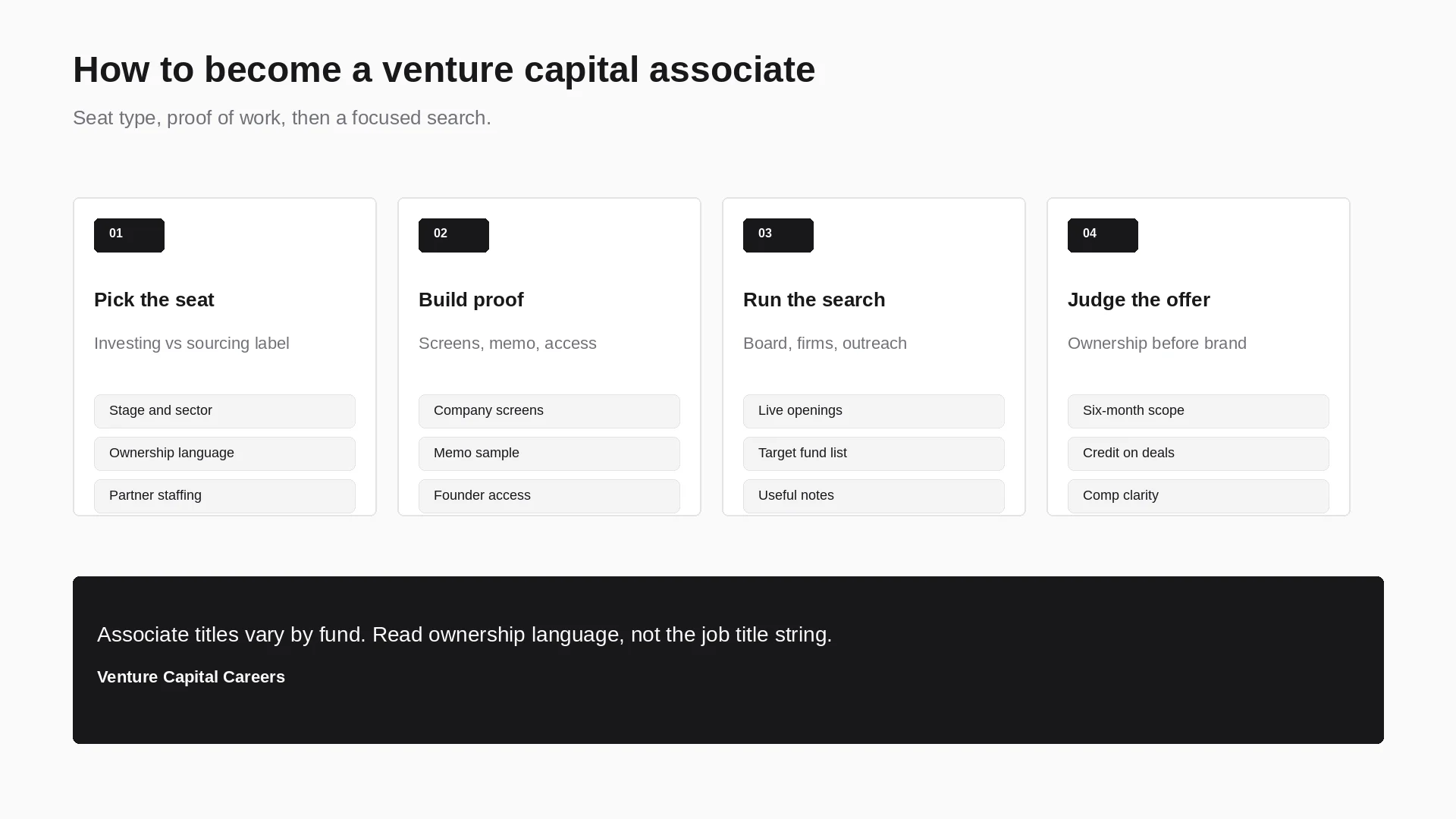
A venture capital associate is a salaried hire who supports partners on sourcing, diligence, deal execution, and portfolio work. Most funds hire associates after banking, consulting, operating, or analyst experience. The title is not standardized. At one firm "associate" means post-MBA investor. At another it means a pre-MBA sourcer or a platform hire with an investing-adjacent label.
If you want the junior entry seat that exists mainly at larger platforms, start with how to become a venture capital analyst. If you want any VC job and have not picked a seat type yet, use how to get a job in venture capital. This page is for people targeting the associate layer specifically.
What a venture capital associate actually does
The core job is to make partners faster and safer on decisions they still own.
Typical ownership:
- Build and work a pipeline of thesis-fit companies
- Run first meetings and write crisp screens before a partner spends real time
- Lead or support diligence: market, product, customer, competitive, and basic financial work
- Draft memos and organize materials for investment committee
- Help close process: data room coordination, reference calls, model checks
- Support portfolio companies when the firm actually staffs associates that way
What associates usually do not do on day one:
- Commit the fund or set terms alone
- Own a board seat
- Raise the next fund
- Replace partner judgment on conviction calls
For a copy-ready posting template, see the venture capital associate job description. For a timestamped week, see the day in the life of a VC associate.
Associate vs analyst titles (and why postings lie)
Do not trust the title string alone.
| Signal | More analyst-like | More associate-like |
|---|---|---|
| Background asked | Undergrad or early analyst | IB/consulting/operator, MBA, or promoted analyst |
| Ownership language | Support, coverage, models | Own screens, lead founder calls, drive diligence workstreams |
| IC exposure | Observe or draft under heavy edit | Present pieces of the memo; still partner-owned decision |
| Comp framing | Analyst band | Associate band; sometimes carry language |
| Hiring season | Campus / early career | Off-cycle lateral and MBA more often |
Some emerging managers call their only junior hire an associate because they have no analyst layer. Some multi-stage firms use associate for post-MBA and analyst for pre-MBA. Read the analyst vs associate comparison before you optimize for the wrong posting.
Also separate investing associates from platform, talent, or community roles that reuse the associate title. If the posting never mentions pipeline ownership, diligence leadership, or IC materials, it may be a useful VC job without being an investing associate seat.
Backgrounds that actually convert to associate seats
Funds hire for pattern recognition under uncertainty. They look for people who can already do a piece of the job.
Common converting backgrounds:
| Background | Why funds buy it | Where it fits best | Weak spot to fix |
|---|---|---|---|
| Investment banking / growth equity | Diligence pace, modeling, process | Mid/late-stage and multi-stage | Founder fluency and thesis taste |
| Consulting | Structured problem solving, sector depth | Sector funds and platform-heavy firms | Deal ownership evidence |
| Operator / founder / product | Domain access and product judgment | Early-stage and specialist funds | Finance and IC writing craft |
| VC analyst promotion | Known judgment inside the firm | Same firm or peer funds | External network beyond internal pipeline |
| MBA | Compressed network and recruiting cycle | Funds that run MBA associate hiring | Proof beyond school brand |
Less common but real: research, corp-dev, and specialized technical paths into sector funds. Rare as a cold jump: pure career-switch with no founder access, no diligence craft, and no proof assets.
If your path is "I like startups," you are not ready to apply. Pick a background story that maps to work the fund already pays for.
Skills and proof-of-work funds hire for
Associates get hired for evidence, not enthusiasm.
Skills that show up in real screens:
- Written judgment: short company notes that state a clear yes/no and why
- Founder conversations that surface risk without turning into theater
- Market mapping and competitive framing
- Basic financial fluency appropriate to stage (unit economics early; fuller models later)
- Taste aligned to a thesis, not a generic "AI and climate" wish list
- Reliability on process: clean materials, tracked follow-ups, no dropped balls
Proof assets that beat vague networking:
- A small portfolio of company screens with dated notes and outcomes
- A sector map with a point of view, not a logo collage
- Warm access you can demonstrate ethically (community, customers, operators)
- Prior deal, diligence, or board-adjacent work you can discuss precisely
- A published or private memo that looks like IC material, not a book report
Build those assets while you still have a day job. Cold outreach without samples is noise.
Where associate seats show up
Associate hiring is thinner than analyst memes suggest. Many funds stay flat. When seats open, they show up through:
- Direct postings on firm sites and VC-specific boards
- MBA on-cycle at funds that still run it
- Off-cycle laterals when a partner needs coverage now
- Internal promotions from analyst or platform
- Referrals from founders, co-investors, and prior teammates
Use the Venture Capital Careers job board and companies directory to find live associate titles, then read each posting for ownership language. Filter for investing work, not brand names. Pair that with the recruiting timeline so you are not applying into a dead season for the fund type you want.
A 90-day plan to land an associate role
Treat this as an operating plan, not a motivation poster.
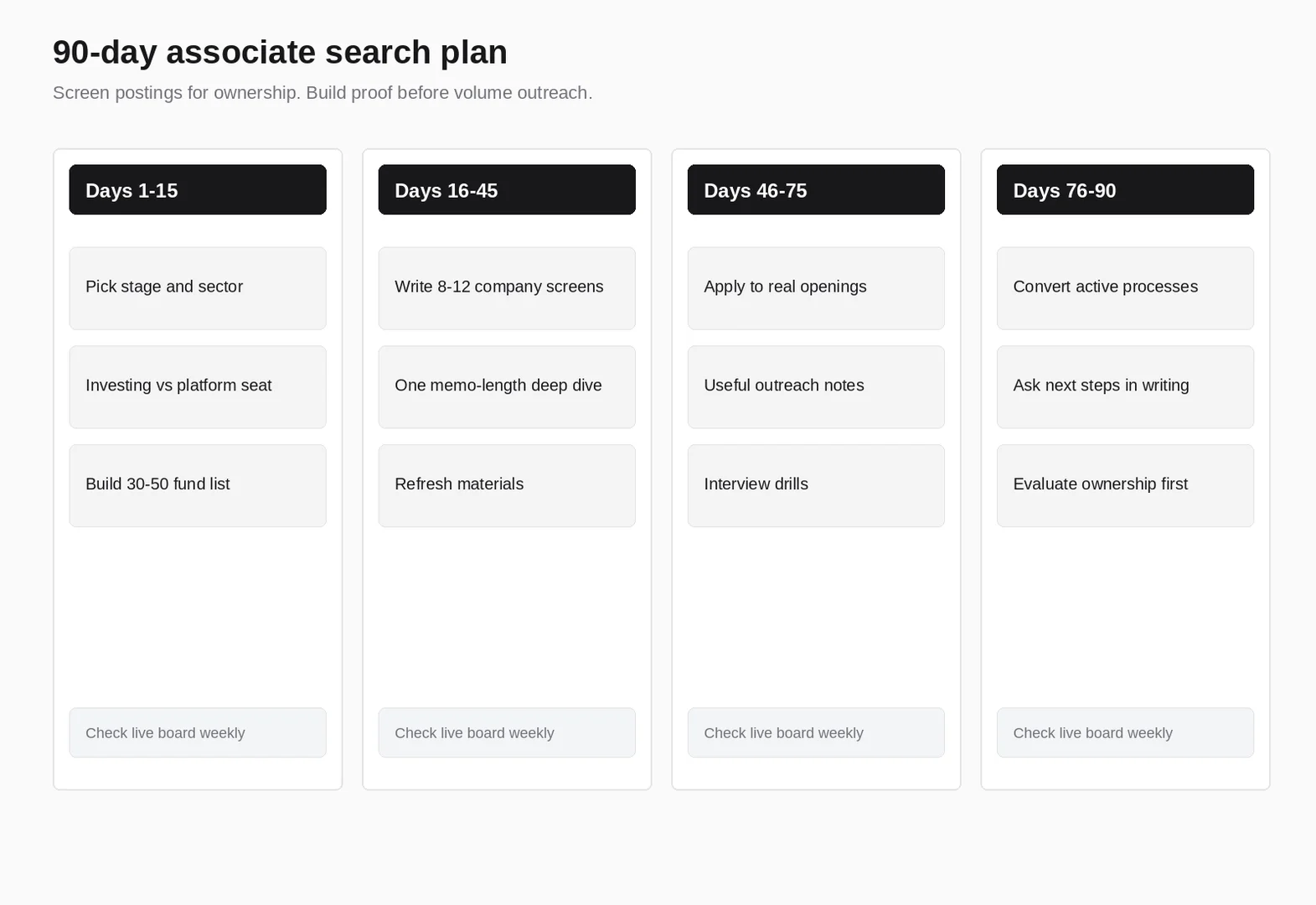
Days 1–15: pick the seat
- Choose stage and sector constraints you can defend.
- Decide investing associate vs platform/sourcing associate.
- Build a target list of 30–50 funds using companies and recent portfolio activity.
- Write one paragraph on why those funds, not "top VC."
Days 16–45: build proof and materials
- Produce 8–12 company screens in your thesis.
- Refresh resume and LinkedIn around evidence, not activity lists. Use the venture capital resume patterns and the associate cover letter only when a letter is asked for.
- Draft one memo-length deep dive you could discuss cold.
- Line up 5 people who can speak to your judgment, not just your friendliness.
Days 46–75: run outreach and applications
- Apply to real associate openings on the job board that match ownership language.
- Send short, useful notes to associates and principals at target funds. Lead with a company observation, not a biography.
- Track replies weekly. Drop funds that never hire juniors.
- Prepare interview drills from the venture capital interview questions hub and the case study interview guide.
Days 76–90: convert
- Push active processes; do not open 20 new fronts.
- Ask for next steps in writing after each round.
- When an offer appears, evaluate it with the checklist below before negotiating.
Create job alerts so new associate postings hit you while you are executing the plan.
Interviews and materials for associate seats
Associate interviews usually test judgment under incomplete information.
Expect some mix of:
- Why this firm and why associate now
- Walk me through a company you like and the risks
- Market or competitive questions in their thesis
- A take-home memo, market map, or case
- Partner conversations that feel like working sessions
Materials that help:
- Resume that shows ownership verbs and outcomes
- One or two writing samples that look like fund work
- Clean story for each prior role: what you owned, what you decided, what you got wrong
Do not outsource your answer to "I want to help founders." Partners hire people who can reduce their error rate. Practice aloud. Time yourself on a 5-minute company pitch and a 20-minute diligence deep dive.
Pay, hours, and promotion reality
Cash compensation for associates varies by firm size, city, and stage. Use the venture capital salary guide for current range framing rather than memorizing one number from a forum thread. Carry, when offered at associate level, is usually small, delayed, and contingent on fund performance. Do not underwrite your life on paper carry.
Hours are usually better than banking peaks and worse than a calm operating role. Deal spikes, IC weeks, and founder time zones still bend the calendar. The venture capital hours guide covers lifestyle tradeoffs without pretending every firm is the same.
Promotion is the part candidates romanticize. Some firms promote associates to principal on a visible track. Many do not. Associate can be a two-to-four-year tour that ends in another fund, an operating role, or a later return. Before you join, ask how many associates made principal in the last five years and what "good" looks like in year two. For the next ladder step later, see how to become a venture capital principal.
How to evaluate an associate offer
A brand-name fund with fuzzy ownership can be a worse career move than a smaller fund where you run real work.
Check:
- What you will own in the first six months
- How partners staff diligence and who presents at IC
- Whether the seat is investing, sourcing, or platform with an associate title
- Comp clarity: base, bonus, carry eligibility, vesting, and clawbacks
- Feedback cadence and whether associates receive credit on deals
- Historical associate outcomes: promotion, lateral, or exit
When you are ready to negotiate terms, use venture capital associate offer negotiation. Do not negotiate vibe. Negotiate scope, credit, and economics you can verify.
FAQ
Do I need an MBA to become a VC associate?
No. Many associates come from banking, consulting, operating roles, or internal analyst promotions. Some funds still hire heavily from MBA classes. Match the fund's actual hiring pattern instead of assuming school is required.
Is associate better than analyst?
Different seats. Analyst is often the earliest salaried investing role at larger firms. Associate usually assumes more ownership and a heavier prior resume. Title prestige without ownership is a bad trade. Compare scope using the analyst vs associate guide.
Can I go straight from undergrad to associate?
Rare at institutional funds. If a posting says associate for new grads, read the work. It may be an analyst seat with different naming, or a non-investing role.
How long does the search take?
Plan for months, not days. Off-cycle seats open irregularly. A focused 90-day sprint beats a year of vague coffee chats.
Should I take a scout or fellowship instead?
Those can be proof paths. They are not the same as a salaried associate seat. If your goal is associate, use them to produce screens and intros, then keep applying to real openings.
Next steps
- Browse open associate roles and note ownership language, not just logos.
- Research target firms in the companies directory.
- Set job alerts while you build screens and run outreach.
- Keep your ladder view honest with the venture capital career path guide.
The associate seat rewards people who already work like junior investors. Build the evidence, target funds that actually hire the seat you want, and judge offers by ownership.
Related posts
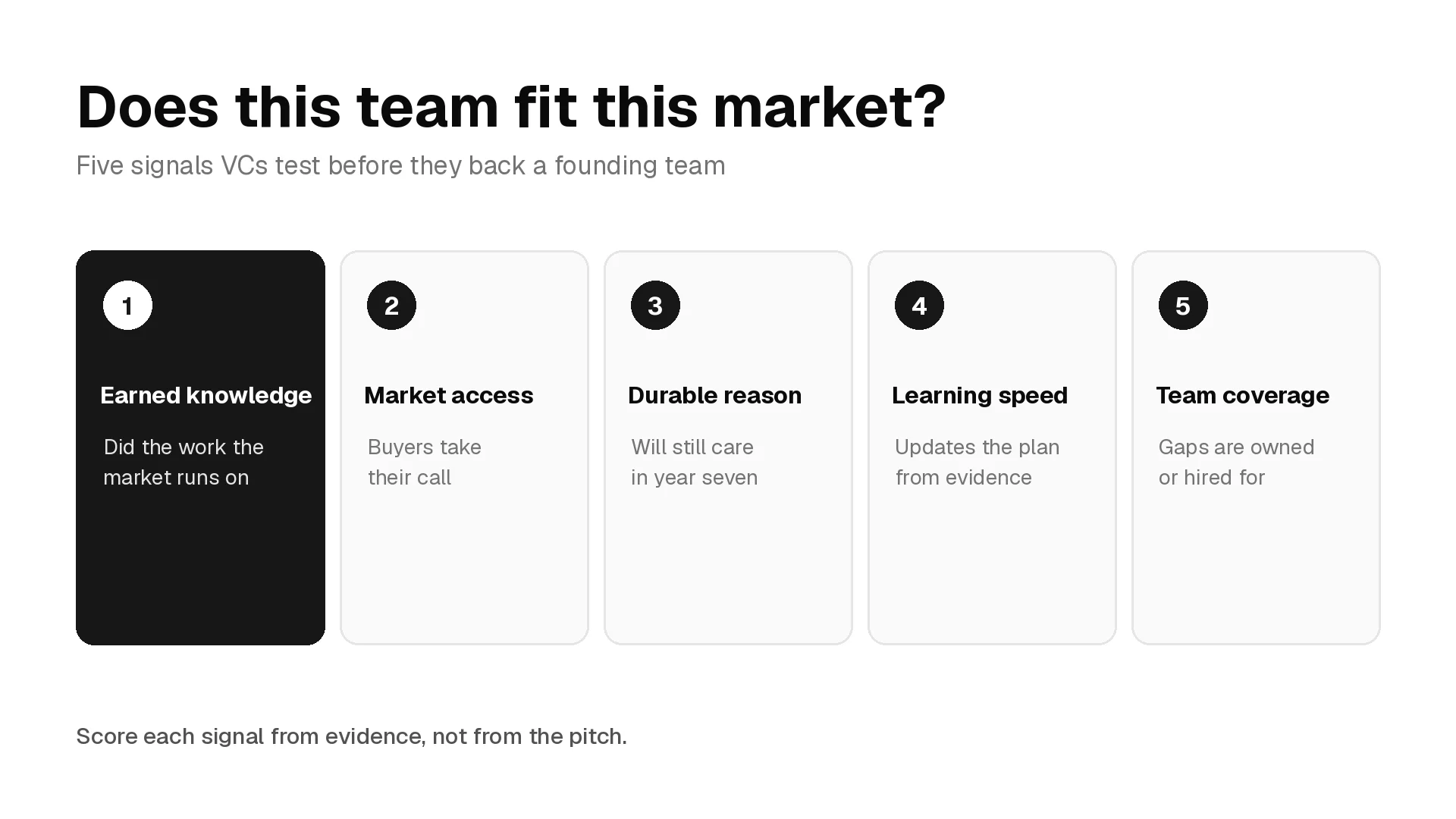
Founder-market fit is the match between what a founding team knows, can access and cares about, and what its market demands. How VCs weigh it, test it with evidence, score it, and write it into a memo or interview answer.
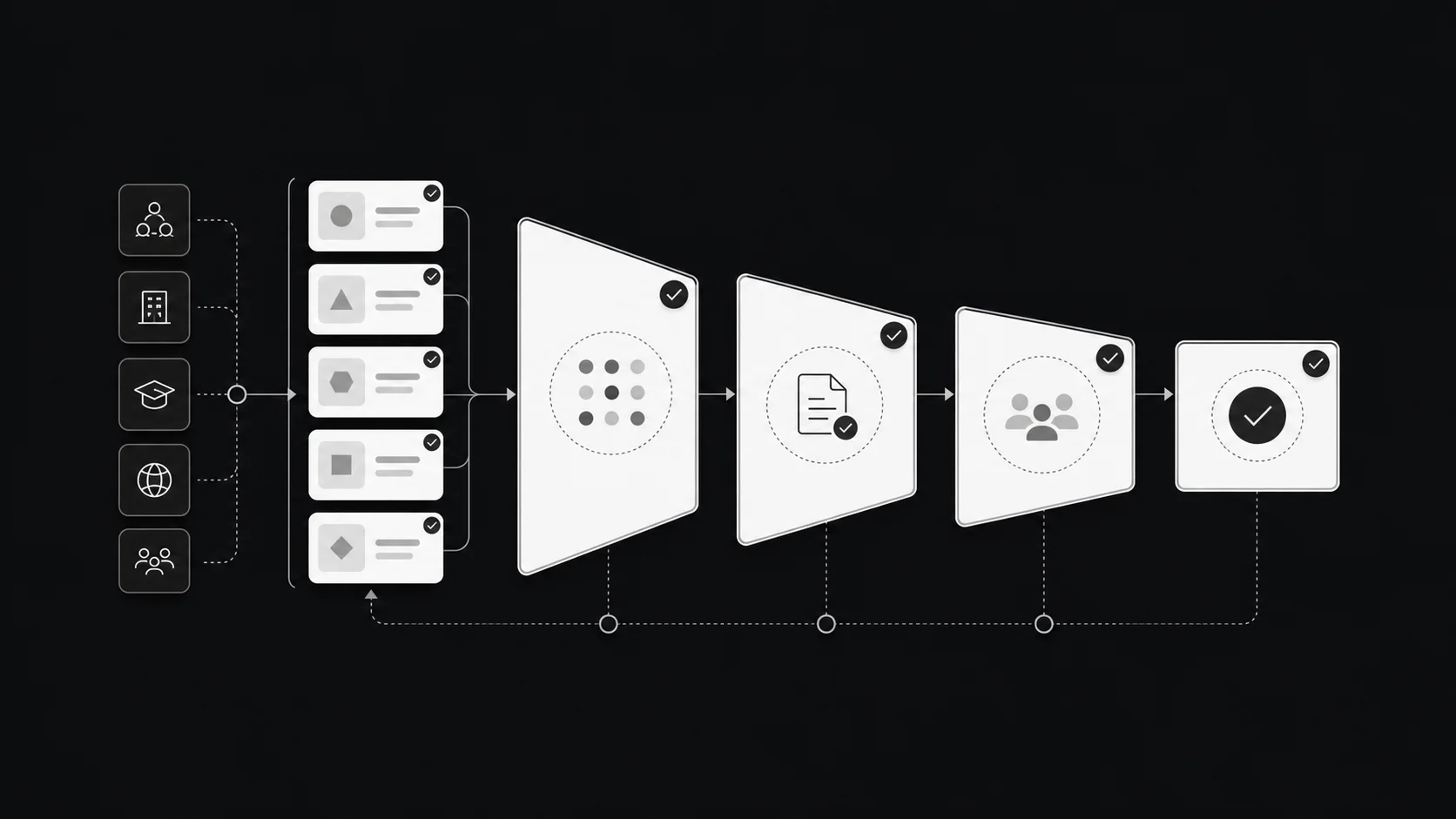
Deal flow is the stream of investment opportunities a venture firm receives and the funnel that sorts them. For every deal closed, firms consider about 101 companies.
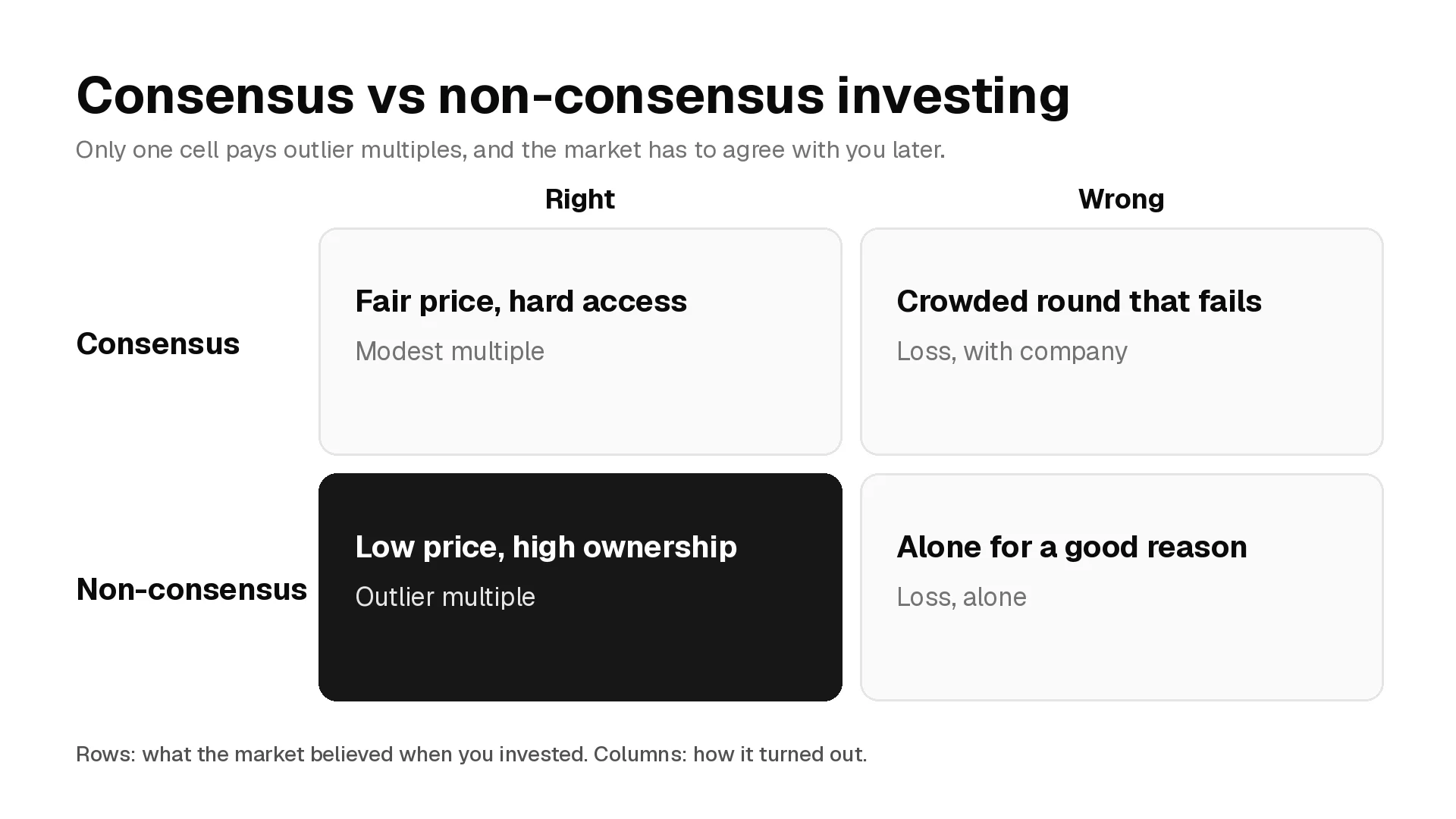
Non-consensus investing means backing a company most investors have passed on or not yet seen, for a reason you can state and test. How the 2x2 works, why firms drift toward consensus, how investment committees vote, and how analysts and associates bring a non-consensus deal.