
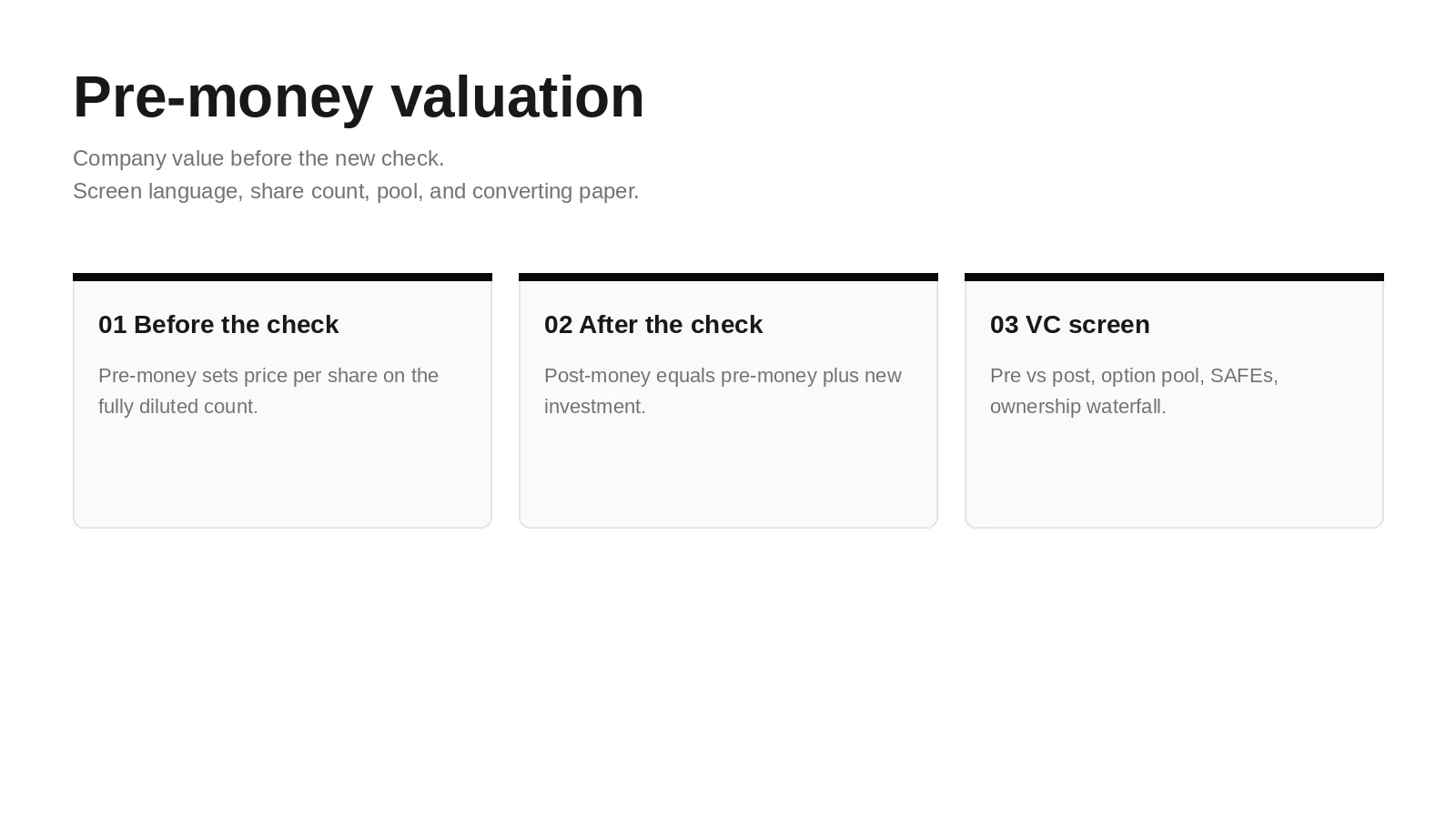
Pre-money valuation is the equity value of a company immediately before a financing round closes. The simple formula is:
Pre-money valuation = post-money valuation − new investment
If a startup raises $2 million at an $8 million pre-money valuation, the post-money valuation is $10 million. The investor who puts in the full $2 million owns 20% after the round, before option-pool increases and convertible instruments.
That number is what a term sheet is usually arguing about. It sets the price per share, how much of the company existing holders keep, and the entry price a fund has to underwrite.
What is pre-money valuation?
Pre-money valuation is the implied value of the company's equity before new cash is added. It is not a market price, a 409A fair-market value, or a guarantee of what the company would sell for tomorrow. It is a negotiated input.
In a priced equity round it answers three questions:
- What is the company worth before this check?
- What price per share does that imply on the cap table?
- How much of the company does the new money buy once the check clears?
The number is agreed alongside investment amount, option-pool size, share class, and investor rights. Reading the headline without those mechanics is how people mis-size ownership.
A SAFE or convertible note can postpone a priced pre-money. It does not erase the later comparison. When preferred stock is finally issued, someone still has to pick a pre-money and a share price.
Pre-money vs post-money valuation
Post-money valuation is the equity value after the new investment. Investor ownership is always calculated against the post-money number:
Investor ownership = investment amount / post-money valuation
The same spoken "ten million dollar valuation" is two different deals:
| Framing | Pre-money | Post-money | $2M investor owns |
|---|---|---|---|
| "$2 million at $10 million pre-money" | $10 million | $12 million | 16.7% |
| "$2 million at $10 million post-money" | $8 million | $10 million | 20% |
Ask which one is on the page. Convert every offer into all three figures — pre, post, and percent — before comparing term sheets.
If the new pre-money sits below the last round's post-money, the financing is a down round. If it sits above, the round is up. The label is about price per share, not about whether the company grew.
How to calculate pre-money valuation
Once the round size and ownership are known, invert the formula:
Post-money valuation = investment / investor ownership %
Pre-money valuation = post-money − investment
A $2 million check for 20% implies a $10 million post-money and an $8 million pre-money.
The version a cap table actually uses is share math.
Assume 8,000,000 fully diluted shares before the round (founders, employees, and outstanding options — the denominator the term sheet defines). The company raises $2 million at an $8 million pre-money.
| Step | Calculation | Result |
|---|---|---|
| Pre-money share price | $8,000,000 / 8,000,000 shares | $1.00 |
| New investor shares | $2,000,000 / $1.00 | 2,000,000 |
| Fully diluted shares after the round | 8,000,000 + 2,000,000 | 10,000,000 |
| Post-money valuation | 10,000,000 × $1.00 | $10,000,000 |
| Investor ownership | 2,000,000 / 10,000,000 | 20% |
The share price does not change just because cash hit the balance sheet. Existing holders keep the same number of shares. Their percentage falls because new shares were issued.
If any two of investment, ownership, pre-money, or post-money are known, the other two follow. That is all a calculator does.
Option pool, SAFEs, and the fully diluted share count
Three details change how a stated pre-money feels in practice. They are why two term sheets with the same headline are not the same deal.
Option-pool placement
Investors often require an option-pool increase so the company can hire after the round. If that pool is created or expanded in the pre-money, existing holders take the dilution and the new investor does not.
Take the $8 million pre-money, $2 million raise again. Require a pool equal to 15% of the post-money company, built before the new money.
| Holder after close | Ownership |
|---|---|
| New investor | 20% |
| Option pool | 15% |
| Founders and other existing holders | 65% |
The headline pre-money is still $8 million. The effective value of the existing shares is lower because 15 points of the company were reserved for future employees before the investor's 20% was measured. A founder-friendly alternative is to size the pool after the money comes in so new investors share that dilution. The term sheet has to say which one it is.
SAFEs and notes already outstanding
Y Combinator's SAFE documents have used a post-money SAFE as the standard US form since 2018. On that form, ownership sold equals the SAFE amount divided by the valuation cap, and the cap is "post" all SAFE money already raised. It is not post the later priced-round money, and it is not post a new option pool adopted as part of that priced round.
Those SAFEs still convert when preferred is issued. They eat shares in the pre-money of the priced round unless the term sheet says otherwise. A stack of uncapped or loosely capped instruments can move the founder percentage several points without changing the spoken pre-money. Model every converting instrument. Do not treat "pre-money $8 million" as a fully diluted fact until the conversion is in the spreadsheet.
Pre-money vs post-money SAFEs own the instrument comparison. This page only needs the conversion effect on a priced pre-money.
Preferred stock is not common stock
Most institutional rounds issue preferred shares. The NVCA model legal documents — certificate of incorporation, stock purchase agreement, voting agreement, and right of first refusal and co-sale — are the usual package. Preferred can carry liquidation preference, anti-dilution, and voting rights that common does not. The pre-money is the pricing wrapper around that security, not the economic whole.
What pre-money valuation does not tell you
It does not tell you cash in the bank after fees, enterprise value, or what a buyer would pay in an M&A process.
It does not tell you how proceeds split on a downside sale. A 1x non-participating preference and a 2x participating stack are different outcomes at the same headline.
It is not a 409A valuation. Fundraising pre-money and common-stock fair-market value used for option strike prices are related and not interchangeable. Mixing them is how companies create tax problems for employees.
It does not, by itself, say whether the round is expensive. That judgment needs growth, remaining dilution to exit, ownership the fund will hold, and the return multiple the entry price implies.
Methods such as discounted cash flow, public comps, and the First Chicago method can inform what someone is willing to pay. In an early venture round they rarely spit out the number on the term sheet. The term sheet number is a negotiation.
How a VC screens a pre-money number
Founder explainers stop at the slogan. The desk that underwrites the check runs a shorter list.
1. Confirm the language. Is the stated valuation pre-money or post-money? Convert to pre, post, and percent. If the verbal number and the term sheet disagree, the term sheet wins.
2. Rebuild price per share. Take the fully diluted denominator the document defines. Divide pre-money by that count. Do not use "shares outstanding" if the term sheet uses fully diluted, and the reverse.
3. Place the option pool. Size, whether it is pre-money or post-money, and whether unused prior pool is being recut. Recalculate founder and prior-investor percentages after the pool, then after new money.
4. Convert the paper. List every SAFE and convertible note: cap, discount, interest, and which of cap or discount bites. Put those shares in the pre-money unless the documents say they convert alongside new money. Watch for a post-money SAFE stack that already sold more of the company than the deck implies.
5. Read the security, not only the price. Preference multiple, participating or not, seniority, pro rata, and protective provisions. A cheaper pre-money with a heavy preference can be worse for common than a higher pre-money with a clean 1x non-participating pref.
6. Check the last round. New pre-money versus prior post-money tells you up, flat, or down. If it is down, the anti-dilution and pay-to-play work happens on those pages, not here.
What belongs in the memo. Pre / post / percent, price per share, fully diluted count, pool placement, converting instruments, ownership waterfall for founders, prior preferred, employees, and new money, and the entry price the fund is underwriting.
What does not belong. A generic essay on "how to value a startup," a methods tour, or a claim that this firm always pays X times revenue. Those belong in a textbook, not in the IC packet.
People who do this work for a living browse open roles on Venture Capital Careers and research venture capital firms by stage and sector while they learn the paperwork.
Common mistakes
Treating a spoken valuation as pre-money by default. If the investor meant post, you just sold extra points.
Ignoring the pool. A 15% pre-money pool on an $8 million pre-money is not a rounding error.
Ignoring converting paper. SAFEs and notes are not "off to the side" until they convert. They are in the denominator.
Using pre-money as a proxy for common-stock value. Option strike prices follow 409A, not the preferred round price.
Confusing a high pre-money with a good deal. Price is one term. Preference, pool, and next-round pressure travel with it.
Frequently asked questions
What is pre-money valuation in venture capital?
The company's agreed equity value immediately before new investment in a round. Add the new cash to get post-money. Divide the investment by post-money to get the new investor's ownership.
How do you calculate pre-money valuation?
Subtract the investment from the post-money valuation, or divide pre-money by the fully diluted share count to get price per share. If you only have investment and ownership percent, post-money is investment divided by that percent.
Is a higher pre-money always better for founders?
It means less dilution for the same check. It also sets a higher bar for the next round. A price the company cannot grow into becomes a down round later, with anti-dilution and morale costs.
How does the option pool affect pre-money valuation?
If the pool is increased in the pre-money, existing holders take that dilution and the new investor's percentage is measured after the pool exists. Always model both placements.
Do SAFEs use pre-money valuation?
A priced round uses a pre-money. A SAFE uses a valuation cap and sometimes a discount, which convert into the priced round later. A post-money SAFE cap is a different framing of the same idea; it is not the priced-round pre-money.
Is pre-money the same as 409A?
No. Pre-money prices preferred stock in a financing. A 409A values common stock for option grants. Related, not interchangeable.
A pre-money valuation is a pricing fact with cap-table consequences. Screen the language, the share count, the pool, and the converting paper before the narrative. For the related paperwork, read post-money valuation, term sheets, cap tables, SAFEs, convertible notes, and down rounds. For the jobs that diligence these deals, start at Venture Capital Careers.
Related posts
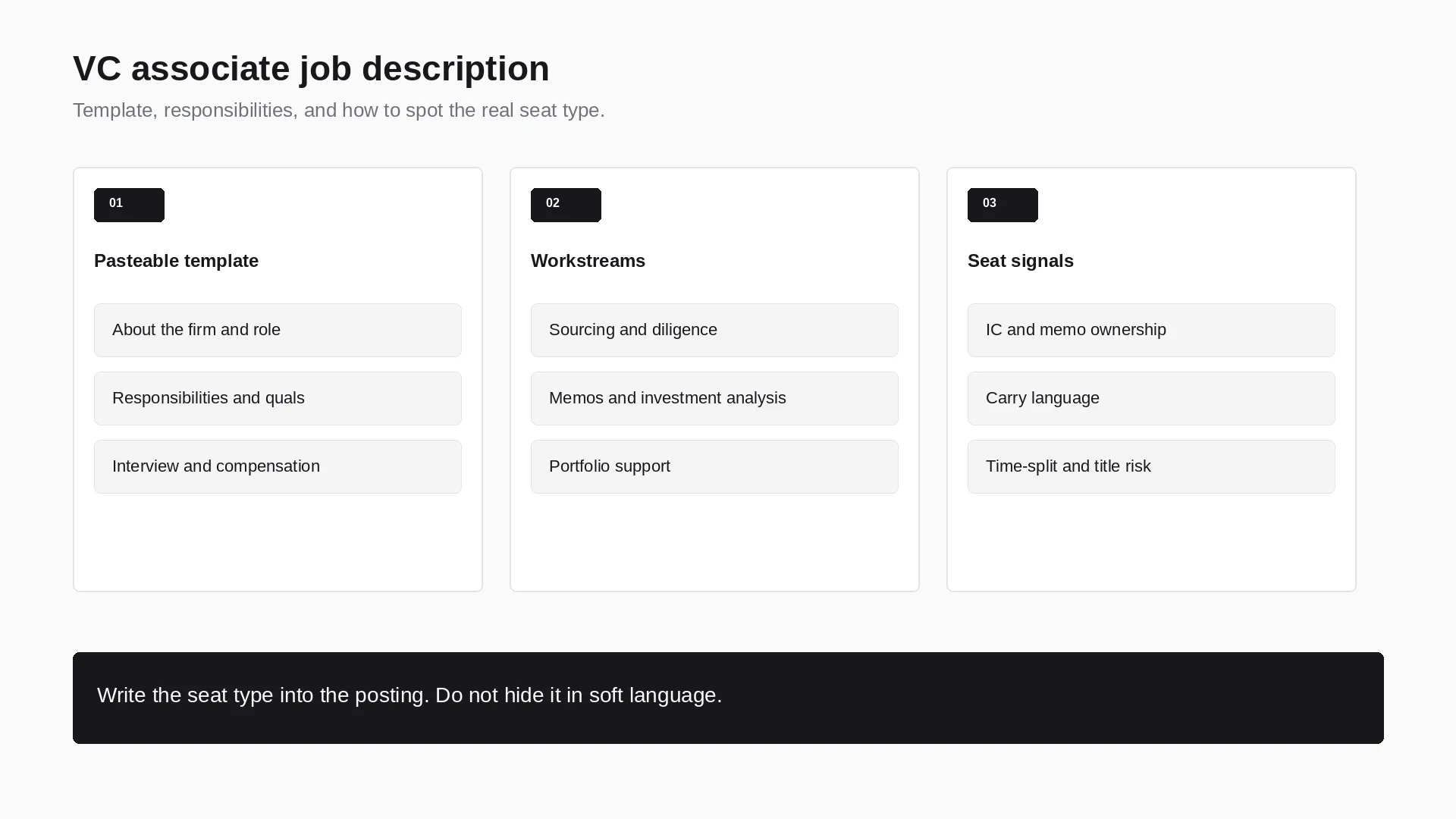
Copy-ready VC associate job description template with responsibilities, skills, investing vs sourcing seat signals, interview scorecard, and how candidates should read a posting.
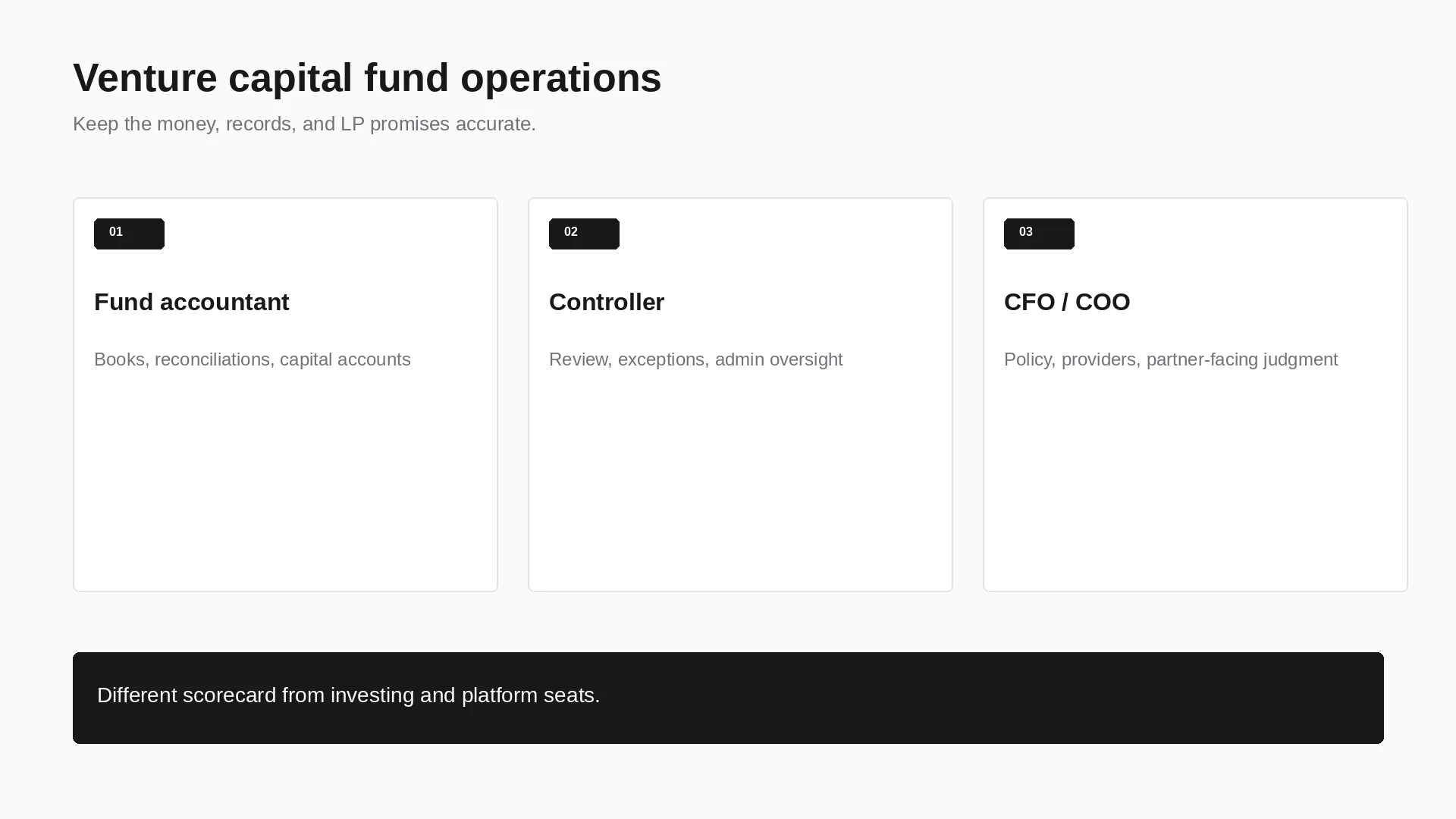
A practical career guide to venture capital fund operations: roles from accountant to CFO or COO, skills and proof of work, and how to evaluate the seat before you apply.
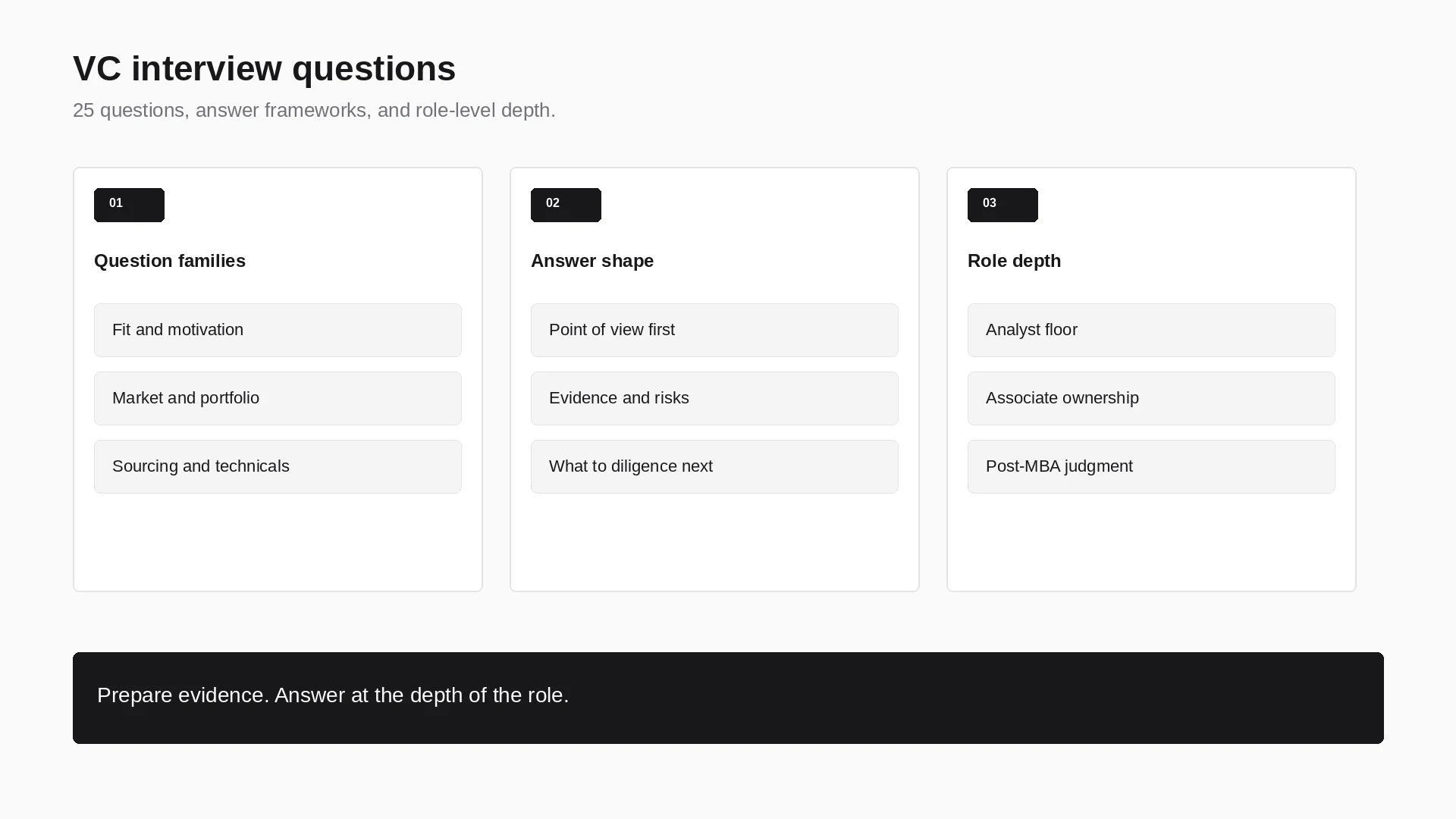
Prepare for analyst and associate VC interviews with 25 questions, answer frameworks, technical priorities, and role-level calibration.